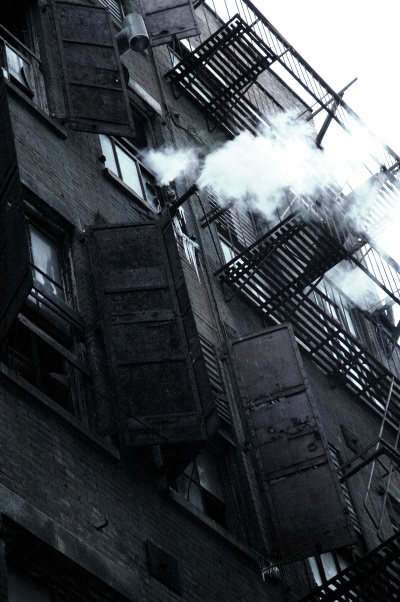
a steamy Cortlandt Alley, on a freezing Saturday afternoon
Not all of Tribeca has been turned into luxury lofts – yet.
Author: jameswagner
NBC Nightly News has puppies!

always good for ratings
Sherry Mazzocchi, of Blog Chelsea, writes to us that she sees NBC has apparently taken for a constructive suggestion the example Barry had used to condemn the triviality of what the networks represent as news. For a look at the incredible Brian Williams’s “look at these puppies!” segment recorded last night, go to this video (you’ll have to wait fifteen seconds for the advert to run).
[image from zimfamilycockers]
Homeless Museum at home to guests this Sunday
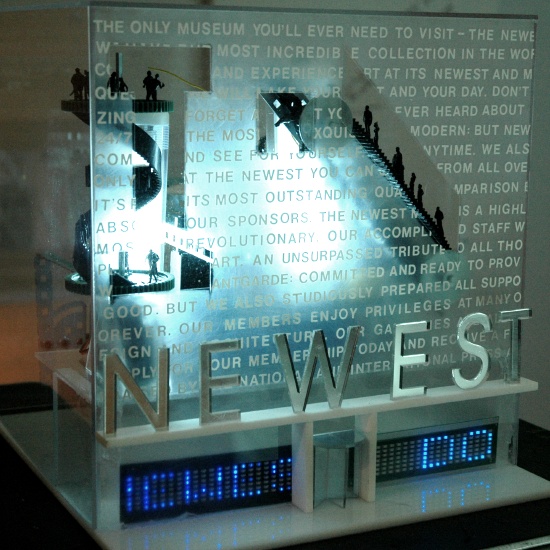
Filip Noterdaeme THE NEWEST� 2006 model (plexiglass, LED screens, figurines, remote-controlled robotic system) [installation view]*
The Homeless Museum (affectionately referred to as HoMu by both adoring fans and its own creators) will be welcoming visitors once again this Sunday. I don’t think anyone could describe this incredible institution as well as the creators themselves do on the museum’s website, and I’m certainly not going to try:
A product of New York City’s cultural decline, the Homeless Museum (HoMu) is a budget-and-staff-free, unaccredited arts organization that enables and engages cultural dialogue practiced at the intersection of the arts and homelessness.
Originally established mostly as a concept, two years ago the museum found a home in the fifth-floor walkup the founder shares with his partner Daniel Isengart. Once a month they open their doors to guests by invitation. Visitors are encouraged to email (info@homelessmuseum.org) or call (718-522-5683).
The NYTimes has found out about it and last month Dan Shaw wrote an excellent account of its mission and its work. The Believer has an extended article by Samantha Topol in the December/January issue.
I highly recommend a visit to the museum. Barry and I were there several weeks ago and we were charmed by the wit and sincerity of our hosts and delighted with the museum experience. We had first encountered what I’ll call the creative humanism of Filip Noterdaeme’s projects two years ago when we read about his campaign to shame the Museum of Modern Art (called MoMa by both supporters and critics, with little warmth from either) for its introduction of a compulsory $20 admission charge. Noterdaeme encouraged and inspired visitors to pay the entire amount in pennies, making it necessary for the museum to place buckets beside the station of each ticket clerk.
The admission at HoMu itself is determined on the basis weight (1�/lb.), cash only. The Times article describes its membership policy:
The museum raises money for the homeless with a twist on the usual cultural memberships. ”We encourage visitors to become members,” Mr. Isengart said. ”We tell them they can choose from any levels, from $5 to $125, and that they must give the money to a homeless person of their choice directly. We do it this way so that 100 percent of their donation goes to the homeless.”

Filip Noterdaeme Spoon, 1/8 Iroquios drawing
“Spoon, 1/8 Iroquios” is in the museum’s collection. It is part of a series which represents a kind of empathetic curating concern absent from any museum of my experience. From the HoMu website:
The One-on-One Collection is a deeply felt and authentic engagement with the grim and stultifying lives of countless homeless adults who yearn for love, but instead must settle for broken dreams, abuse, and danger.
What began as a fascination with the sex lives of homeless men and how they fulfill their sexual desires has inspired this collection of body prints that are reminiscent in style of Yves Klein’s Anthropometries. Paintings on paper made by the imprint of naked bodies previously drenched in “Homeless Orange” provide a range of erotic connotations, addressing taboos such as homelessness, public sex, and homosexuality. For example, in “Spoon, 1/8 Iroquois”, two silhouettes suggest a hurried sexual encounter between two men.
What’s the tie-in between HoMu’s championing of the homeless and its critique of the museum? I think it lies in a profound awareness of the contrast between the outlandish sums of money and attention devoted to the increasingly-elaborate (and increasingly-inaccessible) temples in which we house the high-end items branded as our official cultural idols, and an incredibly wealthy society’s neglect or spurning of its own most-forsaken things and people, including its own material detritus but above all the homeless, the outsider, and the uncompromised artist. Noterdaeme and Isengart bring it all home with their phenomenal mix of minimalist panache and compassion.
The open house is Sunday from 1 to 6, on Clinton Street in Brooklyn Heights.
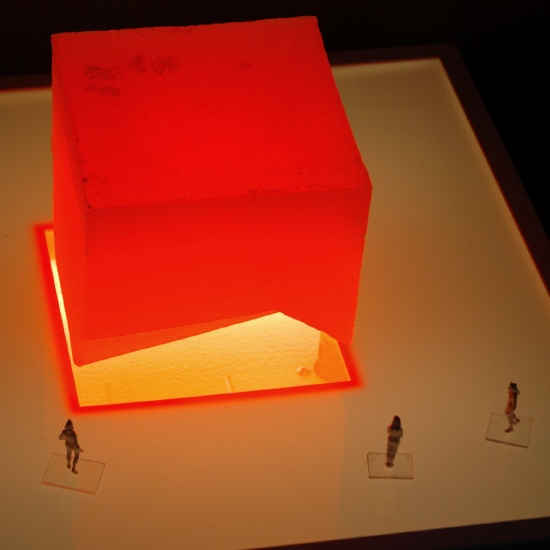
Filip Noterdaeme ISM (The Incredible Shrinking Museum) 2004-2006 model (glycerin soap) [installation view]*
*
descriptions of the two works shown in model form above, adapted from material furnished by the artist:
“The Newest�” presents itself as a new contemporary art museum. Viewed from the front, it appears to be a building that is inundated by visitors whose silhouettes can be seen moving about behind its see-through fa�ade, outfitted with several slogan-flashing LED screens. But a look behind the scene reveals the effect to be a choreographed deception: The Newest� is not a building but an oversized stage-set simulating a building front. The visitors turn out to be dummies circulating on conveyor belts and rotating platforms. The machinery is controlled from a computer operated by a single person, the museum director.
“ISM (The Incredible Shrinking Museum)” is a project for an interactive museum consisting of a sixteen-foot cube of glycerin soap. The cube is subject to constant change through exposure to the elements. In addition, visitors will be invited to exploit the structure like a mine until is it is used up, the goal being to reach out to a new audience and challenge visitors to think about their role as active participants in the shaping and destruction of culture through direct participation in the realization and, ultimately, the deconstruction of a museum.
[image of “Spoon” from HoMu]
Boston authorities crazy about LED street art

1/31 changed everything
I’m so embarassed for my friends in Boston. No, wait: Maybe our good neighbors are all actually onto something really, really big (I’m not talking about the suits and uniforms – or an impressively stupid Boston Globe editorial*): the growing role of the artist as the new and very visible hero of whatever pockets of progressive political life may still survive in locked-down America today. Fortunately the best of our twenty-first-century court jesters are not really part of the court, and they’re not really just jesting.
This Aqua Team Hunger Force LED bomb scare thing sounds like the outrageous scenario for a summer movie, so why aren’t Boston’s mayor and police department laughing?
Go here for the press conference archtype for a new age. It’s Dada!
*
the editorial, from this morning’s edition, isn’t available on line without a registration, so here are some excerpts of “PARALLYZED BY A GIMMICK”:
. . . Turner’s ad gimmick, undertaken in 10 cities from coast to coast, affected tens of thousands of people in the Greater Boston area. Businesses lost customers. Commuters lost time. Even more serious, first responders from local, state, and federal public safety agencies were called away from their legitimate duties.
One wouldn’t expect the promoters of the TV program “Aqua Teen Hunger Force” to score high on a maturity index. But anyone older than 8 or 9 should be able to understand the dangers of staging such a stunt in the post-Sept. 11 world. Homeland Security experts will need to review the response of local law enforcement. Public safety personnel may have overreacted ; local bloggers apparently identified the guerrilla advertising campaign early on. But it’s hardly surprising if others who weren’t in on the gag were suspicious. As a rule, first responders are left little choice but to assume they are facing a legitimate threat.
Perpetrators of terror hoaxes face prison sentences of up to five years if convicted. Police arrested an Arlington man last night in connection with the ad stunt, but potential criminal prosecution is only one consideration. The tricksters at Turner, a unit of Time Warner Inc., should pay the bill for the consequences of a lame marketing gimmick.
[image of Boston supporters of the artists Peter Berdovsky and Sean Stevens by Bizuayehu Tesfaye/AP via Gothamist]
“blogger summit”: WNBC wants in

MSM news
During the station’s introductory presentation last night at what was billed as New York’s first Blogger Summit, the host, WNBC, reported that its own advance survey revealed that zero percent of their invited blog respondents thought that local TV news was helpful to their posting. This must have come as something of a shock to the network people, although I can’t imagine why, because minutes later the station’s News and Station Manager, Dan Foreman (who later told us that he had not really expected to enter much into the discussion) asked the assembled crowd of bloggers whether in light of their responses WNBC should just shut down its TV operations and concentrate entirely on developing a blog medium.
A show of hands from the audience, after what seemed like a moment of shock in response to what seemed like a genuinely impulsive question, indicated that there was a strong affirmative response. One blogger however did cry out, “what about the old people?” In the exchange which followed, one guest described local TV news coverage as composed mostly of stories on “fires and murders”. Wow: Only two hours later, while awaiting the station’s coverage of its own “blogger summit”, I noticed that WNBC’s 11 o’clock news led with an account of a fire, followed by a report of a murder. I was visiting the site for the very first time since the early 90’s, when, because of a vested interest in the “broadcasting” of a politcal message, my friends and I would regularly scan local news coverage of our own creative theatrical actions or “zaps”.
While sitting in Studio A last night I was trying to imagine why any smart New Yorker would actually want to, or be able to, regularly wait around for a brief, fixed-schedule television news program in order to learn what was happening in the city – even if that were what was actually to be found on the little screen. At one point last night even Editorial Director Adam Shapiro admitted that the abbreviated nightly news format permitted only very limited coverage of any story.
I think that, except for those employed by NBC, few people in that studio normally watch network news of any kind. Later last night, during the local station’s on-air coverage of the summit, technology reporter Sree Srinavasan explained to viewers browsing the web as novices that they would have to be sceptical about the accuracy of the information they find on blogs. He encouraged them to look around and not to trust the face value of anything, suggesting that it would be wise to get to know the sources of the information found: This is always good advice – for both journalists and those they serve, but in this case the scepticism absolutely has to begin with the powerful MSM, best described as our mainstream corporate entertainment media. [footnote: NBC is owned by GE]
On the subject of journalistic malpractice, that most excellent community source, Blog Chelsea, says that Barry put it best, in conversation last night:
Theres a war on, but all they can say is, “Look at these puppies!” They talk about Clintons sex life, but not about all of the freedom that is slowly being taken away from you.
[image from diamondsintheruff]
thug cars for a thug America?
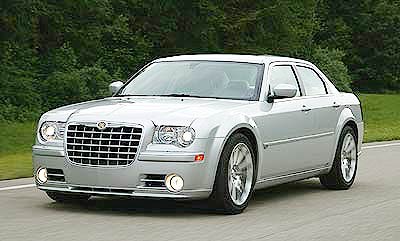
Chrysler 300

Hummer H2

Toyota FJ Cruiser
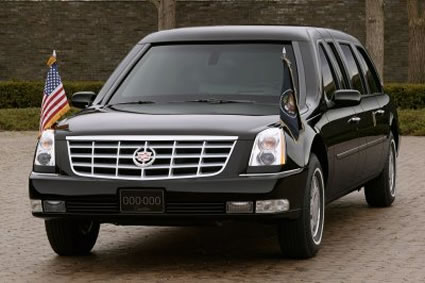
Cadillac presidential tank

Ford Synus concept*
Brinks truck, thugmobile, or armored personnel carrier? The only accessory that seems to be missing from these and the many other examples (real or teaser) of the offensive, fierce-looking, yet quite silly, fake-macho mounts commanding our roads these days are the gun slots or the gun mounts. America’s long love affair with the car has finally turned into fear and loathing, not of the idea of a personal wheeled vehicle, but of the other not invited into our private, luxuriously-equipped mobile panic rooms.
It’s probably no coincidence that the last time our frightened man-boys went off the deep end in a neurotic obsession with toys which dramatically represented unrestrained brute power was also during a period dominated by an unnecessary and brutal war fought, and lost, on the other side of the earth. The peak period of the American “muscle car” was 1964-1975, roughly the last decade of the American war in Vietnam.
The whole world would be a much better place if we ever grew up.
*
the two-year old Ford Sinus is actually a very small vehicle, but an excerpt from one 2005 industry report, perhaps clipping directly from the manufacturer’s press release, assures its readers:
But considering that the majority of the world’s population will live in urban areas by 2010, the time may have come for the [small-]car market in the US market. The Synus concept explores what such a car might look like, along with a fanciful design theme based around ultimate security.
While Synus may be small, it has been designed to stand up to the rough and tumble of life in the big city, and has been given a look that says it can stand up for itself. Taking its inspiration from bank vaults and armored cars, this concept’s exterior design immediately communicates that it takes security seriously. When parked and placed in secure mode, protective shutters are deployed over the windshield and side glass. Small windows on the flanks and roof are non-opening and bullet-resistant. The rear hatch has no window at all.
The Synus concept also signals security through its use of a driver-side dial operated combination lock on the B-pillar. The rear hatch is operated via a vault-style four-spoke spinner. Flat glass in a slightly raked windshield furthers the armored-car look of this concept.
I have no idea whose tongue is in cheek here.
[images from bigtex (Chrysler), Legends (Hummer)cartracker (Toyota), Autoblog (Cadillac), cardesignnews (Ford)
censorship, a goddamned slippery slope

Michael Kelly that goddamned george bush 2006 computer drawing
Just spotted this tiny item in this morning’s Newsday:
BLEEPS ON A PLANE. So much for God and country, at least during some in-flight showings of the Oscar-nominated movie “The Queen.” All mentions of God are bleeped out of a version of the film distributed to Delta and some other airlines, The Associated Press reports. Jeff Klein, president of Jaguar Distribution, the Studio City, Calif., company that supplied the movie to the airlines earlier this month, said it was a mistake, committed by an overzealous and inexperienced employee who had been told to edit out all profanities and blasphemies. Jaguar has been sending out unedited copies to the airlines.
[image from openstudio, spotted while searching for an image for “goddamned”,]
Joe Ovelman at Oliver Kamm 5BE
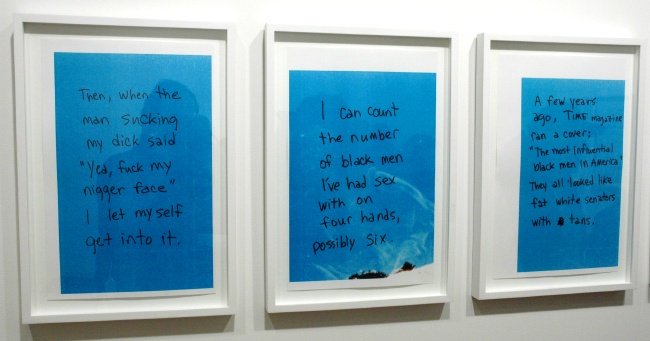
Joe Ovelman: the first three drawings from the series, Twelve Drawings 2007 [installation view]
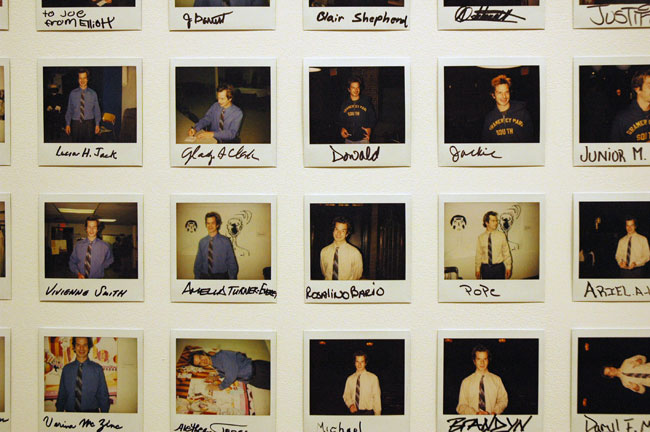
Joe Ovelman Rosa Parks 381 2007 381 polaroids and ink [detail of installation]
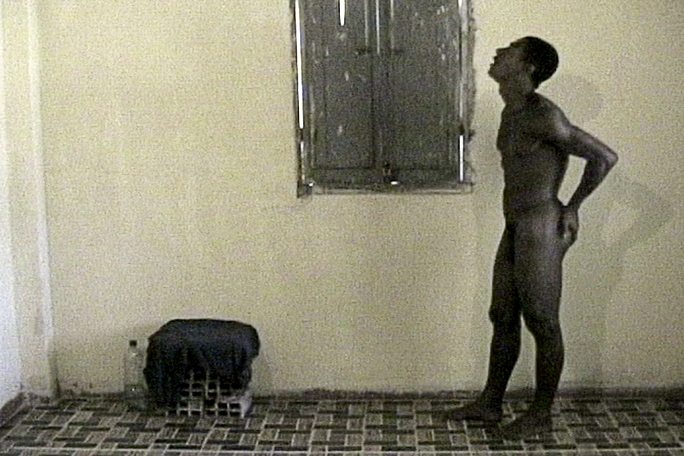
Joe Ovelman Regi 2005 video [still from video installation]
It’s a tough show. Joe Ovelman gets right inside the wretched, beating heart of white racism with his passionate exhibition, titled “For Whites Only“, currently at Oliver Kamm’s 5BE Gallery. There are only about seven works in the gallery, but the minimalist, and oddly almost sanctuary-like installation manages to include one piece from just about every one of the media forms available to an artist today.
Missing however from this virtuoso show, perhaps significantly, is any representative of his own still photography, the medium with which Ovelman has been most closely associated until the last year or so. The 381 polaroid portraits of the artist installed on one wall were taken and signed by 381 different people who could self-identify as African-American.
The press release describes the show’s one video, and the source of its ambient sound, very simply:
“Regi”, 2005, is a video in which the paid subject, chosen for his African decent, stands naked and confined to one end of a room for 8 hours, the length of a typical work day. The video was shot in Porto Seguro, Brazil, a historic slave-trading port.
UPDATE: See Holland Cotter’s review in the NYTimes February 3.
[third image obtained from the artist]
“Every Last Day” at Chashama
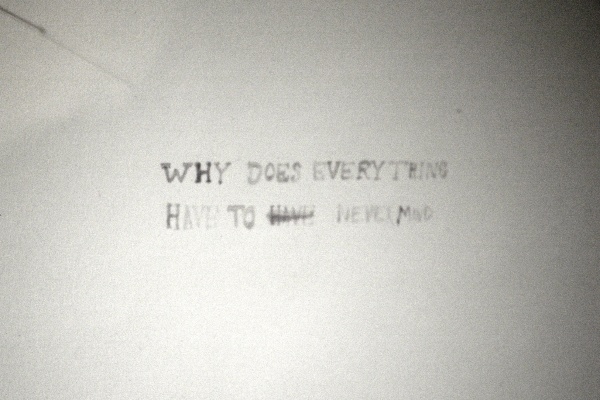
a small, faint, almost painfully sad drawing by Vivienne Griffin, from the show “Every Last Day”
There were a number of interesting gallery openings in Chelsea and elsewhere on January 11. We had tickets for a 7:30 performance in SoHo, but we still might have been able to make a number of shows before heading further downtown. We decided instead to visit perhaps the least obvious opening, that for a show called “Every Last Day“, at the current, storefront location of Chashama, just off Times Square. We weren’t disappointed.
The exhibition was mounted by an expanding collective of inventive artists called Dos Pestañeos. The show is called “Every Last Day”. I want and expect to see more from these people, whether together or otherwise.
The last day of the show is February 28.
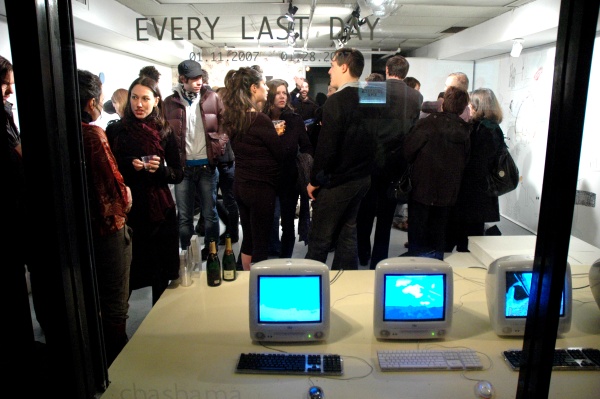
the reception crowd, mixed together behind work by Alex White with Lori Scacco in the window, as seen from the busy W. 44th Street sidewalk at 6 pm.
Abbé Pierre, the excessive priest

“holy anger”
Abbé Pierre died yesterday. If there is such a thing as a “saint”, this man clearly deserved the title, but he will never be canonized by the Church. Too excessive.
He wrote that as a young priest, he had sex with a woman, and further infuriated Roman Catholic authorities by advocating gay marriage.
Even Jeanne d’Arc, who finally made saint after waiting 600 years, had never talked that kind of nonsense.
This and (almost) everything else in this remarkable NYTimes obituary of a 20th-century St. Francis almost reads like pure invention; it describes the perfect French or even universal hero of the poor, the homeless, the disenfranchised. And there’s recycling in there too!
ADDENDUM: In doing a little searching I’ve just discovered that l’Abbé was a good friend of this dangerous man.
[image of Jacques Nadeau from Le Devoir]