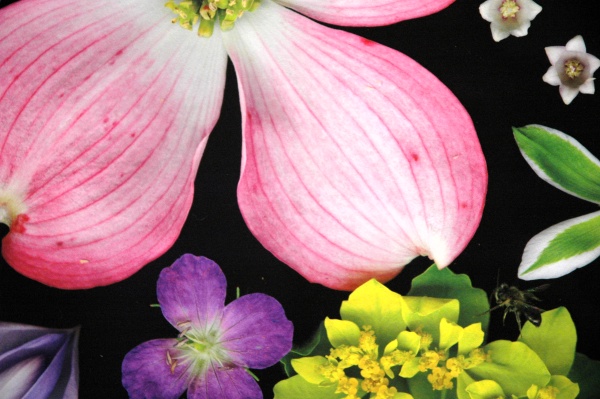
Portia Munson Wish 2006 pigmented ink on rag paper 61.5″ x 44″ [detail of installation]
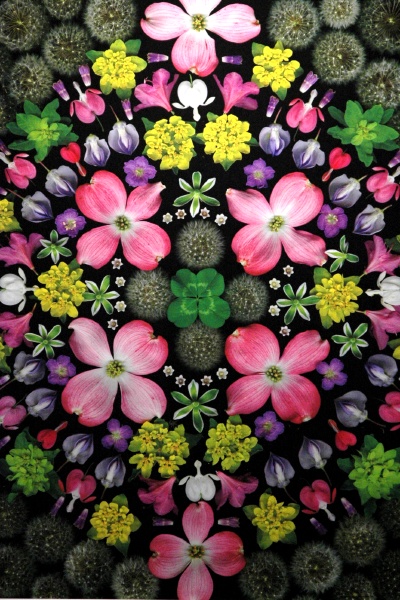
[very large detail]
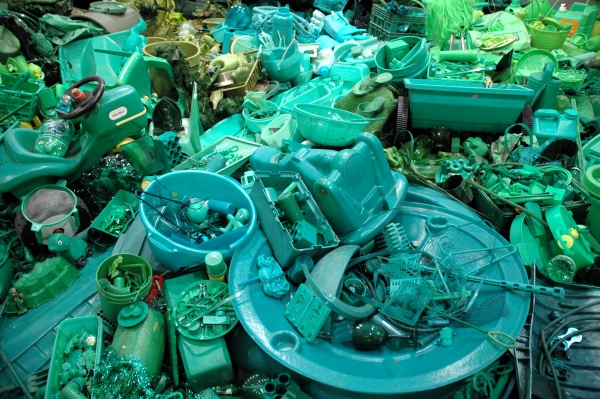
Portia Munson Green 2007 found green plastic 40″ x 200″ x 180″ approximately [detail of installation]
The show is called “Green“, and it addresses the contemporary complexity of a word whose meaning has expanded beyond its traditional utility as just a name on the color scale.
The center of the larger room of Portia Munson‘s exhibition at P.P.O.W. is covered with a huge scary green “lawn” of found, manufactured objects related to each other only chromatically. On the surrounding walls, on an entirely different note, are hung gorgeous medium-sized ink prints of variously-colored kaleidoscopic layouts of flowers from Munson’s own garden. There the only “manufactured” element is the artist’s arrangement of the blossoms she placed below the scanner.
I have no idea whether the bee seen in the detail above arrived on the scene naturally or not, but he or she is now in the continuum of an ancient still life tradition.
Author: jameswagner
“Material for the Making” at Elizabeth Dee
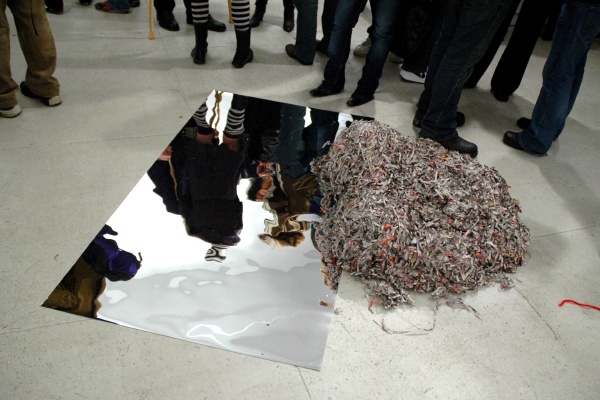
Mai Braun Your Emotions Make You a Monster 2006-2007 mixed media 15″ x 72″ x 66″ [installation view]
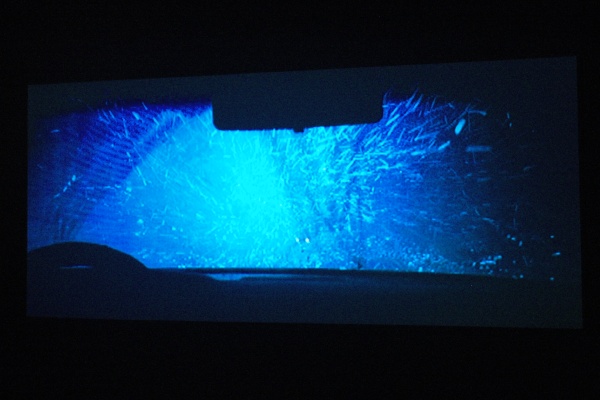
Kerry Tribe Near Miss 2005 35mm color film with sound, transferred to DVD [still from video installation]
Jenny Moore has curated her first show as the new Director of Elizabeth Dee. It’s titled “Material for the Making“. Its quality is everything I would have expected from her, even if the installation includes nothing I could have expected – which is actually what I expected.
A handy press release, discussing both the show’s concept and the individual works of four artists (Mai Braun, Kori Newkirk, Gail Thacker and Kerry Tribe), refers among other things to their illustration of the distance between the real and the represented. It’s a show of visual art however, and everything manages to stand up almost on its own, most things needing only a gentle assist from the keys supplied in the text.
Mike Womack at ZieherSmith
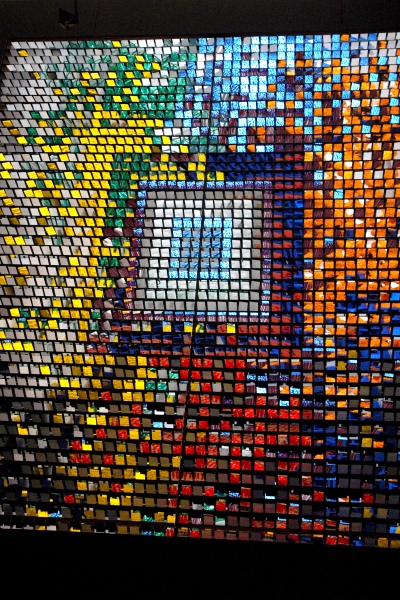
Mike Womack Warbling 2006 mixed media 12′ x 14′ x 20′ [detail of installation, from without]
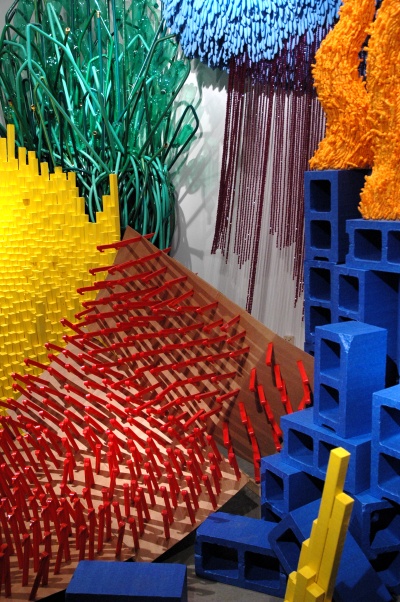
[detail of installation, from within]
Phew! Today, after going over some of the most depressing news stories of the winter (we’re about to escalate an illegal, immoral and failed war while watching the disintegration and possible total reversal of an earlier campaign and learning of the initiation of a third), and after coming away from my previous downer of a post and the exchange it provoked, I’m ready for something completely different.
I’m not going to argue that Mike Womack‘s show at ZieherSmith is the most important thing I could report on just now, but it certainly represents a gentle good humor, a real and unqualified beauty, with the fillip of a delightful conceit in its production. Also, the images should show up very well on line.
There were two sculptures in the gallery (three if you count the background installation, shown in the second image above, which produced most of the magic for the effect pictured above it), and after exploring everything, Barry and I both left them very reluctantly, but smiling broadly.
we’ve just found another war!

is this trip necessary?
Does our singular bellicosity stem simply from our addiction to oil, or from our growing cult of christianism? Or is it simply the pathological expression of a frightened, isolated, ignorant, provincial and bored people?
My question seems to assume that all Americans are responsible for creating and sustaining the most war-like society in history, but while it’s clear the buttons themselves are pushed by a military-industrial-media establishment, if we continue to describe our nation as a democracy we have to take as full a responsibility for the evil done in our name as for the good.
[image from C-130 Headquarters]
Vito Acconci and friends, and Dike Blair at D’Amelio Terras
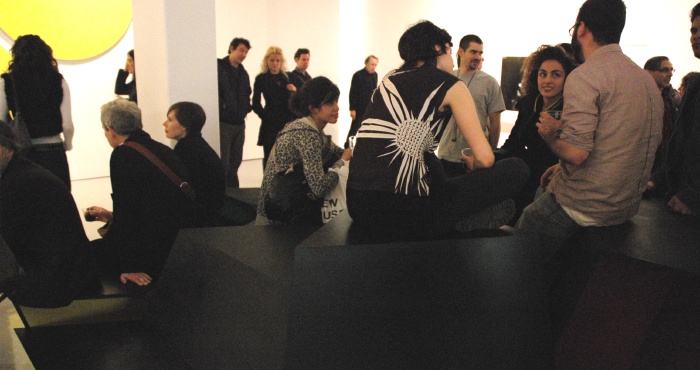
conversation pit [opening crowd enjoying Vito Acconci’s hexagon of trapezoidal seats, with the artist standing in the center background, a detail of Olivier Mosset’s 2003 untitled triptych to the left rear]
D’Amelio Terras opened two very interesting shows on Saturday, a group show of works by Vito Acconci, John M Armleder, Olivier Mosset, Chuck Nanney, Steven Parrino and Sam Samore with the intriguing title, “The loss of history makes them constantly curious and continuously horny….”, and an exquisite exhibition of Dike Blair paintings.
Even without the help of the 1995 structure whose parameters and inspiration is outlined in the gallery’s press release the work in the larger space looks absolutely stunning.
In the smaller room at the front of the gallery there are some beautiful small gouache-and-pencil works by Blair from the late 80’s and early 90’s.
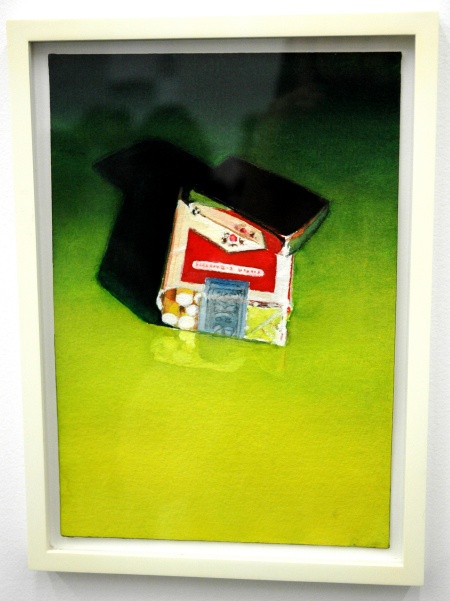
Dike Blair Untitled 1995 10″ x 7″ [installation view, with reflection]
Brian Ulrich at Julie Saul
Brian Ulrich Gurnee, IL 2005 chromogenic print mounted on sintra with luster laminate 30″ x 40
The sign reads “More Outdoors for Your Money Patriotic Chairs $9.99″. The image is just one of the most resonant of the ten extrordinary prints Brian Ulrich has supplied for his first solo show at Julie Saul. I’ve been looking at this artist’s remarkable work since 2004 and he continues to pull large and small miracles out of his more-or-less-candid large-format camera while he explores the familiar acres of the western world’s stores of plenty.
After we had left the opening reception on Thursday we ran into some friends on the street where we told them about the show. To my astonishment I found myself able to describe in considerable detail several photographs I hadn’t seen for several years, and most of the others seemed to be inside my head waiting impatiently for the chance to come out. These images just won’t go away.
The show is titled “Copia”, for its penetrating but very tender tender look at the material cornucopia (horn of plenty) spread out everywhere at our feet today, growing even faster than the communities which feed on it so voraciously. Unlike the image above, most of the work is highlighted by the dazed or absorbed faces of anonymous consumers.
But there’s much more going on in these images, for the artist’s eye and his editing have together produced truly-beautiful composed genre scenes no less authentic than those of Breugel or Vermeer. We’ve long since cast aside our long scythes and short needles, so here the earthy, fleshy busyness of the Flemish master and the simple domestic props of the Delft burgher are replaced by the mountains of manufactured “things” with which we surround ourselves three and four hundred years later.
Not incidentally for work like this, the printing quality of the large color pieces themselves is terrific; any reproduction seems little more than a suggestion of the piece itself.
Ulrich describes his initial inspriration for this series of work as a response to George Bush’s post 9/11 summons for Americans to just go shopping, thereby equating consumerism with patriotism. If shopping has now become a political act, this artist has become the realm’s unofficial limner laureate.

June in January

I don’t mean to unduly upset anyone not already concerned about climate change, and I know that as scientific evidence it’s merely anecdotal, but tonight while I was sitting in front of an open window checking my email I was buzzed by a mosquito. And on the roof garden just beyond the sill our large begonia bush, like all of the other plants not cleaned out of the pots last fall, seems to be thriving.
The place: Manhattan. The date: January 6.
[image from Mosquito Netting Project]
Queens International 2006 shines into January 2007
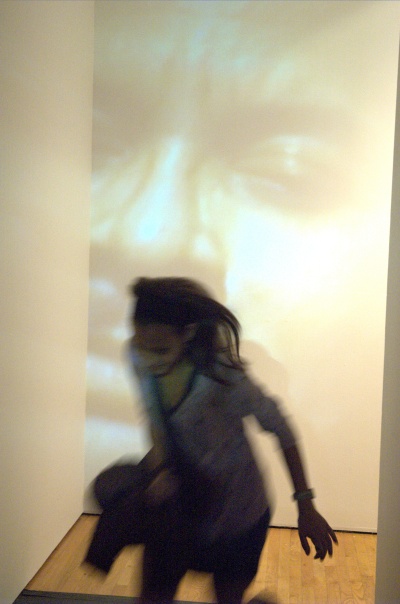
Judith Barry [detail view of video projection installation, including detail of beautiful, exceedingly-considerate visitor trying to escape the line of sight of blogger’s camera]
Tomorrow is supposed to be a glorious day, with the temperature expected to hit a record of 70 degrees. Any lingering rain is supposed to end before noon. For anyone who hasn’t made it out to the Queens Museum in the last three months it sounds like a great excuse for a Flushing Meadows outing to visit the latest edition of that institution’s dynamic biennial survey of Queens-based artists, “Queens International 2006: Everything All At Once“. The show continues for another nine days, but by the final Saturday and Sunday, January 13 and 14, New York weather could very well be handing us freezing winds or even a blizzard.
The show’s two hard-working curators, Herb Tam and Jaishri Abichandani, have put together an amazing and amazingly diverse collection of works by more than four dozen artists and collaboratives, mostly “underknown” (always a subjective standard, that), and mostly undeservedly so, who are associated with the other Long Island borough.
I managed to grab a few images on our visit last October during the opening reception and I apologize now: There is absolutely no adequate excuse for my neglecting to do anything with them until now.
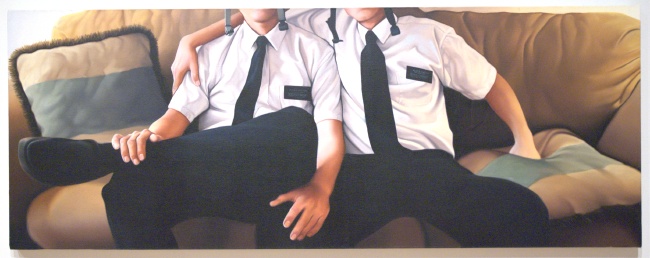
Paul Galloway’s Williamsburg Mormons at ease
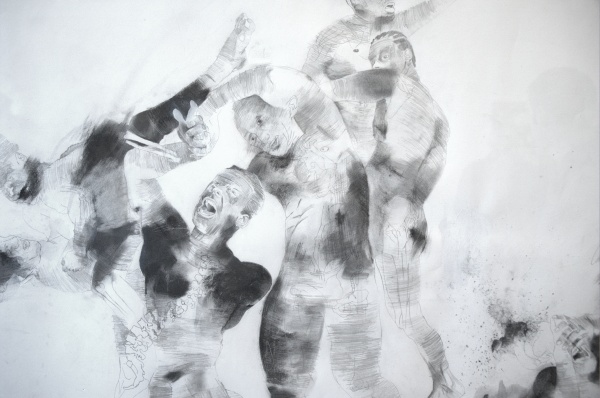
a detail of one of Wardell Milan’s drawings, “Desire and the Black Masseur”
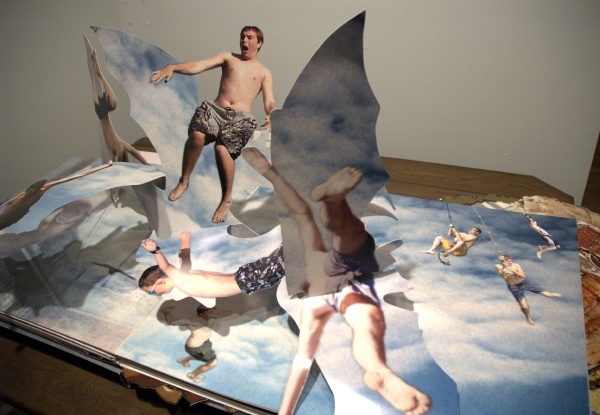
Amanda Sparks’s giant autobiographical pop-up book
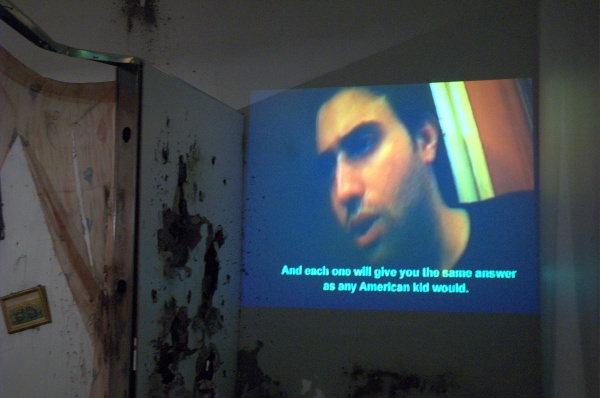
Neda Sarmast’s video installation (“ask any of those kids . . . . “)
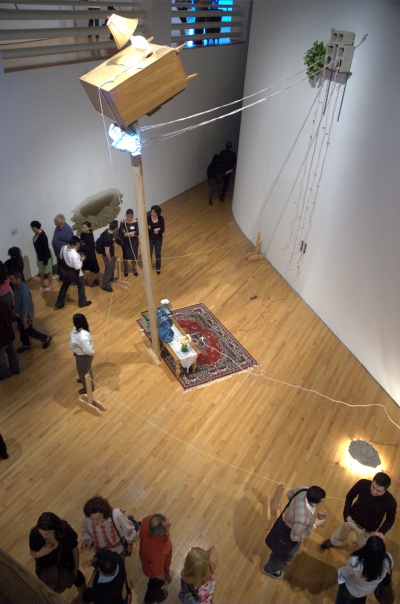
Alejandro Pereda’s precariously balanced environment, and some admirers
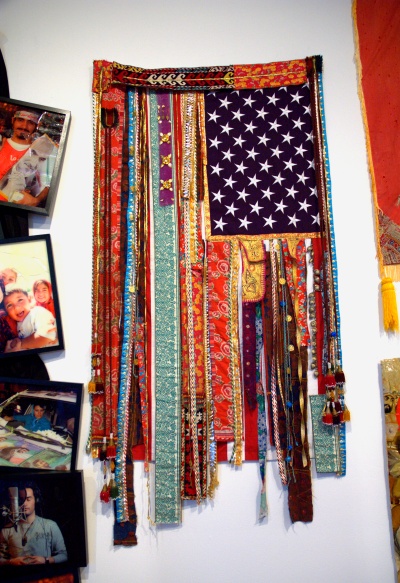
a detail of Sara Rahbar’s installation, “My Iran”
it’s “us” v. “them” in Gigi Chen’s watercolors (here served with coffee)
Marsden Hartley’s “Cleophas and His Own”
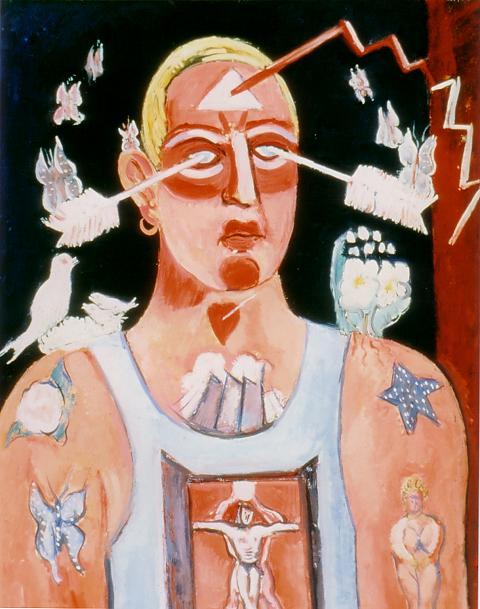
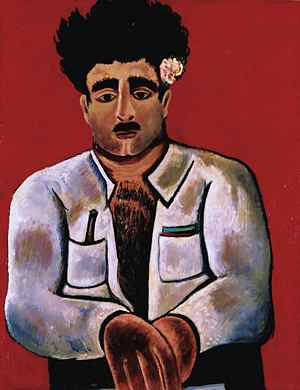
Marsden Hartely Sustained Comedy 1939 oil on academy board 28.5″ x 22″
Marsden Hartley’s vigorous expressionist art is clearly a part of today’s world more than it was while he lived, and the man himself is today less a mystery* to the world than he was, perhaps even to his friends, while he was still alive. At the same time the largely pre-industrial world where, very late in his life, his painting flourished so robustly, and where we now know his capacity for love was generously requited, disappeared long ago, even in quiet coastal pockets populated by communities of honest and loving fishers.
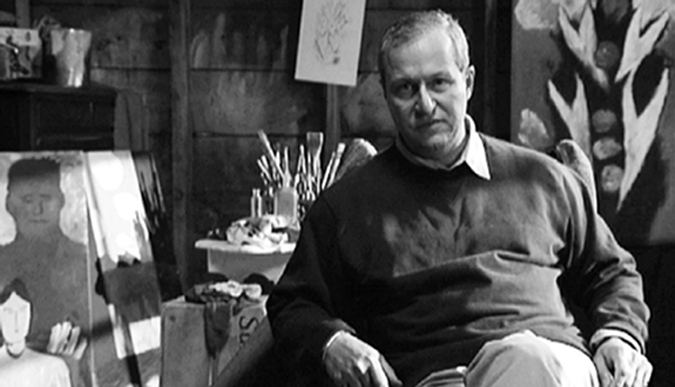
In the film, “Cleophas and His Own”, Michael Maglaras plays Marsden Hartley while sitting inside a reconstruction of Hartley’s 1943 studio
We try to experience the shape and the feel of lost worlds through our imagination and our art, and sometimes our success will seem to rival the actual experience of the dead. The filmmaker Michael Meglarus has resurrected Hartley’s stay in isolated communities in Maine and Nova Scotia during the last seven or eight years of his life in his poetic film, “Cleophas and His Own“. His creative tools are his rich, mesmerizing voice and his acting and directing skills, the beauty of the land itself (shown here only in crisp black and white), and the artist’s paintings (their breathtaking color a magnificent contrast). Hartley’s surprisingly-good and surprisingly-neglected poetry composes the actual episodic screenplay in a reading, also by the auteur, which recreates the rhythm and accents of early 20th-century Down East speech. Subtlely-introduced strands from Richard Strauss (“Death and Transfiguration”), Charles Ives, an old protestant hymn (“In the Sweet Bye and Bye”), and one exquisite song by Schubert enrich long, exquisite languors within the text and flow through white rooms, above the sea and along the rocks of the shore.
It’s a very long film, and the luxury of its slow pace almost seems to mock the “movie” form itself. “Cleophas and His Own” will have limited popular appeal, but any single one of its bells would probably have been sufficient to draw me into its graces. Those tags, generally representing something specific in my own past beyond just an interest or curiosity, start with Marsden Hartley of course and continue through the idea of the solitary outsider, New England (and Nova Scotia), forbidden homosexual passion and love, homosexual passion and love embraced, language, the simple built aesthetic, the survival of ealier social forms, domestic arrangements, subsistence farming, beautiful people and good souls, history, anthropology vanished worlds, spoken poetry, the sea, and coastal New England.
“Cleophas and His Own” will be shown in New York at 7 pm on January 17 at Sunshine Cinema. The DVD is available from the film’s generously complete website, www.two17films.com.
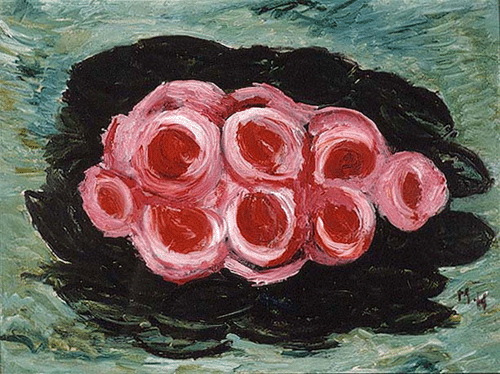
Marsden Hartley Roses circa 1936-1938 oil on board 12″ x 16″
This image has been described as Hartley’s represention of his beloved Mason family.
When Cleophas said ‘Fine large morning,’ it sounded as if a page of Blake had been blown open by the wind. – Marsden Hartley
*
The image at the top of this post is a remarkable self-portrait, described here on the Artcyclopedia site by Joseph Phelan:
“Sustained Comedy”, a self-portrait that was never publicly identified as such, is the most astonishing [of Marsden’s late likenesses]. This work transforms the aging, homely and shy Hartley into a young bleached blonde gay stud complete with earrings, butterfly tattoos and a pumped up torso bedecked with a tank top. Contemporary taste has finally caught up with Hartley’s revelation of himself.
The image shown just below was painted at about the same time as the self-portrait. The subject is Hartly’s last great love, Atly Mason, who was drowned together with his brother and his cousin during a hurricane in the summer of 1936.
Sunday morning. And the boys still not home. – Marsden Hartley
Marsden Hartley Adelard the Drowned, Master of the “Phantom” circa 1938-1939 oil on academy board 28″ x 22″
[image of “Sustained Comedy”, belonging to the The Carnegie Museum of Art, from artcyclopedia; image of “Roses” from Barridoff Galleries; film still from 217 Films; image of Adelard, belonging to the Weisman Art Museum, from The Crocker Art Museum]
Noah Fischer at Oliver Kamm
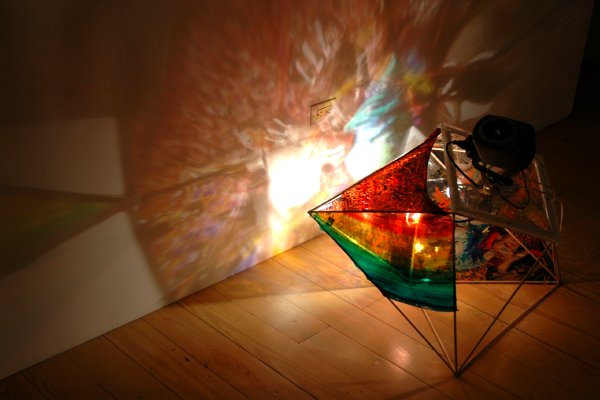
Noah Fischer Rhetoric Machine 2006 mixed media, dimensions variable [detail of installation in room two]
It’s an awesome piece and an awesome engineering feat as well. It’s also a beautiful work of art, but it wouldn’t have been possible without more than half a century of the mendacity or pure villainy of Americans with great power and the laziness or stupidity of us lesser folk.
Remember when you couldn’t find art with a political element if your life depended on it? Unfortunately for the sake of many lives it’s already too late.
Noah Fischer’s Rhetoric Machine, installed at Oliver Kamm through January 6, specifically addresses the language of a diseased political environment which even the “unpolitical” are now finding increasingly impossible to ignore. From the gallery’s statement:
Rhetoric Machine is a two-room kinetic installation that appropriates the language of movies, television, radio, and speechmaking. Presidential speeches and emotionally laced pop songs serve as the soundtrack for a sculptural light show that marches through the last sixty years, what many would call the golden age of American history. American icons such as an eagle, a tank, and a television set react variously to the soundtrack, creating what Sergei Eisenstein called an “intellectual montage” where jarring associations between light and sound lead to new meaning constructions, often charged with emotion.