
Susan C. Dessel OUR BACKYARD: A Cautionary Tale 2006 sandbag tarps, EMS blankets, shellac, plaster gauze, cement, dimensions variable [view of installation]
The first part of the first real-time show either Barry or I have curated opens this Friday at Dam, Stuhltrager in Williamsburg. The opening reception for Susan C. Dessel’s sculpture yard installation, “OUR BACKYARD: A Cautionary Tale“, is the evening of September 8, from 7 to 9. The address is 38 Marcy Avenue, just west of the BQE on the corner of Hope.
The inside galleries will be showing the work of five Spanish artists, Yolanda del Amo, Ruben Ramos Balsa, Rafael de Diego, Esther Manas and Javier Viver, in “Echo”, an installation curated by Sara Abad & Elena Blanque also opening the same night.
Yes, of course we’ll be there.
Check ArtCal for the remaining 110+ openings we care about in the next few days, and see Bloggy for some suggestions for simplifying your cultural mapping for tomorrow, Thursday, by any account New York’s biggest night of the year for new art.
The second part of our own show opens inside at Dam, Stuhltrager five weeks from now, on October 13. More on that adventure in this space during the weeks to come.
Author: jameswagner
Kamp K48 at John Connelly
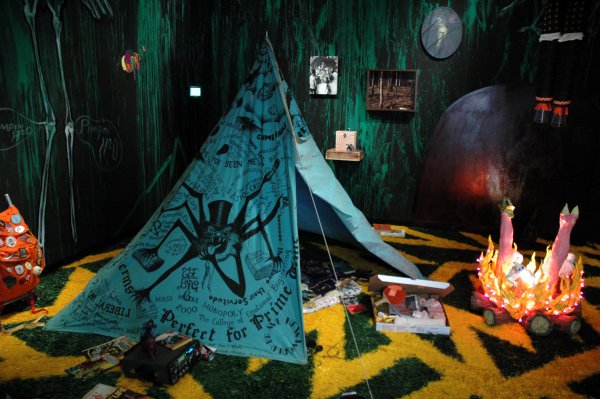
“Kamp K48”, a large detail of the installation inside the “JCP Annex”
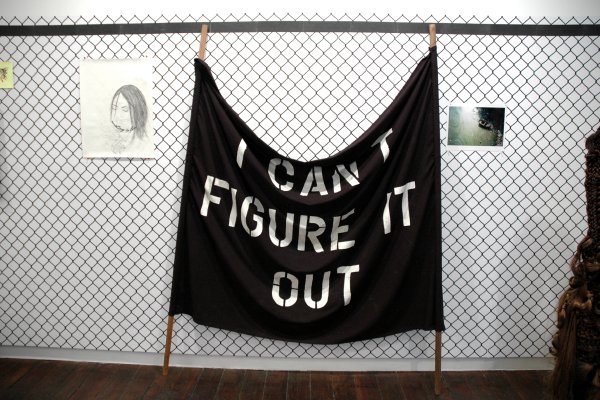
Shay Nowick Protest Banner 2005 acrylic on cotton fabric 4′ x 6′ [view of installation, with a glimpse of Hrafnhildur Arnardottir’s “The Hairy Hunchback” on the right, Hug & Magnan’s “Chainlink wallpaper” behind, A.L Steiner’s “Untitled (trail of loathsome slime)” to the right, and rachel Howe’s “We Lit the Fires (Misfit)” on the left]
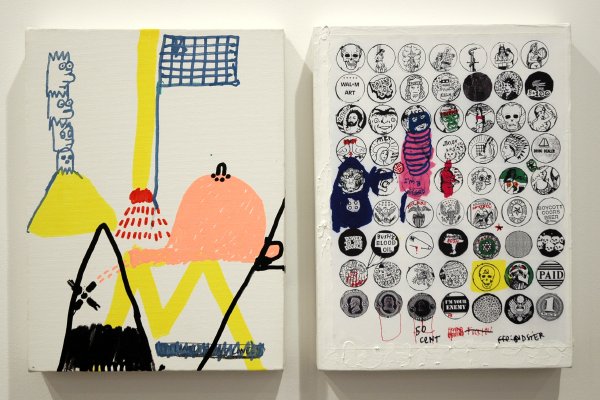
Noah Lyon 50 Cent Friendster (aka White Tees) 2005 marker and collage on canvas 9″ x 12″ and It’s Lonely Being Lonely aka Breeeaaaast Milk You Made My Daaayaaa!!! 2005 paint and marker on canvas 9″ x 12″ [view of installation]
John Connelly’s last show of the summer, which closed last week, was ostensibly about camp, but not the one in Susan Sontag’s notes, and not the one your parents thought they were sending you to. “Kamp K48” was the inspiration of Scott Hug, the artist, curator and publisher of the magazine K48. From the press release:
For this outing, Troop K48, consisting of artists who have been affiliated with K48 throughout the years, will take you on an artistic hike through the breathtaking scenery and boundless beauty of the natural world.
The exhibition plans to explore both the stereotypes and realities of our relationship to the environment, how nature is sometimes used as a marketing campaign and how we have cultured nature to suit our own needs. In the installation, nature and the art it has inspired has been visually fenced in, either to keep you out or to keep it in. The 48+ contributors in Kamp 48 have been working from their own ideas of nature to create a campsite where mass medias manipulation of nature is fully explored. Featured works take cues from horror movies, abduction stories, troop leaders gone wild, alien abductions and the army-like transformation of boys to men under the stern direction of the Boy Scouts of America.
But if you made it to 27th Street last month, it wasn’t really that simple; camp probably never was.
See the review by Wayne Northcross in Gay City News.
I have to single out the work of an artist in this show of whom I haven’t seen enough lately. Deborah Mesa-Pelly had three modest-sized photographs mounted in different areas, and I can show images of two of them here. The second was a big surprise when I uploaded my card onto the computer, since it hung in almost complete darkness inside the gallery’s smaller room described as the “JCP Annex”.
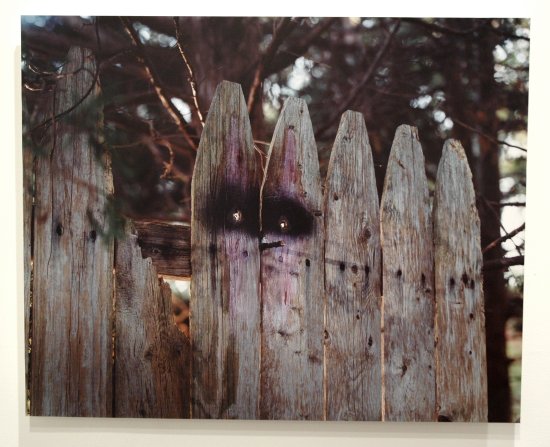
Deborah Mesa-Pelly Racoon Eyes 2005 C-print 19″ x 24″ [installation view]
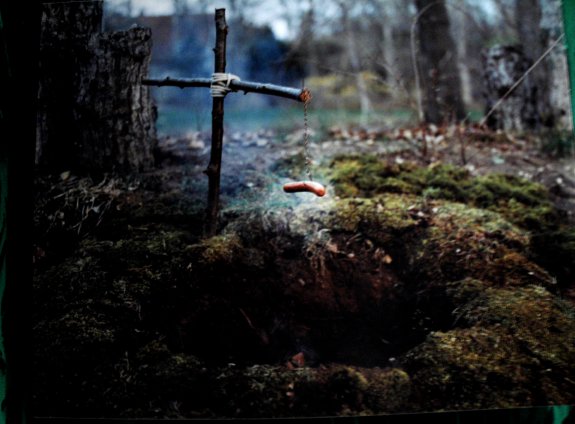
Deborah Mesa-Pelly Wiener Hole 2006 C-print 15″ x 19″ [large detail of installation]
polished Gehry
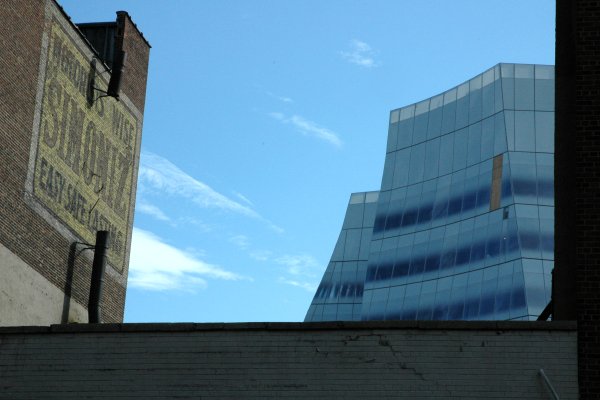
The old Chelsea confronts the new: The faded remainder of a painted twentieth-century advertising sign for a popular auto body polish faces the sparkling highlights of a nearly-completed Frank Gehry building on the West Side Highway. The top of the painted brick facade of the Anton Kern Gallery fills the bottom of the picture frame.
asking why there isn’t a protest movement?
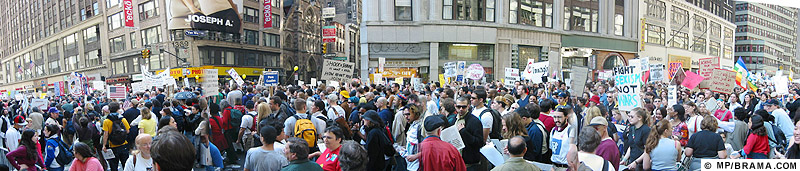
some kind of “Silence in the Streets”, NYC, March 23, 2003
I saw this “Editorial Observer” piece by Andrew Rosenthal in yesterday’s NYTimes and I could hardly believe my eyes. The writer asks, in the words of the piece’s title, “There Is Silence in the Streets; Where Have All the Protesters Gone?, and then goes on to complain about how indifferent to injustice, or plain soft or cowardly, today’s generation is when compared to the nobility of his own:
. . . its hard to imagine anyone on todays campuses willing to face armed troops. Is there anything they care about that much?
Student protesters helped drive Lyndon Johnson in so many ways a powerful, progressive president out of office because of his war. In 2004, George W. Bush in so many ways a weak, regressive president was re-elected despite his war. And the campuses were silent.
Yes, the lack of a military draft is an important explanation for the lack of political involvement on today’s campuses, but Rosenthal is being more than a little disingenuous in not mentioning the most important element of what he portrays as, at best, the apathy of our youth.
I’m outraged that an Assistant Managing Editor of the Times can pretend to be blind to the fact that we have taken to the streets, repeatedly, in numbers of up to a million people in New York alone. We were virtually ignored by our President, our Senators and Representatives, our courts and, most importantly, our media, notably his own employer. Little has changed even today, when two thirds of the country opposes the Iraq War and just about everything else done by this administration. We’ve also voted, tried to nominate candidates, written letters, made phone calls, leafletted, hung posters, organized action groups, started committees and blogs, created art and eventually screamed at the top of our lungs. We’ve been arrested for protesting, or for looking like we were going to protest, and sometimes we’ve been injured or held for days without charges. We remain nevertheless virtually invisible and even less effective in impacting Washington than, say, Miami Cubans have had in influencing Havana. Now there’s something worth thinking about, Mr. Rosenthal.
Fortunately some Times readers know a fool or a villain when they spot one, as I was pleased to learn in going through all five letters on the subject of his column which appeared in today’s edition. Theodore S. Voelker speaks for so many of us:
Andrew Rosenthal raises a timely question. The silence in the streets is partly a sign of millions of tired or retired protesters. There is also silence because we currently have an administration that would not listen to protests if 200 million Americans marched on Washington.
And Nancy Goor is more specific:
I think one reason we have so few protests is that the news media in general did not and do not cover any protests in more than a cursory way.
From the earliest antiwar marches, protesters learned that it wasnt worth the effort because their demonstrations were not covered by the news media and thus their message was not reaching their audience.
But Leslie Kauffman gets right to the heart of the matter:
Andrew Rosenthal writes that there is silence in the streets about the Iraq war. Does he mean the streets of New York City, where a million people have marched and protested since before the war? Five major antiwar demonstrations have been held here since February 2003, most recently last April 29.
Or is Mr. Rosenthal referring to the streets of Washington, where hundreds of thousands of people have marched and protested since before the war? At least four major antiwar demonstrations have been held there since January 2003.
More than 1,000 local antiwar groups are active in at least 530 cities and towns. Every week since the war began, peace vigils have taken place in at least 90 locales.
Mr. Rosenthal says that it takes crowds to get Americas attention. Large crowds have consistently taken to the streets to call for the troops to come home. Why is the scope of todays antiwar movement, like the war itself, largely hidden from American eyes?
The idiot in Crawford would have gotten nowhere without the pass he got from the commercial media from the very beginning; the ultimate blame for our potentially fatal national agony, Mr. Rosenthal (and you should be squirming by now), lies on your own conscience and that of almost every editor and publisher in America.
In fact that failure began at least as far back as the campaign of 2000, but who’s counting anymore.
[image from brama.com]
UPDATE: Josh Wolf free on bail – after 30 days in prison!
Josh Wolf, the young California video blogger and freelance journalist who was imprisoned August 1 for refusing to turn over videos of a political protest to a federal grand jury, has just been freed on bail by a federal appeals court, exactly one month later.
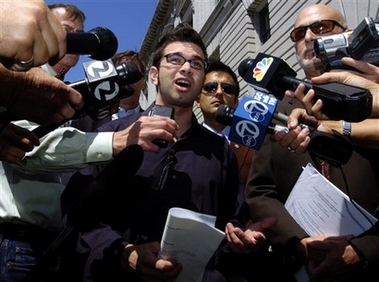
Wolf has left the Dublin prison facility, but he hasn’t left the community he found there. Yesterday, before once again thanking those who have supported him while he was inside, he wound up his statement before the press:
Im sure that many of you are curious about my experiences being imprisoned in Dublin; I have been very fortunate and much of my time incarcerated was actually quite positive. While locked up, I met many fellow prisoners who are truly stellar individuals and a observed a community which is actually one of the healthiest that I have ever lived in. To my friends in Unit J2, thanks for everything and I wish you all the best of luck.
In an effort to help get the stories of those incarcerated out into the world, I have started to develop a not-for-profit organization which will be known, for now, as prisonblogs.net the project is dedicated to giving a voice to the voiceless, and is something that I am very excited about. Expect more details about this initiative in the coming weeks.
For more on the story of Wolf’s release, see the San Francisco Chronicle and his own website.
clowns commuting to Brooklyn
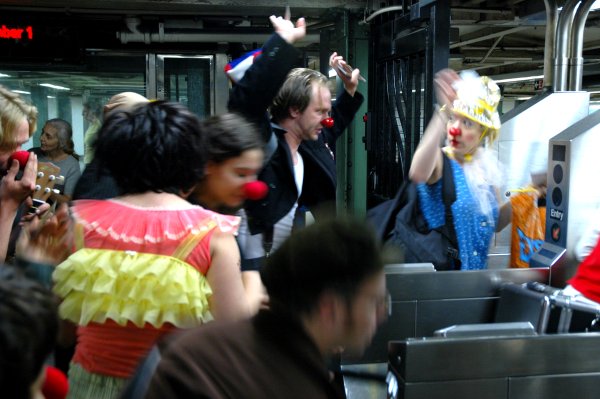
rushing the turnstiles
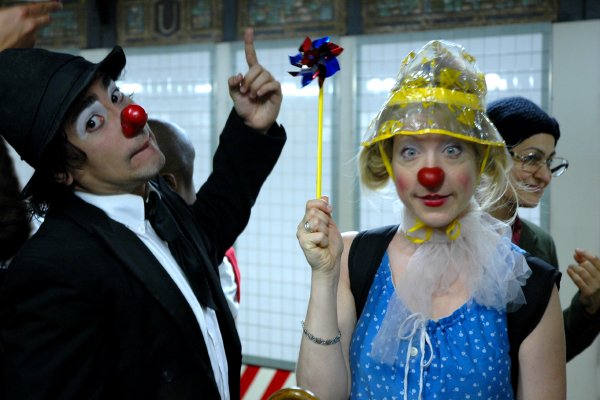
happy together
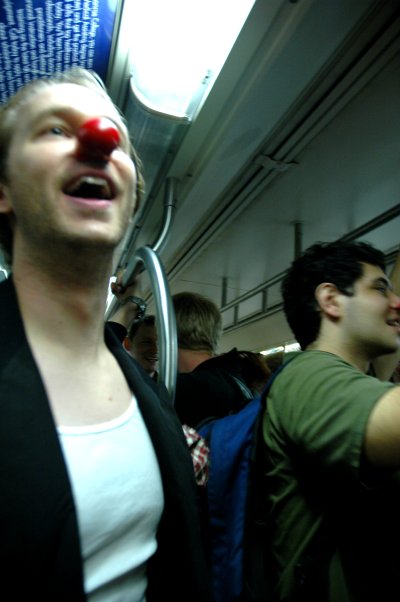
favorite hunky clown
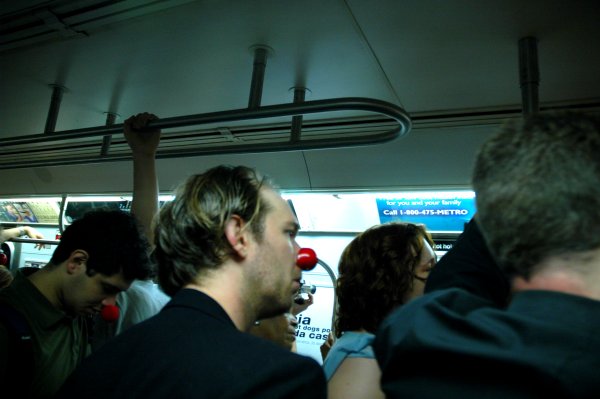
just ordinary commuters
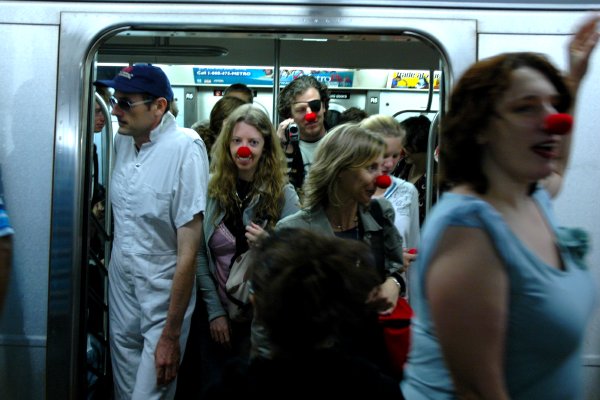
DIY nose jobs
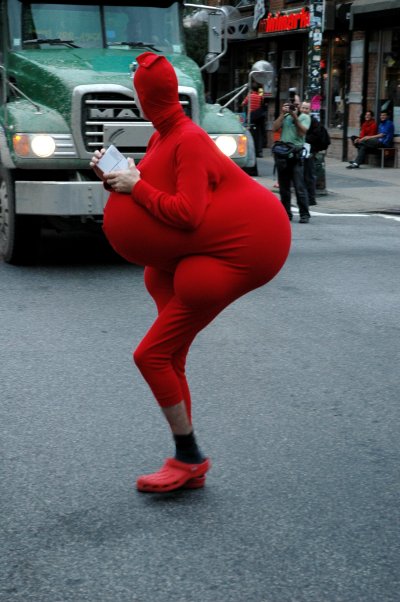
but hard to miss
I knew pretty much what to expect. I was told a horde of clowns would be descending onto a subway platform in Union Square at 5 o’clock this afternoon where they would squeeze into the L train heading into Williamsburg. I thought, “clowns”! How wonderful! And then I saw the pictures of pie fights on the website, and I thought of traditional scenes of eratic behavior, sadism including lots of let’s-pretend violence and the the cutting-up-little-babies illusions. Real clowns don’t come conveniently packaged for innocent amusement, and they never did. But that’s precisely the secret of their universal and historic appeal. I went with this particular, merely mildly-scary bunch only to the Bedford Street stop and then a few blocks further down the street.
They were on their way to the Brick Theater, where the NY Clown Theatre Festival will be headquartered for the next three weeks. If New York is lucky these clowns won’t confine themselves to the building at 575 Metropolitan Avenue.
We’re told this is New York’s first clown festival in twenty years. That probably goes a long way toward explaining why some things have been so messed up around here in the last couple of decades: Some folks need a little constructive provocation to stay in line, and New Yorkers could certainly use a regular extra-strength antidote for the common humbug.
But I’ll own up to my own cowardice this evening: I never believed the baby stuff, but I’m still afraid of pie fights.
bzzzzz

busy
Everyone in the arts world is going to be out and about beginning next week as the galleries reinvent themselves for another season. Even Barry and I are uncharacteristically formally committed to more visibility than usual in the next two months.
We’re curating a gallery show at Dam, Stuhltrager in Williamsburg, including separate openings (four weeks apart) for a one-woman show in the sculpture garden and a small group show inside. In addition we’ve been invited to be guest speakers as part of “Muse Fuse”, NURTUREart’s informal monthly salon, also in Brooklyn. Later in September we will be travelling to Providence where we will be visiting the studios of visual arts undergraduates at Brown University with an artist friend of ours as guests of the curator of the List Art Center.
It’s all enough to spoil a couple of humble bloggers, except that I think we both already feel pretty spoiled: We’re already doing what we want to do most – the way we most want to do it.
The Dam, Stuhltrager sculpture garden show is an installation by Susan C. Dessel, one of the Brooklyn College MFA degree students whose work was censored and destroyed this past spring [their legal case is continuing). Her opening is Friday, September 8, the same night the gallery’s front rooms open with “Echo“, a show of five Madrid artists.
“Muse Fuse” was created by Karen Marston of NURTUREart, a valuable community non-profit registry and gallery, as a forum for its artists, curators and guests to exchange ideas and information. This month’s gathering will be held on Wednesday, Sept 13 at 7 pm. Details are on the NURTUREart site.
My relationship to Brown goes back decades, beginning even before my graduate school ambitions introduced me to the wonders of Rhode Island. At that time this sober old Yankee institution expected the fine arts to be left to technical schools – if they could imagine they should be taught at all. Fortunately for my spiritual health RISD was just down the hill, where no one was surprised when The Velvet Underground* was invited to play class dance [ordinary schools had “proms”] the year I arrived in Providence.
Anyway, Brown now has an Arts Faculty, and as I’m writing this our good friend Sharon Louden is up there busy installing a large sculpture outside its home on the hill, the List Arts Center. She has persuaded the curator at the Center’s David Winton Bell gallery, Vesela Sretenovic, to invite us to join her when Sharon tours the studios of new and returning students on the September 21, and later in the afternoon she and her New York gallerist, Oliver Kamm, will join Sretenovic for a lecture/demonstration at the school. Barry and I will be in the audience, by that time I imagine sitting with some new friends.
*
from a piece by Robert Greenfield which originally ran in Rolling Stone on February 18, 1971:
The Velvets suffered from all kinds of strange troubles. They spent three years on the road away from New York City, their home, playing Houston, Boston, small towns in Pennsylvania, anywhere that would pay them scale.
“We needed someone like Andy”, John [Cale] says. “He was a genius for getting publicity. Once we were in Providence to play at the Rhode Island School of Design and they sent a TV newsman to talk to us. Andy did the interview lying on the ground with his head propped up on one arm. There were some studded balls with lights shining on them and when the interviewer asked him why he was on the ground, Andy said, “So I can see the stars better.” The interview ended with the TV guy lying flat on his back saying, “Yeah, I see what you mean.”
We still love Andy, and we still love RISD – to which we owe so much of Rhode Island’s cool.
[the Rolling Stone excerpt from howdoesitfeel; image from Bloggy]
Darmstadt and John Moran in the Spiegeltent
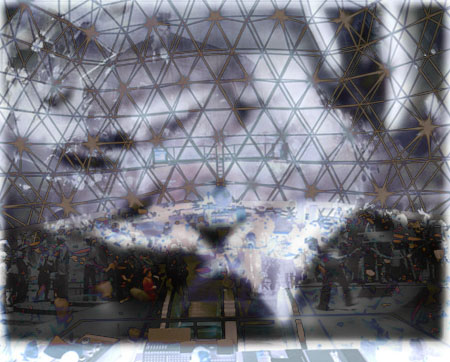
Darmstadt, newly popular avant
I definitely don’t post enough here about arts other than the visual. Serious or non-commercial music is extraordinarily important in our lives, and while I suppose a lot of people can make that statement Barry and I are fortunate to be able to live with an enormous collection of recordings, including an accumulation of more DVD’s of underknown or underappreciated operas than we can keep up with.
One of the reasons for our inevitable neglect of the music recordings, at least in warmer months, is the enjoyment we get from the complex songs of birds in the garden, but in the evening, when we are more likely to sit down at home in front of a screen not attached to a laptop, the competition is even keener. We actually spend as many evenings (and a few afternoons) away from the apartment watching live performances as we do days visiting galleries or museums.
Our enjoyment of music, dance, theatre, or their combination are rarely recorded in my blog. I suppose the reason is partly the difficulty or impossibility of capturing a visual image of my own (and the inadequacy or even the unavailability of promotion images), even when there is visual content, and partly the fact that most of the obscure experimental works which attract us are scheduled for only one or two performances.
Once in a while, and unfortunaely more often than you would know from looking at this site, a performance is just too wonderful to let me keep my silence.
To begin describing what we saw and heard last night, I have to admit that a certain credit has to be given to the venue, the Spiegeltent. I had heard about this temporary, very downtown performance space all summer, but I think it was July’s weather that had discouraged me from investigating it earlier.
The tent is an almost unbelieveably perfect relic of the European cabaret and music salons of the 1920’s and 30’s, but last night we spent hours of pure delight inside carried away into the twenty-first century. No, “Absinthe“, wasn’t on the program last night, although the authority of good friends whose judgment we respect tells us that it’s great fun.
Instead we were a part of a wonderful audience for a performance of the Brooklyn collective Darmstadt, Classics of the Avant Garde [I like the reference to Darmstadt, but I love the phrase in the second part of the name!] in collaboration with ICE (International Contemporary Ensemble) and pianist Emily Manzo. The works we heard/saw performed in this colorfully-spotlighted, smoky (artificial) mirrored and brocaded tent were by both contemporary composers and the those of the classical avant garde who still inspire adventurous musicians and audiences with works which haven’t gathered a speck of dust in the years which followed their composition.
Cage, Ligeti, Xenakis and Andriessen works were interspersed with newer pieces by Rodney Sharman, Aaron Siegel and Du Yun. Maybe it was partly the buildup of enthusiasm, since they were the last wo works on the program, but I was totally crazy about the performances and the music of Xenakis’s “Dmaathen” (Claire Chase on electric flute and David Schoztko percussion) and Andriessen’s “Workers Union” (David Reminick on saxophone, Gareth Flowers on trumpet, Daniel Lippel on electic guitar, Randall Zigler on bass, Cory Smythe on piano and David Schotzko and Adam Sliwinski percussion).
This kind of stuff totally wipes out the boundaries of “classical Music” which have been assigned to its acolytes over the last century. The enthusiastic, standing-room-only audience was composed of much more than the older, sober and often slumberous faces found uptown in our heavily-funded music museums.
There are three more nights of ICE performances at the Spiegeltent: September 11, 18 and 25.
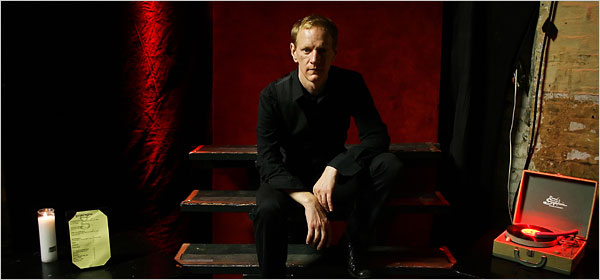
John Moran, as if at rest
Everything I said in the last paragraph can be said in spades for the performance which followed Darmstadt, John Moran‘s “Zenith 5! (Vrs. 2.0)”, programmed by Performance Space 122. Moran is something of a legend among downtown music and performance entusiasts. I had first heard about him, I believe, soon after I moved to New York two decades ago, maybe in a tribute from Kyle Gann. I searched everywhere for a recording and kept my eyes open for any notice of a performance, but for years I found nothing.
This was In the early and late 80’s, when I often often visited small to medium-sized rooms where the “downtown” or “new music” audiences numbers often barely exceeded those of the performers, and this was for groups I was already virtually worshipping. These were musicians who had already produced a number of records, and I knew I had most of them at home – or would have them in my hands by the next day. There was one hot evening in the late 80’s when I stood in Manny Maris’s CD store on Bleecker Street, called “Lunch for your Ears”, crowded together with maybe seven other people (including Manny) to hear John Zorn do a solo horn gig. There was no AC and the door was closed to protect us from the neighbors’ wrath. I was physically miserable, but I couldn’t believe my privilege!
But back to Moran. I finally tracked down a CD. It was “The Manson Family: An Opera“. And it was only a few years ago that I finally heard about a live performance of his ahead of time and of course I went. I was delighted, and I snatched up every CD he offered for sale after the music and the wonderful madness stopped. I resolved never to miss another opportunity to see what he’s up to. It still happens once in a while, but only because this brilliant artist apparently doesn’t keep a mailing list.
Unfortunately the piece performed last night was a one-off, at least for now. He’s sure to be back, and what may be just as sure is the fact that the work will not look the same when we find him again.
For all of its innovation, even within the context of his own exotic body of work, “Zenith” was probably more typically Moran than anything I had seen before – precisely because it was a new direction as well as being so truly bizarre. “Zenith Five” was annoying and disturbing but totally unforgettable. We may not all be ready for it yet, but its beauties were real. The music was concrete and sampled and homemade; the movement was the same. I once wondered where “minimalism” could go once it had become part of our canon of styles; Moran seems to have found an outlet in the direction assumed by this exquisite piece. He’s calling this work a ballet, at least tentatively; if he sticks with both the form and the appelation the virtually dead-ended world of “the ballet” can only be enriched by what started in the Spiegeltent last night.
ADDENDUM: I just realized that as respects the Darmstadt program the two pieces I had singled out for mention, of the eleven included in the program, were both written by recognized giants of the late twentieth century. Even though one of them is very much alive, my notes may look like a deliberate slight of Andriessen’s younger colleagues and that was certainly not my intention.
The acoustics of the tent were not kind to the solo piano that was Emily Manzo’s instrument during the first part of the evening, and it was in this portion of the program that Siegel and Sharman’s compositions were heard. After the pause the ICE musicians moved in with their multiple instrument groupings and it was during this segment that we were treated to Du Yun‘s “Vicissitudes No. 1” (David Reminick on saxophone, Daniel Lippel on guitar, Kivie Cahn-Lipman on cello, Cory Smythe on piano, Randall ZIgler on bass and David Schotzko percussion).
The piece was totally new to me and I was equally unfamiliar with the composer, but I loved what I heard and I would really like to hear it again – elsewhere. Even with these larger forces the tent took its toll: I’m guessing that it was because of a lack of familiarity with the quirks of the space that the easy asssertiveness of the electric guitar and the natural power of the larger percussion instruments ended up bringing their players’ contributions distractingly too forward of those of the ensemble. I think of the work itself – and its interpreters – as otherwise truly powerful and “electric” – in the very best way.
[unattributed Darmstadt image from Darmstadt; John Moran image by Chang W. Lee from NYTimes]
Duke Riley at White Box
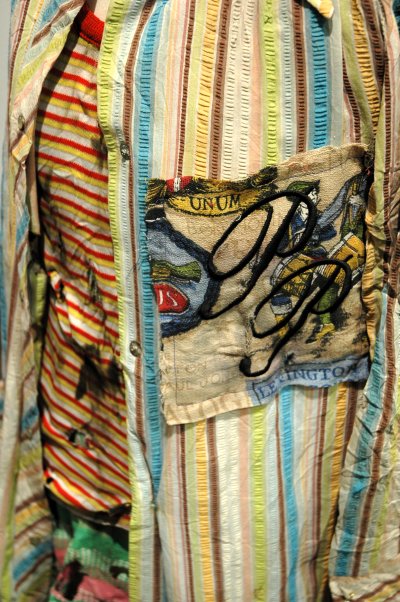
Paul Piers design
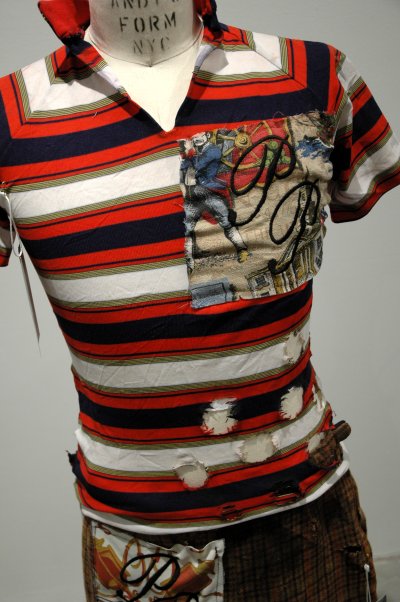
Paul Piers design
The window read “CHANEL” but almost obscuring the merchandise inside was Duke Riley‘s large drawing of a burning Greenpoint shoreline crowned with a huge cloud of smoke. Inside White Box the night of August 17 Riley was introducing his own line of upscale, burnt-look fashion under the brand “Paul Piers”.
The crowd was wonderful, and wonderfully appreciative, I think, of both their own hip and the show’s smooth rips.
Juan Puntes, the show’s co-curator and with Judith Souriau the director of the non-profit space which hosted it, seems to agree with Riley that Chelsea has waited far too long for the arrival of the boutique phase in the timeline of the gallery district phenomenon. Now, with the dramatic and suspicious disappearance of its own most interesting and historic commercial building stock (including warehouses storing tons of old clothes) the Greenpoint neighborhood may have missed it altogether – and hastened the arrival of the successor stage, “luxury highrise condominiums”.
Riley’s art is built on the East River and the historical relics of New York real estate.
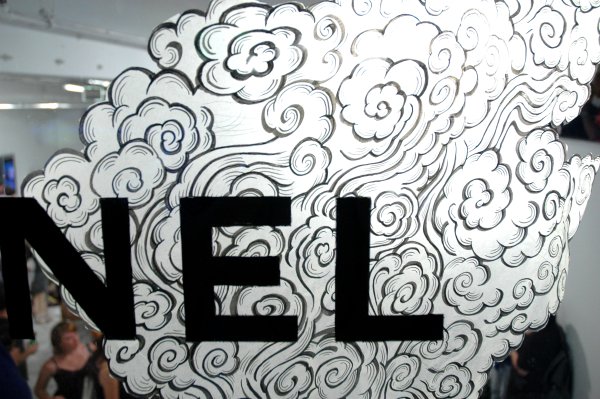
history (and fashion) up in smoke
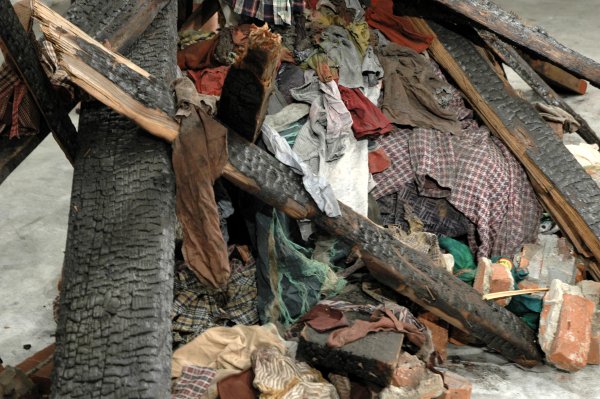
the charred warehouse remains
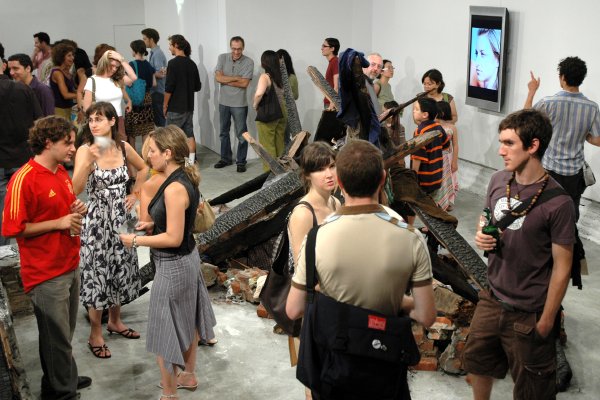
gathering around the cinders
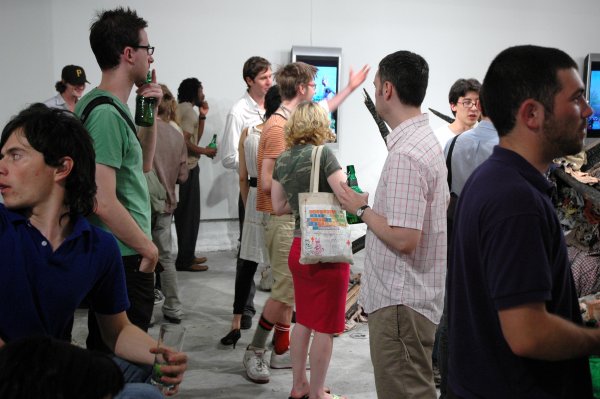
crowd scene
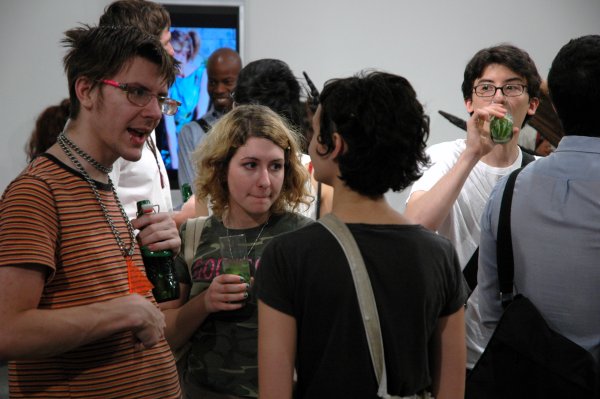
crowd seeing
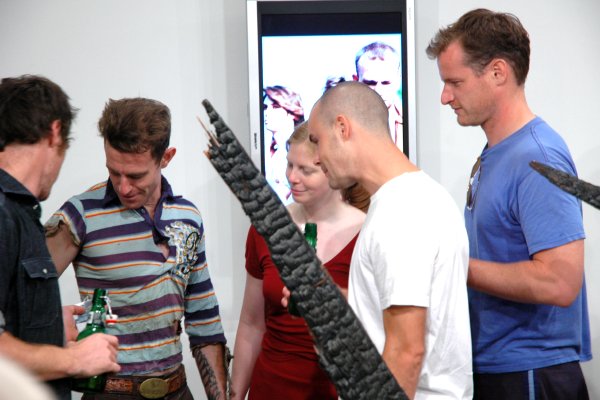
the artist checking his own tag
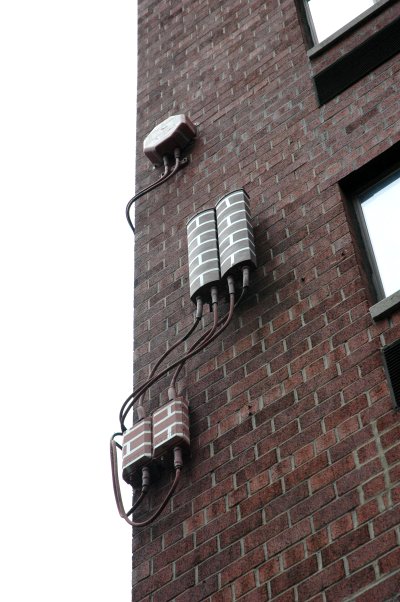
brick wannabes on 9th Avenue
(nice try, but I wasn’t fooled for a moment)