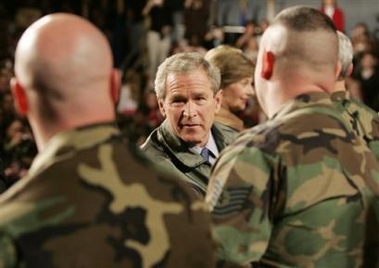
I mean, what are they going to say?
Has anybody not noticed that the man frequently described as the President of the United States addresses his constituents only inside military bases or, if anywhere else, only in the company of very carefully selected groups of supporters who have been given passes?
Lately in fact the venues for his speeches or appearances have been more and more of the uniformed sort. Even during his first term I can’t recall that Bush ever addressed a free assembly of any kind, and a commencement address or two in front of a religious college doesn’t count.
[image by Charles Dharapak from the Associated Press]
Author: jameswagner
design and evolution

untitled (golden angles) 2005
the Target is women – the weapon, “religious freedom”
you can no longer expect more from Target.
Barry just sent me an email with a link to this story reporting essentially that the Target corporation will refuse to fill certain prescriptions because to do so would be both immoral and a violation of religious freedom [my italics]. Alright, officially they’re saying that they won’t force the pharmacists they employ to violate their own personal morals, although apparently neither the corporation nor the pharmacists will have any problem with dereliction of professional duty.
I instant-messaged him a reply:
ref. Target’s morals, I now expect “religious freedom” will soon trump everything else the Constitution says
And Barry typed right back:
It’s the only right left
Those crazy cults have won: Welcome to the promised land.
Rockefeller Center takes on the Empire State Building

the money shot
But, continuing the sex metaphor, getting there was at least half the fun.
Last Sunday Barry and I went to the top of the old RCA Building in Rockefeller Center. We went because we wanted to see what the restored observation deck looked like, at least as much as for the anticipated views.
We weren’t disappointed, once we managed to get by the hype of the obligatory, very flashy presentation the owners have installed on the street and mezzanine levels of this dignified, classy building. Their very distracting “trailer” even continued through the short elevator ride itself, but all this unnecessary glitz was forgotten once we walked out in front of the world which opened up outside the enclosed 67th floor.
There we found there were two still higher, much more open levels, including the actual roof itself, where nothing but the original, roughly waist-high parapet of the building stood between us and all of New York and much of New Jersey.
We did regret missing out on the comfy chairs which can be seen in pictures of the original deck, and we might have enjoyed something like the Metropolitan Museum’s simple roof cafe while we were up there (a glass of bubbly would have been perfect). In fact however we were so clear of the building’s basic structures and services that even the water lines stopped somewhere under our feet. The last WC we had passed that afternoon was 65 floors below. At least that meant plenty of room at the top for the view.
The outlook from a certain tower to the south of Rockefeller Center still has a lot to recommend it, but you just can’t see the Empire State Building from the top of the Empire State Building.
These pictures are arranged in the order in which we ascended after getting off the elevator.
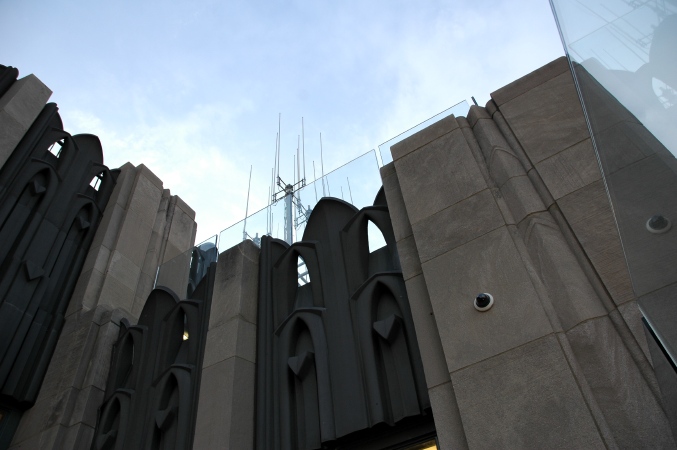
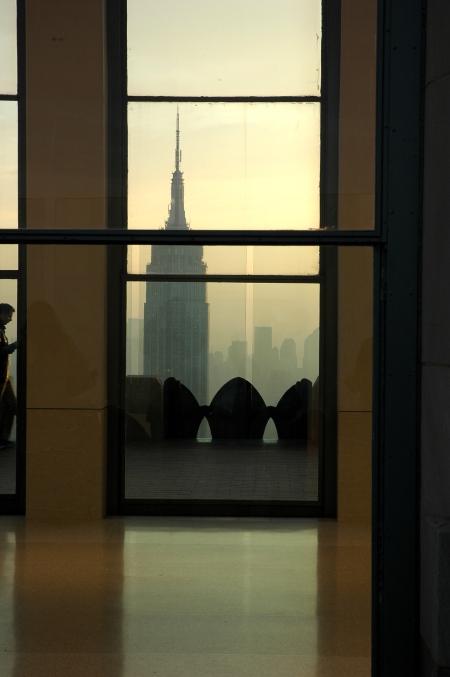

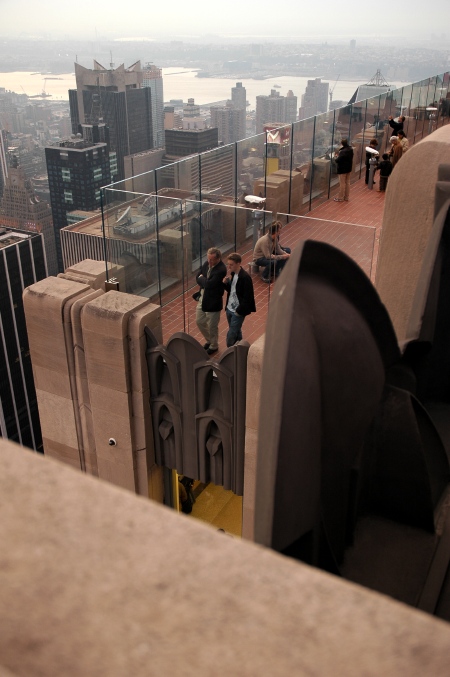
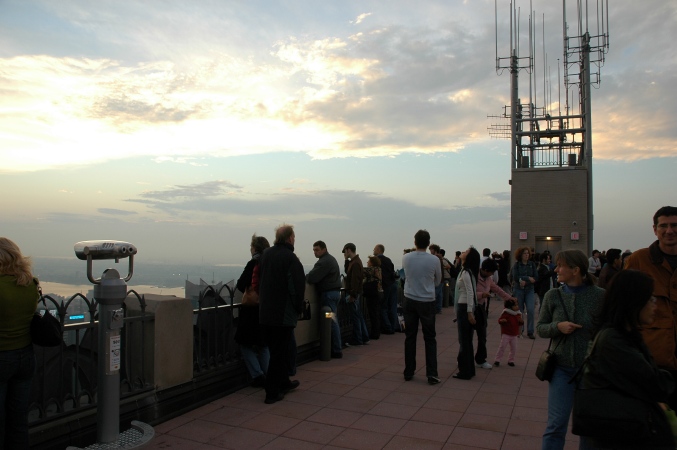
like the roof deck of a dirigible
Bill Bartman, Als das Kind Kind war
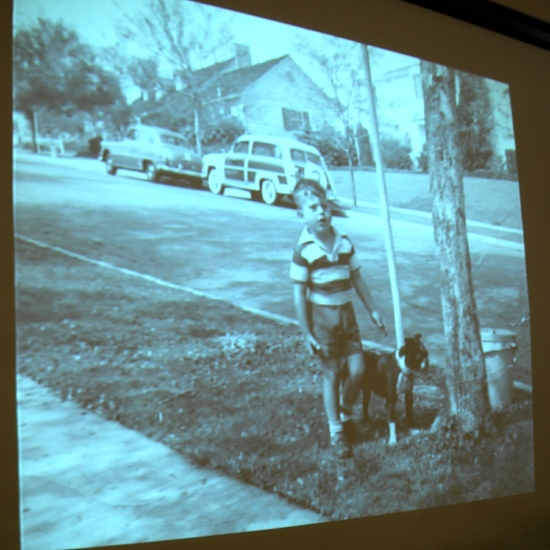
Barry and I joined a large gathering of some of Bill Bartman‘s friends in the Friends meeting house off Stuyvesant Park on Saturday. It was a beautiful fall afternoon. There were wonderful words, much good cheer, barely-suppressed tears, lots of hugs and of course some great cookies. There was also a delightful slide show of images which included this snapshot of the irrepressible Bill, when the child was a child.
Song of Childhood
by Peter Handke
When the child was a child
It walked with its arms swinging,
wanted the brook to be a river,
the river to be a torrent,
and this puddle to be the sea.
When the child was a child,
it didnt know that it was a child,
everything was soulful,
and all souls were one.
When the child was a child,
it had no opinion about anything,
had no habits,
it often sat cross-legged,
took off running,
had a cowlick in its hair,
and made no faces when photographed.
When the child was a child,
It was the time for these questions:
Why am I me, and why not you?
Why am I here, and why not there?
When did time begin, and where does space end?
Is life under the sun not just a dream?
Is what I see and hear and smell
not just an illusion of a world before the world?
Given the facts of evil and people.
does evil really exist?
How can it be that I, who I am,
didnt exist before I came to be,
and that, someday, I, who I am,
will no longer be who I am?
When the child was a child,
It choked on spinach, on peas, on rice pudding,
and on steamed cauliflower,
and eats all of those now, and not just because it has to.
When the child was a child,
it awoke once in a strange bed,
and now does so again and again.
Many people, then, seemed beautiful,
and now only a few do, by sheer luck.
It had visualized a clear image of Paradise,
and now can at most guess,
could not conceive of nothingness,
and shudders today at the thought.
When the child was a child,
It played with enthusiasm,
and, now, has just as much excitement as then,
but only when it concerns its work.
When the child was a child,
It was enough for it to eat an apple,
bread,
And so it is even now.
When the child was a child,
Berries filled its hand as only berries do,
and do even now,
Fresh walnuts made its tongue raw,
and do even now,
it had, on every mountaintop,
the longing for a higher mountain yet,
and in every city,
the longing for an even greater city,
and that is still so,
It reached for cherries in topmost branches of trees
with an elation it still has today,
has a shyness in front of strangers,
and has that even now.
It awaited the first snow,
And waits that way even now.
When the child was a child,
It threw a stick like a lance against a tree,
And it quivers there still today.
Lied von Kindsein
von Peter Handke
Als das Kind Kind war,
ging es mit hängenden Armen,
wollte der Bach sei ein Fluß,
der Fluß sei ein Strom,
und diese Pfütze das Meer.
Als das Kind Kind war,
wußte es nicht, daß es Kind war,
alles war ihm beseelt,
und alle Seelen waren eins.
Als das Kind Kind war,
hatte es von nichts eine Meinung,
hatte keine Gewohnheit,
saß oft im Schneidersitz,
lief aus dem Stand,
hatte einen Wirbel im Haar
und machte kein Gesicht beim fotografieren.
Als das Kind Kind war,
war es die Zeit der folgenden Fragen:
Warum bin ich ich und warum nicht du?
Warum bin ich hier und warum nicht dort?
Wann begann die Zeit und wo endet der Raum?
Ist das Leben unter der Sonne nicht bloß ein Traum?
Ist was ich sehe und höre und rieche
nicht bloß der Schein einer Welt vor der Welt?
Gibt es tatsächlich das Böse und Leute,
die wirklich die Bösen sind?
Wie kann es sein, daß ich, der ich bin,
bevor ich wurde, nicht war,
und daß einmal ich, der ich bin,
nicht mehr der ich bin, sein werde?
Als das Kind Kind war,
würgte es am Spinat, an den Erbsen, am Milchreis,
und am gedünsteten Blumenkohl.
und ißt jetzt das alles und nicht nur zur Not.
Als das Kind Kind war,
erwachte es einmal in einem fremden Bett
und jetzt immer wieder,
erschienen ihm viele Menschen schön
und jetzt nur noch im Glücksfall,
stellte es sich klar ein Paradies vor
und kann es jetzt höchstens ahnen,
konnte es sich Nichts nicht denken
und schaudert heute davor.
Als das Kind Kind war,
spielte es mit Begeisterung
und jetzt, so ganz bei der Sache wie damals, nur noch,
wenn diese Sache seine Arbeit ist.
Als das Kind Kind war,
genügten ihm als Nahrung Apfel, Brot,
und so ist es immer noch.
Als das Kind Kind war,
fielen ihm die Beeren wie nur Beeren in die Hand
und jetzt immer noch,
machten ihm die frischen Walnüsse eine rauhe Zunge
und jetzt immer noch,
hatte es auf jedem Berg
die Sehnsucht nach dem immer höheren Berg,
und in jeden Stadt
die Sehnsucht nach der noch größeren Stadt,
und das ist immer noch so,
griff im Wipfel eines Baums nach dem Kirschen in einemHochgefühl
wie auch heute noch,
eine Scheu vor jedem Fremden
und hat sie immer noch,
wartete es auf den ersten Schnee,
und wartet so immer noch.
Als das Kind Kind war,
warf es einen Stock als Lanze gegen den Baum,
und sie zittert da heute noch.
Now it’s up to us to find a way to keep that child’s stick quivering. Bill’s dream of a world of art to which access is generous and free for both the artist and the public has to live.
[Handke’s words are from the Wim Wenders site]
between the rails
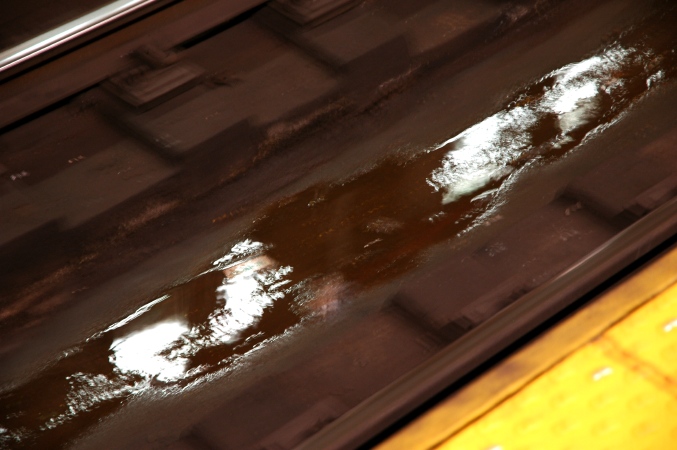
untitled (Bill dark day) 2005
Cynthia Madansky and Robin Graubard at Momenta Art

Cynthia Madansky P.S.A. #8 2005 DVD [large detail of still from video projection]
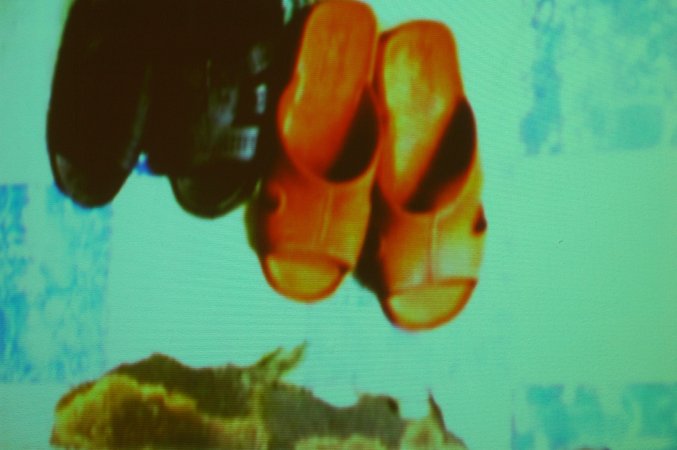
Cynthia Madansky P.S.A. #2 2005 DVD [large detail of still from video projection]
Even in a world which includes so many other galleries showing new work and new or little-known artists, a visit to a show at Momenta Art is always like inhaling a breath of fresh air. But that certainly doesn’t mean they make it easy for us. The work shown in the little rooms on Berry Street is always smart, always new, never dull and never derivative, but this is a serious space and I think it’s safe to say that nothing you will find there is ever going to be just pretty.
That said, I have to admit that the aesthetic of the current show in the front gallery and office area, of work by Cynthia Madansky, can survive very well without any notes. You’re going to want to know more however, and even a quick look at the press release will do some service. These beautiful drawings are from three different series, their subjects being historical instruments of human torture, the contemporary violation of the landscape and our enduring destruction of self.
Inside the office area two of Madansky’s gorgeous short films, from an ongoing series titled “Public Service Announcement,” are continuously projected on one wall. Largely abstract in their imagery, they are a hauntingly beautiful protest against “the American occupation of Iraq and the act of war.” The films were made in collaboration with Brad Wolfley and Elle Flanders, and the wonderful soundtracks were composed by Zeena Parkins.
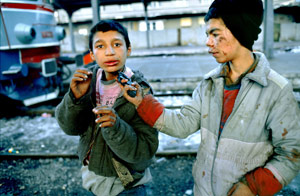
Robin Graubard This is War (Bucharest) 1995/2005 lambda print 16″ x 20″ (image
size 13′ x 20″) from the series “Black + Blue”
In the rear gallery Robin Graubard makes no attempt to seduce us. She has installed almost two dozen haunting, almost totally repellent photographic prints nakedly displaying the scars of neglect and violence borne by youths and children she has known or encountered in various brutal, yet almost entirely anonymous and interchangeable environments around the world. Think of Nan Goldin without any humor or joy, nor even a suggestion of conventional unconventional beauty.
[image of Graubard’s print from Momenta Art]
Doeringer swept off street: gallerist has police remove artist
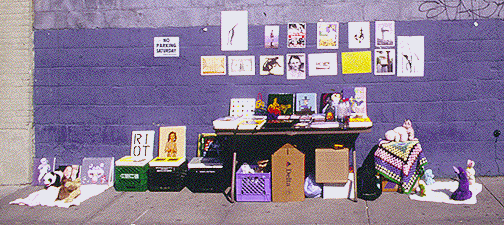
dangerous art
I still can’t quite get my mind around this story, although I first heard the particulars much earlier today: It’s essentially the tale of an owner of an art gallery asking the police to get rid of an artist who was selling his work on the sidewalk a few doors down from his business.
If I didn’t know Eric, I’d even be tempted to think this entire story was his invention, the perfect extension to one of his most interesting and familiar bodies of work.
For four years the young New York artist Eric Doeringer has been producing a series of work he calls “bootlegs.” He sells the pieces outside [and sometimes inside] galleries, museums and art fairs in a conceptual project which has enjoyed some real critical and commercial success. The individual works take the form of scaled-down, very-affordable, crafted versions of the most recognizable products of the contemporary art market’s biggest and priciest stars. His gallery is normally a sidewalk and a folding table, his public is a wonderful melange which can include the casual passer-by, the sophiticated patron or even some of the artists referenced in the work (some of whom have become his collectors).
Doeringer has a show in Los Angeles opening next weekend, he will be in an art fair in Zurich the week after that, and we can expect to see him at Miami Basel later in the month.
Apparently Mike Weiss, who runs his eponymic gallery on 24th Street, where our young artist has usually set up his shop, had complained about [what I would describe as the performance element of] Doeringer’s art the weekend before this and had threatened to call the police if he returned the following Saturday. According to Doeringer, Weiss told him he didn’t like him selling work outside, “because it attracts people.” Doeringer says he thought at first Weiss was joking. Eventually he realized that he meant that Doeringer’s presence would attract other artists selling their work there as well. Weiss complained about his high rent and how the artist was making it difficult for him to sell art.
In spite of the pressure, Doeringer was certain he was within his rights in what he was doing and so he returned this weekend. At some point in the afternoon on Saturday he was approached by the police, who told him they were responding to a 311 complaint. They informed him he would have to leave [later he learned that he only had to file some paperwork and register as a vendor, collecting sales tax, in order to be legitimate].
He packed up his work and confronted Mr. Weiss, who admitted he had called the police. He said that he didn’t like “seeing people walking around with tiny paintings,” while he was paying high rent for his gallery and, “trying to sell $30,000 paintings.”
When Doeringer told him he was certainly going to let everyone he knew in the art world hear about what he had done, Weiss said, “If that’s the way you want to play it, I’ll call the police whenever I see you anywhere.”
Gotta get rid of those pesky artists; they can so get in the way of the real business of art. But this one’s so pesky that he’s now determined to be back on the street when he’s in the city and weather permits, even though he hadn’t originally planned a continued open-air presence in Chelsea.
[image from Eric Doeringer]
Chelsea towers

these two are rare exceptions to the classic, and ubiquitous, wooden barrel versions
gotta love a boy with a little bicycle and a red scarf
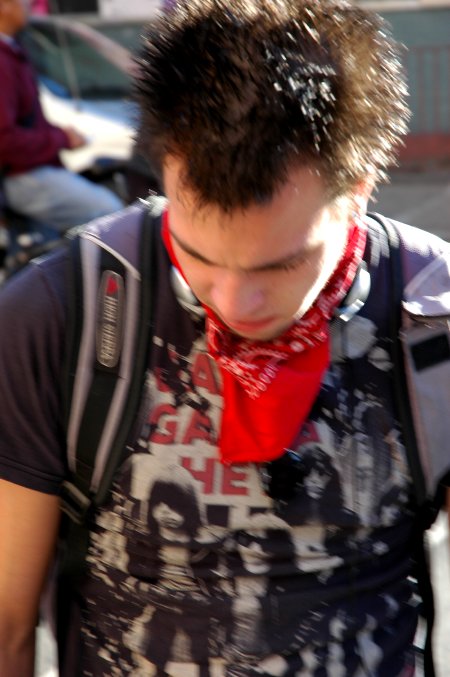
especially if he’s part of a “Drive Out the Bush Regime” demo
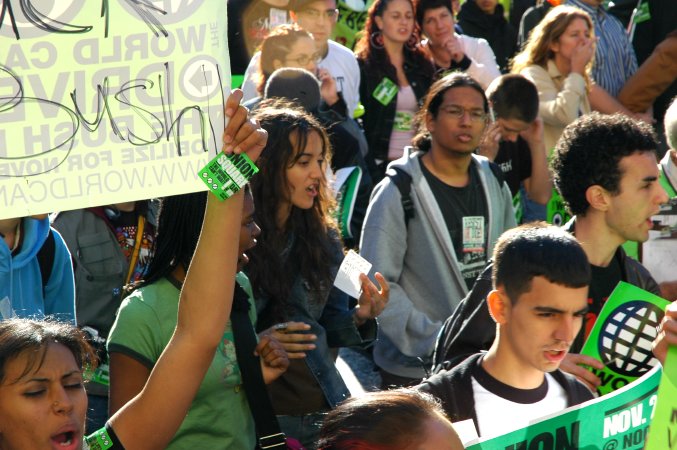
marching up 8th Avenue this afternoon
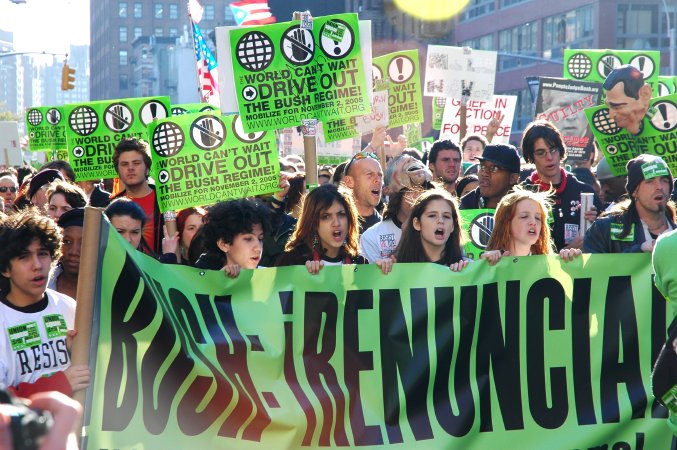
led by some of the youngest revolutionaries I’ve ever seen
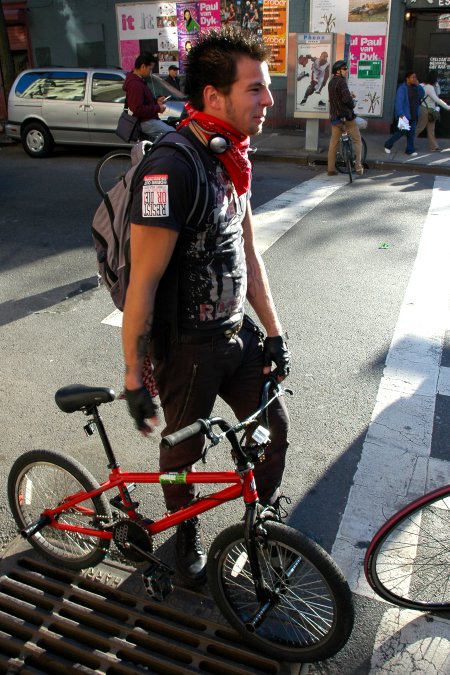
the youth in question looking particularly endearing stopped by a flat tire at 21st Street