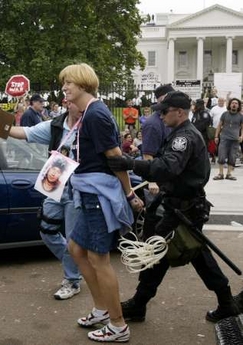
White House arrests Cindy Sheehan

Sheehanarrest.jpg
dangerous woman

Cindy Sheehan has been arrested for not moving from the sidewalk in front of the executive mansion on Pennsylvania Avenue. White House press secretary Scott McClellan:

“it’s the right of the American people to peacefully express their views. And that’s what you’re seeing here in Washington, D.C.”

And it’s the right of a pseudo-authoritarian regime to arrest us if we try it without asking permission.

[image of Molly Riley from Reuters via Yahoo!]

Bush has made beatings and torture very American

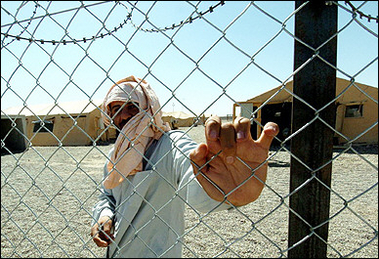
Iraqbeatingtorture.jpg
An Iraqi detainee at a jail in the outskirts of Baghdad, 2004. Troops from the army’s elite 82nd Airborne Division routinely beat and mistreated Iraqi prisoners at a base near Fallujah in central Iraq with the approval of their superior officers, a New York-based human rights group said [AFP caption]

“3 in 82nd Airborne Say Beating Iraqi Prisoners Was Routine”

The prodigious fool and duplicitous monster who let a very gullible nation believe Iraq was responsible for September 11, and who then told its very frightened citizens that Iraq was about to drop nuclear bombs on them, is the one who did this. Our natural proclivity for violence was the perfect instrument.
If we are citizens of a democracy*, we are all guilty, but the beatings and torture which continue today began four years ago at the very top, with the commander-in-chief himself.

*
perhaps a dubious assumption today

[image by Jewel Samad from Agence France-Presse file via Yahoo!]

John Weir goes to Houston and finds ‘home’

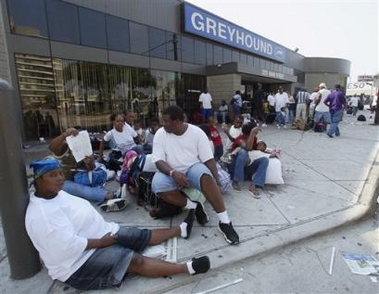
NOLAAstrodomeRita.jpg
Chiquita Garner, left, of New Orleans, waits with her family outside the closed Greyhound terminal in Houston on Thursday, Sept. 22, 2005. Garner and her family had been evacuated from New Orleans after Hurricane Katrina hit and have been living in the Houston Astrodome since. They were hoping another bus would come by despite the fact that the station had closed.

The store of hurricane Katrina literature is already pretty vast, but it hasn’t always been very, well, literate. John Weir didn’t get to Houston until some time after the disaster in New Orleans which saw thousands of people flee to Texas and into the Astrodome, but he came away with a story about . . . home.
It’s no longer breaking news, and in fact evacuees in the Astrodome itself have now been [re-evacuated?] in the face of a new hurricane threat, but his is the kind of intelligent, primary-source account we will need in order to understand what went so terribly wrong in Louisiana this month.


ASTRODOME

This is how Americans lose everything: in public, within range of TV anchors taping standup segments for the nightly news. A week after 23,000 people left the New Orleans Superdome and fled to Texas, I’m in Houston’s Astrodome with a media handler and five other journalists taking notes and aiming video cameras. There are still 3,000 people sleeping on army cots across the playing field of the Astrodome – a caravan of misplaced persons moving from dome to dome across the Gulf Coast. Reporters mill around them, watchfully ignored by the arena’s inhabitants until one of them decides or is persuaded to tell her story.
Two-thirds of the people in the Superdome were women, many of them young mothers, and the Astrodome is a makeshift city of stunned moms whose little kids, playing jacks and doing cartwheels, seem unable or unwilling to relate to the disaster except as a day off from school. Beds made up with gray wool blankets are covered with boxes of Huggies, along with copies of the Bible, paperback novels by John Steinbeck, and inspirational books: Walk on Dry Land, a 12-step self-help manual that has been fortuitously named. Whenever someone is reunited with a lost family member, a cowbell clangs.
Postings on the giant message board speak of hope, and, indeed, in the past few days, there have been celebrity visitors here. Oprah came with her camera crew. George and Barbara Bush, Sr. showed up last Monday, with Bill and Hillary Clinton and Illinois Senator Barack Obama. Each of the dignitaries responded according to his or her inclination. Mrs. Bush, a booster for Texas, welcomed the new arrivals to her home state. “So many of the people in the arena, here, you know,” she told the radio audience of American Public Media’s Markeptlace, “were underprivileged anyway, so this. . . ” She paused for emphasis, laughing slightly. “This is working very well for them.”
Just whom she meant by “them” – not to mention “underprivileged” – and how much of the life and future of New Orleans has been permanently lost by their displacement, was a question that everyone was addressing directly, yet also, somehow, in code. There was the problem of what to call the arrivals in Texas, hundreds of thousands of black people who had fled New Orleans, a city whose largest Parish, Orleans, had been 66% black, and a majority of whose black citizens lived below the poverty line, many of them holding jobs that did not require marketable skills in the information economy – busboys, warehouse workers, hotel maids.
They were being called refugees. They were being called evacuees. They were being called victims and survivors. In Houston, the relief workers and city functionaries had begun calling them neighbors and guests and, finally, residents. NBC news anchor Brian Williams, talking to Jon Stewart on The Daily Show, called them, defensively or apologetically, Americans, as if to distinguish them from the third world poor whose plights they suddenly if temporarily appeared to share.
They did not fit easily into the national narrative of opportunity and prosperity and the all-inclusive American melting pot. Moreover, the hurricane itself presented problems for the media and national government, restricting triumphant photo opportunities. There was the lack of a signature visual, as when the Twin Towers collapsed on 9/11. There was the lack of a unified band of Police officers and firefighters whose heroic rescue efforts could be praised and shared. Instead, the media leaked reports of members of the New Orleans Police Department abandoning the Superdome and the Convention Center, of officers looting homes and businesses, of the Police Department’s spokesperson himself committing suicide after spending a few days in the flooded city.
There was finally the complication of the people in the Superdome being, not assassinated by terrorists and mourned as American martyrs, but in fact still alive, still trapped in the ruined building days later, still needing government aid. This time the victims were twenty-three thousand working class black people, many without cars or ready cash or means of escape. They had spent their lives within drowning distance of a lake whose levees everybody seemed to know would collapse, and they were corralled into a giant sports dome while the rains came and the toilets overflowed, and media choppers flew overhead without the apparent intention of getting anybody out.
In the aftermath of this tragedy, while President Bush was keeping a rather aristocratic distance, members of America’s shadow government – celebrities, NBA jocks, movie stars – were everywhere, flying over the Superdome to assess the damage and then touching down in Mississippi and Louisiana and Texas to talk to survivors and offer leadership and support. For a period of two or three days it appeared in fact that Oprah was President. She said what many must have felt but none of the country’s national leaders had yet articulated. Visiting the Astrodome, speaking to those who had endured the ordeal at the Superdome, she said, “We owe these people an apology.”
The apology came on Thursday in the form of debit cards. The survivors of Hurricane Katrina were now being called “clients,” and they were being invited to apply for ATM cards that were issued by the Red Cross on a sliding scale depending on family size, good for anything from a few hundred dollars up to a couple thousand. Then FEMA announced it was issuing cards worth $2000 to anyone who qualified for aid.
In America, when all is lost, someone gives you paperwork, and then you stand in line. On Thursday morning in Houston, two weeks after the flood, there are two massive lines snaking around the front of the Reliant Center, the convention center facing the Astrodome. One line is for people wanting to apply for Red Cross debit cards; the other is for successful applicants, cleared for access, validated forms in hand. Twenty-five hundred people are out in the heat, some of them under umbrellas, some of them holding newspapers and cardboard boxes over their heads to shield themselves from the sun. They are wearing flipflops and sandals, shorts and t-shirts, and clutching whatever they own. People are in wheel chairs; the disabled lean on canes. One small red stand dispenses Coke.
I speak to a young woman named Trina who has fifteen dollars pinned to her shirt. She is carrying her clothes in two plastic Whole Foods bags, while her son drives his toy car across the Reliant Center windows, shouting, “Whee! Whee!” Trina was in the Superdome for four days. “The government sending all that money to Iraq,” she says, angrily. “Whatever money they give us ain’t going to replace everything we lost.”
Lainez Fisher, a beautiful sleek woman in her mid-twenties, is wearing a Marilyn Monroe knapsack on her back and a black scarf around her head. She was in the Superdome from Monday until Friday. “The military got the help, not us,” she says. “They treated us like animals.” Her sister Gretchen agrees. “No need for that,” she says. “Really no need.” Gretchen has a pit bull with eleven puppies that she shipped in a crate to Gonzales, Louisiana. Otherwise, she left New Orleans with the clothes on her back and her Betty Boop handbag. “Back in the day,” she says, “we used to run on those levees. We saw the holes. We knew they would collapse.”
I am introduced to a woman named Miss Claiborne. She spells it for me. “M-i-s-s,” she begins, then her last name. I ask her if it’s true that the Red Cross is giving out money. “They’re supposed to,” she says, loading the word “supposed” with the kind of skepticism and scorn that only certain middle-aged black women are able to achieve. She tells me, as do so many others, about living in the Superdome, about being treated like animals, fed like dogs, watching corpses rot, guarded by members of the National Guard who seemed interested only in protecting themselves. And then, thinking back before the Superdome and the flood’s damage, she remembers what else she lost. “I owned a home,” she says. “I owned a home.”
I can’t convey how slowly and proudly she says it, how hopeful and tragic it sounds, how terribly sad, the beautiful American word, “home.” Whose home? The ruined homes on the coast of Biloxi, the historical homes? The drenched housing of the New Orleans poor? The temporary shelters, the sports domes, the welcoming cities, the question, repeatedly asked, “Will you go home? Can you go home?” In Houston, a week after the hurricane, people can name what they lost, their homeland, their families, their security – “Everything,” so many tell me, “I lost everything” – but the question of exactly what it was worth, and to whom, is only beginning to be addressed.
[image of Rick Bowmer from the AP via Yahoo!]

don’t expect freedom of speech or assembly in New York

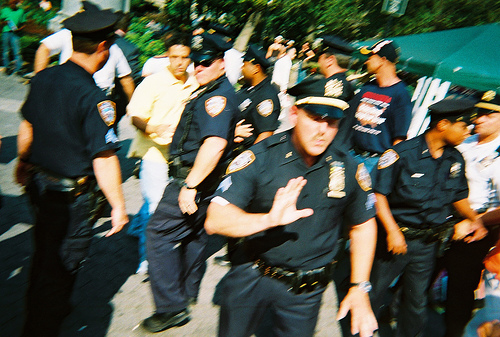
Cindyrallyarrest.jpg
bedlam immediately followed the arrest of the organizer of Cindy Sheehan’s appearance in Union Square [the guy in the yellow shirt is a plainclothes punk “kid” who tried to start trouble before the rally began, according to a witness, Kim Arnold, one of the principals of the site where this image was spotted, tanasimusic]

Barry has a very good take on what happened when Cindy Sheehan tried to speak in Union Square on Monday.
No innocent in the ways of our benighted republic, including its most worldly city, he suggests, “They should have added some religious content”. [“worldly” is a relative thing here in America]
Incidently, the secondary headline on Sarah Ferguson’s Village Voice article reads:

City’s Finest pulls move even Bush wouldn’t have tried

[image courtesy of Mike Fleming via tanasimusic]

Community Labor United – now in site [sic]

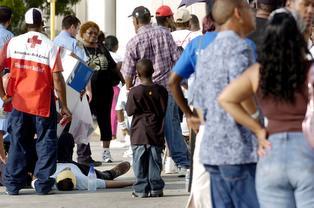
NOLAReliantArena.jpg
A man in the crowd in front of Reliant Arena, lies passed out from the morning heat. He was taken away in an ambulance. Residents of the shelter were told they were being evacuated to Arkansas, due to Hurricane Rita [Times-Picayune caption dated September 21]

Anyone who has been looking at this site for the last month knows how much I’ve been concerned about local control of the reconstruction of lives and neighborhoods in New Orleans.
This afternoon, as Louisiana awaits the impact of another hurricane, the burden for these communities and those who would help them has become more overwhelming than ever.
I was happy to find out only a few minutes ago that Community Labor United, the people whose experience and projects seem to best describe such an initiative now have their own neat and very useful website.

[image by Eliot Kamenitz from the Times-Picayune]

Bill Bartman, continued [and very likely forever]

billphoto.jpg
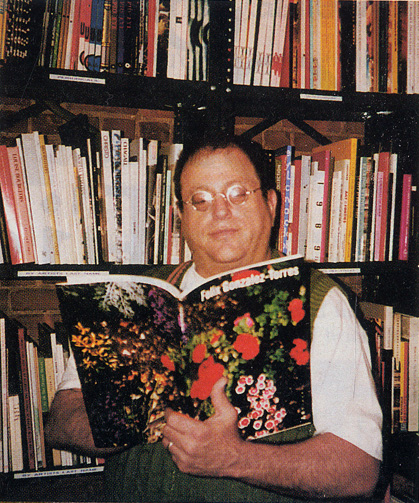
bookish Bill

A full week after it was reported to the rest of the world the NYTimes finally got around to including the news of Bill Bartman’s death, at the very bottom of its page of obituaries.
Many will be dismayed over what they will find there. It will be a shock to his friends, admirers and co-workers, and even to those who were often put off by his brusqueness. It will confound the thousands of people from every walk of life who have been touched by and encouraged by his love and respect for the arts, especially the visual arts, and above all the artists themselves.
This short factual account of his birth and the places of his residences, the names of the unique institutions he created and guided, the cause and location of his death and the names of family survivors will not satisfy those who survive him and continue to take joy in the art he encouraged and nurtured so selflessly.
The contracted text of the paper’s obituary reads like the paid death notices typeset on the page to the right in the print edition. It would not even challenge the resources of a small-town weekly shopping rag.
The Bill Bartman left on that page today is not the irrepressible genius I was privileged to know and who persuaded me against my every inclination and better judgment to become a part of his foundation’s board. I would never have said yes, or been so devoted to “William S. Bartman, 58, Art Patron”, in the words of the Times headline.
Bill could be incredibly charming and absolutely impossible almost at the same moment. His many art books and his “bookstore-gallery” were totally unique. No one who happens across any of these beautiful published tributes to one or more artists, and especially to art itself, or who ever wandered into the eccentric, cookie-stocked Chelsea space he dominated will ever forget his work.
This dynamo doesn’t fit into five column inches. It will take an artist and a great editor to tell his story. I’m sorry the NYTimes wasn’t up to it this morning.

See the warm tributes, the giggles and the stories which have been accumulating as comments to my post of September 25.

UPDATE: There will be a memorial for Bill Bartman at 2 pm on Saturday, November 5, at the Society of Friends Meeting House off Stuyvesant Square. Everyone is welcome. There will be cookies.

[image furnished by A.R.T.]

after the flood, waiting for the new owners?

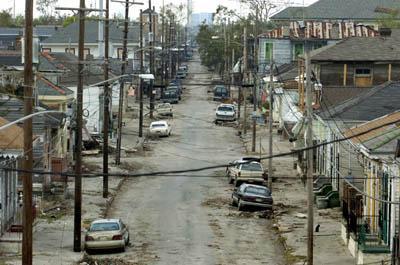
NOLAmudstreet.jpg
where Dumaine crosses North Roman, central Treme after the flood, sometime late last week

The title of Jordan Flaherty‘s latest letter is “Shelter and Safety”, but the context is racism, a racism exacerbated by the horrors of Hurricane Katrina, a racism which continues even today in “rescue” and “shelter” operations and which is built into the plans for tomorrow’s New Orleans.
The sections I’ve excerpted below describe just a little of the desperate struggle of a poor, almost-powerless, displaced community to remain a community. [The entire text includes much more detail on the specific horrors of “Shelter and Safety” today in Louisiana, and I expect it will soon appear on leftturn].

Just north of the French Quarter . . . is the historic Treme neighborhood. Settled in the early 1800s, it’s known as the oldest free African-American community in the US. Residents fear for the post-reconstruction stability of communities like Treme. “There’s nothing some developers would like more than a ring of white neighborhoods around the French Quarter,” said one Treme resident recently. The widespread fear among organizers is that the exclusionary, “tourists only” atmosphere of the French Quarter will be multiplied and expanded across the city, and that many residents simply wont be able to return home.
. . . .
Diane “Momma D” Frenchcoat never evacuated out of her Treme home on North Dorgenois Street, and has been helping feed and support 50 families, coordinating a relief and rebuilding effort consisting of, at its peak, 30 volunteers known as the Soul Patrol.
. . . .
Asked about her plan, Momma D had these words, “Rescue. Return. Restore. Can you hear what I’m saying, baby? Listen to those words again. Rescue, return, restore. We want the young, able-bodied men who are still here to stay to help those in need. And the ones that have been evacuated, we want them to come home and help clean up and rebuild this city. How can the city demand that we evacuate our homes but then have thousands of people from across this country volunteering to do the things that we can do ourselves?”
Community organizers like Momma D in Treme and Malik Rahim, who has a similar network in the Algiers neighborhood, are the forces for relief and rebuilding that need our help. The biggest disaster was not a hurricane, but the dispersal of communities, and that’s the disaster that needs to be addressed first.
Yesterday a friend told me through tears, “I just want to go back as if this never happened. I want to go back to my friends and my neighbors and my community.” Its our community that has brought us security. People I know in New Orleans don’t feel safer when they see Blackwater mercenaries on their block, but they do feel security from knowing their neighbors are watching out for them. And that’s why the police and national guard and security companies on our streets haven’t brought us the security we’ve been looking for, and why discussions of razing neighborhoods makes us feel cold.
When we say we want our city back, we don’t mean the structures and the institutions, and we don’t mean “law and order,” we mean our community, the people we love. And that’s the city we want to fight for.

[image by Ted Jackson from the Times Picayune]

our sidewalks are now for sale

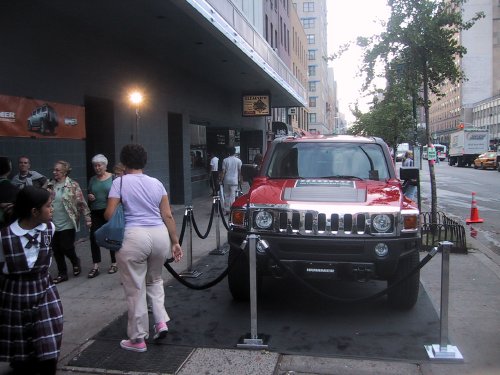
Hummer.jpg
everybody into the streets!

They could hardly have come up with a petty outrage more perfectly designed to get me going. Hummer, blocked sidewalk, trashy action movie: Could anything be more civilized in a crowded neighborhood on a warm afternoon?
At 5 o’clock today I was walking west on 23rd Street across from my home when I saw a shiny Hummer facing me, almost totally blocking the sidewalk. Crowds of pedestrians were squeezing through the bottleneck it presented. The monstrous red tank was on a carpet, surrounded by chrome stanchions draped with black velvet ropes, and there were at least two spotlight towers positioned nearby. To add insult to this injury the parking spaces along the curb for a hundred feet ahead were blocked by traffic cones, apparently in order to keep a view of the Hummer clear for cars passing in the street (the prol’s bus stop served the purpose in the area immediately to the rear).
I was told by a guy with “Star Theatrical Services” spread across his tee shirt that the car was a promotion for a film festival, but I suspect it was mostly only a promotion gimmick for a silly truck whose sales are currently plummeting, even if it was tied into some rude action movie playing in the multiplex behind it. There was no advertising other than a Hummer poster slappped on the movie house wall.
The guy also said they had a permit. That may be, but how does that happen in a city already choked by millions of cars routinely playing games with people on foot whenever they step into a street? I reported the installation to 311 anyway, for “impeding pedestrian traffic on a sidewalk”, which I learned is the responsibility of the Department of Sanitation. The 10th Precinct said they’d send a car by. I’m not holding my breath.

UPDATE: As I was leaving our building just before seven, someone told me that Chelsea’s Hummer show had been [taken down] just ten minutes earlier. That would put it a little over an hour after I called 311. No, I don’t know if there’s any connection. I just hope we don’t see it there tomorrow.

life on the edge – of the reservoir

CPkreservoirnattyguy.jpg

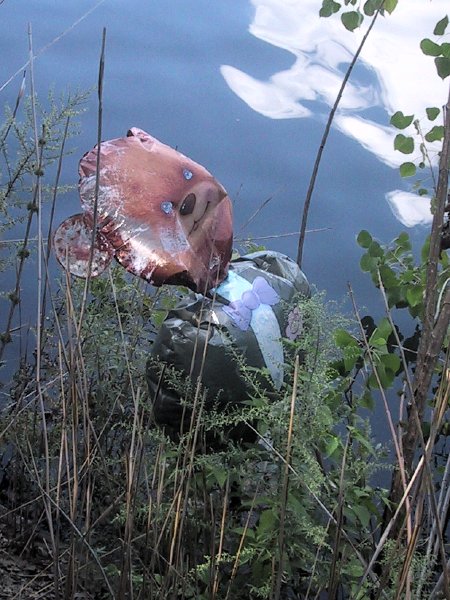
I was up by the Central Park reservoir (the Jacqueline Kennedy Onassis Reservoir) yesterday. It was one of the last days of summer and I was anxious to find some sign of color or life other than the green monotone of the brush surrounding a body of water deliberately kept pretty sterile. As I peered over the fence, hoping to spot a flower or a duck, I spotted this slightly ragged, yet still rather natty gentleman standing on the rocks below.
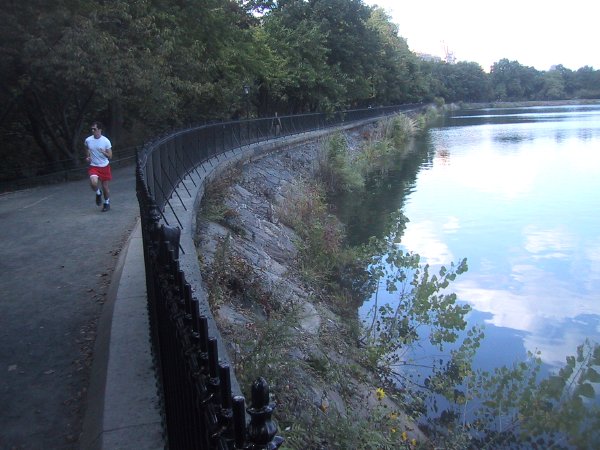
Incidently, a low, elegant black-painted steel and iron fence now separates the reservoir from the busy jogging path which surrounds it. I checked when I got home and was surprised to find that it’s been there two years, a huge improvement over the seven-foot chain-link horror most of us always associated with this underappreciated pond.

CPkreservoirfence.jpg
handsome, running fence