getting into New Orleans, with some paper and some attitude

NOLAroad trip.jpg
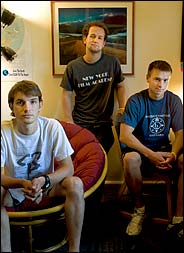
back at Duke, Sonny Byrd, David Hankla and Hans Buder

“It made no sense whatsoever that reporters were getting in and out of New Orleans, but the National Guard couldn’t remove those people from the convention center,” said Mr. Hankla, 20, a sophomore. “All we knew was that we were sick of being armchair humanitarians and that we intended to help get people out.”
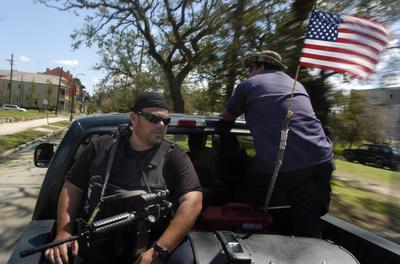
So he and two dorm mates, Sonny Byrd and Hans Buder, set out in Mr. Byrd’s Hyundai sedan for a road trip and rescue mission. [read the whole story in the NYTimes]

That’s the can-do spirit which seems missing in most of the country these days. It’s also the spirit (and the devices) we used in ACT UP, especially in the early 90’s: Sometimes you just have to figure out how to make your own credentials if you want to help people.
Hey, these dudes weren’t arrested, and they even got media coverage – key in any action!

[image by John Loomis for the Times]

Michael St. John and friends at Cynthia Broan

StJohnFoundGod.jpg
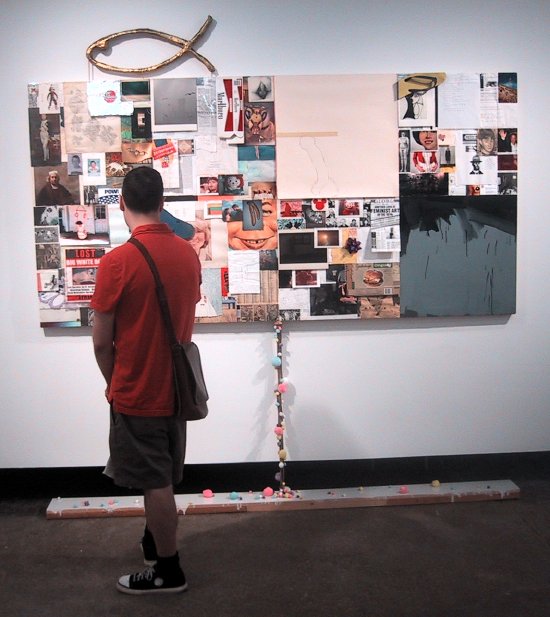
Michael St. John In a daze ’cause I found god 2003 plaster, spray paint on wood, atlas, collage, pencil, paper, tape on canvas, pom poms and enamel on wood 98″ x 96″ [installation view with Barry]

RamplemanRachel.jpg
Rachel Rampleman A Glimpse of a Thursday afternoon 2005 UltraChrome ink on canvas 30″ x 64″ [detail]

ChampneysTaylorApple.jpg
Champneys Taylor Still Life with Apple 2004 mini DV 1:55 minutes [still from installation]

“I’m a child of divorce, Gimme a break” is the rummy title of the current show at Cynthia Broan. The artists and the works were chosen for their affinity with the artmaking of the curator himself, Michael St. John. Not surprisingly, given its particularly ebullient character, all of them seem to be having a good time, and this writer was almost all smiles as he shared in it.
A very good, smart show, with no redundancies in spite of the risks of its conceptualization.

do birds drink?

vodkabirdhouse.jpg

I was walking with Barry and some friends along 11th Avenue just above 24th Street when I spotted a birdhouse shape on the far side of a tree [by coincidence one of my most favorite trees in the entire city]. I went to investigate and discovered the entrance hole blocked by something constructed of wood and painted black. Concerned for any potential occupants, I poked the obstruction with the end of my umbrella and what looked like water flowed out of the perch/spigot below. The “water” turned out to be vodka.
I don’t know this fairytale at all.

“Floating Island” sighted off Manhattan

Smitsoncloudsbefore.jpg

Smithsoncoming.jpg

Smithsonhere.jpg

Smithsonislandonly.jpg

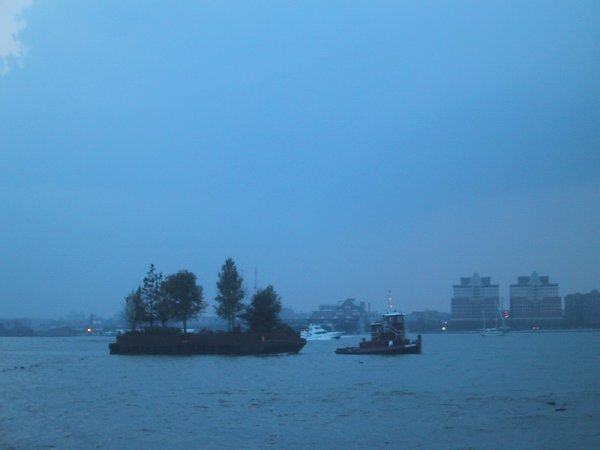
It was already early Saturday evening. We were walking down through Hudson River Park with a destination in mind, but we had started to assume that we would arrive too late to see the posthumous [performance?] of Robert Smithson’s 1970 sculptural concept, “Floating Island”, an homage to Manhattan and Olmsted’s Central Park.
I stopped at the shore railing for a moment with my camera in order to capture a golden lining on the last clouds to witness a sun which had probably already set.
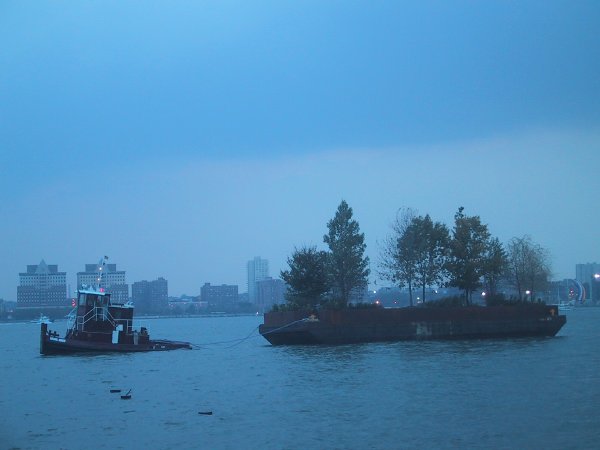
Then I caught up with Karen and Barry and we soon spotted downriver what the world had only seen as a child-like sketch until that afternoon: a little tugboat pulling a small barge along the shoreline, the barge filled with what looked like a chunk of landscape from the park itself, complete with shrubs, grass and boulders [the rocks borrowed from the park for the occasion].
The excellent skipper of the “Little Toot”-like tug had amazing control of his charges, and none of the spectators were disappointed, whether they stood on the shore or on the piers, as he passed by with his chunk of Manhattan in tow, then turned and passed again and again and again along the edges of both.
The three of us weren’t even disappointed that we had forgotten about invitations to receptions which had promised food and drink. We had lingered too long among the temptations offered by Chelsea galleries that afternoon. By the time we arrived at the scene by the piers further downtown black-garbed, white-aproned caterers were emptying lots of unused bags of ice into the Hudson.
But the chase and the catch (here, the art, a delightful late-summer gift to the people of New York) was the thing, we reminded ourselves, especially if we couldn’t picnic on the barge. It was now almost totally dark, so we crossed the highway and headed into the West Village to track down what turned out to be a fine dinner with excellent company.
One last thought: At what age did we first learn that most islands don’t float?

orgiastic greed, opportunism, and militarism in New Orleans

NOLApatrol.jpg
NOPD officers Danny Scanlan and Juan Lopez keep a watchful eye during patrol Thursday, Sept. 8, 2005 in New Orleans.

Jordan Flaherty continues to write from Louisiana, and on Friday he argued that the most serious damage done to New Orleans was not the consequence of the hurricane or even of the floods which followed the breaks in the levees. An excerpt follows.

But the worst damage is what is being done now, this confluence of forces barraging New Orleans and its Diaspora, what some local organizers have referred to as the Disaster Industrial Complex. This is the perfect storm created by an orgy of greed and opportunism engaged in by the jackals of disaster profiteering. The list of those who are gaining from our loss is large, and it includes everyone from the heavily armed thugs of Wackenhut Security and Blackwater USA to the often well-meaning but ineffective bureaucrats of Red Cross and FEMA, to the Scientology missionaries crowding the shelters, to journalists and disaster-gazers taking up a chunk of available housing, to the major multinationals such as Halliburton, working in concert with rich elites from uptown New Orleans seeking partners with which to exploit this tragedy.
These are the institutions and individuals poised to profit from this disaster, while the people of New Orleans face nothing but further dislocation and disempowerment.
. . . .
Whether its in the shelters or in the streets of New Orleans, this may go down as the most militarized “relief” effort in history. The Chicago police are camped out on a bar on Bourbon Street. Wackenhut security convoys are riding in and out of town. Israeli security patrol Audubon Place Uptown. White vigilante gangs patrol the West Bank, with tacit permission of local authorities. National Guard and Blackwater are on patrol throughout the city, along with DEA, INS, State police, New Orleans police, NYPD, and countless other agencies.
. . . .
This militarization of New Orleans stands in stark contradiction to the people’s efforts at reconstruction. The Common Ground Collective, in the Algiers area of New Orleans, has built a community health center and food distribution network serving, according to organizer Malik Rahim’s estimate, about 16,000 people in New Orleans Parish and surrounding areas such as Plaquemines and Jefferson Parishes. “Have the police helped us?” asked one local organizer, “no, they’ve stood in our way at every turn.”
. . . .
Today I received a call from Royce Osborne, a local filmmaker who made the New Orleans classic film All On A Mardi Gras Day. Royce is also a community activist and one of the Mardi Gras Skeletons, another Black Mardi Gras tradition. Royce told me he’s aching to come back, and looking forward to Mardi Gras 2006. “If we see the Indians out on the streets in the next Mardi Gras, then I’ll know there’s hope for New Orleans,” he said.

[image by Michael Democker for the Times Picayune]

anyone care what the owners of those houses think?

shotgun.gif
not everything’s in the French Quarter

I obviously haven’t seen everything being written about the reconstruction (or, gasp, “urban renewal”) of New Orleans, but I know I haven’t read a single word about who actually owns all those unique, traditional/vernacular style houses we’ve seen throughout the flooded older, poorer neighborhoods. I suspect they are mostly owner-occupied or rented from people who live in the neighborhood.
I certainly don’t think Halliburton or the developers own them – yet. Why are we talking about these neighborhoods as if their ownership had evaporated, as if the governments which failed them can now decide their disposition in a vacuum?

[image of two shotgun houses from Ingolf Vogeler]

a huge transfer of art resources: Bill Bartman

Bartman.jpg
with Elizabeth Murray

Bill Bartman died this morning

An often messy, quirky, ornery bastard, but otherwise (and often at the same time) great company and a great friend with a great heart, Bill Bartman was also a selfless, totally-committed patron of the arts and an enemy of the morally and spiritually-dead who currently control the larger American public landscape and dialogue.
A dogged defender of women in the arts, an enemy of elitist institutions of any kind, but especially those which seek to prevent easy access to literature and the visual arts, Bill never lost touch with the smaller lives around him: He was unapologetic about his exuberant affection for kids and animals; I’ve watched him read to both.
Bill worked tirelessly to get books, especially art books, into the hands of people who did not have them, including many who would know they wanted them only once they became his beneficiaries.
His gallery space survived until the money finally ran out (including much of his own capital, and the gradual de-accessioning of his own art collection) and throughout those years Bill refused to compromise his principle that the artist was the real curator, and the artist must not have to share the receipts of any sales.
Bill Bartman died this morning after a truly heroic struggle with the multiple fiends which had been assaulting his body for years. Most of his friends have been so impressed with his awesome survival story that this latest news will be no less a shock than a report that he had been run over by a truck. He was a great soul.
Gosh, we’re going to miss him.

William S. Bartman was the founder and continuing head of Art Resources Transfer, Inc., A.R.T. Press and the Distribution to Underserved Communities (DUC) Library Program

UPDATE: There will be a memorial for Bill Bartman at 2 pm on Saturday, November 5, at the Society of Friends Meeting House off Stuyvesant Square, and everyone is welcome. There will be cookies

[image by Bill Zules from A.R.T. Press]

was “mission accomplished” even in Afghanistan?

Afghanistanpatrol.jpg
in Afghanistan the Taliban remain an enduring threat, freedom only clings to life, especially for women, and more Americans are dying than ever before

Sixty-nine American service members have been killed in Afghanistan this year, the NYTimes reported today in an article discussing Pentagon and military officials’ plans to start pulling out of the country which was the site of “Operation Enduring Freedom” in 2001.
The first paragraph of the article tells us that the contemplated reduction, as much of 20 percent of our current troop level of 20,000, would be “the largest withdrawal since the Taliban were ousted [my italics] in late 2001.” Check that verb. Not untypically the paper is being a bit disingenuous, since the article continues for four long columns packed with the disconnect of these phrases I’ve pulled out from the text. They describe the current very real insurgency and why our allies don’t want any part of a combat role:

“handle the counterinsurgency mission”
“where much of the fighting is occurring”
“the American combat operation”
“contribute troops to counterinsurgency”
“small special forces involved in combat”
“where American troops have clashed with Taliban”
“anticipated spike in insurgent attacks”
“attacks against American forces”
“stepped-up American offensives in areas sympathetic to the Taliban”
“commander of daily tactical operations in Afghanistan”
“soldiers to fight throughout the winter”
“keep the pressure on Taliban fighters”
“effort to impress villagers in the Taliban heartland”

The total count of U.S. military fatalities since the beginning of the war which “ousted the Taliban” almost four years ago is 231. According to at least one site* which breaks down the statistics by year, the numbers have been going up each year since 2001:

2001: 12
2002: 43
2003: 47
2004: 52
2005: 77

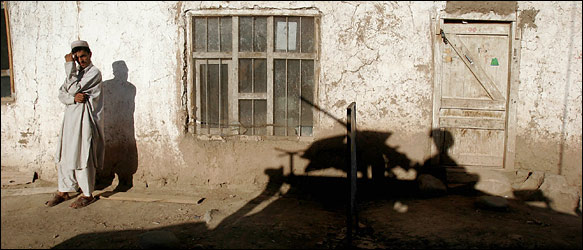
The caption for the photo above as it appears on the Times site reads:
A patrol vehicle from Company A, 508th Infantry, casts shadows in a town in Paktika Province, [southeast] Afghanistan.

*
whose statistics were compiled from Department of Defense and Central Command press releases [the discrepancy in its 2005 total and that in the Times may be due to different ways of measuring the years used in the calculations]

[image by Scott Eels for the Times]
for two weeks, “anyone could see his body from the street”

AlcedeJackson.jpg
free at last

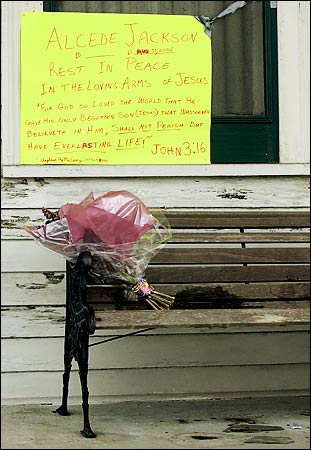
In a post I did one week ago I included a Times Picayune photograph of the blanket-wrapped body of Alcede Jackson lying on a bench on his front porch in New Orleans, and I included some strong lines from James W. Bailey. The NYTimes now reports that on Monday, almost two weeks after he died, the body was collected.

NEW ORLEANS, Sept. 12 – They collected Alcede Jackson on Monday, relieving him at long last of a duty in death he never requested in life: to be a poor man’s Pietà for his broken city.
They collected Alcede Jackson, finally.
They took nearly two weeks to do it, making their way through streets in Uptown that were never underwater, to the worn white house at 4734 Laurel St. Mr. Jackson’s body had been laid out on the front-porch bench – as though for an interminable outdoor wake – waiting to be transported to some semblance of dignity.
Anyone could see his body from the street, and many did. It cried out for retrieval, lying there under a baby-blue blanket mottled with cigarette burns, a bouquet of dead flowers resting nearby, as 90-degree days came and went.
The loudest cries, though, came from the epitaph, scrawled in large letters on the kind of yellow-green cardboard that seemed to glow in the dark and taped to the house above the body’s head. This was what it said:

ALCEDE JACKSON
B – D Aug. 31, 2005
Rest in Peace
In the Loving Arms of Jesus
“For God so loved the world that he gave his only begotten son (Jesus) that whosoever believeth in Him, shall not perish but have everlasting life!” – John 3:16.

For nearly two weeks, this was what it said. And not just from the porch.

Law-enforcement officials and search-and-rescue teams had regularly visited this neighborhood since the first of the month. Newspaper and magazine reporters and photographers passed by the modest house on Laurel Street every day. In fact the entire world read about this front porch and the entire world watched the body of Alcede Jackson lying there uncollected, day after day.
The entire world now wants to know how that could have happened, and it won’t be satisfied with Bush’s touchy, reflexive denial that there was any racial component to the government’s response to this disaster.

[image by Monica Almeida for the NYTimes]

brilliant move on the part of the White House

NOLABush.jpg
brilliant?

Maybe we’ve just been watching the latest sally in the radical conservatives‘ continuing campaign to dismantle the government. The results of a Newsweek poll released a few days ago suggest that it’s working.

But Katrina’s most costly impact could be a loss of faith in government generally, and the president, in particular. A majority of Americans (57 percent) say “government’s slow response to what happened in New Orleans” has made them lose confidence in government’s ability to deal with another major natural disaster.

The only complication for the Bushies is that an even larger number of people are also convinced their own special damn fool – and his entire party – is a very big part of the problem.

Reflecting the tarnished view of the administration, only 38 percent of registered voters say they would vote for a Republican for Congress if the Congressional elections were held today, while 50 say they would vote for a Democrat.

Even showing up on a [helicopter] carrier again, as he did yesterday, won’t change those numbers.
Thank goodness we can’t afford still another war.

[image by Ron Edmonds from AP via Yahoo!]