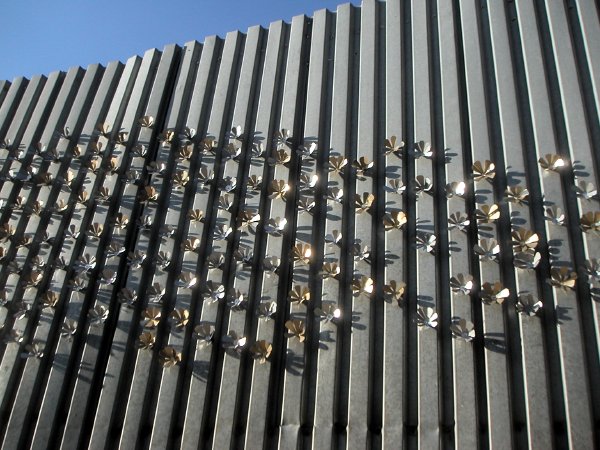
[spotted this flock on York Street in the new DUMBO late this afternoon, just steps from a large pack of black Town Cars waiting for their masters to leave the office]
Author: jameswagner
Marcos is gay

Subcommander Marcos
Well, maybe not, but he sounds really good, and he still looks wonderful.
His words, especially since they’re from the mid-90’s, won’t be news to many out there, but I tripped over this powerful quote from Subcommander Marcos while trying to get more information about the Mexican rebel this morning. I had just read this piece in the NYTimes about his current campaign to move his great nation to the Left. It was accompanied by this attractive photograph. After more than ten years of news accounts and imagery, I was immediately smitten all over again. The reporter himself was not immune to his attractions, for he wrote that Marcos “may be the only man in history to make a ski mask and pipe look sexy.”
Marcos is gay in San Francisco, black in South Africa, an Asian in Europe, a Chicano in San Ysidro, an anarchist in Spain, a Palestinian in Israel, a Mayan Indian in the streets of San Cristobal, a gang member in Neza, a rocker in the National University, a Jew in Germany, an ombudsman in the Defense Ministry, a communist in the post-Cold War era, an artist without gallery or portfolio…. A pacifist in Bosnia, a housewife alone on Saturday night in any neighborhood in any city in Mexico, a striker in the CTM, a reporter writing filler stories for the back pages, a single woman on the subway at 10 pm, a peasant without land, an unemployed worker… an unhappy student, a dissident amid free market economics, a writer without books or readers, and, of course, a Zapatista in the mountains of southeast Mexico. So Marcos is a human being, any human being, in this world. Marcos is all the exploited, marginalized and oppressed minorities, resisting and saying, ‘Enough’!
[image by Adriana Zehbrauskas from the NYTimes]
bring the National Guard and the money home now
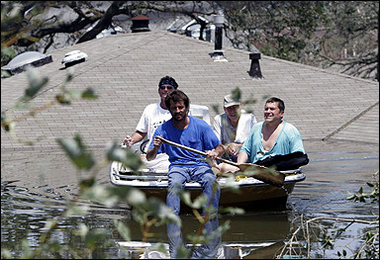




I cry for New Orleans.
And I don’t want to see another photo with a caption screaming about folks “looting,” when they are in the midst of an unprecedented disaster where there is no food, no water and no help. Only people with real resources could have afforded to leave before the hurricane hit: For the many who stayed, everything they ever had was in their homes. They could expect no protection, and almost certainly no insurance compensation.
[UPDATE: I’ve just learned that in fact many people who were mobile and who wanted to leave just couldn’t, as there was no public transportation. Our blindered media doesn’t point out that since this is America if you didn’t have a car you didn’t get out. The Greyhound station was closed before the hurricane hit, and of course there are no trains. Similarly, there’s also no media discussion of how the sick and the aged were expected to leave.]
Also, I hesitate to dignify their status by even mentioning the network, but this morning FOX “NEWS” includes a discussion asking seriously whether this city and these stricken people should get any disaster funds from the federal government. I guess they should all have known better and chosen to live in a less vulnerable area, say . . . Florida(?), where there’s always government disaster relief available. Not heard explicitly, but perhaps implied here, and certainly to be found along the long, rough road ahead, is the voice of racism – and even that of the hellish “Christian” Right: Colored folk don’t deserve the help, and for its sins this entire great, irreplaceable city itself should go the way of Sodom and Gomorrah.
We must save these people and this city, and of course we must do what we can to reduce the impact of the next storm. Just for starters, we should have the National Guard and skilled Army and Navy engineers here now, when and where they could make a difference.
The enemy is here, not in Iraq.
[images, in descending order (all via YAHOO! Photo) by Chris Graythen for Getty Images, Rick Wilking for Reuters, James Nielsen for AFP, Bill Haber for AP Photos, and Rick Wilking for Reuters]


the art of United Architects

United Architects World Trade Center Proposal Project 2002 Plexiglas [detail of installation]
It was my favorite when I saw it in a magnificent exhibition organized by and presented at Max Protetch now more than three years ago. It may have been the only proposal which looked like a work of art as much as it looked like it would actually work. I think that suggests great architecture. Apparently MoMA now agrees, since the model of the United Architects study for the site of the World Trade Center has entered the collection. [see the architects’ site for more]
Yes, I know that in recent years, because of the stupidity and the chaos which has accompanied discussions since this structural model was first shown, and the banal or junky designs which have been advanced in its stead, I have argued for a big green lawn or, more recently, a grand pedestrian plaza.
But if build we must (this is still New York) my heart would still be with this gorgeous proposal, in spite of its size. It somehow remains the least monstrous, on account of its elegance and its irregularity. It may be the safest structure, because of its structural connectors and its multiple exits; and, oddly, it comes off as the most humanist, for its anthropomorphic shapes and the suggestion of an organic community within.
Every one of the extras which have been suggested or promised for the site since this model was built could fit within its mass. At this point I’m even willing to do without those two holy holes, although the United Architects design actually does contemplate keeping those areas clear and the combined segments of the building actually embrace them.
Also because this is New York however, this great proposal is likely to stay just where it is – a work of art.
Sasquatch Society at Sixtyseven

Chris Kannen Chris Making Out with Bigfoot 2005 oil on canvas 12″ x 10″ [large detail]
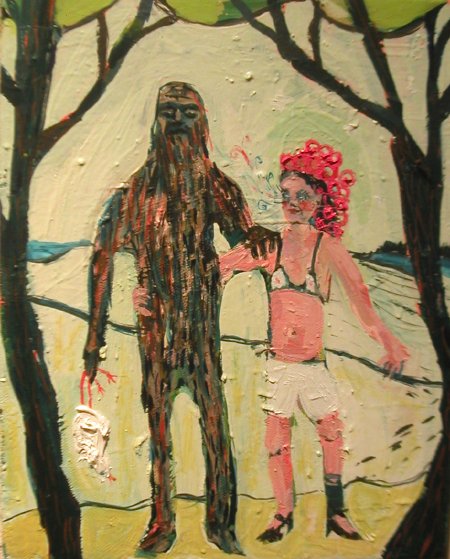
Emily Lambert They Called Him a Wildman 2005 acrylic on canvas 10″ x 8″ [large detail]
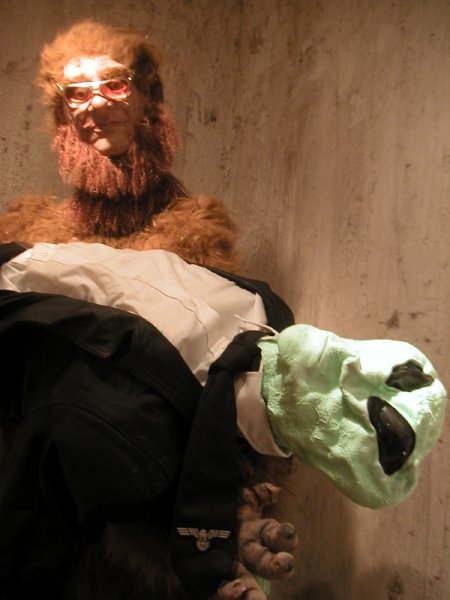
Peter Caine Untitled mixed media 8′ x 5′ x 4′ [detail of animated installation]
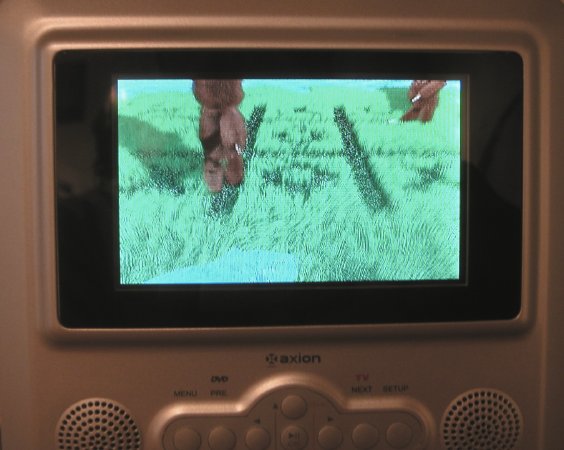
Tricia McLaughlin The Nazca Lines Explained 2005 2 min. animation [still in video installation]
Like so many of my species, I really would like to believe in these creatures, but the only thing I’m certain about right now is the quality and great fun of the group show at Sixtyseven gallery, “Sasquatch Society,” devoted to Bigfoot, Yetis and other hominoids.
There’s enough interest out there in stories about wilderness sightings of large, hair-covered, man-like animals to inspire dozens of young artists to jump at the chance to each produce one or more remarkable works illustrating our often quite intimate relationships with an elusive beast which remains stubbornly remote to [most of] us. The majority of the works in the show were created this year, but the fact that there was already a reserve of pieces which pre-dated the gallery’s Sasquatch call suggests that interest in these stories was not just something induced for our summer amusement.
fiores stravagantes

in the Channel Gardens, Rockefeller Center, on Thursday
miniature Manhattan wildlife II

up the wall
He’s back! I’d seen nothing since last July, but there were two sightings of our roof garden lizard this morning, both on the wall above the planters. Barry thinks we actually saw two separate little creatures, one a bit larger than the other. Hmm. When do we get to see the kids? And are they going to want to come inside when it gets colder?
Sorry for the quality of the image, but she or he’s really tiny, and I didn’t want to frighten the little guy away by getting too close.
excellent roof garden seating – in our imaginations
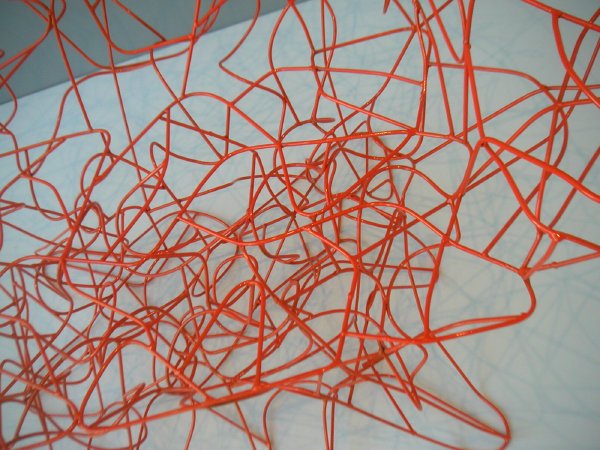
Fernando Campagna and Humberto Campagna Corallo Armchair 2004 steel wire and epoxy paint [detail of installation]
It’s MoMA’s new aquisition, not ours, but it sure is an exciting chair.
For a few seconds I fantisized that I’d found the perfect sculptural seating for our roof garden. Orange on green. Fantastic. It could accomodate two very good friends at once, but we’d probably have to commission a nice cushion or two and it would need a cover for bad weather. None of this is a problem however, since I’m sure we can’t afford it anyway. This piece is handmade, and since according to the label it was donated to MoMA by its Chairman, billionaire Ron Lauder [presumably for the Architecture and Design Collection], even if it isn’t unique it had to cost a bundle.

Fernando Campagna and Humberto Campagna Corallo Armchair 2004 steel wire and epoxy paint [installation view]
Maybe if I could locate an old innerspring mattress . . . .
functional, beautiful, timeless: for looking at and sitting on

Gebr�der Thonet, company design Vienna Caf� Chair (no. 18) 1876 bent beech wood 33.5″ x 17″ x 20″ [detail of installation]
One of my favorites in MoMA’s Architecture and Design Collection is this simple chair.
Thonet patented the bentwood process, but their patent expired a few years before this chair was manufactured. D.G. Fischel Sohne was one of several Austrian firms ready to imitate their success with seductively-curved wood. Years ago, while acquiring modest colonial and federal Rhode Island furniture for my old house in Providence I managed to pick up a simple Fischel side chair very much like this Thonet for only a couple of dollars.
I appreciated its simple beauty from the beginning, but In Providence it had to wait upstairs in a small back storage room for years. In New York it has been able to join the very eclectic collection of stuff I’ve spread throughout our 1930’s apartment. Now I admire its simple dignity every day, although I have to admit that it wouldn’t have looked at all odd if I had mixed it with the skinny windsors in the little 1760’s house from the start.
where did good industrial design leave the road?
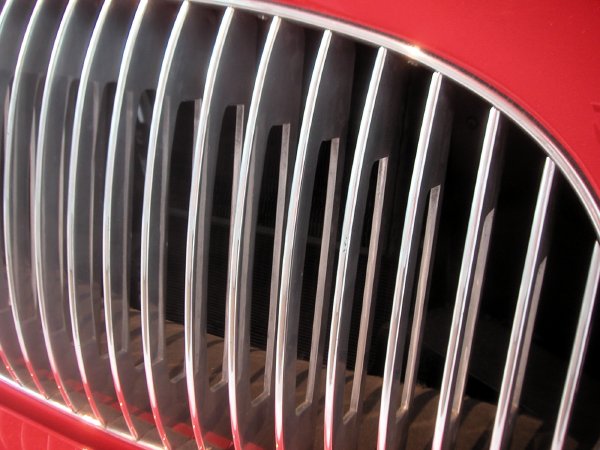
Pinin Farina Cisitalia 202 GT Car 1946 aluminum body 49″ x 57 5/8″ x 13′ 2″ [detail of installation]
I didn’t expect to look for the Cisitalia again when I casually wandered into MoMA’s Architecture and Design galleries earlier this week. I’d seen it many times before and in spite of my obsession with interesting automobiles I didn’t think it could mean much to me any more.
Uh-uh.
I was particularly sensitive to industrial design that day because we recently decided we needed a new land phone and I had just been looking at the lamentable, no, painful choices available. This beautiful car was imagined and put together almost 60 years ago. Have we learned nothing since?
I’m not even going to dwell on the ugliness and gigantism of the SUVs, Town Cars and Ford taxis which confronted me as I left an art museum which has tried since 1932 to honor good, simple design in everyday objects created over the last 150 years or so.
I’m sticking my neck out a bit by bringing up the subject of this Museum collection in the first place. Many people still think a design gallery in an art museum is inappropriate in the first place, but I’m happy with the idea that we shouldn’t be content with a world where art is only found hanging on walls or standing in public spaces.
There’s also the subject of the [ethics?] of any kind of enthusiasm for the private automobile, especially in the twenty-first century, even if Americans don’t have any real alternatives at the moment. In any event, when this car was built General Motors and the oil companies had barely begun their campaign to destroy public transportation, so the idea of a private pleasure vehicle did not carry the baggage it does today.
Incidently, this little Cisitalia has an engine smaller than that in my 1962 VW Beetle, but with more power, and it weighs about the same (1600 pounds). Hey, those power and weight figures are pretty much the same as those of a basic Smart. Now there’s an original and almost perfect design for modern industry, and it too is now a part of the Collection. But, and no surprise here, we’re not allowed to have it on our streets. Too pretty and too sensible, and it doesn’t have a brutal line in its body.
But back to the old car and the new phone. The color of the sleek Italian antique on MoMA’s third floor is a luscious red which could never be forgotten, much less ignored if you’re anywhere near it. When I’m through with this post I’m going to plug in my new phone system. it’s in a busy combination of a dull black and a grey pseudo-aluminum, and it looks like it will be almost too painfull to live with. Maybe I can cover it with a doily. But, really, it’s not about color. The colors are only symptoms.