Heathrow mess: what’s the real story, the clients or the serfs?

HeathrowstrikersNYT.jpg
are they invisible?

Is the story about lost or missed flights and the attendant inconvenience for thousands of travellers, or is it about humiliating and discarding hundreds of low-paid Asian workers struggling in a racist society?
There have been headlines about the British Air interruptions everywhere in the mainstream media since last Wednesday, but you’d have to be a very determined newsy indeed if you wanted to know what started the disruption.
Most American accounts, when they included any information about the origin of the toubles, referred to “wildcat ground staff strikes” or some equally vague and pejorative description of the original offense.
I did some digging and I’ve come up with some facts which have been reported almost nowhere within the reach of most U.S. news consumers. They must have been considered too complex for us to understand, or, more likely, too destructive of the conventional wisdom of contemporary American society about the evils of labor unions. Besides, images of people (especially attractive blond people, and most especially young women) stranded at Heathrow are a better sell to corporate media advertisers than the background facts and images which might assault their Olympian indifference to the people in real markets.
In a front-page article in the NYTimes this morning, at least four days after the [“unofficial strike,” in the brief, enigmatic description found in the piece’s first lines] you would have to read through thirteen paragraphs and move onto page 4 before you would find anything about the origins of the disruption in London.

And in fact, the dispute at the heart of the walkout – over employment practices at Gate Gourmet, an independent catering firm based in the United States [my italics] that provides food for British Airways and other airlines – is only indirectly related to the airline.
The strike began when the catering firm abruptly fired about 670 of its Heathrow-based workers on Wednesday, causing the rest of the catering staff to walk out in a show of support. On Thursday, about 1,000 other airport workers – including baggage handlers, bus drivers, ramp workers and check-in staff, walked out, too, for an unofficial strike.

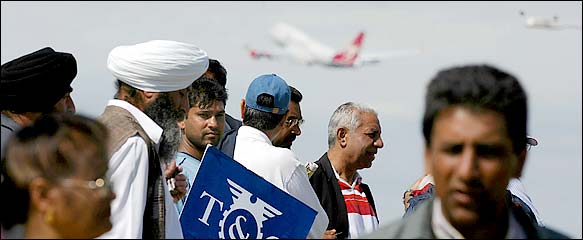
To give the paper credit, the larger image accompanying the article on the inside page is of a group of Gate Gourmet [ex-?] employees assembled at the airport.
But the context of the firings is missing, as is any attempt to describe why they might have been kicked out in the first place.
I went looking and turned up this story on thisismoney, a financial website belonging to Britain’s [populist right-wing] Daily Mail/Evening Standard:

But what happened last Wednesday in a car park in Hounslow, near Heathrow, was everything that [Sir Rod Eddington, British Airways’ departing chief executive] says he condemns. It was crude, unintelligent and ultimately totally counter-productive.
When Gate Gourmet sacked 650 workers – some of them pregnant – by bellowing through a megaphone in the car park [italics mine again], it was, he believes. the inevitable trigger for retaliation.
In the closeknit Asian community around Heathrow, sacking lowly paid workers in such humiliating terms was an outrage.
Many Gate Gourmet workers had relatives employed by BA – not surprising since the airline sold its catering division to Gate Gourmet in 1997 for £60m.
The illegal sympathy strike action by 1,000 BA staff had the understanding and sympathy of all BA workers, even at the highest level.
Eddington, whose wife is Asian, has diplomatically refused to comment on Gate Gourmet’s management style. Publicly, he says: ‘I would like to apologise unreservedly to our customers who have suffered because we have been dragged into a dispute not of our doing.’
But he has not hidden his anger to close friends at the ‘stupidity’ of Gate Gourmet. ‘When you tackle change, you need to be clever and box clever,’ he said. ‘What happened out there was unintelligent and stupid,’ he is alleged to have said, adding ‘You can’t treat people in this way. They were not fat cats for God’s sake, they were hard-working lowly paid people.’
As for Gate Gourmet, it is satisfied it has not made any mistakes in its handling of the dispute, which started after an attempt to change working conditions and cut the workforce. A spokesman said it was haemorrhaging cash and unless there were agreed changes, the company would go into administration. As for sacking people by megaphone, he said: ‘ Sometimes the only way to communicate with the staff is by megaphone.’

Or whips?

[image by Andrew Stuart for the Associated Press via the NYTimes]
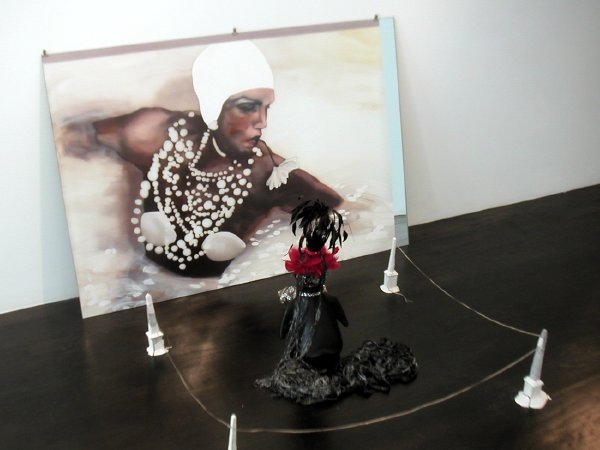
Jack Smith lives at Grimm|Rosenfeld

SaundersMatt.jpg
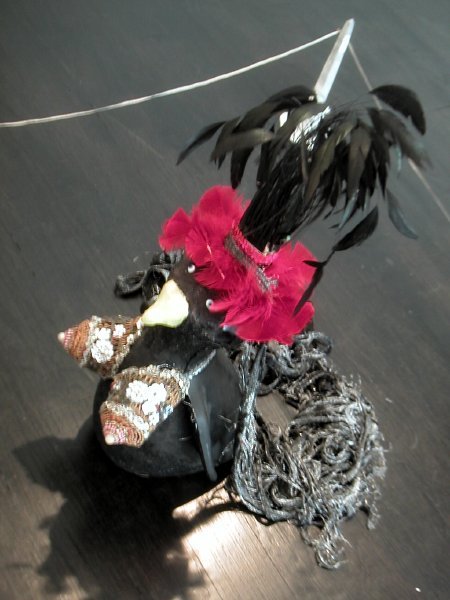
detail view of gallery installation, showing Matt Saunders‘s Mario Montez contemplated by Jack Smith’s Yolanda La Pinguina

New gallery! Well, it’s new here. But, anyway, it looks like this one’s gonna be really, really good.
Grimm|Rosenfeld has had a significant presence in Munich since way back last year, but the current show on 25th Street, “Founders Day,” is only their second in New York, and it’s very impressive.
We missed Kiki & Herb‘s opening bang last month, and because of that poor judgment we’ll probably be kicking ourselves forever, but we finally made it to a much quieter gallery this afternoon. And it’s a full week before the end of the current exhibition! The show is brilliantly curated, and beautifully installed, by the artist Jonathan Berger. It’s both a tribute to Jack Smith (the “founder”) and a platform for an understanding of the continuing impact of his pioneering work today in virtually every art and performance medium. The press release describes the show as “an idiosyncratic, iconoclastic and a little bit worshipful look at artists making use of any and all available materials to create worlds that respond to personal obsessions, ideals and dreams.”
Check that statement for some good bits on each of the remaining artists and works included in the show: Paula Court (stills from Reza Abdoh’s “Quotations”), James Hampton (monumental millenium sculpture), Peter Hujar (Ethyl Eichelberger as Nefertiti), Athanasius Kircher (diagrams of the workings of the universe), Louis Klahr (animated film materials), and Katherina Sieverding and Klaus Mettig (Jack Smith Photographs).
Thanks, Jack.
Damn, we hardly knew ya when.

SmithJack.jpg
Jack Smith Yolanda La Pinguina ca. 1974 mixed media 22″ x 10″ x 30″ (does not include stanchions) [detail of installation]

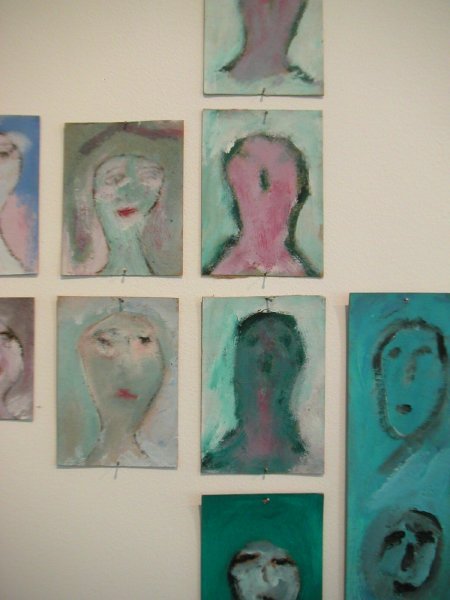
DavisVaginal.jpg
Vaginal Davis Dames Égarées: Je Veux Acheter Vos Visages 2001 mixed media [mostly make-up] on tag board, dimensions variable [detail of installation]

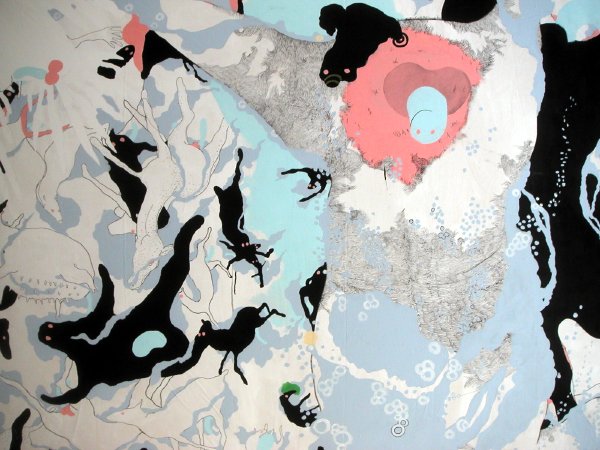
Shishkin.jpg
Dasha Shishkin Untitled 2005 mixed media on canvas, approx. 78″ x 161″ [detail of installationon ceiling]

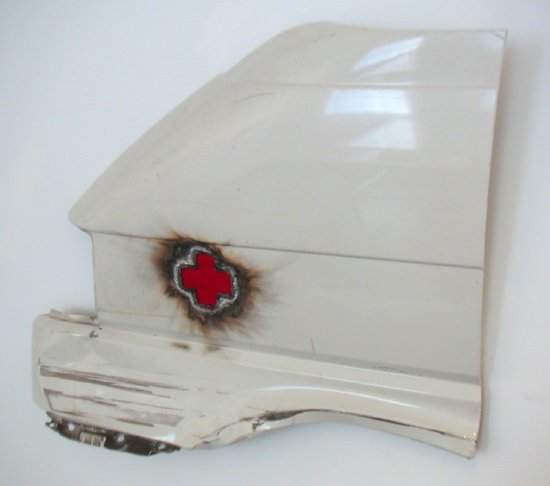
FrankoB2.jpg
Franko B Untitled (metal sidepanel with cutlouts) 1997 metal and felt 28″ x 32″ x 4″ [installation view]

the first of the PS1 sketchers


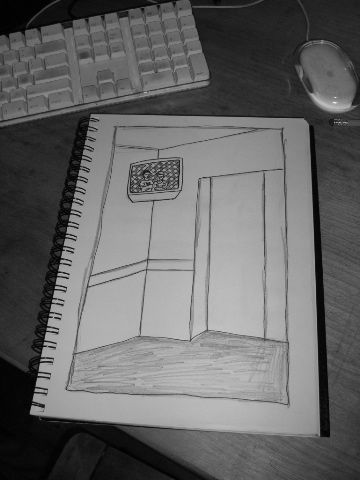
Cory Arcangel and Frankie Martin video, 414-3-RAVE-95, sketched by M. River

Earlier this week I invited artists to submit sketches of the works in the Greater New York 2005 show at PS1, since the museum does not allow photography of any kind, and because there are few images available on the lousy flash web site.
I think of it as a modest step in a campaign to free the visual arts from the darkness to which they are too often committed by their custodians. We’re starting with PS1/MoMA.

Barry
has set up a gallery for the images, and we’ve just put up the first submission, by M. River, a drawing of Frankie Martin and Cory Arcangel’s video shown on a monitor in the big elevator.
I haven’t yet come up with a snappy name for the artist call, or the gallery, so if anyone has a suggestion I’d be pleased to hear it.
I certainly didn’t start the discussion of camera policy in museums, and I don’t expect to be there when it ends, but I feel very strongly about access. This quote from his editorial, “On Camera Policies in Privately Owned Public Spaces.” on Thomas Hawk’s Digital Connection basically reflects my own frustration:

I feel that not only is it bad business for [public museums] to prohibit or impede photography but that it is morally wrong. The whole point of a museum is to open up the arts and sciences to as broad an audience as possible. The San Francisco MOMA should be as interested in sharing it’s [sic] collection with someone in a village in China who will never make it to San Francisco in their lifetime as they are to the patrons that pay the cover charge at the door. They should be enouraging, not discouraging, the widest possible public viewing and distribution of their content and collection.

Barry McGee at Deitch on Wooster Street

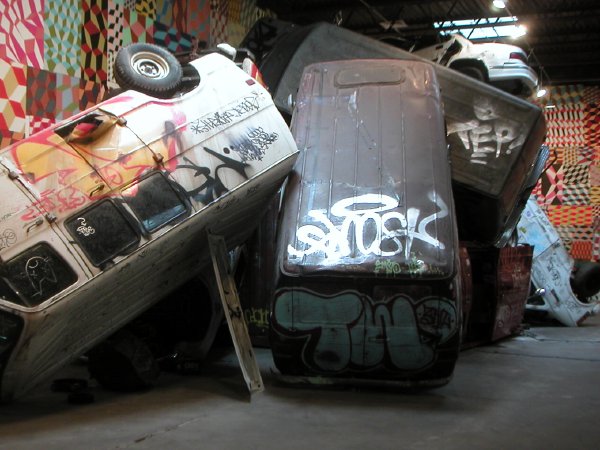
McGeecars.jpg
it gets better, but no bigger, than this

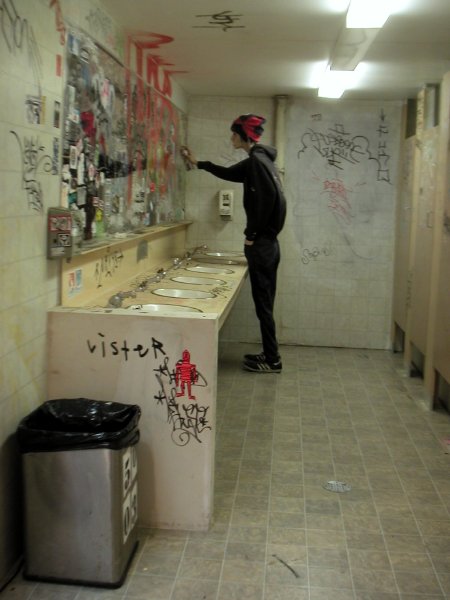
McGeelooartist.jpg
mechanical loo artist at work

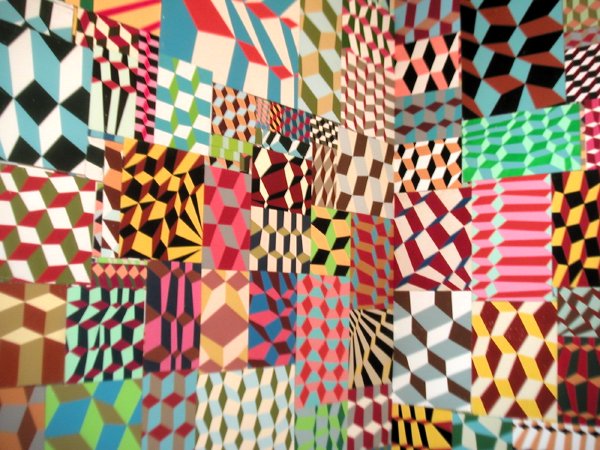
McGeegeo.jpg
neo neo geo?

McGeeartiststack.jpg
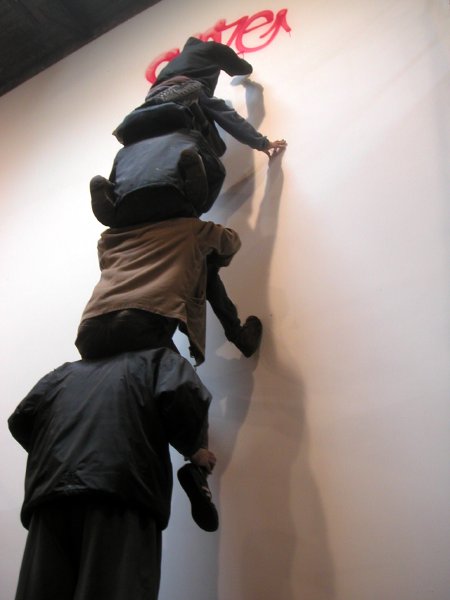
getting it all together for art

Barry McGee’s installation at Deitch, which is around the corner and down the street from Swoon’s, was well lighted by skylights yesterday, and there was lots of room to go around, so the camera and I had a ball. But while the show was very entertaining, in a guy-kid, hazardous amusement park kind of way, I went away feeling that not much had really happened.
But it was fun. A bit too lifeless at first, it got better when the huge space filled up with people while we were there.
I almost giggled at the auto junkyard which confronts you after you enter the gallery through an overturned van truck, I liked the massive expanse of geo stuff, I did shiver a bit when I stepped into the very realistic messy loo, and I was amused by the animated figures. I confess the ubiquitous painted sad-eyed men never really got to me before, so I wasn’t disappointed to find they had been somewhat eclipsed in this installation, even if I’m not sure by what.
Both artists work with and in the street, but while McGee’s sources are apparently much more specifically the world of outcasts and his materials are very real, it’s Swoon’s paper creations which evoke a truly visceral response to a city usually hidden from most of us.

Swoon at Deitch on Grand Street

Swoon.jpg
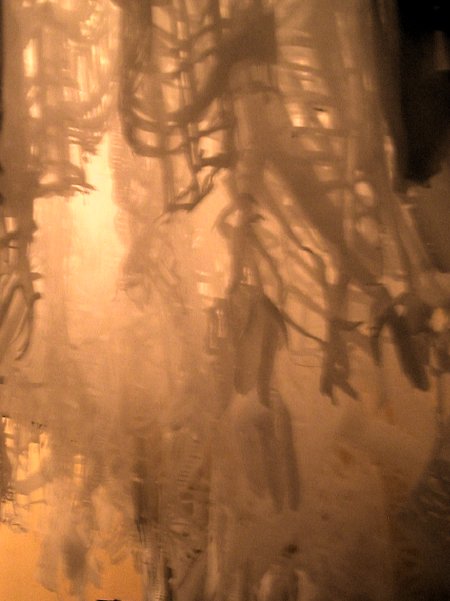
view of an untitled section of an installation by Swoon at Deitch

It’s a terrific show, and to think I almost missed most of it. Barry and I were at Swoon‘s opening over a month ago, but the crowd and the heat discouraged us from even trying to get into the main gallery that night. Since then we had been putting off going back to Soho until we might line up more shows to see on the same trip. I had even resigned myself to missing the larger installation altogether [there was all that hype, and I was ready to persuade myself that what I saw of her work on the streets was probably superior to anything she’d put in a gallery].
Wrong.
We finally made it back downtown yesterday and I’m very glad we did. This work is on another plane altogether. It’s a really great show. She’s created a brilliant environment. It’s like walking through a surreal, silent, film noir set! Unfortunately I can’t give you much to look at this time. It’s pretty dark in there, so my little camera balked at my suggestions. Barry however was able to pull off a couple of great images. But if you can make it to Grand Street, don’t be satisfied with these two dimensions. You should walk through those paper streets yourself.

one for the revolution

revolutionarywithblock.jpg

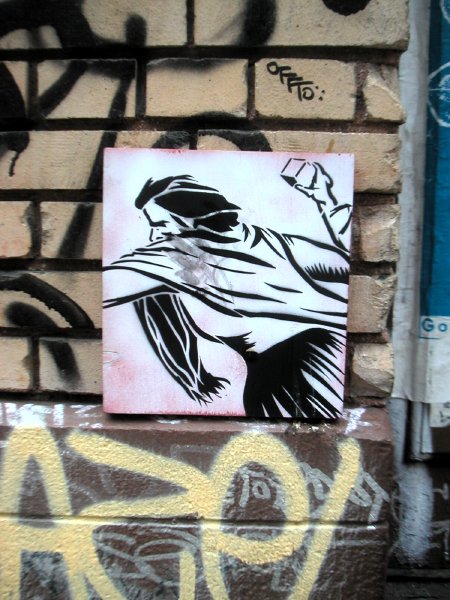
This revolutionary [paint on panel] was spotted attached to the same wall as the arrow and the penis. The paving stone she’s hurling in anger would have made a better weapon than the large granite blocks of Wooster Street below her.
Real revolutions have been made in France, not here; I don’t suppose we can blame that on the size of our paving blocks however.

art on and off the street in Soho

grafittiWoosteratGrand.jpg
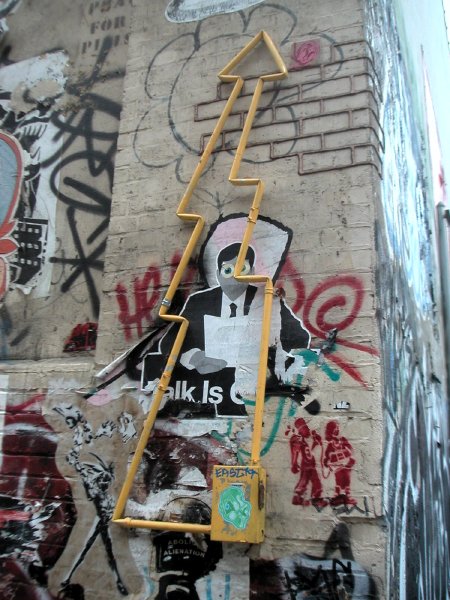
it starts with the realistic electrical box (complete with pull-switch) in the lower right corner, and it points toward a pudgy paper penis person pasted above it by another artist

The building walls across from Deitch Projects on Wooster Street must be among the most coveted (canvases?) in the city for street art, even rivaling what Williamsburg can throw into the competition. They’re very busy, with a changing exhibition of work in many materials and on almost every scale, but there are even more major diversions inside this summer.
This afternoon after I photographed this wall we visited first the Barry McGee installation down the street and then that of Swoon around the corner.
Soho can still look street smart, even off the street. Of course it helps if you’re able to drag a good chunk of the street into the gallery, as Jeffrey Deitch and his artists do in both spaces [including a pile of a dozen or so wrecked vehicles inside the gallery on Wooster].
Hey, is that Playdough outlining the mortar near the top of the pic?

pull down the blackout curtains at PS1 – we need sketchers!

sketchingartists3.jpg
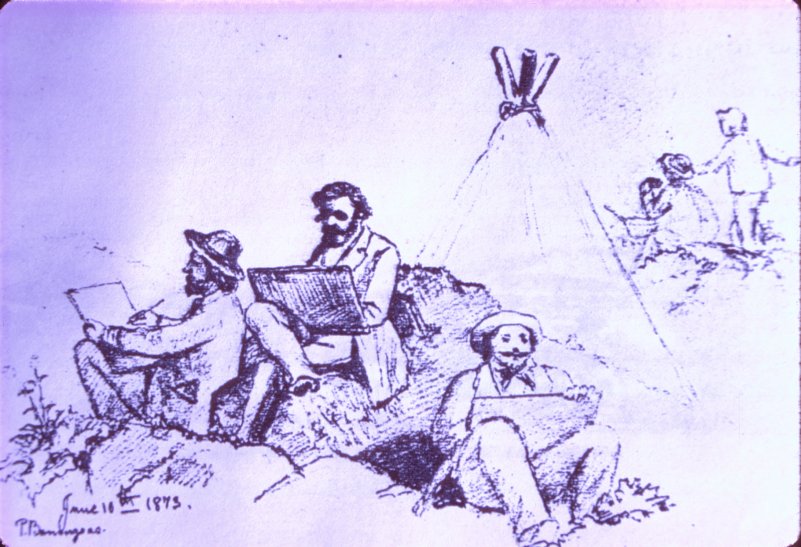
Peter Baumgras (1827-1903) Three Artists Sketching (1873) pencil on paper 8.5″ x 10.75″

Ladies and gentlemen, a reader has written in to comment [see the first one on my crabby PS1 post], that I should send out a call for sketchers and then post their images on this site.
Yes!
It’s a wonderful idea. Here’s the deal:

Michael Cambre (a wonderful artist who’s done some competitive sketching in his time) suggested that people be assigned an artist’s work in the Greater New York show, but I don’t know how to go about that without seeing who’s raising their hand. I’m thinking we should just leave it up to the field out there to choose subjects, and then watch what comes in.
So I want to encourage anyone who’s interested in using her or his own skills to show the world what the MoMA team is keeping partially under wraps to get out to PS1 and send me a jpeg or two. If this works, I’ll show anything decent that comes in on a gallery I’ll set up here for the purpose.
With each piece sketched, please include the name of the artist and the title.
I’m thinking we should encourage creativity as much as realism, just to keep it more interesting for everyone, but the idea should still be to describe another artist’s work.

[image from The College of the Siskiyous]

to PS1: but they’re called the visual arts, aren’t they?

blackoutcurtain.jpg
on some very rare occasions blackouts might be a good thing*

But, even when they aren’t iniquitous, others are just plain stupid.
Barry writes that I’ll probably be doing a post about our return visit to PS1’s Greater New York 2005 show, but I don’t know how I can do that without images.
There are no documented pictures on the institution’s website [okay, there’s a silly slideshow/teaser of a dozen or so works, but no information and the images can’t be uploaded], and photography is not allowed in the galleries. My site can’t function without pictures, and besides, they’re called the visual arts, aren’t they?
So, we did have a nice afternoon, but I don’t have anything for you on this show. In a way, as I’m writing this, it almost seems like we were never there. I’m sorry.
The Museum of Modern Art owns PS1, and MoMA directors are about as jealous of the firm’s image and perogatives as global capitalists seated in the country’s fattest corporate board rooms are of theirs. Within the arts business/community, this museum is notorious for its insensitivity and its reluctance to recognize media credentials. Reflecting its lamentable growing irrelevance in times we still call “Modern” the Museum of Modern Art has assumed a posture which refuses to recognize that arts bloggers today exist as a part of media.
So just forget about a press pass. The 53rd Street Brahmins don’t even deign to reply to inquiries. Knowing I had nothing to lose, and thinking that things might be more relaxed in their farm team operation, I tried yesterday once again to photograph a work of art on display in their Long Island City galleries. I was told, once again, that photography wasn’t allowed. No surprise, but in fact it wasn’t even permitted to photograph the painted tin ceiling. I know. I tried that too, and was firmly chastened for the attempt.
The museum was almost empty, I had no intention or interest in using supplemental flash, my miniature digital camera is perfectly silent, the images it captures can’t possibly be mistaken for original works, and there can be no question that any picture would be used commercially.
The only consequences of my being permitted to use a camera would have been, first, your enjoyment of the images of works neither created nor owned by MoMA; second, an internet record of the work, which might in fact be permanent; and third, some modest assistance to MoMA’s marketing campaign – without any inconvenience, and with absolutely no cost, to the museum.
So we eventually left PS1 and went north to Socrates Sculpture Park, where cameras run free, even if they’re just having fun. See my next post.

*
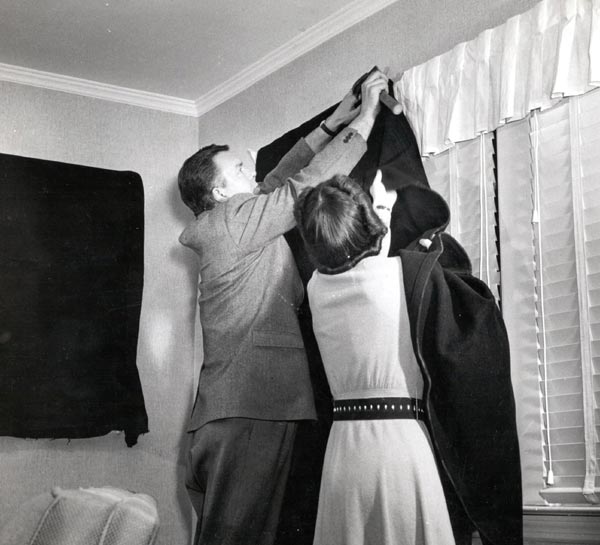
the caption to this vintage WWII photograph reads, “A couple nails a blackout curtain over the window”

[image from VIRGINIA FIGHTS]