IDEC: can the Greeks’ moira steer a ship if it’s French?

IDECfate.jpg
IDEC in New York, two weeks ago

I absolutely do not follow yachting news. Well, at least not since I lived in the old, “undeveloped” Newport and enjoyed the regular visits to that sleepy town of hunky crewmen from around the world seeking to wrest the Americas Cup from the New York Yacht Club.
But the yachts can be extraordinarily beautiful themselves, even if today their design may sometimes approach the grotesque in the hands of skilled engineers and mathematicians.
A little over two weeks ago I saw the great tricolor trimaran IDEC moored in the basin below the Winter Garden in the World and casually snapped the picture above. I decided it wasn’t a bit grotesque, but rather resembled a giant water strider. The vessel looked shockingly purposeful, even if I was ignorant of its mission.
While going through my photo library this evening looking for something else I decided the IDEC shot was worth uploading for the image alone. Since I wanted to identify the craft I Googled the name and discovered that after leaving New York the vessel and her skipper, Francis Joyon, had broken the 24-hour world speed record when they clocked up 543 miles and, on arriving in France six days out of New York, the transatlantic record for a single sailor as well. The French landfall occurred just three days ago.
But there’s more to the story, an ending the ancient Greeks would surely have understood.

Just a few hours after breaking the outright singlehanded transatlantic record yesterday (see news story here) Francis Joyon was involved in a collision which has totally destroyed his 90ft trimaran IDEC.
Having crossed the finish line off the Lizard, Joyon – still unaccompanied – did a quick u-turn to head back to his home port in La Trinite, France but fell asleep and hit the rocks at Pte de Marc’h at 0100 this morning.

The skipper survived unscathed.

NOTE: the Greek moira is similar to the Latin fortuna.

Something at Monya Rowe

AlbertsonAjaIf.jpg
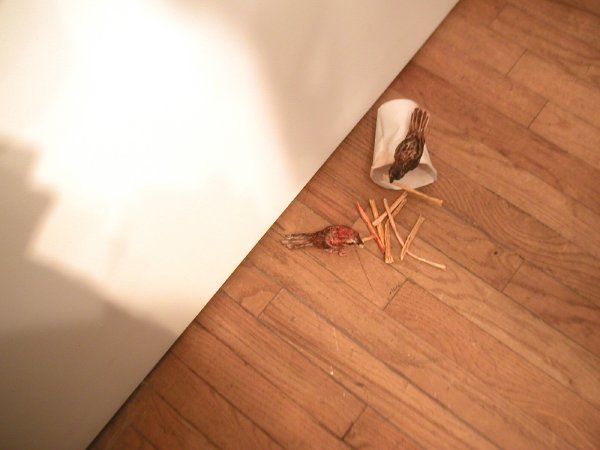
Aja Albertson If a birth flower falls in a forest, and no one is there to smell it, will it then grow a stone? 2005 silk flowers, faux gems, urethane, glass vase and butterfly approx. 12″ x 12″ [view of installation on gallery shelf]

The show is called “Something is Somewhere,” and in the Monya Rowe Gallery’s elaborate press statement the curators, Anat Egbi and Monya Rowe, explain a conceit which doesn’t seem to be attached to the amusing image on the invitation (and the gallery site). The photo shows most of the participation artists lined up in front of a wall on either side of the two curators, every one of them dressed as the gallerist, in little black dresses and white neck scarfs. Yup, no guys.
I couldn’t get anything into my camera’s memory card which would do justice to the great pieces I saw in the gallery. A view of the shelf near the door will have to suffice for this post. This show, which includes work in the mediums of painting, photography, video, drawing, and sculpture, really has to be seen in person. The artists are Aja Albertson, Katia Bassanini, Larissa Bates, Amy Bennett, Jen DeNike, Angela Dufresne, Echo Eggebrecht, Adriana Farmiga, Sabrina Gschwandtner, Magalie Guerin, Elizabeth Huey, Ellen Lesperance & Jeanine Oleson, Caitlin Masley, Sigrid Sandstrom, Erika Somogyi, Frances Trombly, Whitney Van Nes, Abbey Williams and Sheri Warshauer.

fractal geometries at Greene Naftali

PetersonAraStandingWaves.jpg
Ara Peterson Standing Waves 2004 wood, acrylic 45″ x 168″ x 30″ [detail of installation]

Ara Peterson is included in a group show at Greene Naftali based loosely on the idea of fractal geometry. Both the concept and its execution suggest the mystical as much as the scientific. A stunning show, and there are some great images on the gallery site itself.
In addition to Peterson’s work there are fascinating contributions from Julie Becker, Keith Connolly, David Dempewolf, Rachel Harrison and Michaela Meise.

ConnollyKeithQvaris.jpg
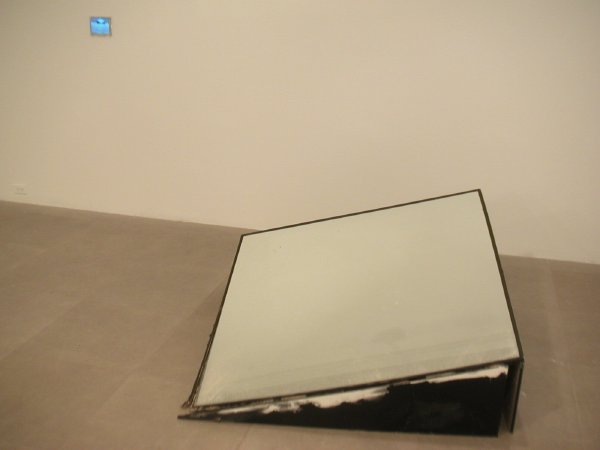
Keith Connolly Qvaris Object at Dawn 2004-2005 wood, mirror, acrylic, plaster, DVD, mini monitor 49″ x 49″ x 25″ 40 minutes [view of installation]

DempewolfDavidTime.jpg
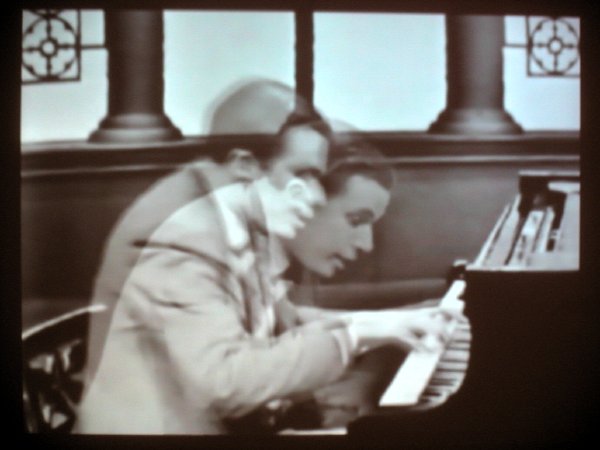
David Dempewolf Time Travel Project – Glenn Gould 2005 digital video installation dimensions variable [still from installation]

Spencer Brownstone, Guild & Greyshkul and Deitch stop traffic

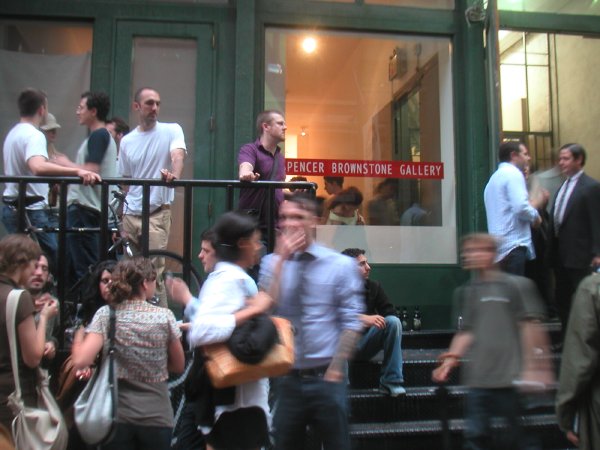
SpencerBrowndock.jpg
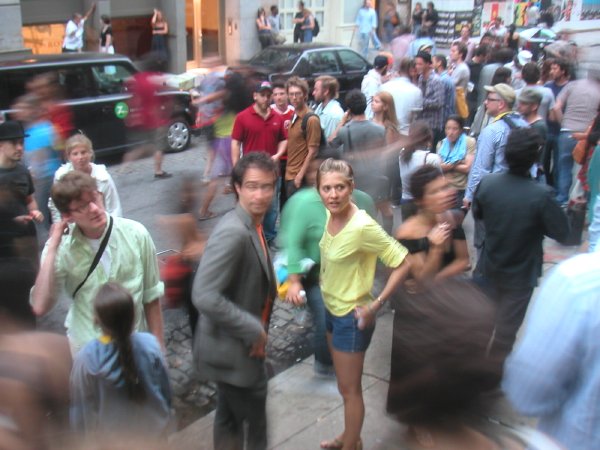
the view from the paving stones in the middle of Wooster Street

SpencerBrowngirl.jpg
and the prospect from Spencer Brownstone’s loading dock moments before

It’s just a summer show, but it includes a huge list of artists, and it was only one of three neighboring galleries in the only part of Soho which still has any creds with openings last night. The street outside Spencer Brownstone was effectively closed because of the crush of art fans and related sorts.
Last night we started out at the gallery’s group show and then squeezed further down Wooster Street to Guild & Greyshkul‘s “The General’s Jamboree/Second Annual Watercolor Exhibition,” which was just as well attended (that is to say, totally jammed). Both shows are basically surveys of what’s going on in New York today that hasn’t yet been seen in a major gallery (or any gallery) anywhere. Worth a detour! Actually, worth a trip, even without the attractive opening-night crowds.

Guild&Greyschkulbirds.jpg
Valerie Hegarty Still Life (with Birds) 2005 paper, watercolor, glue, wire [detail of a piece, which included work on the wall above, installed at Guild & Greyshkul]

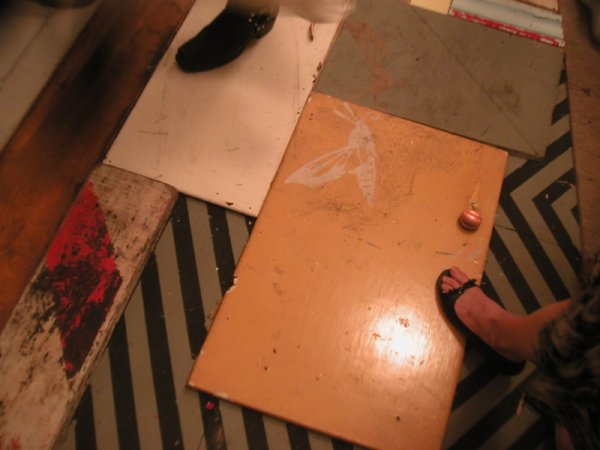
I can’t speak to the attractions of Swoon‘s installation at Deitch on Grand Street, which also opened last night, since Barry and I decided to pass on the opportunity of slipping through the eye of a needle to get into the steamy inner sanctum where her big stuff is installed. Had to be content for the evening with this view of the floor in the outer gallery:

DeitchSwoonfloor.jpg
the very beautiful, and somewhat challenging floor installed by Swoon in Deitch’s small south gallery

For more, see Bloggy.

always seductive, it finally is fashionable

germanfoodatrocities.jpg

In a NYTimes review of the restaurant Loreley published just over a year ago Julia Moskin wrote, “German food can be a hard sell. It is deeply unfashionable . . . . ” I copied the quote down. Today I’m not entirely sure why, but it ended up in the pages of one of my German cookbooks where I found it a few days ago.

I didn’t start off this week intending to prepare German dinners exclusively every night, but it’s been working out that way ever since we made a return visit last Saturday to one of our favorite hometown restaurants, Kurt Gutenbrunner’s Austrian restaurant, Wallsé.
My original idea was just to so something from my own childhood experience of a 4th of July meal, but a simpler, low-key version, since that was how Barry and I were dealing with the day otherwise. The fact that I didn’t want to heat up the kitchen and we weren’t able to cook outside certainly contributed to reducing my ambitions as well. I ended up with bratwurst (unfortunately they were nothing like the legendary Sheboygan sausage) grilled on a ribbed castiron pan, real German potato salad, some fantastic pink/white radishes, a cucumber salad my mother would have been proud of and a decent loaf of pumpernickel bread. In a significant departure from my Wisconsin family’s experience we decided to raid the wine rack rather than the beer we’re no longer laying down in the refrigerator because we need the space. The excellent riesling is probably what persuaded me to continue the Rhineland theme the next day, the day after the next, and eventually through tonight as well.
On Tuesday I located some excellent smoked trout, which I served with a bowl of whipped cream I flavored with lemon and grated horseradish, and we continued through most of the vegetables we hadn’t been able to finish the day before, with the rare addition of some spicy puntarelle not consumed in an Italian salad two days earlier. Another Rhine or Moselle from the “cellar,” and then a ginger rhubarb compote for desert.
Wednesday evening we had some crisp flatbreads with two smoked eels I had collected from the Union Square farmers (fisherman’s?) market that afternoon, some wild watercress and the rest of the whipped horseradish cream. For an entree I turned on the gas for the first time since Monday in order to saute a thick slice of Niman Ranch ham and to boil some new potatoes I finished in sauteed sweet onion slices and topped with fresh thyme. We had small bowls of what remained of the cucumber salad on the side, now slightly augmented and refreshed with chopped puntarelle. Another good riesling, a Pfälzer, a Deidesheim.
Tonight after returning from a number of art openings in Soho we only needed a small snack, since following an afternoon in Chelsea galleries we had enjoyed Korean sushi at what was an outrageous hour for lunch – even for us. I had managed to save a bit of the ham from last night and we had it together with some good German mustard, the last of a potato salad which was still showing the stuff it was made of and some buttered slices of the sturdy pumpernickel. A fine Nierstein Riesling Kabinet was our company.
My point is that German food does not have to be scary. It never did, but today there is even less cause for alarm because of the development of a nouvelle German cuisine which I had predicted was inevitable years ago, at a time when I could and would abandon myself to the heaviest examples of German cookery with no regrets, no complaints. Unless she has changed her opinion, wherever she may be now, I would argue with Ms. Moskin that today German cookery finally has become fashionable; it’s just that most of the world doesn’t know it yet.
If anyone is looking for inspiration they should take a peek at the gorgeous photographs in “Culinaria Germany.” My potato salad came straight from its pages, but I fell in love with Mimi Sheraton’s “The German Cookbook” four decades ago and won’t let it out of my sight. I may have moved from a German kitchen into a French one and today an Italian, but my first great love was this 1965 classic. It remains unchallenged as an English-language guide to German cooking even if it can’t boast a single illustration. It was Sheraton’s cucumber salad we enjoyed this week.
I knew I was going to go back to Southern Italy again, at least for a while, but I bought another handfull of kirbys just yesterday at the greenmarket. Tomorrow I’m going to see if I can find anything in Italian cuisine which could possibly love a cucumber.

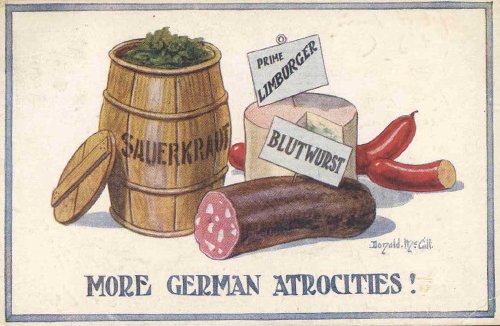
NOTE: I tried to locate an image from “Culinaria” or elsewhere which might do justice to my argument, but without success, so I settled for the entertainment value of a World War I British propaganda postcard which may or may not be serious in complaining about the enemy’s cookery.

[image from firstworldwar.com]

PS1’s “Greater New York 2005”

Jankowski.jpg
Christian Jankowski 16mm Mystery 2004 35mm film

I waited a long time before checking out the “Greater New York 2005” show at PS1, but in taking in much of it on a relatively short visit this past Sunday I ended up thinking it was surprisingly good, and sometimes great fun. It was the weekend of July 4th, and there was almost no one else there, so I’m wondering how that might have effected my impressions. Well, it was relaxing, more like visiting a dusty museum in Calcutta than the vital loft-like spaces in which is installed the art we are told best represents our own anxious time and space.
Sure, we’re seasoned veterans, so there weren’t too many surprises, but even artists with whom Barry and I were pretty familiar generally showed unfamiliar work. That was what the curators had wanted, and most of the invitees seemed to have gotten that part down pat.
After hearing so many friends in addition to ourselves admit that they hadn’t made the trip out to Queens (and not just because even now there are still almost three months left to see the stuff), it turned out to be much more interesting than either of us had been led, or had led ourselves, to expect.
We’ll be going back soon to catch what we missed the first time around.

first they came for the pornographers . . .

. . . but I wasn’t a pornographer*

internetpope.jpg
safe enough for him?

Patrick Moore has an OPINION piece in today’s Newsday, “Bush team uses ‘skin game’ to attack porn,” which sounds an alarm on behalf of principles much greater than the protection of our access to adult sexual entertainment. An excerpt follows:

Under the guise of regulatory powers, the department [of Justice] is planning a punitive and ideologically motivated assault on the adult entertainment industry. A legal challenge last month delayed the onset, but Justice is hoping later this year to begin enforcing a host of regulations so onerous that they may represent the end of pornography as a viable business in America.
Regardless of one’s feelings about adult entertainment, the situation is a disturbing illustration of a larger trend in the Bush administration: the use of regulatory powers to advance a conservative moral agenda.
. . . .
One can understand that the government wants to ensure that porn performers are of legal age. However, these regulations ensure no such thing. In fact, in several lawsuits involving underage performers, the minors had provided government-issued IDs to producers. As we are learning in terms of both national security and immigration, government IDs are easily obtained and easily falsified. And demanding proof of age for performers who are clearly 30 or 40 years old seems less about protecting children than about punishing an industry the government deems immoral.
By focusing on regulatory enforcement, the Department of Justice cannily avoids repressing adult entertainment on the basis of content, knowing that the First Amendment presents a challenge that probably cannot be overcome. But the effect – suppression of protected speech, whether or not it is deemed obscene – is achieved outside the normal checks and balances of American government.
The Bush administration has a track record of attempting to regulate morality behind a smoke screen of law enforcement, bureaucratic rules and scientific research. These efforts are often focused on unpopular issues, where the administration is fairly certain that public opinion will provide protection, regardless of the ethics involved. Few citizens in an increasingly conservative America will fight to protect the constitutional rights of pornographers.
AIDS is another example. For several years now, researchers applying for National Institutes of Health grants to study AIDS have been told to remove references to gay men, even though they continue to represent the majority of cases here in the United States. And, famously, the Bush administration has touted its compassion for those dying of AIDS in Africa, even while it denies funds to organizations that offer reproductive health services or stress condoms over abstinence.

Full disclosure: I knew Patrick Moore slightly but I admired his good sense hugely when we were both busy with ACT UP fifteen years ago.

*
My introduction is a conscious reference to Martin Niemöller’s lines about moral failure in the face of the Holocaust:

First they came for the Communists, but I was not a Communist, so I said nothing. Then they came for the Social Democrats, but I was not a Social Democrat, so I did nothing. Then came the trade unionists, but I was not a trade unionist. And then they came for the Jews, but I was not a Jew, so I did little. Then when they came for me, there was no one left to stand up for me.

Yes, I know a morality crusade does not make a holocaust, but although we deal with new evils in new times, fascism’s tactics, and the kind of popular response needed, have changed very little.

[image via E. Heroux]

liberty and justice for all

galleryhug.jpg
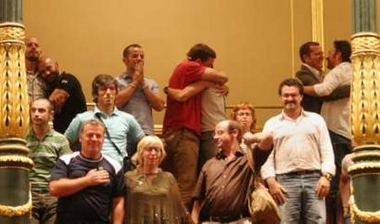
reaction in the public gallery of the Cortes on June 30, as the Spanish parliament extended full rights of marriage to all citizens

Some day a people crazy about waving its own flag at home and around the world may actually understand the liberty and justice it was intended to represent.
Meanwhile, much of the rest of the world has already overtaken us.
Excerpts from the speech by Spanish prime minister Jose Luis Rodriguez Zapatero delivered just prior to the vote last Thurday which legalized gay marriage and adoption of children by gay couples:

We are not legislating, honorable members, for people far away and not known by us. We are enlarging the opportunity for happiness to our neighbors, our co-workers, our friends and, our families: at the same time we are making a more decent society, because a decent society is one that does not humiliate its members.
In the poem ‘The Family,’ our [gay] poet Luis Cernuda was sorry because, ‘How does man live in denial in vain/by giving rules that prohibit and condemn?’ Today, the Spanish society answers to a group of people who, during many years have, been humiliated, whose rights have been ignored, whose dignity has been offended, their identity denied, and their liberty oppressed. Today the Spanish society grants them the respect they deserve, recognizes their rights, restores their dignity, affirms their identity, and restores their liberty.
It is true that they are only a minority, but their triumph is everyone’s triumph. It is also the triumph of those who oppose this law, even though they do not know this yet: because it is the triumph of Liberty. Their victory makes all of us (even those who oppose the law) better people, it makes our society better. Honorable members, There is no damage to marriage or to the concept of family in allowing two people of the same sex to get married. To the contrary, what happens is this class of Spanish citizens get the potential to organize their lives with the rights and privileges of marriage and family. There is no danger to the institution of marriage, but precisely the opposite: this law enhances and respects marriage.
Today, conscious that some people and institutions are in a profound disagreement with this change in our civil law, I wish to express that, like other reforms to the marriage code that preceded this one, this law will generate no evil, that its only consequence will be the avoiding of senseless suffering of decent human beings. A society that avoids senseless suffering of decent human beings is a better society.
With the approval of this Bill, our country takes another step in the path of liberty and tolerance that was begun by the democratic change of government. Our children will look at us incredulously if we tell them that many years ago, our mothers had less rights than our fathers, or if we tell them that people had to stay married against their will even though they were unable to share their lives. Today we can offer them a beautiful lesson: every right gained, each access to liberty has been the result of the struggle and sacrifice of many people that deserve our recognition and praise.
Today we demonstrate with this Bill that societies can better themselves and can cross barriers and create tolerance by putting a stop to the unhappiness and humiliation of some of our citizens. Today, for many of our countrymen, comes the day predicted by Kavafis [the great Greek gay poet] one century ago: ‘Later ’twas said of the most perfect society/someone else, made like me/certainly will come out and act freely.’

Can we try to remember these noble words the next time any U.S. politician opens his or her mouth?

[a dear friend of mine, Jamie Leo, forwarded the speech text this morning; it can be found on Doug Ireland‘s site, where the translation is credited to Rex Wockner; image by Susana Vera from Reuters]