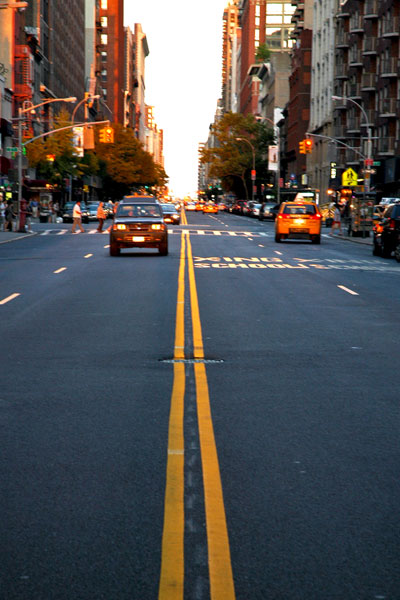
looking at the light cast from the west toward the stones to the east
As I prepared to leave the apartment this evening to go to the market, Barry reminded me that the phenomenon known as Manhattanhenge was about to light up our east-west street in its semiannual visitation. He said he’d heard on Twitter that it would take place precisely at 8:17. At that moment it was only 8:05, but as I didn’t know exactly what I would see when I got outside, I immediately headed out the door.
There I found that our doorman already knew all about our modest urban astronomical occasion, just as he always seems to know everything that goes on inside the building and anywhere in its proximity, so I didn’t have the satisfaction of inducting a new member into the cult. I then learned that, if anything, I may have been a moment too late rather than too early. The sun seemed to have already hidden itself somewhere in the Hudson River, but its corona was centered on the street axis and was still able to impede a direct glance.
I turned around to see what the eastern axis of the street might look like, stepped into the middle of the holiday-emptied six-lane thoroughfare, and snapped the picture above. Just as I got to the corner of Seventh Avenue (it was now 8:17 exactly), where the traffic signal was momentarily arresting the progress of the few east-west vehicles, a dozen or so pedestrians suddenly appeared in the crosswalk out of nowhere. Everyone seemed to have a camera and was snapping pictures of the setting sun, all the while totally ignoring the rich golden light momentarily transforming everything behind them, even to the white lane-dividing lines on the pavement.
I’m thinking the original stone-age celebrants on the Salisbury Plain would also have been more interested what the stones made of the sun’s rays running east, but there’s no way to know for sure. As I told my friend at the front desk, nobody stayed around to tell us.
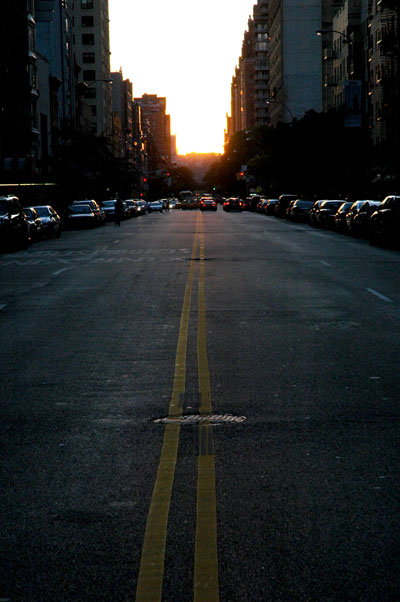
and looking at the sun positioned in the portal between the western stones
Author: jameswagner
the real meaning of Memorial Day (or Decoration Day)
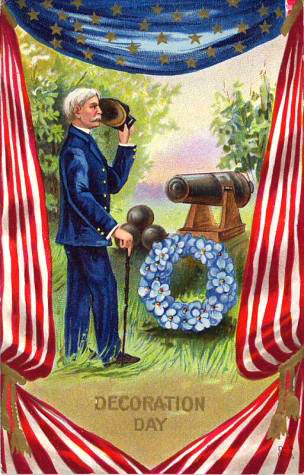
but where’s the gray, and, for that matter, the colors of our countless other fallen foes?
And it’s not for generals.
It seems Memorial Day is not supposed to be just about hot dogs, the Indianapolis 500, or summer whites. In fact the holiday formerly known as Decoration Day (the official name by Federal law until 1967) wasn’t even originally owned by war veterans. While today it commemorates Americans who died in any war throughout our extraordinarily-aggressive, warlike history, it was first enacted in response to the horrors of a civil war. The date itself, now established as the last Monday of May, was originally determined by the month of the final surrenders which marked the conclusion of the American Civil War.
But its disjointed history is actually far from the tidy story which an official declaration might seem to suggest.
What became Decoration Day, and eventually Memorial Day, had many separate origins. Towns in both the North and the South were already memorializing their recent war dead, and “decorating” their newly-dug graves, in spontaneous observances in the years before the 1868 official proclamation by General John Logan, the last national commander of the Grand Army of the Republic, in his “General Orders No.11”.
The holiday the general created was first observed on May 30, 1868. Flowers were placed on the graves of both Union and Confederate soldiers at Arlington National Cemetery. That cemetery, incidentally, was located on land the U.S. government had appropriated from Robert E. Lee at the beginning of the war, a development likely to have made an significant impression on the defeated South as much as on the Lee family itself.
Within two decades or so all of the northern states were observing the new holiday, but the South refused to acknowledge it. This should not have surprised anyone, either then or since. Even though the date May 30 had been picked precisely because it was not associated with any battle or anniversary, the observance itself was tainted by its association with the victorious and hated Union.
The various states of the old Confederacy continued to honor their own dead, on separate days, until after World War I, when the holiday was broadened to include not just those who died fighting in the Civil War but Americans who died in any war. Even then, most of the states of the old South still maintained separate days for their own dead, and do so to this day, although with varying degrees of enthusiasm.
I checked into this history yesterday when I was trying to decide whether I could honorably display the antique 48-star flag I’ve had for almost 40 years (antique in fact when I acquired it). I had kept it in a Chinese camphor-wood trunk for decades because our flag had come to be associated almost entirely with American jingoism; it had been hijacked by the crazies on the Right. Although I still had my doubts about the direction of this country even after Obama’s 2008 victory, I pulled the old banner out and hung it in the apartment last year, on the day of his inauguration, and again a few months later on July 4th.
Bush’s wars have now become Obama’s wars, and my very tentative interest in flag-waving, even flag-hanging, has (please excuse the choice of word) sort of flagged, although I still find things to love about this increasingly dysfunctional country.
When do we get a holiday celebrating the peacemakers? Of course that’s entirely a rhetorical question, coming from a citizen of a country which has almost never not been at war somewhere.
I went to Wikipedia in my search for a quick answer to my question about the original significance of the day we celebrate today mostly as just another excuse for a long weekend. There I learned that one time the holiday many originally associated with uncomplicated patriotic sacrifice did not mean the same thing for everyone, even in the 1860’s. In the Wikipedia entry for “Memorial Day: History”, I found this very moving and evocative window onto an America which was cursed to know war far better, and was far more weary of and horrified by it than our own:
At the end of the Civil War, communities set aside a day to mark the end of the war or as a memorial to those who had died. Some of the places creating an early memorial day include Sharpsburg, Maryland, located near Antietam Battlefield; Charleston, South Carolina; Boalsburg, Pennsylvania; Carbondale, Illinois; Columbus, Mississippi; many communities in Vermont; and some two dozen other cities and towns. These observances coalesced around Decoration Day, honoring the Confederate dead, and the several Confederate Memorial Days.
According to Professor David Blight of the Yale University History Department, the first memorial day was observed by formerly enslaved black people at the Washington Race Course (today the location of Hampton Park) in Charleston, South Carolina. The race course had been used as a temporary Confederate prison camp for captured Union soldiers in 1865, as well as a mass grave for Union soldiers who died there. Immediately after the cessation of hostilities, formerly enslaved people exhumed the bodies from the mass grave and reinterred them properly with individual graves. They built a fence around the graveyard with an entry arch and declared it a Union graveyard. The work was completed in only ten days. On May 1, 1865, the Charleston newspaper reported that a crowd of up to ten thousand, mainly black residents, including 2800 children, proceeded to the location for included sermons, singing, and a picnic on the grounds, thereby creating the first Decoration Day
So, the real meaning? I don’t think we have agreement even now, and for myself I haven’t yet decided whether to pull that faded old cloth from the trunk tonight.
[image of pre-WWI Decoration Day postcard from vintagepostacards]
Momenta Art Benefit Wednesday: tickets still available
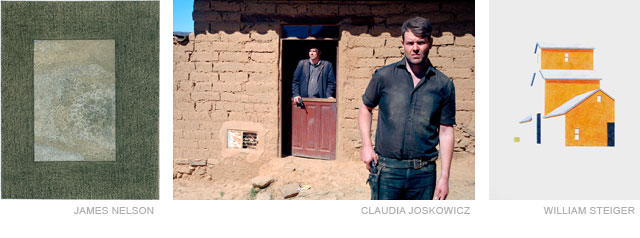


Barry and I went by Momenta Art last Thursday to preview the raffle and auction artworks available in their annual benefit Wednesday evening, May 26. We’ll be there because we want to help a great institution. We’re also going because we know we will be taking home a terrific piece, even though right now we have no idea right now what it will look like. Our confidence comes from the space’s great curating of donated work, from our own experience in every previous year, and from seeing the entire selection of some 150 works first hand.
It’s one of our favorite non-profit arts organizations in the New York area, and we have a number of great pieces in our own collection from earlier benefits. This artist-run non-profit space based in Williamsburg is absolutely as good as they come; they totally deserve and definitely can use our support.
I’ve put up images from their site of just a few of the over 150 raffle artworks; the next opportunity we’ll have to see the entire assemblage (and put together an exciting list) will be at White Columns on West 13th Street beginning at noon on Wednesday. The event itself starts at six, with a performance you won’t want to miss soon after that by Guy Richards Smit. Tickets are only $225, and as I’m writing this there it appears there are some still available. Please join us that night.
[images from Momenta]
Man Bartlett will be your parrot, if you can #24hEcho

Man reading Barry’s Manchurian Candidate tweet
UPDATE: the artist speaks for himself
As I’m writing this Man Bartlett is in the third hour of his contribution to P.P.O.W. Gallery’s Hostess Project, “#24hEcho“.
The artist has vowed that for 24 hours he will repeat, into a webcam, whatever we tell him to. “I will be present in repeating your words. I will be your puppet, your sounding board, your refuge. Otherwise, I will be silent.”
If you want to part of the performance go to Bartlett’s website for further directions.
Barry and I were at the gallery at 7 o’clock tonight, just as he had arranged himself behind his computer, and the tweeting half of our partnership communicated this from his iPhone, an homage to a bit of the history we share:
William Powhida is the kindest, bravest, warmest, most wonderful human being I’ve ever known in my life.
The artist will be present until 7 o’clock tomorrow night, and, as they used to say in the darker ages, the lines will be open throughout the night. Help keep the guy company, and see if you can inspire a conversation with strangers.
Paterson ghosts greet “Escape from New York” visitors
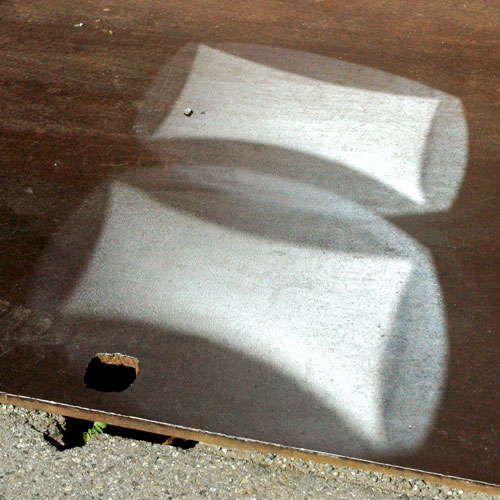
It took us only about 45 minues to get to Paterson by train from Manhattan on Saturday afternoon (it can take longer for us to get to some parts of Brooklyn). At the end of our pleasant urban walk from the station at the New Jersey end we were rewarded at the entrance to “Escape from New York” by the sight of this pair of shapes kissing the surface of one of those familiar steel plates we see all over Manhattan covering temporary holes dug by utility construction workers.
The odd, shiny silvery glow and doubled light image attached to each shape, visible in full daylight, was so remarkable that I immediately assumed it was one of the pieces curator/impresario straordinario Olympia Lambert had attracted to her show, but I was soon disabused of the notion when I looked behind me at another old industrial structure towering above us next door. Like so many other handsome 19th-century mill buildings in this historic city, this one was being reinvented for tomorrow: The two shapes were actually reflections cast by the slightly-bowed surfaces of plexiglass panels used to secure window openings in the ancient brick wall.
Nature was cooperating with man’s built history to shape the present.
So it goes.
My images from the Paterson show itself will follow in another post.
Dominus totally gets Harry Weider, in today’s Times
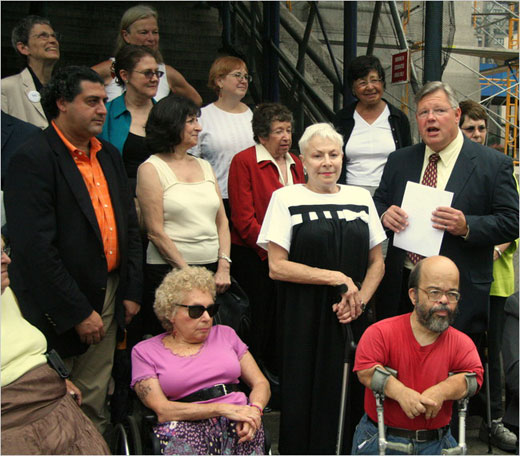
Harry Wieder, above at lower right, at a press conference calling for wheelchair access seven days a week to the James A. Farley Post Office. [Times caption]
Today’s New York Times will include this lovely, absolutely lovely piece about Harry Wieder (which the paper unfortunately burdened with a totally lame headline*) by Susan Dominus: “Remembering the Little Man Who Was a Big Voice for Causes“.
He sometimes attended seven or eight meetings in a day, even if he snored his way through one or two of them. His friends joked that he must have a clone � �but why would anyone clone someone that strange?� Mr. Wasserman [Marvin Wasserman, a longtime ally and occasional victim] said.
*
I dunno, but I think I actually prefer, “Gay dwarf activist killed by New York taxi“, the headline I saw two days ago on an Australian site.
[Michael A. Harris image from the Times site]
Harry Wieder (1953-2010)
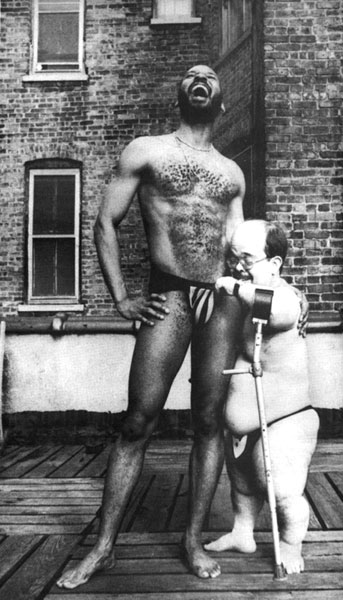
Harry was always an activist (here he is saying hello to the late Keith Cylar)
ADDENDA: I’ve now located* the original full image of the photograph I included above when I first did this entry, as well as the text which accompanied it, from a pre-summer issue of OutWeek published almost twenty years ago; this is Keith Cylar and Harry Wieder’s reply to the photographer and activist Michael Wakefields’s question about their ideal getaway:
“We would live in a world where we would then have the freedom to do more than just fantasize, where our fight to end AIDS has brought a reality, and there are countless sexual possibilities, especially for a militant sexual dwarf”
I’ve also added an image further into the entry, of Harry inside the maw of the beast, an ACT UP Monday night meeting
He described himself as a “Disabled, gay, Jewish, leftist, middle aged dwarf who ambulates with crutches”, but Harry was much more. He was the essential activist, and he was much loved.
I first met him through ACT UP, where I sat next to him at a Monday night meeting, and after that he seemed to be everywhere, especially wherever there was something to be said to power. I was deeply proud to call him a friend.
I hadn’t yet heard his own multifarious description of himself, but as I came to know better both the man and his work I watched his identity as an activist and as a man gradually enlarge in my own consciousness. Eventually I seemed to have assembled an image of all of his various hats and identities on my own, even adding “person of color” in my enthusiasm. I can’t account for that add-on. Harry might have been a bit “swarthy”, but I think it was his compassion and his natural affinity for the issues which affected blacks, or maybe there was even an ambiguous word from Harry himself. Then, only years later, when he told me where he then lived on the Lower East Side, in a home for the deaf, did I realize that his physical challenges included a hearing disability.
The news magazine OutWeek called Harry a “militant sexual dwarf” in a 1991 article which included the photo above. He’s seen peeking into the swimsuit of Keith Cylar, one of the co-founders of Housing Works. Barry remembers, “he was [certainly] aggressively flirtatious”.
We all loved him.
During all of his active life he worked to improve transportation for all so there was more than a little irony in the fact that he was struck down the night before last by a taxi on Essex Street, on the Lower East Side where he lived. It’s one of the most dangerous of the stretches which had attracted his latest traffic-control activism, virtually up to the moment of his death. He was leaving a regular meeting of Community Board 3, one of several groups which has been concerned with the neighborhood’s safety.
Board 3 will be joined by Community Board 2 at a public hearing scheduled by the NYC Department of Transportation for next Thursday on the issues of traffic and safety in the Village and the Lower East Side. Harry will certainly be a part of it.
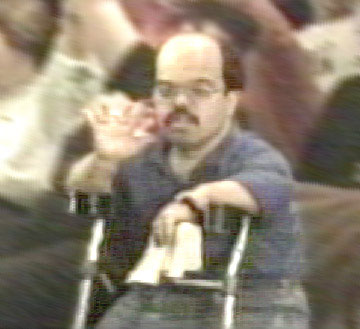
Harry, waving from the front row during a 1990 ACT UP meeting [detail in a still from a video]
For more details: DNAinfo; The New York Post; Wall Street Journal (blog); the Lo-Down; Gothamist; The Edge (for starters)
*
EDIT: When I first published this post I was unable to locate Michael Wakefield’s original, uncropped image, but Bill Dobbs located it in the OutWeek archive and pointed me to it (it’s on page 36); it now appears here at the top
[first image by Michaeld Wakefield from the OutWeek archive; the second from James Wentzy]
8th anniversary of jameswagner.com
Today is the eighth anniversary of this blog.
I said it last year, and I’m delighted and incredibly privileged to say it again: This is also the anniversary of what turned out to be the most important event in my life, the night Barry and I met (now nineteen years ago).
Last year I also wrote, looking at the world outside our circle of close friends, that I was “more upbeat about the world” than I had been the year before, the eighth year of our second Bush, adding, “but only a bit”. That hasn’t changed, a bit.
And happy birthday, Paddy Johnson!
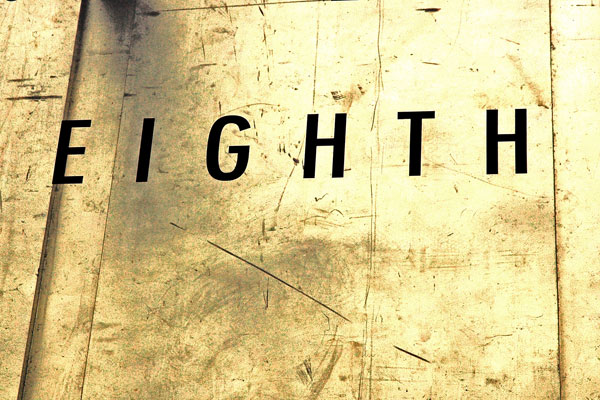
[the image is of a portion of the street number on the glass above one of the Art Deco entrances of the former Port Authority Commerce Building (1932), 111 Eighth Avenue the wall seen several feet behind the glass is covered with gold leaf]
the Starns install “Big Bambú” on the Met Roof Garden
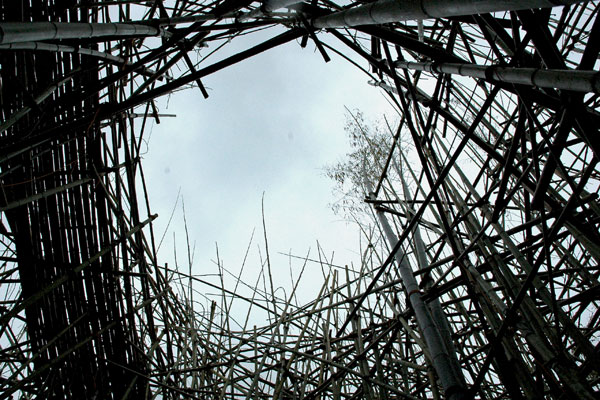
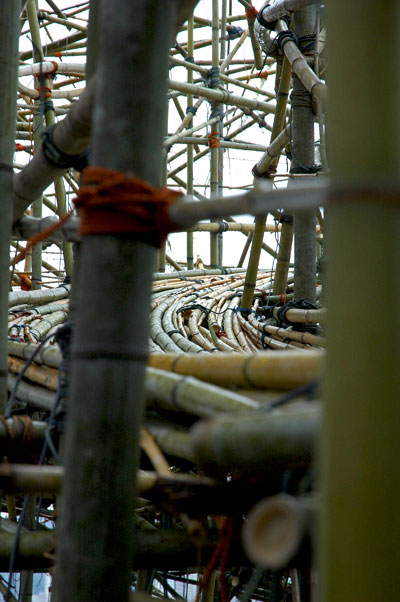
Brothers Mike and Doug Starn‘s Metropolitan Museum roof installation, “Bambú: You Can’t, You Don’t, and You Won’t Stop“, opens today, April 27. Barry and I were at the press preview yesterday morning. I’m sharing here a few of the images with which I returned.
I’m not really drawn to openings (of any kind, galleries, performances or film) just for the sake of being there first. There has to be some other lure; it might be the prospect of being around creative friends. And only the promise of something very special, also something which almost has to be experienced in the relative isolation of a preview could normally bring me to the Upper East Side before noon, but there we were yesterday at 11 am, standing in the rain on the roof of the Met, and there wasn’t a friend of any kind in sight.
Oh yes, I admit that I was also there because I was looking forward to some terrific, uncrowded photo opportunities, even if we weren’t going to be able to scale the heights of the bamboo cloud surrounding us.
It turned out that the “Bambú” itself was friendly enough, even if the wet-blankets working at the underwriting desks of the museum’s insurance company refused to let anyone enter the internal footpaths. It’s a prohibition which can be expected to be applied, throughout the spring, summer and early fall, whenever the surfaces become wet.
The Starn’s piece will not move across the roof, as did their earlier bamboo sculpture at the former Tallix factory in Beacon, New York. There the structure, assembled inside an enormous, 320-foot space, was continuously reconstructed by dismantling individual poles and carrying them down the floor to be reassembled into (another?) monumental piece, several times over and over, and then back again.
The forest at the Met will continue to grow in height throughout the spring and summer, and the existing paths constructed within it (in the sky, so to speak) will be extended further during at least much of that time. Visitors who are not so unfortunate as to show up on a drizzly day can expect to encounter a number of sturdy rock climbers, mustered from northern New England and the European Alps, working on the piece above their heads.
The other friendly faces we encountered were those of the Starns themselves. I’ve been encountering their work for more than 25 years, and I’ve never been disappointed by what I’ve seen as they’ve reconfigured the world around them. On Monday they were completely generous with their time and open to any queries from the press.
“Bambú” likely represents the most complete transformation of the Iris and B. Gerald Cantor Roof Garden in the twenty-three years of the space’s history. It may also turn out to be the most successful, not least because for its visitors it’s probably going to be the most exciting ever.
I thought it was a pretty awesome piece, not least for the fact that its rather serious scale depends on only a rather smallish carbon footprint, and for being a frankly ephemeral construction (ephemeral except in the memory of those who will experience it). The very fact that it was done at all is a remarkable accomplishment for the artists, the Museum, and, yes, that insurance company too.
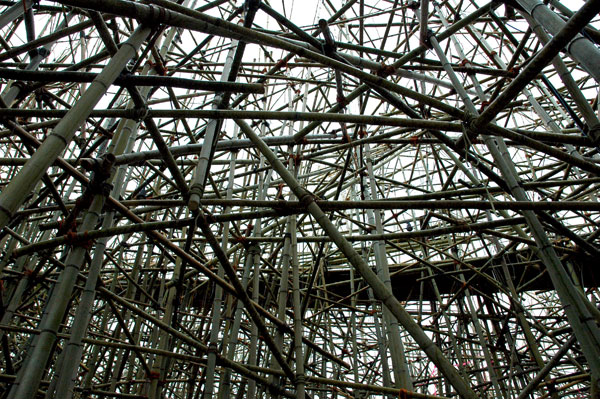
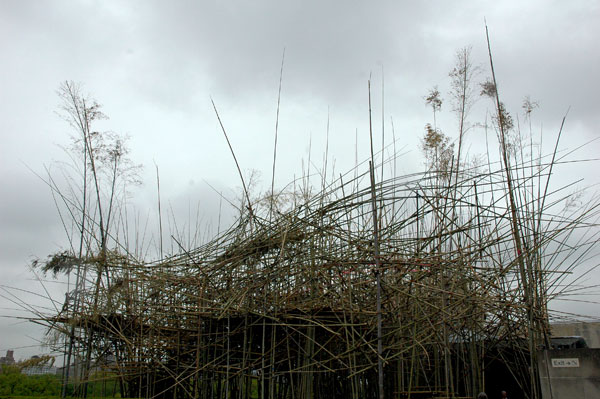
Now I’m thinking about the piece as art. It’s a maze, with elements both random and designed. It’s a forest of natural, wooden materials, yet bound together with synthetic, nylon cords. But this “forest” has been planted in the middle of, and yet above, a great artificial metropolis by the hand of man alone. It has been accomplished through the borrowing of the products of nature as well as human genius. It displays attributes of chaos as well as order, and the contributions made by nature and by man both exhibit each of those. Every piece in it was assembled, arranged, and bound into place by artists, although working closely with their collaborators. Every element of the structure has an intelligence and a rhythm. Not one part of it is quite accidental or entirely superfluous.
The forest maze closes forever on October 31. I wish instead that we could flood the roof and watch it grow forever.


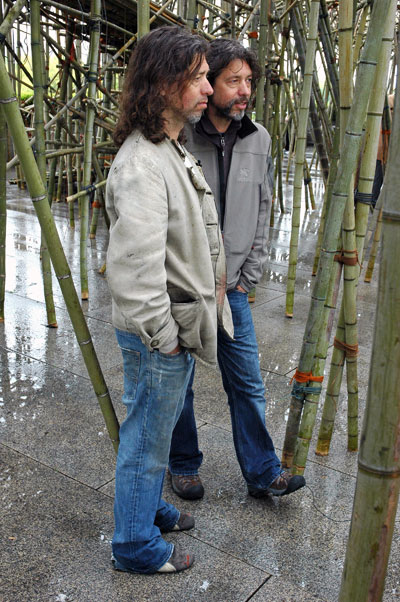
the artists: Doug (l.) and Mike
Fifth Avenue tulips

Even the tulips manage to look more genteel on the Upper East Side. This pink bower was spotted on Sunday gathered together in the tidy front garden of an elegant apartment building in the 70’s.