Wiener Kunst for the outsider

ACF-UPS.jpg
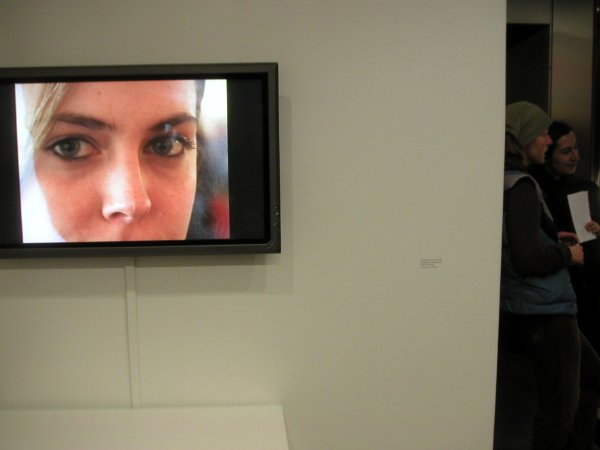
Richard Hoeck and John Miller Something for Everyone 2004 video installation view
ACF-Twin.jpg
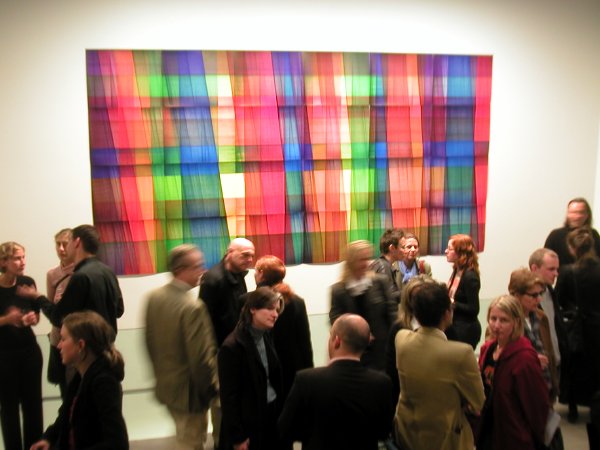
Sabina Hörtner Twins 01 2002 Eddy marker on multiple cardboard sheets installation view
ACF-pool&video.jpg
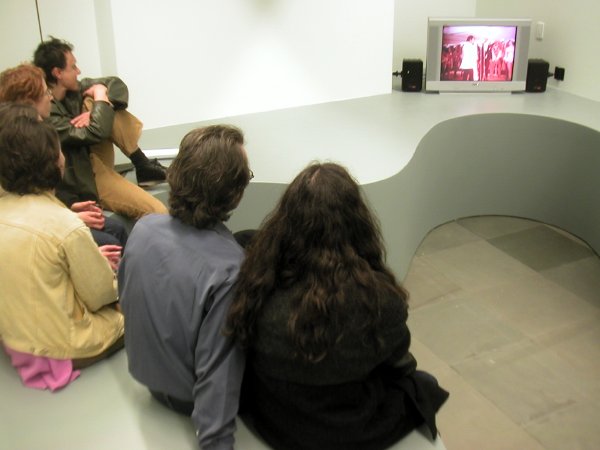
Marko Lulic Hart und weich Nr.2 [Hard and Soft No.2] 2002 painted wood platform with vintage film by Dejan Karaklajic and Jovan Acim installation view

I feel like we just came back from a trip to Vienna (again), or more specifically a visit to the studios of nine emerging artists living and working in the city which could arguably be described as the geographic and cultural center of a Europe which has rediscovered the treasure of its eastern lands. The Austrian Cultural Forum (ACF) is hosting this group exhibition curated by Trevor Smith of the New Museum through August 20.
Smith points out that although his assignment has placed these artists in a geographic context they do not necessarily define themselves geographically.

Many of the artists’s works that I have chosen for the New York version of “Living and Working in Vienna” are marked by this tension between somewhere and anywhere, using architecture or film as the site for mediations on history, memory and cultural critique.

If artists are outsiders regardless of where they find themselves, we should all be delighted to see what creative minds can do with the fantastic kind of “outside” which is described by this gorgeous and surprisingly modern city today.
Go to this little bit of Austria on 52nd Street for the show and for how well it has been integrated into the spaces of this very interesting building. For the rest of this week there’s the additional incentive of the avant garde festival “Moving Patterns: Electronic Music and Beyond,” which is fully described on the website. Go early in order to check out the visual art, especially since its arrival seems timed perfectly for the cross-genre festival of sound.
Oh, and ACF performances are always absolutely free.
this time it looks like suicide; cross your fingers

clericsin hell.gif
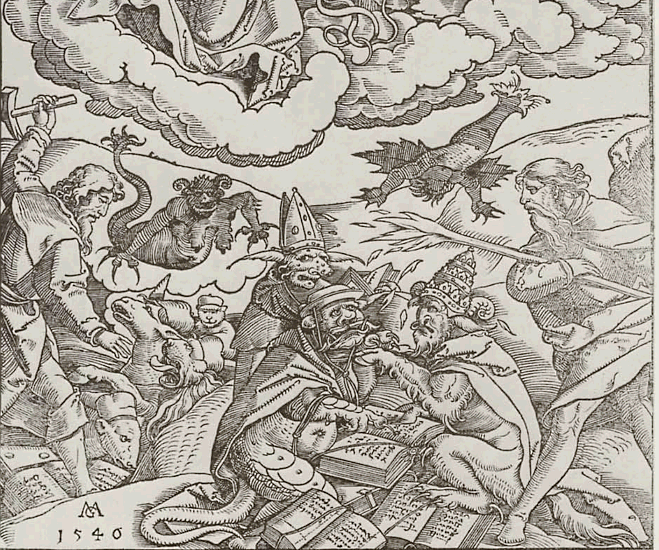
Matthias Gerung Der römische Klerus in der Hölle [Roman clerics in hell] 1546 wood cut detail

They always insist that suicide is a “mortal sin,” but at least there’s hope for the survivors, the rest of us, those not members of the cult but who have had to suffer its injuries.
As I suspected immediately upon hearing about the appointment of Ratzinger as its chief executive, the Roman Catholic Church seems to have committed suicide. For reasurance, see the essay by the Catholic intellectual Hans Küng which appeared in Der Spiegel several weeks ago, while the last pope was still dying. Küng is the eminent Swiss German theologian who in 1979 was stripped by the Church of his right to teach because of his liberal critique of papal authority. This is only an excerpt from his conclusion:

For the Catholic church, this pontificate, despite its positive aspects, has on the whole proven to be a great disappointment and, ultimately, a disaster. As a result of his contradictions, this pope has deeply polarized the church, alienated it from countless people and plunged it into an epochal crisis — a structural crisis that, after a quarter century, is now revealing fatal deficits in terms of development and a tremendous need for reform.
Contrary to all intentions conveyed in the Second Vatican Council, the medieval Roman system, a power apparatus with totalitarian features [my italics], was restored through clever and ruthless personnel and academic policies. Bishops were brought into line, pastors overloaded, theologians muzzled, the laity deprived of their rights, women discriminated against, national synods and churchgoers’ requests ignored, along with sex scandals, prohibitions on discussion, liturgical spoon-feeding, a ban on sermons by lay theologians, incitement to denunciation, prevention of Holy Communion — “the world” can hardly be blamed for all of this!!
The upshot is that the Catholic church has completely lost the enormous credibility it once enjoyed under the papacy of John XXIII and in the wake of the Second Vatican Council.
If the next pope were to continue the policies of this pontificate, he would only reinforce an enormous backup of problems and turn the Catholic church’s current structural crisis into a hopeless situation.

These word were written weeks ago. Today it doesn’t look like there’s much doubt about what can be expected of the regime which has succeeded that of Wojtyla, since it was the choice of, in Küng’s words, the “largely mediocre, ultra-conservative and servile episcopate” he created. Suicide.
Amen.

[image from Alois Payer]

star-struck pope

popecamerabug.jpg
(documenting his own fabulousness)

I’ve been looking at pope-arama pictures for a couple of weeks now. Frankly however, since the more colorful elements of Vatican porn, the Medieval pomp and circumstance, have been severely cut back over the last few decades, there’s really not much to look at any more. These old men are very happy going back to the heavy Middle Ages thing, but without the fun part.
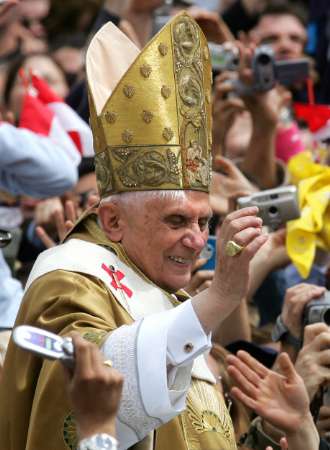
Nevertheless I shouldn’t have been surprised (although I really was) to see “the faithful” raising thousands of arms holding cameras aloft while various old relics pass in front of them (present reality isn’t good enough; people today don’t think they’re really looking at something unless they manage to get their own snapshot of it). What really shocked me was seeing Ratzinger himself apparently seduced by his own fame in the same way.
Okay, the camera in his hand is just an illusion produced by a telephoto lens, even if it was fun for a second. But do we think Jeb Bush or Berlusconi took any pictures when they went up to kiss the guy’s ring while he sat on his throne? Maybe I have to rephrase that: Can fans get away with just shaking his hand these days?

[image by Max Rossi from Reuters]

Pablo Helguera at Julia Friedman

HelgueraSym.jpg
Haydn, still fully-staffed

Helguerasymgoing.jpg
oops there goes another one

“Well, Julia Friedman Gallery has definitely upped the ante on art openings,” Barry said to me as we walked along 10th Avenue to the second of two sites dedicated to yesterday’s opening of the art of Pablo Helguera.
To be sure.
This was no ordinary gallery reception; First there was the opening performance and then the opening reception. It worked, at least for these two music nuts. I don’t remember what the calendar looked like yesterday, but this was the only Chelsea event we hit before heading downtown for the LMCC open studios reception.
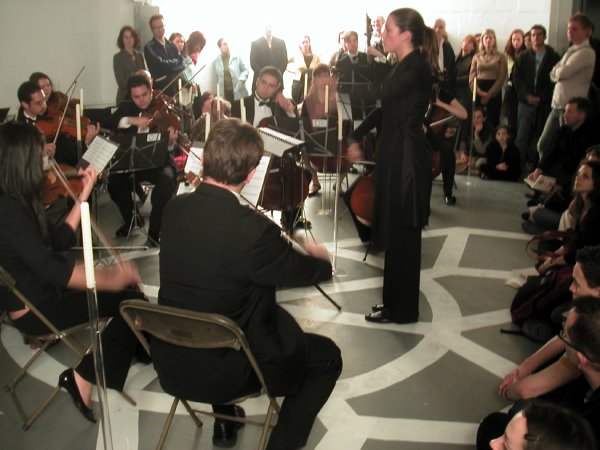
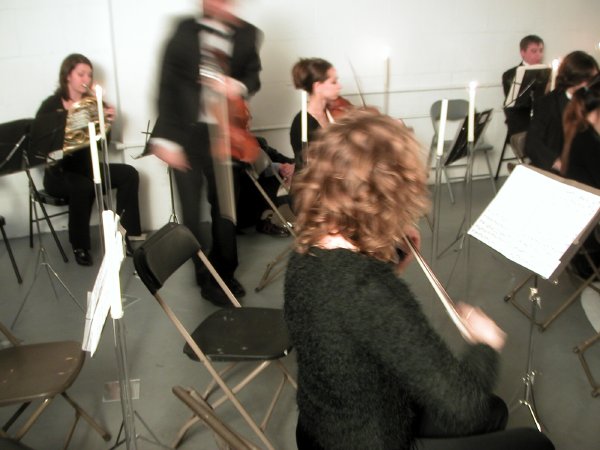
Helguera’s exhibition, “Swan Song,” can be seen in the gallery space on West 22nd Street through may 28th. Last night however, in a loft space in the Starret-Lehigh Building four blocks north, there was also a performance by a 23-member symphony orchestra of work related to the show. The short program included a minimal theatrical element attached to a beautiful composition by the artist himself, “Endingness,” and to the last movement of Haydn’s “Farewell” Symphony which actually ended the event, somewhat definitively.
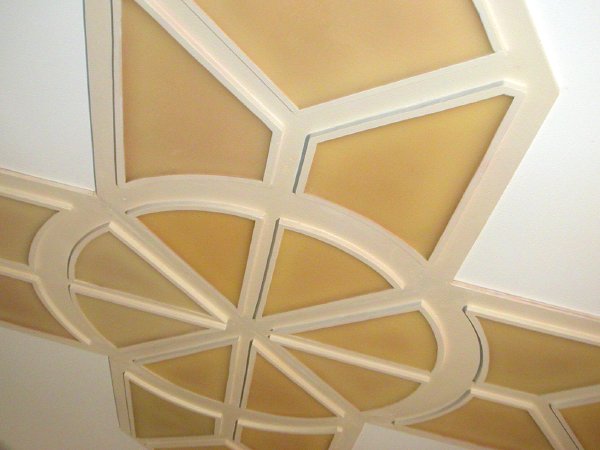
On the floor below the musicians was outlined in wide masking tape the renaisance-era ceiling design which is integral to an important work installed in the gallery; As the individual players completed their parts in the Haydn piece, each rose one by one to extinguish a single wax candle supported on a clear lucite base near his or her music stand and then quietly exited the room.
The ensemble was the Mexican-American Orchestra, conducted by Alondra de la Parra. If I may be excused for doing so, I’ll add here that it did no harm to its appreciation of the performance that this largely visual arts-oriented audience was listening to players who were led by the most beautiful conductor I have ever seen.
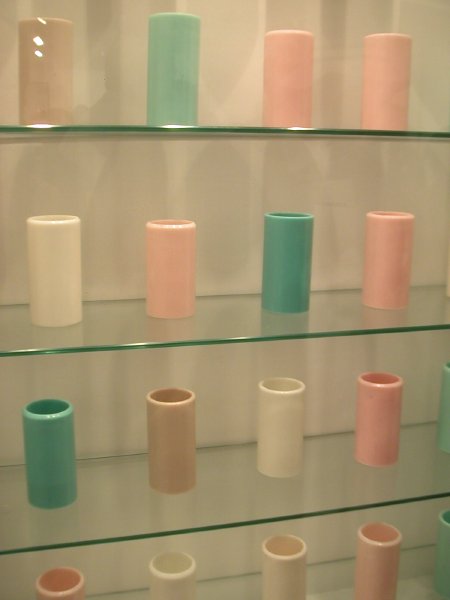
The works you’ll find in the gallery each relate to the artist’s theory about finitude, and the relationship between history, legacy, culture and language. In the midst of a crowded opening reception I found the most beautiful, and potentially “resonant,” piece to be “Conservatory of Dead Languages.” Resting on the shelves of a lighted vitrine built into a wall of the gallery are dozens of pale variously-colored wax cylinders, each of which documents a dying language.
On the ceiling in the front room is “Acolman.” It is a sculpture in wood and wax repeating the design some of us had first seen earlier in the performance loft. It and the sound recording which is a part of it relate to a local belief that the voices of long-dead monks who sang in a Mexican monastery built almost 400 years ago can still be heard under the ceiling of its chapel.

Helgueracylinders.jpg
Pablo Helguera Dead Languages Conservatory (Conservatorio de Lenguas Muertas) 2005 recordings on 30 wax cylinders 43″ x 30″ large detail of installation

helgueraAlcoman.jpg
Pablo Helguera Acolman (#1: Play) 2005 wood, wax and sound recordings 8′ x 8′ large detail of installation

Jim Drain at Greene Naftali

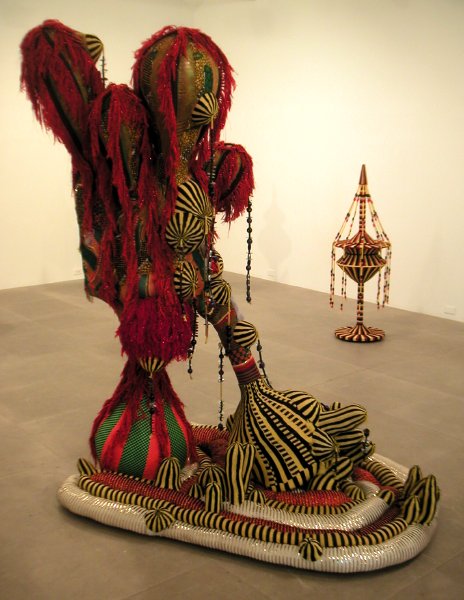
DrainSourpuss.jpg
Jim Drain AIDS-a-delic 2005 mixed media with yarn, fabric and beads 84″ x 60″ x 40″ [I believe Ball Buster is the smaller piece to the rear]

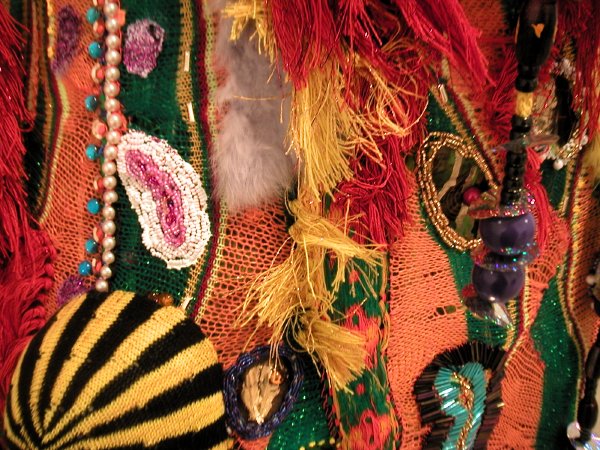
DrainSourpussdetail.jpg
Jim Drain AIDS-a-delic detail

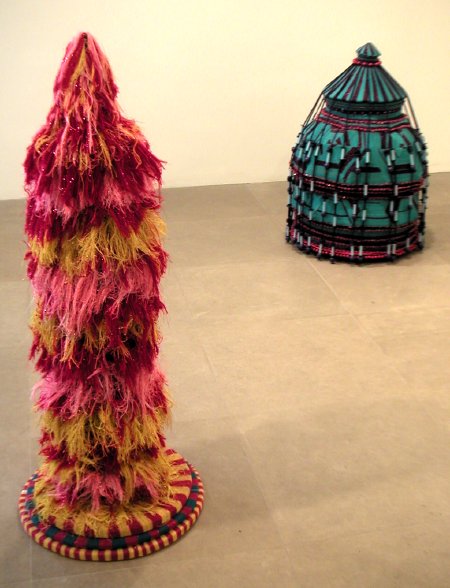
DrainSergioBigBoy.jpg
Jim Drain installation view of Sergio (forground) and Big Boy

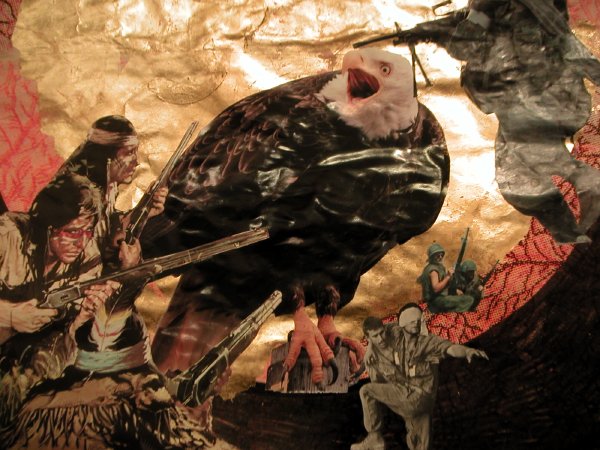
DrainWarCrydetail.jpg
Jim Drain War Cry 2005 mixed media on paper 21″ x 17″ detail [of a piece which is part of an assembly/installation in the back gallery]

I’m a little late, but not quite never. Barry did a post last Sunday about Jim Drain’s fantastic show, “I Wish I Had A Beak,” at Green Naftali. I just wanted to show some of the images I managed to take home on our visit the afternoon before.
And I want to add that I was totally relieved to hear that the yarn for these complex pieces doesn’t have to be knitted by hand, as Dean Daderko explains in his review, “Magic Mushrooms,” in Gay City News.

Sterling Ruby at Foxy Production

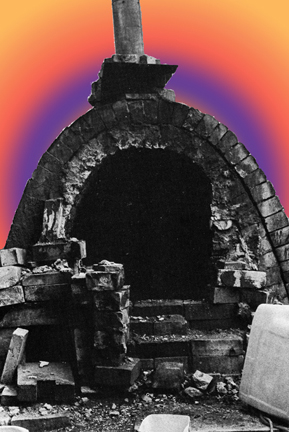
RubyKilm.jpg
Sterling Ruby Kiln #2 2004 Lambda print mounted with Plexiglas and Sintra 22″ x 33″

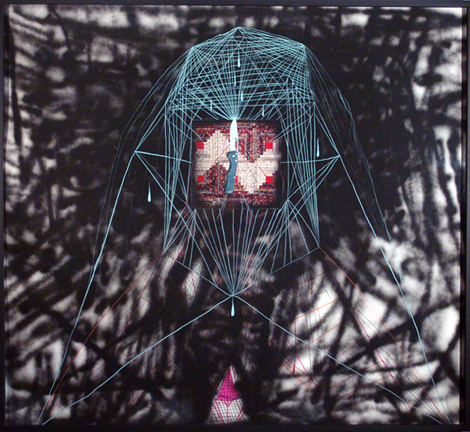
RubyPrimeMover.jpg
Sterling Ruby Prime Mover #1 2005 pencil, spraypaint and collage on paper 52.25″ x 57.25″

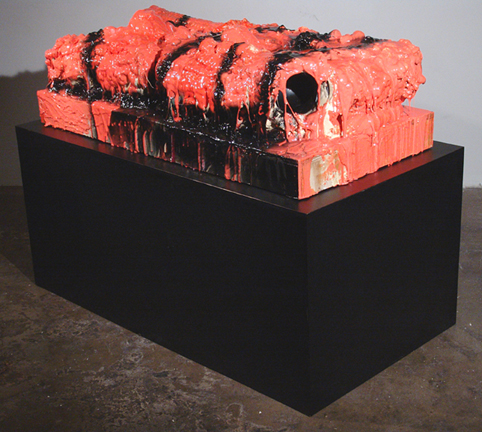
RubyTorso.jpg
Sterling Ruby Orange Inanimate Torso 2005 resin, PVC, spraypaint, formica pedestal 28″ x 48″ x 34″

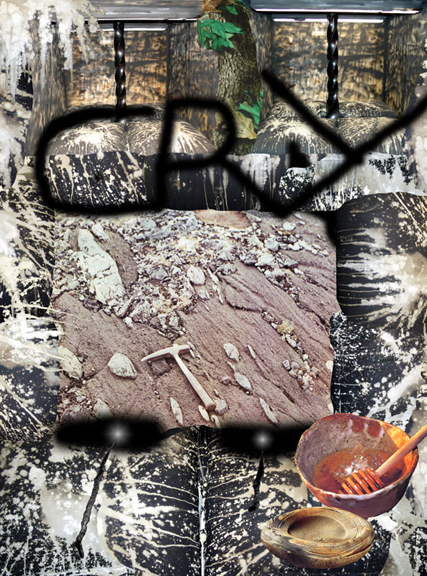
RubyCry.jpg
Sterling Ruby Cry 2005 Lambda print mounted with Plexiglas and Sintra 72″ x 46″

Sterling Ruby is back at Foxy Production and once again he’s all over the place in both the solo show as a whole and in the individual works that each refuse to be limited to a single medium themselves. Collage seems to dominate new work in the visual arts everywhere lately, but Ruby’s entire oeuvre can be understood as a single great collage of inventions, and each one of them in turn collages his bold, complex understanding of his world in layers which reveal little but promise much.
I just wish I could take it all home where I might see just how far I could get with it.
Ask Michael or John about the videos.

[images from Foxy Production]