I neglected to point out yesterday that the works seen in the students’ studios may or may not have been completed at the time they were seen this past weekend. My images may therefore be, in at least some cases, of works in progress. They might also be only studies, not intended to be shown out of their context. While these people are artists, at the moment they are also working as students, in rooms normally not visible to the rest of us.
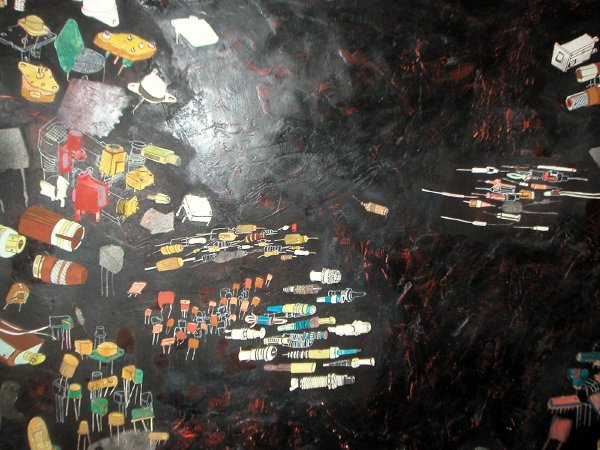
Alicia Gibson (detail of painting)
Gibson is actually part of Hunter’s BFA degree program, not the MFA; she wasn’t in her darkened studio when we passed through it, so this image of one of the paintings is compromised by my camera’s flash; what I saw there was extraordinary, mature work which will not stay in the dark for long; she will be part of the college’s “Degree Show” opening this May
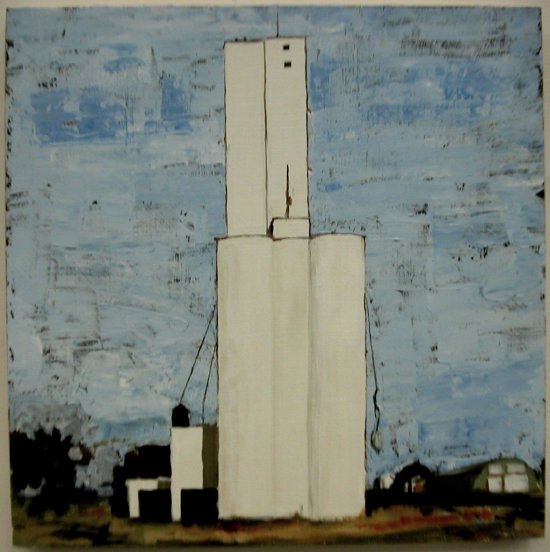
Chris Coronel
Coronel showed somewhat ghostly small paintings of midwestern grain elevators, beautifully executed; my favorite by far was the one shown above, but because the image is fuzzy I felt I had to make an exception to the format I’ve used otherwise in these two posts and show a second work below
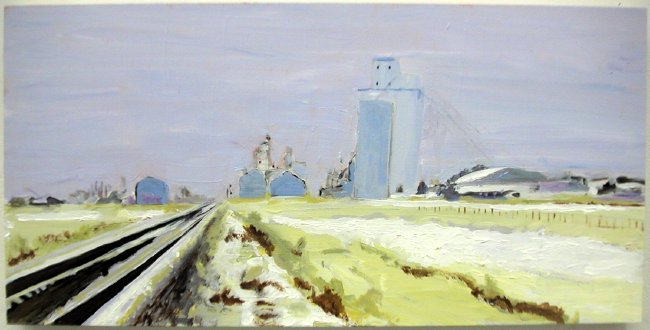
Chris Coronel
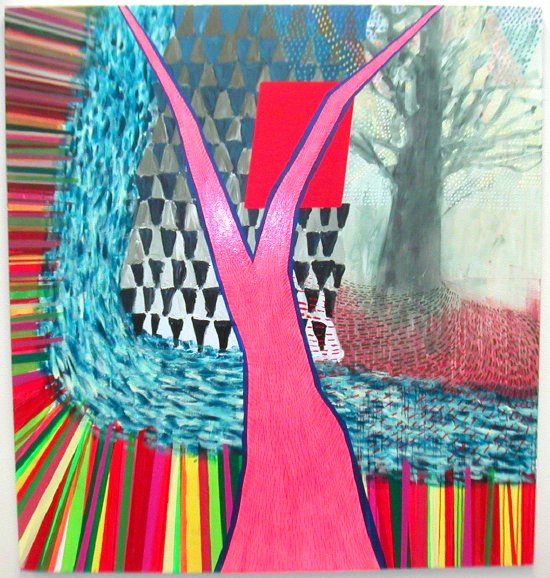
Stephen Canino
incredibly dramatic use of color and form for pictorial narrative
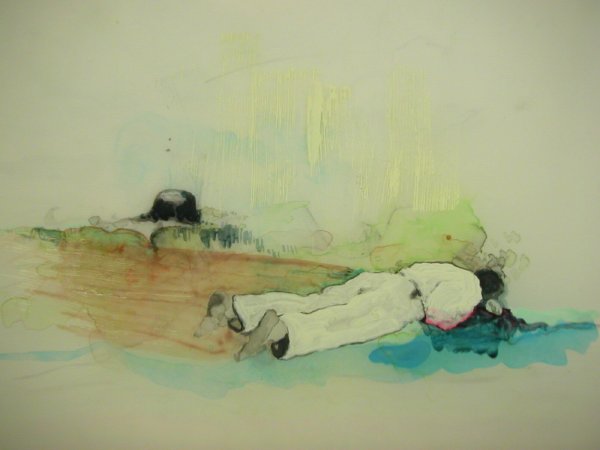
Jennifer MacDonald
luscious small drawings and two wonderfully-bizarre short videos
I’ve run out of camera images, but I can still see in my head the good work, among that of so many others, of Becket Bowes, who seems to be at home in almost every media; the drawings and haunting desert photographs of Christina Dixcy; the humanist photo portraits, far beyond documentary, of Roberto Carlo Soto; the smart/silly sculpture and video of Scott Penkava; and the sweet/sorrow playground landscapes and jungle gym “portraits” of Lauren Orchowski. After this too-short list, testimony to a ridiculously inadequate memory, I begin to lose track altogether.
Author: jameswagner
Hunter College MFA degree show
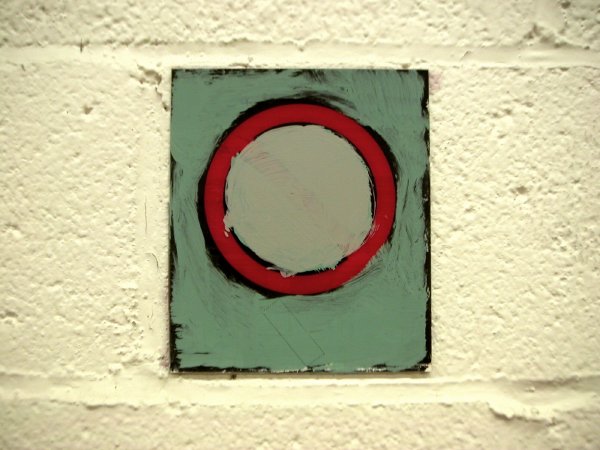
seen on the 6th floor, between WC’s marked for separate genders
Fortunately we were on foot. And at least we didn’t rush uptown on opening night, when the most of the local artworld zipped through the open studios at the Hunter College BFA degree show. We waited until the last day (okay, it was also only the second day). Actually, for all I know, these people have already all signed with New York’s most agressive galleries.
Nevertheless, I’ve uploaded below images of some of the most interesting work Barry and I found today, although their presence here is very much dependent on whether I was able to get a satisfactory picture. To be sure, there’s still much, much more left on West 41st Street.
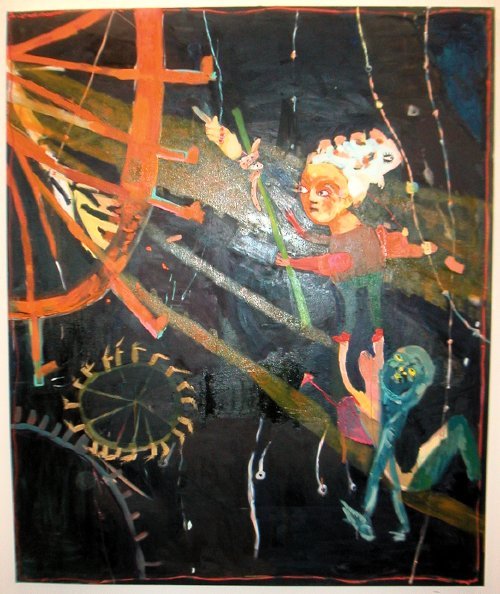
Emily Noelle Lambert
wicked good painter, growing in leaps with every work we’ve seen
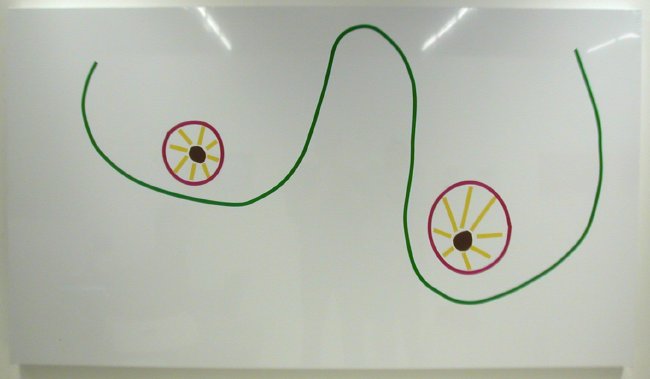
Ruslan Trusewych (tape on large vinyl surface on stretcher)
minimalist sculptor and painter, and the most common materials imaginable

Katy Krantz (large detail)
gorgeous works on paper
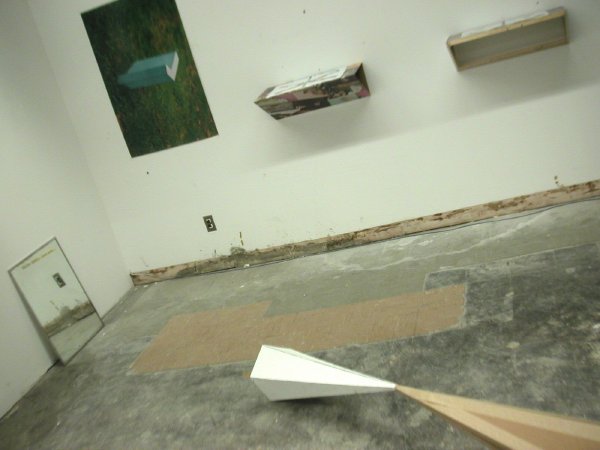
Dominic Nurre (view of studio)
Nurre’s genius aches to be unwound and shown: I’m thinking a project room somewhere would be appropriate – now
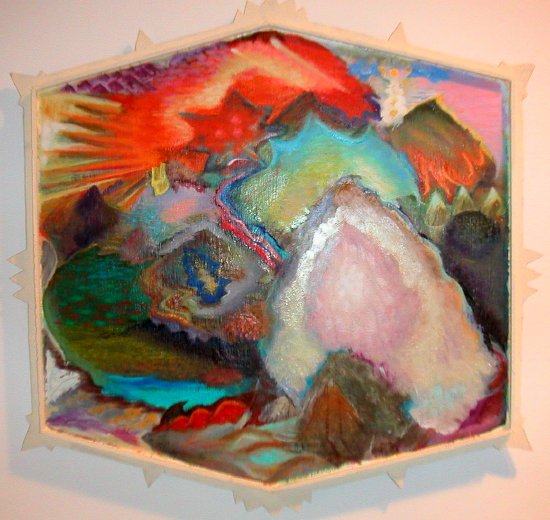
Zach Harris (painting and artist’s frame)
this stuff is scary brilliant, and I mean that in every sense of both words
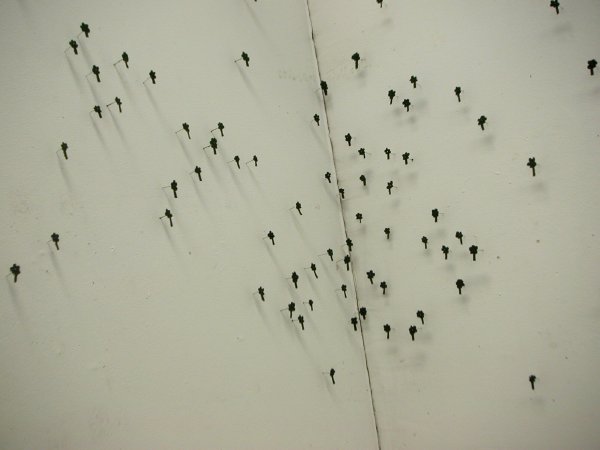
Hope Hilton (cut-out paper installation)
beautiful, sensitive, smart and mesmerizing, although the work is difficult to photograph
I’m going to stop for tonight, and continue in another post tomorrow. If anyone is interested in seeing more of the work of any of these artists, I may have some additional images I could share, or at least be able to direct you to a website or an email address.
meanwhile, with merry wives and husbands in Windsor today
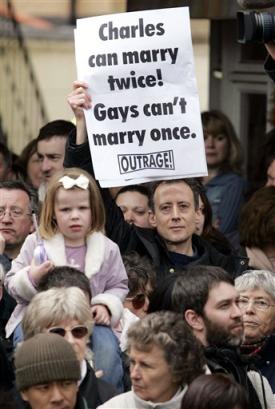
a voice crying in the wilderness
Peter Tatchell is fabulous, and absolutely irrepressible. We love him!
The AP photo caption reads:
Gay rights activist Peter Tatchell makes a protest as he stands in the crowd that were spectating the royal wedding between Britain’s Prince Charles and the Camilla Duchess of Cornwall in Windsor England Saturday April 9, 2005.
[image by Peter Tarry from the Associated Press pool; caption also from the AP]
if there is a hell, Wojtyla had real reason to worry
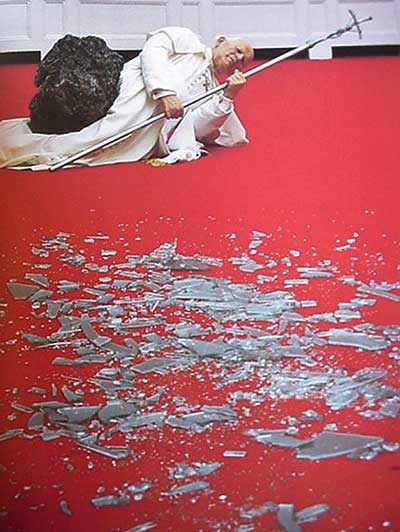
Maurizio Cattalan La Nona Ora (The Ninth Hour) 1999 carpet, glass, wax, paint as lifesize figure
The incredible fanatical scene which surrounded the death of Karol Wojtyla should be slowing down now that he’s buried, but already the latest headlines ominously suggest that the next story will be his canonization. Do we care? Yes, because most of it is a big lie, it was invented by his contemporaries for evil purposes, and unlike its ostensible subject, this one’s not going to die.
This pope had a lot of time to write and talk in more than twenty-five years of personal autocracy, and it’s mostly all out there on record. Norman Birnbaum’s piece, “An Ambiguous Papacy,” in the newest Nation [the entire text is only available in the print edition or on-line to subscribers] argues that while some of this stern pontiff’s lectures were directed toward enlightened ends like the critiques of war, capitalism and (eventually) capital punishment [all ultimately without any success], when it came to his appalling positions so dearly loved by the media, like those related to gender and sexuality, the man was a total disaster [an amazing success] for ordinary people all over the world, regardless of their sacramental status. His “culture of life” was empty, morally bankrupt, from the beginning.
He was an inflexible traditionalist in denying equality to women in church and society. He regarded homosexuals as sinners and so legitimized the most primitive of hatreds. These are not just matters of dogma. The Vatican’s opposition to birth control programs contributes to the poverty of the Third World; its refusal to accept the use of condoms likely facilitated the spread of AIDS; its coalitions with Islamists in international bodies reinforced their capacity to deny rights to women.
Argument and experiment within the church, so creative under John XXIII, gave way to a personalized party line. The great alternative tradition of Catholicism, conciliar church government with the participation of the governed, was consigned to the history books. Theologian Father Hans Küng declared the papacy of John Paul II a monarchical nightmare. Often, the most engaged groups of the Catholic laity had to struggle with their own church for the right to carry its social doctrines into the public arena. The fate of the liberation theology movement is a striking example: In a continent desperate for justice, it was pronounced heretical–setting back reform of Latin American society a generation.
. . .
[In Europe, the] Christian [Roman Catholic] social parties have recently put their energies into an entirely symbolic campaign to write into the European constitution an affirmation of Europe’s “Christian identity”–or into supporting anti-Muslim campaigns. In Italy itself, the Vatican and bishops have allied themselves with Prime Minister Silvio Berlusconi, a figure who hardly reminds us of Saint Francis.
The case of American Catholicism is especially disappointing. Our great social achievement, the development of an American welfare state, owes much to Catholic thinkers and organizations. . . . . Nevertheless the American Catholic Church–despite the Pope’s opposition to the Iraq War, the Bush doctrines of global domination, and the sovereignty of the market–contributed to the defeat of John Kerry. Prominent cardinals and bishops instructed Catholics not to vote for him because of his views on the rights of homosexuals and women.
Too much was given to this man; the least we can do is stop now. This was more than a horrible waste of a life; his was responsible for wasting those of countless others, and the evil will continue for generations.
The shoes of the fisherman stink.
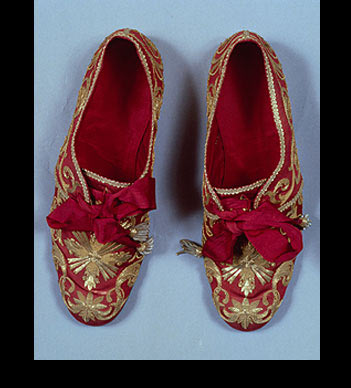
[Cattalan image from artthrob; image of Pope Paul VI’s red shoes from spiritrestoration]
“people fall in love with these creatures”
I was feeling just slightly abashed as I sat in the waiting room of a small-animal veterinarian a few days ago. I was gently cradling Sweetpea, our little green parakeet, slumped in his small clear-plexiglas travelling case, waiting our turn to be interviewed and examined.
To Barry and I our bright, chirpy roommate looked and acted perfectly healthy, but he had not been eating any of his normal seeds for almost a week and we had become very concerned. Other than the receptionist, our bench companions were a woman waiting for her dog to come out of the examination room and a young girl holding a box which sheltered a beautiful small rabbit with an injured leg.
Sweetpea had flown into our apartment two and a half years ago on a cold November day, and this was the first time he’d had any occasion to leave its safety since. He had become precious to Barry and me, but every visit to a pet store was a reminder that his relatives were being traded everywhere in New York for only $9.95.
And then everything in that room changed.
The door from the street opened suddenly and a tall, sturdy young man came in with a container similar to Sweetpea’s, but smaller still. Even before sitting down he addressed the room sheepishly, almost apologetically, “you probably haven’t seen a ‘small animal’ this small before.” In the box was a tiny turtle, a red ear, its carapace perhaps an inch in diameter. The man’s little charge was one of three he had brought home from Chinatown a few months earlier. The other two had flourished and grown considerably, but this little Fred only languished, and his companion thought he even appeared to be shrinking.
Sweetpea checked out fine, and he’s back home now, although he’s still ignoring the food mix which once seemed to make him so happy. He’s also acting more than a bit subdued now, probably because of the trauma of his capture and tranport to and from the East Village by taxi, not to mention some intimate torso-poking and the drawing of blood for tests. But I’m hoping he’ll eventually tire of his current diet of millet and greens, and go on to fill his biblical half score of years – at least – with two people who smile every time they look at him.
I’ve read that those cute little turtles could theoretically outlive their owners, even if they do cost half the going price of a parakeet when they’re very young. I asked the veterinarian today whether Fred was going to make it, and she admitted he didn’t have a good prognosis.
“It’s such a shame; there are so many natural hazards for some species, and only some of them can survive. People fall in love with these little creatures, and sometimes there’s nothing that can be done.”
Chris Martin at Uta Scharf
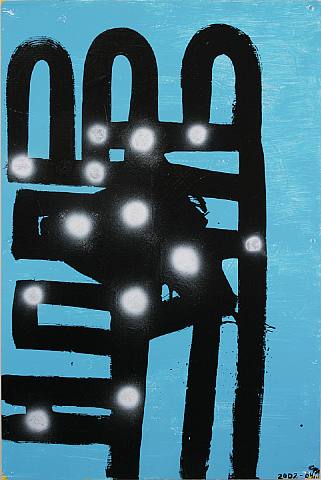
Chris Martin Midnight 2002-2004 oil, enamel and spray paint on plastic
I took this gorgeous image from the website of the Uta Scharf gallery, which is currently showing paintings by Chris Martin. It’s a bit smaller than what I normally like to show here, but this shot looks much better than what I could come up with using available light on my visit this afternoon. Still, I have to say that there’s no way I could try to reproduce many of Chris Martin’s other, signature works on such a small scale.
It was the larger, much larger, canvases which first jumped in front of me a number of years ago, and I haven’t been able to forget them since. Although his 1997 show at Pierogi 2000 had just closed, in the spring of that year I picked up a card at Joe Amrhein’s space whose image was that of two men carrying across a Williamsburg street an extremely large (129″ x 143″) black canvas with a few iconic straight, white, chalk-like lines. The reference was the Abbey Road LP cover, whether conscious or not, but I was certainly hooked. I had to know who this artist was, and while I did a little research, for a while I couldn’t find a live show anywhere.
In 2001 I was finally able to see what I had missed. That spring Martin had, I believe, shows in three separate venues at once, in Brooklyn and Manhattan. I think I might trade an entire salon-style wall of works by other artist if I could afford one of Martin’s big pieces. A few years ago Barry and I managed to claim a smallish canvas at a wonderful something called, I think, “The Cheap Art Show” in Williamsburg. It really was cheap, and we’ve treasured Chris’s [blacklit abstract birds] ever since.
I think he’s a brilliant and materially-spectacular artist. What you will find in the modest space on 76th Street this week is an amazingly rich and remarkably heterogenous selection of his current work, with a couple of pieces stretching toward sculpture. Unfortunately the current show at Uta Scharf closes Saturday, but I’m sure Ms. Scharf would be more than happy to pull out a few pieces from the back room if asked.
In the meantime, please forgive me for uploading so many images here; it was hard enough to stop with just five.
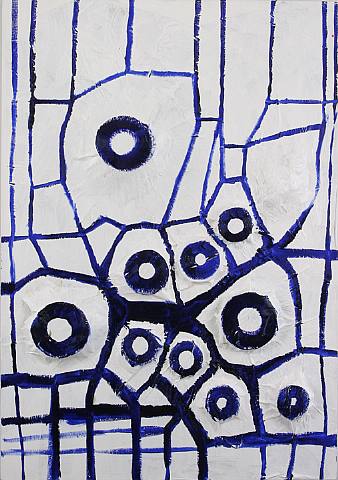
Chris Martin Untitled 2005 oil, acrylic and collage on canvas 43″ x 30″
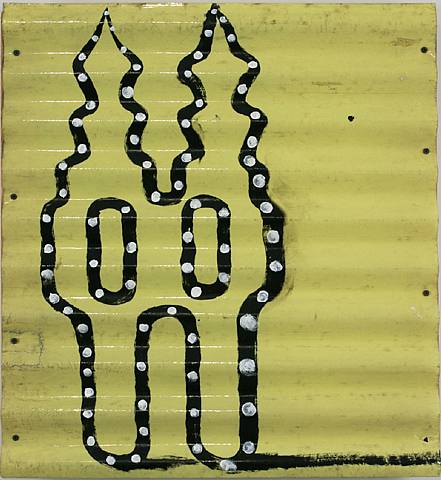
Chris Martin Thirteen (For Ray Johnson) 2004 oil on corrugated plastic 26″ x 24″
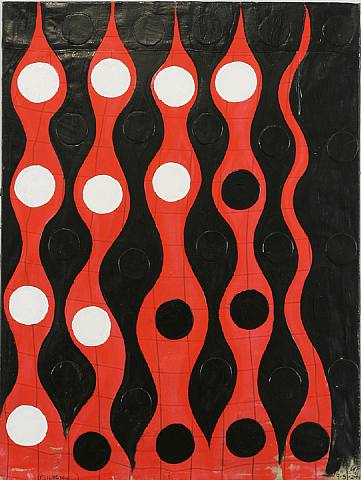
Chris Martin Psilocybin 2004 oil, acrylic and collage on shirt 24″ x 18″
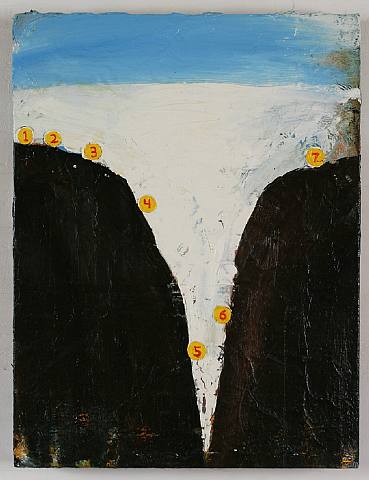
Chris Martin 1,2,3,4,5,6,7… (Ravine) 1987-2004 oil, aluminum foil and collage on canvas 25″ x 15″
[images from Uta Scharf]
“Culture Vulture” at Jack the Pelican Presents
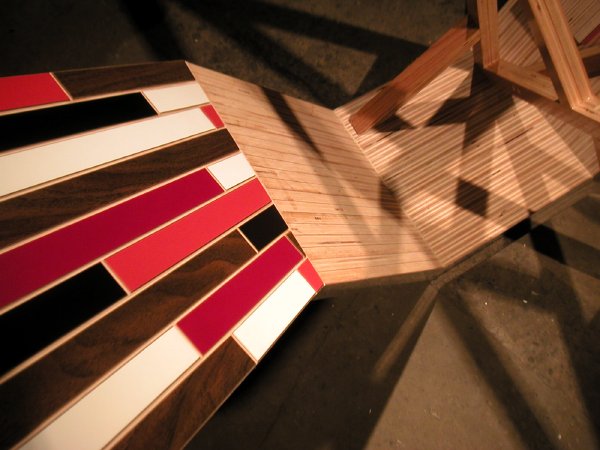
Diana Puntar Dual Disturbances 2004 plywood, plastic aluminum laminates 47″ x 40″ x 60″ large detail of installation
But we found much more than Gae Savannah‘s newest creature extravaganza, a slightly-larger-than-life-size sculpture, “Paroxysm,” at Jack the Pelican Presents this month.
As for the at least slightly-quaint title of the show, “Culture Vulture,” the press release explains it simply:
In 1967, Carl Andre said, “Art is what we do. Culture is what is done to us.” “Culture Vulture” show explores notion that art and culture are not the same thing.
“Culture Vulture” originated in diverse sources: a sixties article in MAD Magazine on the rent-a-beatnik craze; tourists at Hopi villages, buying up all the cheap roadside jewelry like it were the last on earth and gawking at rain dances; revelers at night clubs; late night internet junkies downloading Paris Hilton. The search for culture, or its most immediate facsimile, is a search for identity. Culture is an imposition, or even a virus, that infects us with the need to fill in the blanks.
The crowds at the opening reception for this very interesting group show curated by David Gibson were almost overwhelming, so a proper look at the goodies was very difficult, and for the same reason decent pictures were almost out of the question.
I love group shows; they often open up totally new worlds to the curious. But they also present some difficulties. Aside from the occasional frustrations caused by a look at interesting work which under the circumstances can only be a tease, the problem with installations which can display only a single piece by a new artist is the difficulty the format presents for any kind of fair judgment. In this case however I can already stand by my impressions of the pieces I saw that night by Savannah, Diana Puntar, Karen Heagle, Russell Nachman, Katherine Daniels, Amie Cunningham and Emmanuelle Gauthier (list in formation). Ooops, is it unfair that I am already at least slightly familiar with the work of five of these seven artists? Or am I just demonstrating my point about the challenge of group shows?
Gotta go back, if I can, and do some sleuthing.
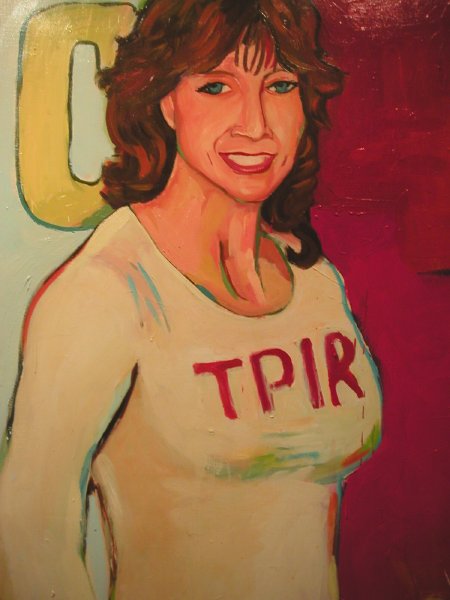
Karen Heagle Holly 2003-2005 oil on panel 53″ x 61″ large detail
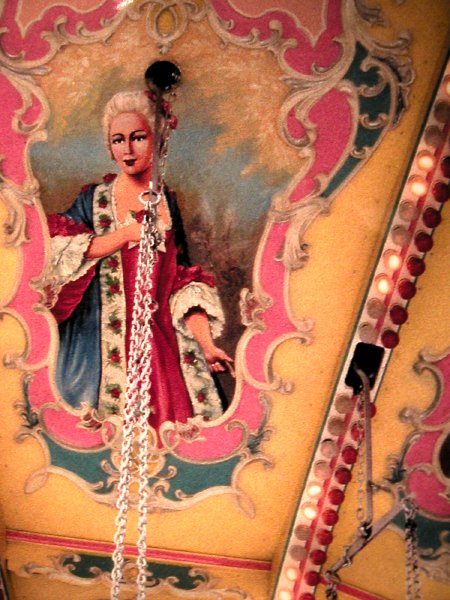
Emmanuelle Gauthier Courtesans 1996 C-print mounted on plexiglas 30″ x 40″ large detail
toward a more beautiful New York
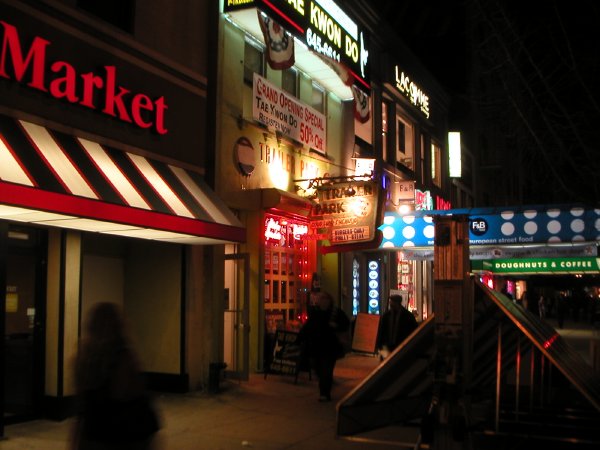
sign race
This was the scene on 23rd Street a few nights ago. Boston Market was installing a long canopy stretching to the curb, presumably to compete for attention with its fast food and fast life neighbors. This miniature Las Vegas is immediately adjacent to our own building, whose storefronts are currently being restored to their restrained, mid-1930’s art deco appearance (including curved glass and awnings that roll out of pockets above display windows). A cab ride home in the rain the other night revealed that this electrified visual pollution is taking over much of the city.
Footnote: When I moved into Chelsea Gardens the buildings which stood where most of these signs are now composed a small row of once-dignified brownstones, the last on our side of the block. By the 1980’s it was clear that they were the victims of malign neglect by absentee owners. Their tenants were eventually removed by one means or another (except for the pigeons), and the buildings slowly disintegrated, their rotting carcasses meanwhile presenting a continuous assault to the aesthetics, health and safety of the neighborhood. Years passed before they were torn down altogether, and by that time only the birds seemed to care that they were gone. The two-story replacements seen in the picture are built of Styrofoam, bent aluminum strips and wallboard. Their property titles are very likely in the hands of the same people who once owned the brownstones.
Meredith Allen at Sarah Bowen
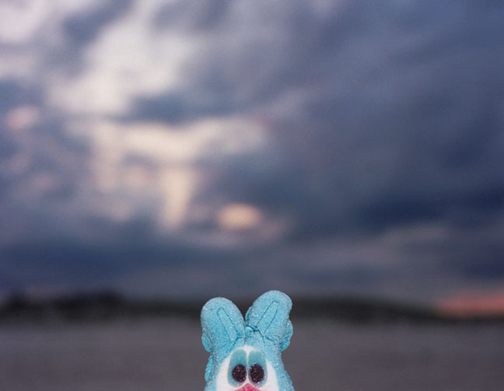
Meredith Allen blue bunny #5 (blue sunset) 2000 C-print 8.5″ x 11.5″
Meredith Allen is showing her wonderfully-inspired combination of concept, color, abstraction and humor in a show of new work, “Forever,” at Sarah Bowen Gallery in Williamsburg.
From the press release:
In Forever, a series of photographs portrays the artist’s mother’s loving yet obsessive collection of beanie babies preserved in found plastic packing materials as well as clear Ziploc bags. The photographs are at first glimpse personable; however the literal and somewhat amusing presentation of beanie babies enclosed in plastic bags becomes more unnerving upon examining the logical yet perverse nature of encapsulation as a cherished act of preservation.
The image at the top of this post is obviously not part of the show, but I wanted to show it here anyway. It’s a favorite of mine. It haunted me from the first moment I saw it, I think because its sweetness didn’t hide a suggestion of mischief, vulnerability, even terror. Blue Bunny is part of an older series, “Sugar Tales.” I don’t think it’s been shown anywhere yet.
Allen’s own site, which was incidently built by Barry, includes many more really great images, both from the current show and of older work, but two of her beanie babies are shown just below.
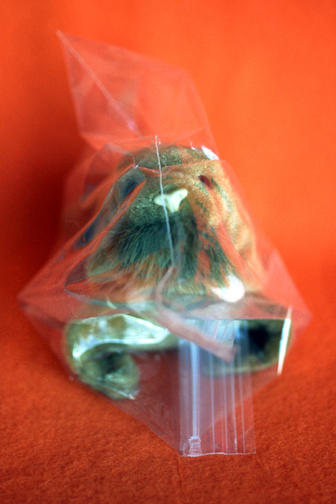
Meredith Allen Forever (walrus) 2005 digital archival dry pigment print 11.5″ x 17.25″
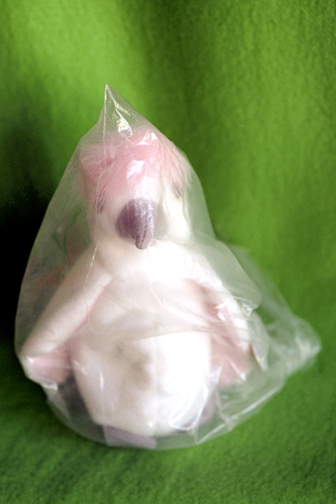
Meredith Allen Forever (cockatoo) 2005 digital archival dry pigment print 11.5″ x 17.25″
[images from Meredith Allen]
my world isn’t mourning this pope
Just call me anti-pope, but the incredible AP story headline looks to me like someone’s fantasy: “Americans Mourning the Death of Pope.” And not to be outdone, their competition, Reuters, has a story with a banner even more over-the-top, “Pope John Paul Dies, World Mourns.”
Now our media will be telling us repeatedly that we’re all waiting around for the appearance of his reincarnation, when his reactionary staff chooses his reactionary doppelganger. With a Dalai Lama at least, the world has an even chance each time he dies off.
I’m just sorry they didn’t plug him in, as I said two days ago.
For a brief starter course on papal malevolence and malefactory, see Buggery.org.