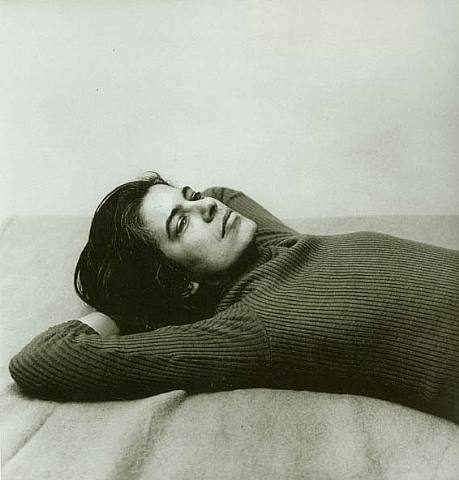
Peter Hujar Susan Sontag [1974-1975]
Susan Sontag died on Tuesday.
Beginning almost twenty years ago I had included her as a part of the homeland I had just adopted and which she had acquired at birth. Because of my profound general “otherness” and two nearly-profound early family dislocations, while it may not strictly fit the meaning of the German das Heimat, my New York City home had come to mean everything for me.
In this Manhattan Heimat Susan Sontag was my neighbor. Physically she really was my neighbor, since she owned an apartment just two blocks away from mine. For years I saw her everywhere in the city, although we never met. Her mind and what she was doing with it had already ensured that she would mean much more to me than an ordinary neighbor normally could. And then one evening I walked through the aura with which I had surrounded her.
I had already seen Edgar Reitz’s monumental first “Heimat,” (most sections twice) when I eagerly subscribed to the first American screening of the thirteen episodes of “Zweite Heimat” at the Public Theater almost twelve years ago.
After arranging myself in the first row for a double feature of two episodes, I noticed that she was only a few seats to my left. Only by coincidence, I had brought her new book, “The Volcano Lover,” with me to keep me occupied while waiting for the lights to go down. I think it was during the break that I gathered the courage to speak to her and ask if she might sign my copy.
I must have mumbled a few words, I hope not too gushing, about how much I admired both her writing and her bold social and political activism, and then we exchanged a few thoughts about the film, all of which escape me now, except that we discovered that we were both enormous fans of both epics. She signed the book, “for Barry and Jim – Susan Sontag ‘Heimat 6&7’ 7 July 1993.”
On every other day I spotted her in the audience she was totally absorbed in conversations with various companions. I was saved from embarassing myself, but I seriously regret the lost opportunities. Gosh, I wish I could have gone with her to Sarajevo, but Barry has written from the heart about how much she became a part of our New York experience, of our own shared Heimat.
She will certainly be greatly missed by many.
It’s late Tuesday night as I’m writing this. The death toll for all the shores around the Indian Ocean, the work of one wave over only a few hours, has now exceeded that of the U.S. military alone in Vietnam over a period of ten years. I’m already recalling Sontag’s unassailable morality, her creative curiosity and her courageous voice as I think about the individual and community tragedies millions of people in southern Asia are enduring at this moment. What would Sontag say about our government’s lame response? Colin Powell is absolutely wrong. We are stingy, very stingy, and we have been for decades.*
*The United States initially offered $15 million in relief to cover all of the nations affected (what we spend on the Iraq war every hour, and a fraction of the estimated cost of Bush’s January 20 Nuremberg rally). Oh sure, after being ridiculed by people in a number of other countries, we’ve now apparently upped our commitment by another $20 million, although that figure is marked as a loan.
Radically contrary to popular U.S. opinion, the amount of our foreign aid, in terms of percentage of gross national product (approximately one tenth of one percent), is the lowest of any industrialized nation in the world. Incidently, Norway’s contribution is proportionately almost ten times that of ours.
[image from Matthew Marks via artnet]
Author: jameswagner
Lutz Bacher and Jesper Just
Two shows, both already gone, both video installations, but I’m not making anything of whatever other similarities they may have.
They are very different artists, doing very different work. Okay, there is singing in each of the pieces, but combining them in one post started out only as a device to make a decent-sized package for the few words I expected to be able to come up with separately for these two artists’ very moving shows. Now I’m thinking that it kind of works.
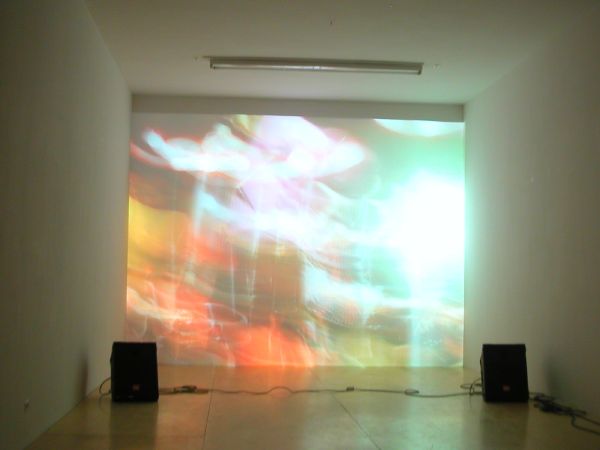
Lutz Bacher Crimson & Clover (Over & Over) 2003 30:00 min video still
Lutz Bacher’s “Crimson & Clover (Over & Over),” shown at Participant Inc. on Rivington Street on the Lower East Side, documents one of the performances within a memorial concert for the beloved art dealer Colin de Land at CBGB some time last year. Of course the video itself also played over and over, but it was continuously mesmerizing and the combination of its abstract and romantic beauty transcended the identities of the performers (Angelblood and others) and even the extraordinarily moving occasion.
The gallery had installed the work on its upper level and the screen occupied every inch of the far wall, top to bottom, from one side to the other. The otherwise empty room became a long, flickeringly-lit box frame for an extraordinary kaleidoscope of sound and light.
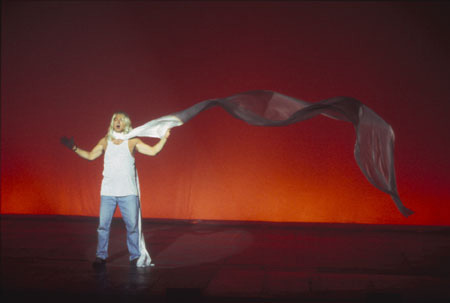
Jesper Just Bliss and Heaven 2004 6:30 min video still
Over in Chelsea Perry Rubinstein had installed three videos by the young Danish artist Jesper Just. The work got a lot of attention from critics and for good reason. I was pretty much taken with each of them, perhaps even shamelesssly, but maybe I’m just very vulnerable to this sort of genuine sentiment when it is mixed so brilliantly with the wacky context established by the artist here.
And great production values, too.
For more on Just, see this discussion and this awesome five-minute video opera.
[second image from Galleri Christina Wilson]
art bloggers in hard print
Wow.
I haven’t seen the January Art in America, but I’ve heard, through subscribers who have already received their copies, about the “FRONT PAGE” article, “Art in the Blogosphere.” The issue still hasn’t reached the stores, and there’s nothing on their site, but I did receive a scanned image from one generous blogger.
Barry writes that I’ve achieved fame in the print media.
[for more on the story see Joy garnett]
This modest site, jameswagner.com, is one of twelve included in a list assembled for the magazine by Raphael Rubinstein, who writes in his introduction, “. . . there are now quite a few interesting art-related blogs. Here is a list, briefly annotated, of those that I’ve found to be worth regular visits.”
My first reaction was shock, especially when I heard how short the list was. When I finally saw it I realized that a number of important people weren’t there. If the list actually means anything, I think it’s quite unfair. I can only explain my inclusion as something of a fluke, especially since I’m “not in the industry” (in the words of a friend who is, Michael Gillespie). Not only do I have no academic credentials in the fine arts, but I’m also neither a working artist nor a critic, I’m not selling anything, and I can buy very little.
I’m a fan.
Then I thought (again, if the list actually means anything), wow!, the blogosphere makes it pretty easy to become slightly famous. Without the financial resources, the connections, real talent or probably even the will to get “published,” a lot of people now see the stuff I upload.
If I can do that, almost anyone should be able to. I wonder if this world is ready for us.
Scary.
But I’m not going to let the pressure get to me. (the audience is hushed here) This is going to remain the very independent, subjective and idiosyncratic arts-politics-and-whatever blog it’s been for two and a half years. With the arts I write only about (some of) the things that please me; with everything else it could be praise, condemnation, plain observation, or just a silly whim. I also try to amuse with decent images whenever possible, while trying to avoid overwhelming bandwidth with their size or number.
Chie Fukao
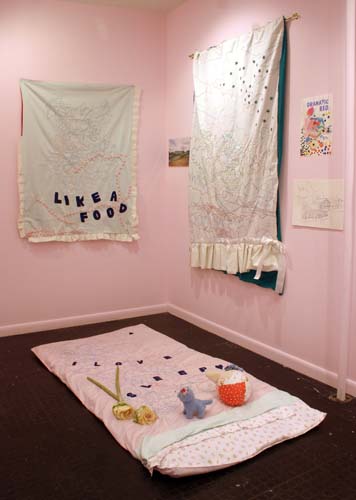
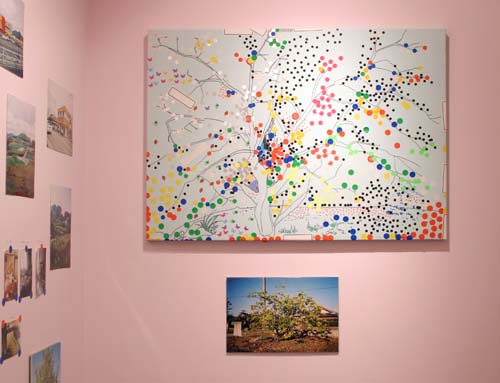
Lital Mehr was holding down the fort at Bill Brady’s ATM Gallery on Avenue B and East 10th Street a week ago when we stopped in to see the first New York solo show of an exciting young Tokyo artist, Chie Fukao. The two images above are details of a gallery installation which almost defies description. The exhibition includes photographs, collages, drawings, sewn clothing and other materials, sculpture, and found objects, some of the pieces the creation of her mother or younger sister.
Several of her works on canvas represent something of a culmination of a process in which Fukao passed one image through several media in succession. Those pieces may be the most sophisticated in a show which has absolutely no clunkers, but on this first visit I was most excited about the softer stuff suspended from hangers or pegs, or left lying on the gallery floor.
It’s a little messy, but absolutely lovely, and you know you’re in a very new world the moment you walk through the door. I’m going to want to see more of it.
In the middle of our conversation that afternoon Lital said something about how absolutely fearless Bill was about taking chances, above all in trusting an artist no less than his own good judgment. She’s absolutely right. We’ve been fascinated watching it happen. It’s what makes ATM so important.
[images from ATM gallery]
the winter happy plant

My mother grew up in a large German Catholic family on a prosperous dairy farm in Wisconsin. Tradition was important, so important that even into her children’s generation the excitement of St. Nicholas Eve, December 5th, managed to give Christmas Eve some pretty good competition.
Having later lived in a very elegant style for a short time in Los Angeles during the late 20’s, and being familiar with the history of the plant’s marketing, she always told us that she didn’t think Poinsettias should have anything to do with Christmas. While growing up I absolutely loved the holiday, but our house always remained Poinsettia-free, just as it stood impervious to the much-advertised charms of shiny aluminum or pastel plastic trees during the peak of their popularity.
Today I’ve shed absolutely any attachment to December 24th (or 25th), but my mother’s attitude toward Christmas has preserved this beautiful weed for my enjoyment. I’ve abandoned the religion as well as the holiday, but I still love occasion and I’m crazy about flowers. The bright red version is still a little too much identified with the celebration of a virgin birth or a visit from Santa Claus, but I really love every other color of the blooms most people think of as the Christmas plant.
This one sits on our dining room table tonight.
I guess this explains a lot
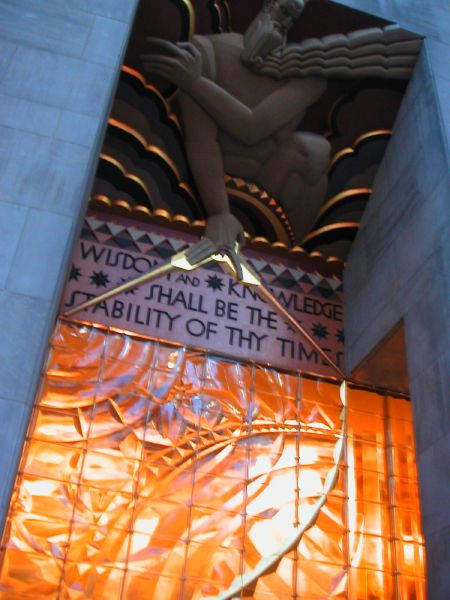
A lot has changed in 65 years. The country which built this great skyscraper now seems to have decided it can do so much better without wisdom or knowledge; we’re in for a very bumpy ride.
I took the photograph at dusk, while walking across town on Monday. The image is of Lee Lawrie’s sculpture relief above the front entrance of the RCA Building (today sometimes thoughtlessly referred to as the GE Building) on Rockefeller Plaza. According to the Rockefeller Center Visitor’s Guide, the William Blake-inspired figure represents Wisdom, who rules over man’s knowledge and interprets the laws of nature. The compass points to the light and sound waves of the cast glass screen below. The inscription is based on Isaiah 33:6
today’s “Europeans,” civilization’s imposters?
“To the whites, the lives of their black office boys or chauffeurs seem unimaginably separate and isolated from their own. . . . But to the urban Africans, the ‘Europeans’ are the ones who seem isolated, in their remote and hidden mansions in the superior suburbs. The Africans no longer feel themselves reliant on white patrons or promoters for their education and cultural development; they see themselves as the heirs of Western civilization, and the ‘Europeans’ as the impostors.”
Anthony Sampson, a British jouranalist and biographer of Nelson Mandela, was writing about the divide which separated whites from blacks in the cities of Apartheid-era South Africa, but today his last sentence seems prophetic on a scale he might not have imagined when it was published in the NYTimes Magazine in 1960: Try substituting the word “non-Europeans” for the word “Africans” and the world won’t look as simple as it might have a moment before.
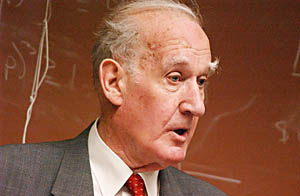
Sampson loved Africa and Africans, as much as he loved civilization and liberty, human rights and social justice. He died on Saturday at the age of 78.
Winter Solstice

Solstice lights
Only now that my birthday has passed (even when quite old, late-December children sometimes remain pretty sensitive about their personal nativity celebratory rites) I can start to think about the pagan Saturnalia, the forest peoples’ Yule or any of the other defiantly-non-commercial celebrations of the return of the sun. I think Festivus could well be included among those observances and entertainments.
I took the image above on this very cold, windy afternoon. It’s a deliberately fuzzy representation of one of the most prominent modern manifestations of hoary early-winter tradition, the fully-lighted Rockefeller Center tree. (I prefer to think that any connection between it and Christian worship is pure invention). It’s a pretty neat sight if you could forget almost everything around it right now. I couldn’t, so I decided the shot had to be fuzzy – and dark. This huge dead tree’s penultimate resting-place environment is not a pretty thing one week before Christmas.
Of course the deco buildings are pretty fabulous, but the several rows of security barricades set up around the tree (they’re gaily painted red and green) and the offensive, vulgarly-omnipresent NBC visual promotions (even during the hours when their storefront studio lies empty) have at least temporarily erased the charm once associated, even in the last weeks of the year, with this wonderful midtown oasis. Cranky tourists and pushy shoppers (and big Christmas tchotchkes in the terraced Channel Gardens) only added to the ugliness today.
I haven’t even mentioned the scary over-amplified “holiday music,” which seems to be stressing out even the normally-unflappable pigeons around St. Patrick’s and the Olympic Tower.
Alright, I’m now back home in my warm cave, so maybe I should be quiet and think lovely thoughts. Happy Solstice everyone, and many happy returns!
today’s MTA photo ban protest

my own rather lame sign, as seen somewhere in the system this afternoon
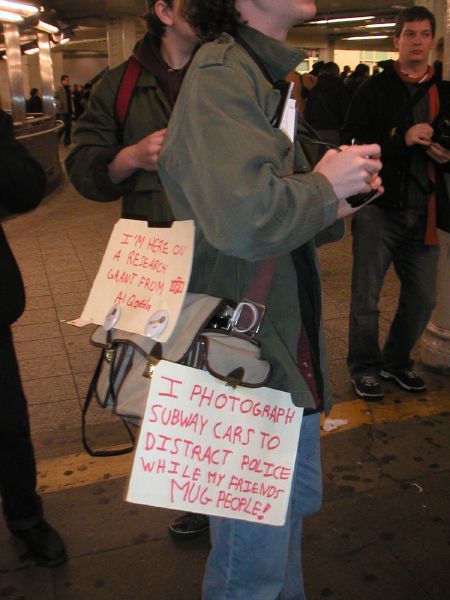
(the sign on the guy’s left reads, “I’m here on a research grant from Al Queda”)
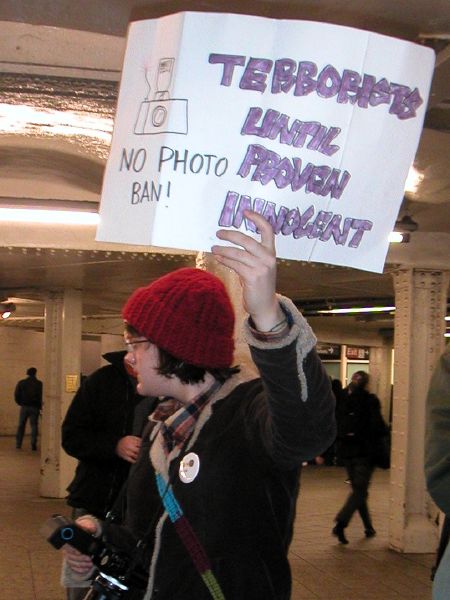
this sign became a moving beacon for today’s odyssey (the stylized font reads, “TERRORISTS UNTIL PROVEN INNOCENT”)
The second time around it had already seemed a little routine. Some of the wonder and energy which had accompanied the first MTA photo ban zap was missing this afternoon, but I have to admit there were a few sassy-sarcastic signs this time, and there was even something resembling an information handout.
We’re getting better at broadcasting the issue, but actually I’d be very happy if we never had to do this thing again. Will the MTA come to its senses?
Perhaps not, if some of the sentiments of subway users overheard today mean anything. One woman, although a little sympathetic to our argument, was seriously worried about the threat cameras pose to the privacy of riders. While she was speaking to me, standing on the subway platform, I snapped the picture below and pointed out what had attracted my attention. She had nothing more to say.
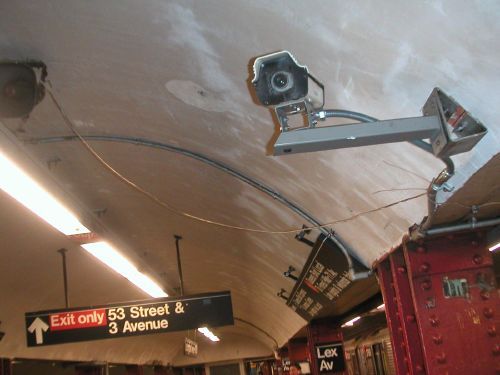
[image at the top of this post from jpreardon.com]
“Black Box BRD”
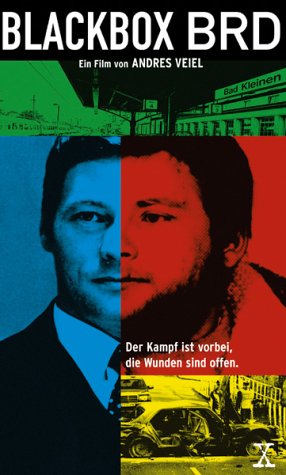
“Der Kampf ist vobei, die Wunden sind offen” (“The battle is over, the wounds are open”)
The 2001 German film, “Black Box BRD,” is in a documentary form, and it uses the Baader-Meinhof/RAF story as structure. Barry recently found it in a regular Sundance Film Channel email and recorded it. He had thought the human story (one victim and one activist, along with the people who knew them) was fictional and that is what he had told me.
Okay, even if we’re both pretty familiar with German history and German culture, maybe our memories for news names and disasters is somewhat wanting, because only after we finished watching the film this evening and did some on-line searching did we find that it was entirely based on fact. It sure makes a difference in how one sees the “actors” if only later do you realize they were playing themselves. Now I find myself running most of the scenes of the film through my mind over and over again.
I thought it was an interesting and pretty successful attempt at making its two historical extremes sympathetic. The Deutsche Bank honcho ends up as an idealist, not so far from where the young revolutionary began, and the revolutionary just may have lost his soul before he died.
But in the end I’m not sure that it makes much difference to my appreciation of the filmmakers’ accomplishment whether the characterizations of the two protagonists is accurate or not. Neither Alfred Herrhausen nor Wolfgang Grams are really important as individuals to most of the members of its intended audience. What may matter to us most is the gift of imagining for a moment that the archetypes they represent might be more complex than what is usually presented to us.
[quote appears on the film’s website homepage]