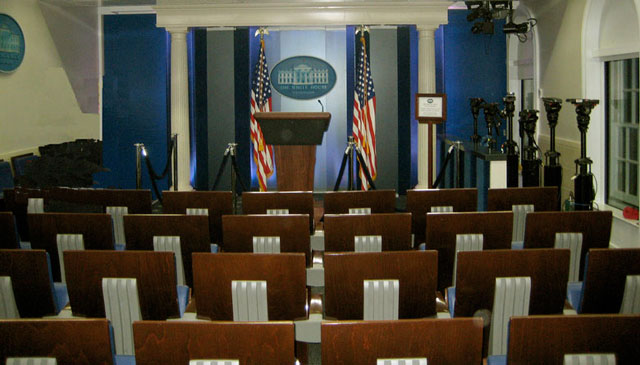
if he’s not going to come by anymore, why not bring back FDR’s pool, or put up a parking lot?
Sure, I know it’s not a race, but I did beat (scooped?) the Times again, although by only slightly less than a week this time: Obama hasn’t held a press conference since July, as I wrote here. However if you read this story by Peter Baker in the Times today you’ll get the impression that it only means that our current President is being hip, that he’s found a better way.
What he’s found, the article tells us, is a media strategy that works for the White House. Baker doesn’t bother to address whether it works for his own profession, or for the public, whose only window onto the doings of our so-called representative government is a vigilant, independent press.
I’m certainly anything but a part of MSM, but it doesn’t make me feel any better about this president’s relationship to the press to be told that he has a more generous understanding of what constitutes “the press” than did his predecessors. Obama may be, as the Times headline puts it, “taking questions”, from other than the wire service, print and broadcast reporters who work inside the White House, but he’s doing it on his terms, and those terms have been dictated to us.
Addressing “alternative” media alone does not satisfy the public’s need (and a free republic’s requisite) to see that reporters of all kinds are able to freely ask their own questions, not those induced by an officeholder, and in a forum and at a time not engineered by that same public servant.
[image of the renovated James S. Brady Press Briefing Room at the White House from visitingdc]
Author: jameswagner
an IDIOM: a conversation with Salinger’s ghosts
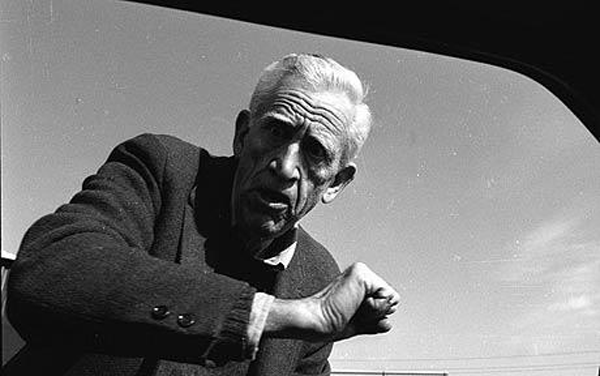
just how much could it have hurt?
I know I’m one of the publishers, and so it may not be quite proper for me to sing the praises of the online arts magazine Barry and I introduced late last summer, but I’m going to risk it anyway.
Although so much else of IDIOM is just as good or even better, because of its particular timeliness and its unexpected format I wanted the conversation between some of the publication’s writers, “On the passing of J.D. Salinger“, which we published yesterday, to get more attention than it might otherwise attract.
So consider this a flag.
The spirited short piece is nothing like the fulsome academic discourse available almost everywhere this week, and you’ll feel like you’re sitting in the room with the three young participants – even contributing to the conversation. The voices you’ll hear are those of Alice Gregory, Editor Stephen Squibb and Jessica Loudis.
While you’re at the site, take a look at the latest posting, which is equally timely, “Art and Culture in Haiti after the Quake“, by Hong-An Truong, and browse through the still-modest-size archives.
My own two cents about Salinger’s “The Catcher in the Rye” is the thought which came to me almost immediately after hearing about Salinger’s death: I don’t mean to minimize the importance of what he accomplished back in 1951, but, as a gay boy the year it was written, and a gay young man when I finally read it, “Catcher” never quite resonated with me in the same way it did with others. It seems to have attached itself to the psyche of many of my approximate contemporaries, or at least the straight, male, white, middle to upper class types.
Today I’m no longer gay; I think of myself as totally queer instead, but I can remember what it was like when being gay meant dissemblance, invisibility, powerlessness, desperation and, for “practicing” Catholics, eternal damnation. I’m now more than cool with my orientation, in fact I consider it a strength in almost every way, and I’m definitely no longer totally alone with it. So maybe I should try once again to make Holden Caulfield’s acquaintance: His own much-analyzed disconnect looked pretty trifling to me at a time when the the whole world despised my, literally, unspeakable differentness and when I would have been crushed in an instant had I revealed myself.
This last thought can only serve as a footnote, and I don’t want to make too much of a purely personal irony, but I can’t help noting that, at roughly the same time I began emerging from a closet to which I had been condemned by others, J.D. Salinger shut himself up in one of his own construction. It’s his odyssey that still baffles everyone.
[image from the Telegraph via IDIOM]
so how about a frakking presidential news conference?
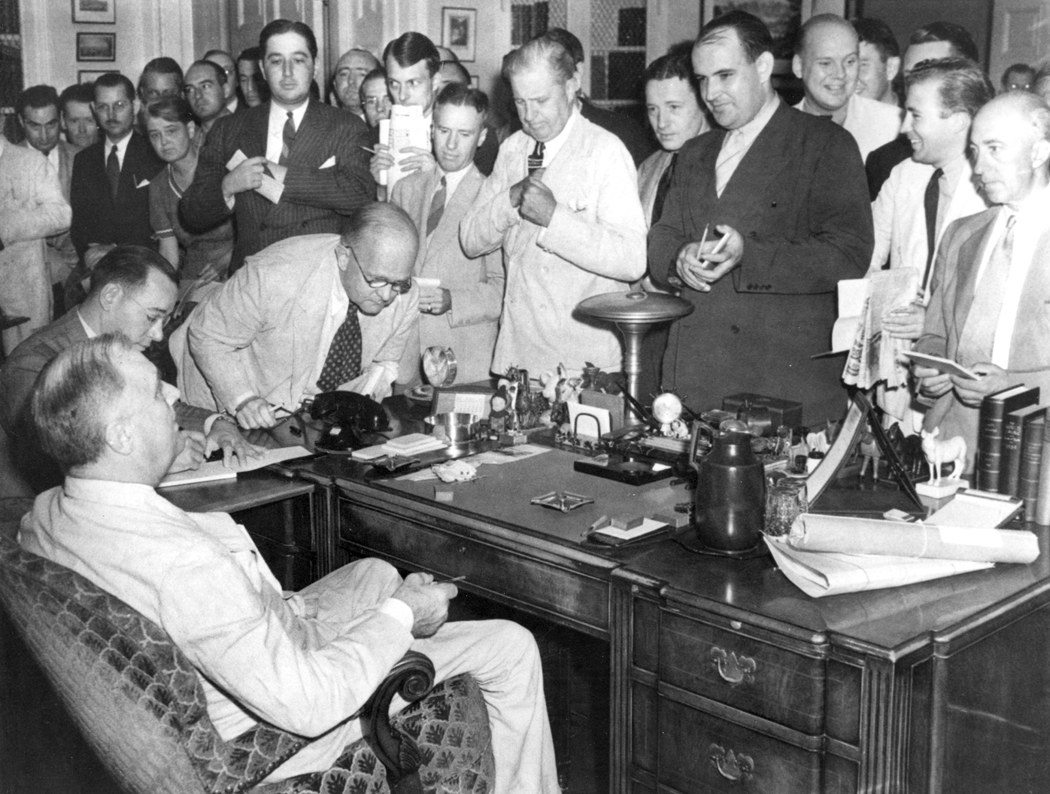
FDR talks to the press; the press talks to FDR
I was only slightly confounded to realize I had no interest in watching the speech last night; didn’t even think about recording it in case it turned out POTUS actually said something. When it comes to a corporate one-party state, I guess I make a bad subject.
And I’m old-fashioned: As unsatisfying as they may almost always have been, I still have some good memories of actual Presidential news conferences. Not recalling the last time I had heard of one, this morning I went on line looking and found that Obama hasn’t had a press conference in six months.
Transparently nontransparent.
[image from swamppolitics]
Hunter College 2009 MFA thesis exhibition – continues
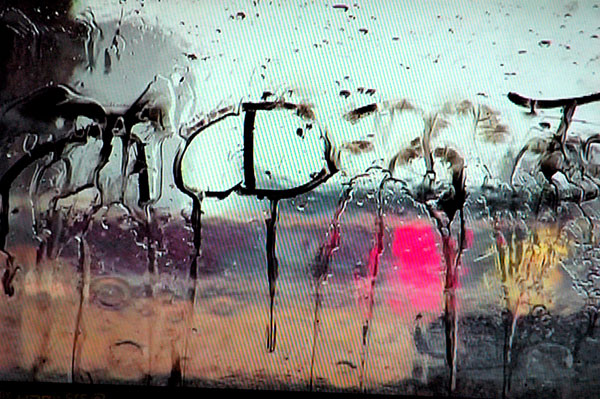
Ezra Wube Amora 2009 [large detail of still from video installation]
Barry and I visited the fall 2009 Hunter College MFA Thesis Exhibition galleries twice last weekend, and we both agreed it was probably the best collection of their MFA program artists we’d seen. We had been asked to be a part of a “walk through conversation” with the artists and others on Sunday, along with Paddy Johnson of Art Fag City and artist Clive Murphy and we had gone up to 41st Street to preview the installations the day before.
The “show” is definitely worth a visit. We made it a “top pick” on the ArtCat calendar, partly because of the opportunity to see work by artists who may not yet have shown in galleries, and because of the challenge it offers in seeing the work “raw”, without the interventions of galleries, press releases, curators, or even, in most cases, identifying labels. The exhibition has been extended through Tuesday, January 19. Details are here.
The Hunter Times Square Gallery is not normally open on Sundays, but tomorrow at 3 pm there will be a panel discussion in conjunction with the MFA show. It will be moderated by Katy Siegel, Professor of Art History at Hunter College, and the guest panelists are Bob Nickas, Gabrielle Giattino, and Oliver Herring.
I’ve uploaded here a small number of images I took on Saturday. The complete list of artists includes Courtney Brecht, Meredith Davenport, Jared C. Deery, Allison Evans, Peter D. Gerakaris, Vivienne Griffin, Nathan Gwynne, Paul Helzer, Ellie Irons, Darren Jones, Yashua Klos, Noah Landfield, Lori Merhige, Dave Mishalanie, Jo Q. Nelson, Alta Price, Sarada Rauch, Rebecca Simon, James Weingrod, Ezra Wube, and Seldon Yuan.
It may be a wrong call, but I’m going with a translation of the title of Ezra Wube‘s video which suggests the role of “teacher”, giving me an excuse to use it at the top of this post describing a magister program in the fine arts.
Wube was not at the walk-through, so there was no exchange with the artist, but I had been drawn into his multimedia installation on a visit to the galleries the day before. Today I was streaming WQXR2 while I watched this luscious, semi-narrative soundless video, “Amora“, once again, this time on line. Just as the video started so did a recording of Kyle Gann’s “Etude No. 4: Folk Dance for Henry Cowell“; then, when the image shifted from words to figures, that player piano piece was succeeded by Olivier Messiaen’s “Fantaisie burlesque“. A perfect, serendipitous cross-disciplinary, interactive invention, although impossible to produce in the gallery, or reproduce anywhere. [large detail of still from video installation]
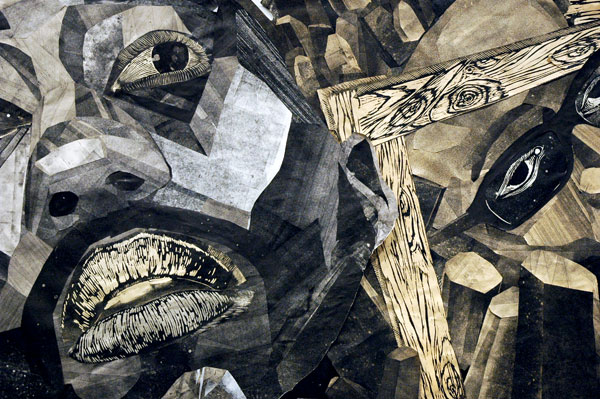
Yashua Klos‘s dense woodblock collages reveal their handsome portraits, sometimes only reluctantly [medium detail]
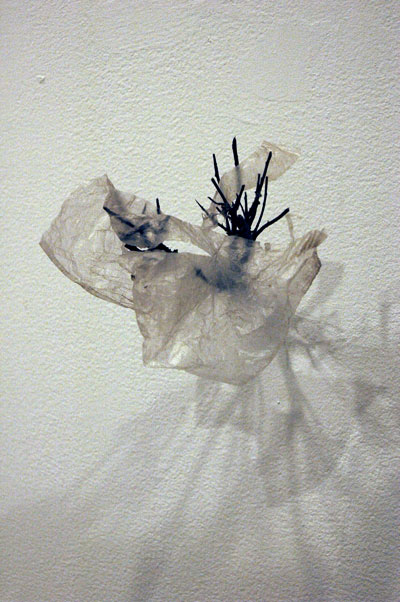
Ellie Irons, in a number of installations which include abstracted drawings of rivers, deltas and watersheds, along with reconfigured found organic materials, and the litter which is attracted to them, addresses our “attachment” to our environment, both the gifted and the corrupted. [detail of one element in the installation]
Nathan Gwynne‘s work is almost audible: “The Rhythm Method”, his installation of colorful drawings in pencil, gouache, acrylic, pastel and collage, and his freely-worked sculptures reflects the artist’s percussive music projects outside the academy. He’s gotten my attention there too. [large detail of “Greatest Hits”]
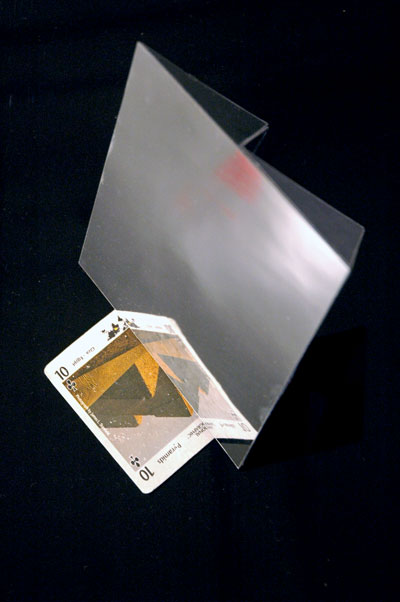
Vivienne Griffin’s work, while executed in a number of media, has an intense affair with film, although always in an extremely oblique way. [detail of installation]
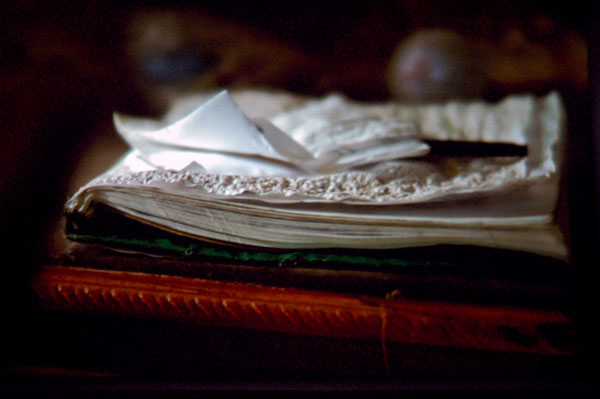
Paul Helzer’s richly-colored and lighted video documents a roughly-hewn cabin, paradoxically constructed entirely inside his white studio, which is oddly-alluring and almost surreal. It’s fully-occupied by a sound design as compelling as it is mysterious. [large detail of video still from installation]
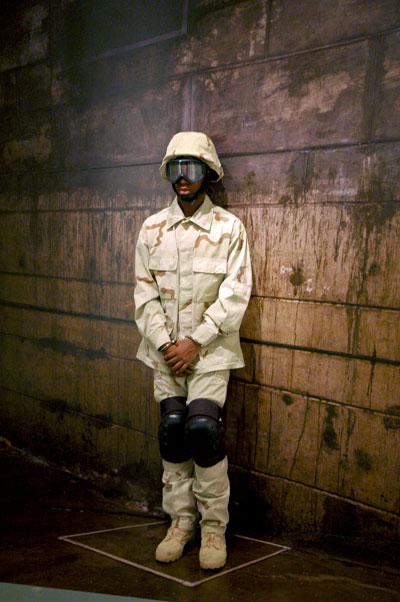
Meredith Davenport‘s installation included a revolving cast of live “stand-ins” (in several senses of that compound) and a more obscure element involving a looped video on a small monitor vis-�-vis with the printed-photo “stage”. In a country where war reenactments of all kinds and all periods manages to thrill millions, it was a show stopper, even for visitors less attuned to “art which is political” than Barry and myself. [large detail of installation, including performance]
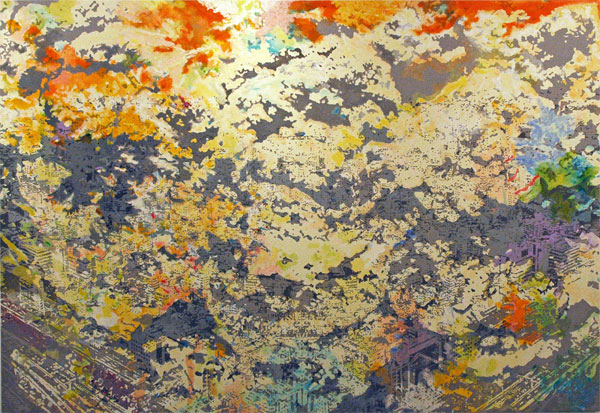
Noah Landfield‘s spectacular city/landscapes describe scenes which may be understood as gloriously celebratory or unambiguously apocalyptic. Only on Sunday did we learn from the artist that each of the paintings began with his own photograph of sections of specific Japanese cities.
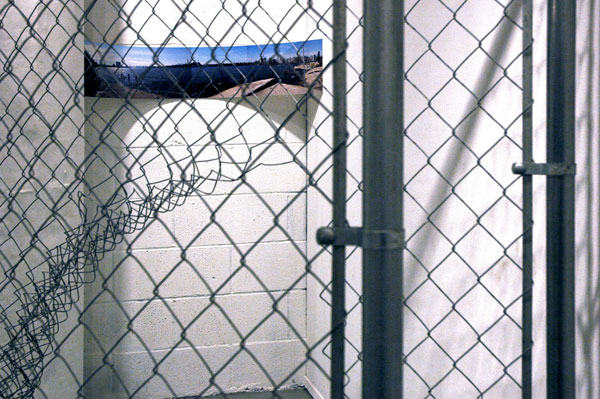
Jo Q. Nelson‘s sculpture and installation project has an important interactive element, involving her interviewees’ understandings of place, addressing their relationships with familiar private/public spaces. [detail of one element of the installation]
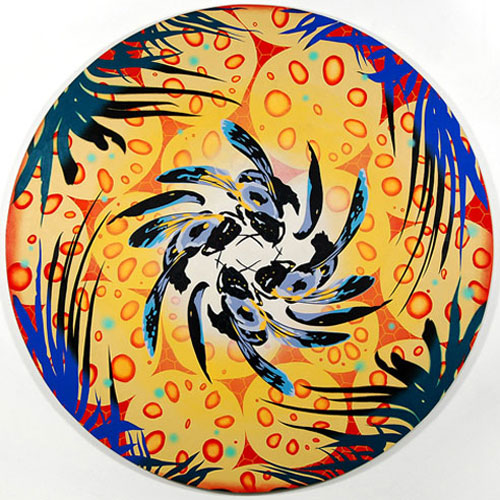
Peter Gerakaris straddles town and country, in his background and in his art, where he weaves natural and constructed worlds into unstable electric relationships inside his compelling, almost tantric tondos.
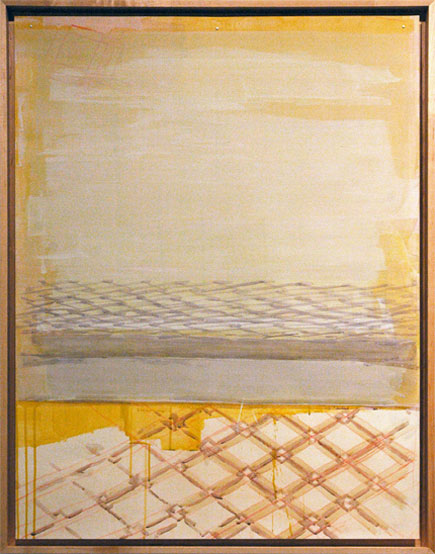
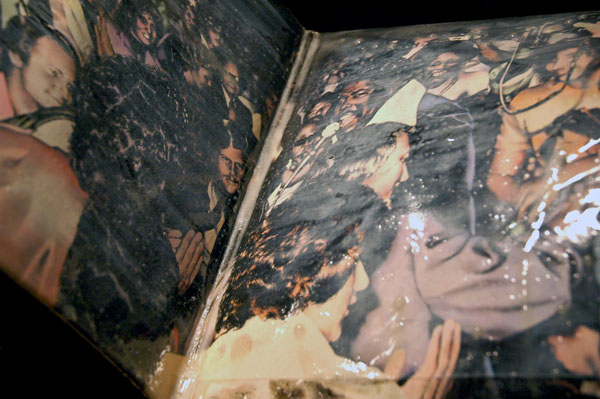
Dave Mishalanie resurrects the records of long-gone innocent, or at least ambiguous, intimacies between men in a large, very beautiful installation inspired by found images, artifacts which had been crinkled, faded or erased, re-contextualizing them among gorgeous abstractions picked out from the patterns of old fabrics, also found. [detail of installation]
NOTE: In a gallery just inside the entrance to the MFA Building and the Thesis Exhibition is an installation of work by Mathew Spiegelberg, who was a part of the 2009 class but who died on April 18th last year, after falling between two New York subway cars.
[image of painting by Peter Gerakaris from the site of the artist]
Joanna Malinowska at CANADA
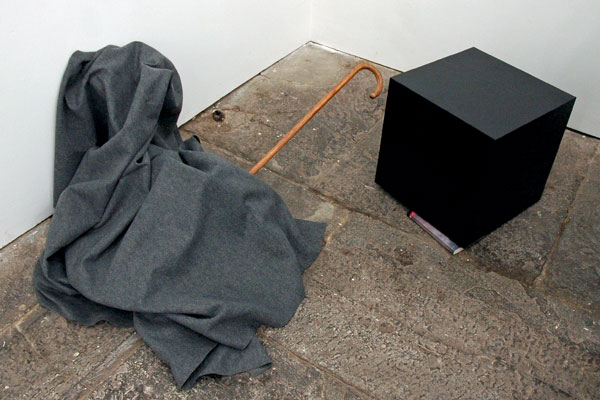
Beuys’s cane continuously raps on the surface of Ustvolskaya’s percussion box, one corner of which rests on a copy of Castaneda’s “Don Juan”
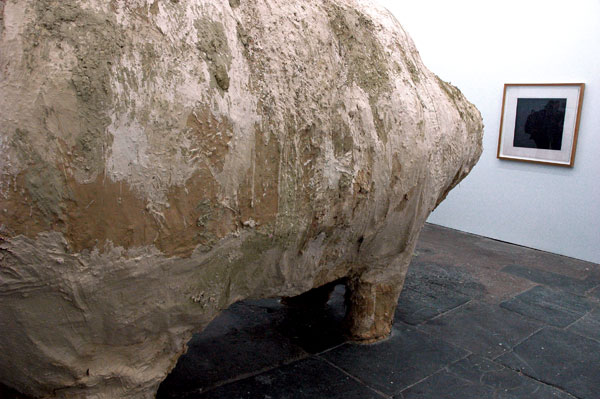
the hugely-outsize Boli, constructed of sacrificial materials, including one of Evo Morales‘s acrylic sweaters, contemplates Malinowska’s replica of Malevich’s “Black Square”
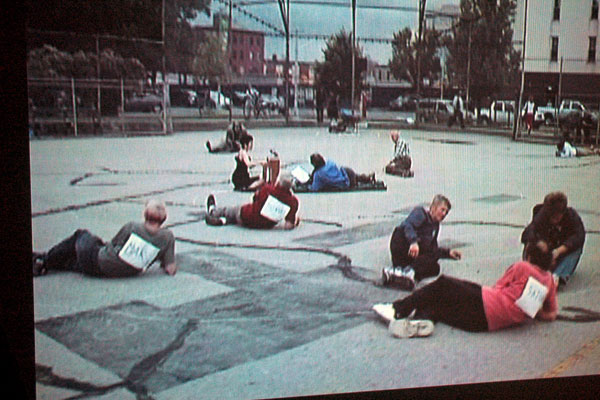
a group of slightly-scruffy habitu�s of McCarren Park “performing the Solar System model falling apart”, accompanied by toy piano, in a video using Messiaen’s “Visions de l’amen” as sound
Joanna Malinowska has installed her own aggressively-idiosyncratic diagram of the universe, “Time of Guerilla Metaphysics“, inside the two gallery spaces of CANADA, on the Lower East Side.
It’s not a simple walk-through show. A certain amount of attention has to be paid when the universe is being re-imagined. Its appeal may only develop slowly, at least partly because it’s surfaces are largely brown and gray, and because its pieces echo the diversity of Malinowska’s model, the universe itself, but ultimately the installations, both separately and together, register as powerful, tantalizing, and, ultimately, deliciously enigmatic. Their mysteries mirror the artist’s sources themselves, which include traditional West African totems, Joseph Beuys, Copernicus, Mammoths, Galina Ustvolskaya, Oglala Sioux dance, Spinoza, Kazimir Malevich, Evo Morales, and Brooklyn�s McCarren Park.
I left the gallery thinking that visitors to this, her second New York show could only be scratching the surface of this artist’s creative imagination.
Man Bartlett’s “24h Best non-Buy, a Performance”
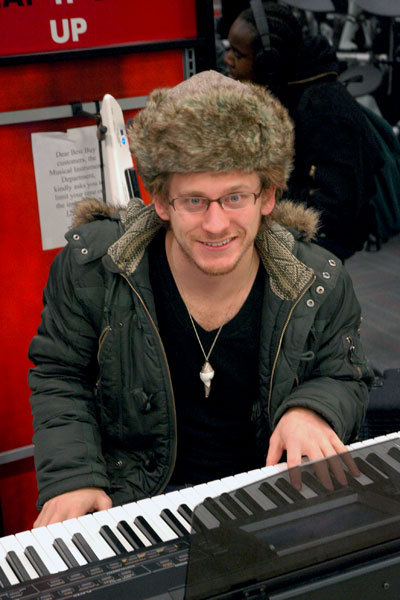
This sort of thing is why I don’t despair of the art world.
It’s almost 6 o’clock, and that means the artist Man Bartlett is about to complete his “24h Best non-Buy, a Performance” inside the aisles of the Best Buy store in Union Square.
Barry and I learned about the piece through Twitter, and Barry was able to follow that traffic all afternoon. There’s also this. I visited Bartlett in person around three o’clock, on my way home from the Greenmarket. He told me that the going had been tough at times, mostly during the middle of the night, when he may have been the only “customer” in the store, but that security had been pretty cool. He also said that he fully expected to be able to leave tonight at 6 without having bought a thing.
While talking to him I learned that he had recently been asked to be a part of the residency program at the Flux Factory.
The more I learn about this artist’s work the more I find I want to know. I’m pretty sure we will all soon have that opportunity.
There’s much more, from Hrag, on Hyperallergic.
our security lies not in the TSA, but in ourselves
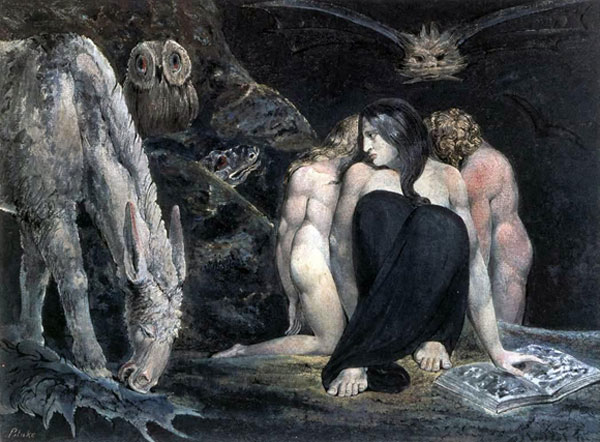
William Blake Hecate or the Three Fates 1795
“The fault, dear Brutus, is not in our stars, but in ourselves, that we are underlings.”
[Cassius, in “Julius Caesar”, Act I, Scene II]
The stars, the fates, Hecate, Parcae, Fata, the norns, the three sisters, they’re us, and we should start acting like we know it.
The Transportation Safety Administration can’t give us security; it’s in our hands. All of the grotesque, costly, and invasive measures the TSA has already introduced, or might still introduce, are only reactive, and cannot match the efficacy of the initiatives which a look at the broader geopolitical picture would demand. We should also remember that all the current fuss is about passenger air travel, which is only a tiny portion of our national security responsibilities.
The only comprehensive security measure that makes any sense, and which incidentally would be acceptable to, if not applauded by, the entire world (including air travelers everywhere) would be an elimination of the cause, not a continual search for the effect of the intense resentment and hatred behind suicidal and other terrorist acts.
We should begin by looking at ourselves as others see us. We should end all of our current, totally optional wars, close the U.S. military bases and operations currently located within�well over 130 countries, and begin to show a decent respect for the cultures of other peoples.�
Of course it would also be helpful if we could actually bring ourselves to extend real foreign aid, not military hardware, and only where it can be constructive, not where we believe we can buy love or increase our own wealth.�
[image from poor old dirt farmer]
chartreuse holiday lights, good as gold
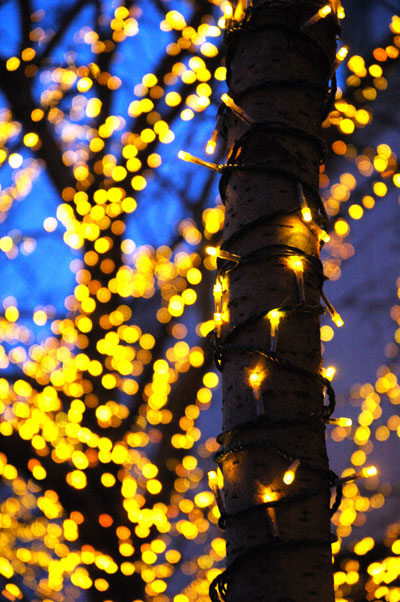
A few days ago, unable to entirely escape the sometimes forced jollity of the season while walking about the City, I found myself casually thinking about the number of color schemes that could be drawn on to celebrate these December holidays (or decorate things which already had perfectly respectable aesthetics) – and also the hues that couldn’t.
The decor I had in mind at the time was mostly that which attaches to the traditional, Christmas-inspired parts of these celebrations, and the colors which even in the mixed societies of today still seem to dominate the December palette, even in warmer climates, where balloons are sometimes pretty Christmas-y.
I decided in my head that, at least when it comes to monochromatic lighting arrangements, orange was certainly out, if only because orange was so important to some major October and November holidays. I think I had also eliminated bright yellow, and hadn’t even thought of chartreuse, so I was pretty surprised, coming out of Chelsea Market two days ago, to come across thousands of these tiny chartreuse lights fixed to every surface of the trees planted just west of the raised terrace of the Maritime Hotel on 9th Avenue.
I decided they were probably actually yellow, or gold, that it was the bright blue light remaining in the sky that was tinting them a bit chartreuse. By the time I got closer and captured this image the sky had darkened a bit and they no longer looked anything but gold. I now determined that one way or another, gold goes with almost everything, including (let’s hope for all of our sakes) this brand new year.
Chelsea hats, crazy wigs, and Serigne, New Year’s 2009
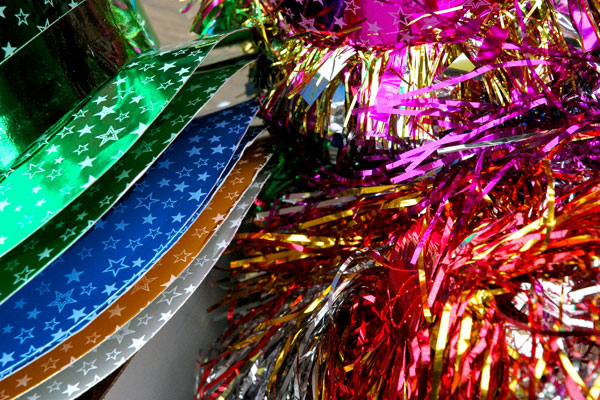
I passed the stand set up on the corner of 7th Avenue and 23rd Street. It was late last evening, windy and bitterly cold. The two vendors were selling New Year’s Eve party hats, light wands, and noise makers. I had already passed them by when I stopped to think about checking out the merchandise. My arms however were already juggling several heavy bags of food, so I decided I’d go back today to pick up something for a occasion to whose observance I’ve never been indifferent.
I’ve saved stuff from past years when I thought something was a little more special than most of the ephemera manufactured for this ancient holiday; I could recycle the old tin horns and such, but I probably needed some fresh party streamers. Then I asked myself, should I also get two pairs of 2010 spectacles? I’d never worn the silly things before, but this just might be the very last year for that classic template.
Aside from satisfying my needs, or encouraging last-minute buying impulses, I was looking forward to seeing what I expected would be a colorful array of merchandise (bring the camera!). It hadn’t occurred to me that the market experience, the bargaining between customer and seller would itself have been a powerful draw.
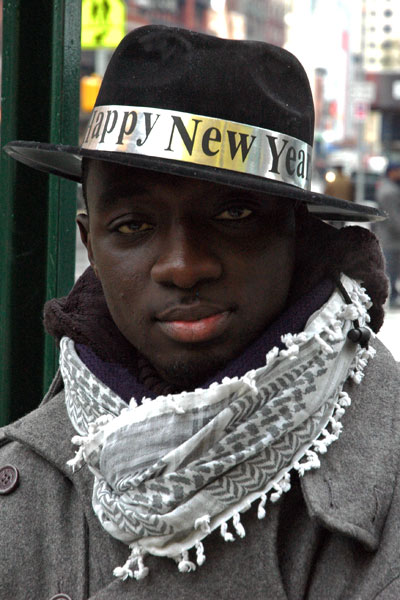
I didn’t see any streamers, and I didn’t spring for the glasses, but Serigne gave me a good price on two outrageous tinsel “wigs” (I might have some work in persuading Barry to wear his). I had already asked Serigne if I might take a few pictures of his table display, and he was kind enough to ascent – even without the condition that I make a purchase, although he encouraged me to do so. I heard him talking to the woman he was with, who later told me he was her son, and I was mesmerized by the cadences of their speech. I asked what language they were speaking, and they told me it was Wolof, that they were Wolof, from Senegal.
Serigne suggested I take a picture of his hat. It was one of the many models arrayed accross the table, but I doubt it could ever look as good as it does on his own handsome head.
Chelsea winter garden

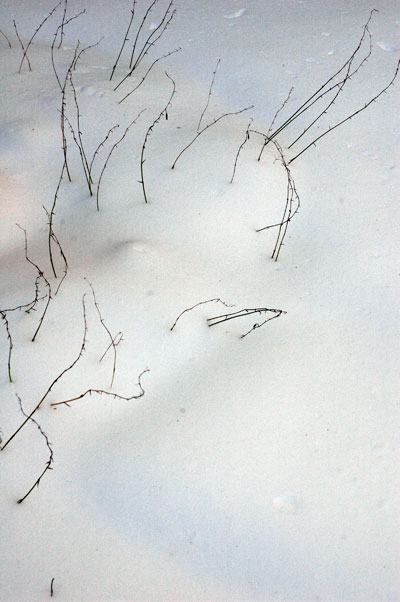
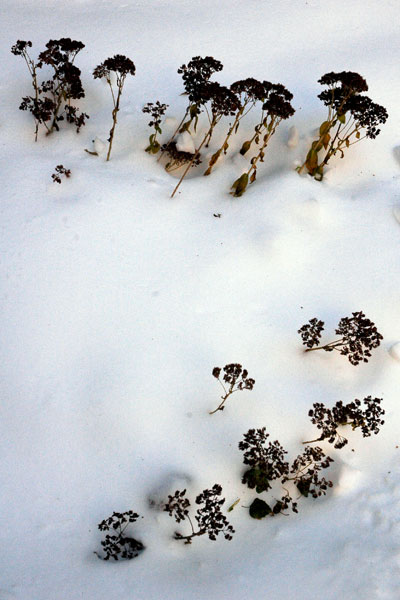
The beauty created by a heavy snowfall is even more exceptional for its certain evanescence – although a camera can still try to keep it from vanishing.
This afternoon, 24 hours or so after the snow had ended here, I took all three of these images in the central garden of our building, but the pair which appear below really want to be together.
 |
 |