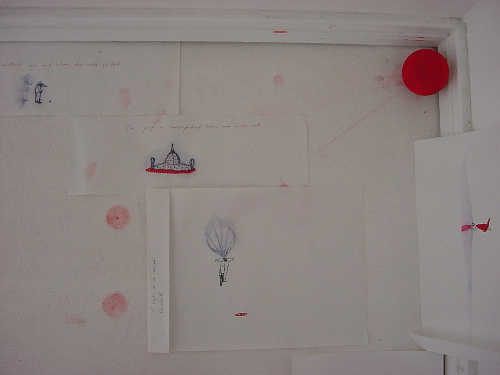
installation view of, among other things, a giant clown nose
The work of Fernando Carabajal has haunted me since we saw it in Mexico City late last month. Fresh, charming, quirky, and each piece a beautiful, microsmic reading by a very interesting artist.
I wanted to post something about this young Mexican from the moment in late January when we saw his work at the beautiful Galeria Nina Menocal, but at first there were no pictures available on line, and then when there were, Barry beat me to it with his post eleven days ago.
Now we’ve gotten a few more images from the gallery, but none of them can say as much as did our visit to his installation in the gallery’s project room on the roof. Fortunately we should all be able to visit his wonderful clowns, elephants and other serious fun – the real things – at The Armory Show next month.
Author: jameswagner
letting there be [wonderful] light
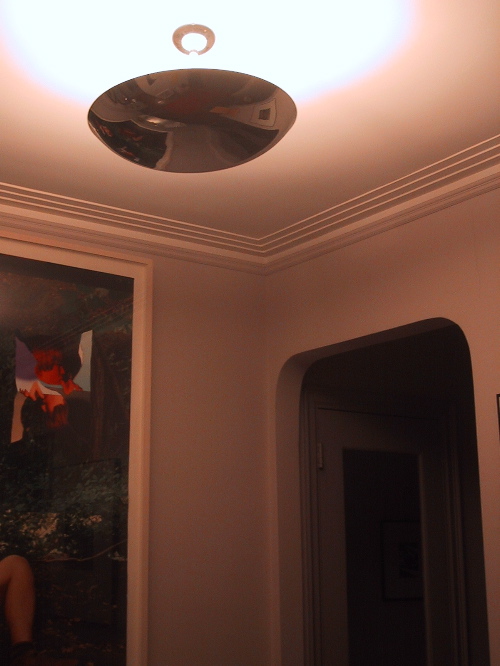
the Lescaze ceiling fixture in the small gallery
The 16 inch in diameter chrome-plated brass lamp was designed by William Lescaze for his 1938 Garrett A. Hobart III house, now destroyed, in Tuxedo Park, New York. See yesterday’s post, “scuttling a great building”.
“Buy your own president!”
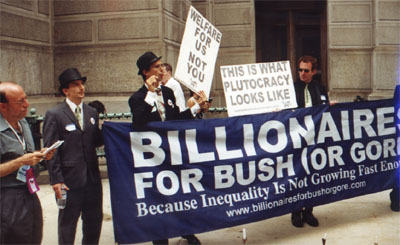
Billionaires for Bush at the 2000 Republican Convention
Count me in!
It’s going to be a very interesting summer in New York.
We couldn’t make it to last night’s fundraiser, but we certainly want to catch up with this fabulous group. Politics, maybe it’s not just for those other guys any more!
Karl Rove attended a moneyed Bush election event at a nightclub on 24th Street last night, and it wasn’t always easy telling the hellfunders from the hellraisers. The NYTimes reports that even some of the demonstrators were confused for a while.
“Fabulous, fabulous,” Mr. Rove said as he left after giving a 20-minute talk to several hundred people gathered inside [and collecting about $400,000 for the Bush-Cheney campaign].
But while Mr. Rove was inside, more than 100 protesters were outside, standing behind blue police barricades chanting slogans, waving placards and offering a bit of street theater that confused the police.
At one point, as hundreds of guests with invitations waited to pass through velvet barriers to enter the club, a small group of men in bowler hats and women in gowns marched up, chanting, “Four more wars” and “Re-elect Rove.”
As the group approached, a man who appeared to be a security agent of some type, was overheard whispering into a microphone: “We’ve got two groups. One for and one against.”
Actually, it was two against. The person was confused by a group that calls itself Billionaires for Bush, a collection of activists who use satire to make a political point. Indeed, members of the Sierra Club, who were protesting on the other side of the street were also confused and began shouting at what they thought was a pro-Bush contingent.
” We want the truth and we want it now!” the Sierra protesters shouted.
The billionaires shouted back, “Buy your own president!”
It took a few minutes, but the police finally realized what was going on when they escorted the group behind the blue barricades as well. Still, the show was not over. A black town car pulled up and out stepped a man whom who the crowd assumed to be Mr. Rove. “There is Karl Rove,” people shouted.
Reporters, photographers and television cameramen swarmed the man, but the police pushed them back. Another man lifted the velvet rope to let him enter. But the would-be Mr. Rove walked over to the crowd of protesters and began shaking hands, when finally, again, this was seen to be a joke. It was not Mr. Rove, but an actor playing the part.
Each of the groups has said it planned to stage similar events when the Republican National Convention comes to New York City from Aug. 30 through Sept. 2.
By the way, what’s this thing with Bush, and now Rove, regularly waving the adjective “fabulous” around like only the good fairies have been doing for years. It’s raising some fabulous eyebrows.
[image from Dru Jay at Monkeyfist]
scuttling a great building
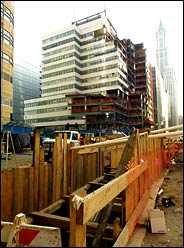
William Lescaze’s Fiterman Hall today
There were no tears shed, and no tears should have been shed, for the collapse of 7 World Trade on September 11, 2001. No one was killed or injured when it fell. We are left with the memory of a pretentious and ugly building which could only have been produced by the excesses of the 80’s – that is, until the even less imaginative excesses of the aughts.
We will miss the elegant, light urban grace of Fiterman Hall however.
My office was in 7 World Trade, but I felt more at home in Fiterman Hall. I loved my brief lunch-time visits to the ground floor art gallery set up by the Borough of Manhattan community College shortly after it was given the building by its owner, Miles and Shirley Fiterman, in 1993. The work of emerging artists, and the passing student bodies, allowed me to ignore the surrounding neighborhood of empty suits, if only for a moment.
Fiterman Hall, originally built in the 50’s to house the same kind of suits, specifically those in charge of some of the operations of the Guaranty Trust Company, was designed by William Lescaze, the Swiss-born, adopted American, International Style architect responsible for the groundbreaking PSFS Building in Philadelphia.
Late in the afternoon of September 11 the 47-story 7 World Trade building mysteriously succumbed to the fire raging out of control within its structure and collapsed, some of its weight landing on the side of 15-story Fiterman Hall. For two and a half years the emphasis has been upon restoring the half-century-old architectural landmark. Now it appears that the entire building will be scuttled, to be replaced by something new, although I’m not sure that decision has any element of inevitability. There’s always more money to be made in building than restoring, or at least that is the case in the world we have set up in this country.
I confess to another, very tiny connection to the building and its architect. Several years ago I found a modernist chrome-plated brass light fixture for the ceiling of the one of the rooms in our apartment. It was very expensive, but I loved it and everythig that it represented. The beautiful, minimalist disc was designed by Lescaze for a daringly-modernist house, since destroyed, which he had created in Tuxedo Park outside of the city. Now it was going to grace a somewhat less bold art deco apartment built the same year in Chelsea.
In spite of its simplicity and its [misleading?] appearance of having been machine crafted, it is in fact unique. There could be no replacement.
There can also be no proper replacement for Lescaze’s jewel on Barclay Street.
[image from Fred R. Conrad/NYTimes]
UPDATE See an image of the Lescaze fixture in Thursday’s post.
superstition and ignorance as policy
I want my money back. No, I mean I want part of my life back. Actually, I want my civilization back, for all of us. Why did we have to endure institutionalized superstition for a thousand years? Why do we endure it again [still?] today?
I just read a short review in the NYTimes of a new theological and intellectual history of Europe, “THE CLOSING OF THE WESTERN MIND/The Rise of Faith and the Fall of Reason” by Charles Freeman. The book’s author argues that classical rationality was deliberately destroyed by Christianity for its own political purpose. That is to say, the Dark Ages were a deliberate plan.
For at least a thousand years, from late antiquity until the Renaisance, the Church, which is to say the entire European world it controlled, shut down its minds, and for many the doors remain closed today.
Freeman’s main thesis has two parts. First, that the Greek intellectual tradition did not simply fade away but was actively suppressed by the rise of Christianity, especially in the fourth and fifth centuries. Second, that the main reason this happened was political. The Emperor Constantine and some of his successors thought that by throwing the weight of the state behind Christianity, and institutionalizing it, they could turn it into a weapon of mass distraction: it would act as a unifying force, at a time when the empire was under threat from marauding invaders, and be an effective means of social control. It was, according to Freeman, because the bishops acquired political power, and were given a rich and powerful institution to operate, that dissent and the tradition of free inquiry were crushed.
. . . .
By the year 1000, all branches of science, and indeed all kinds of theoretical knowledge except theology, had pretty much disintegrated. Most classical literature was largely unknown. The best-educated people (all of them monks) knew strikingly less than many Greeks 800 years earlier. And the few mathematical writings from the time were for the most part downright stupid.
I was raised a Catholic, and in spite of some of the advantages available to me in Augustinian and Jesuit schools, my own mind was really opened only in the first weeks of graduate study in Madison. My dark age ended only then.
I am now an enemy to all superstition, but I look around and I can’t help but fear that civilization may be losing the battle once again, and for the same reasons.
so why is it Kerry?
I don’t even want to talk here about the relative merits of the various candidates for the club’s nominee for the presidency, but I am pretty amazed that such a sense of inevitability became attached to John Kerry’s name so early in the Democrats’ process.
I know, some will say it’s the invisible hand, the miracle of the democratic system, even the will of god, but I have another theory. I think it’s the poverty of our minds and our imaginations. Early on Kerry had somehow been perceived as the The One, and everybody wants to be with the winner. It’s the same phenomenon which creates blockbuster films, as Barry volunteered, or our mad obsession with SUV’s, this year’s Britney and the coolest camera cellphone of the month.
This time I’m not even sure that we’ve bought a bill of goods advanced by the market or the commercial media. It seems that we just don’t want to be different. Americans are both too ignorant and too insecure to think for themselves. Kerry doesn’t stand out much, but we understand that for some reason he just seems to be the one.
Who are we to argue with such evidence of virtue?
one lost candy heart
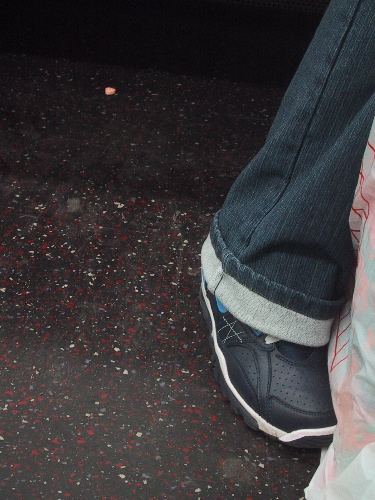
uptown no. 2 train, February 13
lifting the gag order – this time
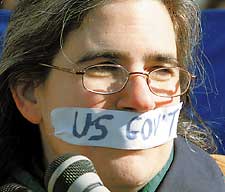
Drake University law professor Sally Frank
“a culture distracted into obedience by fear” [from a press release for a show, Halliburton”, of paintings by Adam Simon opening Friday at art Moving, 166 North 12th St. in Williamsburg]
Oh, I’ve neglected this followup until now.
The immediate crisis is over for this particular group.
Federal authorities retreated Tuesday in their investigation of an Iowa anti-war demonstration, withdrawing grand jury subpoenas delivered last week to four peace activists and Drake University.
The shift came as the investigation drew nationwide condemnation from civil liberties advocates, politicians and peace activists.
Also Tuesday, a federal judge lifted a gag order on Drake, where employees had been ordered not to discuss an inquiry into a meeting the anti-war activists held there Nov. 15. Federal authorities had asked for records of the campus chapter of the National Lawyers Guild – which hosted the anti-war conference – and for the impressions campus police had of the gathering.
Ah shucks, Barry.
But, seriously, it was the memory of the various surveillance authorities at all those old ACT UP meetings and demonstrations, including our own civil disobedience training sessions, that made this particular outrage so disturbing for me.
And we know the obscurants are even now regrouping for another opportunity to spread the fear with which they hope to preserve their power.
One reaction, picked almost randomly, appears in an editorial of The Examiner, where the outrage is much more restrained than that which can be found elsewhere, even among very reasonable people.
While it was good to learn the subpoenas had been withdrawn, the fact that they were ever issued raises some disturbing questions about why. An explanation put forward by many civil-liberties groups and peace activists is that it was a maneuver by the federal government to suppress antiwar activities by making potential participants afraid they could be arrested or prosecuted. Indeed, word the subpoenas had been withdrawn came as lawyers for Drake were preparing to fight the demands. They had intended to argue that the subpoenas would have put a damper on students’ constitutional rights to free speech and free association.
We’d like to think that’s not true. We’d like to think that partisan politics would not lead to abuse of the federal law-enforcement system. We’d like to think that public servants would not capriciously abandon their oaths to uphold the Constitution. But over the past few years, when the ability of the government to reach into the details of our private lives has been exponentially expanded without even the most basic oversight of a judge brought into play, it’s become difficult to think that way. It doesn’t help that everywhere the president goes, people who want to express opinions opposed to his are sequestered in distant pens insultingly labeled “free-speech zones.”
No, it unfortunately appears that the Drake subpoenas were inappropriate and unnecessary at best, and quite possibly nothing less than callous political thuggery.
[image from Common Dreams]
“silver alien fortress” to displace a Brooklyn neighborhood
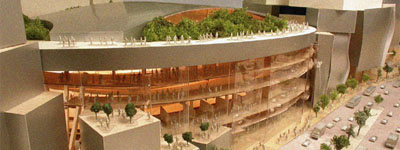
Bilbao-ball in Brooklyn
More on the Brooklyn basketball boondoggle, this time from The Morning News.
But first a reminder of what this whole thing is all about.
Developer Bruce Ratner is responsible for both Brooklyns MetroTech Center and the Atlantic Center Mall. Neither of these ugly projects, finished in recent years and so heavily subsidized by taxpayers’ money [$300 million is the estimate for MetroTech alone], has been a real success. The Mall stands virtually empty today.
One more project, a new stadium to house the New Jersey Nets, recently purchased by Ratner, is expected to guarantee enormous rewards for both of his earlier, failed, ventures. But not only will it destroy an entire neighborhood, once again it will cost the City a bundle.
In The Morning News Pitchaya Sudbanthad outlines the stakes for those unfamiliar with the taxpayers’ role in the story.
The proposed plan for the stadium not only will involve the citys giving up land to Ratner that could be worth hundreds of million of dollars but could also include hundreds of millions more to expand streets and utilities and to help pay off bonds for the complexs construction.
But it’s all for such genuinely good Brooklyn causes: pleasure for passive sports enthusiasts, and reward for a millionaire contractor who has been so wrong about the Borough at least twice already.
Still, Sudbanthad’s piece is mostly concerned with what will be lost. He talks to longtime Brooklynite Joe Pastore, who lives in the neighborhood targeted for “improvement”.
The Spalding building, a red brick, four-story factory, has been converted into co-ops. [Pastore] slaps the building with his gloved hand. Its a beautiful, solid building, Joe continues. This building should be a landmark. How can he tear this down? How could you say this buildings no good?
Joe, I love this building, too. I think its beautiful. I love the Pechter Bakery buildings down the block even better, with the clean towering white walls and Greek Revival touches. They would make great places to live. I can see the soaring ceilings inside. But these buildings arent made of audacious metallic curves and pop architectural whiz-bangs. Ratner has dangled Frank Gehry over Brooklyn, and almost everyones mesmerized. I remember being dazzled by Gehrys Guggenheim Museum in Bilbao when it was first built. And after Bilbao made its splash, every city wanted a Gehry of its own. The architect complied with the demand, producing made-to-order variations of his titanium-sheathed design. It became a symbol of arrival for cities into the new millennium, an easy investment that endowed an image of artful taste to insecure politicians and businessmen. Gehry buildings became the corporate builders equivalent of Lladró and Hummel figurines, but where those figurines lend an air of harmless luxury and preciousness, Gehry buildings are Trojan horses for more sinister intentions: By design, Gehrys recent buildings declare war against everything that surrounds them. They are places that spurn any notion of history and any idea of people. They look, simply, like silver alien fortresses.
[image from DANDA]
bombings as usual?
BAGHDAD (Reuters) – A suicide car bomb killed 47 people at an army recruitment center in Baghdad Wednesday, taking the death toll to about 100 in two attacks on Iraqis working with the U.S. occupation forces within 24 hours.
After the previous day’s bombing, our guy Rumsfeld said this sort of thing happens in cities routinely.
WASHINGTON (Reuters) – Defense Secretary Donald Rumsfeld, asked about Tuesday’s car bombing in Iraq that killed about 50 people, said there are murders in every major city in the world “because human beings are human beings.”
What city does he lives in? And if he thinks the thousands being killed in Iraqi cities are just routine events in all civilizations [read, “Sodoms and Gomorrahs”], how does he and his Administration justify making those killed on September 11 the foundation of all U.S. domestic and foreign policy?