so, what are they thinking?

“Peaking too soon?”
Gary Trudeau had Mark on the phone to Iraq yesterday.
Are we “supporting our troops,” or are we afraid to admit that our government is one of idiots and spoilers, and that we personally share in that idiocy, but without sharing the spoils? Can we close our eyes forever?
Can a government which clearly doesn’t know what it’s doing long survive, at least if the people notice?

The issue of soldiers’ tours [of duty] has been contentious, with troops and their families posting missives on the Internet criticizing the their government for keeping them in Iraq.
Some express concern about “mission creep,” in which what begins as a swift war turns into a long-term occupation that could cause heavy American casualties as Iraqis become more and more skeptical of U.S. promises to let them govern themselves.

No, not too soon, and maybe not too late.

actually, talk isn’t cheap after all

Is our current philosophy of government killing our troops and abusing Iraq? Paul Krugman says the mess in Iraq isn’t just about poor planning and mismanagement.
The Bush administration’s mixture of penny-pinching and privatization (both pursued for reasons of ideology and profit) is more than just an embarassment for our military, for our government and for ourselves. In fact it’s become absolutely fatal for many.

In general, the “support our troops” crowd draws the line when that support might actually cost something.
The usually conservative Army Times has run blistering editorials on this subject. Its June 30 blast, titled “Nothing but Lip Service,” begins: “In recent months, President Bush and the Republican-controlled Congress have missed no opportunity to heap richly deserved praise on the military. But talk is cheap — and getting cheaper by the day, judging from the nickel-and-dime treatment the troops are getting lately.” The article goes on to detail a series of promises broken and benefits cut.

Troops in Iraq are still subsisting on M.R.E.’s, “the dreaded meals ready to eat,” in Krugman’s words, and there are serious shortages of water in the field.

An American soldier died of heat stroke on Saturday; are poor supply and living conditions one reason why U.S. troops in Iraq are suffering such a high rate of noncombat deaths?

We’re not willing to pay what we must to support our fighting forces, but the greater scandal may be that the money being paid to corporations, in a shift of many tasks traditionally performed by soldiers, is money that is being wasted, and costing lives.

According to the Newhouse News Service, “U.S. troops in Iraq suffered through months of unnecessarily poor living conditions because some civilian contractors hired by the Army for logistics support failed to show up.” Not surprisingly, civilian contractors — and their insurance companies — get spooked by war zones. The Financial Times reports that the dismal performance of contractors in Iraq has raised strong concerns about what would happen in a war against a serious opponent, like North Korea.

Even the enormous and essential task of rebuilding what we have destroyed in Iraq is being compromised in the name of ideology and patronage.

In Iraq, reports The Baltimore Sun, “the Bush administration continues to use American corporations to perform work that United Nations agencies and nonprofit aid groups can do more cheaply.”

The bizarre experiment which we refer to as the current administration in Washington is sustained only at enormous human and material expense – ours and Iraq’s.

for good sports and the people who love them

The 2003 Ford ITU New York City World Cup Duathlon [sic], a “dry-tri,” because of the polluting effect of recent perpetual heavy rainfall in Manhattan, was staged completely within Central Park on Sunday, incidently making it easier on the spectator, and especially the spectator’s eye. Who’s designing the boys’ and girls’ costumes?

We [heart] Spain! Ivan Rana (Esp), described before the race as a favorite, came in eighth in the men’s. Well, he’s probably still a “favorite” for lots of us.

Pip Taylor (Aus) was second in the women’s.
Hot, but except for the wonderful ribbons, the costume just can’t compete with Ivan’s.

a beautiful man


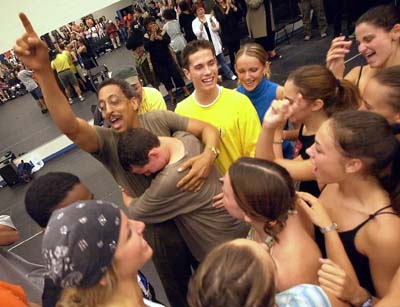
Students celebrate with Hines after a tap class of the Broadway Theatre Project in Tampa.
Gregory Hines died on Saturday night.
He was a good man, a beautiful man, a dancer, a New Yorker, a singer, an actor, and always a generous teacher for younger tap-dancers.
The last time we saw him was in the audience at LaMama a year and a half ago. We were all there for Thaddeus Phillips, a friend of ours who uses a gentle, timeless tap (in combination with incredible, abstract or improvised puppetry) in his own brilliant theatre pieces, to extraordinary effect.
Hines was obviously waiting after the performance to talk to him, so we spoke to Thaddeus only very briefly. It was a wonderful meeting of creative styles, and I sure wish we could have eavesdropped that night.
[image by Clint Krause]

John Weir, sloppy style pundit – and “dad”


Storied John Weir ( “The Irreversible Decline of Eddie Socket” author, CBS terrorist, elusive man about town, beloved professor) has been watching Television. Well, maybe it’s less like pay-per-view than view-per-pay, since his account of what he has been seeing ran under his own byline in the NYTimes on Sunday.
Professor John has been watching “Queer Eye for the Straight Guy,” but he has his own reading of both the amazing current popular flowering of queer sensibility, and the popular sense of queer powers which accompanies it. He thinks it’s something of a misreading of reality, and something less than the straight guy’s envy of a putative higher aesthetic way out of his reach.
I think John has adopted a French deductive approach in his analysis of the queer aestetic, something like, “It doesn’t fit with my experience therefore it must not be true.” John tells us that it’s his experience that queers do not have an “eye” – or at least that they don’t let it fashion their own appearance or manner, and especially not that of their personal environment.

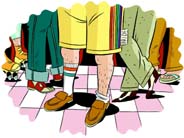
If this is reality TV, why aren’t the straight guys hostile and punctilious and the gay men sloppy and depressed? “All the gay men I know are terrible slobs, including you,” my mother told me, when she called to discuss the show. “Do you think you could get them to clean up your apartment?” Indeed, the show insists on reinforcing the stereotype that gay guys are groomed and charming and slender and witty, and no more than 35 years old. Yet here I sit in my Megadeth T-shirt, dirt broke, middle-aged, downing a carton of vanilla ice cream and spilling it on my computer keyboard.
Some gay men dress down to look “street,” but I’m not a chic slob, I’m a real one. My apartment is designed like a bowling alley, with the furniture pushed against the walls, except where it can be used to cover carpet stains.

Well, his proposition is at least worth an entertaining argument, and John is more than equal to that, but his take on why straight guys are willing to listen to queer style coaches is even more intriguing. He says the new “reality” TV show flatters heterosexual men by putting them where they already are, at the center of the action.

In the meantime, is “Queer Eye for the Straight Guy” creating a new “common ground” where gay men and straight men can bond? No doubt it is, for some people — in particular, for television executives and advertisers impressed with the show’s ratings. To me, however, the most touching aspect of the show is its plain proof that all men, straight or gay, yearn to be praised by a guy.
. . . .
Anybody with a father has learned how difficult it can sometimes be to get a man to pay attention to you. The subversive charge of “Queer Eye for the Straight Guy” may not be its homo/hetero get-together, but its demonstration that all men want contact with other men. Of course, you can learn the same thing from a hockey game.
Still, I think of the show’s grooming guru, Kyan, asking his [straight guy] buddy Adam if anyone had ever taught him how to shave, and Adam’s mumbled reply, “No, unh-unh, no.”
In that moment, it seemed like five gay dads had been beamed down to planet Earth to give men what they really want: a father who’s not afraid to pat your head and say, “Atta boy.”

Oh John, we miss you. Now where’s the new book, dad?
[image by Chris Gash, NYTimes]

love in time of war


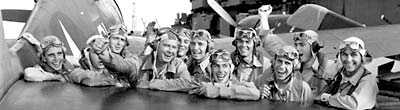
WWII pilots
All day long, after posting the item below, “their flesh . . . revives,” I’ve been thinking about WW2. I have to admit that it’s not dead to me. I actually remember it.
No, not exactly as a combatant. Even though I was in love with my two dashing and much older flyboy cousins, in the end the hunks wouldn’t let a pre-schooler sign up and fly off to the Pacific with them. And then the war ended, and so did their uniform grace and their frequent visits. Those later war years and the immediate postwar years were to be the last time I was interested in military service – except eventually as the very special friend of other soldiers and sailors.
But I do remember the war. There was the threat from Germans (strange, I don’t remember “Nazis”) and Japs (sorry). There was rationing, car fan belts constantly needing mending (rubber, like our very pampered tires), white margarine. There were paper pennies, care packages from the farms in Wisconsin, certain big news stories. We loved spam (the old kind), and plane spotting (maybe less as a serious occupation than as a hobby) and dealing with the heavy blackout curtains was very exciting (blackout curtains were going to save us from Axis bombers – yes, in Detroit!), and finally VE and VJ days. I don’t remember any atom bombs until much later, but my parents were always pretty good at keeping other bad stuff from us – like prejudice – and bless them both.
Still, one of my strongest and earliest memories is of peeing in glee and excitement on the chest of my knockout-handsome cousin Dick, while he was upright bathing the infant me during one of his frequent visits from Selfridge Field. It was very exciting. I also recall he was as genuinely sweet as he was hot.
Mother had gone out and put the big guy in charge for the afternoon. I don’t remember the baths she gave me. I also can’t remember where Dad was that day, but I do remember he and these two nephews were very close so long as he lived. They all loved each other very much. They were certainly all charmers and they made everyone around them very happy – or so I remember it.

Israel moves to destroy another family

Omigosh, James is asking for money now. No I’m not! I think the story in this post is important by itself, especially if you have been following Steve‘s reports from Palestine regularly included on this blog since last summer. However, if you do have any spare funds they would abviously be very useful in saving one good family in the occupied West Bank, and they might even help to establish a precedent which could help others.
The entire segment below is from Steve, but in fact his own words are only in the introduction to the letter from Tracie.

Folks,
I hope you can help out in the case of Nasser Quzmar. Please read Tracie’s letter below, and let me know if you have any questions.
Steve
Dear Friends,
I am writing on behalf of a man by the name of Nasser Quzmar. Nasser is a 32 year old Palestinian man who is a farmer in the village of Izbat Salman in the Qalqilya District of The West Bank, Palestine. Izbat Salman is a village of 690 people on 4,800 dunums of land (1 dunum = 1/4 acre). Of these 4,800 dumuns, 4,000 have been isolated or bulldozed for the wall. Last September, on our tour of the villages, Nasser was one of the farmers whose story we were told. His greenhouses were slated for destruction and his land for confiscation. Of course, his families’ source of income historically has come from agriculture. Nasser is the breadwinner for a family of six. Their ages range from 2 months to 8 years old. Once a farmer with 27 dunums of cultivated lands of olive, citrus and vegetables, as well as greenhouses, he has lost almost everything due to the wall surrounding his village.
All the papers, documents and evidence that Nasser collected to demonstrate his ownership of the land would not spare him and his community from the devastation. He filed legal complaints through a law office that deals with a number of cases about the wall. The clearest response he got was the arrival of bulldozers to his land. Another response he got was imprisonment. In the middle of the night, approximately 2 months ago, the Israeli Defense Forces entered the home of Nasser and took him away. At the time of his arrest, Nasser’s wife was 9 months pregnant.
He has not been charged with anything. Nor has his wife been able to communicate with him since his imprisonment. Nasser was not involved in any political act at the time of his arrest, nor has he ever been. One can only surmise that it was due to his legal complaints and documentation that he may have become a target. He is a simple farmer who carries on the tradition in his family. In the eyes of the IDF, he defied them by continuing to work on his land. It has become increasingly difficult for the family to subsist with Nasser out of the home. It is possible that he will be in prison for years. In the words of Nasser Quzmar, “I never imagined that I would helplessly watch as my land was destroyed.”
Nasser was formally arrested today after two months in administrative detention. He will be charged on Thursday, and it is likely that the charges will attempt to link him to terrorism. One of the ways that the Israeli government tries to quell non-violent resitance is to lump those resisters together with armed groups. This, we believe, is what is happening to Nasser.
Of course, there are many stories like this throughout the Occupied Territories of Palestine. Because this is a family who graciously accepted us into their home on two occasions, we feel a special connection and a duty to do what we can to offer assistance. The family is not in a position to pay for legal services. We have been able to lcoate an excellent attorney who is willing to represent Nasser. He is an Israeli Lawyer by the name of Shamai Liebowitz (do we want to put this in the letter?). The cost for his services is NIS 5000 (approximately $1180 US dollars).
We are asking for people to make contributions to the legal fund for Nasser Quzmar. Any money that is raised beyond the NIS 5000 will go to the ISM legal fund. Because our goal is to get Nasser back to his family as soon as possible, we are asking for people to donate today. We ask that you consider sending a check for $100, although any offering will be most appreciated! You can make checks payable to Gabriel Ash and write “Nasser Quzmar” in the memo section of the check. Gabriel is an activist with SUSTAIN who is with us in Palestine and will put the money up now to be paid back through your generous donations. Please send your donations to:
Jews Against the Occupation
Prince Street Station
PO BOX 494
New York, NY 10012
Please send an email to Tracie at pnut119@nessanphotography.com with the amount you are donating so we can keep track while here in Palestine.
Thank you for your assistance and on behalf of the Quzmar family, I thank you.
Sincerely,
Tracie De Angelis
NOR CAL ISM
From The Occupied Territories
West Bank, Palestine
01197267723326 (from the states)

“their flesh . . . revives”

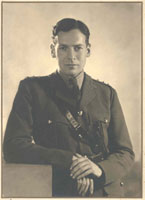
prince_f_t_young.jpg
Frank Templeton Prince

A soldier and a poet died on Thursday.
In 1942 he wrote what some say is the greatest poem of a great war, not the Great War, but the one which seems to have been strangely niggard in inspiring great verse. It was a war which is now almost dead to us all, having been succeeded by so many unnecessary imitators which have perhaps been even more successful in killing poets.
An interesting man, and an interesting poem.

SOLDIERS BATHING
The sea at evening moves across the sand.
Under a reddening sky I watch the freedom of a band
Of soldiers who belong to me. Stripped bare
For bathing in the sea, they shout and run in the warm air;
Their flesh, worn by the trade of war, revives
And my mind towards the meaning of it strives.
All’s pathos now. The body that was gross
Rank, ravenous, disgusting in the act or in repose,
All fever, filth and sweat, its bestial strength
And bestial decay, by pain and labour grows at length
Fragile and luminous. ‘Poor bare forked animal,’
Conscious of his desires, and needs and flesh that rise and fall
Stands in the soft air, tasting after toil
The sweetness of his nakedness: letting the sea-waves coil
Their frothy tongues about his feet, forgets
His hatred of the war, its terrible pressure that begets
A machinery of death and slavery,
Each being a slave and making slaves of others: finds that he
Remembers his old freedom in a game,
Mocking himself, and comically mimics fear and shame.
He plays with death and animality;
And reading in the shadows of his pallid flesh, I see
The idea of Michelangelo’s cartoon
Of soldiers battling, breaking off before they were half done
At some sortie of the enemy, an episode
Of the Pisan wars with Florence. I remember how he showed
Their muscular limbs that clamber from the water,
And heads that turn across the shoulder, eager for the slaughter,
Forgetful of their bodies that are bare,
And hot to buckle on and use the weapons lying there.
– And I think too of the theme another found
When, shadowing men’s bodies on a sinister red ground,
Another Florentine, Pollaiuolo,
Painted a naked battle: warriors, straddled, hacked the foe,
Dug their bare toes into the ground and slew
The brother-naked man who lay between their feet and drew
His lips back from his teeth in a grimace.
They were Italians who knew war’s sorrow and disgrace
And showed the thing suspended, stripped: a theme
Born out of the experience of war’s horrible extreme
Beneath a sky where even the air flows
With lacrimae Christi. For that nice, that bitterness, those blows,
That hatred of the slain, what could they be
But indirectly or directly a commentary
On the Crucifixion? And the picture burns
With indignation and pity and despair by turns,
Because it is the obverse of the scene
Where Christ hangs murdered, stripped, upon the Cross. I mean,
That is the explanation of its rage.
And we too have our bitterness and pity that engage
Blood, spirit, in this war. But night begins,
Night of the mind: who nowadays is conscious of our sins?
Though every human deed concerns our blood,
And even we must know, what nobody has understood,
That some great love is over all we do,
And that is what has driven us to this fury, for so few
Can suffer all the terror of that love:
The terror of that love has set us spinning in this groove
Greased with our blood.
These dry themselves and dress,
Combing their hair, and lose the fear and shame of nakedness.
Because to love is frightening we prefer
The freedom of our crimes. Yet, as I drink the dusky air,
I feel a strange delight that fills me full,
Strange gratitude as if evil itself were beautiful,
And kiss the wound in thought, while in the west
I watch a streak of red that might have issued from Christ’s breast.
F. T. Prince
Collected Poems 1935-1992
(Manchester: Carcanet Press, 1993)

Well, maybe you had to be there. The Guardian comments on the aspect of the poem which most grates on modern ears, and relates its parochial imagery to what are its clearly homoerotic elements.

The poem culminates in a powerful, yet ambivalent, evocation of the naked Christ on the cross, the blood issuing from his wound being somehow as lovely as the sunset. Throughout the poem, the unassailable force of weaponry is contrasted with the vulnerability of the naked body.

But then ends its obituary with some words of comfort on the subject of this family man’s religiosity.

A devout Catholic convert, he nevertheless believed that literature could “emancipate one from oneself”, and confessed that he had become irritated [while teaching] in Jamaica at having to contend with students who would only read books written from a religious point of view.

___________________
Note to all noble guardians of literary standards: Each of the two sources to which I referred for the complete text of the poem had its own typographical problems, including errant words, spellings and punctuation. I’ve examined both to complete the text I show above; I hope it’s some improvement.

[image from University of Southampton]

help keep the VILLAGE in the EAST


Antifolk Festival, August 19-26
Let’s respect the history and launch the future of the East Village, LOISAIDA, Village, or whatever our nicknames have been for New York’s most dynamic cultural engine. HOWL!, The “1st Annual Festival of East Village Arts,” begins August 20.
While it sure ain’t just about Wigstock, we’re ecstatic to see the Lady Bunny return three days later – all the way to her roots, to Tompkins Square Park, as part of this new Festival.
All hail the mission statement of the HOWL! organizers, FEVA:

Mission Statement
Founded in 2002, the Federation of East Village Artists honors the historic role of the East Village as the cradle of the city’s, if not the world’s, counterculture. We stand on the shoulders of the gods and the ghosts that have come before us, committed to preserve our unique history and to create opportunities for the next generation of visionaries to flourish. The neighborhood that has spawned the Living Theater and Independent Film, been home to poets from Auden to Pinero, to musicians from Charlie Parker to The Ramones, blank canvas for Haring and sanctuary for Basquiat, long-time stomping ground for generation after generation of beatniks, hippies, yippies and punks, cannot go the way of the dodo bird. FEVA will fight for the rights of local artists for health insurance, professional services and affordable housing. FEVA will provide an emergency relief fund for those in need, will connect local artists with local schools, will bring public art to our gardens and to our streets. FEVA will also create a Smithsonian of the Counterculture, a combination archive, museum, performance space and gallery to preserve our rich past and inspire the artists of the future. Artists are a natural resource, precious as light, air and water and just as crucial to the city’s economic and spiritual environment. FEVA will advocate on behalf of this great community of experimenters and iconoclasts, to insure that its existence is not imperiled and that the legacies of Emma Goldman, of The Fugs, of Allen Ginsberg endure for generations to come.

We’re gonna get art (by genuine artists and other genuine people), a poetry festival (free in every way), a film festival (no awards! no awards!), EV homie Charlie Parker (resurrected!), an Antifolk Festival (Dylan meets Sex Pistols), all the “Way the F**K Off-Broadway people (including, just for starters, Dirty Martini, Rev Jen, FACEBOY, PORNO JIM, The Bitter Poet, World Famous *BOB*) and a nutty everybody-loves-a East Village parade, “The Pantheon Processional,” at the Astor Place Cube (honoring local luminaries from the past, present and future), and all of that just richness and culture goodness just scratches the surface.
This delightful extravaganza seems to be virtually an entirely volunteer-staffed labor of love for the people behind it – as in “I’ve got an idea, let’s put on a show!” This downtown knows how.
Also, while it’s very nice to memorialize the past, this thing is at least as much about the future. It better be, because without a howling future the entire Village will end up being about nothing more than real estate.
We gotta go. August. What the hell did we eschew that country place for, anyway? What country place? What country?