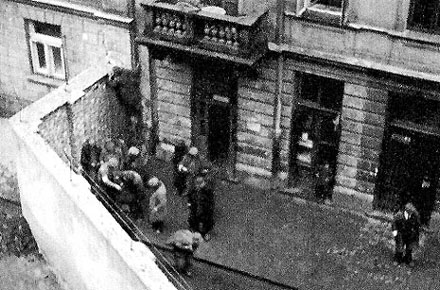
Warsaw, 1940’s
“Does this remind you of anything?” [the text of a sign held, while standing on the scoop of a frontloader, by one of several dozen youg Israeli peace activists trying yesterday to obstruct the construction of the Apartheid Wall at Mas’ha]
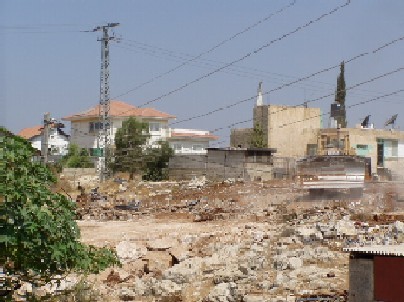
Palestine, 2000’s
The [new, white] houses in the background are in
the illegal Israeli settlement of Elkana. The house
in the middle ground is the house to be isolated by
the Apartheid Wall. And the bulldozer in the
foreground has just demolished the family’s hen house
to make room for the Wall. [from Steve’s text below]
Steve has been in Qalqilya, Jayyous, Mas’ha and Tel Aviv. The letter is very long, but it’s not dull, you won’t read anything like it in the media, and it absolutely must be recorded as witness to the horror we and our Israeli instruments visit on Palestinians every day.
The report itself [followed by Steves attachment of an Israeli Peace groups media alert about an action tonight, which includes an eyewitness account of an Israeli raid of a Palestinian camp near Nablus]:
Jayyous August 5, 2003
I was sad to leave Qalqilya yesterday. The checkpoint
was the usual humiliating experience. The border
guard didn’t know that I could understand the abusive
things he was shouting at me in Hebrew and Arabic as
he demanded to inspect my backpack. Sometimes
internationals are spared the abuse. Palestinians
never are. Then I had to quickly jump into an illegal
taxi to take me to my new home. The Israeli
government policy seems to be to criminalize any kind
of Palestinian movement, knowing full well that
Palestinians will still move, but painting a veneer of
“rule of law” onto military harassment of Palestinian
civilians.
The next time I go to Qalqilya, we’ll have to activate
the Underground Railroad that our local coordinators
and local volunteers have developed. Israelis
(whether Jewish or Palestinian) and internationals
just don’t get through the checkpoint.
As always, I had to change taxis at the roadblock at
the village of Azzun. A week earlier, on the way back
from the Jayyous action to bring supplies to the
trapped Bedouin family, we had watched soldiers and a
military bulldozer (Caterpillar, natch) pile more dirt
and boulders and concrete blocks onto the roadblock.
It’s hard to describe how degrading the scene was. An
elderly taxi driver told me that tomorrow, vehicles
would be making their way around the roadblock
again.he said it was like Tom and Jerry. A soldier
told me to tell my friend (Ryan, who was passing
behind the bulldozer to photograph it) to be careful,
remember what happened to “that girl”. He was
referring to Rachel Corrie. My blood ran cold. I
looked at him and said, “That wasn’t an accident.” He
shrugged.
Jayyous is lovely, despite the ugly scar that runs
across its lands where the Apartheid Wall has been
built. Lately, Border Guards have been coming in at
night and shooting water tanks on people’s roofs. My
landlord here, a local activist I’ll call Saleh,
overheard them saying to each other, “shoot the white
ones [the hot water tanks], they’re more expensive to
fix.”
Jayyous, population 6,000, is not connected to the
Israeli power grid. The illegal Israeli settlements
that surround it of course are connected to the grid.
Power here comes from a generator, is astoundingly
expensive, and is switched off every evening from
5:00-7:30 and every morning from 2:00-8:00. Cell
phone coverage is poor, it’s hard to keep phones
charged with daily power outages, and the Internet
café is slow as molasses (when the power is on-no
Internet of course when the power is off). It’s hard
to stay connected here.
We watched the sunset over the olive groves. Jayyous
is on top of a hill, with a good view of its lands,
and of the densely populated coastal plain of Israel
beyond. Saleh, a mild-mannered and always polite
English teacher, told us that this was the spot from
which he used to throw rocks during the first
Intifada, because it was hard for the Israeli soldiers
to shoot kids from their position on the road below.
We had dinner at the home of Abu Ali, leading Jayyous
activist. He is a farmer, and served us the most
amazing figs I’ve ever tasted. The best ones, he
explained, are the ones the birds have pecked at. I
ate one. It was so sweet, it made my teeth hurt.
(For the record, Jayyous mangoes are pretty tasty too.
I’m looking forward to the prickly pears and guava,
also in season.) Abu Ali just built a house for
himself and his wife; up to now, he spent all his
money sending his children to university, medical
school, and the like.
Abu Ali camped out in front of Abu Mazen’s office to
get him to start talking about the Apartheid Wall.
Today, he’s meeting with President Arafat to demand a
number of services for Jayyous’s beleaguered farmers.
All of Jayyous’s spring-fed lands are on the “Israeli”
side of the wall (any one think that’s an
coincidence?), and he wants the Palestinian Authority
to build pipes to bring that water to Jayyous’s
rain-fed lands inside the Wall. Of course, the PA
can’t go near a project like that without Israeli
cooperation.
Early this morning, Israeli-American New York
Palestine activist Gabriel and I took an early taxi to
the village of Mas’ha, 5 kilometers east of the Green
Line (West Bank-Israel border). Mas’ha has been the
site of a peace camp for several months, a place where
Israelis, Palestinians, and internationals came
together in dialogue and shared rage about the
Apartheid Wall and the ever-expanding settlements it
“protects”. Over the past days, it became clear that
the Apartheid Wall was going to run east of the
westernmost house in Mas’ha, trapping the family in
that house between the Apartheid Wall to the east and
the fence around Elkana settlement to the east. This
plan symbolizes to me the sheer brutality of the Wall
project; it exists only to serve the interests of
Jewish Israelis, and Palestinian people are just so
many obstacles in the way.
Palestinian, Israeli and international non-violent
activists had gathered to prevent the continued
construction of the Wall at that point, and we had
word that the army was coming at 7 this morning to
clear them out. Gabriel and I were late because the
taxi we had booked stood us up, and by the time we
arrived 47 activists were in the custody of the Border
Police. They arrested everyone with a camera first,
followed by all the people who were sitting in the
path of the bulldozers, followed by the people who
showed up during the arrests and began filming. They
kicked people, and they dragged them by the hair.
Most of the Israeli, and surprisingly, Palestinian
activists have been released, but about 40
internationals remain in custody at Ariel police
station (Ariel is an illegal Israeli settlement of
25,000 people, many of them Russian immigrants).
ISM’s Freedom Summer will be decimated if they’re all
deported.
I stayed in Mas’ha about half the day, watching the
Israeli government’s destruction. Check out the
attached photo: the houses in the background are in
the illegal Israeli settlement of Elkana. The house
in the middle ground is the house to be isolated by
the Apartheid Wall. And the bulldozer in the
foreground has just demolished the family’s hen house
to make room for the Wall.
I chatted with Mohammad, the owner of the house in
question. He is absolutely committed to staying in
his house, no matter how impossible the Israeli
government makes it for him. We waited hours for a
chance to get into the house to retrieve the backpacks
of the arrestees; the construction company’s private
security tried to prevent us, shoving around some
fierce Israeli anarchists who showed up to help. We
got all the bags out eventually, and returned to
Jayyous. The future of Mohammad’s family, or of the
Mas’ha peace camp, is unsure.
Several of the Palestinian men I spoke with in Mas’ha
indicated the construction of the Wall going on and
said that Israel doesn’t want peace. I hear that
often from Palestinians, at checkpoints, during
incursions, at scenes of destruction: Israel doesn’t
want peace.
Jayyous, Friday, August 08, 2003
In the wee hours of Wednesday morning, the activists
arrested at Mas’ha were released. The internationals
had the condition attached to their release that thet
not return to the West Bank; as far as I know, they’re
still in Jerusalem. Of the three who were charged
with assault, the Israeli Jew was release after being
charged, the Italian was released on the condition
that she leave the country immediately, and Maher, the
Palestinian from Mas’ha, was kept in jail with a
hearing scheduled for 8 days later. 3 people, all
arrested in the same place at the same time doing the
same thing, all facing the same trumped up charge,
with 3 different sets of rules applied to them based
on who they are. This is Israeli apartheid.
Fortunately, intense pressure from ISM and from our
lawyers resulted in Maher’s release yesterday
afternoon.
I did Gate Watch on Wednesday morning with John, a
75-year old Englishman from Ecumenical Accompaniment.
We waited at the gate that allows Jayyous farmers to
pass through the Apartheid Wall to their lands. The
gate was the site of harassment and beatings by the
construction company’s security guards prior to the
institution of Gate Watch, but is quiet now. Only a
few farmers passed through the gate, since it was
blocked by boulders placed there by the construction
company more than a week earlier, making passage with
anything more complex than a donkey cart impossible.
Afterward, Gabriel and I rushed back to Mas’ha, on
word that Israeli activists were about to stage a
surprise action there. About 24 young Israeli Jews
arrived, held onto the scoop of a front loader, and
stood on a giant drill, forcing work to stop. They
then occupied the front loader. Their signs were all
in Hebrew, and said things like “Separation Wall=Land
Theft=Death”, “This isn’t a fence, it’s a ghetto”,
and, chillingly, “Does this remind you of anything?”
They chanted “No to the fence, no to transfer.”
A couple of settlers watched the scene from their roof
in Elkana, right next door. I wanted to yell at them,
“Aren’t you ashamed? Look at what is being done so
you can have what you have!”
I’m told that many of the people living in West Bank
settlements now are Russian immigrants. They arrive,
the Ministry of Absorption tells them, “You will live
in Ariel (Elkana, Shaarei Tikva, etc.), and voila!
Instant settlers.
Had they been Palestinians, they would have been met
with live fire immediately. Had they been
internationals, they would have been quickly and
brutally arrested (Freedom Summer’s campaign
coordinator). But as Israelis, they were permitted to
stay for a few hours, were then presented with an
official order of a Closed Military Area (how a
residential area can be a Closed Military Area I don’t
understand), and then given 30 minutes to leave.
Finally, soldiers removed them, not gently, but
without apparent brutality, and they were bussed to
Ariel for arrest. Ragheb was arrested along with
them; he was inside the house that is going to be
isolated, photographing the scene for AP. He was
released that evening, and given a paper allowing his
return to Qalqilya (the checkpoint is closed at
night), but his photos were confiscated. The
government of Israel really doesn’t want light shone
on what it’s doing. The police on the scene tried to
arrest us for taking pictures, but we scrambled to the
Mas’ha side of the roadblock, which they were
unwilling to cross (jurisdictional issues, I think).
While the Israeli demonstration was going on, some of
the men from Mas’ha, including the owner of the house,
got into a heated argument with the head of the
security staff on the scene and some of his men. The
security guy told the owner of the home, that he, the
Palestinian, belonged to the past, and that all he
cared about was money. Meanwhile, the owner of the
surveying firm was on the scene, fuming that work had
stopped, and dynamite went off behind us as the
construction company continued to clear land further
south.
Gabriel and I proceeded to Tel Aviv, where Ady and
Nirit had organized a commemoration of An-Nakba, the
Palestinian Catastrophe of 1948, for the eve of the
Jewish Fast Day of Tisha B’Av. We took a bus that
wound through several illegal Israeli settlements,
each of them accessible through one gated entrance
with an armed guard, each of them transformed from the
arid landscape around them to lush irrigated suburbs,
each of them far more luxurious than most Jewish
residential areas inside the Green Line. One of them
was Shaarei Tikva, the settlement I had seen from the
outside suffocating the villages of Beit Amin and
Azzun Atme. From the inside, the development had been
designed in such a way that the adjacent villages were
invisible.
In Tel Aviv, the commemoration went well, with a
number of Israeli activists participating and thanking
JAtO/NYC for taking the initiative. We lit yahrzeit
candles and arranged them to spell the number of
villages destroyed in 1948, and then we read the names
of all the villages. I stayed in Tel Aviv, because
one can’t return to Jayyous at night.
John reported from Gate Watch this morning that a path
had been opened up in the boulders at the gate (the
way had still been blocked when we took an American
visitor there yesterday afternoon), but that the gate
was closed for the first time. He was able to open
it; we’ll see what develops in the days ahead.
Jayyous, Saturday, August 9, 2003
Yesterday afternoon Abu Ali picked up Saleh (his
nephew, turns out), me, John, Gabriel and David for a
night on his farm. We were able to pass through the
gate on his tractor thanks to the small gap in the
boulders in the road. We noted however with alarm
that the gate now has a chain and a lock on it, ready
to be shut tight at the whim of the Border Guard or
the private security. My guess-the authorities will
wait until the international attention to the Wall
dissipates, and local Palestinian activists are
pacified by the fear that escalation will limit
access, and then they will start locking the gate from
time to time, perhaps more and more often, perhaps
demanding permission from farmers to be on their own
land as they already have started doing in nearby
Qalqilya.
Abu Ali’s farm is right next to a giant ugly quarry
gouged out of land confiscated for the settlement of
Tsufim on the hilltop above. The crater is surrounded
by signs in Hebrew that say “Danger, building here.”
I changed one to “Destroying here.” Abu Ali showed us
the blast holes that have been filled in by court
order when he sued about the damage they were doing to
his water tank right next door. He told us about his
8-year successful legal fight against the confiscation
of his farm. He told us about the soldier who put a
gun to his head to get him to stop planting during
that court fight, in front of his 8-year-old daughter,
and the counseling and medication she needed as a
result of the trauma.
The night on the farm was lovely-our own 5000 star
hotel-and Abu Ali went out and picked up dinner and
breakfast (supplemented by his wife’s homemade
goat-milk yogurt cheese). In the morning, we visited
a couple of other farms, and heard stories about
recent beatings of farmers at the gate at the
neighboring village of Falamiya. Farmers with cars or
trucks have been taking a big detour to use the
Falamiya Gate since they still can’t pas through the
Jayyous Gate (the space in the boulders is only big
enough for a tractor). Tomorrow morning and
afternoon, we’ll expand Gate Watch to Falamiya Gate,
and see what happens.
We passed by one of the water pumps, whose operator
was targeted by the Israeli army and jailed without
charges for a 4 1/2 year term as part of the Israeli
government’s economic war on Palestine. David showed
me where they installed a meter to make sure that on
only a certain amount of water is pumped each month,
while on the Jayyous lands across the Green Line that
were confiscated in 1948, cotton, among the thirstiest
of crops, is grown by the land’s Jewish owners using
unlimited water from the same aquifer.
Farmers are urging us to open the path to Jayyous
Gate, and John, 75-year-old British Quaker, is itching
to take a sledge hammer to those boulders. But Abu
Ali is urging us to wait, while he demands that the
Border Guard remove the boulders as promised.
Abu Ali told me this morning that all international
solidarity activists add to the struggle, but that
Israelis are the most valuable, and foreign Jews the
second most valuable. He’ll be pleased to learn that
a second Israeli is joining us tomorrow from the ISM
training.
We had lunch back at Abu Ali’s farm, and were joined
by 3 French and Swiss solidarity activists, as well as
a Swedish diplomat and some Palestinian activists.
Needless to say, lunch conversation was stimulating.
Back up in the village, David’s been telling me about
last month, when Border Guard were shooting at
children, threatening Saleh’s life, and shooting up
water tanks as noted above. Things are quiet here
this week, but now that Israel has broken the cease
fire…
Take a look at this media alert about a vigil tonight.
The vigil was called by one or more of the Israeli
peace groups, I believe, and the eyewitness account
is, I think, by an ISMer in Askar Camp, where I was
last year.
Peace and rage,
Steve
The media alert and the eyewitness account:
Media Alert – Join Us
What: A vigil to protest the recent invasion to Nablus
When: Tonight, Saturday, 18:00 o’clock
Where: In front of Ministry of Defense (Hakirya),
Kaplan Street,
Tel Aviv
Early morning yesterday, the Israeli Military invaded the Askar
Refugee Camp in Nablus in a so-called “arrest” operation. During the invasion, four Palestinians were killed and two more are critically
wounded. “We didn’t mean to shoot him, we just wanted to arrest him.”
Yes, we clearly understand that it takes seven tanks, three jeeps, a helicopter and dozens of soldiers to arrest one man.
The attack is yet another of Sharon’s attempts to destroy the hudna and goad the Palestinians into another battle.
According to “Haaretz” even senior military officers admit that Hamas is not, right now, busy with preparing suicide attacks, but is complying with ceasefire plans.
The Sharon government is not interested in de-escalation or any sort of cease fire. He is interested in agitating for violence, so he can use it as a much-needed excuse to continue Israeli’s illegal occupation and complete construction of the Apartheid Wall
Here’s a description of what happened by an eyewitness who lives in Askar.
At 2:30 in the morning I heard a lot of people moving in the streets of the camp. Then I discovered that these people are soldiers or special forces after I heard some Hebrew words. 20 minutes later strong gunfire started, suddenly a lot of tanks, jeeps and one helicopter started to arrive to the area followed by a bulldozer.
The gunfire continued. I started to hear the bombs from time to time, during all this time I didn’t leave my bed. After 4:30, the jeeps started to impose the curfew. After that, I received a call from my father asking me to leave my place and to join the family.
His fears were: in case the army started to search from house to house, having me by myself in the house would give them the chance to do what ever they want to me, as we do have long list of people who been beaten by the occupation forces taking the chances that no witnesses around. I joined my family went up to the roof to have a clear vision about what’s going on, the gunfire, bombs continued, then I heard strong bombing followed with a lot of smoke.
After calling the neighbors to figure out what’s happening, I had been told that the house of the Dwaikat family was shelled by tanks, and they destroyed the fourth and the third floor. The jeeps kept driving the streets imposing the curfew. By six in the morning, the people started to break the curfew going out to the streets. Then confrontations started between the kids, youth, men, women, and the Army, and the army opened fire using live ammunition for the purpose of killing us.
Around 10:00 am I heard huge bombing. Then it was clear that they bombed the entire building. The confrontations kept going on, and the bulldozer started to work to be sure that no one was still alive after bombing the building.
Around 11:30 am, the army left the camp. It was very clear there was no need for releasing the curfew as everybody was outside. I went out to see the area where the operation happened. We been told that the army took the body of the martyr Khamis abu Salim, 22 years old, whilst the people were trying to get some stuff out from under the destroyed house, they found the body of the martyr Fayez Al Sadar 28 years old.
All the people carried him on their shoulders toward the ambulance, everybody went home preparing himself for next day demonstration for the two martyrs. 3 hours later, 2 of the 9 who were injured in the confrontations died; Fawzi Al Alami 45 years old, and Mohammad al Tek 17 years old, and by this new news everybody started to re calculate tomorrows demonstration with four bodies instead of two!
Join us tonight. We have to stop the occupation and the murder.