C.H.U.N.K. women


photo by Basil Bernstat
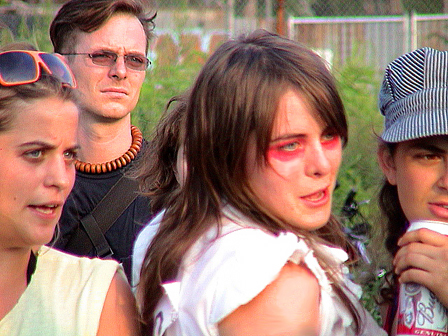
The pix keep coming in. This wonderful image of several competitors [Amy in the center] is from the C.H.U.N.K. 666 site itself.
The picture gives some idea of just how hot the Chunkathalon afternoon really was.
__________________
Go here for the Free Williamsburg story on the Chunkathalon.

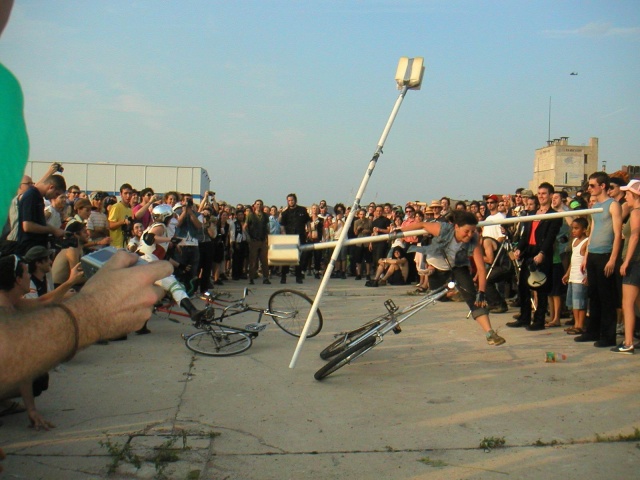
Brooklyn still offers a few places where you can have good, clean fun away from the prying eyes of those who would seek to prevent it (hence, stickball). One of those places is a fenced-in patch of condemned state property abutting the East River in Williamsburg. If you walk down the last desolate trash-strewn block of North 7th St. to where it ends at the disused MTA power station, you’ll find-so long as no cops are camped out and you’re not put off by the No Trespassing signs or the occasional burned-out car- a ratty park that offers one of the most blessedly intimate river views of Manhattan. On any given day there, Williamsburg’s skateboarders and bikers can be found doing tricks on a concrete expanse about the size of football field that rises about five feet above the weeds and crabgrass (a refrigerator offers a leg up). It was here, on the last Saturday of July, that Chunkathon 2003 went down.

a bucolic world returned to Manhattan

The 16 acres formerly occupied by the World Trade Center is not the only large lower Manhattan site whose future is being contested these days; it’s merely the most visible.
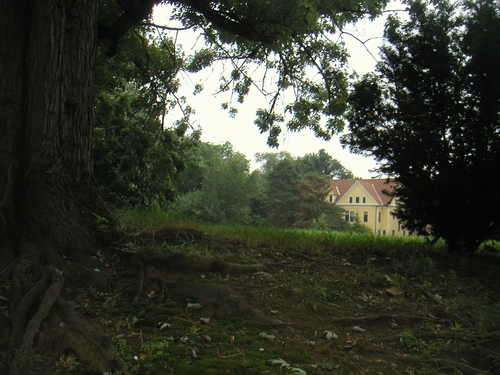
On Friday we toured some of the 172 acres which contain this landscape:

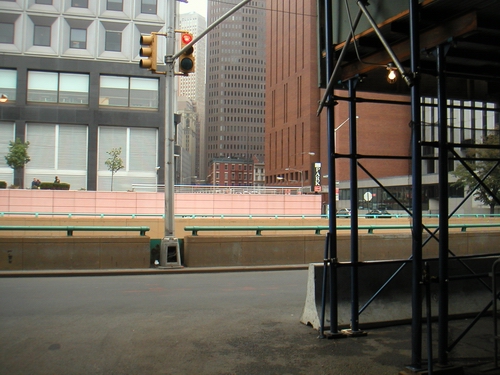
The house in its sylvan setting lies only a thousand yards from this scene:

In the mid-80’s my loft apartment was the second floor from the top of the small early-19th-century brick house in the center of the picture above.
The landscape in the first picture is on Governors Island, located just south of Manhattan. The house in the second is 105 Broad St., part of the landmarked Manhattan block which includes the Fraunces Tavern historic site next door.
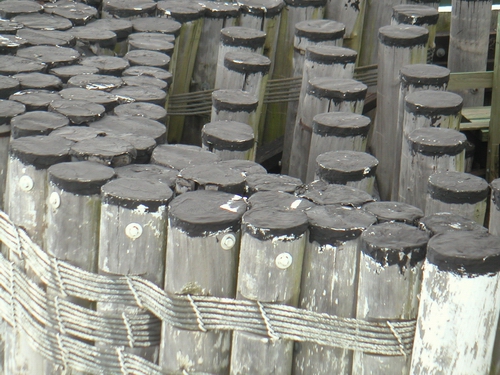
In between these two views lie these dock pilings:

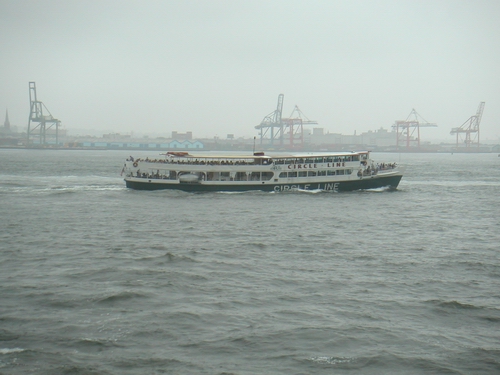
and water, churning, sometimes angrily, between Manhattan and Brooklyn while it tosses boats serious and gay:

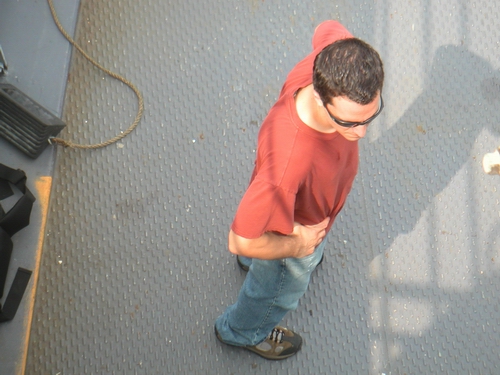
including this particular ferry boat deck, which on Saturday supported a handsome, and very silent, shipmate:

During the three years I lived in the canyon of ancient Broad Street I could look out my windows to salute the Statue of Liberty’s motionless sentinel to the south or the busy little car ferry to the east. Stubbornly refusing to carry civilians, every 10 minutes the floating shuttle left its slip for its short hop to the green island just beyond FDR Drive.
Today the Coast Guard has left, and the Federal Government has handed the island over to New York. The island is ours! A limited number of people are able to visit the oasis for a limited time, apparently because of its inadequate public facilities and because of imminent survey and construction activity, before it is closed again, perhaps for years.
What happens next? Supposedly it’s entirely unresolved, but while we don’t know the answer Im sure there are many who think they already do.
The future disposition of this precious natural and historical treasure is up to us – or it should be. The reality however is that we probably won’t escape the curse of our contemporary officials’ bad taste and bad judgment. We also seem to be kept in the dark lately, probably deliberately. Add a scepticism fed by consideration of the huge amount of money and power at stake and we should not be surprised if what ends up happening on New York’s Governors Island is not in the best interest of most New Yorkers.
But even if we lose, the decisions which define that loss must not be made in unlighted rooms.
____________________
See “Army Brat Life at its Best,” a personal and idyiosyncratic site with history and pictures and memories.

report from Palestine, August 2, 2003


Jayyous food delivery, July 28
Steve writes from the West Bank:

Qalqilya
Aug. 2, 2003
At 3:00 last Friday morning, I was awakened by Kevin,
a member of the ISM Qalqilya action group, and a local
photojournalist I’ll call Ragheb, and told that the
Israeli army had again entered Qalqilya. Four of us
went out to see what was happening. After the
shocking attack on a house earlier in the week, we
felt that it was important that we be present, albeit
at a distance, visible, and out of the line of fire,
in the hope that international witnesses might inhibit
the Israeli army from their worst excesses.
We proceeded to the main street, and spoke to a few
people who were out. An old man said to me, “Why do
you want to drink from that cup?” Others called out,
“Thank you for what you’re doing.” Some young men
told us that the soldiers had been firing into the
air.
A jeep and an armored personnel carrier (APC) entered
the road from a side street. Both were completely
enclosed, with tiny reinforced windows, so that it was
impossible to see the human beings inside. The APC
stayed at a distance, and the jeep stopped with its
bright lights on us for a long time. Then they sped
away.
We continued down the street in an attempt to find the
house(s) being raided. The jeep and APC returned, and
stopped a block away. We’re pretty sure we were
visible to the jeep. A few shots were fired. A
volley of machine gun fire followed, and in the dark
we couldn’t tell if the gunfire was directed at us, at
the buildings opposite the vehicles, or in the air.
I said, “This is how Brian Avery got shot.” We got
out of sight of the army, and returned to our house.
We continued to hear sporadic gunfire as the two
vehicles sped up and down the street. On Friday
evening, we all had a long talk about going out at
night when the army is in town, and decided that we
would only consider going out if we had specific
information about where the army was and what they
were doing. Marwan, our local coordinator, said that
there’s nothing we can do if the army has come to
arrest someone, but if they’re planning to demolish a
house, we might be of use.
On Friday afternoon we visited two of the houses that
were raided. In the first, the wanted man was not
present, and we saw the usual scenes of gratuitous
destruction, although the house was not riddled with
bullets like the one we saw previously. As usually
happens in these situations, there were children in
the family who were eager to take us from room to room
to show us the damage and to bring us spent shell
casings. The family had “Peace Now” stickers in
almost every room, and the soldiers had tried to rip
one of the stickers off the wall.
The adults in the family told us that a large number
of jeeps and soldiers had shown up, and that the
entire family had been made to stand outside for
hours. Apparently, the one jeep and one APC we saw
shooting up downtown were distractions designed to
keep folks scared and in their houses. I wonder if
the soldiers were wearing white sheets.
At a second house that was raided we were invited to
stay and drink tea and coffee. Their son was taken,
and they didn’t know where. We gave them the number
for HaMoked, an Israeli human rights organization that
tracks Palestinian detainees.
In the news in the United States, we hear about the
three-month cease fire. It seems to be that the
Palestinians are the only ones holding their fire.
I got a couple of hours of sleep after we returned
from our failed intervention, and then headed out for
a day in the villages south of Qalqilya with Samir, of
the State Information Service (sort of a statistics
and publishing office) and Courtney, Lysander and Lisa
from our action group. Samir is from Habla, a village
immediately south of Qalqilya. His family came there
from Arabia in the 17th century, and was the first
family in Habla. He can name every other family in
the village, and where they came from (usually other
places in Palestine).
We needed to walk through another farmers’ gate – it’s
now had hurricane fencing installed, so that one can
no longer crawl through it. We waited until an APC
drove away, then tried to open it, but couldn’t figure
out the mechanism. We stepped back to figure out what
to do, when a little boy on a bicycle flipped open the
gate. We ran across the 100 meters of empty space to
the Israeli army’s gate on the road into the village
of Habla. Samir was waiting for us there.
Samir took us around the nurseries there, and a
nursery owner told us the now-familiar story of the
ruin of his once thriving business. We had tea and
grapes with Musa, a cousin of Marwan, our local
coordinator. He told us how Israeli soldiers had come
to him while he was working and demanded to see a
permit to be working the land.even though he owns that
land himself.
The construction site of the “security fence” wound
around this area of nurseries, orchards, and farms,
cutting it off from Habla and from Qalqilya. At one
point, we walked right up to the Green Line (the
border between Israel and Jordan between 1949 and
1967), and crossed over it. The fence doesn’t
separate Israel from the West Bank at all; it annexes
West Bank land to Israel. A farmer with a tomato field
just over the Green Line into the West Bank showed us
how his crop had been ruined when Israeli settlers
released pigs into his field two weeks earlier.
Samir brought us to a spot where a front loader and a
number of workers on foot were putting up the fence at
breakneck speed. He explained that this was his land,
now all consumed by the fence. The workers on foot
were Palestinian.work is so hard to come by for
Palestinians that they will take jobs building their
own prison. Samir is a gentlemanly and businesslike
man, but when we were on his ruined land, he seethed.
We took photos of his irrigation pipes, dug up and
tossed aside by the front loader.
Ragheb took a photo of the Jewish Israeli operator of
the front loader, and armed security showed up and got
right up in his face, screaming at him in Hebrew and
demanding his camera. He didn’t give it up, and they
didn’t lay a hand on him.perhaps because Courtney,
Lysander, Lisa and I were there.
We went to look at a centuries-old mosque in Habla.
The security fence was just feet away from the mosque,
with an Israeli settlement across the road. Samir
explained that this particular portion of the fence
had been built in 1996, four years before the
beginning of the Al-Aqsa Intifada.
We spent midday at Ras Tira, a hilltop village across
the ravine from the sprawling Israeli settlement of
Alfe Menashe. Opened in 1982 and expanding
constantly, Alfe Menashe now has 40,000 inhabitants
and sits on top of the region’s main aquifers (one
Jewish Israeli West Bank settler is allotted twenty
times as much water as one West Bank Palestinian
resident). At the bottom of the ravine, Israeli
soldiers hold military exercise, and when villagers
attempt to approach their olive trees further down the
slope, soldiers shoot at them.
Ras Tira is one of several villages, with a combined
population of 1000, being fenced in with Alfe Menashe
and cut off from any other West Bank communities.
They have been given until 2005 to accept Israeli ID
cards or leave the village. Many of them have ID
cards now that list a place other than Ras Tira as
their home. I doubt those people will be given the
option of Israeli ID.
Ras Tira has already been erased from Israeli
government databases.
We stopped at a giant road block next to the
Israeli-only highway that cuts through Habla on the
way to Alfe Menashe. The only way to pass from one
side of Habla to the other is on foot. I stood at the
side of the road for a long time, looking at the faces
of the drivers passing by, trying to will them into
realizing that everything they have is at the direct
expense of someone else.
We went to Samir’s home for a sumptuous lunch. He and
his wife both work in Qalqilya, and keep an apartment
there because the passage to and from Habla is too
difficult to do every day. Habla is a few hundred
yards from Qalqilya.
When we got back to the gate into Qalqilya, it was
locked (no army around), and lots of people were
milling around on the Habla side. Then a boy-he must
have been about 10-opened the gate, and all of us,
men, women, kids on bikes, someone on a horse, rushed
through before soldiers showed up. The kid seemed
delighted when each of us stopped to thank him.
On Saturday, we were invited to the end-of-summer-camp
presentation of the Palestine Red Crescent Society.
One of the skits was about an ambulance stopped at a
roadblock as the patient dies. The little kids who
played the mean Israeli checkpoint soldiers were
intense.
On Saturday night, Basem, an ISM volunteer, invited
the men among us to celebrate his having passed the
tawjihi, the extremely rigorous end-of-twelfth-grade
comprehensive set of exams. The party was in what
looked exactly like a Brooklyn wedding palace, and was
absolutely packed with deliriously happy young men
dancing to traditional Arab music. At one point, they
began chanting as they danced “kus uchtak yaa Sharon”
(fuck you, Sharon). They were thrilled when we joined
in. After the party, we went for a midnight swim at
one of Qalqilya’s 2 pools-men only, of course.
On Monday, while four from the Qalqilya action group
(including Dena and Eric from JAtO) were participating
in the “break the gate” action in Annin, outside
Jenin, that got international attention, another four
of us (including me and Ryan from JAtO) met up with
David and Nirit from JAtO, other internationals from
ISM, Boston to Palestine, and others, and activists
form Jayyous in another delivery of supplies to the
Bedouin family trapped outside the Jayyous fence. The
army stayed away, realizing, I think, that they had
provided the media with unfavorable photo ops the week
before. The delivery went off successfully, but it
was incredibly sad to see an old woman from the family
standing at this enormous fence, waiting for handouts.
She allowed the media to interview her and photograph
her, and while she was talking to them I saw that she
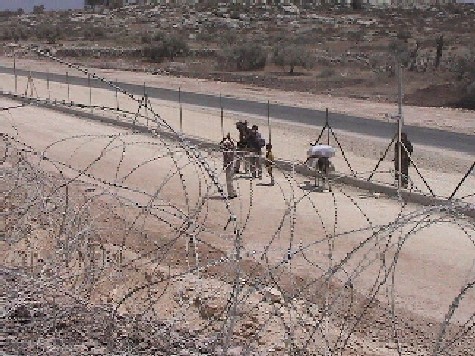
was crying. In the attached photo, she’s on the
right. A man and boy from the family are loading up a
donkey with the supplies thrown down to a Jayyous
activist. All three entered the no man’s land between
the razor wire and the fence for the purpose of the
delivery. I don’t know the names of anyone in the
Bedouin family. I couldn’t speak to them. I was
behind the razor wire barrier with everyone else.
Again, the land “inside” the fence in this picture is
in the West Bank. The land “outside” the fence is
also in the West Bank. This is not a border fence
between Israel and the territory it’s occupied for 36
years. Those of us opposed to the fence believe it
has a two-fold purpose: incorporate valuable land and
water resources outside the fence into Israel,
decreasing the resources available to (and therefore
the viability of) a future Palestinian state, and to
pursue a policy of ethnic cleansing of areas inside
the fence, as Palestinians, deprived of income, are
forced to leave. The more Palestinians leave, and the
more Israeli Jews arrive as settlements are expanded,
the more occupation becomes annexation.
On Wednesday, international activists arrived in
Qalqilya from Ramallah, Jenin, Tulkarm, Jerusalem,
Nablus, Jayyous, and elsewhere to participate in the
Qalqilya face of the week’s Wall actions. None were
allowed through the checkpoint. Some snuck through
the checkpoint when soldiers were otherwise occupied.
Some crawled under a farmers’ gate in the fence. Some
snuck through another gate. Some stayed overnight in
a nearby village after failing to get in (and nearly
getting arrested), and succeeded upon trying again
early in the morning. And some were unable to enter
at all. Ady (JAtO) and Tim from our action group were
also able, with help from arrangements Marwan made and
accompaniment from Ragheb, to get 8 big helium tanks
(!) into town.
Thursday was the big day – the payoff after
approximately one million planning meetings with
everyone in Qalqilya from the mayor on down, and with
each other, after creating a giant banner (“No
apartheid wall” in English, Hebrew and Arabic)
designed to fly 15 meters above the ground, after
filling countless balloons with oil paint to fling at
the wall (and then discovering that oil paint corrodes
latex-oops), and after browbeating the press from Tel
Aviv to Toronto (they usually wanted to know if there
was going to be bloodshed). We marched from the
municipality in the center of town-50 internationals,
and Qalqilyans from the Prisoners’ Club, local
government, the PFLP, the Peasants’ Union, and many
others-to the point at which the wall meets the fence,
joined by a military gate and a sniper tower. It was
a beautiful site as activists flung paint balloons at
the hated wall, and covered its surface (the lower
half, at least) with messages of liberation. We were
met by soldiers in jeeps who had their guns at the
ready, but when they saw that the line of
internationals facing them was neither advancing on
them nor heeding their orders to disperse, they chose
restraint. It’s entirely possible that restraint was
a policy insisted on from above, considering that the
photo of soldiers teargassing activists in Annin on
Monday went all over the world.
The giant banner flew only briefly before the balloons
popped, but long enough for some good photos. It will
now hang from Ash-Sharqa Girls’ School next to the
Wall, a school that has been teargassed in the past by
the Israeli army while the students were present.
There was a fair-sized crowd of Israeli activists from
Gush Shalom and other groups outside the military
gate. They got short notice from us about the demo,
but filled a bus for their companion demo nonetheless.
We ended with Noura, Palestinian-American from ISM,
delivering a message of peace to them (which was
permitted after a lot of wrangling with the soldiers0.
A lot of the Qalqilyans I’ve spoken with are very
pleased about the demonstration, although some had
hoped for a larger turnout of locals. I think that,
now that we’ve proven ourselves, we’ll have a bigger
turnout next time.
Yesterday (Friday) activists in Tulkarm succeeded in
removing the razor wire in front of a gate there, but
were unable to tear down the gate before the Israeli
army opened fire with rubber bullets. There were a
number of injuries among activists, but none serious.
I stayed in Qalqilya, holding down the fort as it
were. I joined the Prisoners’ Club at the Qalqilya
Zoo (the only zoo in the West Bank) for a party for
the children of prisoners, and in the evening, after
the rest of the group returned from Tulkarm, we
participated in another loud, spirited, multi-party
march through town in support of prisoners. It seems
that yesterday prisoners in Ashkelon Prison were tear
gassed while locked in their cells, resulting in 100
injuries, 9 serious. The president of the Prisoners’
Club named for me the 3 prisons in which he was tear
gassed while locked in his cell.
Today, Saturday, we’ll be talking about our work in
the surrounding villages. I may be moving to nearby
Jayyous, in which case my telephone service will be
spotty (but not nonexistent). I’m not sure about
email access there…I’ll check it out when I arrive
(assuming the move happens).
That’s all for now.
–Steve Quester
still, you have to demonstrate a “history” to be saved


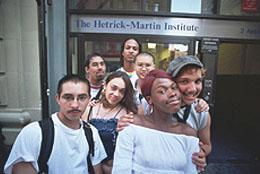
Hetrick-Martin youth
An email arrived Thursday at 8:30 in the morning, asking me to attend a press conference at City Hall to show “support for the Hetrick-Martin Institute.”
Sure, I had heard the recent news that the city had finally agreed to extend serious support for the 19-year-old Harvey Milk High School, so I felt honored that I was being asked to be a part of the celebration, and I thought nothing more. It never occurred to me that some people would seriously attack the concept of educating and protecting from assault or even death kids who were, or who were perceived by others to be, lesbian, gay, bisexual or transgendered, or in some cases just questioning.
When I arrived, I found out that the press conference had been quickly assembled and scheduled in response to the news that some powerful people had decided to file a lawsuit to block the city from funding the school.
Let’s get a few things straight, before we try to address the issues being raised. One, the school is not new. It was first opened in 1984, and it was a public school “program” even then. Two, as a high school which operates to serve kids who would otherwise be lost in the system, it is not unique in New York. Third, it’s not a school where kids learn how to be homos; they are taught the same subjects available in any other school, but here they have a chance to learn, without having to worry about their safety.
These kids are truly at risk. They are tormented by their peers, and sometimes even by teachers, principals and others charged with their care; they are assaulted; they are terrorized. They are unable to learn in what is intended to be a learning environment. For the most vulnerable youths it is a torture environment which may somehow be endured – or not. Sometimes they are killed.
They are not like the character Will on television’s “Will and Grace.” They are not middle class. They are overwhelmingly not white [75% are black and hispanic]. They have no support system. Many are homeless or in foster care. Many have attempted suicide. Many are not open to their parents or any other adults. Many have been thrown out by their parents. They are not codifying their sexuality; others are doing it for them. Their numbers include many who are still questioning their sexuality, and statistically 13% of Harvey Milk students are straight. Regardless of whether they are lesbian, gay, bisexual, transgendered, questioning or even straight but perceived by peers as otherwise, these kids just can’t hide it. And they shouldn’t. They’re kids.
There are 1.1 million children in the New York school system, which means that perhaps 100,000 are homosexual, and that doesn’t even include the other queer categories. Harvey Milk, even after being expanded this year, will be able to protect only about 170. Obviously not every queer gets to be saved.
LGBT and Q youth have been in danger in our schools for hundreds of years, and they shouldn’t have to wait for adults to realize this and to decide what they will do about it – even whether they will do something about it. We should not inflict society’s bias on the young and simply say they have to live with it.
This totally unnecessary battle is being waged today in an electric environment. We are in the midst of a period of great change. The larger American public’s acceptance of sexual difference is clearly growing, but it is still appallingly retarded. Only this summer did our highest court decide that private homosexual acts could escape criminal charges. Largely due to attitude changes now everywhere so apparent, what I call the forces of darkness are feeling more threatened than ever, and they will not roll over. Bush and the Pope are freaking out. They hope variously to bring others along with them or to personally profit from the ignorance and fear of millions.
Notorious homophobe Ruben Diaz and his friends and allies want to erase us. Are they threatened by GLBTQ people finally being recognized as human beings?
Well, they sure ain’t interested in the kids. Diaz says his opposition is not based on prejudice but rather on the fact that the Harvey Milk school promotes “segregation,” yet Diaz and other social conservatives and religious fundamentalists have never supported the “integration” of queers, and they aren’t starting now.
The “Children of the Rainbow Curriculum” proposed ten years ago to foster greater tolerance and diversity in New York public schools was excoriated and thrown out the window by Mr. Diaz and other homophobic individuals and institutions. The result is the moral chaos we have now. My partner Barry looked at this photograph and said that Diaz and the New York Hispanic Clergy Association might as well be screaming, “We want our gay kids dead!” For Diaz-sorts however, there are no gay kids. There are only what he calls “normal” kids, and any others are just deliberately being perverse.
Diaz and his cronies shout that HMI means segregation. “It’s misleading to say this is an issue of segregation,” Newsday quotes the Hetrick-Martin Institute’s director, David Mensah. “Kids have fled their home schools to get to us. They need a safe haven.”
Mensah cited the example of a student referred to Harvey Milk after his third suicide attempt. “For him, suicide was not a mental health issue,” Mensa said. “He was being harassed at his school.”
In the latest Hetrick-Martin Institute newsletter, Debra Smock, the Director of its brilliant child, the Harvey Milk School, describes the need for its expansion as bittersweet. “In a perfect world, there wouldn’t be a need for HMS, but in this day and age there is a need for the school and a need for the expansion.”
The saddest part of this very sad story of what we do to our youth was made clear to me during the press conference, when several speakers described the means by which a student is enrolled in the school. Harvey Milk High School is over-subscribed. A kid can be referred by his or her parents, his teacher, principle or his guidance counselor. The kid can also apply directly. There’s just one catch. To be admitted, you have to be able to demonstrate what one person called “a history.” Think what that means, especially when so many still have to be turned away.
We have to get to work on the schools that are not Harvey Milk. We have to get to work on New York. We have to work on America.
For more, see Bloggy, “REGARDING ‘THE GAY HIGH SCHOOL,'” and dkos, “Gay hysteria.”

Israel passes Nuremberg law

Israeli yesterday passed legislation which was designed to clarify the requirements of citizenship, to assure the purity of Israeli blood and to clarify the position of Palestinians in the Jewish state. Ok, I deliberately described the law in language closely patterned on that which is used to describe the notorious 1935 Nazi Nuremberg racial laws, but the reference and the impact of this act is extraordinarily important for the people affected by its abomination, and in fact for the entire world.

JERUSALEM, July 31 — The Israeli Parliament voted today to block Palestinians who marry Israelis from becoming Israeli citizens or residents, erecting a new legal barrier as Israel finished the first section of a new physical barrier against West Bank Palestinians.
. . . .
Opponents called [the marriage law] a racist measure that threatened to divide thousands of families or force them out of Israel. Roughly 1.2 million of Israel’s 6.7 million citizens are Arabs, and they are far more likely than Israeli Jews to marry Palestinians.
“It cannot be that because of the actions of one, or 10, or 20, that a population of one million will be punished,” said Ahmad Tibi, an Israeli-Arab member of Parliament. He called the law “blacker than black.”
Also today, Israel solicited construction bids to build 22 new homes in a settlement in the Gaza Strip. A new peace plan, the road map, calls on Israel to freeze settlement construction, but Israel says it must keep building to accommodate “natural growth.”

Building walls around enclaves of inferior peoples, keeping them out of Jewish society and ultimately out of Jewish territory, and finding Lebensraum in what was formerly a Palestinian ghetto. Today’s Israelis have had good teachers, but this horror was no more inevitable than that of Nazi Germany.

Trent Lott afraid of Smart runts

Anything smaller than an SUV is just plain un-American, says the Senate.

Washington – The Senate yesterday easily rejected an amendment to require the nation’s car makers to boost the gasoline efficiency of their vehicles.

And Trent Lott (who certainly knows something about trying to overcompensate for a man’s feelings of inadequacy) says, about DaimlerChrysler’s tiny Smart car, one of the most brilliant automotive designs of our time, “Don’t make the American people drive that little runt of a car.”
In fact, contrary to the commercially-cultivated prejudices of the American consumer who will never feel, or in fact be, safe even in a Bradley tank, the Smart is one of the safest cars ever designed. DaimlerChrysler’s site in the UK describes the design [click onto “safety”] here.
In fact I’m just crazy about the car, and my affection has little to do with its ability to withstand impacts – other than the impact of its own delicious appeal. If it sounds like I’m marketing this beautiful little car and its entire way of life, I am. The more people in the U.S. know about its virtues the sooner I may be able to drive one here.
Well, I can dream.

infectious image from the Brazilian site, Carsale

Mensch-y diversity

Mitchell’s Home Delivery Service drops the NYTimes and Newsday (the latter is essential because it’s more human and more Lefty than its big sister) in front of our door every morning (well, almost every morning). I’m pretty fussy, so there have been times when I had to call their office for one reason or another, but I’ve always been very impressed with the people at the other end, especially Maury.
I sometimes talk to Maury. Maury Gordon is actually the co-president of this scrappy little company, but not only does he know my account number by heart, he seems to know each of the carriers like sons and daughters, and he has actually delivered papers himself when some emergency or human failure meant there was no alternative. In our conversations Maury sounds like a Mensch.
I learned more about Mitchell’s this week when the Daily News did a story on another aspect of the company’s resourcefullness, and in doing so it filled in some of the blanks about its history. Now I had to look for more, and I found Mitchell’s website. I suppose I shouldn’t have been surprised at the amazing diversity I found in the kind of people working at the top. Take a look for yourself at what I love about New York – Mitchell’s included.

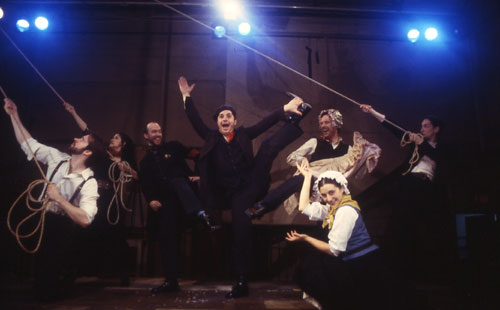
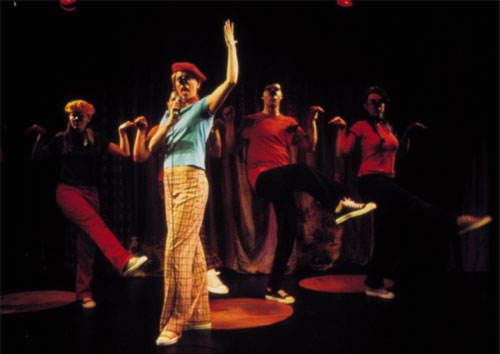
Steve Cosson, and The Civilians


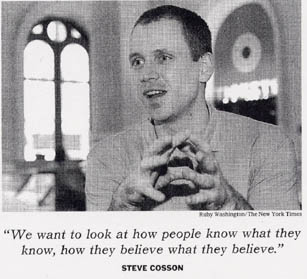
Steve Cosson has a mini-profile in today’s NYTimes.

He was drawn not only to theater as a child but also to directing, getting his parents to act out bedtime stories. He and a playmate in elementary school wrote a play about Persephone’s fall into the underworld. He wrote a play for his second-grade class. By third grade, he had won a playwriting competition sponsored by Children’s Radio Theater in Washington, not far from his childhood home in Potomac, Md.
“It was agitprop,” he said. “It was about an albino eagle whose parents die from DDT poisoning. But they wrote music for it and it was broadcast. It was the coolest thing that happened to me by the age of 8.”
He plunged into the usual world of high school theater, although he acknowledges he is a mediocre actor. He perished on stage as Mercutio in “Romeo and Juliet.”
“I acted my heart out,” he said. “Unfortunately, there was no way that scene was not going to evoke gales of laughter among my high school classmates.”
He was in three productions of “The Music Man.” But by college, convinced that life in the theater was a hobby, not a passion, he was studying to be a biologist. Unfortunately, he said, he went to Dartmouth, a place where he felt on the margins of campus life.
“I did not know there were people my age that actually supported Ronald Reagan,” he said. “It was the height of the culture wars. I had no idea what this New England prep school thing was about. I was confronted with a narrow elitism that drove me back into the theater. By sophomore year, I was a theater major.”

Steve remains as thoroughly committed politically as he is committed to theatre – but not as an actor, even if he’s as much a delight to look at as he is to listen to. If you don’t have the print edition, you’ll miss out on the photograph which accompanies the article.
Steve’s a beautiful and amazing phenomenon, but the Times piece hardly begins to describe the incredible theatre company which now gives expression to his energy and creativity. How many people would pick the shockingly-radical failed social and political phenomenon of the 1871 Paris Commune as a subject for a musical and still be able to retain the integrity and good conscience of the history?

“Paris Commune”
The Civilians performed the delightfully gentle and eccentric play alluded to in the closing lines of today’s article, “Canard, Canard, Goose.”

In the fall of 2001, The Civilians leave New York City to pursue a story about a Hollywood movie and a lost flock of carelessly imprinted geese resulting in an eclectic show about disorientation, misplaced empathy and coming home.

An audio clip is available here.

“Canard, Canard, Goose”
Barry and I are crazy about these people and this company, and we both shun traditional “musicals” like the plague. This is more than a recommendation; this is unconditional love.
“Gone Missing” opens October 9 at the Belt Theater in New York.

boys and girls and their bikes


both go down here, but in the end Amy, the white knight on the left, was topped
We walked down to the Willamsburg shore yesterday afternoon and had a delirious good time as part of the 2003 Chunkathalon. By the organizers’ [C.H.U.N.K. 666] own description, the event was “a series of death-defying bicycle contests that purge the group of weaker members while amusing the survivors.” No attitude, no swagger, and as some cute sage said yesterday, “bikes are for fun.”
There are dozens of annotated images in this gallery.
Bloggy has much more. Don’t miss the [teabagging] item at the bottom of his post.
We ran into Tom Moody on the field of honor yesterday. Tom has his own report, with still more pictures.
See this site for a report, with pix, on last year’s event.
Who needs Chelsea, when you have ambisexuality, who needs cars when you have bikes, and who needs a summer getaway when you have North 7th Street?
And so to Relish, for dinner.
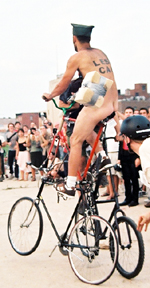
Oh, now there are more images available, on the yeabikes site, including this, of Zach:

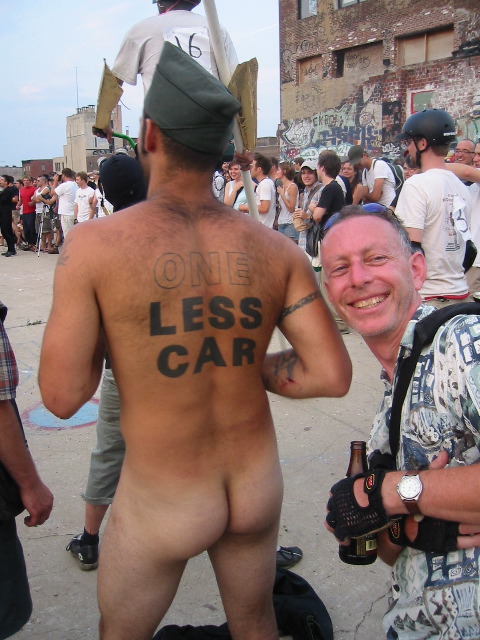
The tattoo reads, “ONE LESS CAR” – but more Zach is good.