Qalqilya, Occupied Palestine
Thursday, July 24, 2003
On Monday night we learned that a time bomb had been
found by security near the farmers’ gate, and was
detonated by the Israeli army. As a result, the area
around the gate was closed by the army and was
crawling with troops. We decided not to attempt
access to the lands west of the fence on Tuesday.
There has been speculation here that the Israeli army
planted the time bomb in order to justify widening
their off-limits zone on either side of the fence.
Tuesday morning, we participated in a demonstration
organized by all the political parties in Qalqilya in
support of Palestinian political prisoners in Israeli
prisons. We started with a short talk at the Qalqilya
branch of the Palestine Prisoners’ Association, a very
important group made up of former prisoners (i.e. just
about any Palestinian man) which provides support for
prisoners and for their families. They explained to
us that their current focus is to have 3 prisons
located on army bases (Howwara, Salem, and I can’t
remember the third) closed because the conditions
there are so harsh as to violate not only
international law, but Israeli law as well.
The demonstration was in the Qalqilya demonstration
style: loud, colorful, and short. ISM was there with
banners and signs (a picture of us made it into the
Palestinian daily Al-Ayyam today), and we’re told that
people were really happy to see us there. There was a
group of boys in front of us-little boys, not
teenagers-who were chanting energetically without
apparent adult guidance. I was struck by how these
boys see themselves as empowered members of the
resistance to Israeli occupation and injustice.
There were family members of prisoners at the demo
carrying photos of their imprisoned loved ones-some of
the people carrying photos were little kids.
The demo went from the city circle to the office of
the International Committee of the Red Cross/Geneva,
where Lysander and I joined the officers of the
various political parties and the head of the
Prisoners’ Association to present letters to the ICRC
with our concerns. The ICRC representative was an
Australian who could only talk about ICRC policy,
passing on concerns to the Jerusalem and Tel Aviv
offices, etc. The official meeting was interrupted by
some women who demanded to know why they were being
denied permits to visit their sons, and wanted to know
what ICRC was going to do about it. One has two sons
in prison, and had been denied a permit as a “security
risk”. She wanted to know how she, an old woman,
could be a security risk? Another also had two sons
in prison, had been granted a permit to visit one, and
was deemed a security risk when she applied for a
permit to visit the other. She wanted to know how she
could be eligible for a permit for one visit, yet a
security risk for the other. They represented Israeli
policies about family visitation as cruel and
arbitrary, and expressed frustration at the ICRC’s
apparent impotence.
In the afternoon, we met with Faris, the local
coordinator for a village called Mas’ha, and 5 from
our action group (3 from JAtO) volunteered to go there
for a couple of days. Mas’ha has hosted a peace
encampment along the fence for months now, and it has
become a place for Israelis, Palestinians and
internationals from all walks of life to come together
in dialogue and in opposition to the fence. The 5
return tomorrow, and I look forward to hearing more
about Mas’ha Camp.
I was talking with a little boy in front of our
building, and one of the adults pointed out to me that
his father was killed by the Israeli army. There are
6 children in the family.
Late in the evening, some local Muslim leaders came
over to talk with us about Islam. They are people who
dedicate their lives to the service of Allah and the
duty to be a good person, and I was thinking about how
painful it must be for them to hear Islam slandered by
political and religious leaders in the U.S., Israel,
and elsewhere. Their talk was a little too much like
a visit from the Jehovah’s Witnesses for my taste, but
they were well-intentioned, and we had a good time
just shooting the breeze after they were done with
their spiel.
I was awakened at 3:00 yesterday morning by Jihad, a
young man who spends time with us internationals. He
was alarmed that Israeli army jeeps had entered the
city, and a couple of internationals walked him home.
We then bolted our door, and I didn’t sleep very well
as I waited for the alarm to ring at 5:00. At 6:00
[the hours seem to be accidently transposed in these
few lines – JAW] I saw a jeep driving right near our
apartment, and quickly ducked inside.
I was up at 5:00 for attempt #3 to go out with the
farmers – successful this time!! There were no
soldiers or security at the farmers’ gate, and we high
-tailed it into the fields west of the fence. We
ducked behind some trees as construction vehicles and
security sped past, and were not spotted.
We were horrified, however, to see that the Israeli
army had dug a trench between the gate and the road
from Qalqilya, and piled the dirt and boulders up
before the trench. Passage into the lands outside of
the fence, impossible by car, truck, or tractor for
months, is now impassable by donkey as well. Farmers
must bring in their crops on foot. Some of the trees
immediately west of the fence and its attendant jeep
road had been destroyed by a tank or a bulldozer.
Mohammad from the Peasants’ Union took us around the
lands of Qalqilya and Jayyous all morning. We stopped
and talked with many farmers (and drank tea, natch).
The scene was idyllic – carob, loquat, orange, avocado,
fig, berry, and olive trees, grape vines, fields of
cauliflower, tomatoes, cucumbers, peppers, and
eggplant, lovely little farmers’ day huts, and a huge
chicken house. But the idyll was marred by the fence,
this awful gash that cuts across Palestinian farmers’
lands. We passed many dried up fields and abandoned
greenhouses belonging to farmers who just can’t get
through the security at the gate. We encountered
numerous road blocks; many dirt roads within this
agricultural area have been rendered impassable by the
Israeli army. Some of the lands are on the other side
of a settlement bypass road put in during the Oslo
process, and no Palestinian agricultural roads are
allowed to intersect with this Israeli-only West Bank
highway built on confiscated Palestinian land.
Farmer after farmer told us about the assaults on
their livelihood caused by the fence. One man has a
property that was cut in half by the fence. He used
to go from one olive grove to the next by walking a
few meters. Now he has to walk half an hour to the
farmers’ gate, and half an hour back. Another has a
number of farm vehicles at home. He can get none of
them onto his land. He has to bring in his crops by
donkey cart, and then unload them by hand onto a
vehicle at the roadblock. Some farmers have taken to
sleeping in the fields during the week, because the
way home has now been made so circuitous and long. To
make matters worse, Israel has declared economic war
on Palestinian areas during this Intifada, no longer
allowing Palestinians to export, and using roadblocks
and checkpoints to impede commerce within Palestine.
Qalqilya was once the bread basket of the West Bank,
with exports to Jordan and Iraq as well. Now, all
produce goes to market in Qalqilya, at a fraction of
the price.
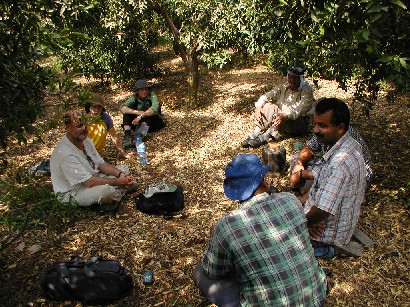
The attached photo shows me, Andrea from California,
and Eric from Sweden sitting with Mohammad and 3
farmers from Jayyous in an olive grove, talking about
the difficulties of harvesting caused by the fence.
We crossed back through the farmers’ gate quickly and
without incident. There was a security vehicle there,
but no personnel. We went to the farm of Ziad, also
of the Peasants’ Union, for lunch. He and his son
made a delicious feast for us, cooking everything with
vegetables he picked as he cooked. While we waited
for lunch to be ready, Mohammad told me about reading
Angela Davis’s book about prison in the U.S. while he
was in prison in Israel, and talked about how similar
the conditions are. He also told me about the little
girl in Qalqilya who’s named Angela, after Angela
Davis.
Ziad’s farm is breathtaking, but his property, which
used to extend further than it now does, is abruptly
cut off by the fence. The contrast between the beauty
of well-tended fields of tomatoes and cauliflower, and
rolls of accordion wire blocking entrance to the ditch
in front of the fence, is enough to make one cry.
Back in town, we visited a house that had been visited
during the night by the Israeli army (hence the jeeps
we saw). There were eleven people in the house: 3
women, one 13-year-old boy, and the rest little girls
(one a baby). We saw hundreds and hundreds of bullet
holes in the house outside and inside, including in
one of the women’s dresses in her closet. It’s a
miracle that no one was shot or killed, and I can’t
imagine how frightened the children must have been.
One little girl (I can’t say how old she is; I usually
underestimate the age of Palestinian children because
they look so small. Perhaps it’s malnutrition?) was
eager to show us the damage, and they all welcomed the
attention. The teenage boy lay in a fetal position on
a mat, having had his stomach stomped on by Israeli
border guards in an attempt to force him to say where
they can find the man they were looking for. They
never found the wanted man, so they took another man
from the family, 26 years old, beat him, and arrested
him. He may be facing 6 months of administrative
detention now; under Israeli law, no charges have to
be laid for administrative detention to occur.
For the past 2 days our action group has been meeting
with community members about our proposed action at
the Qalqilya wall on Wednesday. This morning I
participated in meetings at the Palestine People’s
Party with someone from the Farmers’ Union, and at the
Chamber of Commerce with the Chamber’s president.
Everyone has the same story – total economic devastation
as a result of closure and the wall. The rest of the
day has been preparation for the action – it’s a giant
undertaking, but we hope it will be spectacular.
Tomorrow morning I’m off to document the plight of the
villages south of Qalqilya, which have themselves been
encircled by the wall.
Then President Bush’s canon will come back to us: “You’re either with us or with the terrorists.” Those words hang in time like icicles. For years to come, butchers and genocidists will fit their grisly mouths around them (“lip-sync,” flimmakers call it) to justify their butchery.
Arundhati Roy
September, 2002