Cassandra getting a hearing?


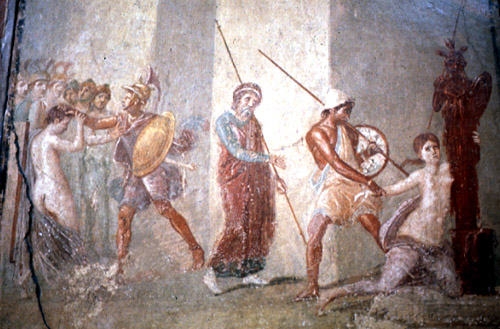
Ajax drags Cassandra from the Palladium before the eyes of Priam (Roman wall painting, Pompeii, House of Menander)
He’s back. I posted something from Sheldon S. Wolin just two months ago, but since he just may be our Cassandra I thought another hearing was in order.
If the administration hasn’t changed in the interim, perhaps the country has. In May Wolin’s words were found in the lefty [by U.S. standards] Nation. This month they appear in a mass-circulation daily, Newsday. Excerpts:

No administration before George W. Bush’s ever claimed such sweeping powers for an enterprise as vaguely defined as the “war against terrorism” and the “axis of evil.” Nor has one begun to consume such an enormous amount of the nation’s resources for a mission whose end would be difficult to recognize even if achieved.
Like previous forms of totalitarianism, the Bush administration boasts a reckless unilateralism that believes the United States can demand unquestioning support, on terms it dictates; ignores treaties and violates international law at will; invades other countries without provocation; and incarcerates persons indefinitely without charging them with a crime or allowing access to counsel.
. . . .
In institutionalizing the “war on terrorism” the Bush administration acquired a rationale for expanding its powers and furthering its domestic agenda. While the nation’s resources are directed toward endless war, the White House promoted tax cuts in the midst of recession, leaving scant resources available for domestic programs. The effect is to render the citizenry more dependent on government, and to empty the cash-box in case a reformist administration comes to power.
Americans are now facing a grim situation with no easy solution. Perhaps the just-passed anniversary of the Declaration of Independence might remind us that “whenever any form of Government becomes destructive …” it must be challenged.

[image from VRoma]

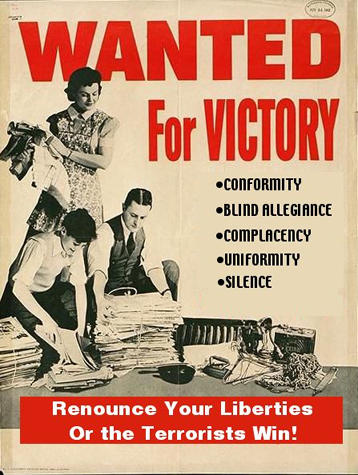
“good Germans” in America


Jasper Johns, “White Flag” (1955) Metropolitan Museum of Art
Some day, when we stop shaking in our boots in fear, we’ll realize just what evil we have done in the name of September 11. While history doesn’t give us much reason to seriously believe that anyone in a position of power will pay for his or her crimes [remember Vietnam], some of us already already know that their victims here and abroad already have, and that they will continue to be paying forever.
But we ourselves should not be able to simply point fingers, now or on some hoped-for day of redemption. A letter to the NYTimes today is a sober reminder that not all of the guilty sit in Washington.

To the Editor:
Re “16 Words, and Counting,” by Nicholas D. Kristof, and “Pattern of Corruption,” by Paul Krugman (columns, July 15):
Mr. Kristof and Mr. Krugman make strong arguments about the deception tainting the White House, and rightly so.
But there’s another party that should not be let off the hook: the American public.
When most of the deception by the Bush administration and the intelligence communities was lauded as truth and reinforced by the media, despite the numerous reports and intelligence stating otherwise, most Americans took the lies at face value, without questioning their validity.
Worse, many Americans chided and dismissed those who called for truth and reason.
True, as Mr. Krugman writes, Iraq “didn’t have significant weapons of mass destruction and wasn’t supporting Al Qaeda,” but that didn’t stop many Americans from thinking otherwise.
Those who substituted liberty for a blind patriotism are as much at fault as those who perpetrated deception.
HAYAN CHARARA
Jersey City, July 16, 2003

I read this to Barry this morning. His immediate retort: “We’re ‘good Germans.'”
Three months ago Harley Sorensen explained what what a “good German” was.

One of life’s mysteries, for me, is how masses of people can do the incredibly cruel things they do. Individual brutality makes a certain amount of sense in that it’s limited to one person. But mass brutality?
I think this subject first came to mind after I read Adolf Hitler’s Mein Kampf and William L. Shirer’s The Rise and Fall of the Third Reich, A History of Nazi Germany.
There was nothing in either book that told me how such a highly civilized and culturally advanced nation as Germany could sink to the level of the Nazis.
“How could that happen?” I wondered.
“What is there about the Germans that allowed them to become the monsters they became? How are they different than the rest of us?”
So I spent a month pondering the question.
The answer I came up with satisfied me then, and it satisfies me still: There is nothing different about the World War II Germans. What happened to them could happen to anyone. It could happen to us. We are no better than them.
. . .
The formula to become a brutish leader, as Jean-Marie Le Pen proved recently in France, is a two-step process. First, you convince the masses they are in grave danger (Le Pen used immigrants as his boogie man), then you promise to save them.
That’s exactly what Hitler did, and it’s exactly what Bush and Sharon are doing.
. . . .
It’s the fear factor, I believe. They go against their basic decent instincts and support a brutal regime for fear of being criticized or ostracized as traitors. Peer pressure.
You see the same thing with Americans’ blind support of Bush’s war policies.
“If you’re not for us, you’re against us,” Bush said, immediately making sheep out of otherwise hard-nosed, independent-thinking Americans.
Driven by fear, masses of people can do horrible things. Now is a good time to recall the admonition of Franklin Delano Roosevelt, who said:
“The only thing we have to fear is fear itself.”
Roosevelt’s warning was about the Great Depression, but the words are appropriate now. Fear can turn us all into “good Germans.” We must resist it. We must not let it turn us into sheep.

time to scare us again?


Things are just not going well for the White House. Nothing is being handled well. This has been the case for almost three years now, but finally people are beginning to notice.
Barry suggests that any day now we can expect the terror alert will be raised to orange [where it’s been in New York City ever since September 11].
[photo image Courtesy of E.J. Fischer and the Propaganda Remix Project]

report from Palestine, July 16, 2003

Steve reports on his last 6 days in Palestine and Israel.
The subjects, in order, include Ramallah, Black Laundry, checkpoints, “refuseniks,” his new all-gender affinity group “faygelach,” a Tel Aviv court, the farming village of Jayyous, the Apartheid Wall, aquifers, Qalqilya, the wonderful and sad Amal Society for the Deaf, “extrajudicial executions,” and his friends’s chagrin about being generously feted rather than actively useful in the communities so far.

Qalqilya, occupied Palestine
Wednesday, July 16, 2003
We went to Ramallah on Friday and Saturday for ISM
training. To get into Ramallah from Jerusalem, we had
to pas through the Qalandia checkpoint. The
checkpoint is a huge affair, with giant concrete
blocks arranged into mazes for incoming and outgoing
people, lots of Israeli soldiers scrutinizing people
passing through, and an Israeli sniper tower overhead.
Where once people could just drive between Jerusalem
and Ramallah, two of the most important cities and 20
minutes apart, there are now giant clogged parking
fields at either end for the taxis taking people to
and from the checkpoint. We got through without any
problem because they were only checking people leaving
Ramallah on Friday, but the whole experience was
incredibly stressful. I can’t imagine what it’s like
for people who live in Ramallah.
There were about 25 of us trainees, from the U.S.,
Scotland, England, France, and Canada. Quite a few of
us were Jewish, including one Israeli-American and one
Orthodox woman.
Our trainers were a member of Jews Against the
Occupation/New York and a member of the Michigan Peace
Team. They facilitated role play and discussion about
commitment to non-violence, how to de-escalate in the
face of settler and soldier violence, how to protect
Palestinians and ourselves non-violently, what to do
if arrested, and so on.
George Rishmawi, a co-founder of ISM from the
Palestinian Center for Rapprochement Between Peoples
in Beit Sahour, Palestine, talked with us about the
history of non-violent resistance in Palestine and
about Palestinian cultural norms in the communities in
which we will live and work.
A member of Black Laundry, Israel’s gay, lesbian,
bisexual and transgendered activists against the
Occupation, talked about his military service in the
Occupied Territories and Lebanon, and why he now
prefers to serve time in a military prison rather than
serve the reserve duty required of every Israeli
Jewish man until age 55. While in prison, he met one
active duty soldier who was in prison for 6 months for
smoking a joint, and another who was in for one month
for killing an elderly Palestinian civilian. The
death had been deemed an accident, but the prisoner
said that his commanding officer knew that he had
killed the old man on purpose. He also met fellow
“refuseniks” who had served their active duty during
the Intifada of the late 80s and early 90s. He said
that they were gentle, intelligent, educated men who
had never talked about the things they had done in the
army, not even to their wives, until their time in
prison with him. He was amazed at the terrible things
they had done, and the trauma they were still living
with.
Neta Golan, an Canadian-Israeli co-founder of ISM who
now lives in Nablus with her Palestinian husband and
their baby came to speak with us, baby in tow, about
arrests, deportations, and legal issues. She also
spoke about the weaponry that the Israeli army uses
against peaceful protest, and how to respond safely to
tear gas, sound grenades, rubber bullets, moving
vehicles, shooting over out heads, and live fire aimed
at demonstrators. (The way to respond safely to live
fire is to remove oneself from the situation
immediately.)
Two Palestine activists from New York helped us work
on how to use the media to get the message out.
Ramallah is a bustling, prosperous town, now that it
is not under Israeli military curfew, although one
must still pass through Israeli checkpoints (more like
choke points) to get there. We had a nice time there
on Friday evening, eating shawarma and ice cream, and
visiting an Internet café.
By the time we left, our affinity group had
crystallized. An affinity group is a small group of
activists who know one another well and trust one
another, who work as a unit in planning and
implementing direct action. There are 6 of us in my
affinity group, all from New York, all of whom have
organized together before, and we named our mostly
queer, mostly Jewish group Faygelach for a Free
Palestine (faygelach is Yiddish for faggot, although
we intend it to mean queers of all genders). For the
JAtO and DAP folks on this list: the group is me,
Eric. Lisa B., Amy Laura, Ady and Lysander. Dena will
be joining us in a few days, Ryan a week after that,
and Gabriel from DAP in early August. We are hoping
that Ora and Ramzi will be joining us as well.
Leaving Ramallah was a little tricky, because the
Israeli soldiers suspected that our Israeli-American
member was Israeli. She pretended not to understand
Hebrew, and was eventually waved through despite her
lack of a visa. Our taxi was then stopped at a
traffic checkpoint, where the soldiers said they were
going to hold us for a while so they could check out
the two of us with U.K. passports. Must have had
something to do with the guy they were looking for in
the West Bank, who’s a peace activist, but who the
authorities are claiming is an IRA bomb maker.
(Thankfully, he has no connection to ISM; I’m sure
they’d love to use him to smear us.)
On Sunday, a large number of ISM activists, consular
officials, and Israeli peace activists went to court
in Tel Aviv for the trial of 8 ISM activists awaiting
deportation. (The American, French, Swedish, Danish,
and British consulates were all contacted because the
arrestees come from all those countries. Only the
Swedes and Danes bothered to show up to support their
citizens.) The judge was clearly impressed to see a
full courtroom; deportation proceedings usually
involve workers from Nigeria, Thailand, and other
Third World countries who have replace Palestinian
menial labor in Israel since the Intifadas. They
usually sit in prison while their deportations are
adjudicated in writing.
The case has been put off for a few days or longer,
and the 8 young men continue to be held in the police
station at Ariel, one of Israel’s illegal West Bank
settlements. We did win a preliminary injunction
preventing the deportations while the case is being
decided; one of the Ministry of the Interior’s
favorite tricks is to put people on a plane in the
dead of night while their deportation cases were being
argued. Hopefully this injunction will prevent them
from doing so. We of the Feygelach have volunteered
to contact folks to write affidavits attesting to
ISM’s non-violent mission, and have had a good
response from Israeli and international individuals
and organizations, including members of the Knesset.
On Monday, we traveled from Tel Aviv to Jayyous, a
West Bank farming village close to the pre-1967
border. We had to travel to an Israeli road block
where trucks have to back up to each other on either
side of the road block and their cargo has to be hand
carried from one to the other. We got into Jayyous,
where we met almost all the men, women and children of
the town, as well as about 40 internationals, for a
march initiated by the farmers.
Jayyous lost 90% of its land when the war of 1947-1949
ended, and the village found itself on the Jordanian
side of the armistice line with its land on the
Israeli side. (That land had been slated to be part
of the Arab state of Palestine in the U.N. 1947
Partition Plan, but was captured by the new state of
Israel in the war.) When Israel occupied the West
Bank in 1967, more land was confiscated to build
illegal Israeli settlements nearby. Now, with the
construction of Israel’s “Separation Fence” (which we
are calling the Apartheid Wall), they are being cut
off from 70% of what’s left. Farmers have one gate in
the fence through which they may pass to get to their
fields, but when internationals aren’t present to
monitor, they are often detained and/or beaten by the
private armed security guards hired by the contractors
who are building the fence for the Israeli government.
First, we attended a lecture in the municipality by a
Qalqilya hydrologist about how the Oslo Agreement maps
and the location of the Apartheid Wall have nothing to
do with security, and everything to do with stealing
access to West Bank aquifers. (Millions of
Palestinians in the West Bank have limited access to
fresh water for living and for agriculture, while
hundreds of thousands of Jewish settlers in the same
territory have watered lawns and swimming pools.)
Then the people of Jayyous, with international
accompaniment, marched through the olive groves to the
fence. The women and young men of the village chanted
for a while as we watched the construction equipment
completing the fence that cuts through Jayyous’s
lands. Some nearby soldiers watched, and some of the
security guards joined them, but the men of the
village made sure that the youngsters kept their
distance. On the way back, some of the boys had
slingshots to throw stones at the security guards who
stood menacingly in the distance as we passed, but
they were not permitted by their elders to engage even
in this symbolic act of violence. The march ended
without the soldiers gassing, beating, arresting or
shooting at anyone, a testament to the discipline of
the Jayyous organizers as well as the effect of
international accompaniment.
Back at the municipality, the mayor thanked us for our
support, and explained that the Israeli decision to
cut them off from their land and therefore their
income is an attempt to force them to abandon their
homes. I agree. The fence is part of a policy of
ethnic cleansing, in which parts of the West Bank are
slowly being emptied of their indigenous Palestinian
population and replace with Jewish settlers, many of
them from the United States.
We proceeded from Jayyous to nearby Qalqilya, through
the Azun roadblock and the Qalqilya checkpoint.
Again, we made it through the checkpoint with our
Israeli-American member coming under special scrutiny
and pretending not to know Hebrew. We joined up with
the crew of Americans and one Brit already here. And
met our local coordinators.
Qalqilya is a town of about 50,000 Palestinian Muslims
that sits right on the Green Line, next to the most
densely populated part of Israel. It’s surrounded by
rich agricultural lands, and appears to be a busy,
though not particularly prosperous, trading center. I
imagine that things were much better here before the
Intifada, when Israelis came here to shop and
Palestinians from neighboring communities didn’t have
to beg soldiers to let them through checkpoints in
order to come here. When I participated in a summer
high school program in Israel in 1980, we were taken
to the position in Qalqilya where Jordanian artillery
had been able to shell Israel before 1967. We were
taught that the occupation of the West Bank was
important to protect this narrow and heavily populated
strip of Israel. We were not take to see the town of
Qalqilya, not taught anything about how the people of
Qaqilya suffered during fighting between Israel and
Jordan 1948-1967, nor given any indication of what is
was like for the people of Qalqilya to live under
military occupation. The occupation was 13 years old
then. Now it’s 36.
Our primary local coordinator, Marwan*, invited the
12 of us to his home for a delicious meal. That
evening, we were hosted at Qalqilya’s Amal Society for
the Deaf, the only deaf society in the Arab world
that’s run entirely by deaf people. We toured their
school, received dictionaries of Arabic sign language,
and had a fascinating triple-translated discussion.
Hamid*, a member of the Society, spoke to us in sign,
the Society’s one hearing member translated what he
had signed into spoken Arabic, and Marwan translated
from Arabic into English. Hamid taught us a great
deal about the Society and its programs and
international contacts. He also told us about the
deaf Palestinians who have been maimed and killed by
Israeli soldiers during this Intifada. In each case,
soldiers had opened fire on an unarmed deaf
Palestinian man after he failed to follow an order to
halt that he did not hear. Hamid also told us about
the night last year when Israeli soldiers raided the
Society’s boarding school, terrifying the children and
wrecking their offices and computer lab.
Yesterday, we were invited to a demonstration in the
town center in support of political prisoners in
Israeli prisons. Tens of thousands of Palestinian men
are in prison in Israel under the administrative
detention law that relieves the Israeli government of
the responsibility of laying charges or trying the
Palestinians the army arrests. Abed*, my host from my
first time with ISM in April 2002, was imprisoned
under this law after his wedding and while his new
wife was pregnant with their first child. As far as I
know, he’s never met his daughter.
The demonstration was lively and colorful, and
without army interference. The army came in the
middle of the night last week to assassinate someone
(look up “extrajudicial executions” on Amnesty
International’s website to find out just how flagrant
a human rights violation that is), but in general they
don’t come into Qalqilya much. Instead, they’ve built
a wall and a fence all the way around the town, so
that the only way in or out is the checkpoint. Now
that 50,000 people are locked in a cage, there’s
little need for the Israeli soldiers to step into the
cage with them. One little boy in the demonstration
was holding a photo of his mother, who was murdered by
Israeli soldiers.
In the afternoon, we went to look at the wall that
separates Qalqilya from Israel and from the rest of
the West Bank. A photo of the wall is attached.
Construction started in April of 2002, and the
Qalqilya will be completely surrounded some time this
summer. We passed by the new girls’ school that was
attacked with tear gas by the Israeli army last year.
Now they don’t gas anyone-they watch from their tower
in an 8-meter-high concrete wall.
We also visited a farmers’ road into orchards near the
“security fence”, which has been blocked by 4
roadblocks by the Israeli army. We’re going to talk
with the Farmers’ Union about clearing the roadblocks
together. Last, we visited a gate in the fence meant
to allow farmers to pass into their fields and
orchards on the “Israeli” side of the fence. The
fence at that point is indeed a fence, about 8 feet
high. It appears to be electrified, although the
cable may be for motion sensors or camera. On the
“Israeli” side of the fence is a paved road that is
restricted to army jeeps, and on the Palestinian side
there is a dirt track, a ditch, and rolls and rolls of
razor wire. The path to the gate is impassable except
on foot or donkey. Farmers were returning from their
fields without interference, but we’re told that at
times Israeli soldiers prevent them from passing
through the gate.
This morning, four of us spent two hours watching
Qalqilya Checkpoint. There was nothing out of the
ordinary-just the usual humiliations of men being
forced to wait for an hour in the sun while the
soldiers hold their IDs, and then being allowed to
pass. Yesterday, other members of our team intervened
on behalf of a taxi driver who was arbitrarily
detained and his taxi confiscated. They succeeded in
getting him his ID back and passage through the
checkpoint, and will try today to get his taxi back.
The cab is his only way to feed his family.
Everyone we’ve met in Qalqilya has been warmly
welcoming, and we’ve received official invitations to
events as well as lots of public thank yous. We’re
being treated a little like a delegation to be feted
and not as participants in non-violent resistance, but
we’re working toward a more active relationship with
the community. There was a big meeting today toward
that end while I was at checkpoint watch, and I’m
looking forward to hearing about what was
accomplished.
That’s all for now. Thanks for reading, and call
anytime.
Steve
*In these journals, I will always use pseudonyms when
writing about Palestinian individuals other than
members of ISM’s core group. Using their real names
could potentially subject them to imprisonment by the
Israeli government, which has historically taken a dim
view of Palestinian non-violent organizing.

straight to the point

And then there was one, or two.
We love Al Sharpton and Denis Kucinich both, but it’s Al who goes straight to the point.
The question was gay marriage. Everyone else avoided logic and the plain issue of fairness and human or civil rights, and not least the nature of the secular state.
Senator John Edwards of North Carolina and Senator Bob Graham of Florida didn’t bother to show up for a candidates’ forum sponsored by the Human Rights Campaign in Washington yesterday. Five of the seven who did come by equivocated. It seems that they variously believed that boy-girl marriage deserves the same respect for its historical, cultural or religious roots as once commanded by slavery, child labor, male overlordship, the divine right of kings, religious crusades, heretic- and witch-burnings, among other pillars of our civilization.
Kucinich and Sharpton are both reported by the NYTimes to have supported gay marriage unambiguously, but yesterday Al captured the moment with his forthrightness.

“That’s like asking me, ‘Do I support black marriage or white marriage,'” Mr. Sharpton said, to thunderous applause, when the moderator, Sam Donaldson of ABC News, asked if he supported gay marriage.

Sharpton’s the only candidate who is a member of the clergy. The directness which has always described him becomes him handsomely here, and it shames his rivals competing for the votes of obsessive religious zealots.

joy in French North America


And we can avoid the long plane trip!
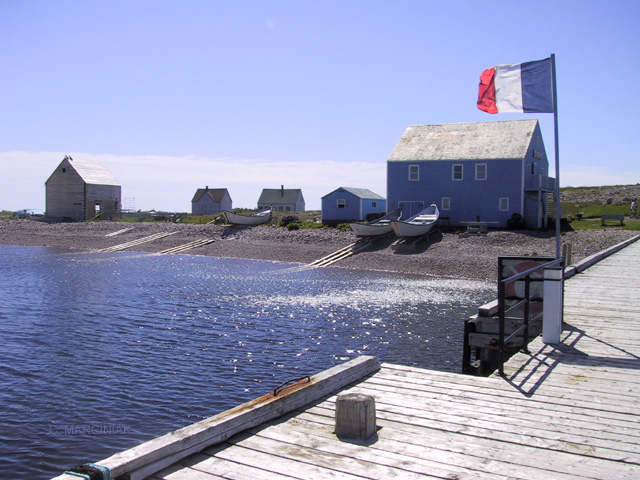
Suggestion for celebrating the anniversary of the birth of the first state fully heir to the Enlightenment: Visit St.-Pierre and Miquelon next July 14, a collectivité territoriale, a part of metropolitan France, just off the southern coast of Newfoundland Island.
Years ago I had heard that bread was flown in each morning from Paris, to be sold at the same price as in the capital, just to maintain the strength of the islands’ ties to the rest of the nation, since they are now the last relic of what was once a French empire which included most of North America.

After France lost Quebec [all of Canada] to the British during the Seven Years War, Paris managed some deft negotiating in 1763 to keep this sliver of its colonial empire to give its fishermen a safe haven.
During Prohibition, the archipelago became a way station for Canadian liquor smuggled into the United States. Virtually every basement was converted into a warehouse for bootleggers, and Al Capone set up shop at the Hotel Robert, where his straw hat still graces a small museum.
Capone came here to solve a problem. The wooden whiskey crates that were to be unloaded near Fire Island made too much noise when they knocked against each other, tipping off the feds. Capone decided to discard the crates for jute sacks and straw, leaving behind 350,000 cases a year here that stimulated an odd housing boom — one cabin outside town made completely of crates is still known as “Cutty Sark villa.”
When the Volstead Act was repealed in 1933, truckers held a mock funeral.
Not much has happened here since, although the archipelago was the site of a World War II military landing that arguably spelled the beginning of the end for the Vichy government. On Christmas Eve 1941, Free French fighters aboard three corvettes and a submarine landed in St. Pierre without bloodshed. They held an election, and the people voted to boot out the local Vichy authorities.

[photo from C. Marciniak]

New York

wegee summer
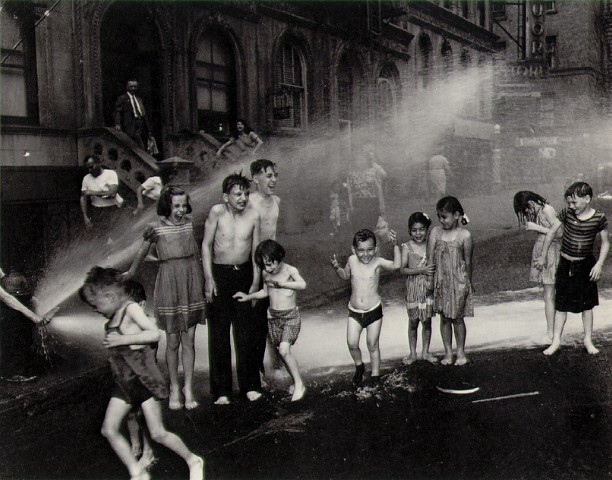
Weegee (Arthur Fellig), “Summer, Lower East Side” (1937)
Maybe the longer you’re here the more likely New York will feel like a small town, but normally that means small in physical scale. What about the dimension of time? When we find really long-term survivors in our midst, our assumptions about the city’s evanescent joys and sorrows fly out the window, and the years themselves are abreviated.
Linda Wolfe recently tripped over her own and her city’s histories on a recent afternoon when she returned for the first time in 50 years to two old houses on East Broadway, nos. 185 and 187,* where she had lived one summer between college semesters.
She admits that she knew nothing of the nineteenth-century history of the neighborhood when she was there in 1953, although that of the 20th century was very much present.

After all, The Jewish Daily Forward building, with its columns, crowning clock and bas reliefs of the heroes of European socialism, was three doors over. The Educational Alliance, where assimilated uptown Jews once tutored their rough-edged newcomer cousins in English and social graces, was just across the near corner. The Garden Cafeteria, where aging Trotskyists and Stalinists sat chain-smoking and arguing the future, was on the far corner. These famed institutions were all still functioning. I had moved into the bleachers of history.

What she found when she returned put the last two centuries in a perspective denied most New Yorkers.
____________________
*
In Caleb Carr’s “The Alienist” the title character operates an institute for children at 185-187 East Broadway. I wonder if Ms. Wolfe knows about this shared reference.

no road for Palestinians

I’m sorry, but there is no way I could excerpt this message. It’s information is too rare here, and the authority of its source requires that it keep its integrity.
It was forwarded from Queers for Peace and Justice, and was written by Jordan Flaherty, a New York activist currently one of the International Solidarity Movement “NOLA Freedom Summer” delegates. The others are Adam Wilson and Thomas Bacon. They are currently in Palestine working with the ISM, which was formed to non-violently resist the Israeli occupation.

July 6, 2003 – From Jordan
Letter from Jenin
I can’t even put my anger into words. Really, its so much worse than you suspect and fear.
While the media talks about a roadmap to peace, here’s whats happening:
People want to know if its true that the Israeli military have pulled out of Bethlehem. Of course they haven’t, but so what if they had? Can people from Bethlehem leave Bethlehem? “We haven’t left this camp in two years,” say my family in the Azzeh refugee camp. Where can they go? They are trapped by checkpoints, fenced in by bypass roads, and choked by settlements. The hills around Bethlehem are alive – with huge, monstrous settlements, built on stolen land.
Bethlehem residents can visit the church of the Nativity. But what about the other major holy site in Bethlehem, Rachel’s Tomb? Rachel’s tomb is off limits to Palestinian Christians and Muslims. Only Israelis have access to this major holy site. The several hundred yards around it are also confiscated. In fact, the Israelis are in the process of confiscating more of Bethlehem, to “annex” Rachel’s Tomb into Israel. If they change the definition of Bethlehem – redefine it into a fraction of its former self – when its easier to “pull out.”
This is what’s happening in the whole West Bank. The definition of what is the “West Bank” is being physically changed. Once the Israeli Government has cut the West Bank into tiny pieces a fraction of their current size, it will be easier to “pull out” of the West Bank.
The major tool of this confiscation is the “security wall” being built by Israel. They call it a “separation fence”. Fine, lets call it that. And lets recall the the Afrikaans word for “separation”: Apartheid. The Apartheid Wall is nearing completion on the West side of the West Bank – where its estimated to have confiscated around 10% of the most fertlie land. As well as cutting through or displacing – redefining – 30 towns or villages. But this is just the beginning. The Israelis are also beginning a Wall along the east side of the West Bank. The exact dimensions are unclear, because the Israeli government wont say its plans. Some estimate it will take another 40% of the West Bank.
Here’s some of what I’ve seen here in Jenin:
All of the villages here along the “green line” border are facing land confiscation. There is no formal notice. One day, Israeli engineers come onto their land, leaving behind blue flags marking a line. Within days or weeks, the bulldozers come. Then, the builders. And within weeks, their land is gone, and a Wall is in its place.
One farmer uprooted his own trees, hoping to replant them somewhere, rather than see them destroyed. He is currently being threatened with a prison term.
The wall is being built at a devastating speed. In the Jenin area, there are at least seven Israeli companies working at building the Wall, so it is being built in several places at once. In some areas, the Wall is almost 100 meters wide. There is barbed wire, followed by a trench, followed by a fence, followed by a settler road, followed by another trench. The atmosphere in the cities is different from before – a quiet desperation.
People are still being terrorized by regular invasions: last night, there was an explosion, and all the power in Jenin went out, tonight, there was a tank outside our building – but the real terror is in the villages, where a massive land grab and depopulation is happening, with almost no media attention.
This is ethnic cleansing on a massive speed and scale. Remember that when the media talks about a roadmap to peace.

update on Reza


Reza at rest in the back of the motor home in Oklahoma
Reza [new site!] is in Forrest City, Arkansas right now. Dave Hyslop, who’s travelling with him by car, says they should reach Memphis by tomorrow evening. He asks if anyone has an Elvis costume for Reza.
From a June 23rd report, now on the website, made while Reza and Dave were still in Oklahoma:

Meet Eddie and his wife, owners of the Elk Run RV Park in Elk City, OK. We spent the night here (41 mile marker) after Reza’s first day of running in Oklahoma. I’d gone here to check their rates and scope out the accommodations in advance.
We’ve found that $25 a night for two people has tended to be on the high side of what we’ve encountered along the way and $15 a night has been the low end.
As you can see, Reza and I have added a little signage to the side of the motor home…some handy work he and I created at Kinko’s and then applied in the parking lot of Home Depot–both in Amarillo, TX.

The poster is always a good ice breaker in conversation. I tell Eddie what it’s all about and he says, “Ahh, I’ll let you stay for $!2.” Very kind of him but his generosity was only getting started! I say, “Thanks.” and said I’ll return after I pick up Reza.
When I return he fills out a receipt for me and asks if he can get Reza’s autograph? “Eddie,” I say, “I’ll do you one better than that–come on out to the mobile mansion and I’ll introduce you.”
Reza’s got both his knees iced and a third ice pack resting on the right side of his groin area but still makes the effort to stand up and greet the man. “Oh don’t get up for me,” Eddie said, “you’re the one that’s been work’n all day.”
“Thank you so much.” Reza said.
Seeing all this, Eddie says, “Tell you what–I’m gonna let you stay for free. I want to help you guys out.”
By this time, Kamran, the 18-wheel over-the-road driver has just arrived to drop us off a load of provisions from the Food Bazaar Market in Los Angeles. This is the third time Kamran has stopped to check up on us. He’s drives a route between Wisconsin and Los Angeles so it’s enabled him to rendezvous with us at various points along the way. From this point on we won’t be seeing him as he always turns north at Oklahoma City. Can’t tell you what a friend he’s been to Reza and I along the way. He’s always stopped for at least 2–3 hours to visit with us. The man’s pure heart.
We spot the motor home (hook up the electrical, water, sewer and when available, cable line) and here comes Eddie. “How are you doing for money?” he asks.
“Well…” I say, “we’ve always been looked after.”
“Are you taking donations? he asks.”Well, yeah but you’ve already donated, Eddie!” I said.
“He’s from Iran, right?” he asks.
“Yes.” I said.
“Well my wife of 35 years died of cancer a year and a half ago and her doctor was from Pakistan. He took care of her for three and half months–sometimes he’d come out twice a day–it didn’t matter. You know how much his bill was?” he asks.
I shook my head.
He held his right hand up and formed a circle with the index finger and what remained of an amputated thumb, “Zero.” he said.
The hospital, however, wasn’t so kind. “I didn’t have no insurance; ” he said “they took pretty much everything I had. The bill was $100,000. They took my farm, two rental units I had in town, a building I had and gesturing around the RV park he said, “This is all I’ve got left.”
He pulls a ten-spot out of his wallet and goes to hand it to me and Reza says, “No, you can no give, you no business tonight.” and sweeps his arm around toward all the empty spots in the RV park. Kindness killing kindness.
So that’s the way it’s been this whole trip. People like Eddie who don’t have it to give–going ahead and giving anyway.
“I came into this world with nothing but skin so if I go out that way I guess that’s alright.” Eddie said. “I hope you guys make it good.”


A couple of fans in Oklahoma City go through the scrapbook begun in central Asia

“their kind”


Ellen Hemings Roberts, granddaughter of Thomas Jefferson.
Sally Hemings still has to stay out of the drawing rooms – at least while the “white” folks are around.
Incredible as it may seem, even today, after all the fuss endured in ending slavery and after the happy surprises of DNA, the descendents of the union between Thomas Jefferson and Sally Hemings are neither permitted to be part of the Monticello Association nor allowed to join in its annual reunions.
During a regular meeting of the Association, when the presiding officer was challenged by a cousin to explain a broadening of the ban, one of the other descendents

grabbed the microphone. What he said, according to [the challenger] and three other people who were in the room, was that he had no interest in associating with the Hemings descendants in this life — or in death. (The phrase “their kind” was used.) Judging by the amount of applause he is reported to have received, he blurted out what must have been on nearly everyone else’s minds.

For the complete story, see the more delightful parts of the rebelliously-inclusive Jefferson cousin Lucian K. Truscott IV’s account of the family feud in today’s NYTimes Op-Ed piece linked at the top. You’ll find Walker, the groundskeeper at Monticello, his cousins (the elderly Randolph ladies, Truscott’s great-grandmother, Mary Walker Randolph, and great aunts Aggie and Miss Moo), the neat little round windows above the house roof, and the Buick parked on the lawn on a hot July day in 1951.