What with everyone trying to show off their best things at once, it’s always difficult to “cover a larger art fair – even physically – and Armory 2009 was no exception. I’ll have to go back, but in the meantime what follows are images of just a few of the things that attracted my attention at the “Contemporary” section during last night’s reception.
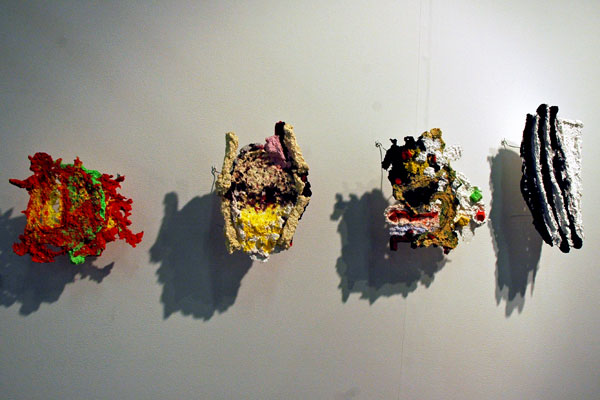
Richard Tuttle paper-pulp edition at Dieu Donne (new York)
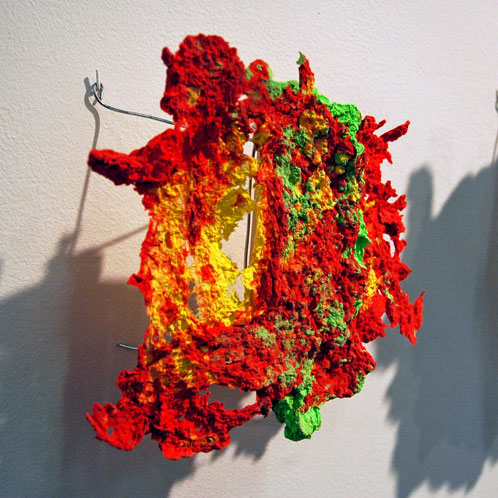
[detail]
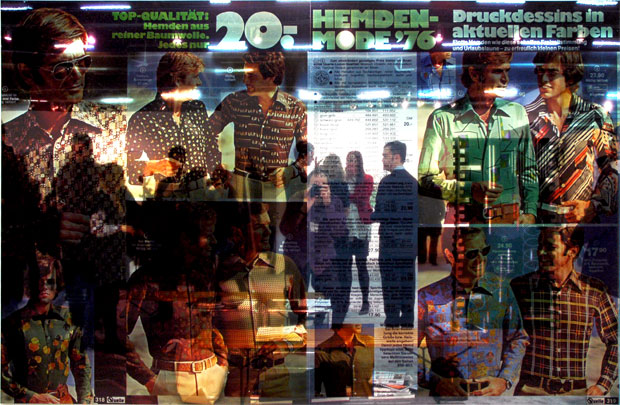
Josephine Meckseper print on reflective Mylar at Elizabeth Dee (New York)
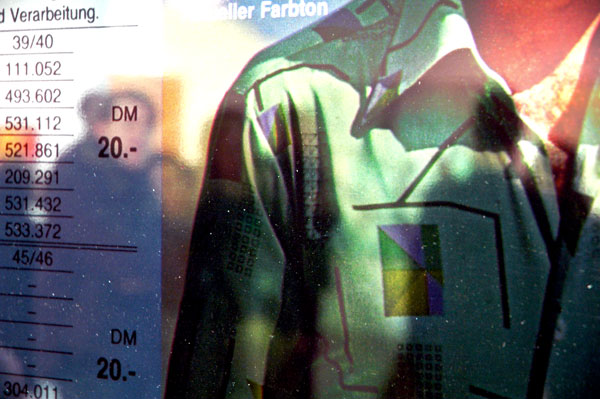
[detail]
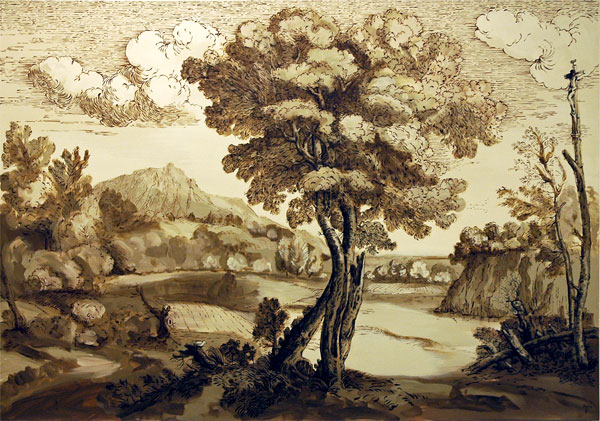
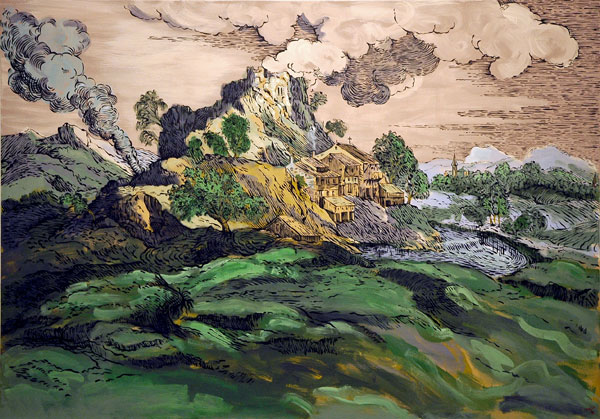
two David Godbold paintings at Kerlin (Dublin)
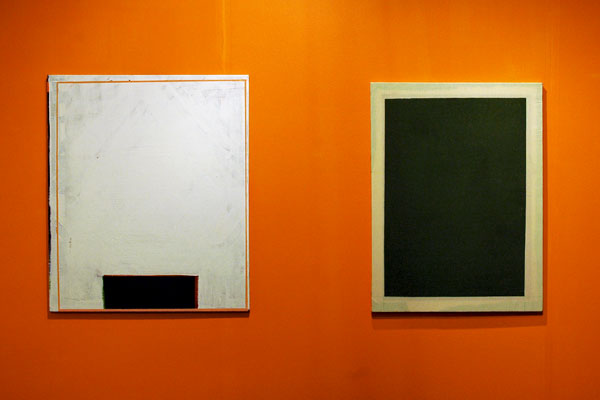
section of one Matt Connors wall at CANADA (New York)
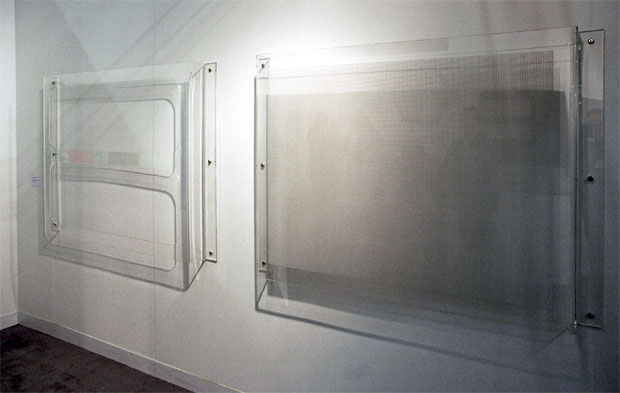
two Gerwald Rockenschaub sculptures at Georg Kargel (Vienna)
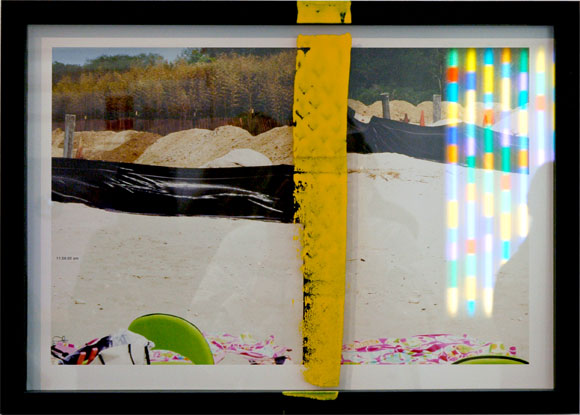
Jan De Cock architecture-related sculpture, including artist-countenanced reflections, at Stella Lohaus (Antwerp)
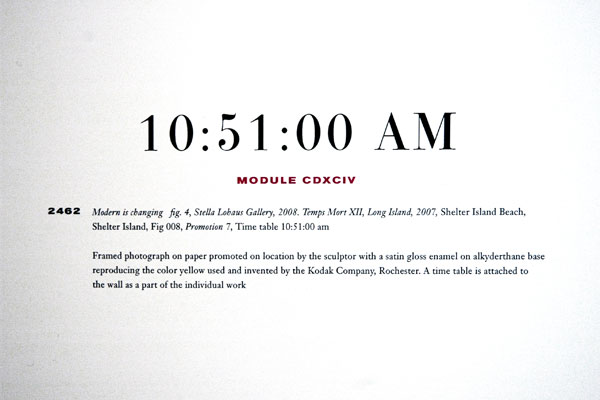
[large detail of artist’s label]
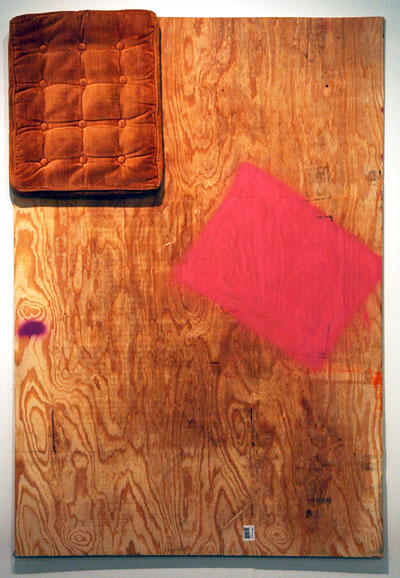
Sarah Braman sculpture at Museum 52 (New York, London)
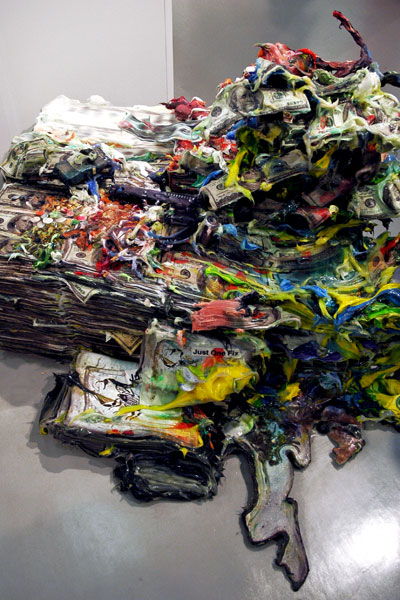
large detail of Fabian Marcaccio sculpture at Thaddeus Ropac (Salzburg, Paris)
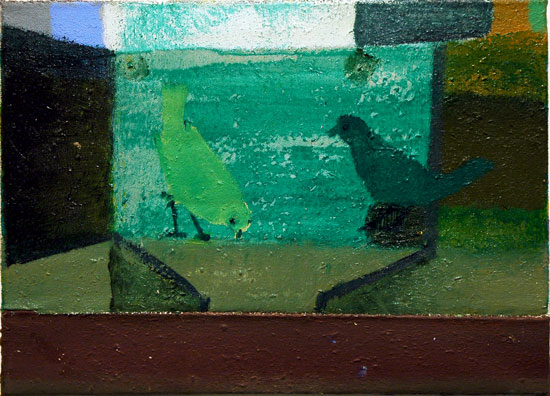
small Merlin James acrylic at Kerlin (Dublin)
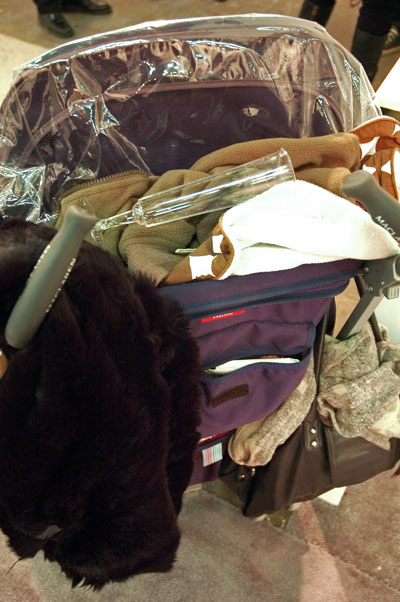
stroller spotted parked inside a booth during last night’s VIP reception
Author: jameswagner
Rachel Whiteread’s Water Tower is back
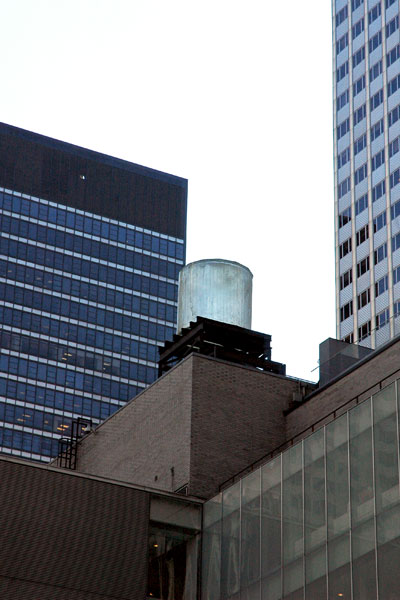
Rachel Whiteread Water Tower 1998 translucent resin and painted steel 12′ 2″ x 9′ in diameter [installation view]
I don’t know how long it’s been up there, but while at the Kippenberger press preview at MoMA last week I spotted a discreet label on the wall behind that artist’s jaw-dropping Styrofoam-to-aluminum “Santa Claus Lamp”*, which is installed where Rodin’s Balzac normally stands. I turned around and looked past the Sculpture Garden and up to the roofs where you see it here. Now owned by the museum, Rachel Whiteread‘s “Water Tower” was commissioned by the Public Art Fund. The last time I saw it was ten years ago when it was installed in its temporary home on top of a building in Soho.
*
It’s shocking to find that there’s no image of this piece on line, and perhaps even more shocking to find that MoMA has only one image of the entire Kippenberger show on its site (MOCA, where the exhibition originated last year, has only six). Especially for a museum operating in the twenty-first century, such neglect doesn’t make it look like the “educational institution” which its founders wanted MoMA to be when it began in 1929.
To be fair, MoMA is relaunching its website later this week, and that may be the reason for the lack of images on moma.org.
winter pots
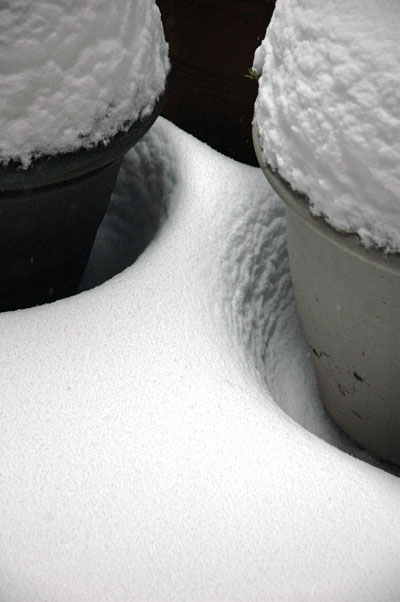
untitled (two pots) 2009
It was only noon today, but I wanted to capture an image for the blog of the ho-hum big storm of March, 2009. At the same time, not wishing to suit up for the cold and the wet before breakfast, I decided to stick my camera out of the breakfast room window. It was still snowing.
Believe it or not, this is actually a color image: I can’t wait until spring.
”Hallelujah!”, Reverend Billy’s running for mayor
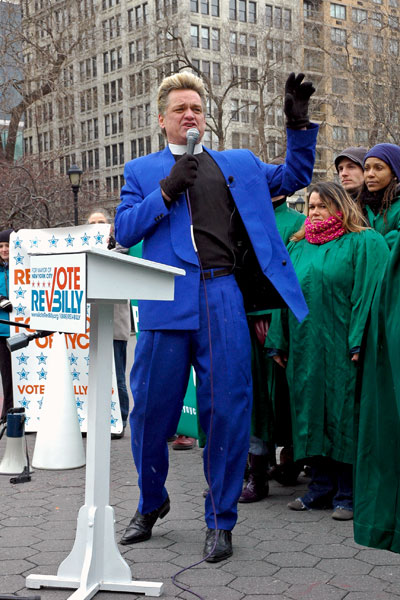
he’s not just preaching to the choir
Billy’s the real thing.
Reverend Billy of the Church of Not Shopping is more than a performer and a performance. His, its, their dedicated and vocal supporters are only one center of a contemporary activist, grass-roots movement for economic justice, environmental protection, and anti-militarism, but their performances and meetings have typically been among the most entertaining and joyful manifestations of a growing movement which may be about to come into its own, even if it may not yet be in sight of the promised land.
Bill Talen (Reverend Billy is the stage name he’s used for years) wants to be mayor. Let me go on record right now by saying I’d vote for him at the drop of a hat, and that’s what I saw happen today at noon in Union Square. Since the good Reverend himself is never seen in anything resembling a hat (his thick theatrical comb-back “do” probably supplies enough warmth), if I’m going to resurrect another hoary expression to describe what I saw, I’ll have to emphasize that Talen threw his hat into the ring only metaphorically, when he declared his very serious candidacy for the office of Mayor of the City of New York on the Green Party Ticket.
If you’ve heard him speak you know Billy’s a master with metaphor, but you may not know that he’s a master at gently but firmly cutting through the cant, stupidity and obfuscation which passes for political discussion in New York. He’s quick on his feet in front of both large and small crowds, but he reveals an awesome, genuinely-sincere mind – and heart – in the very smallest groups, or in one-on-one conversation.
He’s an impressive speaker and an impressive candidate. If only he were able to appear in front of voters and speak to them as I’ve heard him talk, both in and, at least as importantly, out of his theatrical character, I believe he’d be a shoe-in for the office (another clothing metaphor, but we do know Billy wears shoes). They’ll come to smile and to laugh, but the message he delivers is serious, and it now has more meaning for more New Yorkers than ever before.
In the midst of an economic disaster Billy can no longer be dismissed as a voice crying aloud in the wilderness, but of course for many of us he never was.
He’s not going to be quiet, and as the candidate of an established party he can’t be ignored.
When the choir had finished and he was done speaking, Talen walked down the steps from the rostra (where he stood at a white-painted wooden church “pulpit” constructed for an earlier “Church” action) to take questions from the press assembled below it. He was asked what he thought about the difficulty in beating the incumbent, Michael Bloomberg (the richest man in Gotham, who literally bought the office – twice – and is willing to do so again) “Bloomberg? I don’t think he’ll win; he’s running against democracy; it’s Mike vs. democracy, and democracy will win. It actually is that simple and clear to lots of New Yorkers”. Asked if he himself represented democracy, he answered generously: “There are a number of very worthy candidates,” adding, “we have to respect the people of New York”, alluding at least partly to the voters’ decision to impose and uphold term limits recently scrapped by the Mayor and City Council.
The new Green Party nominee pointed to the historic focus of his political activism up until now, New York’s 500 real neighborhoods*, as the new political reality with which he will be working, and which he said should and would replace that of the paternalistic and undemocratic system of failed corporations, insolvent banks and ruined developers. “The key is in the neighborhoods, [even if] for some neighborhoods it’s too late.” Reminding us of one the Church of Not Shopping’s battles, that focused on the multiplication of the big chains and the disappearance of local businesses, the Reverend seemed to be warning Bloomberg and the beneficiaries of his largesse, “We all now know what the monoculture is, and we know to oppose it.”
From the candidate’s letter to New Yorkers which appears on the campaign web site:
The 500 neighborhoods of New York, if they are healthy, are protecting our families and jobs. Local economies anchored by independent shops and public spaces are not as sexy to this administration as luxury boxes, corporate jets and the like, but really the greatness of this city is in its neighborhoods.
This would all sound like only an utopian dream if we weren’t already experiencing the beginnings, within the country as a whole, of virtually a revolution in public attitudes and government programs proposed, and even an alteration in the political system itself, all being driven by circumstances, the internet, and Barack Obama’s emergence originally as candidate and now as President.
ADDENDUM: Video documentation of the scene in Union Square yesterday:
Billy’s oration
Billy and the press
Bill of Rights chorale
*
Billy says he and the members actually got together to try counting, and stopped at 500.
Tehching Hsieh at MoMA

the artist’s life becoming a concept [the wooden cell]
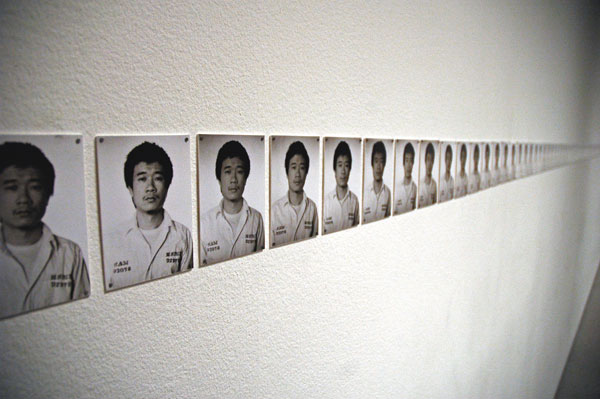
documented in time [the photographs taken daily]
I was ashamed that I hadn’t immediately recognized who Tehching Hsieh was. That is, I had not only forgotten about his 1978-1979 “Cage Piece” but I had also, for the moment at least, not remembered the “time clock piece”, “the outdoor piece” or “the rope piece”, even though just the idea of these had thrilled me at the time, as I read about them in ordinary newspapers while living in Rhode Island before moving to New York.
After having breezed through Hsieh’s exhibition at MoMA last Tuesday on our way to Klara Liden’s piece in the next room (a first priority, because her piece had not yet been opened to the public), Barry and I were returning to check out his own, more sober installation, located just off Kippenberger’s “Kafka’s ‘Amerika'” piece in the atrium. Museum Director Glenn Lowry had left the Liden room just before us, where I had heard him congratulating the curator for introducing such a terrific piece into the museum. He stopped to look at the Hsieh materials and documents and turned toward us as we entered the room apparently wanting to his clear enthusiasm for the work. [I love to see the guy at the top running around the big “shop” and sharing his excitement with visitors.] We agreed that it was an incredibly impressive and even astonishing project. I said that on registering it for the first time my second thought, and first question, had been, what does such a long experience of isolation from any outside stimulus do to your mind? I wondered aloud, what do you do after being alone with your mind for a year? I asked Lowry, do we know what he did later? He answered, “Apparently he didn’t do much”.
Which is both true and not quite so true, as I started to learn almost immediately after asking the question. Hsieh went on to commit himself to several more long-term performances equally as challenging, although not nearly so isolating as the first. But no, apparently until very recently no art was ever formally exhibited or sold. The last (latest?) two projects, the first a one-year assignment to “go in life”, not seeing, making or talking about art, and a “13-years plan” to make art but not show it publicly, would each appear to have been a relative piece of cake, but together they seem to have meant the end of his art, at least by his own account, as documented inside a long and fascinating piece. “A caged Man Breaks Out at Last“, by Deborah Sontag appearing in tomorrow’s New York Times [slide show].
Tehching Hsieh tells us he is no longer an artist, but I think we can’t take him at his word, and we must not, as I’ll try to explain.
The work haunts me as I sit here trying to express something about the inexpressible. Alexandra Munroe, the senior curator of Asian art at the Guggenheim Museum, is quoted in Sontag’s article, referring to Hsieh, “He is deeply philosophical”. It seems to me he is something else: Hsieh is not a conceptual artist; rather, he has reduced his entire life to a concept. The work he has given to us seems to have come out of nowhere. It is so pure and sublime that it doesn’t seem we could possibly deserve to be its legatees, especially since we’ve virtually ignored it for thirty years.
real New York Times front page evokes fake Times
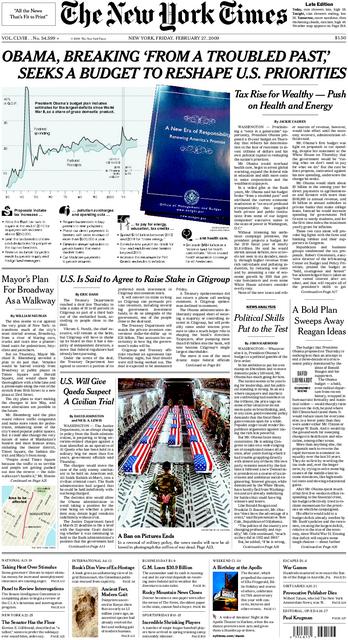
real
The front page of this morning’s real New York Times looks an awful lot like the fake New York Times published by the Yes Men with the help of many others last November 12. My own hard copy of today’s Late [City] Edition differs only slightly from the one shown above. It adds a story which suggests the feds are getting closer to nationalizing the banks.
Probably the most significant element missing from the February 27, 2009, paper is the banner headline on the July 4, 2009, edition shown below: “IRAQ WAR ENDS” – but then we still have more than four months to get that one right.
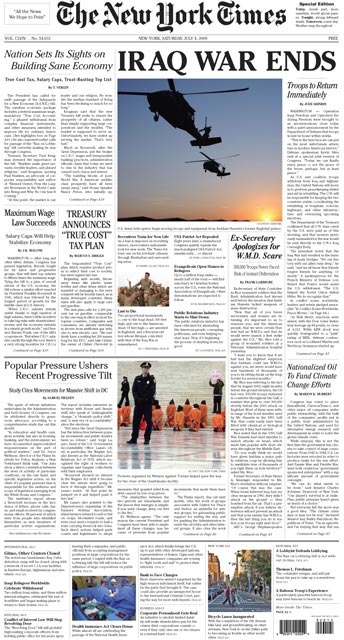
fake New York Times
[first image from the real NYT site; second from the faux NYT site]
a quick return to Kippenberger(s)
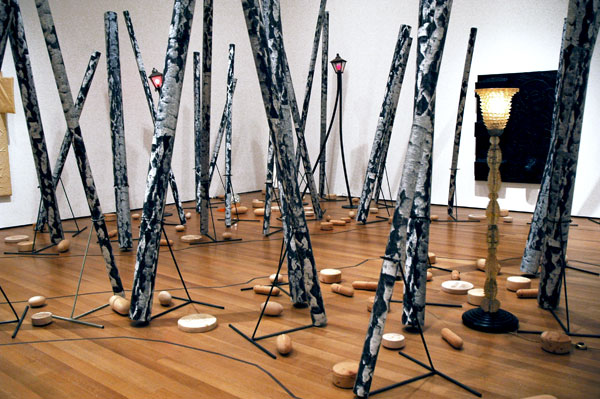
Martin Kippenberger Now I’m Going Into the Big Birch Wood, My Pills Will Soon Start Doing Me Good 1990 twenty-nine artificial birch trees (rolls of cardboard and plastic and black-and-white offset prints), metal stands and wood pills – dimension variable [large detail of installation, including “Kippenblinky”, “Street Lamp for Drunks”, “Untitled” (street lamp), “Disco Bomb”, and parts of two rubber on canvas works hanging on walls to the right and left]
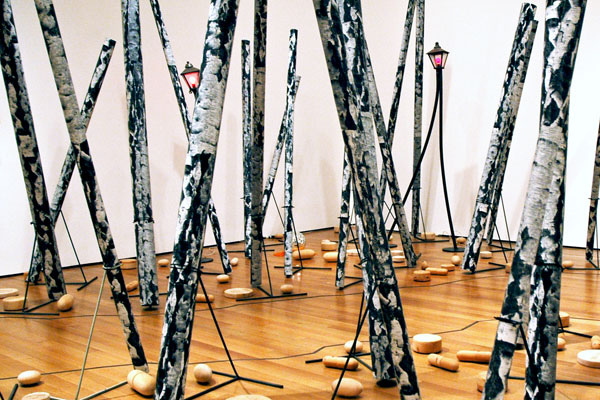
[cropped version of photo above]
I didn’t include this image in my Kippenberger show post of two days ago because it seemed to me somehow adulterated for including works that were not actually part of “Big Birch Wood” itself, but which the curator, Ann Goldstein, had intermingled with the larger piece.
And yet, since I published Tuesday’s entry, I’ve scrolled several times through the many images I took home with me, always finding myself being drawn back to the oddly-calming picture of these trees and oversize pills. I decided to try cropping the document to eliminate most traces of the other works. Then I wanted to share what I came up with, and that suggested this follow-up post.
But then something unexpected happened, barely two minutes before I started writing this paragraph. I had already decided I had to know more about why the installation had been given this shape so I did a little research on line, in the press materials, and in the George Baker’s article on the Kippenberger show in the February Artforum, “Out of Position” [unfortunately not available on line]. As a result of what I learned, I made the decision to add a thumbnail of the original image below the full-size representation of my large detail.
By this time I had apparently arrived at a sufficient degree of enlightenment to see something that has escaped me earlier, because when I took another look at the un-cropped picture I couldn’t understand why if had not satisfied me before. I reversed the arrangement I had just determined upon, so that now my preferred image is at the top. I left the cropped photo as a thumbnail mostly to show what I’ve been talking about here.
Ain’t art wonderful?
I still don’t know enough about this extraordinary artist’s life and work to critique the curator’s decision to meld several different disparate [?] pieces in this part of the gallery. I’m convinced however that Kippenberger’s “Now I’m Going Into the Big Birch Wood, My Pills Will Soon Start Doing Me Good”, largely because of its title, and its relationship to the artist’s personal circumstances, is one of the saddest, sweetest, and yet grandest poetic expressions of Kippenberger’s pain and his creative genius.
I’ve one more thing to share about Kippenberger right now, this quote from Ronal Jones, writing in Artforum in 1997 [I found it on Douglas Kelly’s site] which captures his remarkable fecundity:
Someone was always mistaking Martin’s solo exhibitions for a cattle-call group show. That pleased him no end.
Klara Liden at MoMA
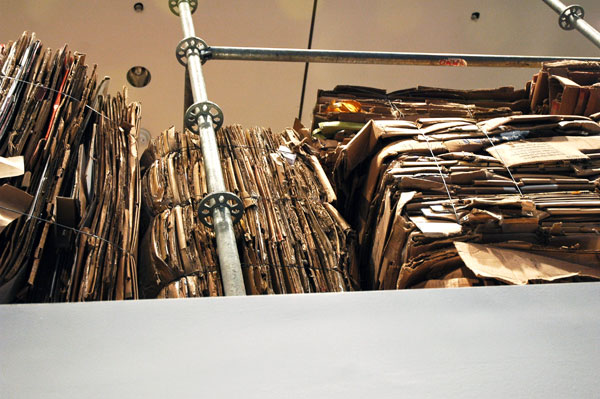
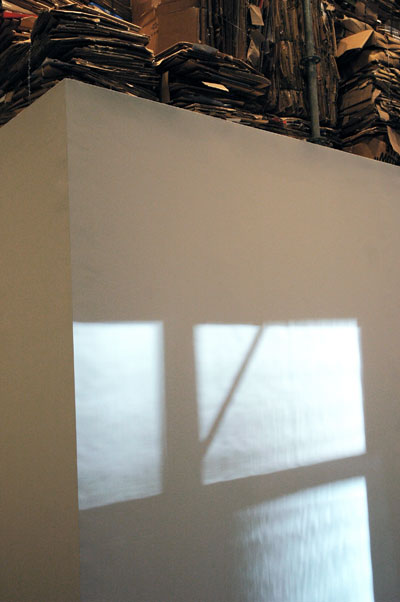
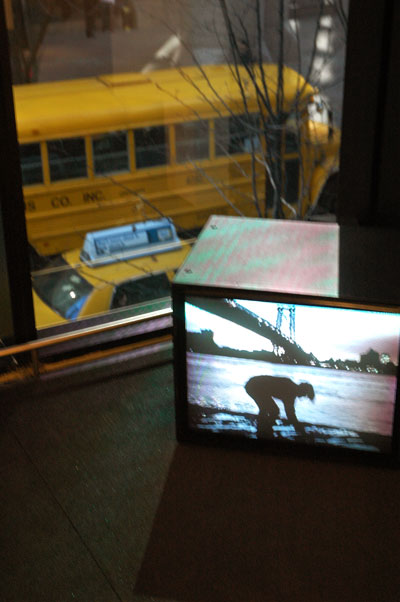
This kind of project is one of the things that we have not been seeing often enough at MoMA, and that was the case even before the opening of the new building. Since there’s now more space, there’s less of an excuse then ever to keep “emerging artists and new art“* out of our premier modern mouseion, founded and endowed as the premier “seat of the (here, visual) muses”.
Maybe some people understand “modern” in a way that does not include the “contemporary”, and MoMA’s decision not to engage in the regular deaccession of works in its collection which reach a certain age might explain what seems to be the museum’s frequent uneasiness with art being created in real time. I hope the appearance of Klara Liden on the second floor gallery signals a new openness on 53rd Street.
I’ve been one of the many champions of this artist’s work since first encountering it inside the storefront of the old Reena Spaulings four years ago, and yesterday during a press preview Barry and I were both charmed to see her working again with cardboard, this time inside a very different space.
Not everyone might agree with us, at least at first, as I learned when we were about to leave the room. A smartly-dressed woman all in black, of a certain age, who, along with several other women, also in black, had been in conversation with the curator, Eva Respini, asked us if we liked the work. I immediately volunteered, “yes”, with a little giddy enthusiasm. She asked me why, and I first described Liden’s earlier work. Turning to this installation, I mentioned the re-cycling element, the ransacking of the museum’s bowels, the white cube, the reference to consumerism (even in a museum context) and waste, the careful ordering of materials, and such. She looked up at the rows of cardboard boxes, broken down and tied, lined up high above the pure white walls, and she nodded, apparently unpersuaded of its virtues. She thanked me, and as she turned to leave, while she passed by I distinctly heard her give a very soft sigh.
Respini told us that the accompanying video of the artist casting stones into the water had only been finished last weekend. It has a more casual air, than the structure behind it, which almost fills the room. At the time I took this picture the huge window behind the heavily-tinted glass (which turned daylight into something like the twilight East River scene on the screen, and also cast a blue light on the cube) was partly filled by a New York cab and a parked school bus, painted an identical yellow. It reminded me of the fact that MoMA routinely hosts visits of young school children on the days it is closed to the public, and we encountered one such very fortunate group, probably a kindergarden class, minutes later on our way out.
Now that’s even more than contemporary. May the gods save this kind of temple forever.
“Martin Kippenberger: The Problem Perspective”
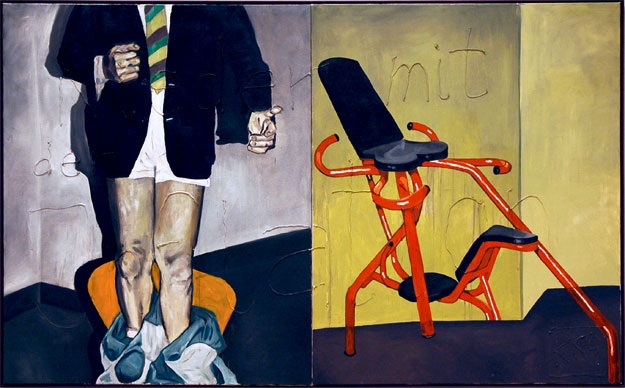
Martin Kippenberger Down with inflation 1984 oil and silicone on canvas (2 parts) 63″ x 104.75″ each
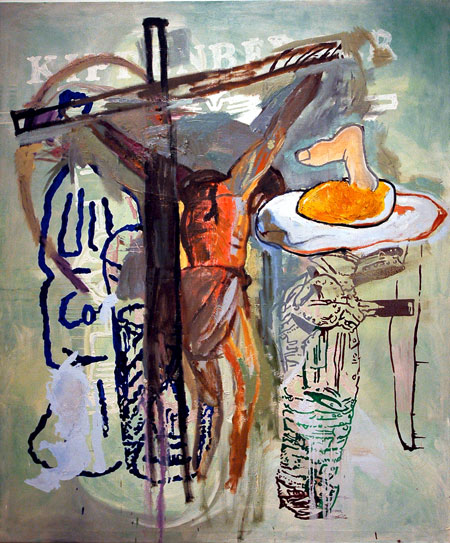
Martin Kippenberger Untitled, from the series Fred the Frog 1990 oil on canvas 94.5″ x 78.75″
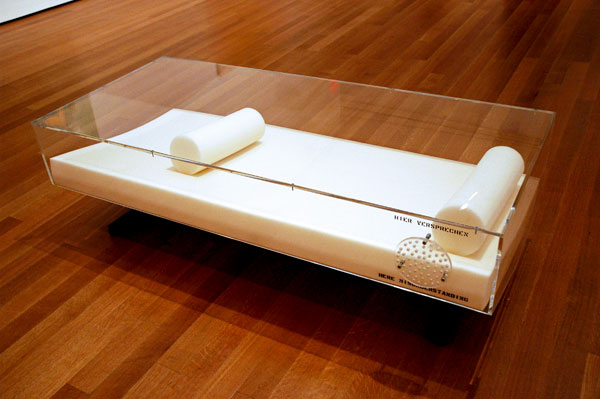
Martin Kippenberger Snow White’s Coffin* 1989 Plexiglas, synthetic foam and metal 15.75″ x 33.5″ x 71″
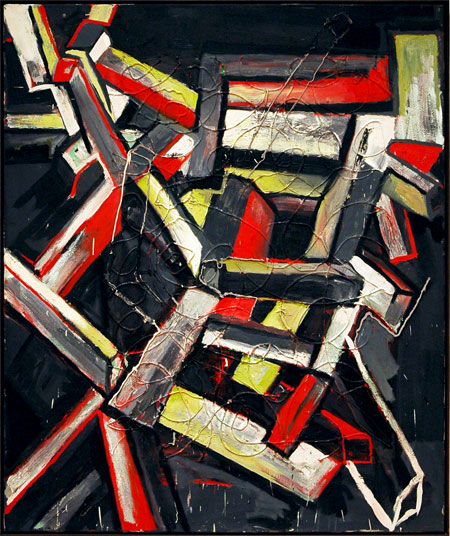
Martin Kippenberger With the Best Will in the World I Can’t see a Swastika 1984 oil and silicone on canvas 63″ x 52.75″
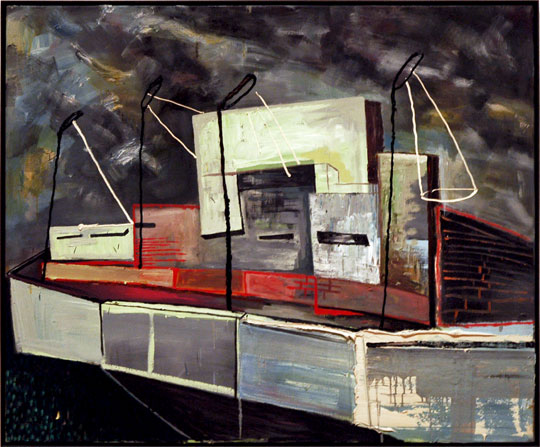
Martin Kippenberger “Stammhelm”** from Three Houses with Slits (betty Ford Clinic, Stammheim, Jewish ELementary School) 1985 oil and lacquer on canvas 49.5″ x 59″ each
This one really is for us. I mean the glorious, rich show, “Martin Kippenberger: The Problem Perspective“, which will open on Sunday (March 1) at MoMA. And I mean that it’s especially appealing to us art junkies: artists, fans and whatnots, zealots who regularly traipse through some of our meaner streets, searching out, and even haunting the more adventurous galleries and grittier rooms in this city and the incredible world beyond it, looking for the real thing, art which both reflects and challenges a world unlike that of even the most recent past. An anomalous rabble, we’re notorious (or more often ignored) for being sustained by under-known art not yet “elevated”, even made sacred, by the respectable museums we’re just not visiting so much any more (and not only because admission to the pantheon can set us back twenty bucks a pop).
But today I feel much better about the Museum of Modern Art than I have for some time.
Because of our interest in the subject of the retrospective, and our relative ignorance of it, Barry and I were eager to go to the press preview on West 53rd Street even though it was scheduled for something like our dawn this morning. I’m delighted to see that this month our local cabinet of early-modern curiosities is bringing us both Klara Liden (opening tomorrow, February 25), and the Kippenberger show, although I have to point out that the Kippenberger was put together by The Museum of Contemporary Art, Los Angeles [MOCA], Ann Goldstein, curator.
It’s a great show.
This is a collection of work which passes back and forth (sometimes doubling and tripling up) in what seems to include just about every medium. Although it all really looks like today, some of the pieces being displayed have been around for three decades. A few of the articles installed in the museum’s sixth-floor Special Exhibiton Galleries may be little more than the size of a hand, and the paintings are generally less than gigantic, but there are also room-size pieces, and one installation, “The Happy End of Franz Kafka’s ‘Amerika'”, which totally fills the bottom of the huge atrium, leaving only a modest square path lining its sides for all the visitors it will delight.
In her remarks today Ann Goldstein shed some light on the title of the retrospective (still slightly obscure to me, since I haven’t yet read all the material handed out at the presentation) when she described Kippenberger as a “profoundly productive problem maker”. I was suddenly all ears – or, in this case, all eyes.
Because of its inherent strength, its enormous influence on other artists, and the fact that, as Goldstein also said, we’ve finally begun to catch up with Kippenberger, I think by now we would probably be seeing this body of work in these major, established settings in some form even if the artist had not died so young, in 1997, of cancer. He should be turning 56 tomorrow, February 25. I can’t imagine what our world would look like if we were lucky enough to still find ourselves provoked, repeatedly, by the wisdom, the humor and the irreverence of this prolific virtuoso.
Now the work he has left us looks like it’s here for the ages, whatever that may mean, but I have to hope “the ages” will always cultivate the liberality which Kippenberger’s art seems to ask of us.
It’s a totally delightful show, great fun and without a dull note. I will be visiting it as often as I can while it’s still here in New York.
The choice of the images uploaded here [yes, they’re mine; fortunately we were allowed to take photos, since the museum seems to have virtually nothing on their site yet] was necessarily impacted by my fast run through the galleries during a far-too-brief press preview this morning, and it therefore doesn’t necessarily represent either a good overview of the installation itself or a list of my top favorites – if any arrangement of either were even possible.
*
the German text above the perforated opening translates literally as “here promise”; the English text below it reads “here misunderstanding”
**
Stammheim Prison, where the leading members of the Red Army Faction (Baader-Meinhof) were held and tried. It is also the site where four of them either committed suicide or were murdered – extrajudicially.
Lisa Kirk’s “House of Cards” at Invisible-Exports
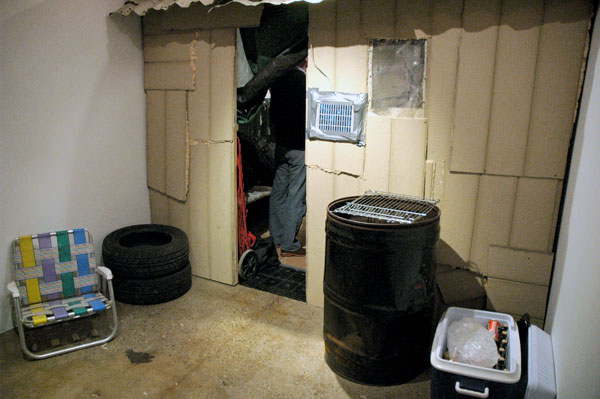
front yard
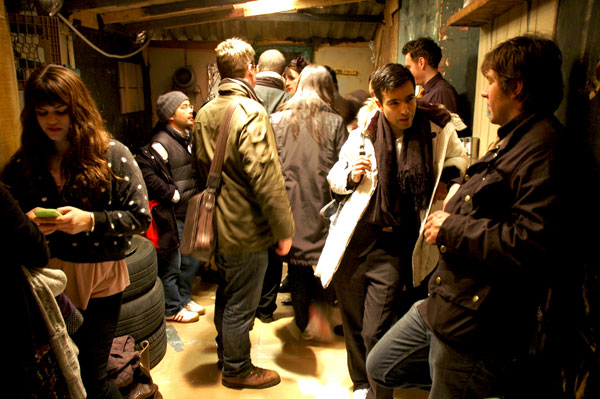
open house
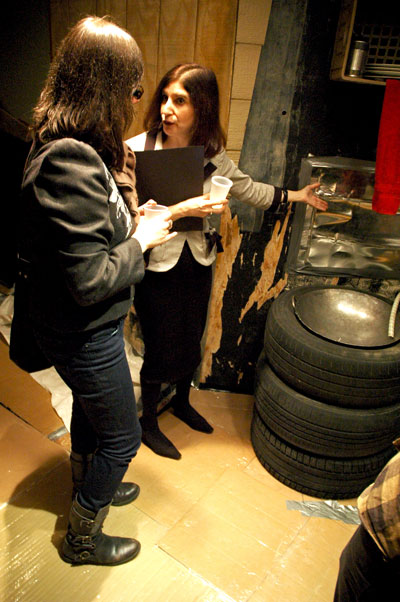
sales tour
Lisa Kirk continues her provocative body of work (what she calls her “series of social occasions”), more recently investigating capitalism, terrorism and political violence, in a dramatic installation, “House of Cards“, currently installed at the Lower East Side gallery Invisible-Exports. Although the show opened this past weekend and will continue there through most of March, after that it will take on the second life for which it was conceived.
This time Kirk has re-conceived the story of our contemporary real estate boom and bust in the form of a show model �shanty timeshare� whose structure and interior furnishings have been assembled, in classic (not “classical”) style, from discarded materials found in the neighborhood.
An experienced sales staff will be present in the rear of the gallery throughout the run of “House of Cards”, and visitors will have the opportunity to buy shares in this “private residence club” featuring all the conveniences which inhabit our current nightmares about home. Upon the show�s completion, the structure will be rebuilt inside a secure, honest-to-goodness gated community located on the edge of one of New York’s scenic waterways, where we are told “shareholders will have the opportunity to experience shanty living. After 52 weeks, maison des cartes will be disassembled and distributed to the shareholders as 52 separate and unique artworks,” thus promising a more upscale metamorphosis than that permitted most shanties when they are razed.
None of the serious satire (it’s not a burlesque) I describe here made this show any less frightening when I visited it with Barry during a preview last week, although the images I’m including here, of happy guests mingling inside these digs, would seem to belie that assertion.
It’s pretty scary; and it should be.
The press release announces a second installation, not related to the work on the main floor of the gallery:
Kirk�s shanty will be coupled with an underground installation of her updated project, Revolution (06-09). Last exhibited at P.S.1 Contemporary Art Center, Revolution appeared as a fragrance lab and terrorist headquarters suspended upside-down from the museum�s ceiling.
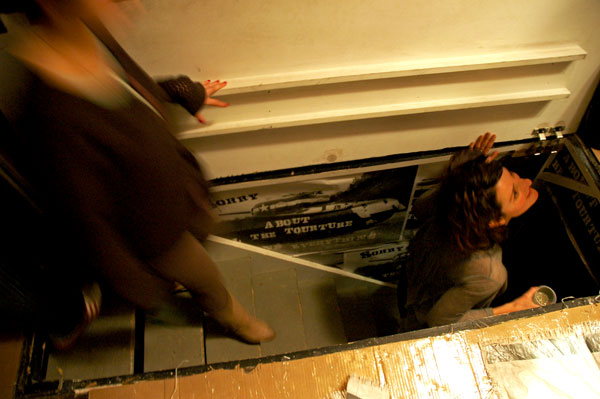
“sorry about all the torture”
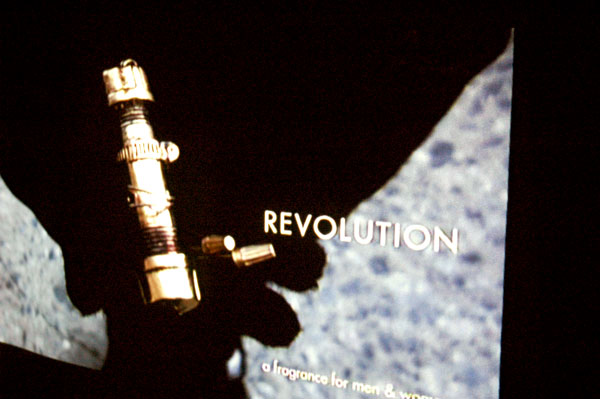
fragrance TV commercial
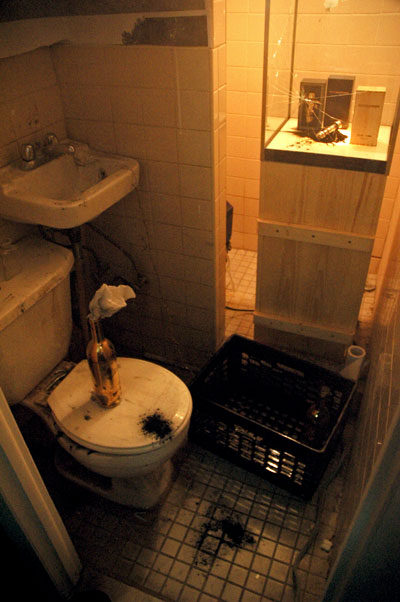
continuing “Revolution”