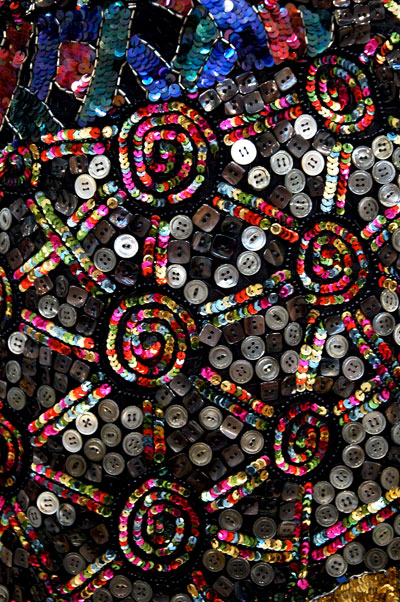

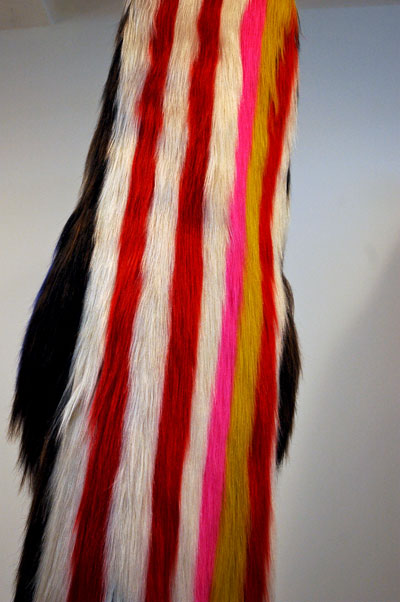

You’ve already heard it from everyone, so I’m not going to bore you with another encomium. You can and probably have seen full images in many publications and on many sites, so I’m only showing details here, plus one mid-distance shot, of some of the works in Nick Cave’s recent show at Jack Shainman, “Recent Soundsuits”.
I’ll only add that it was an incredible show. Nothing which we had seen or heard, in any medium, would have been sufficient preparation for experiencing these sculptures at first hand. My only complaint was the surprisingly static installation, but the quality of Cave’s work would have transcended any platform.
For a look at his appearance in an earlier, group show, scroll down on this link.
Author: jameswagner
On Kawara’s “One Million Years” visits Zwirner
the long count continues
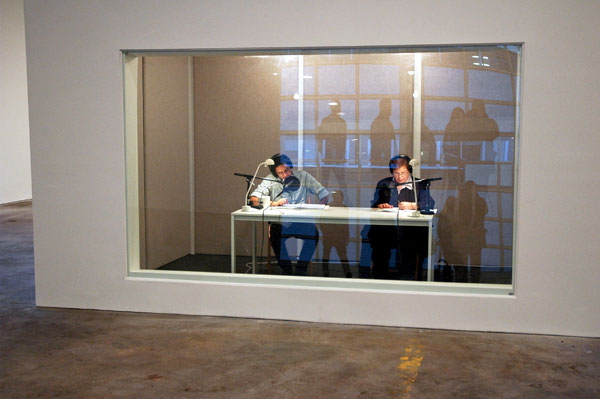
Figuratively, I’ve probably been walking around his neighborhood for several decades, because I’ve been encountering single examples of and groupings of On Kawara‘s “The Today Paintings” since at least the early 80’s. Until I walked into “One Million Years” however, his current show at David Zwirner [closing this Saturday] I confess I never knew what was actually going on inside the vast, minimalism/maximalism of this artist’s cerebral precinct. Although I still can’t claim a complete understanding of it, since I snapped this image inside the gallery last week I think I can say I’m now on the same planet – and in the same century.
For me it all came together for the first time when I saw and heard these two volunteers taking turns reading off (performing and recording) the successive dates which compose this awsome work’s simple, descriptive title while seated inside a temporary studio, a sound technician posted outside.
Did I mention that when I walked out onto 19th Street I felt like I had just left a great temple? And I haven’t a spiritual bone in my body, or at least that’s what I’ve always thought. I highly recommend the experience. Go, if you can, and stay a few minutes. If you’re with a friend, and you say something while you’re there, you’re certain to be whispering.
A million years? We’re none of us there yet (I’m guessing the “readers” are only somewhere around the 40th millennium right now, even though these readings have been going on, and off, at different sites all over the world since 1993). Also, none of us will live to see this conceptual (and also very real) performance completed, but I’m thinking what an extraordinary privilege it is to be a part of it – although I have to live with the thought that, even if it weren’t a question of money, this audiophile would never be able to listen to the entire CD set.
I’ll just have to be content with the more miniature epic song projects of Kawara’s rivals, like Wagner, Feldman, Stockhausen and La Monte Young.
Zwirner’s notes provide a background for the continuing audio project currently visiting the gallery in this description of the original, printed work:
One Million Years is a monumental 20-volume collection, comprised of One Million Years [Past], created in 1969 and containing the years 998,031 B.C. through 1969 A.D., and One Million Years [Future], created in 1981 and containing the years 1996 A.D. to 1,001,995 A.D. Together these volumes make up 2,000,000 years. The subtitle for One Million Years [Past] is “For all those who have lived and died.” The subtitle for One Million Years [Future] is “For the last one.”
ADDENDUM: It’s a few minutes since I wrote the above. I’ve just read Jerry Saltz’s piece in New York magazine. I had already decided to write about “One Million Years” when I saw it but I wouldn’t let myself read it until I had finished my own brief account. I was afraid I’d be scared off by his erudition and charm.
As it turns out, I certainly would have been; this blog slot would have used for something else: For this particular task, Jerry had, among his many other advantages, his brilliance as a critic and writer, and the nobility – and the guts – to actually volunteer to read a section of the text – to be an integral part of the piece itself. It’s really great, and great fun. It’s titled “Reeling In the Years” and you can find it here.
p.s. While looking for the article on line I discovered Jerry’s homage to Steely Dan, and this.
ragged tarps on Grand Street lot, Williamsburg
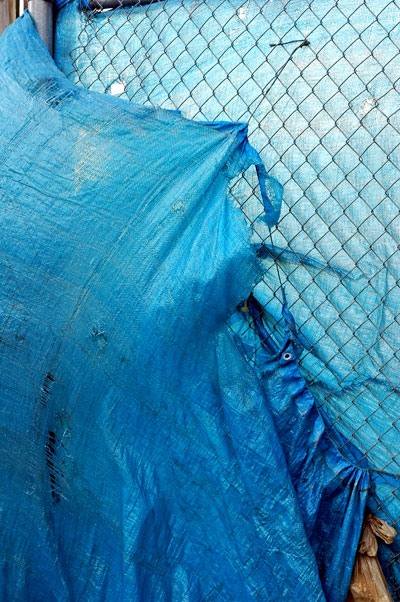
untitled (blue threads) 2009
Yesterday I spotted this section of a sad, somewhat unsound wall which had been assembled around a large vacant lot on Grand Street in Williamsburg. These bright blue tarps, blowing in the wind and buoyed by the February sun, would hardly present any barrier to the curiosity of even the most casual passerby, but as a brilliantly-lit, flapping bauble they managed to relieve the drabness of the dull flat plywood boards they interrupted with their play.
Will their gambolling last until the day the sober speculators return with their cranes?
Richard Wilson’s Mr. Benn’s world at Jack the Pelican
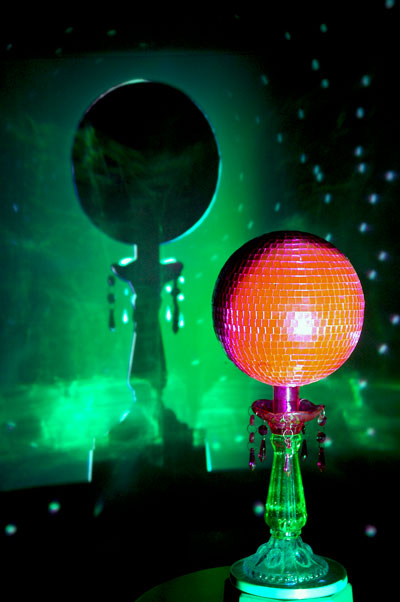
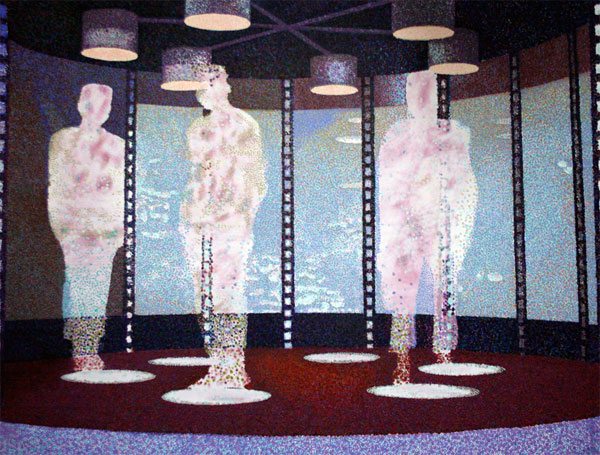
The current exhibition at Jack the Pelican, “Mr. Benn’s Spare-time Continuum” will close tomorrow, Sunday, at 6. This means that there are only two days left for a chance to enter into the squirmy/cozy comforts of what is described here in the gallery press release:
The timely anachronism of Richard Wilson’s mechanistic renderings of super-tech ideas points to Britain in an era when unassuming people lived in modest circumstances [my emphasis, since I love that phrase].
Wilson’s introduction of Mr. Benn to New York gallery goers might have been a risky proposition, since the popular early-1970’s BBC show, based on a popular children’s book published a few years earlier, never made it to our shores, but the installation resonates with our own island’s 21st-century fantasies, sentimentalities and anxieties.
The exhibition may be one of the strangest scenes to be found in an area gallery right now, but I’ve found myself going back to it in my mind since I left it one week ago, no small thing for this crowded ADD head.
The mirrored ball may suggest the iconic 1964/1965 New York World’s Fair Unisphere, and the transporter room painting appears to be a riff on Seurat’s pointillist “A Sunday Afternoon on the Island of La Grande Jatte” [surely what all “trekkies” were thinking each time that set showed up in Star Trek].
If you go, enjoy the soft, tufted Chesterfield sofa and take advantage of the hot water urn and tea makings.
[second image provided by the artist; my own was corrupted by the very low light, but it otherwise had the advantage of including a number of pink points of light thrown from the disco ball across the room]
Wooster door
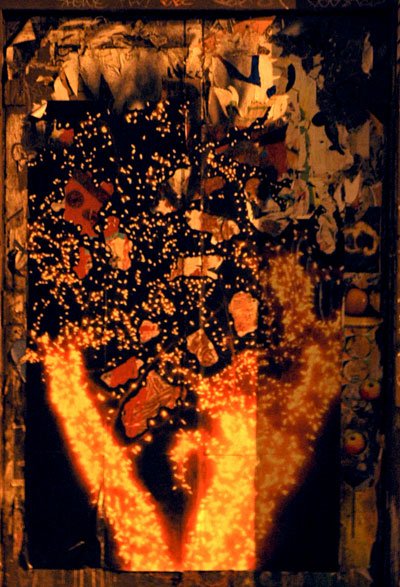
The picture may be a bit colorless and slightly shaky, since there was almost no light off the corner of Wooster Street near Grand at 6:30 tonight, and no tripod in sight, but I still wanted to try to capture the mystery of this doorway. It’s on the side of a building which has attracted (almost literally) tons of street art over the years.
I had heard some time ago that it was slated for demolition, but who knows what’s going to happen to it now?
The image I got makes me think of one of those spooky shadow boxes crafted variously out of feathers, seeds, shells, hair and cut paper that were so popular with the Victorians. When I lived there I used to see them all over New England in shop windows and at barn and estate sales, preserved inside framed glass boxes or cabinets, but now I can’t find a single pictorial relic of their weird vogue on line.
Matt Mullican at the Drawing Center
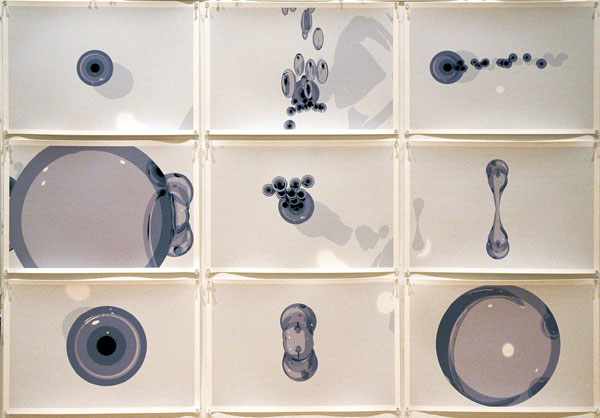
installation view* of nine drawings included in Mullican’s exhibition at the Drawing Center
Matt Mullican‘s just-closed show at the Drawing Center, “A Drawing Translates the Way of Thinking“, was a treat. And what a perfect venue for this extraordinary artist!
When I first walked in and saw its extravagance, knowing even the little I did about the breadth of his sources, the bottomless well of his imagination and the complexity of his sytems, I told myself I was just going to walk around and enjoy myself in that huge room, where central, museum-like vitrines were surrounded by works hung tightly together until virtually no wall space was left uncovered. I stayed much longer than I expected to, but of course not long enough to give even a half-assed account of this extraordinarily beautiful show.
Here is a large excerpt from the press release prepared by the curator, Jo�o Ribas:
For over three decades, Matt Mullican has created a complex body of work concerned with systems of knowledge, meaning, language, and signification. Ranging from schematic diagrams and arcane symbols to explicit text-based drawings, installations, and self-created cosmologies, Mullican�s work classifies, orders, describes, maps, and represents an understanding of the world, using drawing to collapse the division between subject and object.
Since the 1970s, Mullican has conducted performances and created drawings under hypnosis to investigate the nature of the subjectivity and identity. Mullican�s practice ultimately confronts the nature of subjective understanding, rationality, perception, and cognition �proposing a �picture� of the world articulated through the medium of drawing.
*
The shapes which look like reflections? They are not.
Nayland Blake at Location One
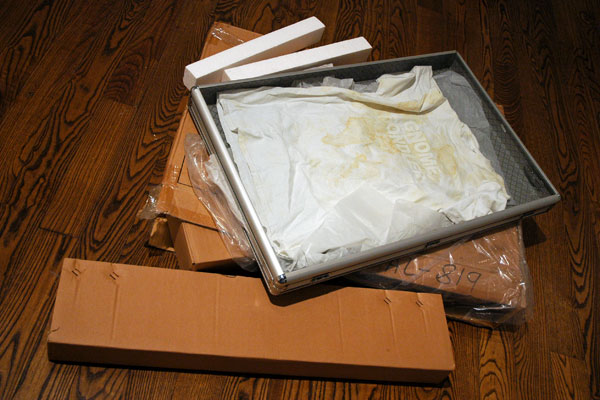
Nayland Blake Companion 2006 t-shirt, bubble wrap, trunk 48″ x 50″ x 9.5″ [installation view]
Just about as inscrutable as Matt Mullican, but different. Very different.
Soho’s Location One is hosting what the gallery describes as a 25-year survey of Nayland Blake‘s work in almost every medium. Curated by Maura Reilly, the show is titled “Behavior“. Even for a visitor familiar, even comfortable with the transgressive, it seems Blake doesn’t really care whether you get much of what he’s doing. But then he’s something of a virtuoso in this field. You can get lost in this installation, but you won’t get out unaffected by some of the images.
Oh, the printed text on the soiled shirt in the image above reads, “GNOME FONDLER”.
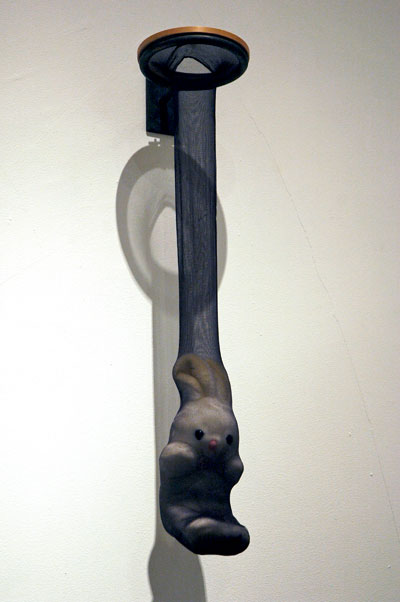
Nayland Blake Bunnyhole II 1997 steel, nylon, wood and stuffed animal 40″ x 7″ x 8.5″ [installation view]
�ELLIS G. signs in on Bedford St. corner
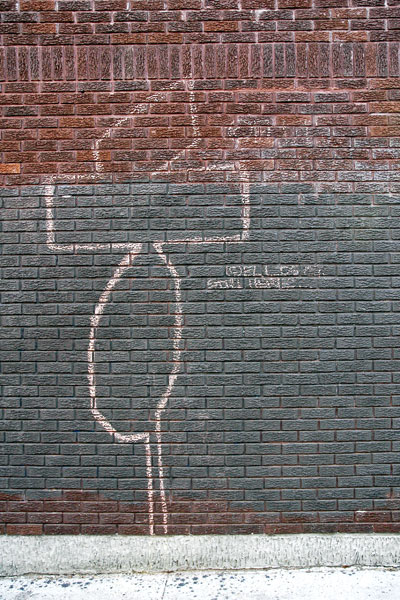
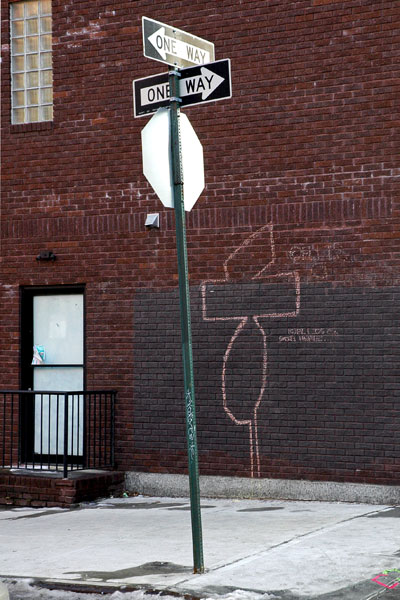
This �ELLIS G. intervention in Williamsburg included the artist’s signature plus the additional note, “STILL HERE”, a possible reference to the arrest of Poster Boy on Saturday.
ADDENDUM: Wooster Collective has a video documentary on the artist.
Cordy Ryman at DCKT
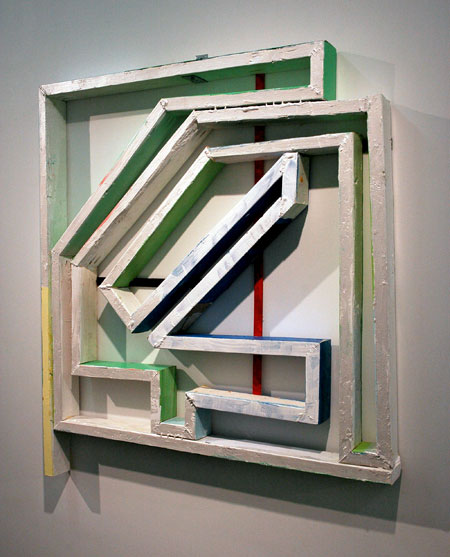
Cordy Ryman Coil 2 2008 acrylic & enamel on wood and metal 47″ x 43.5″ x 3.5″ [installation view]
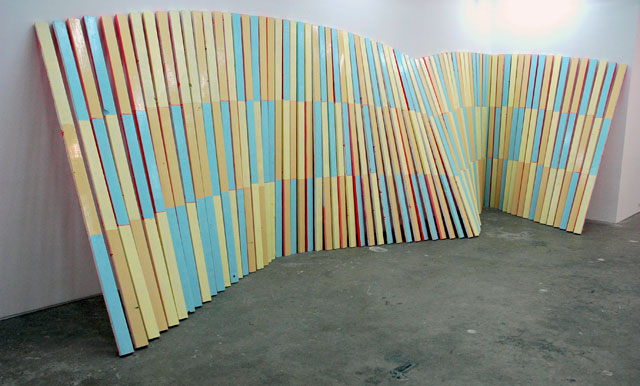
Cordy Ryman Third Wave 2008 acrylic on wood 96″ x 274″ x 79″ (dimensions variable, up to 480 linear inches) [installation view]
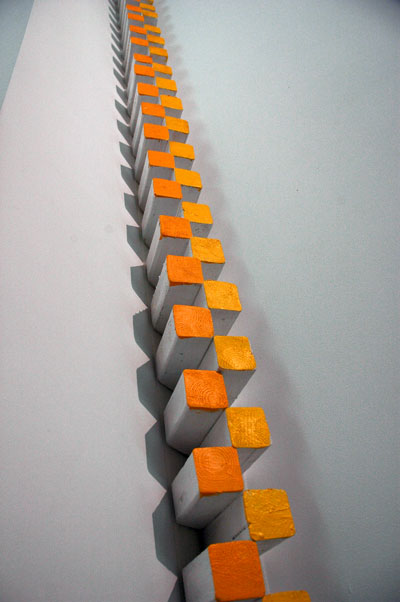
Cordy Ryman Yellow Spine 2008 acrylic on wood 130″ x 3″ x 5″ as installed (dimensions variable, up to 144″ x 3″ x 8″ overall) [large detail of installation]
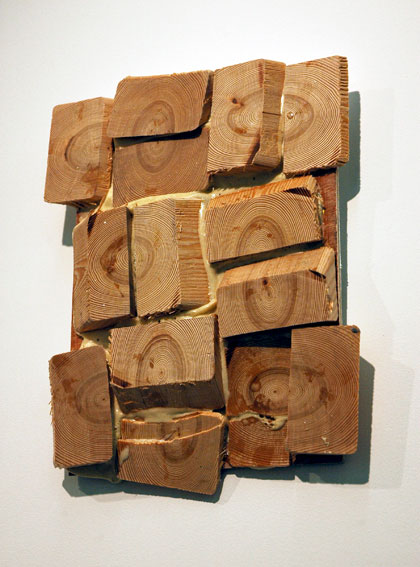
Cordy Ryman Raw Chips 2008 gorilla glue and wood 12″ x 10″ x 1.5″ [installation view]
It’s an appearance which I’ve been anxiously anticipating for months, or even longer: DCKT is currently exhibiting paintings, sculptures and installations by Cordy Ryman, the artist’s first solo show in the gallery.
Ryman regularly wields hammer and nail, glue, staplers velcro strips and much more for what promises to be an infinite supply of solid forms and colored shadows in every size and shape. The work is composed of found pieces of (mostly) wood, finished (usually) with paint applied from a brilliant pallet with the confidence of a first-class AbEx. He balances drama and humor in the result, seemingly effortlessly.
My only quibble? The fact that, unlike some of his earlier outings, their were no droll surprises this time in the form of almost-hidden little pieces hiding about in the gallery’s nooks and crannies. But it may be one of the best things the artist leaves with us: We’re likely to keep looking for art – everywhere – even where we’re not supposed to expect it.
LINK: conversation between Phong Bui and Ryman in the wonderful Brooklyn Rail
soft face on Wooster Street
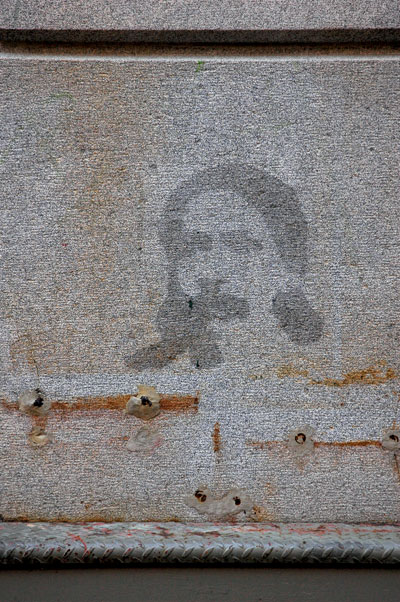
I have no idea who did this quiet piece, or who the image represents.