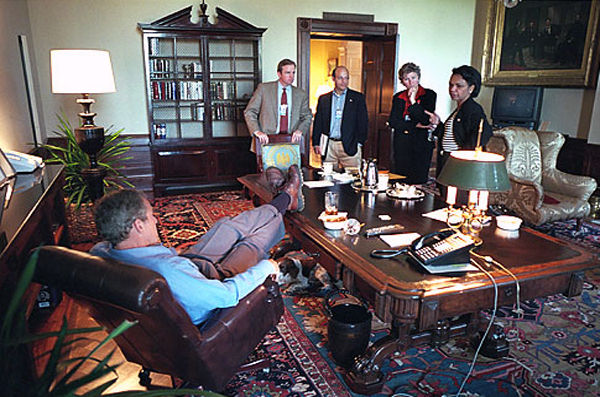
White House office casual

Bush_shoes_on_table_treaty-room.jpg
now that’s office casual, and notice those treads

I have a hatred for the convention of suits and ties, for many reasons, but certainly partly because of my own experience. While I was still working in an office environment, conservative suits were mandated for all male employees, and jackets had to be kept on, regardless of the weather or the capacity of the air conditioning system. Yuck. Double yuck, because most of these uniforms were pretty ugly. Could it be that the decree had nothing to do with aesthetics?
Moving on to today, and on a slightly different bearing, my partner Barry tells me that he’s absolutely had it with the proliferation of stories about how horrified people are, especially veterans of the previous administration [“Workers from the Bush White House are shocked” – NYT], about the informality of Barack Obama’s office etiquette.
Barry shared with me his disgust just as I had begun to glance at the front page of the New York Times this morning, where there’s another long story about what is surely the least important “change” the new administration can be expected to accomplish.
Yesterday I had been investing more time than I had originally expected in looking on line at information about the history, the architecture and the functioning of Hoban’s President’s House, and I had showed Barry the picture I’ve now uploaded above. Today he suggested I do a post about the etiquette fuss. He offered that if I didn’t want to, he would to it himself – if I were able to find the image again. It was an incredibly slow site, so since I had to duplicate most of the labor today I decided to do the post myself, since the actual writing would be a comparative piece of cake.
If you’ve seen the item yourself, yes, you did see the word “tizzy” in the very first sentence of the Times piece:

WASHINGTON � The capital flew into a bit of a tizzy when, on his first full day in the White House, President Obama was photographed in the Oval Office without his suit jacket. There was, however, a logical explanation: Mr. Obama, who hates the cold, had cranked up the thermostat.

I’m so glad they found the “logical explanation”, for it certainly couldn’t come from a recognition that creative, real people will always be able to think and work better, alone or together, without a strait jacket or a uniform, and that they don’t need a costume to have self-respect or the respect of others.
By the way, this table is one of the most historically-important pieces of furniture in the magnificent White House collection. It’s importance has almost nothing to do with its New York provenance [Pottier & Stymus Manufacturing Co., New York], although I might be persuaded to take personal offense with Bush’s crude insult to decorum, especially were I standing on the other side of the table – and above all were I raised in a Middle East culture.
It’s Grant’s Cabinet Table, and it stands today where it almost always has, in the Treaty Room, on the second floor of the mansion. The unofficial White House Museum site informs us: “Many important agreements have been signed on the table, including the peace treaty that ended the Spanish-American War in 1898, the Nuclear Test Ban Treaty of 1963, and one of the SALT [Strategic Arms Limitation Talks] agreements.” In addition, the Pact of Paris (Kellogg-Briand Peace Pact), which provided for “the renunciation of war as an instrument of national policy”, and a number of Middle East peace documents were signed on this table. Maybe we shouldn’t be surprised that 43 had so little respect for its surface.
Oh, about Obama’s mellow approach to the small stuff in the job Bush 2 must have thought was something like that of emperor, I think it’s terrific. The White House may be the people’s house, but it’s the President’s home and office.

[image from the (unofficial) White House Museum]
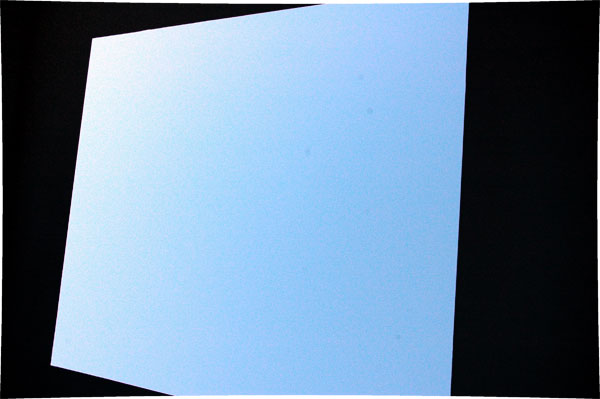
Andy Piedilato at English Kills

Piedalato_blue.jpg
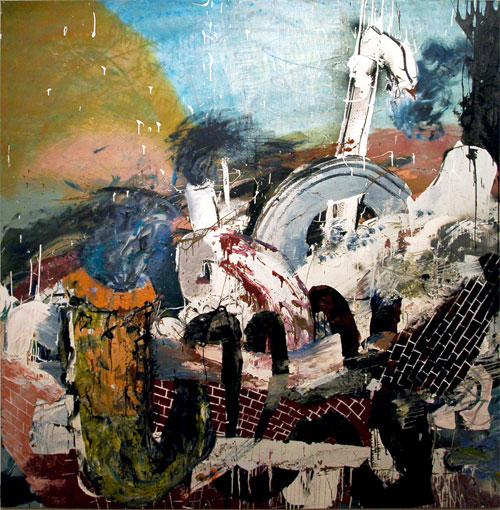
Andy Piedilato Engine 2009 industrial enamels and oil on canvas 99″ x 96″

Piedilato_wire_boxes.jpg
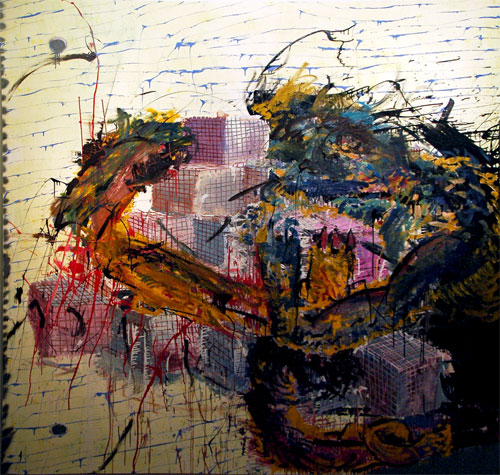
Andy Piedilato Notebook Paper 2009 industrial enamels and oil on canvas 99″ x 96″

Piedilato_Boiler.jpg
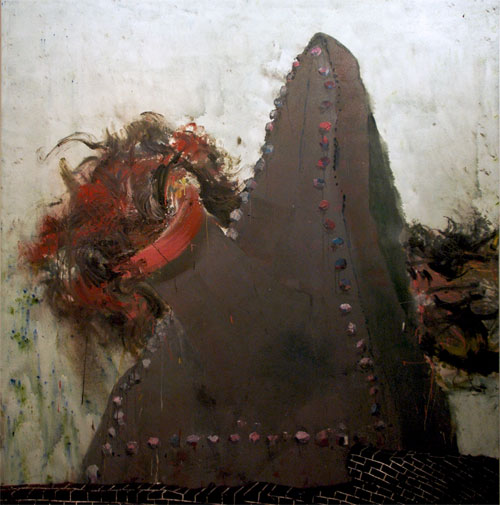
Andy Piedilato Steamship 2009 industrial enamels and oil on canvas 99″ x 96″

I’ve written about Andy Piedilato‘s paintings more than once before, so I don’t have to include much text here. These are just three of the nine or ten mostly huge (up to 12 or 14 feet square) oil canvases in his current solo show at English Kills.
They don’t disappoint.

a return to Michael Mandiberg and his “viewing”

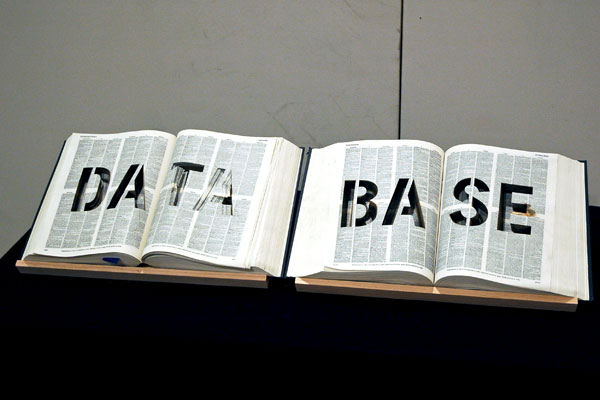
Mandiberg_Data_Base.jpg

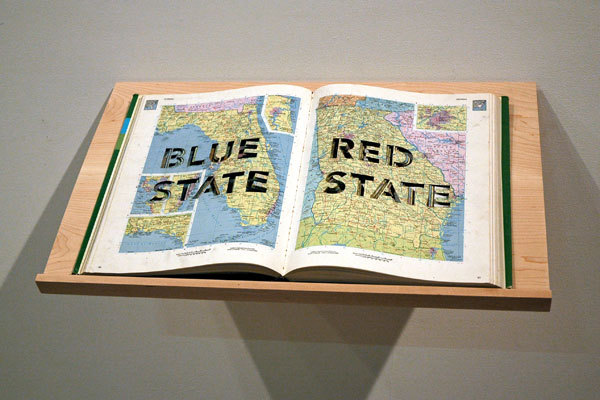
Mandiberg_BLUE_RED.jpg

Mandiberg_Albers.jpg
(look closely at the borders within the drawing above)

NOTE: Yesterday I wrote a hurried and perfunctory post on the work Michael Mandiberg has produced while he has been associated with Eyebeam, because I had been told he would have an open studio last night. The information proved to be mistaken; the date of the formal viewing is instead going to be next Tuesday, January 27, at Eyebeam, from 2 to 4, or by appointment [michael at mandiberg dot com] through the end of that week, until January 30.

Mandiberg has assembled a body of work in a range of various mostly-paper forms using elements of both the old technology and the new. He’s addressing the rapidly accelerating obsolescence of our established information systems; our experience of history and language; what we do with time; our direct participation in changing social structures and the disappearance of old political certainties; and old art subsumed in the new. He does it sometimes with ordinary words, and sometimes with the line of the artist. His tool in expressing both of these languages is the modern laser cutter.
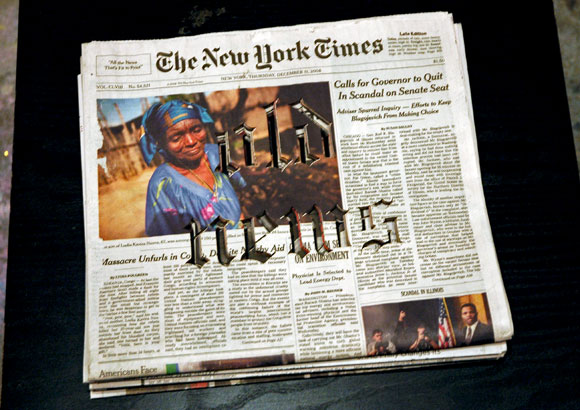
His sitter may be the OED, the New York Times, the World Book, the National Geographic Society or Josef Albers. For these portraits he has cut through variously somewhere between one and several hundred pages of “dated” printed texts to produce dramatic, even ravishing negative spaces, words, which symbolize or articulate the contemporary, cutting-edge approach to words and information, and he carefully scorches surfaces of the artist’s traditional paper medium to reconfigure for today some of the aesthetic icons and arguments of the past.
As modern as they are, these pieces are hardly accomplished just by push button. The mark of the artist’s hand is in each. I don’t know how much of it is a consequence of the process and the nature of the materials and how much of it comes from Mandiberg trying calculatedly to show imperfections; he may not know the answer himself.
Sometimes the machine itself fails to produce a perfect effect, and the artist has gone back to reproduce its desired machine perfection by hand. Sometimes Mandiberg seems to be trying to get rid of imperfections in the machine’s work (to remove the hand), and elsewhere he is trying to make the work of the machine look slightly imperfect (to introduce the hand).
If it is anything like what I describe, this approach registers on this individual, personal scale the complex relationship with our machines which we have all shared – not just the artists among us – since the beginnings of industrialization.
I don’t have the space to describe the individual work displayed, especially because they are all so conceptual, and because much of the work is still incomplete, but if you visit far West 21st Street during the next week, you’ll find the artist is totally up to that task.
Mandiberg is currently a senior fellow in Eyebeam’s R&D OpenLab facility. In a conversation Barry and I had with him there yesterday, we were discussing his art and his process when he avowed that, yes, “all of the work here lives in both the arts sphere and the nerd sphere”. Yum. Members of both communities will find much to their tastes if they are able to check out his installation.

[final image from the artist’s Flickr set]

Michael Mandiberg at Eyebeam

Michael_Mandiberg_Old_News.jpg
the supplanter will be coming soon in a medium near you

CORRECTION: The announcement of an open studio on Thursday evening was a misunderstanding. The formal viewing is instead going to be next Tuesday, January 27, at Eyebeam, from 2 to 4, or by appointment [michael at mandiberg dot com] through the end of that week, until January 30.

It seems like it was only yesterday that we were calling out happy new year to every one we encountered, but I’m suddenly realizing that time’s already a wasting; 2009’s baby is already talking, and will soon begin to walk: What I mean is that I’ve just realized I have to rush this one out before midnight.
Michael Mandiberg is hosting an installation of his latest work at Eyebeam tomorrow night, Friday, January 22, from 5 to 7 pm, and I haven’t written a thing about it.
I’ve already checked it out, and I’m hoping to expand this blog tomorrow with more images and a few additional words, but I wanted to give a heads up right now to people who might be able to stop by for the reception. For others who might still able to haunt our rich streets this month, the work will be assembled there in its own space through January 30.

Michael Mahalchick here and there

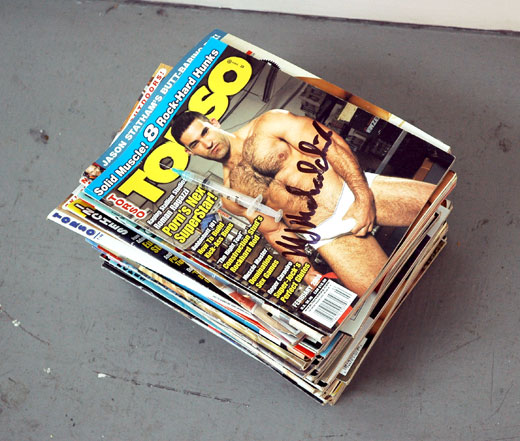
Michael_Mahalchick_Torso.jpg

I have little idea what this is about, but it’s the piece I remember best from all the work I saw in a very interesting show of sculpture, “Without Walls“, at Museum 52. I don’t know if it tells us anything about the artist himself; maybe Michael just found this stack somewhere on the street, with or without the needle lying on top, and decided to mark it with his signature. And then maybe not.
For me the important thing is that I’m preternaturally attracted to it, and would be even if Roman Ragazzi were not staring up from the floor. It also reminds me of the happy happenstance that Mahalchick has another solo show opening at CANADA on Friday, titled, “For What It’s Worth“.

going to be a little grumpy here: about all that god talk

world_war_I_bonds.jpg
1917 poster* by J.C. Leyendecker, successful, closeted [homo] designed to sell war bonds

Although I took huge delight yesterday in Rev. Joseph Lowery‘s contribution, because of his own history and the fact that its grace transcended religion, my experience of the joy of yesterday’s inauguration of Barack Obama was marred by the number of genuine sour notes, all related, that piled up all day long and even into the night at the inaugural balls: Watching the glorious events of the day being soaked in all that god talk made me very, very uncomfortable. You probably know what I’m taking about.
By the way, after all the uproar over Obama giving the nod to Rick Warren’s to deliver that, whatyamacallit, “invocation“, I thought it was some “revelation” to hear the fat gentleman finally speak yesterday. As he rambled on like a Sunday school teenager in “church-speak” mode, Barry and I looked at each other, dumbfounded. Just then Barry saw on his feed that at 11:49 EST justinph had tweeted:

Wow, Rick Warren prays like shit.

I say, amen.
And I want to interrupt myself here with a point of information: In spite of what we have been led to believe, and contrary to the [Justice Roberts-flubbed] administration of the oath of office we witnessed yesterday, the Constitution includes a precisely-worded, prescribed text which absolutely does not include the phrase, “so help me god”. Also, our founders made it very clear that you don’t have to swear an oath, but merely affirm. [Article II, Section 1.]
As a part of all mankind I share the joy of people of every color in the triumph of Barack Husein Obama, but, as an American who knows and serves no god, today I probably feel more excluded than ever before. A black man can become President; we had already discovered that we can have and probably soon will have a woman as President; we can expect some day to find that it isn’t necessary to be a Christian to become President; if absolutely nobody else shows up at the hustings, we might eventually elect a queer; The office is now open to every citizen [if natural-born, at least 35 years of age, and 14 years a resident in the U.S.], yet from where I’m standing it looks pretty certain that, if faking belief isn’t an option, an atheist can never become President of these United States. She or he is more likely to be stoned in the public square.
When I look at the historic talent pool represented by that distinguished class of skeptics, I find that truth to be quite tragic, and I’m very sad for all of us.

*
When I first saw this image, on the About.com site, the medallion at the bottom had been altered to read “For a Christian America”, and the sword was edited to bear the inscription, “Bigotry, Discrimination”. I put at the top of this post before I realized that as originally published and as shown here the picture doesn’t have anything overtly connected to a deity, but I’ve decided to keep it at the top, for the Boy Scouts of America’s connection to god, country and straight-acting-boys – and men.

[image, in which the artist’s male lover {they were to live together 48 years} modeled for “Liberty”, from Library of Congress]

with OBAMA I think we get our flag back

flag_hanging_from_arch.jpg

I have no illusions about the chances of my always being happy with the Obama administration throughout the next four to eight years, but I’ve been watching television much of the day (something I haven’t done since 9/11) and my eyes have’t been dry since some time shortly after I awoke.
Don’t pinch me yet.
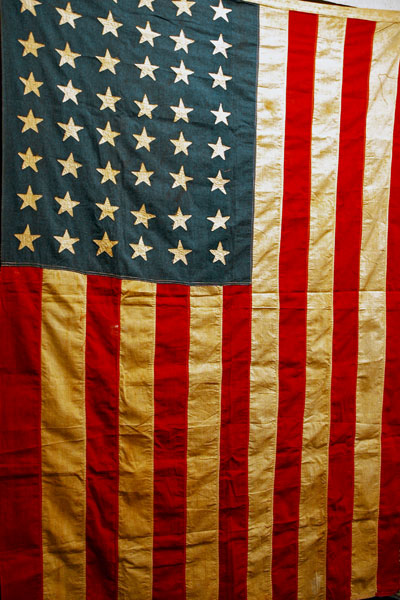
I found this faded 48-star flag in Rhode Island when I was going through the merchandise at a barn sale over thirty years ago. Thereafter, for several years, on each 4th of July I would hang it in the doorway of my pre-revolutionary house on Transit Street in Providence. Then came Reagan and the flag-waving crazies: display of a flag looked like a demonstration in support of everything I despised. I packed it away in an old camphor trunk and didn’t display it again – until this afternoon. It’s now hanging from the arch which separates two of our front rooms.
Looking at it no longer hurts, although I still think it is best honored as the symbol of an ideal we must all continuously pursue, and not as a boast.

Bj�rn Meyer-Ebrecht at Pocket Utopia

Bjoern_Meyer-Ebrecht_red.jpg
Bj�rn Meyer-Ebrecht
Bjoern_Meyer-Ebrecht_lecture_hall.jpg
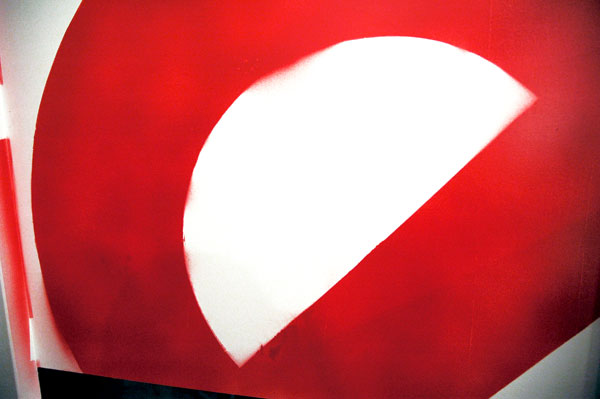
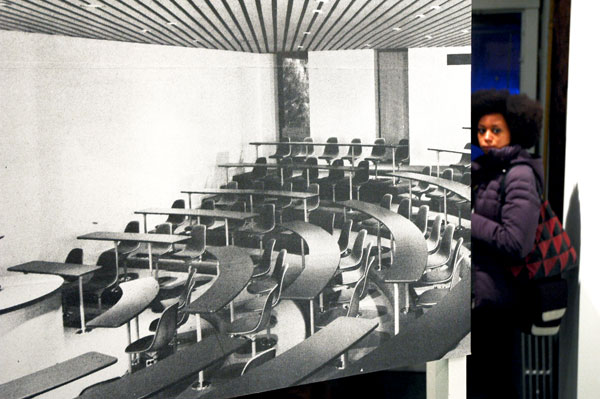
Bj�rn Meyer-Ebrecht Untitled (D) 2008-2009 laser prints, wood, paint, spray paint, 4 panels, each 69″ x 32″ x 21″ [two details of installation, photographed during opening reception]

Bjoern_Meyer-Ebrecht_red_blue_yellow.jpg
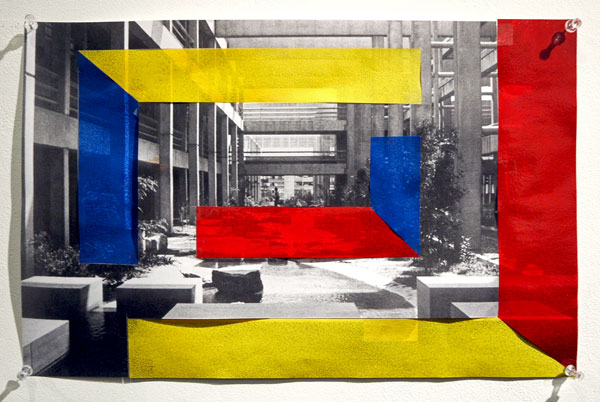
Bj�rn Meyer-Ebrecht Untitled (red/yellow/blue) 2009 collage, laser print, spray paint, transparent tape 10.75″ x 16.75″ [installation view]

Among my many other passions, some disclosed here in the past, I’m a sucker for mid-century architecture and design. In work being shown at Pocket Utopia through the middle of next month, and in images available on his own site, Bj�rn Meyer-Ebrecht presses that button and a few more besides. In Bushwick, in a gallery installation he shares with Elissa Levy and Kay Thomas, he has installed a single four-part sculpture down the center of the narrow gallery and hung several small collages on one side wall.
Today we are all children of the Bauhaus, with the signal exception of the American suburban family, which even in the twenty-first century almost unfailingly chooses neo-whatever for its domestic shelters, er . . . castles.
German-born Meyer-Ebrecht’s work might include an element of (sophisticated) nostalgia, but his affections are not wasted on garrsion colonials, or even Alpine cottages. He “constructs” drawings, collages and sculptures from found black-and-white images of the interiors and exteriors of modernist buildings, most of them built in a post-war Germany rising phoenix-like from its ashes and its shame, struggling to make good its pre-1933 promise. They generally betray a kind of modest optimism largely absent from the architecture of today.
Some of the images depict the clean minimal spaces which were designed to house the “architects” of a new representative democracy in Germany. Some are of buildings designed by German architects, refugees or exiles, but constructed elsewhere in the world. All seem to be images of virginal spaces, in specific environments. They are yet to be occupied by people, although a human presence is suggested by the tools of habitation that architects must provide.
The images, if not the buildings they depict, are all historical artifacts. The artist cuts and paints, and sometimes saws; he adds abstract “windows” and (sometimes) translucent panels of color to make them his own, to make them ours.
They are utopian. They seem to be the labor of a love he shares with us. They thrill me.
This is the last paragraph of the statement which Meyer-Ebrecht has included on his own site:

I see my drawings in many ways as portraits. The buildings often look at me like human figures that at the same time seem to both hide and reveal their inner lives. I see them also as portraits of the architects with their very particular historic experiences of emigration and their individual new beginnings after World War II. And finally these drawings are also portraying a particular time period. In my imagery of this time I find a particular atmosphere that interest me, maybe the feeling of soberness, of something absent or hidden. I am especially intrigued by the absence of history, I could call it a form of collective amnesia, which reverberates in these images.