three Robert Ashley operas in repertory at La MaMa

Robert_Ashley_Celestial.jpg
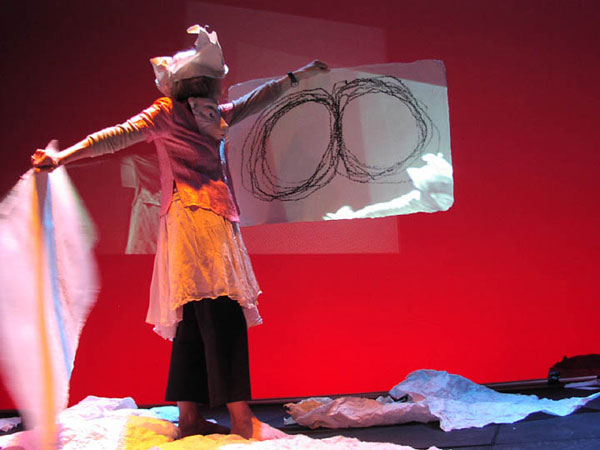
Joan Jonas in the 2003 production of “Celestial Excursions” at The Kitchen

Almost six years ago I wrote these words about the artist who may be my favorite living composer:

For a taste of what people will be talking about and, yes, singing, twenty years from now, not unlike the way that the music of Donizetti or Verdi was popularly enjoyed in nineteenth-century Italy, head for The Kitchen tomorrow evening (Saturday). Robert Ashley is the prophet of modern opera, even if he is still not properly honored in his own country.

I’m reminding myself of that post even as I recall that when I once asked the composer about what he thought of older composed music, Ashley told Barry and I, and David Behrman standing with us, that people should only listen to music from living composers; as soon as a composer dies, we should throw the records out the window. We asked, even Beethoven? he replied: “Toss them out!” We were taken aback, and Behrman seemed just as shocked. I understand what Ashley meant, but should I outlive him I don’t intend to follow his advice, at least in the case of his own music.
In the meantime I am counting us all very fortunate indeed to be still alive and able to see and hear a cycle of Ashley’s three latest operas – “Dust” (1998), “Celestial Excursions” (2003), and “Made Out of Concrete” (2007/09), in newly designed productions to be presented at La MaMa from January 15th through the 25th.
I wouldn’t miss these performances for anything you could throw at me from the Met.
For more information, see Ashley’s own site, where there is a link to an extended press release (PDF).

[image by Mimi Johnson provided by Performing Artservices]

Udi Aloni replies to Noa on Gaza fanaticism: cites Masada

Masada_1730_french.jpg
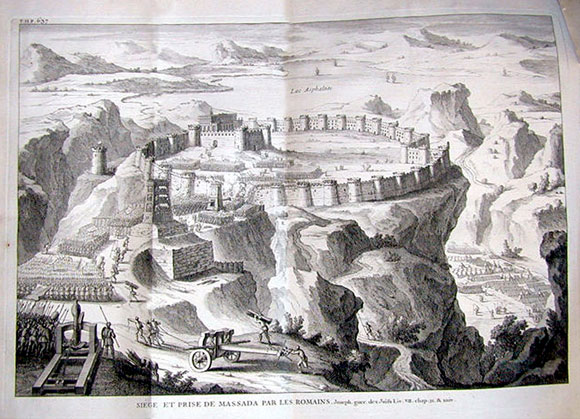
“Maybe, if you think about the mental situation of the people under seige in Masada, you could get a better sense of what’s happening in Gaza” – Udi Aloni

Some time ago I had set aside a blank, unpublished entry on this blog’s admin page with this working title:
“Can someone please direct me to the Israeli refugee camp?”
I never completed the post.
I probably thought it sounded a bit too snide, even for me at my angriest, as I was then and remain now, anguishing over the never-ending insanity and horror of the tragedy unfolding in the Middle East, specifically in Gaza right now. But ultimately this cancer festers almost everywhere else in this world, as relations between peoples have increasingly putrefied because of the mess which resulted from the manner in which the state of Israel was created.
So, since some of my friends may already be staying clear of me in my absorption in the events of the past weeks, and since I wasn’t prepared to assemble a long narrative on the origins of the conflict to substantiate what some might describe as my more provocative statements in this medium on the subject, I was almost totally relieved and very excited to get an email this morning which included a link to the text of an exceptional statement by an Israeli-American artist and activist I have met and whose work I have admired for years. The text of its sender’s public letter manages to provide the perspective I didn’t, and mercifully without the history lecture I would have delivered.

The film director, writer, visual artist and activist Udi Aloni answers a letter written by Israeli singer Noa [Achinoam Nini] and addressed to Palestinians in the Gaza strip and worldwide in which she called upon them to disavow fanaticism:

Dear Achinoam Nini,
I chose to answer you, and not the entire raging Right, because I believe that the betrayal of the peace camp, at this of all times, exceeds the damage caused by the Right a thousand fold. The ease with which the peace camp gives itself over to the roars of war hinders the creation of a meaningful movement that could [sic] a true resistance to occupation.
You roll your eyes, use your loving words in the service of your conquering people and call upon the Palestinians to surrender in a tender voice. You bestow upon Israel the role of liberator. Upon Israel � that for over 60 years, has been occupying and humiliating them. “I know where your heart is! It is just where mine is, with my children, with the earth, with the heavens, with music, with HOPE!!” you write; but Achinoam, we took their land and imprisoned them in the ghetto called Gaza.
We have covered their skies with fighter jets, soaring like the angels from hell and scattering random death. What hope are you talking about? We destroyed any chance for moderation and mutual life the moment we plundered their land while sitting with them at the negotiation table. We may have spoken of peace, but we were robbing them blind. They wanted the land given to them by international law, and we spoke in the name of Jehovah.
Who are the secular people of Gaza supposed to turn to, when we trample on international law, and when the rest of the enlightened world ignores their cry? When enlightenment fails and moderation is seen as a weakness, religious fanaticism gives a sense of empowerment. Maybe, if you think about the mental situation of the people under siege in Masada, you could get a better sense of what�s happening in Gaza.
The seculars in Gaza find it hard to speak against Hamas when their ghetto is being bombarded all day and all night. You would probably say that ‘we would not need to shell them if they held their fire,’ but they fire because they are fighting for more that the right to live in the prison called Gaza. They are fighting for the right to live as free citizens in an independent country � just as we do.
“I know that deep in your hearts YOU WISH for the demise of this beast called Hamas who has terrorized and murdered you, who has turned Gaza into a trash heap of poverty, disease and misery,” you write. But Hamas is not the monster, my dear Achinoam. It is the monster’s son.
The Israeli occupation is the monster. It and only it is responsible for the poverty and the sickness and the horror. We were so frightened of their secular leadership, which undermined our fantasy of the Land of Israel, that we chose to fund and support Hamas, hoping that by a policy of divide and conquer were could go on with the occupation forever; but when the tables have turned, you choose to blame the effect instead of the cause.
You write, “I can only wish for you that Israel will do the job we all know needs to be done, and finally RID YOU of this cancer, this virus, this monster called fanaticism, today, called Hamas. And that these killers will find what little compassion may still exist in their hearts and STOP using you and your children as human shields for their cowardice and crimes.” It is the same as if your Palestinian sister would write: “Let us hope that Hamas does the job for you, and rids you of the Jewish Right.”
So maybe, instead of ordering around a people whose every glimmer of hope we have surgically eliminated, you could help your brothers and sisters in Palestine rid themselves of the occupation, oppression and the arrogant colonialism inflicted by your country. Only then can you urge them to fight democratically and return Palestine to the mental state it was in before we pushed it into the corner of the wall that we built.
And if your brethren in Palestine choose Hamas, you have to respect their choice, just as the world’s nations respected Israel when it chose the murderous (Ariel) Sharon. Hamas is theirs to fight, just like you fought him. That is what democracy is about. Only then can you and your brethren in both Palestine and Israel share � as equals � the joy of the land, the sky and the music; only then can we fight for equality together, for every man and woman living living in our holy land. Amen.

ADDENDUM: “What if it was San Diego and Tijuana instead?”, an analogy which might be helpful to Americans who know nothing beyond the latest headlines, written by Randall Kuhn and published Wednesday in, yes, The Washington Times.

[image of 1730 French print depicting the siege and capture of Masada from preteristarchive]

�How To Cook A Wolf: Part One� at Dinter

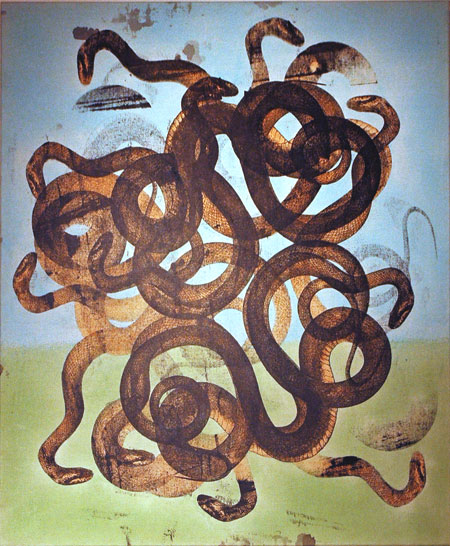
Philip_Taaffe_Caligraphic_Study.jpg
Philip Taaffe Calligraphic Study 1997-2008 mixed media on canvas 35.5″ x 30.25″

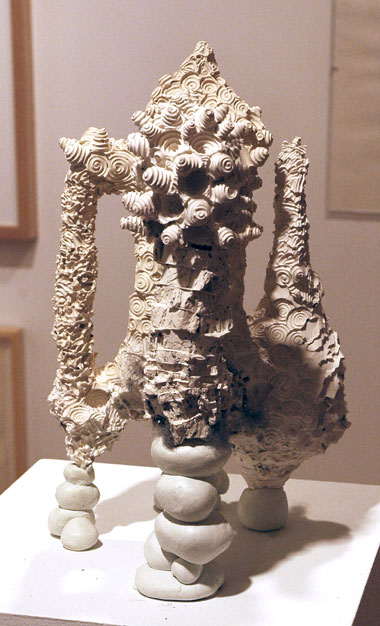
Aaron_Sinift_sex.jpg
Aaron Sinift* As Yet, No Title 2008 hydrocal and bone infusion, sandalwood powder, poppies and felt 13″ x 8.5″ x 8.5″ [installation view]

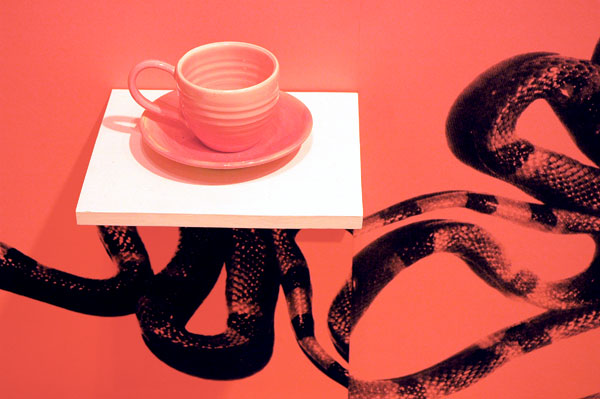
Mary_Heilmann_pink_cup.jpg
Mary Heilmann The Pink Cup 1983 glazed ceramic 4.25″ x 8.5″ x 3.5″ [lying on a shelf attached to a section of] Rob Wynne Snakepaper 2008 hand-screened ink on paper, dimensions variable [installation view]

The current show at Dinter Fine Art, �How To Cook A Wolf: Part One�, has been extended through January 31. It’s definitely worth taking advantage of the extended lease of this sexy, rich bricolage of work created over the last several decades (with one 19th-century exception) by dozens of artists of all ages, both familiar and new.
The list, in the order of the gallery handout, includes David Dupuis, Nicolas Rule, Donald Baechler, Rob Wynne, Judith Bernstein, George Condo, Aaron Sinift, Martin Kruck, Mary Heilmann, George Horner, Jack Pierson, Phillip Taaffe, Mia Brownell, Elizabeth Lennard, unknown artist, Michael Byron, Chris Hmmerlein, Judith Hudson, Donald Traver, Betty Tompkins, Dinne Blell, Julie Ryan, Jason Osborne, Paula Collery, Karen Hesse FLatow, Tracy Nakayama and Konstantin Kakanias.
I’m thinking as I’m typing them just now, wow, that’s an amazing number of names, and several artists had more than one piece in the exhibition. Yet while Barry and I were in the space the show didn’t feel like it was particularly chockablock with stuff. I think that was at least partly because of the clever use of Rob Wynne’s wallpaper.
I’m looking forward to “Part Two”.

*
for a look at another piece by Sinift, scroll 1/3 down on this post I did last May

Vatican calls Gaza a concentration camp

Warsaw_Ghetto_2.jpg
Jews captured during the Warsaw Ghetto Uprising led by German soldiers to deportation

I’m normally not inclined to pay attention to the Vatican when it comes to statements on morals, but this BBC bulletin is hard to ignore: The Pope’s justice minister, Cardinal Renato Martino, has sharply criticised Israel’s actions and likened the Gaza Strip to a “big concentration camp”.
The developments of the past two weeks make me want to pose a question closely related to that analogy: Can anyone say, “Warsaw Ghetto uprising”?
After the horrors committed in our name (and with the active or passive support of most of us) by our own government these past eight years, Americans of conscience can’t easily point fingers at any of the peoples who suffer under immoral regimes whether these systems were historically discredited in the middle of the last century or are very much active in the present. However I still think it’s fair to ask, where are the “good Germans” today [using the phrase sincerely, not sardonically], in both Israel and the U.S., and also in those countries which continue to support and enable the disastrous policies pursued by both.

My thanks for the news tip go to a friend who is with a group, “We are Jews who say ‘Not in Our Name’ to the Israeli Government”, assembling at 5:30 pm this Monday, January 12, in front of the Israeli Consulate at 800 Second Avenue between 42nd and 43rd Streets.

[image from JewishVirtualLibrary]

“In Your Face” at BUIA

Andrew_Guenther_two_portraits.jpg
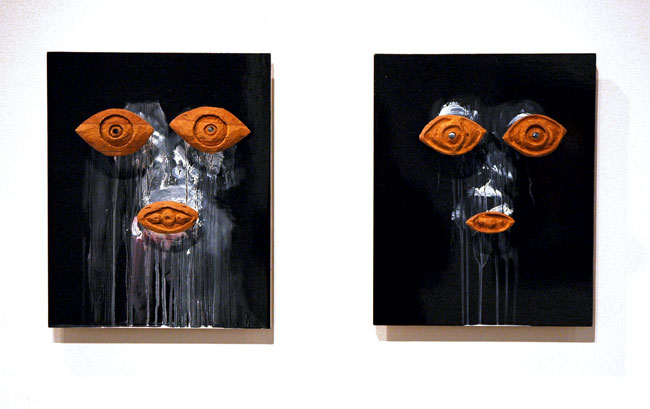
Andrew Guenther Horse Face 2006 and Water in the Planet I 2007 enamel, oil and wood on panels 17″ x 11″ each [installation view]*

I know I just recently did a post on this artist’s show at another gallery, but I couldn’t resist snapping up this image of two of his works I saw at BUIA today. They are the 20th century looking out at the 21st. These two extraordinarily-compelling faces are in an interesting group show on the theme of portraiture (the word interpreted pretty broadly). “In Your Face” will be up through this Saturday.
The other artists represented, by wonderfully quirky works which seem to have nothing in common but their difference, are Rico Anderson, Ion Birch, Brent Birnbaum, Holly Coulis, Dana Frankfort, Daniel Heidkamp, Ridley Howard, Erik Lindman, Matt Jones, Shay Kun, Federico Pietrella, Tom Sanford, Peter Saul, Rachel Schmidhofer and Barnaby Whitfield.

ADDENDUM: It’s now the next morning, and as I look at the image at the top I realize that I should probably have noted two things: One, that the dimensions shown for the two pieces, taken from the gallery’s checklist, may be slightly off, as they don’t appear to be quite the same size; two, and more importantly, that it would have been better to indicate that there is yet a third dimension, since the unpainted, carved wooden eyes and lips hover at least two inches above the planes of the painted panels (each feature is attached with two hand-whittled sticks).

Bloomberg’s Israel-speak is disgusting

nyc_seal.gif
(tell him it’s not his to give away)

Nothing Michael Bloomberg has done yet has disgusted me more than his mindless support of the government of Israel’s bloody insanity in Gaza while he’s wrapped in the trappings of the high office of the cosmopolitan City of New York.
Some of us prefer to think before we act, and we don’t pretend to represent an entire constituency when we do.
While he’s talking about the right of a government to defend oneself, referencing a mighty military state allied with the most powerful nations on earth, a nation which actualized its people’s 2,000-year old memory of a homeland only 60 sixty years ago, why can’t the mayor of all New Yorkers bring himself to recognize the rights of an almost people who are almost powerless and have virtually no allies, whose memory of a homeland is more vivid and within living memory, going back, as it does, only those same 60 years?
Bloomberg may understand money and power (he bought his own political office and since then he’s learned to emulate Putin), but apparently nothing else. His sympathies have always been with the guy on top, and that’s where they remain today.
He’s a damned fool, but that doesn’t make him any less dangerous.

[image of the Great Seal of the City of New York from citizenarcane]

Gilbert & George, and Jesper Just, at Brooklyn Museum

Gilbert_and_George_Finding_God.jpg
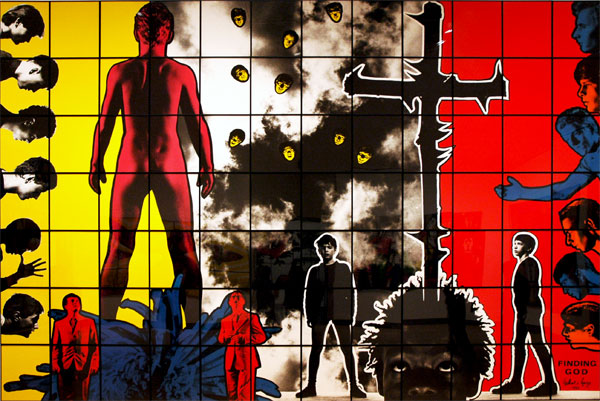
Gilbert & George Finding God 1982 eighty four hand dyed photographs mounted in metal frames 166.5″ x 238.5″

Gilbert_and_George_Sisters.jpg
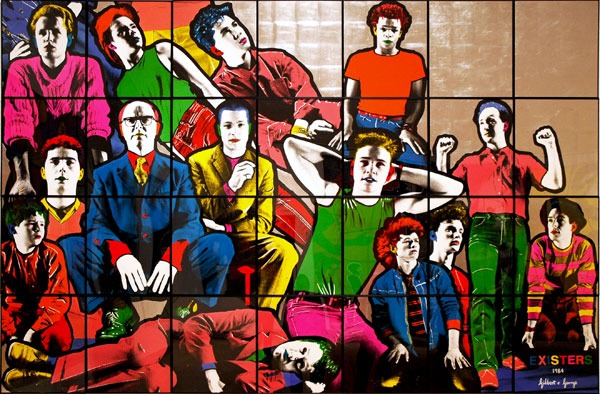
Gilbert & George Existers 1984 mixed media 95.25″ x 139″

Gilbert_and_George_Jungle.jpg
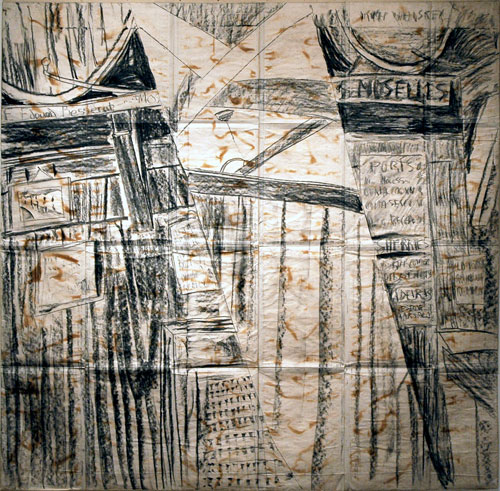
Gilbert & George The General Jungle or Carrying on Sculpting 1970-1974 [one enormous panel, from a set of twenty-three, in charcoal on canvas-backed paper]

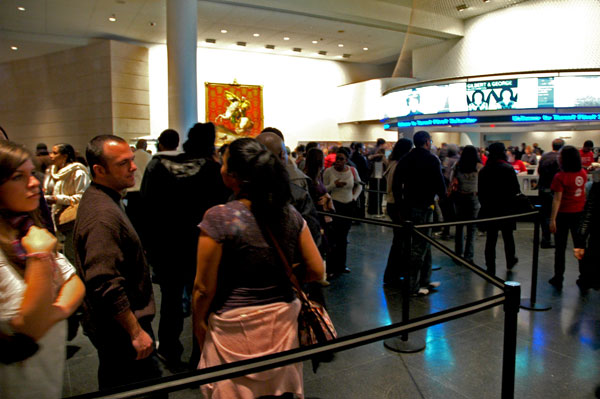
We visited the Brooklyn Museum with some friends from the borough across the waters on Saturday afternoon. We picked the date at least partly because it was one of the institution’s monthly Target First Saturdays, and the first of a new year. On these days the museum is open until 11, and from 5 in the afternoon there is no admission charged and there are special programs of art and entertainment. The caf� serves sandwiches, salads, and beverages and there’s a cash bar with wine and beer. I have no precise way of pinning down the demographic, but I’d be willing to bet that most of the happy crowd, of every level of sophistication, which we saw devouring the art on each floor were Brooklynites happy to be sharing their great museum with friends and family.

Brooklyn_Museum_crowd.jpg
museums are hot

We went because it’s one of the best museums in the country, but I’m doing this post because I love that the institution is so serious about engaging with its community and because, more than any other New York Museum, the Brooklyn appears to be committed to enlarging the scope of the free use of photography within its galleries whenever possible.
We wandered through many of the exhibition spaces, but we were anxious not to miss two installations in particular. One was Jesper Just‘s gentle exhibition of four films, billed with the title of the artist’s latest film, “Romantic Delusions”, and the other was the huge Gilbert & George retrospective installed on two floors. The Just closed yesterday, but the traveling Gilbert & George show will be here through Sunday.
I’ve been a fan of Just for years, but I think I had earlier found the work to be somewhat more enigmatic than it should have been. Being able to see these four works in one installation significantly expanded my appreciation of his explorations.
It was pretty embarrassing to be reminded of how ignorant I was about the career of that most excellent pair, Gilbert & George, but following my visit with these “living sculptures” I felt somewhat enlightened, very impressed, and absolutely charmed.
A final note: Not until after we had left the Museum did it occur to me that each of these temporary exhibitions had at least referenced the complex workings of cross-generational male/male affection. It’s not one of the more frequently-encountered themes in art; I’m sure it’s appearance here was only an odd coincidence. Still, I don’t know how it can have gone entirely unnoticed by everyone but me, and I do know that I’m reminded once again that I’m definitely a long way from Kansas . . . er, Michigan.

jesperjust_bah2.jpg
Jesper Just Bliss and Heaven 2004 still from video

[image at bottom from Witte de With]

welcome to the Republican party, Barack

tax_cut_great_depression.jpg
coming soon to your neighborhood

Change ain’t happening.
Does Obama think we can turn this around with another tax cut? Or maybe he just thinks a few hundred dollars will make a difference to people who have already lost jobs and houses. Even George Bush can see it didn’t, and doesn’t, although he now has the satisfaction of welcoming his successor into the Republican party.

WASHINGTON � President-elect Barack Obama, commencing face to face consultations with congressional leaders Monday, is embracing an unexpectedly large tax cut of up to $300 billion. Obama said the country faces an “extraordinary economic challenge.” Besides $500 tax cuts for most workers and $1,000 for couples, the Obama proposal includes more than $100 billion for businesses, an Obama transition official said. The total value of the tax cuts would be significantly higher than had been signaled earlier.

[image, from the first Great Depression, from thereaction]

Ligurian hake and potatoes, grilled baby bok choy

Silver_Hake.JPG
Merlucciidae Common Name: Silver Hake, Whiting, New England Hake

Oh wow, I do love this fish. It’s very popular in Spain, but the species in European waters may be different from that found in our own. I say that because I remember how after less than a week in Madrid Barry and I would both groan when we saw merluza on the menu. It was tasty, but hidden bones were always a serious obstacle to our enjoyment. I haven’t had the same experience on this side of the Atlantic.
But maybe it’s just the estimable fishmongers at Citarella.
Last night I put together a dinner of “Ligurian fish and Potatoes” (using an 11-ounce Hake fillet and two scrubbed-but-unpeeled red potatoes). Thanks for the recipe, Mark. The hake rested on a cushion of red-rimmed potatoes which were remarkable not just for their taste but for being deliciously juicy, yet still al dente, while staying crispy on some of the edges.
Along with the fish, bought at Citarella in the Village, a few blocks southwest of the Union Square greenmarket from which I had just left, I prepared some very small baby Bok Choy which I was surprised to still find in this increasingly-deserted open-air market at the very end of December (praised be the inventor of the cold frame). But then I also bought some delicious Niagara grapes from another vendor yesterday; how’d they manage that?
The recipe for the contorno, which I modified somewhat from this recipe I found on line seems a bit fussy, but it turned out to be way toothsome, and a sensational complement to the sweet, white fish. It amazes me that this excellent vegetable still makes only rare appearances in Western cook books; I mean, the Italians managed to find New World peppers and tomatoes without making a big fuss, so where’s their bok choy?

GRILLED BABY BOK CHOY
After cutting them in half, brushing them with garlic-infused oil, and sprinkling them with lemon and thyme, I grilled the little cabbages face down in an enameled-iron ribbed pan for about four minutes, covering them loosely with a sheet of foil. I then turned them over and added drops of balsamic vinegar, grilling them for about three or four more minutes. Once they were on the plates, I topped them with a mixture of pine nuts which had been sauteed in the garlic-infused oil and then heated with the chopped dark green outer leaves I had removed earlier.

We had nibbled on taralli al peperoncino while we waited for the main course, and when we had finished the fish I brought out two very small cuts of slightly-aged Caprini Tartufo, accompanying it with thin slices from a loaf of Tuscan bread I’d also picked up at the greenmarket that afternoon, and some phenomenal dried Turkish figs.
Oh yeah, sure, there was wine. We shared a bottle of Spanish Naia Verdejo which we sometimes think of as our current “house white”; it cost us only $12 or so.
Even though I’ve written before about the meals we enjoy at home, when I had already begun this post I suddenly thought that it might be a mistake: Maybe because it was so good and because I seem to be boasting about it publicly, but mostly because while I know that not everyone might want a meal like this many who would are unable to assemble it for one reason or another.
I will admit that it helps, and is probably essential, to have someone you love to enjoy it with you, but that sounds like another assignment.
“Geography is destiny”, may be only a clich�, but if you’re not in a city like New York you may not be able to reproduce this or most of the meals which we enjoy and which I sometimes describe, but you may come up with something just as pleasurable to suit different resources and circumstances. It doesn’t have to mean taking a huge chunk of time out of a day: While this main course took me a little over one hour to put together, a call to the local Chinese or Mexican will always beat the time spent in the kitchen preparing any meal, but on the other hand, it’s not a chore. Finally, considering what real cooks have been able to do without great kitchens and without fat purses, I don’t think that inadequate space should stop anyone who really wants to prepare good meals. In fact I started cooking for myself when I had only a sink, a refrigerator, a stove and two feet of counter space on one side of a one-room apartment ( I now have an additional 4 1/2 feet of counter, but that extra length is only 16 inches deep and my refrigerator is now tiny).
I know that limited funds should be even less of an obstacle. Were I were disposed to feel any embarrassment about what looks like indulgence in this meal, and it certainly was not an exceptional event for us, I would just remind myself that the cost of the entire dinner for two (including the portion cost of herbs, oils, lemon, vinegar, etc.) was something like $16.
But I also get great pleasure (and some physical and mental exercise hauling and bending) out of the planning, gathering and preparation of these dinners, not to mention my huge delight in the enjoyment and sharing of good food, and the good conversation it encourages, while also listening to music of which we might take almost no notice during any other part of the day.
Most days I wouldn’t trade it for any restaurant, even if I do have to do the dishes.

[image from University of Southern Maine]
Andrew Guenther at Freight + Volume

Andrew_GUenther_Skull_Pile.jpg
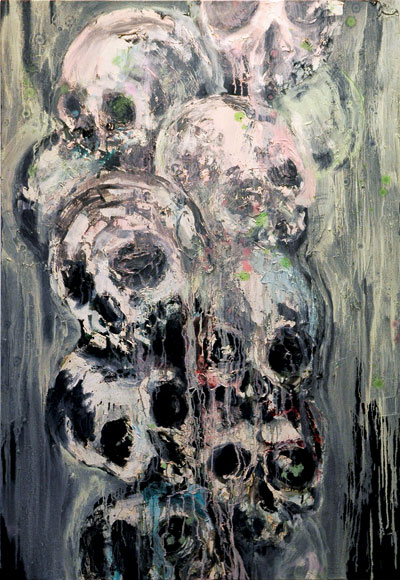
Andrew Guenther Skull Pile 2006 oil on canvas 68″ x 48″

Andrew_Guenther_wall.jpg
view of one wall of installation, including both paintings and objects

Andrew Guenther‘s show at Freight + Volume, “Looking For Culture Part III: Back to My Old Ways“, includes some terrific oils, acrylics and sketches, and a number of indefinable objects. Many of the pieces assume both individual and compelling shared identities, since they’ve been placed on, above or below simple wooden shelves. The drawings and paintings are incredibly fresh, even sweet (don’t let the skulls put you off), and the gallery’s small “cabinet”, boasting as it does so many curious, wonderful, handmade doohickeys, looks something like a collection marshaled by a particularly-inventive Prospero.