W.A.G.E. rage inside “Democracy in America”

WAGE_rage_Armory.jpg
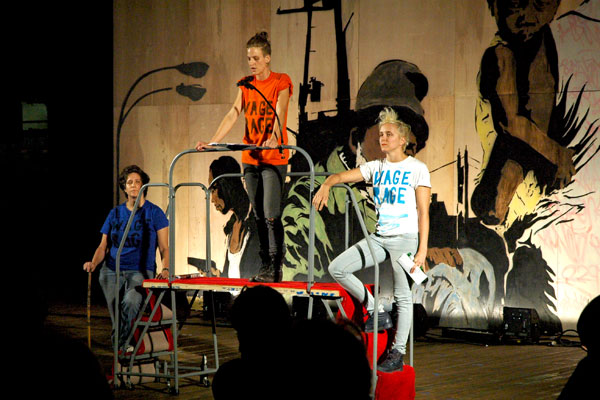
W.A.G.E. RAGE from the speakers’ platform in the Armory Drill Hall

Creative Time’s 2008 project, “Democracy in America: The National Campaign“, was a remarkable achievement on a national scale, and it all came together in our town this past September. I wouldn’t know where to start if I tried to address everything I saw on visits over two days, but I can say a few things about its general success, at least as I see it.
For starters, this is the kind of investment in public art that, unlike so many that are imposed upon us, could really make a difference to both a huge number of artists and a very large public. Also, it probably cost New York something less than the $15 million the Public Art Fund spent on Olafur Eliasson’s surprisingly-lame “New York City Waterfalls”. Thirdly, it involved the active and creative participation of thousands of people all over the country, from all sorts of backgrounds and they were exercising all kinds of talents. And finally, on a personal note, entirely aside from its undeniable intellectual and aesthetic appeal, I would say that any art project which can teach this art fan and political activist new things and radicalize him beyond his previous position must have gotten something very right.
Some of the liveliest elements of the entire Park Avenue Armory “Convergence Center” were to be found inside the Drill Hall. Throughout the week of the installation anyone could speak from a soapbox, but individuals and groups were also scheduled to perform or speak more formally at the east end of that magnificent vaulted shed. I heard parts of only a few segments in either format, but on the night of Saturday, September 27, I was there for addresses, in intense and reasoned argument, by some of the people of W.A.G.E. [Working Artists and the Greater Economy]. The words we heard then will some day be described as marking the moment when the gloves came off and artists in America began to be free.
Their website says that the group “works to draw attention to economic inequalities that exist in the arts and to resolve them”, and their fundamental argument was expressed in some of the statements we heard that Saturday, beginning with these notes which I’ve made with the help of the video available by Creative Time on vimeo:

“It seems apt that W.A.G.E. is here [as the world’s financial systems fall – Ed.] tonight to bring to light ongoing unjust fiscal practices in the art world”
[the speaker goes on to explain that institutions, should they choose to exhibit their work, don’t pay artists the costs for the exhibition, don’t pay their lecture fees, don’t pay fees for the reproduction of their images in their advertising materials, just for starters]
“Does this list sound absurd? It’s long. What is absurd is to exclude artists from payment for their labor and for the reproduction and exhibition of their work, within an economic climate where it is socially acknowledged that payment is granted for services rendered.”
[she added that it’s also not absurd because there are many examples of artist fees being covered in other countries, and then she continued, guessing some listeners might respond that those countries may be socialist, or that they must have more funding than our private institutions]
“If capitalism is you bag or priority, I can’t think of anything more capitalist than getting paid for your labor [italics mine].”

I’m sure you’ll be hearing more about this movement, even if you don’t become a part of it, and even if you don’t go to the site, where there’s much more about W.A.G.E. and CARFAC, the Canadian artist-run organization which has been so successful.
We love creative time, and we love Creative Time.
A.R.T. launches Benefit Portfolio of prints

Miller-070508.jpg
John Miller Untitled (July 5, 2008), The Middle of the Day

Davey-Greatest-Hits.jpg
Moya Davey Greatest Hits

Art Resources Transfer [A.R.T.] has assembled a portfolio of six artist C-prints, in an edition of 50, for what it has dubbed as its 2008 Benefit Portfolio. The artists represented are Moyra Davey, Rachel Harrison, John Miller, Jack Pierson, Liliana Porter, and Martha Rosler. Two of the images appear above. All proceeds will go to the support of the group’s two terrific program areas: The A.R.T. Press, which publishes books based on conversations between artists, and the Distribution to Underserved Communities Library Program, which distributes art books free of charge to rural and inner-city libraries, schools and alternative reading centers throughout the country.
I’ve written in the past about the great service performed by this institution. It continues today to honor the work of its imperishable founder and former prime instrument, Bill Bartman.
There will be a reception to launch the portfolio this Friday, October 10, at Greene Naftali Gallery, 508 West 26th Street, between 6pm and 8pm. The details on this very modestly-priced edition itself are here.

three (3) D.U.M.B.O. doors

3_DUMBO-warehouse_doors.jpg
untitled (3) 2008

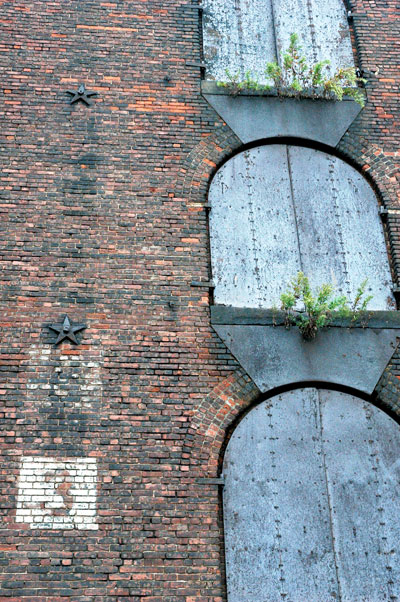
Ten days ago while I was in D.U.M.B.O. I casually snapped this detail of an old brick wall. I was intrigued by the weeds growing out of cracks in the worn masonry and rusted iron of the dignified mid-nineteenth-century former warehouse of which it was a part. The massive structure had long ago lost its purpose and it now hovered above a neat lawn on a Brooklyn shore being made safe for investors and young families.
Only as I looked at the picture just now while I was putting it up, remembering what the huge pattern of brick and shuttered openings looked like on that drizzly day, did it occur to me to relate it (the scene, not my photograph) to Piranesi’s “Vedute di Roma“, which described the weedier walls of a much more ancient city 250 years ago.

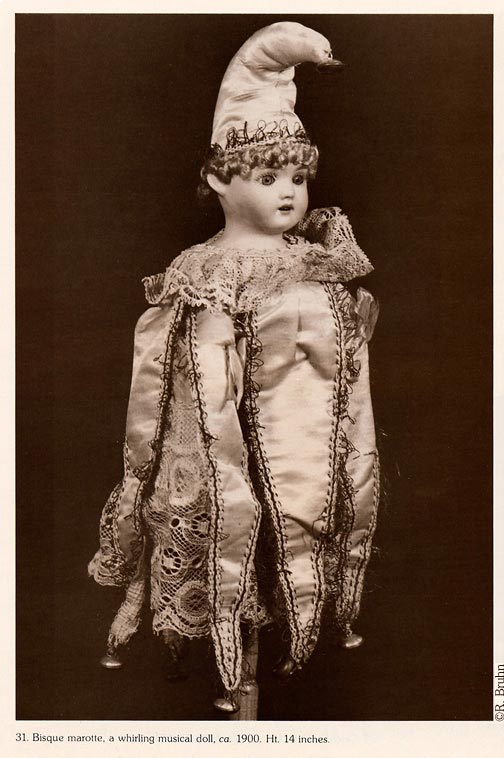
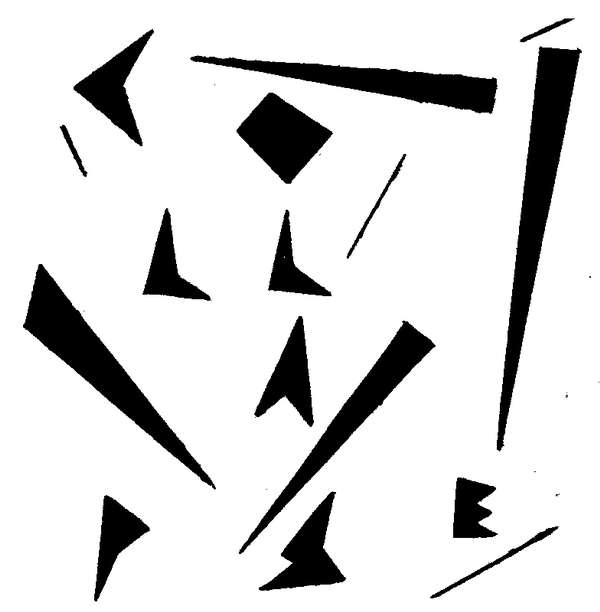
Palin as the “maverick” court fool’s scary marotte*

marotte_Russian.jpg
pretty empty

I’ve just sat through my first – and last, ever – Presidential or Vice-Presidential debate. As Barry twittered, immediately after we had together watched a real TV show in real time probably for the first time since 9/11:

I feel I lost IQ points watching that. I hope I get them back. What we call a “debate” is a travesty of that concept.

Two of my own thoughts: I think the Republican “principal” should be watching his back: My headline refers to his “dummy”, but in this country dummies have a history of taking over everything, even supplanting fools.
And after listening to Ms. Palin’s painful memorized deliveries, I never want to hear anyone visit the word “maverick” again. John McCain has only done two “maverick-ish” things in his lifetime: The first was the moment he asserted that he was capable of performing as President of the United States; the second was the moment he decided to tell us that, in a pinch (or something of that sort), Sarah Palin would be able to do the same.
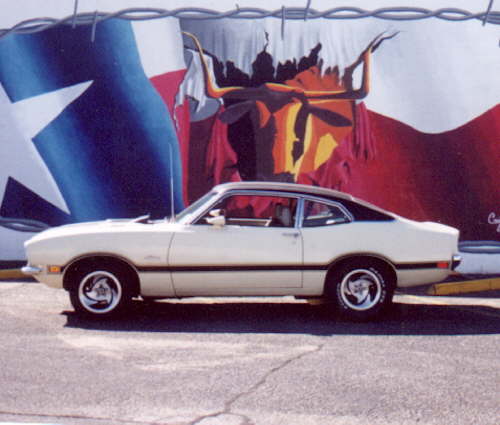
I may be significant of nothing, but does anyone remember the original Ford Maverick, a slightly-gussied-up version of the Falcon, a tired earlier model? I do, for reasons not related to any virtues which might later have been associated with it, sentimentally or otherwise. Let it suffice to say, the Maverick was not a “memorable” car in any sense which could be related to worthiness.
Like the current Republican slate, just lipstick and paint on cheap plastic and rusting tin.


forty years ago a Maverick was merely sort of pathetic

*
the medieval court jester or fool’s own prop-stick fool

[first image, of a century-old bisque marotte, from antiquedolls; the second, of an early-seventies Ford Maverick, from barkbarkwoofwoof]

Matt Wolf’s Russell bio, “Wild Combination”, now at IFC

Arthur_Russell_photo_booth.jpg
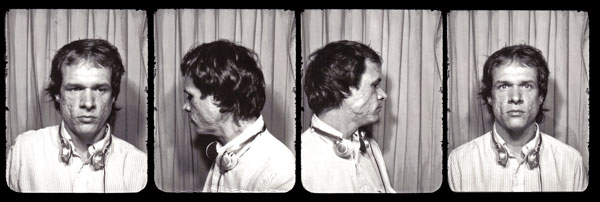
Arthur Russell (and ‘phones) in photo booth

Matt Wolf’s beautiful homage to Arthur Russell, “Wild Combination”, has been showing at the IFC Center in the West Village, the former Waverly, since September 26. It also opened at the ICA Cinema in London that day. In New York it’s currently scheduled to be shown through next Tuesday, October 7, but it might be extended, depending upon attendance. So go now.
It’s a work of art, and a great joy.
I wrote about it after seeing the preview at The Kitchen last May. There are a number on links, including a short sound widget, on my earlier post, but you probably won’t want to miss the film.

[image, credited to Audika Records, from Matt Wolf]

did I say that?

collapse.jpg

Over six years ago, inspired by an earlier series of financial scandals dominated by those redolent names, “Enron”, “Global Crossing”, “Adelphia” and “WorldCom”, I did a post which included this:

Now I know I shouldn’t necessarily be gleeful at the possible or impending sudden disappearance of or depressive shift in the cycle of this “system”, since it would mean havoc perhaps even exceeding the evil it does now. Moreover, as someone living on a fixed income produced by, no, not the sweat of my brow, but by years of borrrre-dom, I should have a selfish interest at stake. And in the end, we know the ones who will suffer regardless of how this all works out will not be the very rich. BUT, I will admit I’m absolutely fascinated by what’s happening right now.*

Now that it’s finally all come down around us all, I’m still fascinated; I’m just surprised it took so long.
And angry? I was already there.

*
I know what I meant, but I sure hope I’d be able to express it better today, at least on a good day.

[image from the band COLLAPSE]

“Greenpoint 100” library benefit returns Saturday

library_books_Wichita.jpg
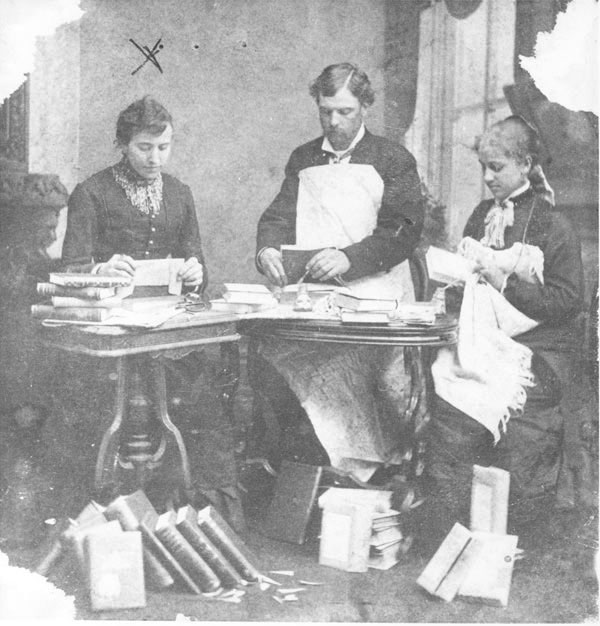
“Del Baldwin, Tence Massey and Anna Pope are preparing library books for circulation.”

Apparently the first time around it was such a great success, and everybody had such a good time, that this Saturday Friends of the Greenpoint Library are repeating an event they held at the Library last September.
“Greenpoint 100” is a benefit art show of works donated by artists living or working in Greenpoint. One hundred pieces, in almost every medium, will be available for the astoundingly modest sum of $25. We’re told that the money and the enthusiasm raised a year ago went toward acquiring new materials for this branch of the Brooklyn Public Library and toward creating a safer, more inviting library environment for the vibrant community it serves.
I’ll say again what I said last year, when we were asked to help with the event: We love Greenpoint, and we love libraries. This time I can add that the work we saw in 2007 was very impressive. Oh, and I still love this photograph.
Details:

The Greenpoint 100: Friends of the Greenpoint Library Artists’
Benefit
Saturday October 4, 2008
11:00 am to 2:30 pm
at the Greenpoint Library
107 Norman Ave. at Leonard St.
Brooklyn, NY 11222
for more information call the library at 718-349-8504 or email: friendsofthegreenpointlibrary@gmail.com

[1878 image by unknown photographer, along with supplied caption, from wichitaphotos.org]

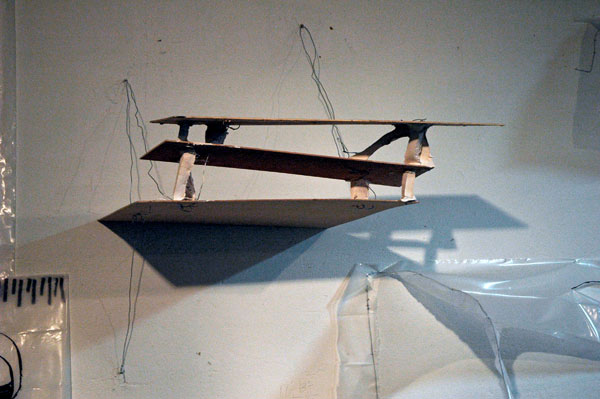
photo, light, chance, design: John Wallbank’s studio


John_Wallbank_triplane_wall.jpg
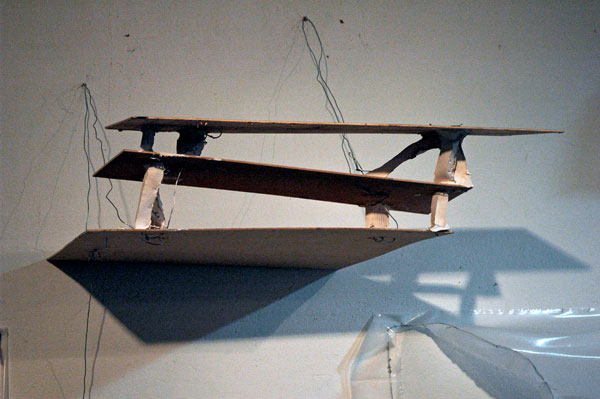
two images of the wall in John Wallbank‘s studio

A photograph of a work of art, or for that matter a visual or sound recording of a work of art, is never the art which it tries to represent, even if it might in some extraordinary instances become art in its own right.
And yet photographs have a life of their own. If only because of a physical distance from the object and the fact that they’re quite separate and distinct from the eye, mind or voice of its creator, the photographer’s own eye, mind and ears always introduce something to any work of art, whether a visual, performance or musical piece. This is the case even for a more casual viewer unencumbered with a recording device of any kind: Every viewer sees something a little different. Photographs of works of visual art, qua documents, are not the works they describe, but they can frequently add an additional dimension, sometimes aesthetic, sometimes intellectual, to what the artist has left us.
In the case of the odd dynamic of the light in the images above, an arguably happy accident which I couldn’t at first explain has added a ghostly element to what I intended to be only a document of John Wallbank’s sculpture as I encountered it several days after my first visit to his space in the Triangle Arts studio program. After taking the first image I looked at the small screen on the rear of my camera. On that scale I couldn’t identify what the fog-like area was. Thinking it was light bouncing around my lens, I took three more shots, but the same hazy area showed up on each one and I shared them and my puzzlement with Wallbank. Only this afternoon, while looking at all of the images on my laptop screen, did I see that the lighter-colored areas on the lower right were simply the part of the wall not shaded by the sculpture’s thin plywood platform. They represented a more direct light coming from the window out of the camera frame on the right.
I deny any conscious responsibility for the cubist display in these pictures. Although I thought until a few moments ago that it was the accident of an unusual play of light which happened to be very friendly to both Wallbank’s use of found materials and to his wonderful creations, I now imagine that in some way the artist anticipated the effect – and many others like it not recorded here.
Either way, the work would not look the same to the next person who saw it or photographed it, or even to the artist himself, as I expect he and most artists would admit.