Dalai Lama and John McCain

Lama_and_that_other_old_guy.jpg
two cult leaders, getting along famously

Why does this photo of McCain’s meeting yesterday with Tenzin Gyatso not surprise me? But then, maybe it really should have surprised me:

“I hate the gooks,” McCain said in 2000. “I will hate them as long as I live.”

This trip down memory lane was brought to us by Eyeteeth.

[image by Carolyn Kaster from AP; and thanks to Barry for the Eyeteeth citation]

Louise Fishman’s “Angry Paintings”

Louise_Fishman_Angry_Louise.jpg
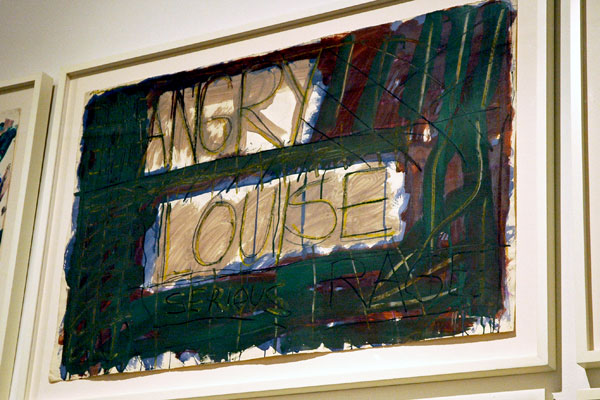
Louise Fishman Angry Louise 1973 acrylic, charcoal and pencil on paper 26.5″ x 40.25″

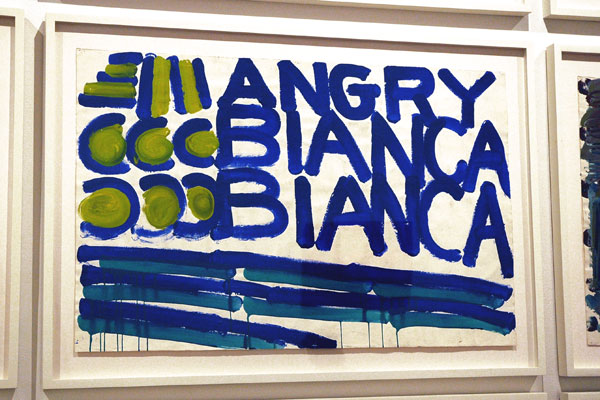
Louise_Fishman_Angry_Bianca.jpg
Louise Fishman Angry Bianca 1973 acrylic on paper 26.5″ x 40.25″

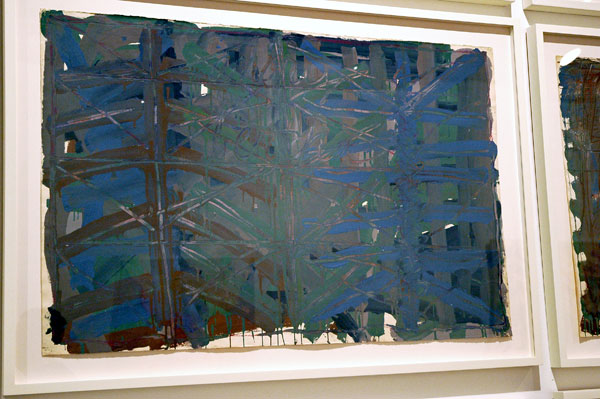
Louise_Fishman_Angry_Bertha.jpg
Louise Fishman Angry Bertha 1973 acrylic on paper 26.5″ x 40.25″

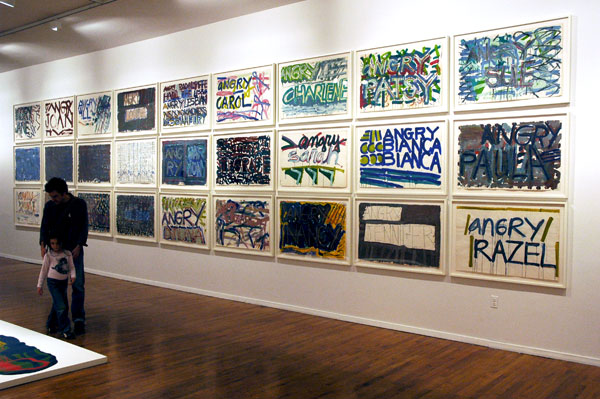
I captured these installation images during a visit Barry and I made to PS1 in May, on one of the last days during which the museum hosted the historical show of feminist art focused on the 1970’s, “WACK!: Art and the Feminist Revolution”. We had eagerly acquired the book long before the show opened in New York; I have no idea why we waited so long to get to the show itself.
It was even more exciting than we had expected, and one of the biggest thrills for both of us was the opportunity of seeing Louise Fishman‘s 1973 seminal piece, “Angry Paintings”. We had heard about it/them almost from the time we met the artist eight years ago and came to know her work, but we had never seen even a representation of any of the 27 dramatic medium-sized works on paper. At PS1 they were shown as they should be, in one installation and on a dedicated wall.
While these remarkable sheets of paper look fresh enough to have been made last month, they could and should be in permanent exhibition in a major museum already. They’re gorgeous, but they’re also as “angry” as they ever were.
Fishman had begun her career as an abstract expressionist working with acrylics on canvas, but by the 70’s she was experimenting with forms only remotely related to traditional painting. Like many of her contemporaries in the flourishing women’s movement she had began to create forms related to traditional “women’s work”. No samplers or scarfs, but rather peculiarly-muscular abstractions “drawn” through sewing, weaving or stitching, sometimes twisting or cutting canvas and other materials, often thin, soft, unstretched cloth. Paper was next.
In a 2004 essay, “Vitruvian Woman”, David Deitcher wrote about the artist:

Unable to see how her paintings could speak to the social upheaval of the early 1970s, Fishman gave up painting and embarked on a period of experimentation . . . . [But] Fishman maintains that she felt “jealous of the writers’ camaraderie [of many within the radical feminist group Redstockings], of their ability to write doctrine and keep journals.” In 1973, she gave poetic shape to those longings, and to the anger and frustration that accompanied them, in a series of forceful paintings on paper that were dominated by the word “ANGRY,” which Fishman followed with the given name of one or more women she either knew directly or knew about.
. . . .
Responding to the boldness of these text paintings, [the academic and critic Catherine Lord] maintains that “the ‘Angry Paintings,’ with their confusion of letters and color, their overlays of slashes and loops, their fields of muddied pigment, their rough edges and archaeological slices, were Fishman’s route home. The choices she would follow in her later work are almost all prefigured here. It may fairly be said that the explosions recorded in the series enabled Louise Fishman to return to painting.” However, it would take Fishman another five years before she would again take up painting on stretched canvas; and almost three decades before she would finally claim as her own the daily practice of monumental gestural abstraction.

We feel very privileged to be here in time to see it.

Louise_Fishman_Angry_Paintings.jpg
[installation]

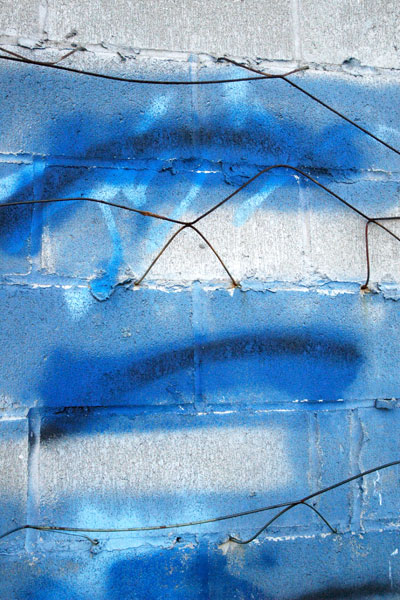
cool blue in Red Hook on another very hot day

Red_Hook_cinder_blocks.jpg

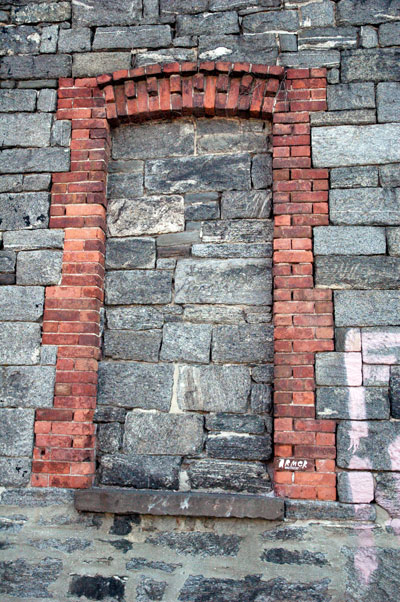
The building was a very dignified mid-nineteenth-century Red Hook Brooklyn warehouse/factory built on the waterfront with local stone. The brick-surrounds of the old windows on the street side had later been filled in, some with the same cut stone used for the walls and others, much more recently, with cement blocks. When I saw them last week the blocks were painted a very gay bright blue; the stone-filled openings hadn’t been touched. I have no idea what purpose the rusting wire had served, but their lines looked real nice.
There must be light and air coming into the building from other openings, as it appears to be in use today.

Red_Hook_stone_blocks.jpg

“Home Delivery” at MoMA seems to miss the point

Home_Delivery_yard.jpg
there goes the neighborhood (single-family houses visit midtown)

How many more suburban mini-estates do we really need? How many more can we bear?
It was a long time ago, and the details are a bit hazy, but I’m sure that my first love was the art of architecture and all its wonderful works. I remember the shapes and structural details of every room and every back yard in which I found myself as a very young child, even those I knew when I was barely able to walk, and Frank Lloyd Wright was my first artistic hero (well, I did grow up in the plains of the Midwest).
To this day architecture is second to none among my passions, and it’s a long list.
And so it was that on Tuesday I found myself getting up at the crack of dawn in order not to miss the press preview for the Museum of Modern Art’s new architecture show, “Home Delivery: Fabricating the Modern Dwelling”. In truth, Barry and I got there just after 11:30, but that’s an exceptionally early hour for either of us to be abroad, and we were just in time to hear the group addressed by Barry Bergdoll, the museum’s new Chief Curator of Architecture and Design. I had already noted his intriguing bio, and that was another incentive to make it up to 53rd Street that morning.
The show is fascinating, at least as much for a historical survey as for a review of the latest innovations. On Tuesday we were whisked out by one o’clock. There was hardly enough time to learn more than that I have to go back for more; this post isn’t a review, by any means. I was also excited enough about the show to buy the catalog on my way out, and I already know that it’s going to make me want to know more.
But I confess to one serious misgiving about the show.
In a world whose population is exploding, whose natural environment is threatened and whose resources are diminishing (including especially the resources which have supported cheap transportation of all forms), it would seem to me that if a modern museum’s show about architecture is focused almost entirely on free-standing private dwelling units, regardless of all the sexy bits about computer design, pre- or modularly-fabricated structures, and revolutionary ecological breakthroughs, it is at least half-dead in the water already and unlikely to be remembered as a landmark achievement by any future generation.
The American model of single-family homes, occupying plots of land preferably as large and as isolated as possible, is an exception elsewhere in the world, and it is about to become obsolete here as well. This ideal could only have been realized on a rich underpopulated continent. This bountiful wilderness was “tamed” by people who had learned everything they would need to know to satisfy their remarkable misanthropic compulsions from the genius generated by the far more amalgamated civilizations, mostly of Europe and Asia, from which they had fled.
To this day the average American disdains apartment living and in fact virtually any kind of shared space. We don’t really like each other very much. We don’t like living near other people and we don’t like traveling with them either. We must have our own houses and our own cars; except for those of us who already live with and thrive with them, we almost universally loathe the idea of apartment buildings and all forms of public transportation. Most of us don’t even want to share a free-standing house (regardless of how large it is and how big the home spread) with relatives not part of our own nuclear family, and even within these families we insist on having our own separate rooms; we also want our own cars, beginning at age 16, and until now these vehicles had to be big (trucks, really) even if we didn’t intend to take anyone else along for the ride. We basically want to be alone, and in both our hankering and the reality we’ve achieved, we really are alone.
We deserve to be by ourselves and we can afford it, or so most of us have been thinking until at least recently.
With its new architectural design show, “Home Delivery”, MoMA seems to have received the wrong delivery, since in spite of the fascination of both its subject and the attractions of its installations, its fundamental focus on the single-family dwelling is the same as that identified with the mid-century modern age which produced many of the historical projects to which it gives homage. For New York it was an age dominated in popular projects by the problematic vision of Robert Moses, and we know now that the salad days of the profligate suburban American “ranch” (in whatever style or pastiche) are finally over, everywhere.
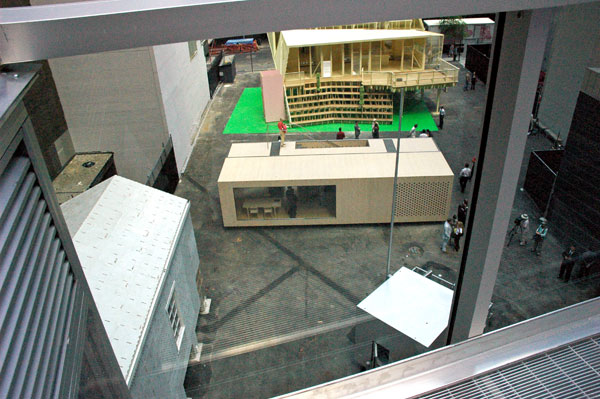
Five temporary, very different “model homes” have been erected on a vacant lot just west of the museum; while each of them is a delight to read about and explore, only a single structure (with the possibility of one other) has been designed so it could be a part of a multiple-dwelling structure.
Frank Lloyd Wright didn’t have any use for apartment living either, but in fairness I would say that when he was born in 1867 there was still a real American frontier and both Europeans and Americans were marveling, even then sometimes in very different ways, at what seemed to be the unlimited possibilities of an industrial age. Also, in the mid-nineteenth century the world’s population was only about one sixth that of today’s figure of 6.7 billion, and the projection for 2050 is for close to ten billion. If we haven’t learned to live in sophisticated multiple dwellings by then, those who have somehow managed to survive are likely to be sheltering inside mud huts.

ADDENDUM: I may be reading too much into its significance, but the architects involved in the design of the full-scale, free-standing houses are almost all Americans.
Except for the special case of the very cool “micro compact home” of Horden Cherry Lee Architects/ Haack + H�pfner Architects (U.K. and Germany), and the elegant and very flexible solution called System3 by Oskar Leo Kaufmann and Albert R�f (Austria), all of the projects in MoMA’s vacant lot were by architects who appear to be based in the U.S.
The office of Kaufman and R�f is located in the pretty Voralberg town of Dornbirn, in the center of an Alpine province not known for population density.
Construction geeks of all kinds will want to watch the stop-time video I just came across on Treehugger showing the assembly of System3 inside MoMA’s back yard. The “module” arrived on 54th Street in a single Hapag-LLoyd shipping container and was assembled in one long morning.

Bruce Connor (1933-2008)

ConnorBruce.jpg
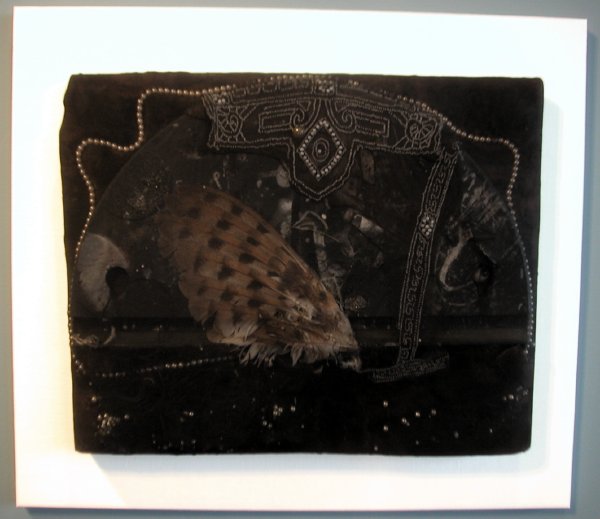
Bruce Conner Untitled 1960 mixed media, pearls, nylon, mesh, wire, etc. 20″ x 24.5″ x 2.5″

I included this image in the first post I did about work I’d seen at the 2005 Armory Show. I remember how excited I was at the time, particularly as I had known nothing (or thought I knew nothing, since I had actually experienced his art for years) about Bruce Connor before I came across this piece, and he certainly wasn’t newly-arrived on the scene. My excitement continues, sadly mixed with the news that Connor died on Monday at his home in San Francisco.

Obama really gets ‘religious’ – but we’ll pay for it

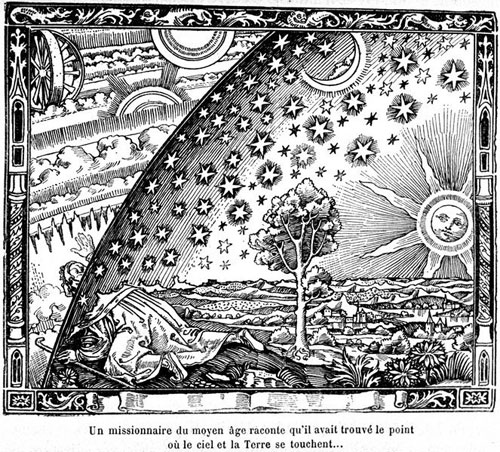
cult_moyen_age.jpg

Barack Obama plans to expand Bush’s “faith-based” initiative.
That just about does it for me. The flag pin he decided to add to his lapel should have been a warning, but I really found myself distanced from the man after enduring his “adjustments” on fundamental issues like gun control, government surveillance, trade policy, and getting us out of Iraq. Now I’m also supposed to go along with his call for escalating the government’s financial support (my taxes included) for the most powerful institutions of superstition, obscurantism, prejudice and hate in the nation.
Haven’t we and the world already paid far too much for the mistake of giving religion the free pass it enjoys now (and I’m not referring only to its tax-free status)? If organized religion were capable of benignly and impartially ministering to the welfare of everyone we wouldn’t have had to invent government. And if religion could possibly be described as fundamentally caring and nonpartisan, there’d be only one of them out there.
Obama still has four months to continue turning off many of his most enthusiastic supporters. Does he think the big money he will attract by doing so will smell better than the mites coming from those with little to spare? Does he actually believe in the junk positions he’s assuming, or does he do it because he has to do in order to get elected? Either way, I wouldn’t hold my breath waiting for any president to move to the left once she or he slithers into the Oval Office. The creditors wouldn’t stand for it.
I should pay more attention to what I’ve already written: We really do have only one political party.
George Carlin was right.

ADDENDUM: This excerpt is from a post by Huffington Post blogger Barry W. Lynn, an ordained minister and Executive Director of Americans United for Separation of Church and State:

The problem with the faith-based initiative is that it’s a euphemism. We used to call such things “taxpayer-supported religion.” Of course, no one would support it if it were called that. After all, the idea of taxing people to pay for religion is scary. It’s what got folks so riled up back in the colonial period. No one wanted to pay taxes to support some other person’s religion.
No one wants to pay them today, either. Yet increasingly we are being asked to do so. Eager to appear faith friendly, candidates in both parties are increasingly upping the ante for how much they plan to dole out to religion if elected.

[image from Steve Kemple]

Pace Wildenstein lets it all hang out

Pace_wildenstein_photography_ban.jpg
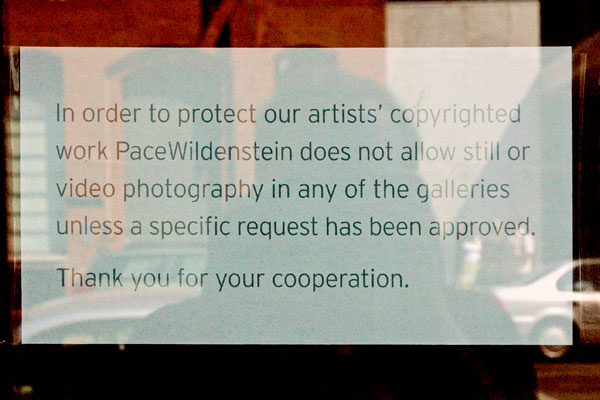
sign inside the window immediately adjacent to the front door of the gallery on 25th Street

They have no idea what they’re talking about. Once one of the most important galleries in the country, sadly Pace Wildenstein doesn’t seem to know the first thing about the usage of photography in the twenty-first century, or the issue of copyright.
Because of the gallery’s photo ban, Pace shows are not posted or reviewed on ArtCal, and they do not appear on this site or on Bloggy.

Joseph Hart’s “Fragments”

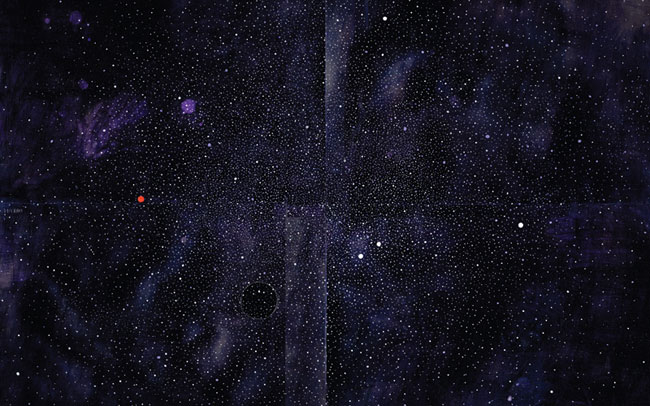
Joseph_Hart_Fragments_constellations.jpg
Joseph Hart Vija No. 9 2007 acrylic on paper 22″ x 30″

Some time ago I wrote about a show of Forth Estate prints at Klaus von Nichtssagend, and I included an image of a work by Joseph Hart. Of course I did an on-line search at the time for more of the artist’s work and really liked what I found. This was no surprise, considering my respect for the Williamsburg gallery, and the company the print shared.
I missed the solo show of collage work which Hart had in the Freight + Volume project space last year, so I was doubly happy to come across an announcement of the publication of “Fragments”, a beautiful new limited edition book of his work, some of which appears to have been in that show. I decided to include one of the images here. I chose it for its breathtaking beauty, even if it seems to be in a style and form a bit different from most of the work I’ve seen.
Hart appears to be interested in systems and the way all the stuff we’re surrounded by is presented to us. This includes our historical and cultural values, science and art no less than all the rest. Investigating the simplest or most complex given or invented artifact, on virtually any scale, he ends up creating living, organic “museums” with his own diagrams and maps, every one of an astounding beauty.
The publisher is San Francisco’s Seems Books, and more pages can be seen on their site.
Wow, I just noticed they also have a book of Mike Par� work!

Christopher Brooks’s studio

Christopher_Brooks_black_snowman.jpg
Christopher_Brooks_black_and.jpg
Christopher_Brooks_black_bar.jpg
Christopher_Brooks_busy.jpg
Christopher_Brooks_white_exclamation.jpg
Christopher_Brooks_pretty_white.jpg

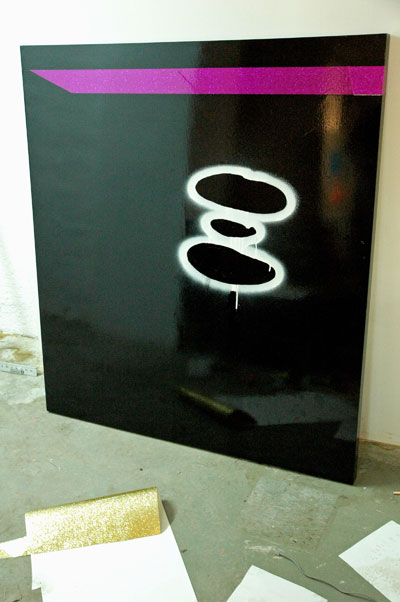
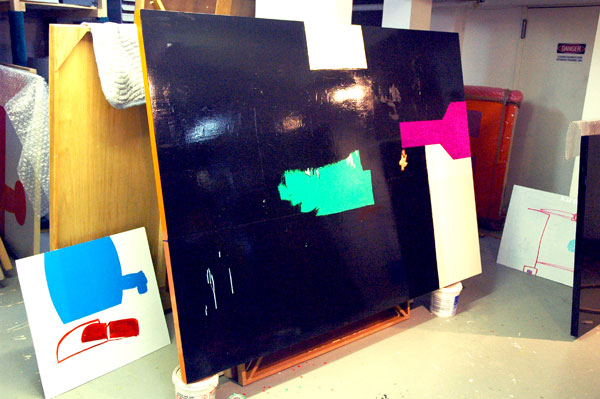
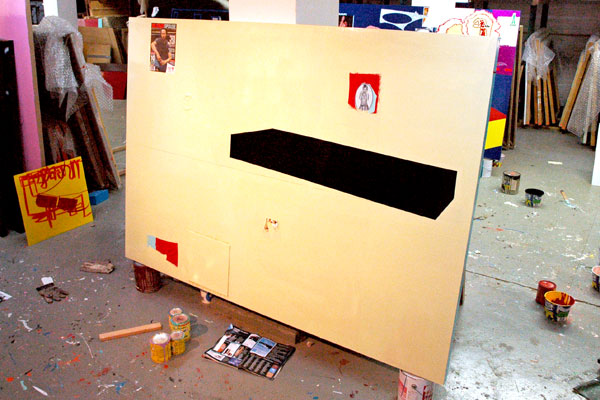
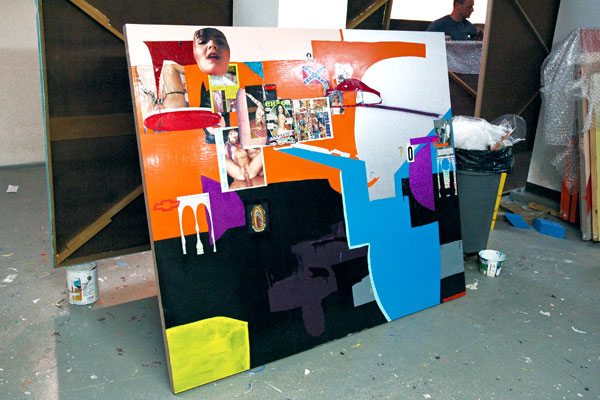
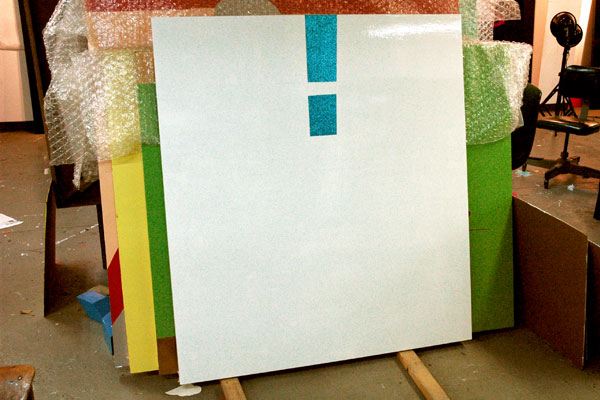
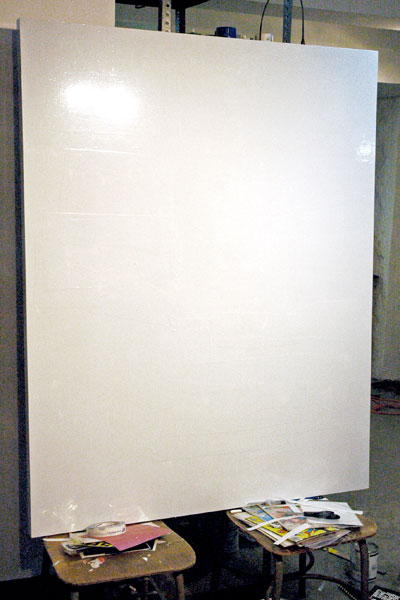
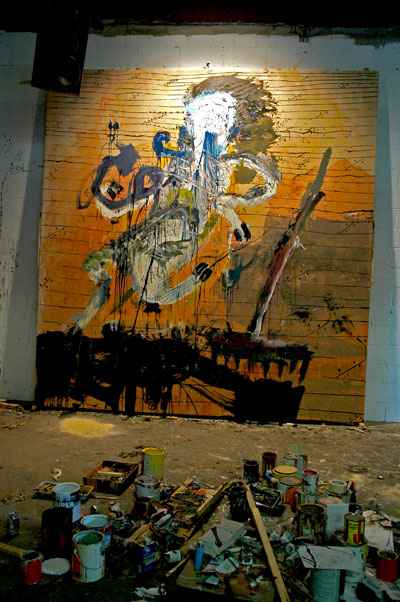
Barry and I were in Christopher Brooks’s studio last week. Unfortunately the images I’ve uploaded here can only begin to describe the work we saw. They start with a black enamel panel which is related to the two pieces we saw at Audiello one month ago and they finish with a very recent work, a shiny panel which is (almost) completely white – at least for now, since the artist is probably not finished with it yet.
You will get an indication from these pictures that we saw a large range of work, stretching even in these shots from extraordinarily minimal painted panels to some whose compositions were almost shockingly busy (for Brooks) with both applied and painted figures and shapes, as well as his characteristic broken or layered surfaces. I think everything we saw had that subtle element of collage that I’ve associated with Brooks’s paintings all along. Some of the pieces we saw had been completed years ago, but a seductive line running through all of the work showed it was all clearly the creation of an independent artist who knows what he wants to do and does it very well.
The images on Brooks’s own site represent a creative period of twelve years and they are very good. Because of that I first hesitated to put up any of the shots I came home with from our visit, but even a professional jpeg isn’t always enough to describe a painting or a sculpture. I think that sometimes an informal installation or studio shot can add a lot to reproducing the image of a painting or sculpture, although there’s no substitute for being able to stand in front of it. There’s also the additional dimension which any kind of editing can bring to the work, and if the photographer is excited about the art images captured more or less impulsively may sometimes do it better service than formal, abstracted shots which present it only straight on, an approach we don’t even use when we’re able to actually be there.
I’ve also noticed that the straight images on both Brooks’s site and my own can represent almost nothing of the excitement of the three-dimensional quality of the surfaces of these particular paintings, and because of the deliberate, rich reflective qualities many of them exhibit, they may just look wrong given conventional studio treatment. In the end I suppose I just wanted an excuse to show more of them, and my computer skills are too modest to work with the images on his Flash site. I was excited, and I hope some visitors to this blog will be as well.

Andrew Piedilato in his Bushwick studio

Andrew_Piedilato_studio_horse.jpg
Andrew_Piedilato_studio_horse_detail.jpg
[detail]

Andrew_Piedilato_studio_chimney.jpg

It was a great studio visit. Along with the pleasure of some fine work, there was the pleasure of conversation with an animated artist (actually two or three) and some other good people (some familiar, some not), even if the ambient lighting turned out to be a problem for decent pictures.
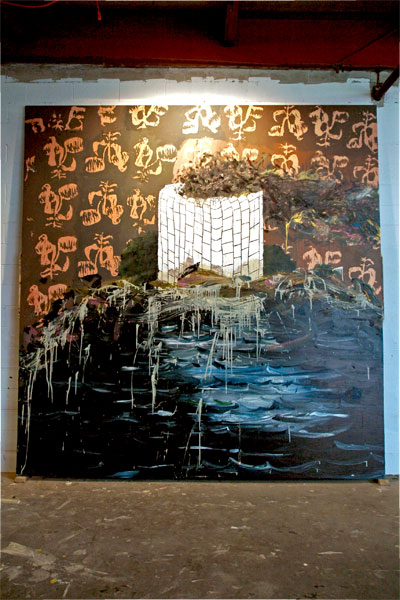
These are the views with which I left Bushwick. They show two of the very large canvases Barry and I saw in situ at Piedilato’s shared studio during a visit to this former ground-floor factory space. I believe these two were both completed works, but in my enthusiasm with their impact I neglected to ask. We met the artist for the first time that afternoon. His own site has much better images of more work from this series, and earlier ones. They shouldn’t be missed; If you take a look you’ll understand why I’m so excited.
I liked Piedilato’s painting the moment I first saw one seventeen months ago. It’s a little strange, but until going back today to my earlier post I hadn’t remembered that work as being particularly large, even though I had actually included its generous dimensions in my text. So I was pretty surprised to see the latest pieces. They were all pretty “awesome”, but not just because of their monumental size. Piedilato continues to combine exuberance and discipline in his new work, now being registered on an even larger scale: Everything we saw the afternoon we were there was roughly twelve feet square.
I love the strength and repetition of the various kinds of blocks, boards, and wallpaper ‘prints’, and then Piedilato always introduces some mad explosion or delightfully messy thing to take it much further than you’d imagine it could go. Not every exhibition space can handle 12-foot canvases, but with work of this quality, I can’t believe this guy doesn’t have serious gallery representation right now.