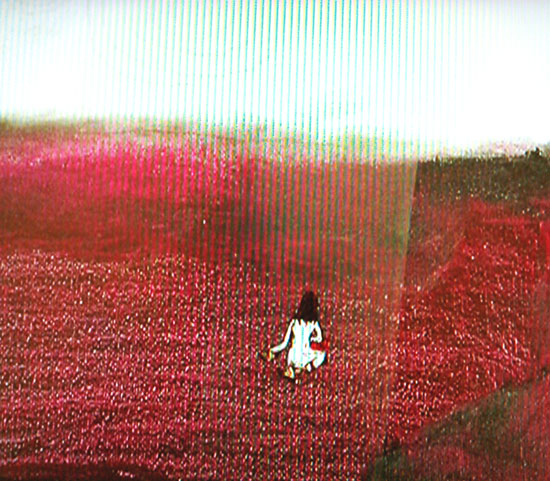
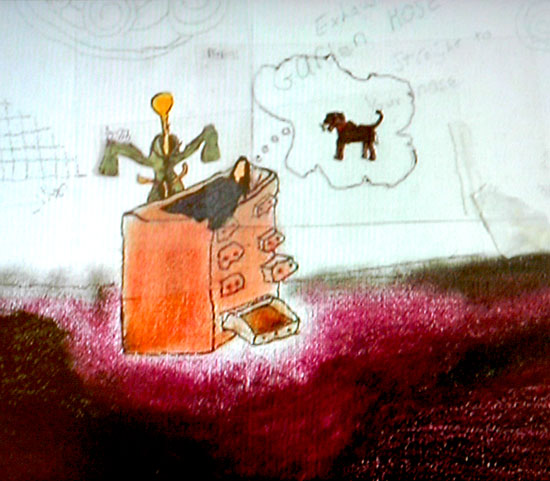
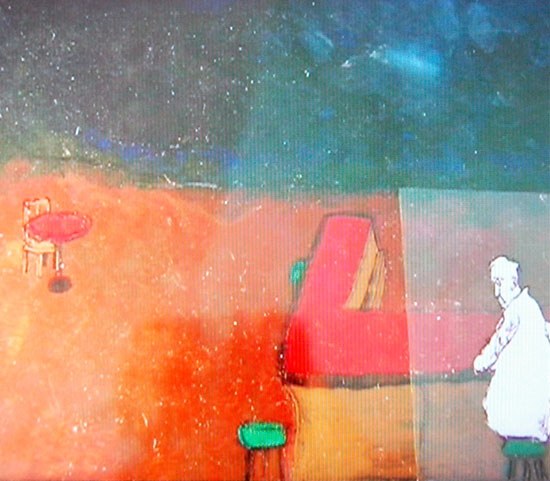
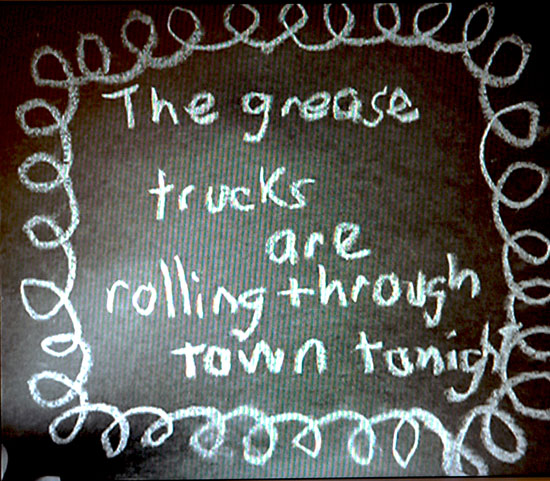
four large-detail stills from “Susan’s Red Ears” (2002), Brent Green’s 6-minute, 16mm transfer to DVD
SUNDAY has a must-see group show, “Tenderly“, which includes work by twelve artists: Erik Bluhm, Martha Colburn, Carl D’Alvia, Edward del Rosario, Echo Eggebrecht, Joel Gibb, Brent Green, Kirk Hayes, Asuka Ohsawa, Ruby Osorio, Hills Snyder and Rachell Sumpter (and almost as many mediums).
The exhibition press release talks about their use of humor, childlike forms and other devices “to soften some of life’s more dramatic, and often tragic, moments”. It worked for me: A perfect mix for a hot summer day perched in the midst of particularly perilous times.
They’re all worth seeing, and I want to go back, but I was totally taken with the video by Brent Green, a young artist not entirely unknown in avant film circles, but whose work I don’t think I’ve come across before. Every frame of this little hand-assembled video is a painting by itself, so it was no problem capturing a few to show here.
Six of his films, including “Susan’s Red Ears”, are available on YouTube, through links shown on the artist’s site.
Green’s doing a live show at the Hammer Museum in Los Angeles next month, screening all of his films with live narrations and improvised soundtracks by himself and four other artists on July 22. It sounds just too good to pass up, if you’re anywhere in the area.
Author: jameswagner
after Jackson – or maybe Pablo
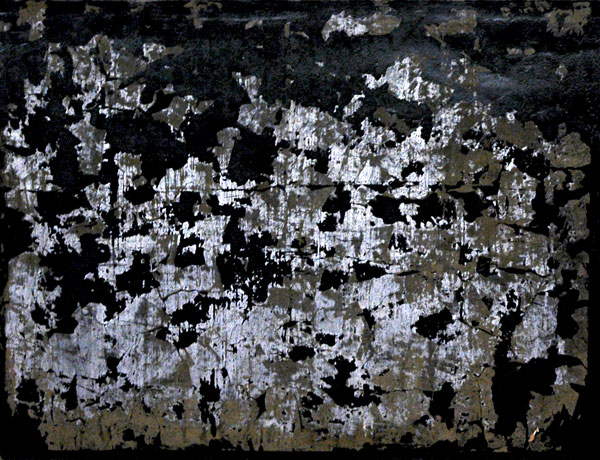
untitled (subway frame) 2008
2008 Affordable Art Fair (“art to go”)
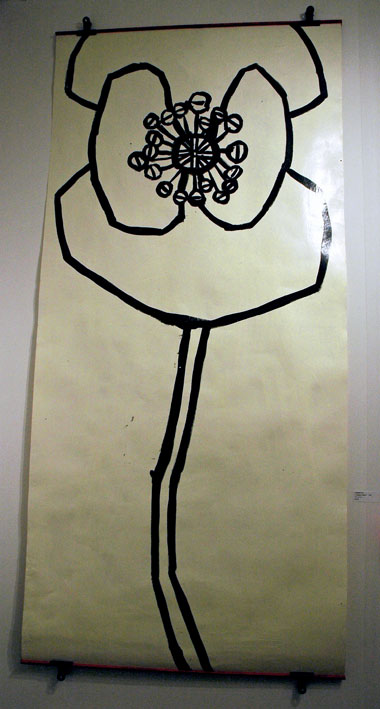
Chihiro Ito‘s 2006 poppy drawing at Shion Art (New York, Nagoya)
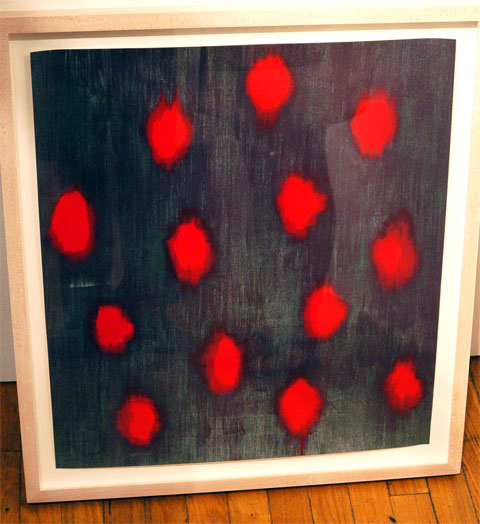
2007 Ross Bleckner print at Hal Katzen (New York)
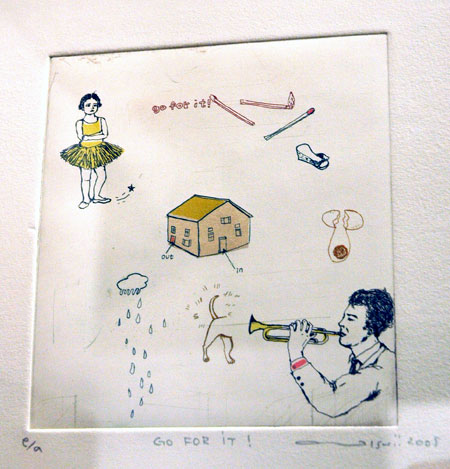
small Atsuko Ishii etching from 2008 at Envie d’Art (Paris)
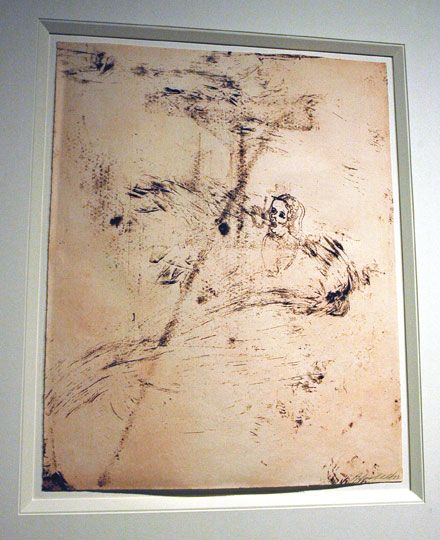
1983 Julian Schnabel etching at Peter Gant Fine Art (Carlton, Australia)
I went to the 2008 Affordable Art Fair [AAF] preview last night thinking, on the basis of previous incarnations, that the slim hour I had allotted for a visit might be enough. It wasn’t, by a long shot. I was very pleasantly surprised that even after overstaying into a good part of another hour I had probably only seen about a third of the exhibitors, and I promise I was hardly schmoozing at all.
There’s some very good stuff to be seen on West 18th Street this weekend, and some of it really is affordable. I think I’m using the adjective judiciously, because with prices which start at $100 or $150 much of this art will find a home with folks who may have only very modest incomes.
I’m not being patronizing about the quality of some of what is available; there are works I wouldn’t be surprised to see in fairs with much higher visibility – and pretensions.
With that reference I should say that on my way down the aisles and past the bar areas I had to slip through dense throngs of well-dressed and well-lubricated bargain-hunters last night, many of whom were doing more than just schmoozing themselves: The rich love a good bargain as much as the rest of us; they’ll compete even with impecunious collectors so long as the packaging looks good, and the organizers have done a very good job with this package.
Prices seemed to be pretty visible, either on the labels or lists set out. The works shown at the top of this post ranged from $150 to $6000. The Fair says the works start at $100 and go to $10,000 (well, “affordable” is always what you think is affordable).
As usual there were still a huge number of gallery names (they came from all over the world) I didn’t recognize. The organizers and the galleries have done a great job this year, but if only to emphasize the idea that money is not the standard by which good art should be judged, it might be nice to see the AAF attract galleries from all levels of “respectability”. Last night I saw some gallery owners walking about who weren’t exhibiting at the fair. They may have just been socializing, or they may have been there for r&d, a professional investment analogous to that of galleries haunting art school studios and graduate shows. But I’m thinking that surely even a blue chip space can find work from its existing shelves or files which it could position for entry-level art patrons. Or perhaps even better, how about “big-deal galleries” exhibiting work at AAF by artists they’re currently only considering representing? Of course it would mean they’d actually have to go out and look at some new art.
AAF continues through this Sunday at 135 West 18th Street.
lazy Bushwick street, Sunday afternoon
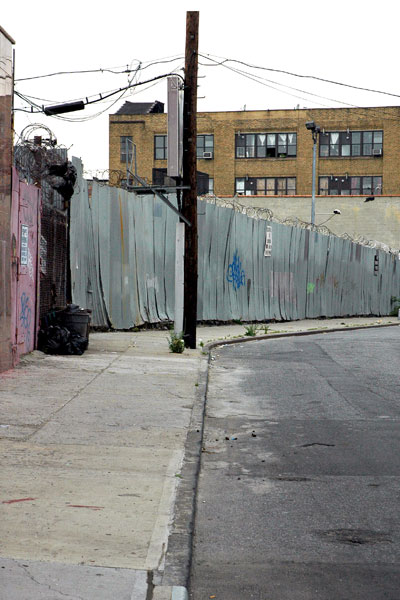
untitled (corrugated) 2008
for her grace on this day: hip, hip, hooray!
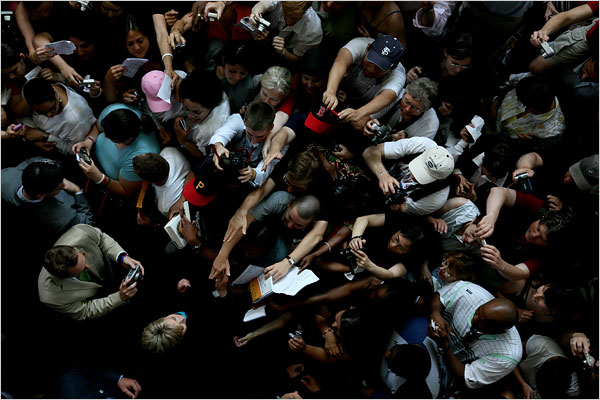
Clinton being greeted by supporters invited from across the country to attend her speech today
From the NYTimes on-line report on Hillary Rodham Clinton speaking this afternoon in Washington, only blocks from the White House:
“You can be so proud that, from now on, it will be unremarkable for a woman to win primary state victories, unremarkable to have a woman in a close race to be our nominee, unremarkable to think that a woman can be the president of the United States,” she said. “To those who are disappointed that we couldn’t go all of the way, especially the young people who put so much into this campaign, it would break my heart if, in falling short of my goal, I in any way discouraged any of you from pursuing yours.”
At that point the cheers, mostly from women, swelled so loud that Mrs. Clinton’s remaining words could not be heard.
[image by Todd Heisler for the NYTimes]
real terrorists don’t photograph anything
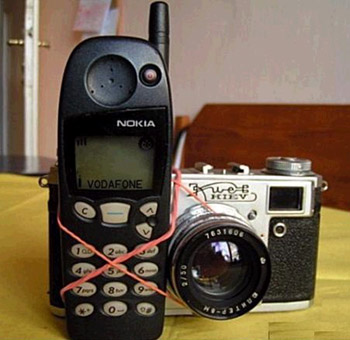
really scary
Why is everybody so afraid of my camera and your camera, even though they all own at least one themselves, and sometimes these same people are the ones spending fortunes installing security cameras to watch us?
I saw this Guardian piece in a Bloggy “linkage” post which appeared yesterday. The paper had published it the day before that. It’s too good, and far too important not to share. And don’t miss some of the links in the second paragraph.
It’s written by Bruce Schneier, an internationally-known security expert and currently British Telecom’s chief security technology officer.
Here’s a tiny excerpt:
Given that real terrorists, and even wannabe terrorists, don’t seem to photograph anything, why is it such pervasive conventional wisdom that terrorists photograph their targets? Why are our fears so great that we have no choice but to be suspicious of any photographer?
Because it’s a movie-plot threat.
[delightful image created by bloganything]
Hillary’s still thinking it over
Will someone please explain to me why it’s going to take the better part of a week for someone to respond to their own colleague’s selection as the candidate to oppose so monstrous an alternative as the man who represents the people who control the party which has virtually destroyed our polity?
saving Union Square for all the people
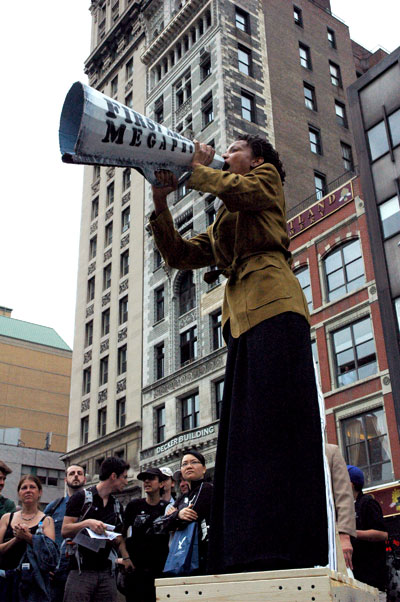
Lucy Parsons on a soapbox, defending the people’s park
WHY WE CARE
Union Square absolutely must remain a place for public assembly and its park pavilion must remain open to everyone, as it always has been. Both must continue to serve the whole community, and for the pavilion that service must include its traditional and essential function as a podium for public speakers at gatherings which are not permitted anywhere else in this city.
The city came to Union Square instinctively immediately after September 11, 2001. We were there many times before and we’ve returned repeatedly since. There we shared and broadcast our feelings about war, threats to the Constitution and any number of other issues. But none were so important as the fundamental freedoms of assembly and movement and speech. The park was always there for us. Now it needs us. Today the site of so many rallies, visible and vocal expressions of unpopular popular opinion is barricaded behind a chain-link fence. If civic authorities and real estate interests have their way, we’ll never get it back.
Central Park is already gone; it’s been privatized and sanitized. No more rallies there: We’ve been told the lawn is just too precious for regular people. Bryant Park is a club. Union Square is all we have left.
Yesterday some of its defenders rallied inside the park, eventually taking their protest across the street onto the sidewalk in front of the large windows of the luxury W Hotel’s street-level lounge. There civic and business planners were meeting to discuss the future of the park. They envision that future as one which includes the privatization of this classic people’s “temple” (first constructed in the nineteenth century, rebuilt 75 years ago, and always intended as a public amenity), as well as additional appropriations of or incursions into the area below its steps which has served as a great open public forum for 150 years.
The rostrum of the park pavilion is in fact no longer available, since it’s in the midst of the construction project already begun. Instead, General Washington, who had gathered his troops here in 1776, and who addressed the crowd first yesterday, stood on one of the half dozen sturdy soapboxes furnished by a crew of imaginative and industrious volunteers. The beautiful and indefatigable Lucy Parsons took it from there. Upon completing her own remarks she handed the baton to Emma Goldman, who was followed by Paul Robeson. Robeson ended his words raising his voice in song, before he turned to a very eloquent Norman Thomas. Dorothy Day completed the list of scheduled guest speakers. They were all pretty hot.
After a musical and tumbling interlude and some words from Rev Billy, a community leader from the 21st-century figure appeared. Rosie Mendez asked for and was given the rally’s improvised podium and an electric bullhorn to read a statement to the crowd (our standards for public speaking have slipped). Mendez is the district’s local Councilperson and just about the only local elected official who actually supports the current plans for the park. I had first thought that she had come to announce her conversion to the side of those opposing privatization, but her statement very quickly told us otherwise.
The commercial media doesn’t seem to be interested in covering this rally, so I feel I have to at least mention that there were hundreds of people of all ages and sorts, some super graphics and props, young patriots wearing three-cornered hats, the Rude Mechanical Orchestra, a staged linked-arms-around-the-Park moment, and some really sweet anarchists with a great black sign.
Curiously, in so far as I could see, the police absolutely did not interfere at any time during the course of the rally.
I accumulated a stash of pictures from yesterday’s very colorful rally. It began at 5pm with speeches from many of the heroes who once stood on this hallowed ground and the energy continued until just about 6:30.
UPDATE: I’ve added a Flickr set here with more photos of the rally.
“Dance for Music” at Judson for Movement Research Festival
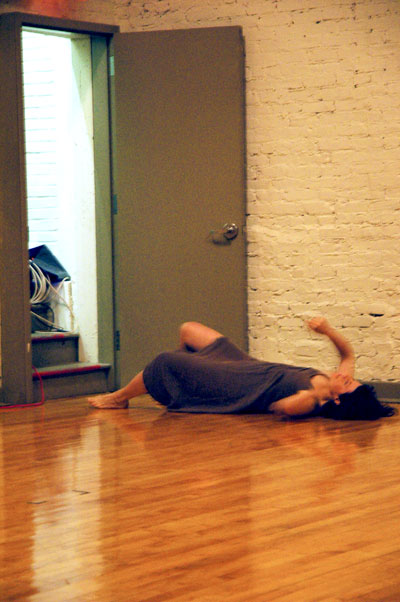
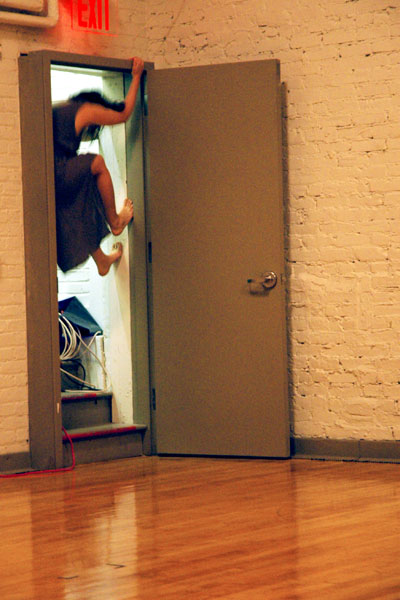
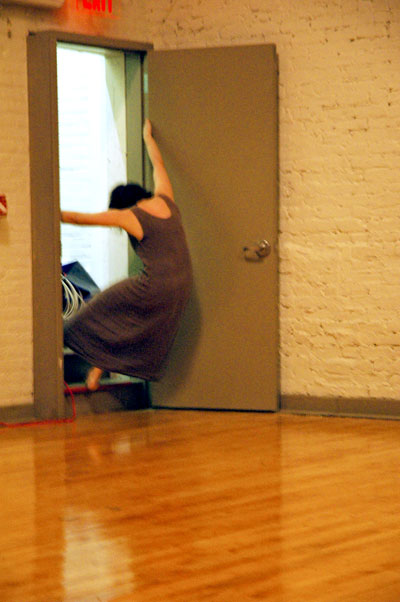
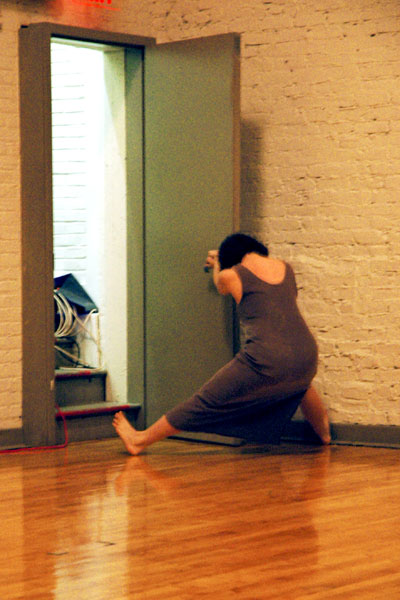
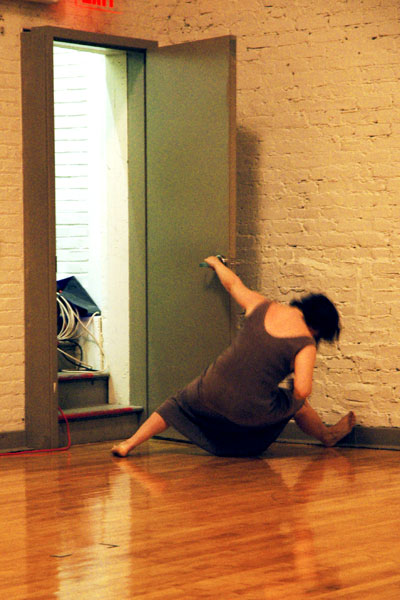
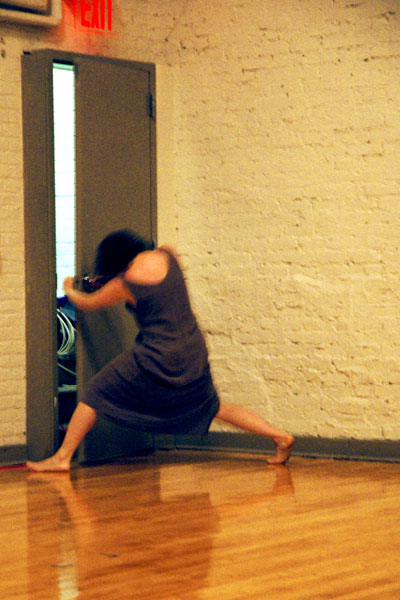
more than a door, and more than a sigh
We were seated (most of us) in a sometime basketball court in the basement of Judson Church. It was this past Tuesday, and it was another event of this spring’s Movement Research Festival. This is what used to be called “experimental” performance. Once again there were no props and virtually no theater lights had been installed. There were no elaborate sound systems; instead, each of the three sets of composer/musicians brought whatever they might need. What we did have were some very-much-alive musical writers/performers and their very lively music, created for choreographers and dancers chosen by the artists responsible for the music. The conceit of the program itself was to be an experiment too, since it was a reversal of the conventional order in which the music is chosen by those who create the movement.
My favorite part of the evening was that which Nate Wooley and Newton Armstrong commissioned for the dancer Jennifer Mesch.
All the seats faced toward two unadorned white brick walls, and at their intersection on the far side of the gymnasium there was an unremarkable plain metal door. We had barely settled down after a short break and only some of us were looking in that direction when the door suddenly burst open with a loud and extended BLAAAAACK! – a fierce explosion of electrifying and other-worldly, animal-like “noise” At precisely that same moment Mesch was thrown/threw herself out of the opening onto the wooden floor.
The excitement almost never slackened during the five or ten minutes which followed, although it was quickly joined with our laughter. The terrific and terrifically-overwrought dancer was having a ferocious battle with that raucous door. It was never clear who was winning, or whether either might have come out on top, even after Mesch had returned through the opening for the last time and the door closed for good.
Only after the piece had ended and all three performers had emerged could we see that the wonderful monstrous sounds had been created by Wooley’s trumpet and Armstrong’s electronics, stationed on the stairs inside the landing. When it was all over I told Barry in my innocence that the work made me think of Pierre Henry‘s “Variations pour une porte et un soupir” [Variations for a Door and a Sigh]. At home last night we decided that in fact it was almost certainly intended as (less-than-concr�te and solo) homage to Henry and Balanchine on the part of these three young artists. I’m playing our copy of the CD as I’m writing this today.
Union Square NOT FOR SALE
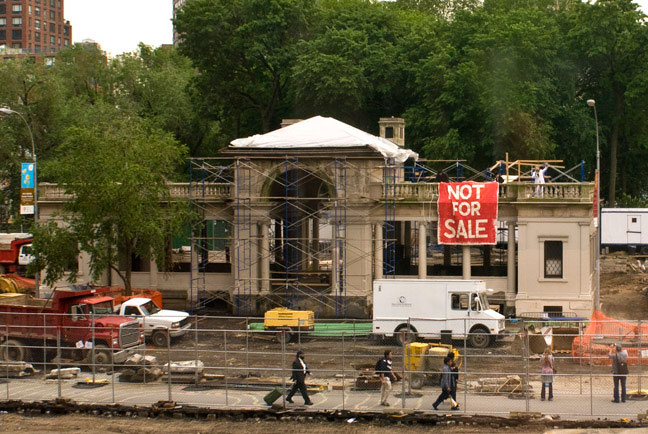
Ceci n’est pas un restaurant privé
It looks like some proud park owners were pretty busy yesterday.
For the background story, see my previous post and still more on the Reverend Billy site. The next act begins at Union Square this afternoon at 5.
Note that the white figure waving from behind the balustrade is the Rev himself.
[John Quilty‘s image furnished by park gremlins]