privatizing and sanitizing Union Square Park – again

Emma_Goldman_Union_Square.jpg
come back tomorrow and there’ll be a lovely restaurant here instead
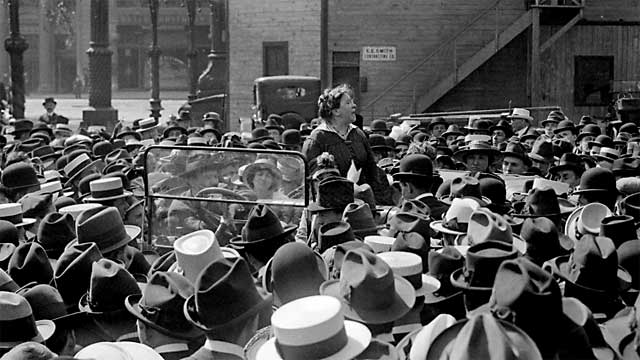
(Emma Goldman speaks to garment workers about birth control in Union Square, 1916)

Some folks have the strange idea that Union Square Park, historically (and continuingly) the site of social and political activism in New York, should remain the park of the people. Others have been trying for years to reduce or eliminate the “troublesome” more open public plaza areas to the north, west and south of the greener areas of the park. These same people also think some of its public space should be handed over to private business. These operatives include tin-pot mayors, tin-whistle police, certain tin-eared planners and a number of tin-horned businesses.
It’s about Free Speech, as much as or more than anything else.
In the past it was basically only about controlling the rabble; the latest campaign to destroy the park appeals to “gentility” and comes supplied with the irresistible attraction of money as well.
New York’s public parks have become Business Improvement Districts [BIDS], or at least that’s true of those located wherever there’s real money; the others are just left neglected and dangerous, since they are viewed by both public and private authorities as “unprofitable”,
The City and the Union Square Partnership Business Improvement District plans a costly renovation plan for the north end of Union Square Park. The plan, currently being held up because of a lawsuit filed by the Union Square Community Coalition would take away thousands of square feet of potential playground, community and free assembly space to accommodate an exclusive year-round restaurant.
This amenity would be located only steps away from dozens of eateries of every description already serving the neighborhood. Union Square represents nothing like the isolation of much of Central Park – as if the hugely-embarrassing model of the ridiculous Tavern on the Green weren’t disgusting enough to put a stop to this proposal long ago.
The mayor supports the BID plan, but the opposition doesn’t come from Leftist heirs of the Emma Goldman, Paul Robeson and their like, the people who helped make the park what it stands for today. Opponents to the privatization plan include the familiar New York names of Carolyn Maloney, Tom Duane, Dick Gottfried, Jack Taylor, Sylvia Friedman, Deborah Glick, Carol Greitzer, Eadie Shanker and Scott Stringer. This is establishment.
So why is it still a live issue? Because there’s so much money pushing it. The courts may still allow the alterations which the community opposes to proceed, but a greater visibility (I mean direct action and attendant media attention) will surely effect the resolution of the case.
There’s a demonstration tomorrow, Thursday, at 5pm near the northwest corner of the park (17th Street and Broadway).
I expect it to be pretty colorful, and tuneful: The announcement I’m looking at asks us to:

Join George Washington, Dorothy Day, Emma Goldman, Paul Robeson, and Lucy Parsons. Join The Stop Shopping Gospel Choir and The Rude Mechanical Orchestra. Join Reverend Billy. Join your fellow citizens for a 90 minute festival of freedom at Union Square Park!

Save Union Square 2008 promises to be at this same location every Wednesday at 5, performing, recruiting support, and urging passersby to sign an online petition and to contact local Councilperson Rosie Mendez.

[image from historycooperative]
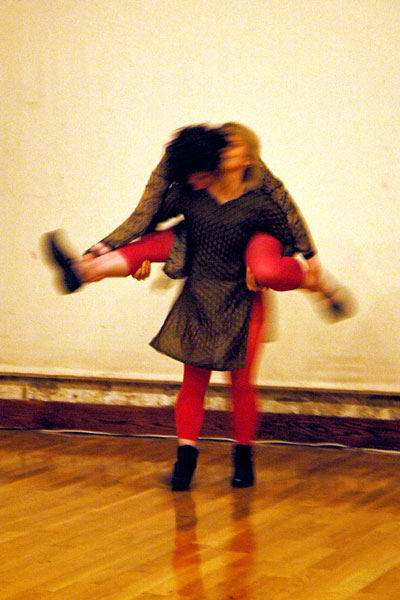
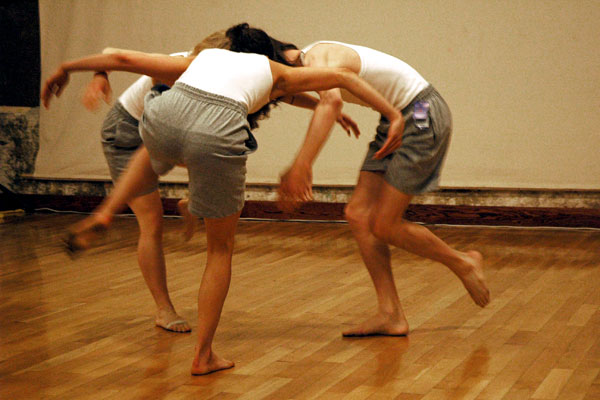
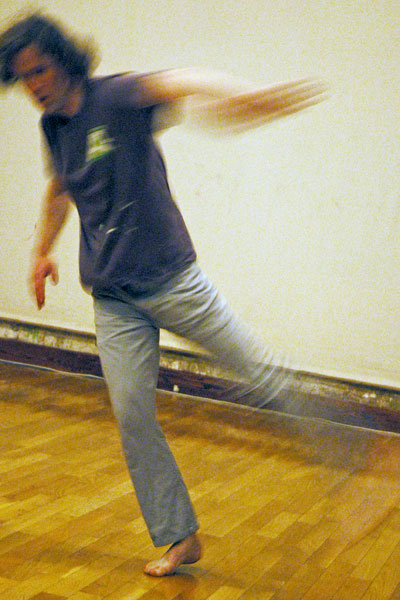
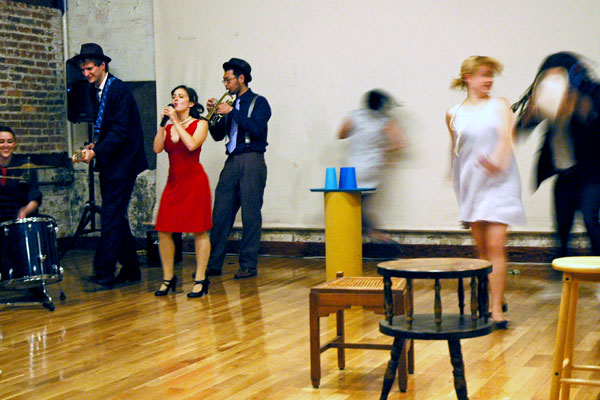
Catch 30 in the Movement Research Festival

Christine_Elmo_youth.jpg
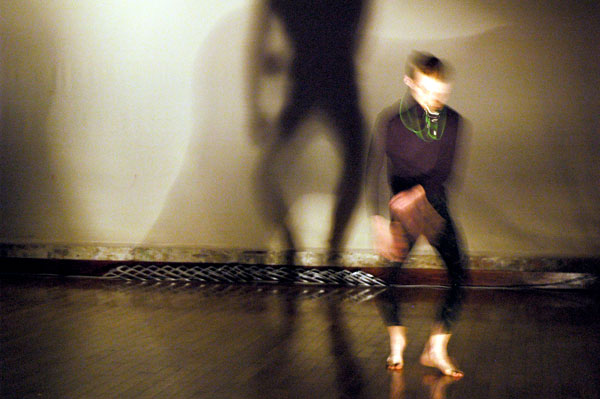
Christine Elmo [the totally amazing Peter Hanson dancing here]

Shogren_%26_McLaughlin_Rain_Thunder.jpg
Anna Marie Shogren & Katie Rose McLaughlin

Pinheaded_Justin_Jones.jpg
Justin Jones [Anna Marie Shogren, Sarah Baumert and Justin Jones dancing]

Justin_Jones_love_things.jpg
Chris Schlichting

Slap_Trap_Scott_Riehs_2.jpg
Scott Riehs [only part of the company of eleven]

These are images of five more short performances included in the Catch 30 night of the Movement Research Festival I wrote about in my previous post. The lighting was a challenge, and I didn’t leave my seat, so my images are both compromised and few.
I think all of the ten pieces we saw were either excerpts, works in progress, or just tantalizing glimpses of more ambitious works. I wish we could be given strings attached to [most of] these artists, to be sure we’d be alerted to what comes next.
Sorting out the printed program was something of a challenge; this is the alphabetical list of the names of the choreographers alone, taken from the CATCH site:

Christine Elmo
JERK
HIJACK
Justin Jones
Myles Kane
Elliot Durko Lynch
Scott Riehs
Chris Schlichting
shitheads on dynamite/living lab
Anna Marie Shogren & Katie Rose McLaughlin

For a real reviewer, see the intrepid Claudia La Rocco, whose NYTimes piece I read just after finishing this post. La Rocco’s also a blogger now.

Elliott Durko Lynch with Catch 30 at Starr Space

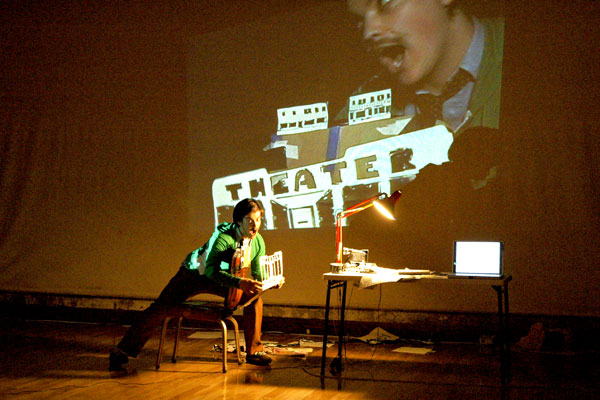
Elliott_Durko_Lynch_theater.jpg
“Everything’s for sale!”

Barry and I were at Starr Space [their own site is down] on Friday night for Catch 30, part of the Movement Research Festival which continues through June 8 throughout the city.
Including the one straight video there were ten separate performances in all (if I’m counting correctly), by dancers and choreographers based in Brooklyn and Minneapolis. The evening was curated by Jeff Larson and Andrew Dinwiddie. It was all very fresh, and there was a huge variety of work. While I enjoyed each of them, I only broke my silence in the midst of one, “Bryant Lake Bowl Intermission #3”, by Elliott Durko Lynch with the special assistance of Kristin Van Loon. Half way through it I whispered to Barry, “he’s a genius!”.
Lynch’s piece is apparently only a snippet from an evening-length performance in progress, so we might find more structure and fewer loose ends if we are privileged to see the completed work, but I really hope that won’t be the case and I really doubt that it will.
In the space of ten minutes, maybe less, Lynch managed to deconstruct the idea, the reality, the nonsense and the value of the twenty-first century American city and the rich life it has repelled and attracted. Most of all what it’s about what it is now becoming. Beginning with an odd “presentation” while seated at a desk/table with projector, he raced through an extreme condensation of an impressive personal repertoire which on that night included tutoring or coaching, rapid-fire drawing and sculpting, a magic-lantern show presentation, photography and film projection, declamation, singing, stage directing, choreographing, dancing and, . . . snacking. He succeeded in weaving a story as sincere as it was mad, but this artist’s satire is totally authentic. The title of the full work will be “The New York Historic Artists Lofts and Residences + Hotel!”.
Shortly after the lights came back on for good we spoke to Lynch. I said that I thought he was a genius, and I told him how much we both had enjoyed the piece. He thanked me shyly and asked, “What is it you liked about it?”. A good answer would have been as difficult as unraveling the performance itself. Maybe it’s best that I didn’t get a chance to explain, since I doubt that I could have. I just know that I was attracted to the energy, the weirdness, and the odd beauty of the images and the movement, and I wanted to keep going with it, even if I never succeeded in sorting it out any better- especially if I never did.
Barry really got it: See Bloggy and especially Barry’s blog on the Movement Research site.

ADDENDA:
more photos after the jump

Continue reading “Elliott Durko Lynch with Catch 30 at Starr Space”

ACT UP oral history marathon

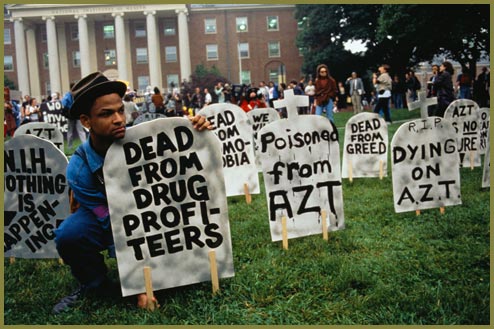
ACT_UP_NIH.jpg
we were never alone*

CORRECTION: I’ve corrected the text for screening location

ACT UP veteran Deb Levine is viewing the entire ACT UP Oral History Project videos from start to finish in a performance project she calls “ENDURING ACT UP”. She is inviting us to join her.
Levine has been working on her PhD. in Performance Studies at NYU and is writing about ACT UP for her dissertation. She says she’s focusing on one aspect in particular:

. . . how collectively people took care of each other during meetings, demonstrations, in committees and affinity groups, and especially as members became ill. I am most interested in the ways in which those relationships became an ethical and political practice – a topic that is not often foregrounded in other histories of the organization.

While she has been watching the interviews recorded by the Oral History Project, which was undertaken by Sarah Schulman and Jim Hubbard, and I assume she’s been through them all, she says that what she is missing is the opportunity to turn around and discuss what appears on the screen with others who witnessed and were a part of the phenomenon of this remarkable band of AIDS activists in the 80’s and 90’s.
The screenings began this morning at 10 at 721 Broadway on the 6th floor, room 613. They will continue through June 15. For a complete schedule and more information, go to the project’s web site.

*
the image is from the ACT UP protest at the National Institutes of Health [NIH] in May, 1990, when we “stormed the NIH” to protest the slow pace of research; things picked up a bit later (the troublemaker seen in the foreground is Brian Keith Jackson)

[Donna Binder image from NIH library – yes, the NIH!, and the site has much more about medical activism]

Anthony Pontius at 31 Grand

Anthony_Pontius_End_In_Flight_2.jpg
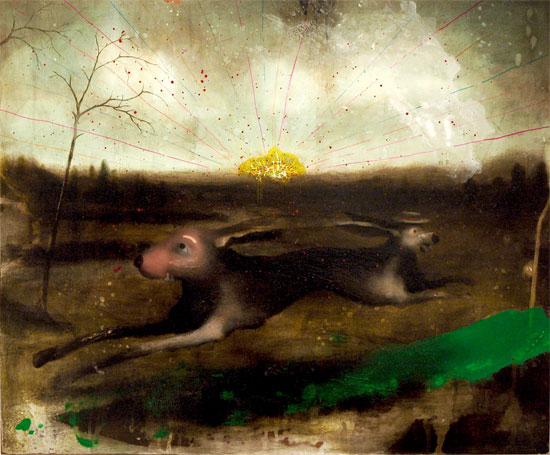
Anthony Pontius there is an end in flight 2008 oil and ink on panel 32″ x 36″

Anthony_Pontius_Ill-Fated_March.jpg
Anthony Pontius the ill-fated march of a plouged jogger 2007 oil and ink on panel 30″ x 36″

It was gorgeous, and now its gone, but 31 Grand’s recent how of work by Anthony Pontius, “Why on Earth?” isn’t forgotten, at least here.
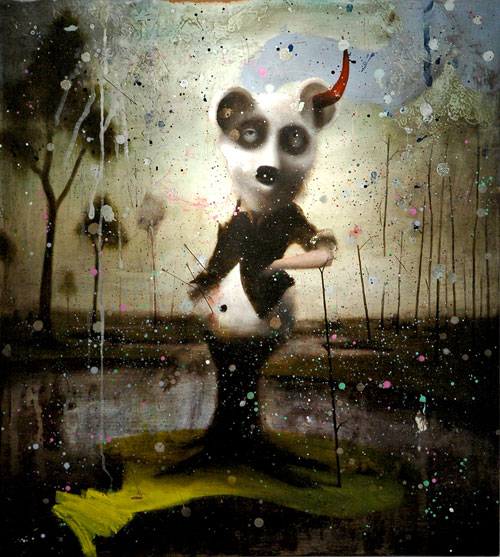
The press release tells us that Pontius examines “the importance of the human connection to history and nature.

By recontextualizing historical imagery, stories and concepts in the world of now , he presents a new narrative that is familiar yet the full meaning is not immediately accessible. Employing a mix of past and present techniques, he forms these new arrangements; using classical clarity to define a specific part of a story and at the same time abstraction to complete or destroy the formation of the work. The finished painting is a proclamation of something new and not easily defined, realizing that history and memory are not clear or concise, but the consequences of interpretation.

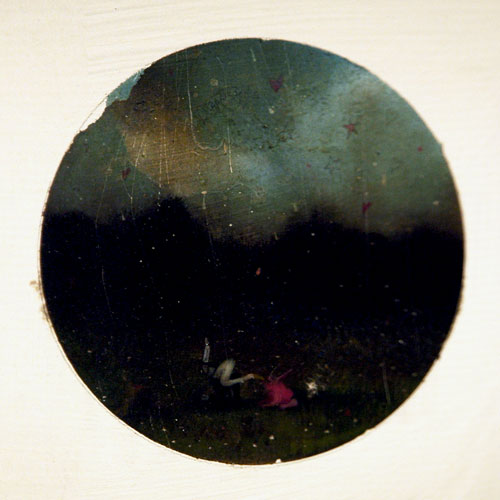
I’ve loaded this post with a few images taken in the gallery, but I have to explain both the presence and the appearance of the one just below.

Anthony_Pontius_April_Fool.jpg
Anthony Pontius the april fool 2006 oil on paper 4″ diameter [large detail of framed paper]

I don’t think this tiny “the april fool” was a part of the show proper, but I fell in love with it immediately. It was hanging near the desk, and its dark colors and shapes were framed behind a piece of glass. A photograph seemed almost impossible, but I gave it a try and snapped the piece from an acute angle, thinking the most I could do with the image would be to remind myself of its charm once I returned home.
This afternoon I decided to play around with it on Photoshop (where my skills are actually pretty abysmal). I managed to bring some life back into the very dark image and I even returned it to its neat circular shape. Now that I’m pointing it out you’ll see some blurring on the right edge of the drawing. It’s caused by either a narrow depth of field or, more likely, the stress of my converting its shape from the oval the camera left me. In any event, I think that what you can see is a fairly good representation of the beauty which caught my eye that day.

Related: “No New Tale to Tell ” at new 31 Grand [scroll down]

Katherine Bernhardt at CANADA

Catherine_Bernhardt_Silver_Gold.jpg
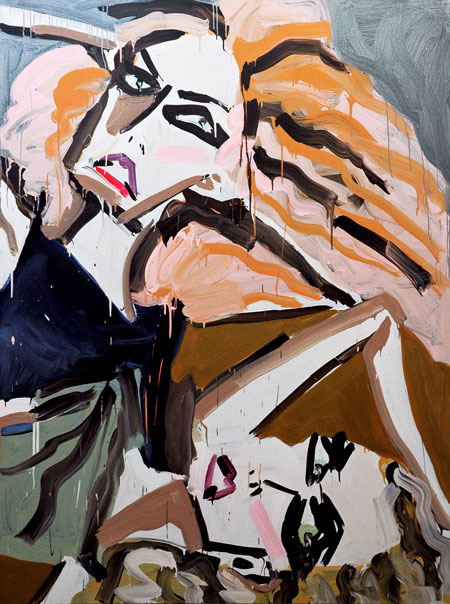
Katherine Bernhardt Silver on Gold 2008 acrylic on canvas 96″ x 72″

Katherine Bernhardt’s loose-limbed and painted-face of a show at CANADA, with the can’t-miss-it title, “Kate, Gisele, Agyness, Natalia, Kanye, George & Simon” (George and Simon? I think I missed them) is only up for three more days. The gallery says she’s been

. . . hosting a month-long sleepover party at CANADA with her favorite people and we are all invited. Fashion models, rappers and pop legends populate Bernhardt’s paintings in dizzying displays of weightlessness and celebrity, all painted in a colorfully loose style on huge canvasses.

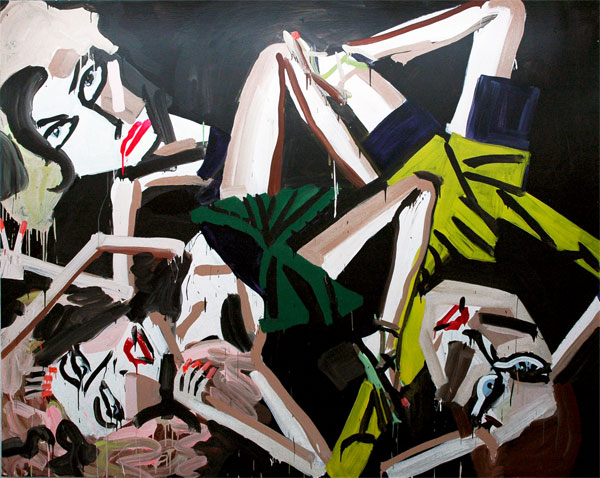
These paintings are expressionist sketches, only they’re done with hardware store brushes and (unblended?) paint. They’re also terrific abstractions.
I may not be the best or intended audience, because I’m absolutely terrible with celebrity rags and a lot of pop culture, but I thought Bernhardt’s stuff was great.
Go visit. It’s CANADA, so you probably know you want to.

Catherine_Bernhardt_Triangles_and_Stars_2.jpg
Katherine Bernhardt Triangles and Stars and Legs and Peace 2008 acrylic on canvas 96″ x 102″

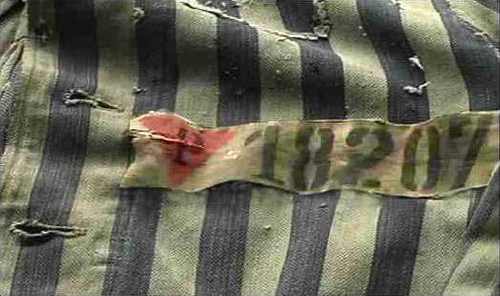
memorial to Nazi homo victims: “but no survivors”

pinktriangle.jpg
only part of the story

Berlin’s memorial to the thousands of homosexuals who were variously persecuted, tortured or murdered by the Nazi regime was dedicated yesterday. The official name of this German parliament commission, Denkmal für die im Nationalsozialismus verfolgten Homosexuellen [National Memorial for the Homosexual Victims of the Nazi Regime], may be formidable, but the structure itself is incredibly simple and ineffably moving in its sylvan setting within the Tiergarten, Berlin’s central park.
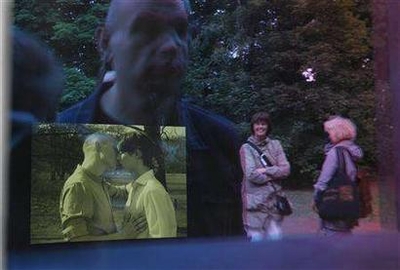
Positioned close to the iconic Reichstag Building, not far from the buried ruins of Adolf Hitler’s concrete bunker and across the street from the German capital’s very different but equally-astonishing Holocaust Memorial, the new memorial was designed by Elmgreen & Dragset, Danish-born Michael Elmgreen and Norwegian-born Ingar Dragset. The artists, who are based in Berlin, used the block shape, gray color and slight tilt of the individual steles of Peter Eisenman’s masterpiece for part of its inspiration, but a small video screen embedded in a recess on one side of this somewhat larger slab will portray a one and a half minute film loop by director Thomas Vinterberg of either two men or two women kissing. In the background of the figures in the videos, which were created before construction began, can be seen the same trees which surround the memorial as built.
Near the end of a very short article in the NYTimes today: “On hand for the unveiling was Berlin’s openly gay mayor, Klaus Wowereit, but no survivors.” The short article goes on to explain that Pierre Seel, who was the last known survivor of the camps, died in 2005.
As a queer man who first heard about this project in the mid-nineties when it was being proposed, and having now seen images of the powerful monument that these two wonderful artists have created, I’m unable to think of this work as a memorial only to the German and European victims of 1933-1945. Many homos who were not murdered but were imprisoned by the Nazis remained incarcerated in the new Germany long after the war. Homosexuality remained illegal in the Bonn Republic until 1969 and was only formally decriminalized in 1994.
Of course queers have been persecuted everywhere on the planet for thousands of years, but especially during the last few decades some societies have managed to grow up. They now recognize and protect the rights of all their members, while nowhere in the Western world do queer men, women and children remain more abused today, both by law and society, than they do in the U.S.
Berlin’s newest monument can be a memorial to all homos hunted in the past. Let it also be a foil for those who would hunt us still.

Berlin_homo_victims_monument.jpg
the protective glass in front of the video screen reflects viewers and surroundings

Note, and more: As the ambient landscaping is still immature, I haven’t included an image here of the structure or “pavilion” in its environment. This link to the memorial’s own site [currently in German only, but with a pretty exhaustive list of links in many languages]; and there’s an AP video below, recorded on the grounds of the memorial during grounds cleanup, with a short statement from the artists:


[image at the top from andrejkoymasky; image of memorial’s screen by Johannes Eisele from Reuters via Yahoo!]

Sarah Chuldenko at Fake Estate

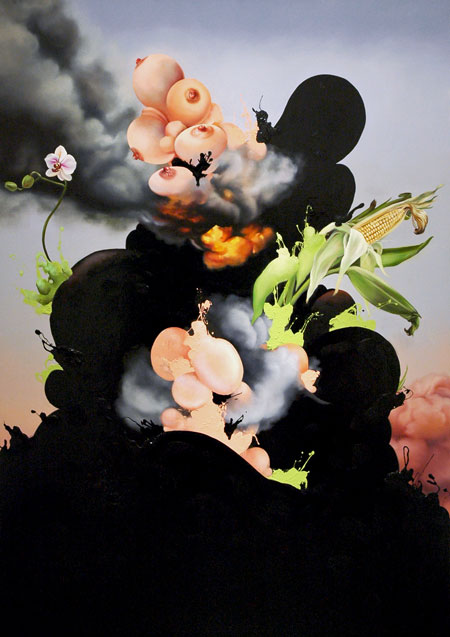
Sarah_Chuldenko_Love_and_Rockets.jpg
Sarah Chuldenko Love and Rockets 2008 oil an enamel 7′ x 5′

It was at Fake Estate, so it was physically one of the smallest shows in New York this spring, but the impact of the work Sarah Chuldenko showed in this broom-closet of a space was not minor in any sense. The show was called “Casualties of Beauty“, and although it closed on Saturday, I’m sure we’ll soon be seeing this artist again.
Some of her squishy images may verge on the off-putting, but I think it’s a good sign that the latest painting seems to be the most successful of all of them. Without losing her quirky organic vocabulary, Chuldenko has managed to open a very different conversation with “Love and Rockets”. The work is no less mysterious for the clues she may be providing us inside the disturbing beauty of the chaos she has created; the artist has only added more complexity to the language of the earlier pieces.
If not quite put off, we remain a little disturbed.

Christopher Brooks, and some other stuff

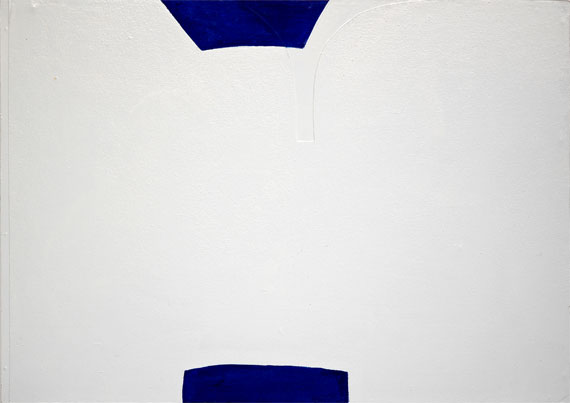
Christopher_Brooks_Untitled_1999_3.jpg
Christopher Brooks Untitled 1999 enamel on canvas and board 17″ x 24″ x 2″
Christopher_Brooks_Untitled_1999_detail_3.jpg
[detail]

Christopher_Brooks_How_To_Lose.jpg
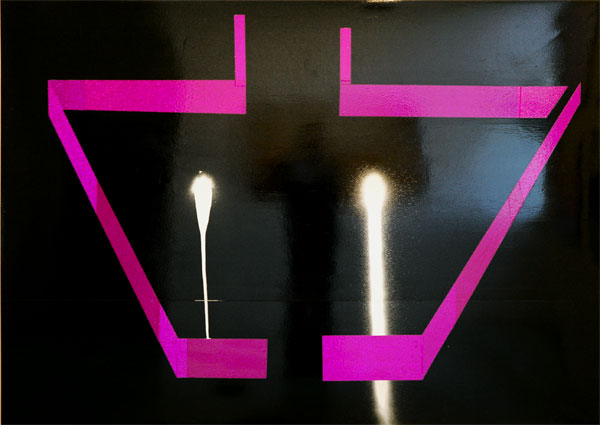
Christopher Brooks How to Lose 10 lb (easily) 2008 enamel and spray paint on masonite 5′ x 7′

Christopher_Brooks_The_Land_That_Time_Forgot.jpg
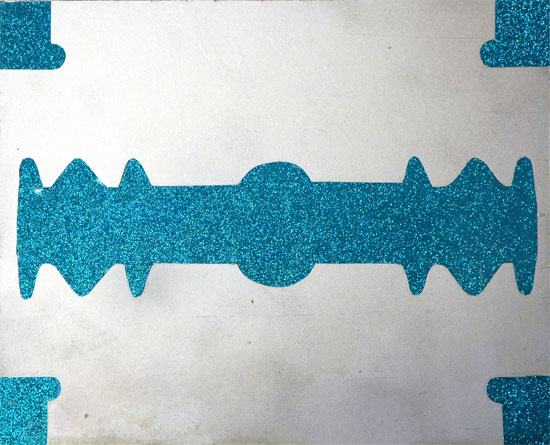
Christopher Brooks The Land That Time Forgot 2006 enamel and glitter paper on masonite 16.75″ x 20.75″

I can never get much information on the artist Christopher Brooks when I try looking on line. He did unfortunately pick a name which makes a web search very difficult, but still I’d expect to find him surfacing more often than he does by now. I did manage to find this, but only by looking through my paper file on the artist.
Brooks first came to my attention in a group show in Brooklyn curated by Lithgow Osborne in 1997. The artist and gallery owner Rupert Goldsworthy presented solo exhibitions of the artist’s work in his eponymous Chelsea space in 1998, again early in 1999 and then finally in 2000. In the first of those three shows, reviewed here by Elizabeth Kley, half of the gallery space was devoted to some large, very handsome but rather odd C-prints of the artist fully obscured and personally abstracted inside an inflated black rubber fetish suit.
I still have the notes from the 1998 show’s press release, and this small excerpt tells us something about Brooks’s work as he conceived of it at least up to the late 90’s:

Christopher Brooks will present a series of paintings and photographic work addressing the theme of the ‘institutition’. Invoking modernist establishments such as the asylum, hospital, clinic, prison and museum [!], the hard-edged geometry and institutional colors simultaneously invite and reject the human content they propose.

Ah, restraint or control. A collaged white and blue painting we found a little over a year later, which without this hint of kink would be as inscrutable as the photographs in that show, remains one of our favorites today; it occupies an honored place in the parlor, on what would be the prime television wall in regular homes. Barry and I were surprised and delighted to secure this untitled 1999 work by Brooks at the New Museum Benefit Art Auction of that year.
That painting and our two other purchases of the day were and remain good company, for we also went home with a terrific John Bock collage and a Roe Etheridge C-print we’re still nuts about. We were and still are impecunious collectors, but we really liked the cause (and Marcia Tucker still at the helm) and I guess we were feeling pretty flush. We were also very, very lucky: All the works together barely cost us $1000, and of course all three bids were below market even then. It’s been our experience and it remains our prescription: Benefits benefit everyone.
I confess to having had one tiny regret at the time: Unlike most of the other paintings by Brooks which I had seen by up to then (all of which were much larger, and each would have been way beyond our budget as a gallery purchase) the piece we adopted didn’t have any tiny, weird cartoon stickers on its surface.
Last week we saw two beautiful and very shiny new paintings by Brooks in an interesting group show in Chelsea, the gallery Massimo Audiello’s “C’mon shake it!—ah ah Check it!—ooh ooh”. Thanks to their efforts we now have a workable bio for this elusive artist.
Finally, only a few nights ago we managed to be incredibly lucky in our draw at the Momenta Art benefit; Barry’s number was pulled out of the raffle bag first, meaning we were able to go home with the work we had put at the top of our long list (we had 45 other choices written down, just in case we were going to be near the end). We were dazed and more than excited to get another Brooks painting, but judging from its reaction I think most of the room may have been fairly nonplussed.
We’re obviously biased, but we think we should have been seeing more of this artist already, and I wouldn’t be surprised to find stuff happening soon.
I just realized the mere existence of this post might look like part of a personal agenda. All I can say is that we have works by a truly huge number of artists. Neither Barry nor I could possibly avoid writing about some of them at sometime, but we’ve never sold a thing and we don’t intend to. These two Brooks paintings aren’t going anywhere; we’re expecting Brooks will.

UPDATE: I guess I didn’t look hard enough a couple days ago. While searching today for something related to this post I put another combination of words into my search engine and – voilà! – I found Brooks’s own site. It has a wonderful store of images of work as far back as 1996.