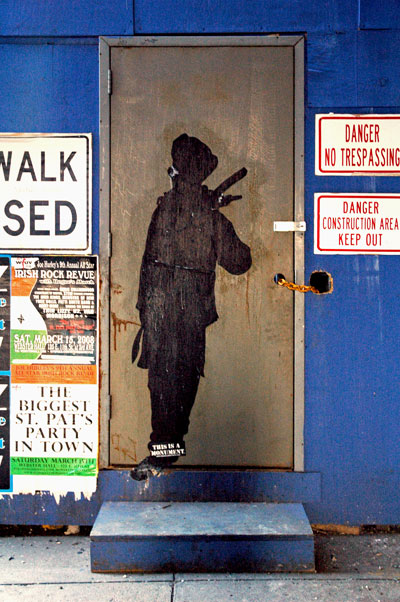
“this is a monument”
This figure darkens the doorway of a temporary construction shed on the south side of West 26th Street.
Author: jameswagner
spring-ish, and surrounded by a promise of summer

These crocus guys have been livening up our garden for a week or so already. Yes, the little trifoliate leaflets around them belong to our local frais de bois.
play in your own yards, and leave Spitzer alone
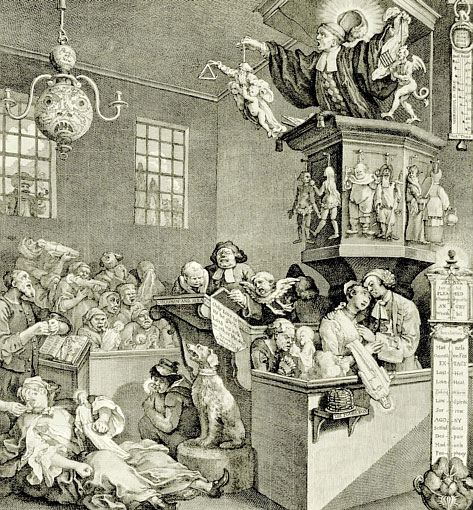
William Hogarth Enthusiasm Delineated 1761
This is stupid, if not just evil. No, I’m not talking about Eliot Spitzer. Let him deal with his family; it’s not our concern. People are screaming at the Governor about his marital infidelity and announcing or calling for the end of his career. Meanwhile, George Bush’s murder count in Iraq, already in the hundreds of thousands, continues to mount and no one will pull the plug or talk about impeachment.
I simply don’t care what kind of sex the people I vote for engage in, just as I insist that they not care about my own – or yours either. Murder and other high crimes I care about.
[image from payer.de via fortunecity]
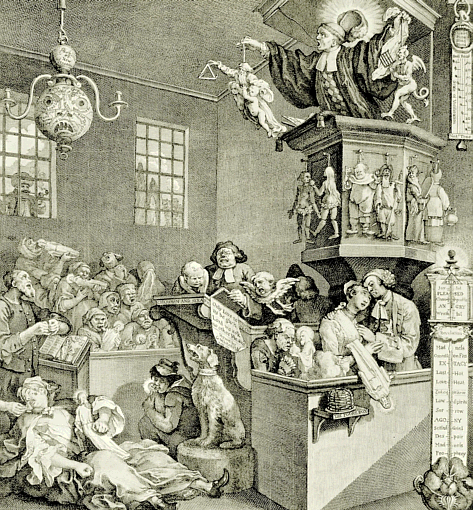
the Whitney Biennial 2008
When it comes to something like the Whitney Biennial, or for that matter the siren of any large display of contemporary art, whether a museum survey, an art fair or even a small-budget benefit, I look forward to seeing stuff by artists I haven’t heard of before but I’m also excited to see emerging artists I’ve managed to scope out already. If I liked the work there’s nothing more exciting than seeing the artist get greater recognition and a broader audience.
While the latest Whitney Biennial makes me happy on both accounts, there’s one area in which it may disappoint even some of its most loyal fans: There is some surprisingly-not-so-exciting new work by familiar and honorable names included in the 2008 survey presumably because of their continued importance to younger colleagues and to the contemporary scene generally.
I’m thinking of the work of John Baldessari and Sherrie Levine, or at least her sculptures, and I was disappointed by the work with which Mary Heilmann and James Welling were represented. I’ll add quickly add that Matt Mullican’s work looked great, even if I can’t explain it.
What will follow all these paragraphs is a list of some of my enthusiasms for work by the show’s less-established artists. I’ll admit there were some rough spots on Madison and Park Avenue last Wednesday afternoon (I just don’t get Kembra Pfahler or Seth Price, for instance), but it was great fun making the rounds.
Someone should write about the impact on curated events like the Biennial of “art shows” like Armory, Basel and the dozens of newer ventures which drag gallerists, artists, curators and collectors to more and more venues all over the planet. Maybe the evaluation will become easier if they begin to lose viability, as many are predicting. In any event, perhaps it’s the hoped-for effect of the “cure” in the curator which brings us back to the Whitney’s signature venture every two years.
I’ve only been to the press preview so far, and that visit was limited to but a few hours (not enough time, even for an exhibition with fewer artists than usual, especially since there is so much performance art included this year). This checklist is therefore somewhat provisional. I look forward to another visit – and a revisit to work which didn’t register with me the first time around. Also, to be fair, these choices represent a limited number of somewhat accidental marriages between picks and my ability to get decent images with my camera.
One more thought: Many of the pieces which have been selected, or in fact commissioned, by the curators are pretty overtly political, something which even a few years ago visitors and critics would have found, literally, “remarkable”. The world has indeed changed, certainly for the worse, but the fact that more and more people understand that may be attributed not least to the many artists who actively pursued truth all along.
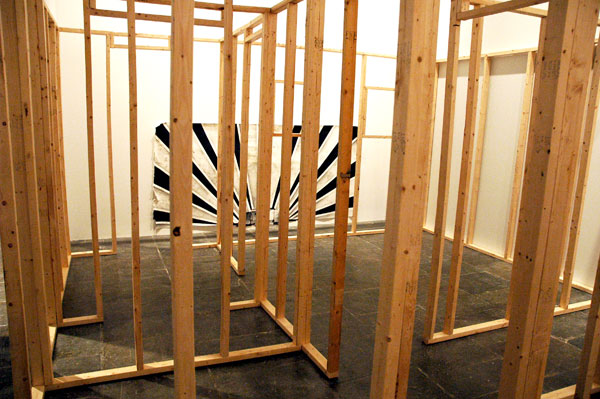
William Cordova’s open, labyrinthian construction of wooden studs, “The House That Frank Lloyd Wright Built for Fred Hampton and Mark Clark”, is an historical and political document; the work seen on the far wall is “Ollantaytambo (for F. CLearwater, L. Lamont & Bunchy Carter)”
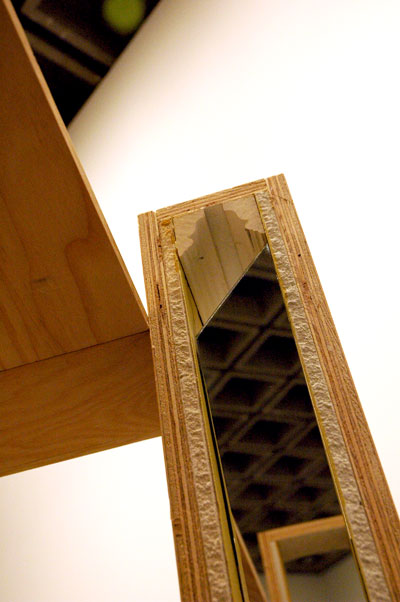
Heather Rowe’s “Something crossed the mind (embellished three times)” defends its Whitney-commissioned territory while literally reflecting its museum environment
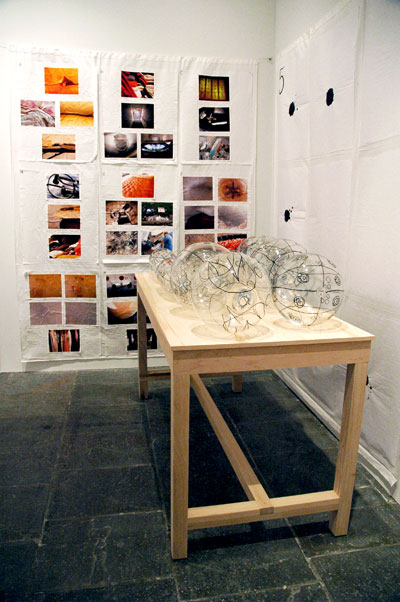
Matt Mullican shows some “ellipses and balls”, and some other stuff; that’s all I know right now
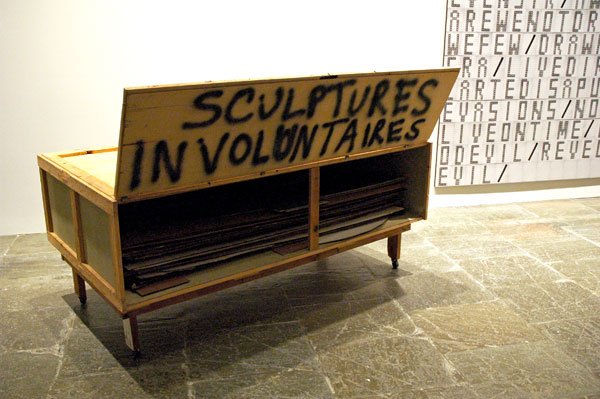
Shannon Ebner’s, characteristically assembled from language, here includes “Involuntary Sculpture” from 2006 in the foreground, and this year’s “STRIKE”, a detail of which is seen to the right
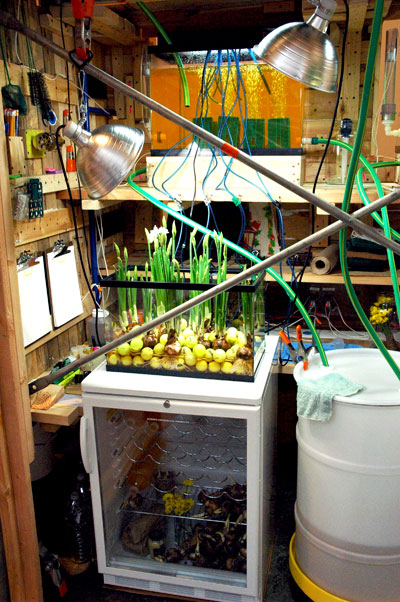
Phoebe Washburn employs golf balls, Gatorade, a wine refrigerator, and whatnot in order to sustain a ecosystem for flowers, “While Enhancing a Diminishing Deep Down Thirst, the Juice Broke Loose (the Birth of a Soda Shop)”
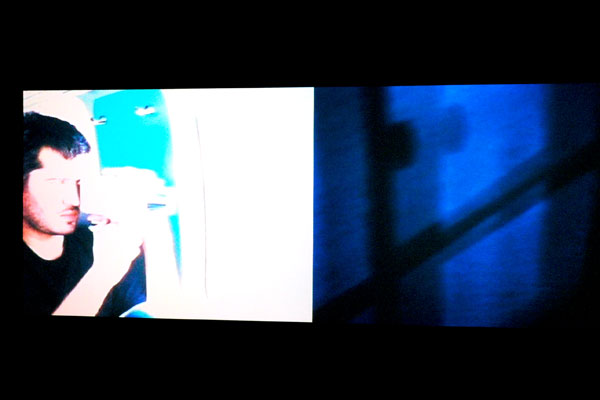
Amy Granat and Drew Heitzler, inspired by Goethe’s Werther, document a road trip in projection stills from “T.S.O.Y.W.”
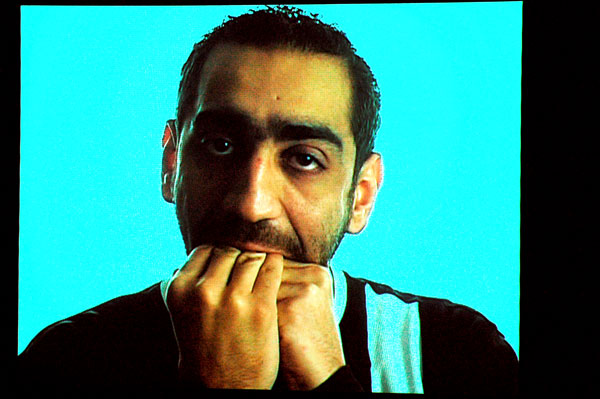
Julia Meltzer, David Thorne and Rami Farah collaborated on “not a matter of if but when: brief records of a time when expectations were repeatedly raised and lowered and people grew exhausted from never knowing if the moment was at hand or was still to come”
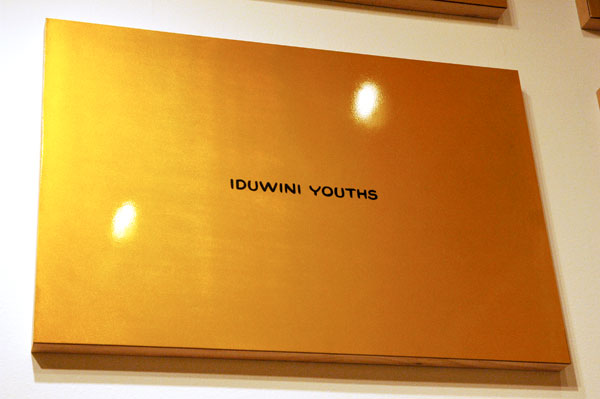
Daniel Joseph Martinez’s installation suggests a golden ossuary, but the bones which sustain the many worldwide terrorist organizations that are the painted subjects of “Divine Violence” are not at rest
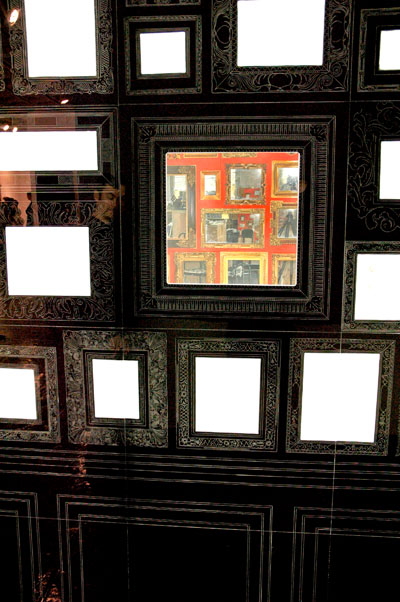
Ellen Harvey has installed an entire environment, “Museum of Failure: Collection of Impossible Subjects & Invisible Self-Portrait in my Studio”, in a room of her own at the Whitney
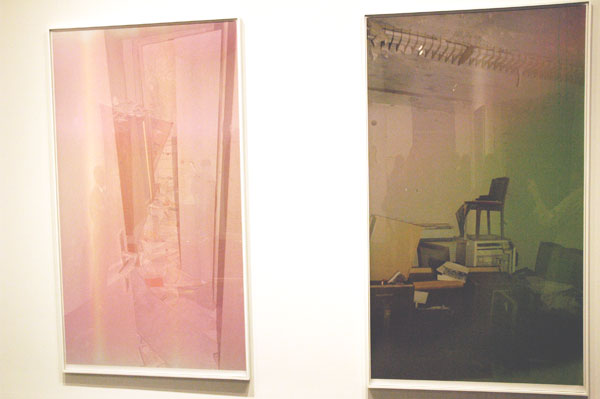
Walead Beshty’s gorgeous series of photographs, “Tschaikowskistrasse 17 in multiple exposures (LAXFRATHF/TXLCPHSEALAX) March 27-April 3, 2006”, documents an abandoned embassy to a state which no longer exists representing a government which no longer exists
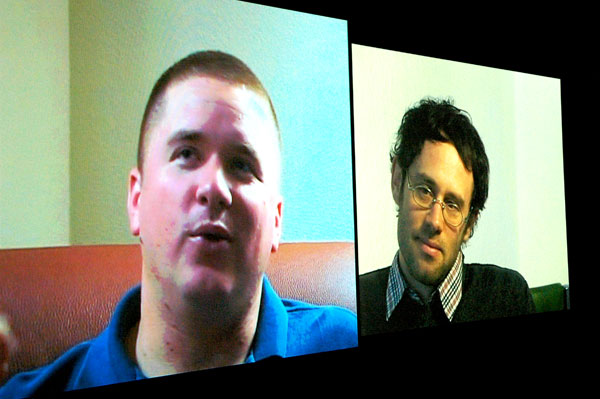
Omer Fast’s “The Casting” conflates the perversity and ordinariness of domestic and military violence in a four-channel video which employs actors and a script
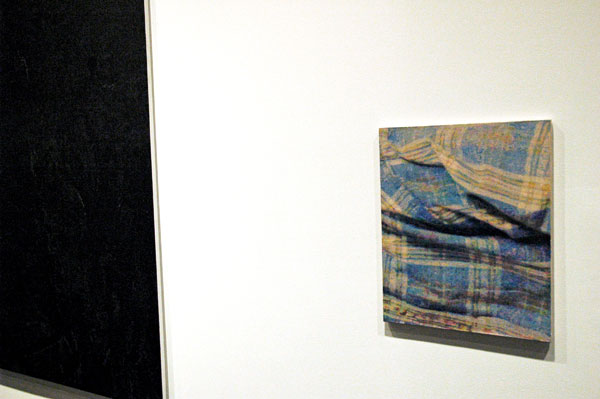
Cheyney Thompson’s paintings, like all of his work, are like nothing else around; there were three large dark (virtually unphotographable) canvases surrounding this single smaller and lighter painting.
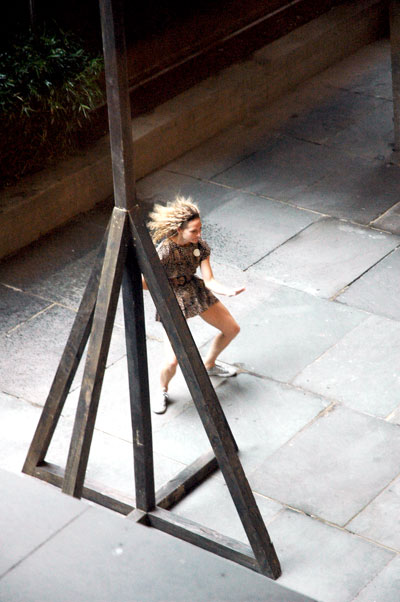
Flora Wiegman, who performed solo throughout the Whitney on Wednesday, dancing [see Barry’s video] the role of various creatures protected by Fritz Haeg’s sculptural initiative, is seen here below the bat house at the bottom of the Museum’s broad moat
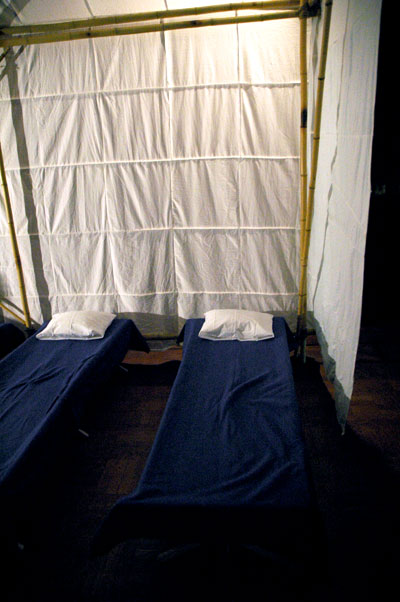
DJ Olive installed a campsite and sound project inside the Seventh Avenue Armory, on the second floor and the mezzanine above
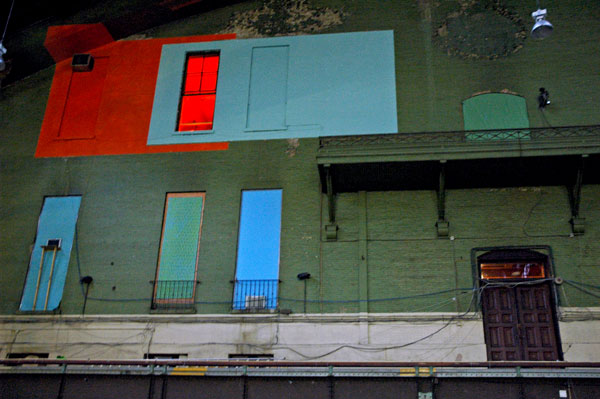
Lisa Sigal re-imagined parts of the east wall of the Administration Building inside the Drill Hall
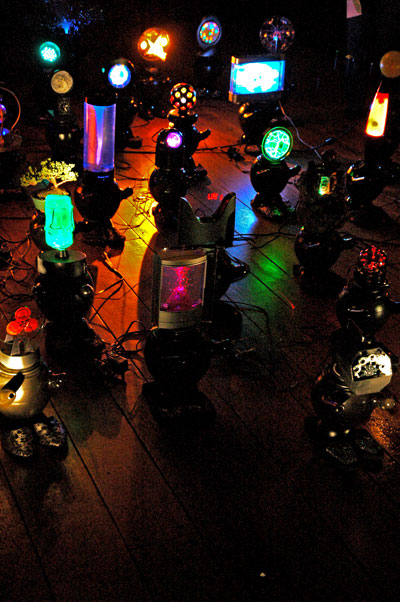
Olaf Breuning assembled a colorful, animated and whimsical platoon of teapot-based electric robots, “The Army”, and installed it on the second floor of the Armory
I didn’t take notes, so I’m sure I’ve forgotten a number of people, but some of the artists responsible for installations I did not record digitally but which I really liked include, : Bozidar Brazda, Harry Dodge and Stanya Kahn, Garder Eide Einarsson, Roe Etheridge, Rashawn Griffin, Alice Könitz, Louise Lawler, Jason Rhoades and Bert Rodriguez.
Times Square bomblet outperforms march of a million
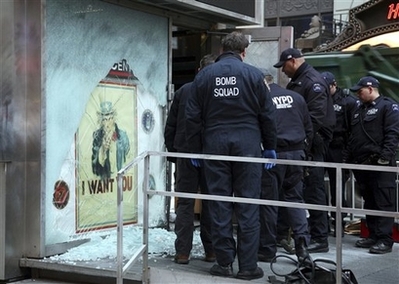
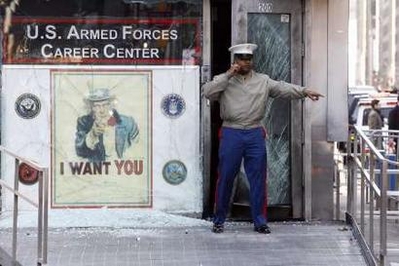
In 2003 nearly a million people marched in the streets of New York against a war (to which the majority of the country was opposed even then) only days before it began and the U.S. press hardly mentioned they were there, but last night a small explosive was detonated outside the door of the Times Square military recruiting station, presumably intended to send a similar anti-war message. This time a protest somehow manages to stir the media.
Our democratic system isn’t working; peaceful protests are not considered newsworthy. It would be nice if we could believe that the only people who are learning this lesson are those who would not consider violence a reasonable means of effecting political change.
[first image by David Karp of AP; second by Keith Bedford of REUTERS; both found on Yahoo!photos]
no, not that “Armory show”, and not Breuer’s building
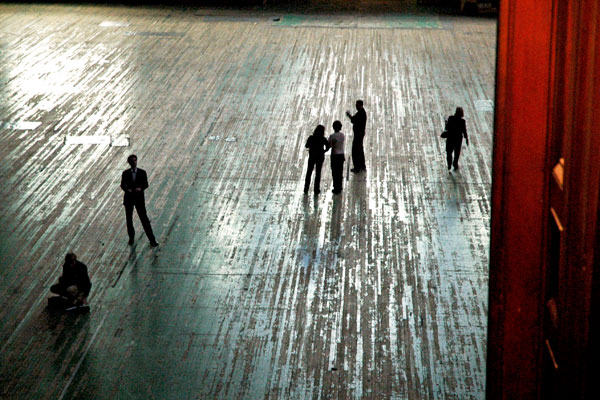
Drill Hall floor of the Armory
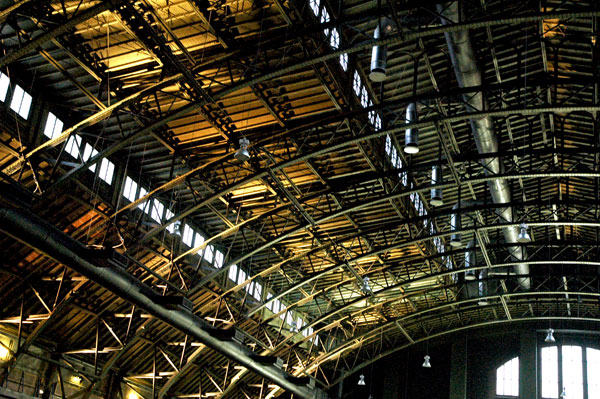
Drill Hall vault of the Armory
We were at the press preview for the Whitney Biennial this afternoon. This year the venue has been expanded to include the Seventh Regiment Armory, in whose extravagant nineteenth-century precincts many of the exhibition’s performance art elements (including some interactive experiences scheduled throughout the next month) have been assigned high-ceilinged rooms and closets.
But I as I wrote last week I always have a lot of trouble resisting the aesthetic and historical seductions of architecture like this even when there’s exciting contemporary art to be seen. So here I am writing a post preceding my observations of this year’s Biennial with a couple images of the Armory which shelters some of the installations, and to show that I’m not indifferent to the charms of Marcel Breuer’s own hall, I’m including a view of his lobby ceiling, one of my favorite details in the Whitney itself.
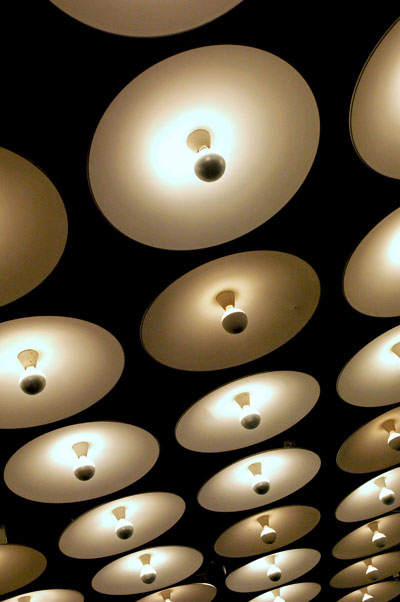
lobby ceiling of the Whitney
do we owe it all to Bush?
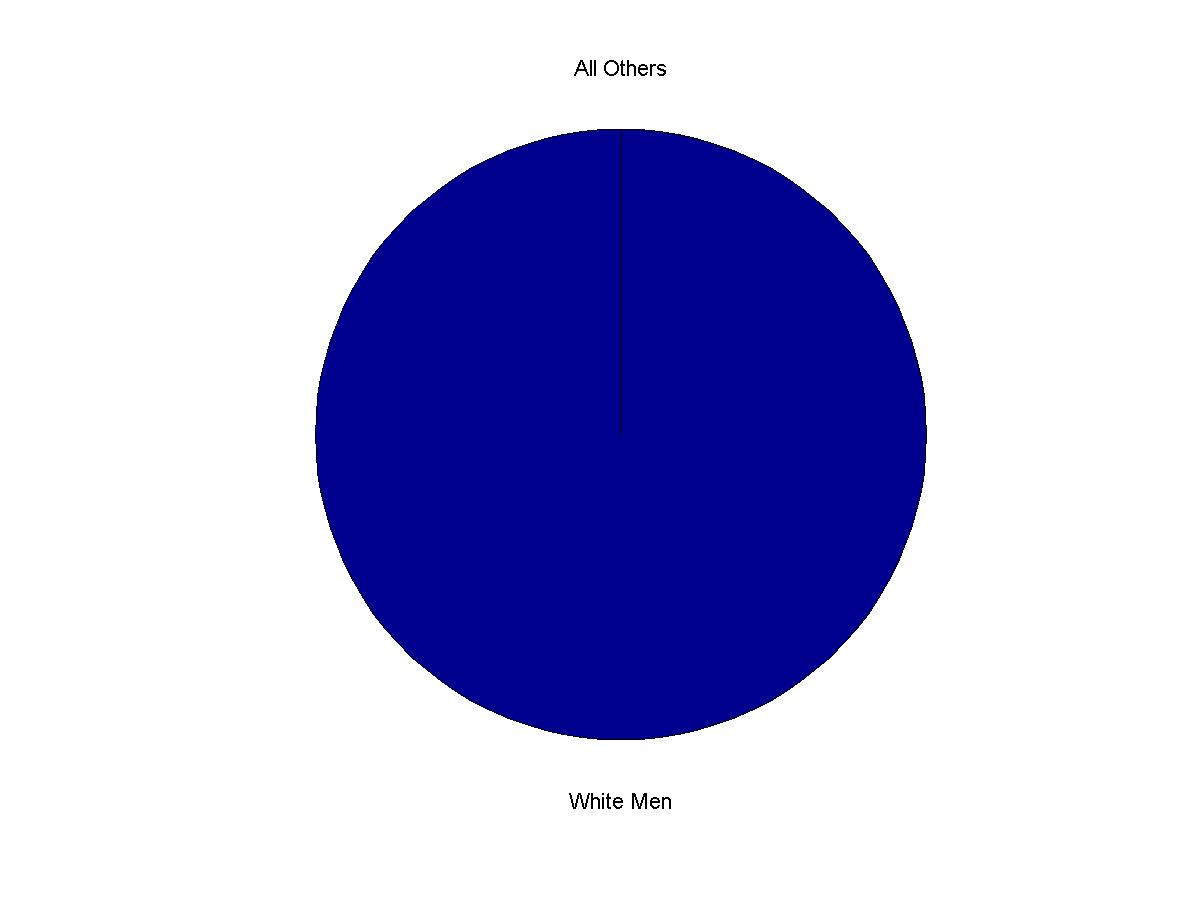
“Certainly the prestige of the office of president must be seriously compromised if a woman has a serious shot at it.”
I would add “or a black man” to that conditional clause, but the subject of the article from which this quote was pulled is specifically that of the place of women in American society. The sentence is inserted as a parenthetical reality check inside the penultimate paragraph of Leslie Camhi’s Village Voice review of “Wack! Art and the Feminist Revolution” at PS 1. She alludes to the current state of our national political life with this reminder of both how far we have come and how close we still remain to the more benighted environment of the 60’s and 70’s which inspired the feminist revolution:
Just how far we’ve traveled since those times might be measured by the fact that the female contender for the Democratic presidential nomination is perceived as the establishment candidate. (Certainly the prestige of the office of president must be seriously compromised if a woman has a serious shot at it.) But some things almost never change: It’s nearly impossible, for example, to imagine this show being staged across the river, at P.S. 1’s Manhattan affiliate, the Museum of Modern Art.
Instead, the artists of “Wack!” remain in the schoolhouse. But their contemporaries might well take a lesson from them.
[Presidential chart image by Automatic Preference whitosphere blog via Francis L. Holland]
“The Cult of Personality” at Carriage Trade
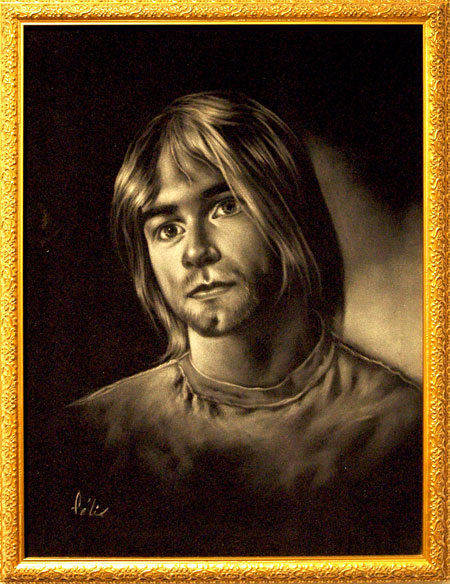
portrait of Kurt Cobain, by an anonymous artist, from a collection of paintings on velvet
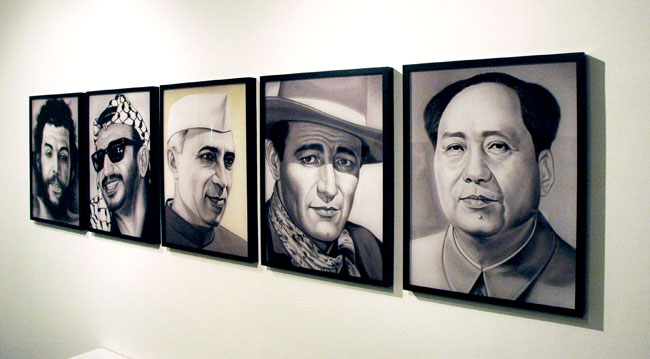
Yasser Aggour‘s photographs of portraits commissioned of Cairo sign painters
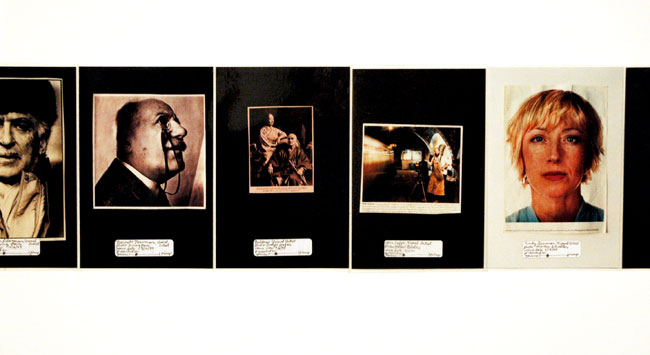
detail of a section of Jennifer Dalton‘s “What Does an Artist Look Like?” captured from three years of The New Yorker
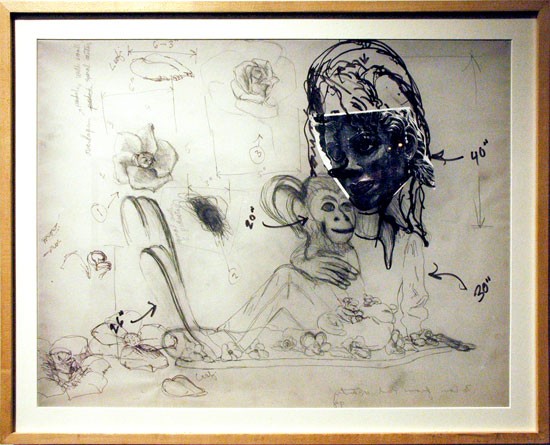
Paul McCarthy‘s drawing referencing Michael Jackson and Bubbles through Jeff Koons
Portraiture isn’t what it used to be; or is it? Maybe it’s just the times; the times, they just aren’t what they used to be either.
SoHo’s Carriage Trade gallery opened its exhibition, “The Cult of Personality, Portraits and Mass Culture”, this past Thursday. An auspicious inaugural show, it uses portraiture as a means to examine the way in which our myths are assembled and deconstructed, specifically marking the similarity between the the myths which create, sustain and dim celebrities (and the products they sell) and those which generate, underpin and erode governments (and the policies they pursue).
An excerpt from the press release elaborates:
The process of crafting present-day myths to be served up for the purpose of turning the news into entertainment requires some belief in charismatic personalities. While the concept of a cult of personality is most often associated with autocratic leaders who use mass media to develop and sustain their popularity in an undemocratic state, the sphere of influence enjoyed by the media within a democratic system, and recent cases of its manipulation by government, suggest that this concept is ready for an expanded definition.
In adopting the genre of portraiture, a form associated with traditional identity construction which focuses on the relative psychological interest of the subject, The Cult of Personality, Portraits and Mass Culture attempts to locate the manner in which the development of an identity for mass consumption adopts the traditional viewer/subject relationship, often with the expectation that viewer will lose themselves in the protectiveness or superiority of the subject while finding momentary fulfillment in a distraction from what they are meant to feel that they lack.
. . . .
In the run up to an election which is mercifully overshadowing our current leaders long, slow decline in popularity, the mechanisms through which personality can trump reason in the public sphere might be worth revisiting, if only as a reminder of the very real consequences of allowing fictions to displace facts.
I was totally smitten with the one piece I couldn’t find on the gallery list. It’s the black and white painting on velvet to the left just before you reach the desk. I had no idea who had created it (and as it turns out, nobody knows, including artist and gallery director Peter Scott), but maybe I was one of the few people in the room who had no idea whose portrait it was. Okay, Scott told me it represents Kurt Cobain, but how was I to know Cobain was beautiful even as a child? The work itself may or may not really be a part of the show. Although it’s signed “Felix”, it’s by an artist whose name is apparently unknown even to its owner, WFMU’s Station Manager Ken Freedman. It was purchased in Tijuana, from the painter.
Popular commercial art, whether produced on commissioned or speculation, is a concept and a subject worthy of a serious book itself, and my apologies to the responsible parties if I’m overlooking the effort(s) of anybody who’s already gone there.
Scott has put on a wonderful show. There are a relatively modest number of works involved, but this provocative and compelling curatorial project enjoys the additional interest which their broad diversity of medium, sophistication and approach provides.
The artists in the show whose work is not shown in the images above are Ligarno/Reese, Karen Yama, Vitaly Komar, Sherrie Levine, Muntadas and Reese, Julia Wachtel and Bill Owens.
Lilibeth Cuenca Rasmussen at Renwick Gallery
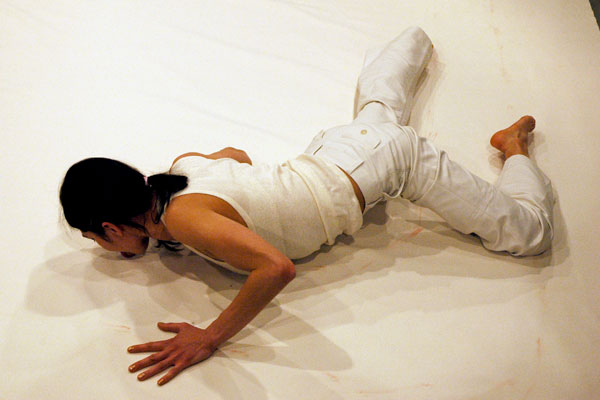
Lilibeth Cuenca Rasmussen’s re-enactment of “Licked Room” 2000 by Ene-Liis Semper
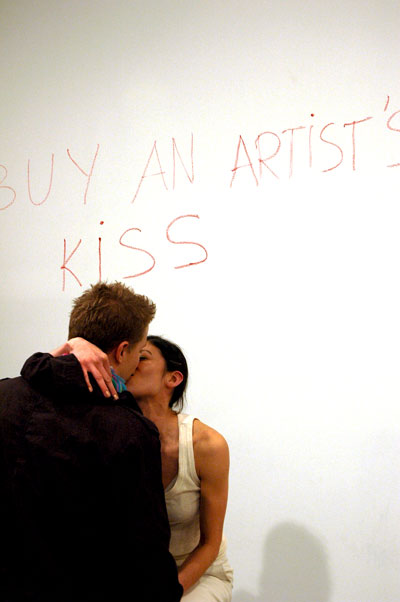
Lilibeth Cuenca Rasmussen’s re-enactment of “The Artist’s Kiss [Le Baiser De L’artiste]” (1977) by Orlan
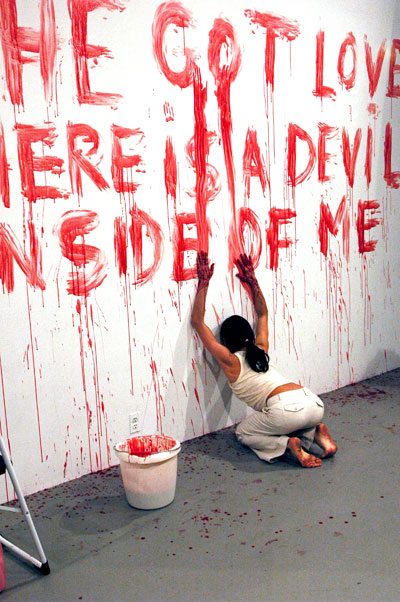
Lilibeth Cuenca Rasmussen’s re-enactment of “Blood Signs & Body Tracks” (1974) by Ana Mendieta
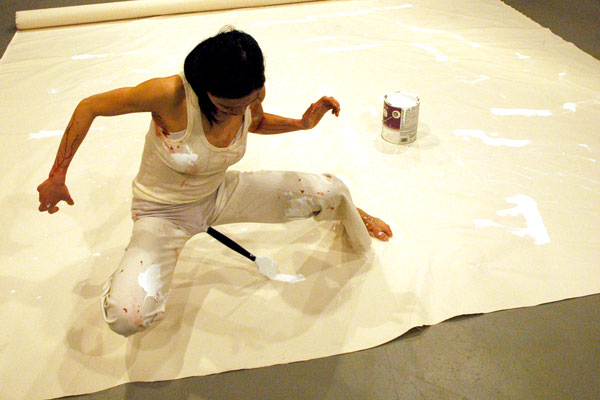
Lilibeth Cuenca Rasmussen’s re-enactment of “Vaginal Painting” (1965) by Shigeko Kubota
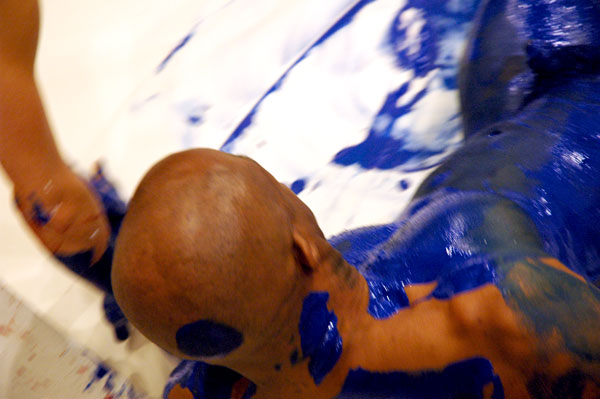
Lilibeth Cuenca Rasmussen’s re-enactment of “Anthropometries of the Blue Period” (1960) by Yves Klein
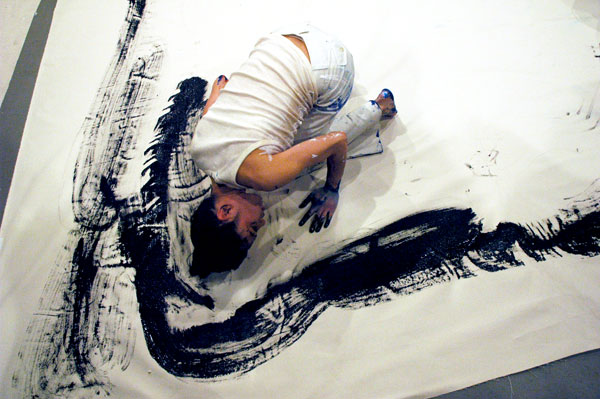
Lilibeth Cuenca Rasmussen’s re-enactment of “Loving Care” (1992-1996) by Janine Antoni
Lilibeth Cuenca Rasmussen performed fourteen historical “re-enactments” (actually, thirteen plus the artist’s own contemporary “The Artists’s Song”) at Renwick Gallery Thursday night, but for those of us fortunate enough to crowd into this west SoHo space for “A Void“, almost all of whom must have missed the legendary originals, the performances may have felt pretty much like the enactments, created over the half century beginning in 1958, felt to earlier audiences – or not. In any case, now they have become acts for our own age, if only because this time we were watching fourteen of them follow immediately upon each other within the space of a single evening.
I loved it, enough to hardly notice that I was standing mostly in one place at an opening for almost three hours (with a quick break early on for another gallery’s reception, a big treat itself, but one which did not offer this kind of live, one-off theater).
Much of what I’ve seen of Rasmussen’s creative output references art, artists and the art world, but the combination of seriousness and wit in her provocative performances is distinctly her own.
Everyone’s experience of the evening must have been pretty personal, but the outline of the artist’s concept for this, her first solo show in the U.S., is covered very well in this excerpt from the press release:
“A Void” investigates the identity of an artist and questions the authenticity of the art work and the history of art. Performance art has been very radical in its transgressions and has expanded the categories of art. The authenticity of performance art is related to the here-and-now experience. When the performance is over, it can only be experienced through documentation far from the original experience. Even if it is performed again, it will be very different from the original experience, dependent on the artist, the audience, time and context.
Lilibeth Cuenca Rasmussen re-enacts other artists’ performances in her own way. The point of departure is identical, but the experience will be completely different. The historical re-enactments will follow each other without precedent announcement as one long performance. They will be documented and shown on video after the opening. Traces of the performances will also be present as drawings and photographs.
The remaining sections not represented in the images I include here were inspired by Piero Manzoni, Rirkrit Tiravinija, Claude Wampler, William Wegman, Yoko Ono and Nam June Paik. Did I say the performances were terrific? Also, I can’t wait to go back to see what the gallery, which started out at 6pm as an empty white box, “a void”, will look like during the remainder of the exhibition, once the water and other debris have been cleared away. There will be the performance documentation, of course, but I’m guessing that at least some of the canvases created Thursday night might play a role as well.
For more, including a video capture of one of the re-enactments, see Bloggy.
The Seventh Regiment Armory’s “American Aesthetic”
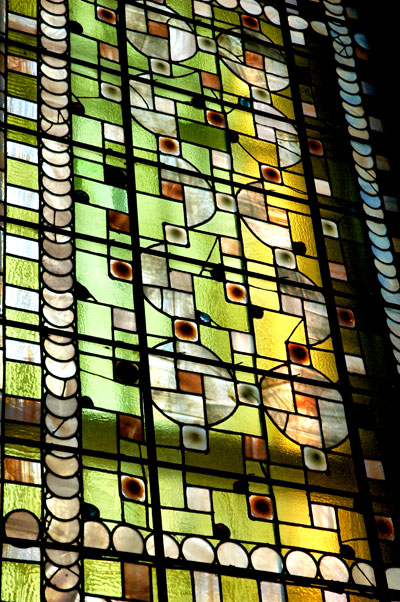
Louis C. Tiffany window in the Library of the Armory
I’ve been walking through the front doors of the Administration Building of the Seventh Regiment Armory on Park Avenue for decades, but until this past Monday I had never had a glimpse of that late-nineteenth-century monument’s most elaborate rooms, in the wing north of the monumental entrance hall. They are just about as vigorous an expression of the American Aesthetic Movement to be found anywhere, but they have been pretty much hidden from the public, their beauties increasingly neglected for the lack of funds to maintain them. Today they are being restored to their original glory by the Seventh Regiment Armory Conservancy.
I was taken by surprise that we were permitted access that during The Art Show of the ADAA, and Barry and I were also in something of a hurry that afternoon, so I didn’t have a chance to get more than a few images before having to rush out. Fortunately it was a beautiful sunny day, so the Tiffany windows and much of the rooms’ other, largely-undisturbed, ornament probably looked their best – at least for now.
When the restoration is completed these rooms will look even richer, as much of the original color and detail had been watered down or replaced by alterations over the years. For instance, the panels to the left of the window in the picture below are now covered with a dull velvet fabric, but were originally painted with a blue field behind a stenciled silver and copper chain mail [it was an armory, after all] pattern.
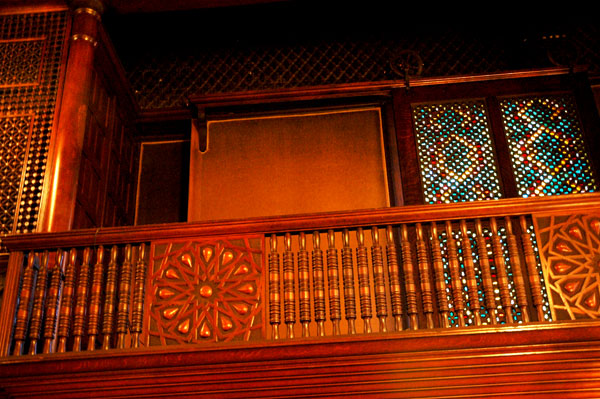
detail of the musicians’ gallery in the Veterans Room