Guggenheim finds Incredible Shrinking Museum (ISM)

HoMuglycerinemuseum.jpg
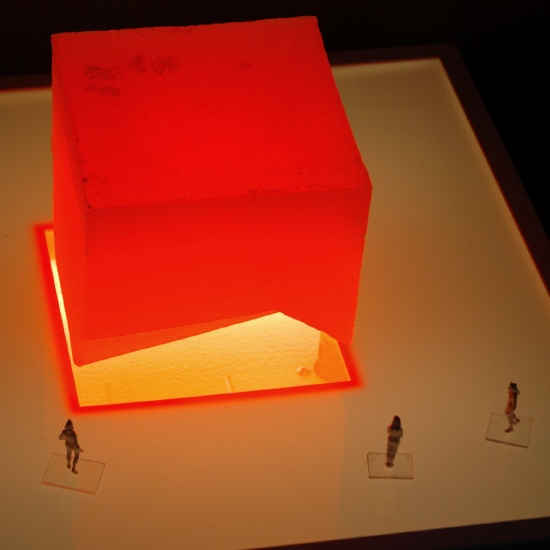
Filip Noterdaeme ISM (The Incredible Shrinking Museum) 2004-2006 model (glycerin soap) [view of installation at HoMu]

When I wrote about Filip Noterdaeme’s Homeless Museum (HoMu) just about a year ago, I included the picture above and copied the artist’s own description of a project, The Incredible Shrinking Museum (ISE), which he had begun some time earlier. It was one of my best memories of the HoMu tour:

“ISM (The Incredible Shrinking Museum)” is a project for an interactive museum consisting of a sixteen-foot cube of glycerin soap. The cube is subject to constant change through exposure to the elements. In addition, visitors will be invited to exploit the structure like a mine until is it is used up, the goal being to reach out to a new audience and challenge visitors to think about their role as active participants in the shaping and destruction of culture through direct participation in the realization and, ultimately, the deconstruction of a museum.

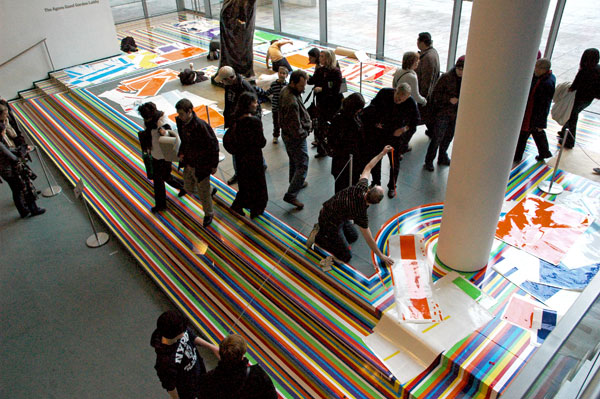
Yesterday I heard that a model of the ISE had been installed inside the Guggenheim Museum as part of an exhibition by Cai Guo-Qiang, “Everything is Museum“. In spite of my huge delight in Noterdaeme’s museum-critique concept, I thought his announcement was merely another of his excellent projects; the email seemed especially suspect because the setting was the Guggenheim, a museum criticized by many in the art world for its franchising history and its unsubtle relationships with corporations and commodities. But as his subject line, read, “You Can’t Make This Up”: When I replied asking him for clarification, I found out the news was both good and true.
Oh, by the way, yesterday the Guggenheim announced the resignation of its director, Thomas Krens. This news is also good and true.
Art Fag City has more, including an image of a different model, one representing the ISE already under deconstruction.

selling off the High Line to developers – no, really!

Denari_hl23.jpg
fourteen floors, most of them condos, to be built on top of our park

I admit that I’ve known about this building for some time. I’ve been quietly fuming about it (something I don’t do often – the quietly part, that is) for perhaps a year; it’s just that getting an email from the developers boasting essentially about how clever they are to have arranged this public scam put me over the top.
This isn’t the first instance in which the city has sold a part of the High Line to developers, and it may not be the worst, but it’s just about the most egregious.
Has New York been able to reverse nature’s own law, that plants need sun, even in parks? And, more importantly, are we going to have parks in this city or are we just going to have developers’ opportunities?
This text is copied directly from the press release I received today:

Denari’s HL23 will rise fourteen stories from a singularly challenging site: a 40-foot wide footprint located at 515-517 West 33rd Street, just steps from Tenth Avenue and half covered by the High Line, the historic elevated railway bed slated for transformation into one of the nation’s most lyrical urban parks. Overcoming this through-block site’s inherited restrictions while exploiting them with boldness [and the power of money and influence], Denari has conceived a building that will dramatically increase in size as it rises from its slender footing to cantilever gracefully over the rails. Made possible by a Special Authorization, comprising of seven waivers granted by the New York City Department of City Planning [my emphasis] in support of the building’s unique contribution to the cityscape, HL23’s reverse-tapering form [absolutely the reverse of New York’s historical and progressive setback zoning] will make it a local landmark while creating cinematic views and unrivaled intimacy with the High Line for residents inside.

Why not call it the Highline Tunnel? Construction is supposed to begin in a few days.

CORRECTION: I originally described it as a thirteen-story building in this post, but apparently a penthouse will comprise a fourteenth floor.

[image from triplemint]

Marsden Hartley at Babcock in ADAA show

Marsden_Hartley_Finnish-Yankee_Wrestler_2.jpg
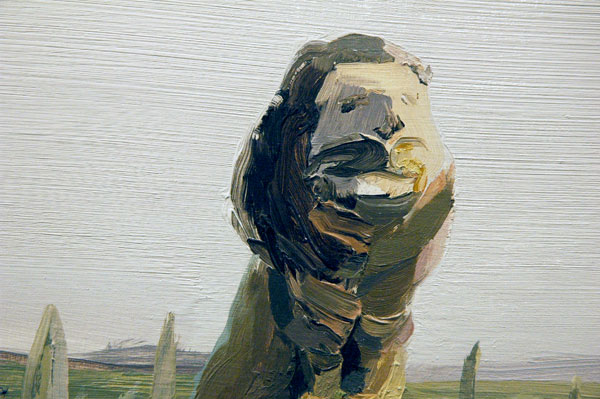
Marsden Hartley Finnish-Yankee Wrestler ca. 1938-1939 oil on board 24″ x 18″

This small painting by Marsden Hartley was one of the reasons I headed up to the Park Avenue Armory on the last day of the ADAA show this past Monday, having been alerted to it by Karen Rosenberg’s article in the NYTimes on Friday.
It was in the Babcock Galleries booth, imprisoned inside an embarassingly-humdrum, molded gold frame. It did absolutely nothing for Hartley’s subject, or his gentle love for the robust New England to which he had returned toward the end of his life.

Joy Garnett at Winkleman

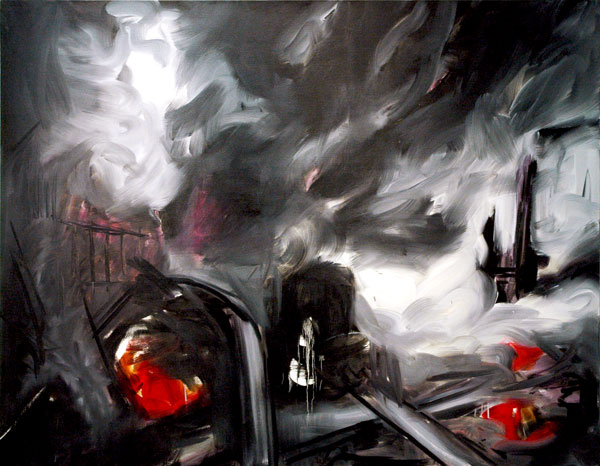
Joy_Garnett_Night.jpg
Joy Garnett Night oil on canvas 60″ x 78″

Joy Garnett has four large canvases installed at Winkleman until March 15. You probably already know how I feel about the artist’s work, so I’m just posting an image this time. It’s probably the least representational of the works in the current show, but that doesn’t say anything about my preferences, since I’m crazy about “Molotov” and I think Garnett is terrific at everything she does.

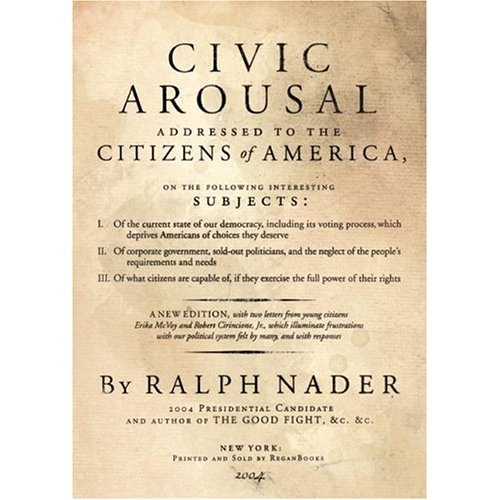
Nader’s candidacy: we should expect nothing less of him

Ralph_Nader_Civic_Arousal.jpg
Common Sense, so uncommon today

The candidate is a brilliant man of the highest integrity. He is generous, dedicated public servant responsible for world-altering reforms which have saved, literally, countless lives. In the words of one of his published critics:

More than any other single person, Ralph Nader is responsible for the existence of automobiles that have seat belts, padded dashboards, air bags, non-impaling steering columns, and gas tanks that don’t readily explode when the car gets rear-ended. He is therefore responsible for the existence of some millions of drivers and passengers who would otherwise be dead. Because of Nader, baby foods are no longer spiked with MSG, kids’ pajamas no longer catch fire, tap water is safer to drink than it used to be, diseased meat can no longer be sold with impunity, and dental patients getting their teeth x-rayed wear lead aprons to protect their bodies from dangerous zaps. It is Nader’s doing, more than anyone else’s, that the federal bureaucracy includes an Environmental Protection Agency, an Occupational Safety and Health Administration, and a Consumer Product Safety Commission, all of which have done valuable work in the past and, with luck, may be allowed to do such work again someday. He is the man to thank for the fact that the Freedom of Information Act is a powerful instrument of democratic transparency and accountability. He is the founder of an amazing array of agile, sharp-elbowed research and lobbying organizations that have prodded governments at all levels toward constructive action in areas ranging from insurance rates to nuclear safety. He had help, of course, from his young “raiders,” from congressional staffers and their bosses, from citizens, and even from the odd President. But he was the prime mover. – Hendrik Hertzberg, in The New Yorker, March, 2004

He is a highly-educated man. His first languages are Arabic and English, and he later acquired Chinese, Russian, Spanish, and Portuguese. He is a crusading attorney, a prolific writer, and he tirelessly delivers speeches with an energy, eloquence and control equal to that of the best nineteenth-century orators. His entire life has been dedicated to public service. An enormously important social critic, but a very private man, he hasn’t been content with the role of intellectual gadfly. Instead he has moved into the more dangerous stage of a personal political activism, most dramatically (but gently) regularly entering himself as a candidate for the Presidency since 1992.
He has been absolutely correct on every issue with which his candidacy has been associated, but the fundamental issue which underlay everything he stood for in each of these elections and which underlies it today is the most important of all: The stranglehold of corporate power over the nation’s political institutions and the economy. Nader is properly disgusted with the Republicans and Democrats equally on this issue.
No other candidate, compromised as they are, can or will ever address this problem, but until it is addressed and resolved there will be no real change, This is the strength of the argument and the campaign identified with a man who, remarkable as it may be, seems to have no personal ambitions for political office.
But so many reject him at the polls, even though they must know he is absolutely right.
My countrymen vote over and over again for far lesser candidates, but for many blind partisans it isn’t enough to simply refuse to support the man and his principles. Nader has to be wiped off the ballot so that no one else can vote for him. The man has to be eliminated from the scene altogether, and this must be done with a venom and an implied violence that often surpasses that directed at Bush and the Republicans who created him.
Yesterday a friend of mine sent an email around to a number of people he knew bearing the subject line, “stop him before he kills again”. It was basically a short note with a hysterical warning about the old bugbear of a Ralph Nader candidacy. There was a link to a story speculating about the former candidate’s plans.
I have no idea where this rabid nonsense comes from about Nader being responsible for all of our travails since the coup which brought us a Bush presidency, but it reminds me of the continuing popularity of the myth which would have Saddam Hussein responsible for 9/11.
I had first replied to my friend that Nader never was the problem, is not now and will not be the problem should he decide to run again. I had been most upset about the email’s call, “stop him before he kills again”. I asked what that was supposed to mean, and suggested that everyone has the right to run for office. I couldn’t help adding that this should be especially important if she or he is right, unlike the competition anointed by the corporations, party bosses and the media.
His response was that “flighty principles” have to be thrown aside and that pragmatism is now the order of the day. He also referred to a comment from a friend of his who suggested that a vote for Nader was a “self-satisfying” act at a time when the Bush menace threatened and that “pragmatism” was now the order of the day.
I couldn’t simply go back to him with another reply; I was spending too much time on the subject to keep it just between the two of us. Like any good blogger, I decided to do a post instead.
Let me say first that I don’t vote in a way to show or feel that I’m right. My votes are never “self-satisfying”. In fact, if I wanted to satisfy myself I’d vote Republican or not at all (the former in the interest of my pocket, the latter in order to accept the basic lie of our system and for my peace of mind).
Politics really are an almost full-time occupation for me, and they’ve been so at least since I sort of campaigned for Dewey in 1948 [yeah, but I’ve gotten smarter, and my parents can’t influence me now], yet I leave the strategizing and maneuvering up to the politicos. It’s the strategizing and maneuvering that produces the abominations which occupy (and always occupy) the highest offices in the nation. It’s the strategizing and maneuvering that gives do-nothing Congresses and play-it-safe presidents. It’s the strategizing and maneuvering that arranges things so that the professional politician’s own special, vetted confederate gets in.
Am I the only one bothered by the fact that American political life has almost nothing to do with “policy” [def. “a course or principle of action adopted or proposed by a government, party, business, or individual”]?
Electoral politics are not a “game” for me, although most Americans seem to see it that way, and the American media definitely plays it that way. Sadly however, the game approach may in fact make a lot of sense, since what we continue to refer to as “politics”, in this country, are not the politics of a free and democratic society. The system has always been in the hands of the powerful. Originally that meant powerful, wealthy individuals, but in the nineteenth century it came to mean powerful corporations, and the Supreme Court certified that development. Our Congress, our Executive Branch and our Supreme Court are all the product of collaborating or competing corporate interests; everything is arranged for profit. The policies you or I vote for are the policies of the candidates and office holders only if they are the policies of the corporations which created them.
Nader has been the only modern candidate for the office of President who has ever told the truth about corporate ownership of Congress and the White House and he has founded his candidacy on a fundamental change in the system. Kucinich has been almost equal to Nader in his dedication to a cause which should be the priority of every citizen. I have voted for both men, whenever I have had the opportunity and with the best conscience. It doesn’t “satisfy” me to do so, because I’ve known each time I did so that the corporations and the media were ensuring that what my candidate stood for would remain invisible to the voters who most need them and who would gain the most from their election.
In a 2004 post I quoted a letter to the NYTimes by Alexi Arango which I thought perfectly explains what drives Nader’s repeated candidacies:

Ralph Nader’s central thesis is that corporate influence on lawmakers is a greater danger to democracy than even a Bush presidency. In this context, Mr. Nader’s run for president is easier to understand.

Nader has never killed anyone, and he’s not going to start now. He runs for office because the Democrats have totally abandoned what they represent they stand for, but he runs for office above all because the party (including both Clinton and Obama) is in the pay of the corporations. In fact in a very real sense today we all live in “the company town”. You may think these are desperate times which demand that I and every other voter, even the smart ones, dance with the big donkey, but I think the times are more desperate than most people realize and I know that nothing will change if we continue to accept the lie about our electoral freedom. It’s the Democrats who threw away the 2000 election, and every election since, including the Congressional elections. By now we have no excuse for not knowing how or why.
It’s up to the Democrats to defeat or overcome a Nader candidacy by making it unnecessary or redundant. To decide to change nothing, but to demand that his candidacy and that of any other true reformer be prevented so that we might get more of nothing (Democratic “winners” forever and ever stuffed into corporate pockets) is simply to assume an absurd position, not a pragmatic position.
Looking at what the Democrats have been saying and doing about domestic and foreign policy for almost two decades, even now with a Democratic Congress, can we blame Nader’s 2000 run for the way the Democrats have behaved since then?
It’s Nader who is the patriot.
When I was very young, like everyone else of my generation, I was told that any American could grow up and run for President. Nobody said, “. . . except for the best ones”.

ADDENDUM: For what I will call the definitive statement on the significance of Nader’s candidacy, read John Nichol’s piece on CommonDreams.

[image from Amazon.com]
Rodney Graham at MoMA

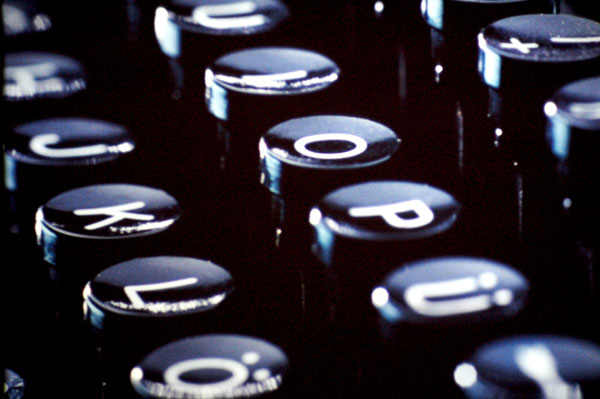
Rodney_Graham_Rheinmetall_projection.jpg
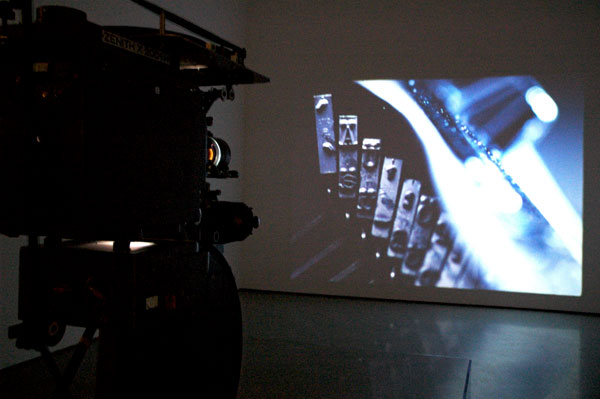
Rodney Graham Rheinmetall/Victoria 8 2003 installation: 35mm film (color, silent), Cinemeccanica Victoria 8 film projector [large detail of still from film image projected within installation]

Rodney_Graham_Rheinmetall_Victoria_installation.jpg
[large detail of installation]

Maybe it’s partly my aspirations as both writer and photographer, since this extremely elegant work intersects both of those arts, but I was fascinated by this Rodney Graham piece when I wandered right into it the other day. It’s part of the current contemporary galleries show at the Museum of Modern Art, “Multiplex: Directions in Art, 1970 to Now“.
There was also the impact of the profound, endless “silence” produced by that huge projector’s rapid click, clack, click, clack inside a darkened room.
The gallery label included this text:

This film depicts a 1930s German typewriter made by Rheinmetall that Graham found in a junk shop. “It was just this incredibly beautifully made, solidly designed typewriter. Not one key had ever been pressed on it,” he has said. His filmed homage is projected with a 1961 Victoria 8 projector issued by the Italian company Cinemeccanica, a mechanical wonder that Graham has described as “very beautiful, kind of overly powerful.” “It’s these two objects confronting one another,” the artist has said of the installation. “Two obsolete technologies facing off.”

“Bread, Milk, and Butter” at Hudson Franklin

Mairead_OhEocha_Springtime.jpg
Mairead O’hEocha Springtime, Truck Museum, Wexford 2007 oil on board 15.5″ x 20.25″
Mairead_OhEocha_Springtime_detail.jpg
[detail]

Munro_Galloway_Country_Life.jpg
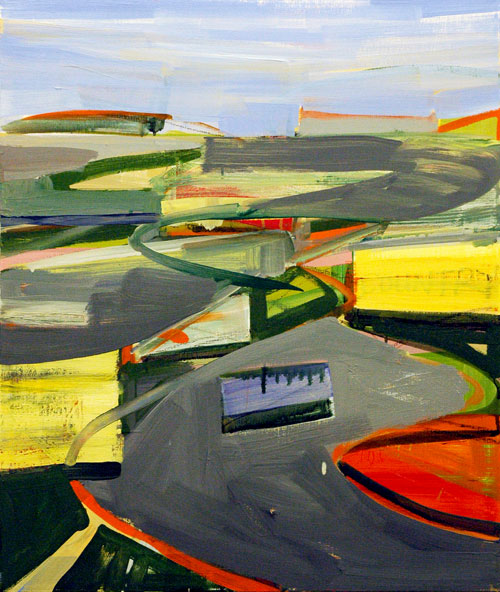
Munro Galloway Country Life 2007 oil on canvas 24″ x 20″

Actually, the full title of the show at Hudson Franklin is “A Loaf of Bread, a Carton of Milk, and a Stick of Butter” but I had to sacrifice a few words up at the top of this entry because I want to keep my own blog titles to one line of text.
Not a thing however has been sacrificed in this wonderful little show of real paintings. The canvases are all fairly modest in size, but they perform their very different roles extremely well. It was Allison Schulnik‘s sculptural extravagance with oil, “Big Fish Head”, (the image on the invitations) that brought me into the gallery, but I stayed to enjoy Mairead O’hEocha‘s clean, fanciful Irish landscape, the endless curved road of Munro Galloway‘s rounded cubism and the other works by Anders Oinonen and Anna Bjerger.
The show, curated by Andreas Fischer and Nicole Francis, continues until March 15.

Mark Bradford at Sikkema Jenkins

Mark_Bradford_Mississippi_Gottdam.jpg
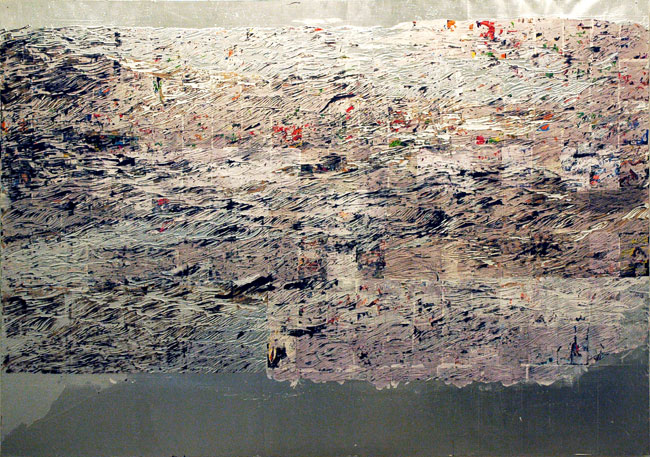
Mark Bradford Mississippi Gottdam mixed media collage on canvas 102″ x 144″
Mark_Bradford_Mississippi_Gottdam_detail.jpg
[detail]

It took me a few minutes. I don’t know, maybe I was already tired from an afternoon wandering between galleries in the wind and the cold on the edge of the North River. I also didn’t remember who the artist was, that I had written about him before, and that his work had been one of my favorite things at the last Whitney Biennial (I like it when an artist changes, even if it often taxes a memory already straining to keep up with my passions). I also didn’t know that two nights later, entirely by coincidence, I would be watching a recording at home of his segment of the Art: 21 series, “Art in the Twenty-First Century”.
In any event, last Tuesday when I walked into Mark Bradford’s show, “Nobody Jones“, at Sikkema Jenkins, I first felt like, well . . . , like show me why these big canvases are special. Had I finally had enough of art-ing? I wasn’t really into the work, even though when I was back at the front desk I found myself going back to check out the map-like features of at least one piece (I love maps). Now looking at it again it no longer seemed important what the lines were, or even whether they represented anything at all (they do). And when I rounded the corner and walked into Sikkema’s west gallery, where “Mississippi Gottdam” was hanging all by itself, my jaw must have dropped. If it had been a spaceship hanging from the ceiling it couldn’t have been more exciting. The big sculptural collage was breathtaking. I studied it for some time and then I turned back into the main gallery. All the other stuff now looked really awesome as well, and I was still thinking I knew little about the artist, or the process which produced these works.
Magic.
Thanks to Art: 21 and its visit with the brilliant and engaging Bradford, both inside and outside of his Los Angeles studio, I now remember everything, even my own 2006 post. The permanent-wave end papers and the bright Whitney paper collages. I had first seen his work at Lombard Freid back in 2001. It was a solo show called “I Don’t Think You Ready For This Jelly”. Lea Freid spoke to Barry and I at the gallery and helped us fall in love with the artist’s work – for its beauty, its medium and its rootedness.
The image at the top can only hint at the brillance of the original, much of which floats on a silvery foundation. I thought Rudolf Stingel‘s shimmering Whitney installation of last fall was pretty magical, but right now I’m thinking about what it would look like with a hands-on color intervention from Bradford.