maybe making a world of difference, and one of correspondence as well
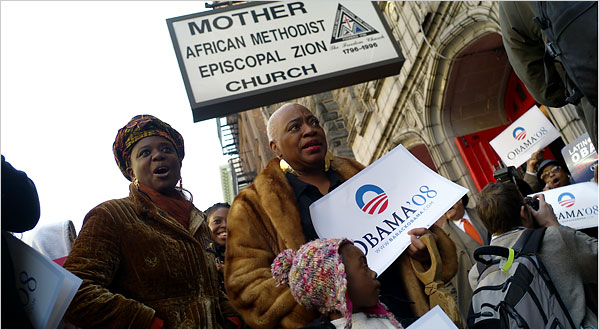
If the candidates could not be everywhere on Sunday, their allies could try. Gloria Walsh, center, a retired schoolteacher, paused to campaign for Barack Obama in Harlem, with Cordell Cleare and Mrs. Walshs granddaughter, Haja Barfield, 3. [NYTimes caption]
A lot of us will be voting in primaries tomorrow. Maybe that calls for a whoopee, maybe not.
For many of us there’s nobody now running for president with whose political positions we have much genuine affinity. I admit this is nothing new in my case, but in a nation as materially-blessed as this one I have no problem laying the blame on an absurdly-frightened, ultra-conservative population rather than my own Leftist soul.
Still, I can’t quite bring myself to stay out of the discussion, at least not yet. There is not enought of a distinction between the expressed positions of Hillary Rodham Clinton and Barak Obama to make a rational choice, and even after all of our exposure to their separate personalities, while I know who I might “like” more, I don’t pretend to know what kind of a president either might be as an individual. But there’s something else going on here.
For me a vote for Obama is not really a rational choice; it’s a vote for a dream, a dream which can be shared by people who can make a difference, and they may just do so. That’s all I can expect of my mark this time, but it may turn out to be a lot. I think we have to go with the dream, since the disastrous wounds we have suffered over the last seven years make it clear that triangulation and incrementalism will not be enough to save the country. If it takes a dream to awaken a much-abused (and self-abused) citizenry, then I can try to be a dreamer one more time.
But in the end we are the ones who will have to do the work; the dream and the man can only inspire, perhaps to things not yet imagined by either.
Oh yes, there are also these four not-insignificant points, arguing against a Clinton candidacy, outlined yesterday by Bloggy. They fester somewhere between the categories of “positions” and “personalities” to which I referred above.
[image by Ozier Muhammad for the NYTimes]
Author: jameswagner
Chris Martin at Mitchell-Innes & Nash
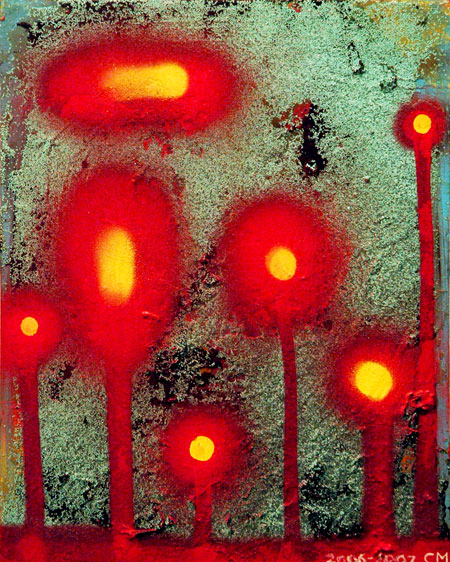
Chris Martin Glitter Painting 2007 oil, spray paint, gel medium, collage on canvas 54″ x 45″
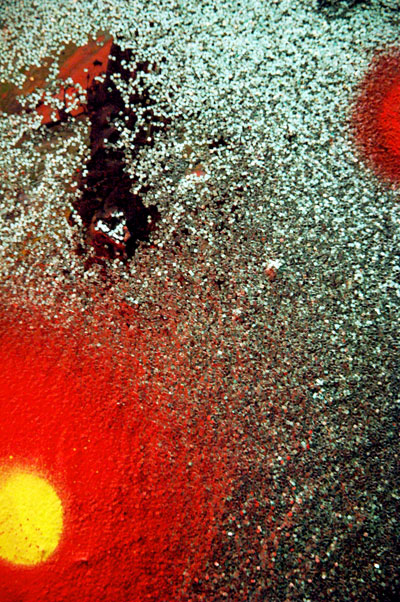
[detail]
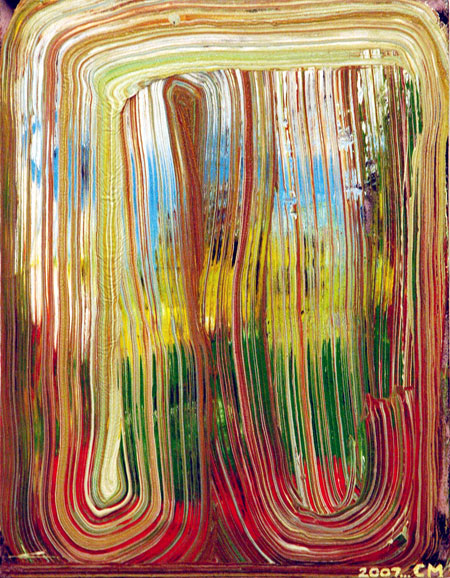
Chris Martin Broom Painting 2007 oil on polyester 48″ x 38″

[detail]
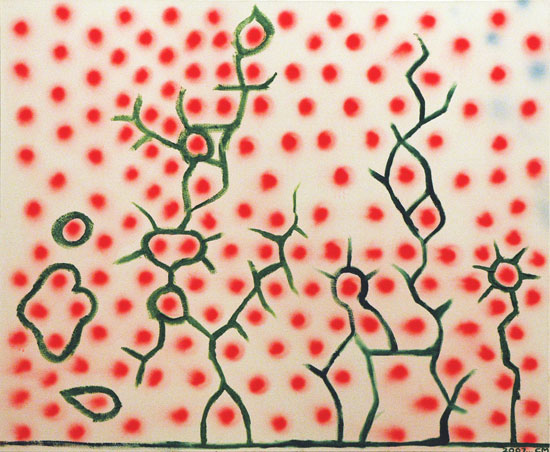
Chris Martin Untitled oil and spray paint on canvas 45″ x 54″
I don’t know how much more I can say about my love for Chris Martin’s paintings, but his latest show, now installed at Mitchell-Innes & Nash until March 1, did not disappoint. There are a few canvases which relate to images and materials done just before this body of work (all of which is from 2007), but there was much that moved into new territory, the kinds of territory Martin is so good at discovering or creating fresh.
I have but one cavil, but it takes absolutely nothing away from my admiration for this show: None of the paintings is particularly large, especially considering the scale of this gallery, and we know the artist is an extraordinary master with canvases executed on a monumental scale. Maybe he’s waiting for the next time; I know I am, whatever it brings.
The first Martin images I ever saw were of some very large black and white paintings reproduced inside a thin catalog I picked up at Pierogi 2000 early in 1997. Unfortunately it was the week after the show had closed. I didn’t know I’d have to wait four years before I saw the real thing. But the reward was great, and only partly because of the great size of two of the canvases shown at Malca Fine Art (one three-panelled work was 36 feet wide) in the spring of 2001. I think I could live with the aura of either of them for the rest of my life.
inside window, 23rd Street platform
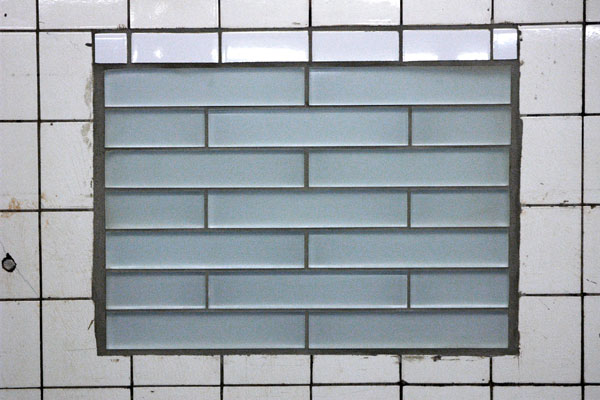
untitled (lines) 2008
303 Gallery continues to ignore modern world
Whew! This photo prohibition thingy is becoming even more insane. Check out Ed Winkleman’s post on the subject, and don’t miss the comments and the several links you’ll find there.
I apologize, to myself and to anyone else who might be concerned about the issue, that the current show at 303 Gallery is listed on ArtCal.
I have written on this site that neither I nor the calendar would include shows in galleries which do not permit photography. The listing which appeared this month was simply an oversight. It will stay up until the show closes, but only because James Kalm‘s provocative video is now tagged on the ArtCal listing. It’s the last 303 show we will be listing until the gallery comes to its senses.
475 Kent: the insanity of New York housing policy
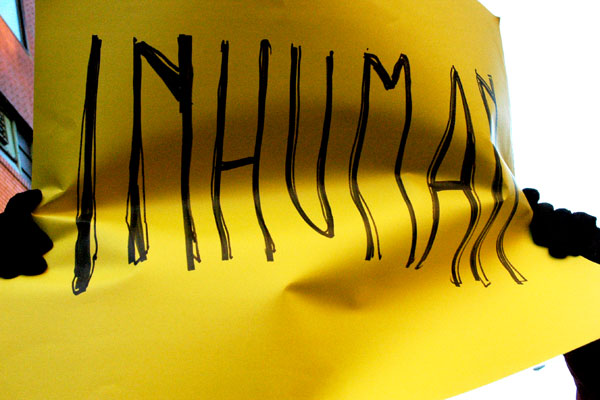
a silent cry from a witness across the street two days ago
Whatever the bureaucratic, commercial or political story which lies behind the human tragedy of New York City’s dreadful and totally irresponsible eviction of over 200 men, women, children and their pets from their homes in the darkness nine days ago on one of the coldest nights of the year, if this doesn’t radicalize New Yorkers, we deserve whatever we get.
But there is no acceptable outcome to this particular tale other than the quick return of these people and a proper accounting of the official malfeasance which resulted in their removal in the first place.
Bloomberg, Markowitz, Quinn, anybody out there? We do note that that very decent local member of the City Council, David Yassky, has been with this story from the beginning, was at the scene on Sunday, and appears to be very supportive of the vibrant and creative community which has lived and worked inside this massive, 11-story Williamsburg building block for ten years.
For more on the story of 475 Kent, see Bloggy and any number of other on-line sites.
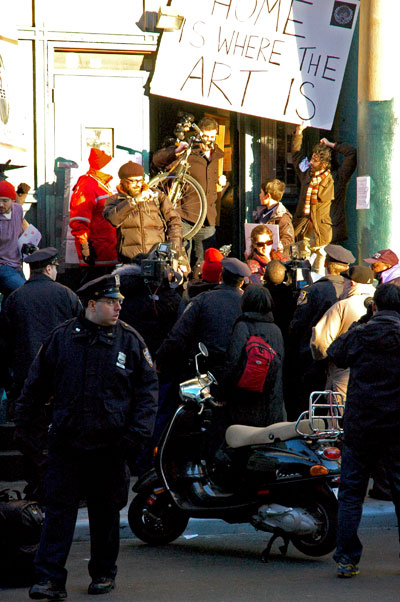
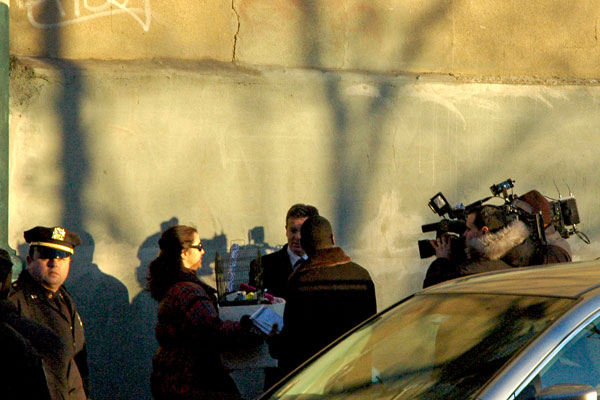
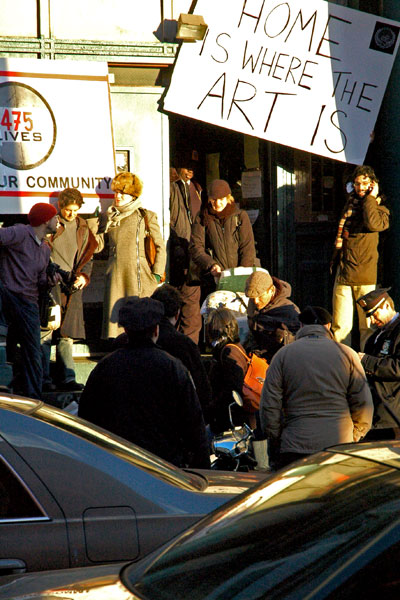
The images below were taken this past Sunday night. They show tenants retrieving their possessions (boxes, art, bicycles, baby carriages, parakeets, etc.) in the last moments before the building was finally padlocked, for a painfully-indefinite period. A large crowd gathered across the street in the bitter cold to observe the sad scene.
If you go to Barry’s flickr images, note the Police van parked on the sidewalk adjacent to the large crowd which was repeatedly pushed back from the parking lane onto that part of the sidewalk not occupied by an NYPD vehicle.
black & white grid under the High Line
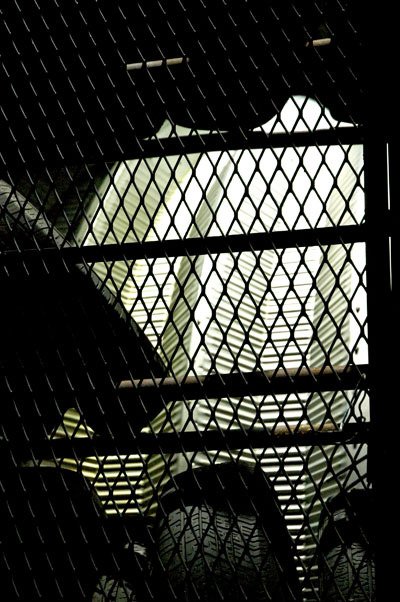
untitled (diagonals) 2008
Jan De Cock at the Museum of Modern Art
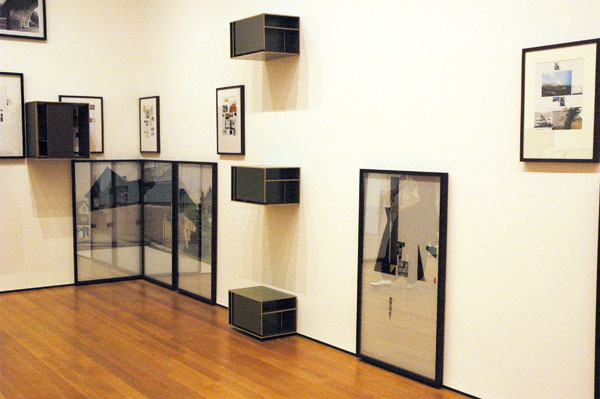
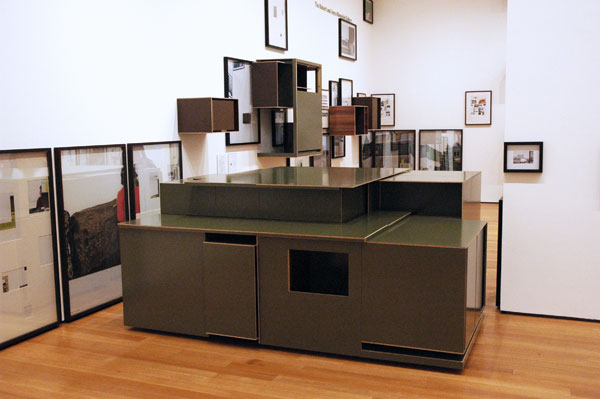
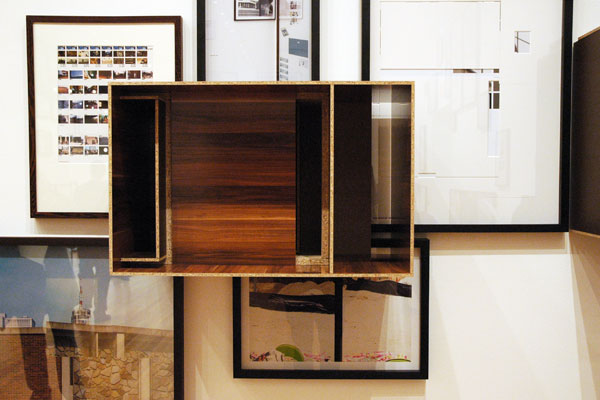
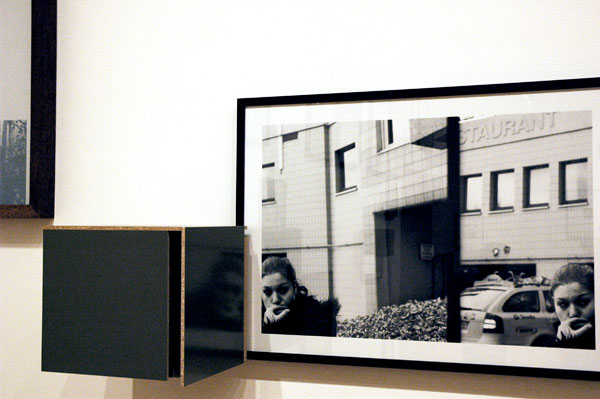
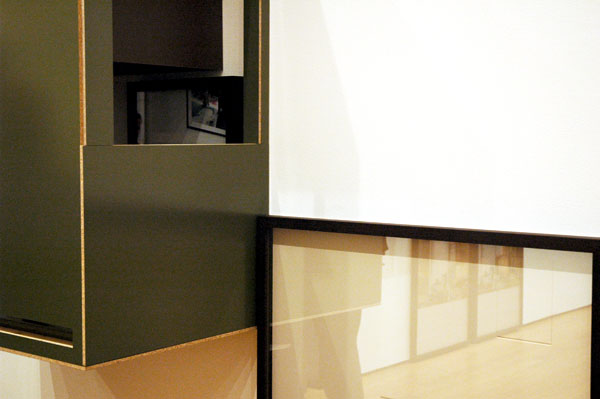
When I was very young and still a wide-eyed Midwesterner, I used to think that one of the neatest things about art was that you could conceivably do something that was more or less an accident, and pretty messy, or you might even find something somewhere that already existed, and you could put it into a frame or in a nice room and it would look very cool.
I loved Modernism, even as a child.
I skip ahead now, and I recall that for a number of years I’ve been watching more and more artists do stuff that didn’t want to be in simple frames or placed in perfect white rooms, and in fact it was stuff that wouldn’t look as cool if it were there.
I love messy art too.
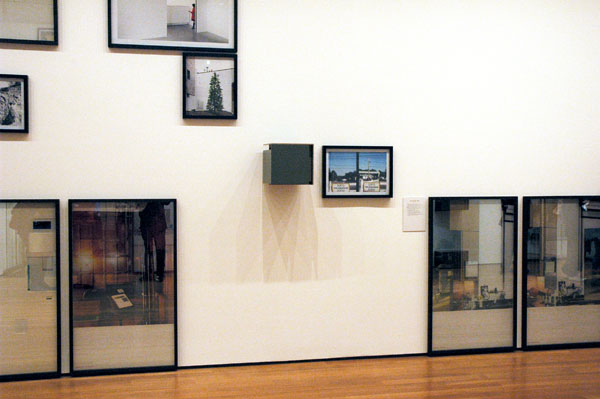
The artist Jan De Cock puts some very nice stuff in those frames and he installs those pictures and his very nice sculptures in those rooms. It works very well, and it looks really great. In fact it looks monumental. The Museum of Modern Art hosted a press preview last night for a very striking exhibition of De Cock’s work, titled, as luck would have it, “Denkmal 11” [Monument 11].
It’s so darn neat! I found myself instinctively resisting its pull, but I can’t argue with what I have to describe as the artist’s genius.
If I say that I think what he does could also work without the expensive constructions which delight the mind and eye here and in other installations, I’m not taking anything away from what he has accomplished. I can imagine his voice and his gaze opening us to just as much eloquence and beauty if he were content with humbler, materials mounted more humbly. While the sharp edges and perfect planes of the elegant Formica boxes which visually secure and give depth to the installation’s two-dimensional works (hung so as to claim the full height of every wall) are clearly his choice, they could just as well be constructed of cardboard with a variety of cardboard mats substituted for the fine frames
But it certainly works as it is.
This is not “found art” as it is usually encountered today, but although what he employs in his work isn’t physical detritus, it really is “scraps” of found and created images which describe a broad category of the “monuments” of our modern American condition. Like the work of his contemporaries who manipulate assembled elements, what makes it art is both what he picks and what he does with it after its picked. What makes it monumental is its encyclopedic ambition.
I’ve now encountered De Cock’s art for a third time, even if this may be his first solo show in the U.S., so maybe I’m ahead of most of my compatriots who will find their way to the galleries at MoMA in the next three months. When I was invited to a private installation in March, 2006, I was little prepared for what I saw. I felt I had come into the middle of a conversation, but my curiosity was roused. A second encounter at an installation in Printed Matter’s Art Book Fair that November reminded me that I had still not done any studying, but at least I finally met the artist – and I tried to cram the book.
The show at the museum looks terrific, and even if all you manage to get to before wandering through the clean white spaces is the writing on the outside wall, you should have enough of an idea of what it’s about to enjoy what you see. Linger. Look closely at the images and the way they have been mounted, then peer at and into the sculptures and investigate the way the frames and boxes have been arranged.
You won’t get bored. There’s probably much more here than any of us will be able to see in the time we alot ourselves. Just as soon as I thought I had put some of this stuff together – brought it to where I thought I had figured out what he’d done – put it into my own frame – I found something that had totally escaped me until then and I wanted to point it out and talk to someone about it.
I brought home two things that might have made the show for me without any help from the art. The outside wall text asks, regarding De Cock’s approach to image-making, “What is the most important thing that remains, the images or a way of looking?” A few minutes later Roxana Marcoci, the show’s curator, spoke to the people assembled at the press preview tonight, saying something about the artist believing, as I very much do, that Modernism is the most important movement in the history of art, and (this is the most important part) that it did not end – that it will not end.
Now if we could only get our local institution to consider those two postulates. Photography prohibitions, to begin, would not survive such an examination, but nor would the current far-too-safe and sleepy curatorial practice. We see truly contemporary modern art too rarely in the Museum of Modern Art; we should all be able to take images of it, and of the rest of the archive, with us when we leave.
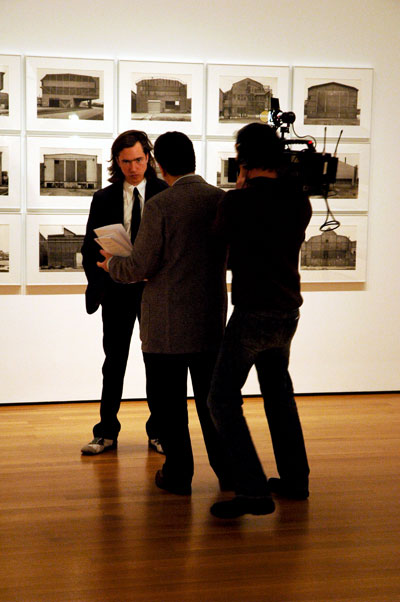
De Cock being interviewed by NewArtTV in the Bernd and Hilla Becher gallery next door
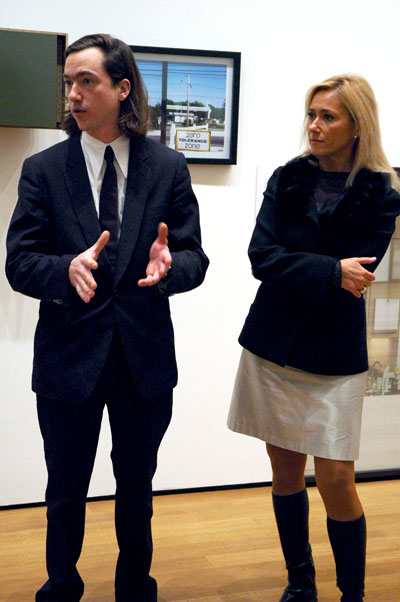
Jan De Cock and Roxana Marcoci
Israel’s civilian blockade war crime creates panic in Gaza
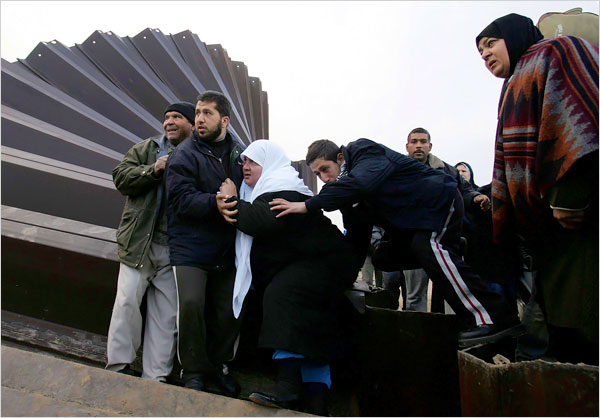
desperate people
Israel’s blockade of Gaza is a war crime*, but the world will not say so.
Desperate Gazans themselves spoke out today when they blew up the wall separating them from Egypt. Tens of thousands have crossed the normally-sealed border to obtain both critical and ordinary supplies unavailable at home.
Much of the beleaguered territory’s 1.5 million residents have faced critical shortages of electricity, fuel, food, medicine and other supplies for months, but in the last week the closure has been tightened dramatically by Tel Aviv.
But we all knew this already, didn’t we? So . . . .
*
Article 54 of the additional protocol of the 1949 Geneva Conventions states that starvation of civilians as a method of warfare is prohibited, and that it is also prohibited to attack, destroy, remove or render useless objects indispensable to the survival of the civilian population, “whatever the motive”.
[image by Abid Katib from Getty Images via NYTimes]
some P.S.1 shows, and the photography thingy
Lovett/Codagnone Party With Us 2006 neon, audio, dimensions variable [partial view of installation (sign flashes on and off)]
When we arrived at P.S.1 the Sunday before last Barry and I identified ourselves at the desk as art bloggers who wished to use cameras inside the galleries. We were asked for cards which would verify our press status and when we produced them we were quickly given identification stickers and permission to photograph anything in the museum.
I felt unshackled in those spaces for the first time since I started uploading art images onto my site, but I didn’t like the fact that our freedom was not shared by every visitor. Barry and I were going to be able to capture, broadcast and comment on images of new and new-ish art to which most people do not have access, but since the photo prohibition continues for people unable to persuade the desk of their worthiness my argument with the fundamental photo prohibition policy of this and so many other institutions has not been overcome.
I should note that the museum’s own web site is really sad, and even if an image actually shows up there it’s so poor it’s almost useless, making the matter of the visibility of work in its temporary custody even worse than it has to be.
The images I’m showing below, which I promised earlier, are of parts of some of the installations which interested me most on this visit. I’d been fighting a virus for ten days so I hadn’t earlier felt up to doing much posting and all of these shows, except for Lazkoz’s mural, closed today. I want to apologize, but at least these modest captures survive.
Incidentally, the usual supply of fliers at the counter by the entry, in which the curators devote some words to the artists and works in each separate installation, was absent entirely, meaning there were no takeaways that day. Did they run out, since some of these shows had been extended, or is this a change in policy which is not welcome?
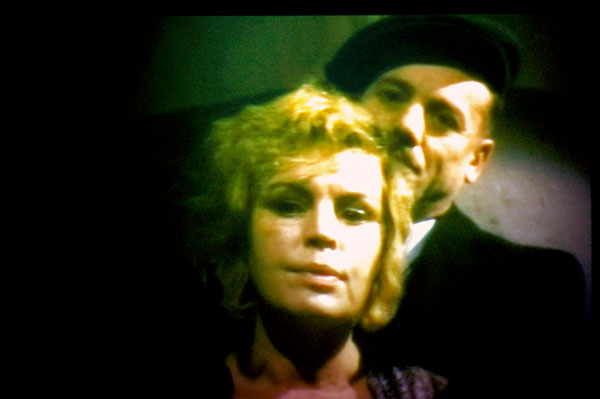
Rainer Werner Fassbinder Berlin Alexanderplatz 1980 film [large detail of still from the screening room showing the episode, “A Hammer Blow on the Head Can Injure the Soul”]
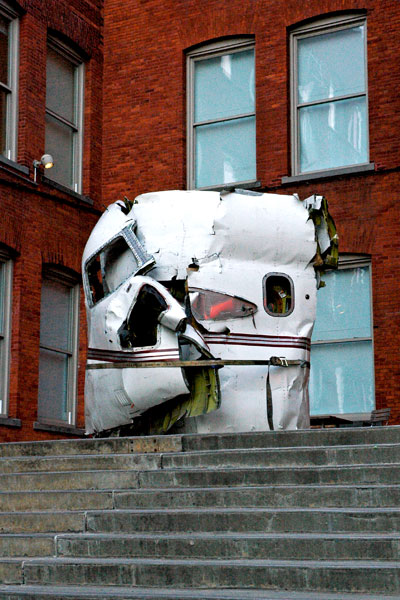
Adel Abdessemed Bourak* 2005 stripped fuselage of an Aerojet Commander 1962 No. 102, 108″ high x 96″ diameter [installation view]
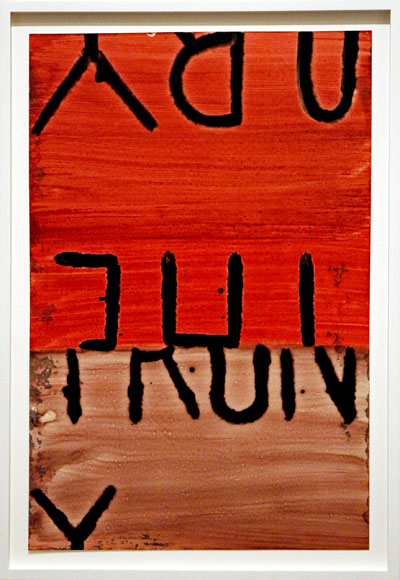
Eyal Danieli Untitled 2007 one of a series of five drawings in ink on mylar or plastic sheeting, 24″ x 16″ each
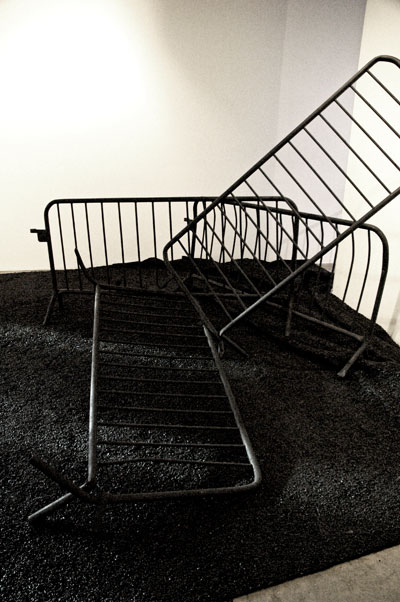
Lovett/Codagnone Interruption of a Course of Action 2007 [detail of installation]
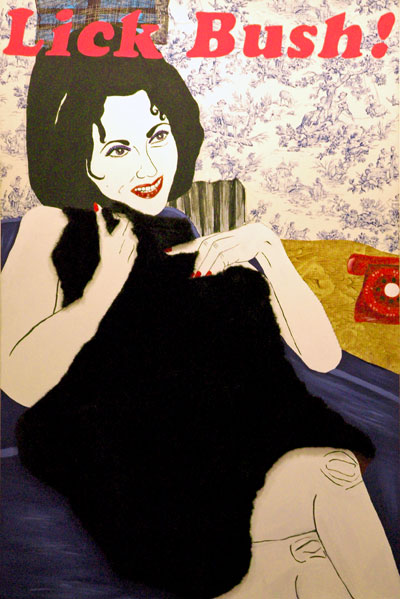
Kathe Burkhart Lick Bush: from the Liz Taylor Series (Butterfield 8) acrylic, fur, mixed media on canvas 90″ x 60″
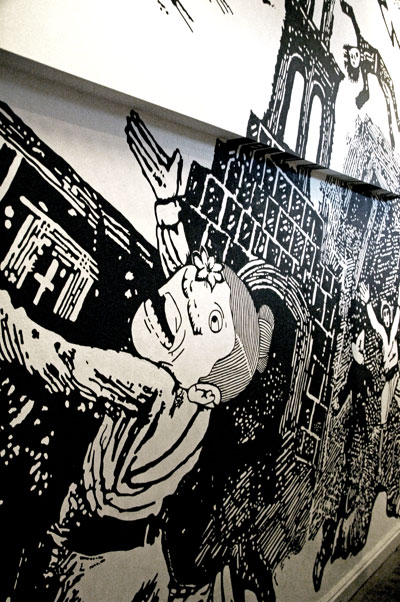
Abigail Lazkoz [detail of mural in stairway]
*
I believe bourak is an Algerian rolled pastry; it can be sweet or savory.
painful “Scenes of Gypsy Life”, in painful seats
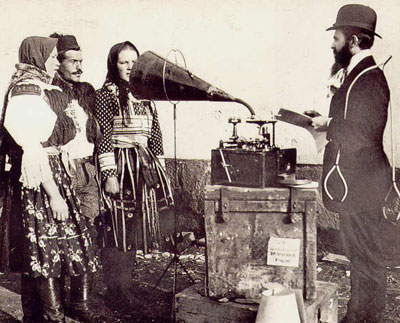
Janáček in a Slovak-Moravian borderland village a century ago, recording singers onto wax
the performance
Did anyone see either of the two performances of the Gotham Chamber Opera’s “Scenes of Gypsy Life” presented this week at the Morgan? Barry and I went on Wednesday, but at this point I’m feeling I must have imagined the experience. While the singers were not to be faulted and in fact should be commended for their courage, the production was otherwise really bad on virtually every count.
I’ve seen nothing in the media suggesting it ever happened (only pre-performance announcements). I waited almost two days before posting this because I thought that maybe I totally missed something. I was hoping to read a review which might explain what the brutal staging was all about, but now I think that reviewers who would ordinarily be inclined to support the company weren’t able to shine a better light on this weird evening than I could.
Basically, I’d like to know whether we’re the only ones who thought it was ill-conceived and incredibly ugly, not to say sadistic and shockingly racist. Neither the poets nor the composers, Antonín Dvořák and Leo Janáček, who set their words into the music heard this week, had intended a slander of the Roma people with whom they all shared a culture. They had all, in fact, intended homage.
And it wasn’t just the director’s treatment of all three gypsies as stock characters. Actually, if there were any reason for the existence of an anti-defamation organization for farm boys represented as monsters, it too would have to be interested in Eric Einhorn’s direction. The raw setup should have presumed one wholesome youth, four pretty gypsy girls, a gentle pastoral scene, music. How (or why) does this scenario become so intensely horrible?
This all seems especially weird since I’ve been to and enjoyed most of this company’s early productions and I would expect to be a part of its audiences in the future. The inspired and often masterful mounting of relatively-obscure operas, with exciting casts and designers, and presented in modest-sized auditoriums: What’s not to like?
the auditorium
I wrote just now that I expected to go back to the Gotham, but I will never go back to a performance at the Morgan library. It’s not so much the architecture of Renzo Piano’s expensive new addition, which is a mess of mall-inspired multiple planes and giant muntins in a confusing layout forced into the spaces separating several worthy late nineteenth and early-twentieth-century buildings, as if these spaces were only so many cavities which needed filling.
It’s the auditorium itself, Gilder Lehrman Hall: I had no idea the architect had retractable feet. But even such a wondrous anatomical gift couldn’t justify making those of us who don’t suffer the consequences of the shape and arrangement of the seats in his little wooden hall. The over-hyped super-star museum architect forgot that most of us ordinary mortals, even when seated, have feet attached to and extending forward from their legs.
Hey, we don’t look anything like the tiny folks for whom Carnegie Hall was designed in 1890 (and refurbished to the same specs a hundred years later); we’re the giants who showed up in 2008, and this is a totally new building!
UPDATE: The NYTimes review, by Vivien Schweitzer, finally appeared in Saturday’s edition. It praises what should be praised and at least as edited for publication almost totally ignores what I found deeply troubling. There will be no more performances, so the review cannot affect a potential audience, and in spite of the writer’s reference to a bloodstained shirt, shackles, and young women being chained up, there is little in her report which might have enlightened anyone who had actually seen the production and been disturbed by it.
[image from remove.radio]