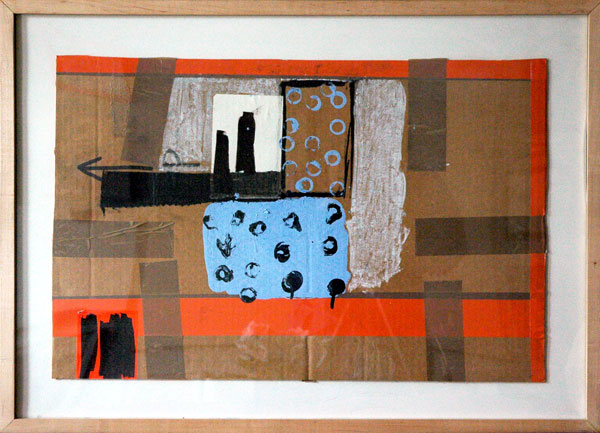
untitled collage piece by Michael Behle, probably from 1999, 16.25″ x 24.5″
I was going to leave the preview stuff on this show to Art Fag City and Bloggy. But then I did spend some time today taking pictures of Michael Behle’s older work, and another post might bring even more people to a Hogar Collection show opening Saturday which he shares with David Choi, I decided not to stay out of it.
Note, as Paddy indicates, Barry writes, ArtCal demonstrates and the artist’s site seems to confirm, that nothing you will see inside the gallery will look anything like this image – or the additional two pix of Behle’s work which appear on Bloggy.
We love Behle’s older pieces, and have always liked Choi’s creature sculpture. Hmmm, . . . . I just realized that the earliest work Barry and I had seen by Behle, even before we acquired these pieces, was also sculpture. In fact these collages may be studies for that series of work, which I’ve still only seen in photographs.
We’re psyched for this show.
Author: jameswagner
Martin Puryear at MoMA
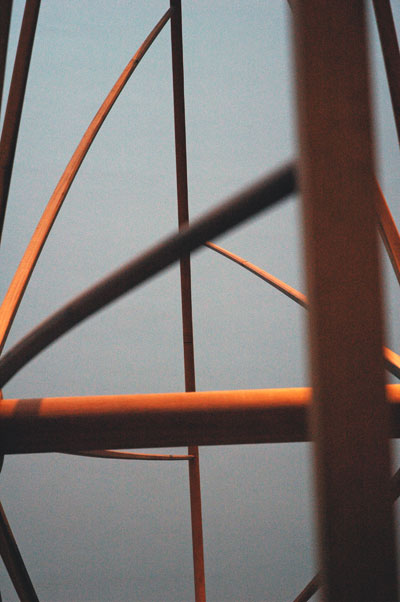
detail of Puryear’s “Desire” (1981)
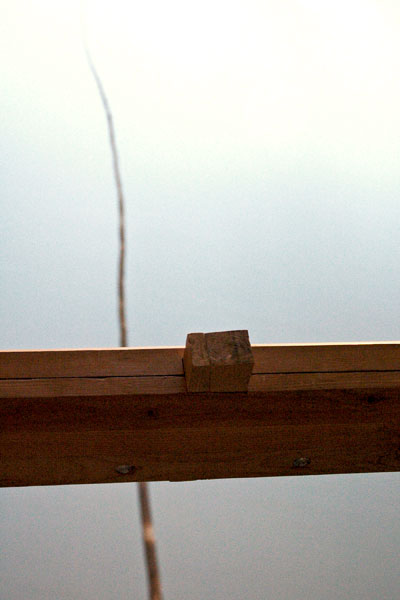
details of Puryear’s “Desire” (1981) in foreground and “Ad Astra” (2007) behind it
I know the show has now closed, but while I was looking at some images to accompany a post on a very interesting visit to PS1 last Sunday, I found these quick snapshots of a part of Martin Puryear’s retrospective at the Museum of Modern Art. They may give an indication of their creator’s intensely-worked craft more than they reveal much about the art itself, but they probably suggest something of how much I loved these pieces – all of them.
I’m not feeling energetic enough to stay vertical long enough to do the post I had started to do. I’m fighting a cold. I think I’ll go take a nap instead, right after I put up these two shots taken in MoMA’s atrium.
Photography of loaned work is still forbidden by the Modern’s directors, but apparently it’s simply too difficult to keep visitors from pulling out their cameras on that large floor and in all the openings which overlook it from the several levels above. If cameras do no harm there, how can there be any justification for continuing the ban elsewhere? I did get to use my camera at PS1 on Sunday, but more about that in my post on the visit itself.
Anyway, I think the Puryear was one of the best shows MoMA’s mounted since the new building was opened. There’s a lot on their web site, but it’s still nothing like being there with the work.
of public toilets: old ghosts and profligate chimeras
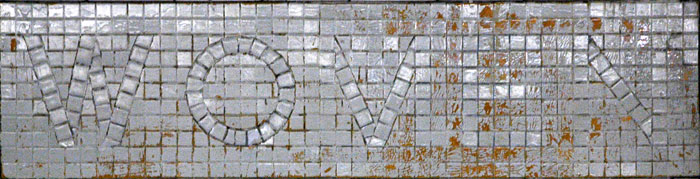
like almost every other public convenience in this city, the two facilities inside the 23rd Street/8th Avenue subway station, one of which is marked by this old whited-out tile sign, has been closed for decades
Now once again [see this 2004 news article, and note that it was certainly not the first] we’re being told that help really is on the way.
The city fathers and mothers (who must never have had to pee, once they were out and about, since some time after World War II) have been talking for years about setting up a few above-ground single-user toilet units around the city for the rest of us. Now we are being told that eventually twenty big automated toilet boxes will be spread over the five boroughs.
There are real problems with this solution which are obvious even now: They call it street furniture, but they won’t be occupying space reserved for cars but will instead be another encroachment on the space left for the increasingly-marginalized pedestrian; it looks like we’ll still have a very long walk between water closets, and a potential wait in line once one of these things is located, particularly if it’s in a high-traffic neighborhood, as I assume they all of them will be; commercial advertising (plus a quarter from each visitor) is supposed to pay for them, meaning that they will also be adding to to the visual pollution of New York’s runaway public billboard epidemic; the toilets will be open (surprise!) only from 8 am to 8 pm; and, oh yeah, they will each use 14 gallons of our precious water reserve to clean the inside of the unit every time it’s flushed (hey, do you think we’re going to be allowed inside to pee during our not-infrequent summer droughts?); finally, how often will they be out of order?
Before replacing it with something else the authorities peremptorily abandoned a system which worked, however problematically. We’ve had half a century to think about what to replace it with, and sadly this is the best they could come up with. I know this is America, but can’t we try thinking minimal once in a while?
Ingar Krauss at Marvelli
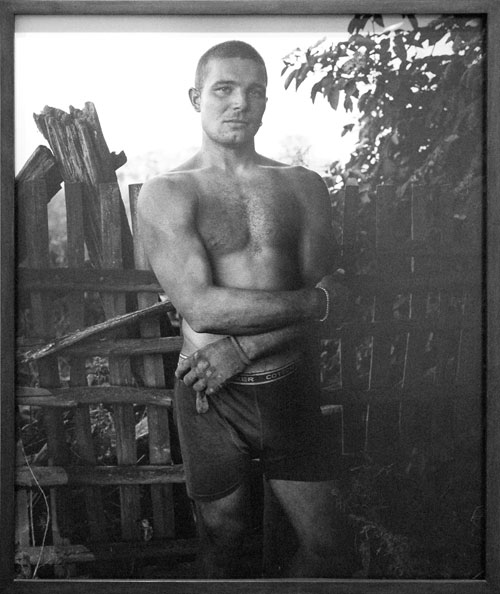
Ingar Krauss Untitled (Beelitz) 2006 gelatin silver print 40″x 33″ [installation view]
Every year thousands of harvest hands come and go like birds of passage.*
Indulge me on this one, as I really wanted to upload this image. No, on second thought, I’d rather bring you with me, and try to explain why I’m so taken with it and all the the others in Ingar Krauss‘s current show at Marvelli Gallery, titled “Birds of Passage”.
Yes, the man is beautiful. In fact he’s very sexy. The very direct, black and white photograph looks like it has the special legitimacy this medium sometimes acquires with age, although the modern knit boxers reveal that the artist is not trying to deceive us on that account.
But there is much more to see here than the man’s own sad beauty and the beauty of the Brandenburg landscape which Krauss has gently draped around his shoulders and around those of most of the other eight men in these portraits. Every one of his workers, photographed here at the end of a long day, is distinctly beautiful. The range of their ages spans every one of the decades in which a fortunate man might expect to enjoy robust life, although several of them would not normally be described as particularly sturdy.
The gallery’s notes tell us that women, and sometimes entire families, are also a part of this seasonal worker migration, but here we see only men, and I suspect that males overwhelmingly dominate the numbers of these seasonal hands. Even the sad subjects of Dorothea Lange‘s documents weren’t usually fighting to survive alone in a foreign land.
Krauss makes me envious of the Germans, and happy for their guests. We need the artistry of a Krauss or a Lange here in the U.S. today, to show us the guest workers on whom we depend so much, visitors both documented and not. This show is a reminder of how much could be done, and what it might mean to us all.
Neither the aesthetic nor the storytelling in work like this can be isolated from the complex history and the simple beauty of the specific environment in which these pictures were captured, in Krauss’s case the underpopulated farms of the former Democratic Republic of Germany, or DDR. It’s also hard to ignore the combinations of personal tragedies and personal hopes contained in the situations in which these migrant Eastern European farm laborers have placed themselves.
There is also tragedy on a larger scale, but a larger hope as well. Even to someone like myself, with a long experience of Germans and Germany, these people look very German. I think about that because it’s likely that no one they are near thinks of them in that way. I’m pretty sure they wouldn’t think of themselves in that way either. And yet here they’re laboring in Germany for long hours on someone else’s land in an alien environment, struggling with an overseer’s foreign tongue in large richly-tilled fields which were once held in common by the socialist brothers and sisters of their own Polish, Russian, Ukrainian or other communities. Will they become Germans some day, or become the proud and prosperous brothers and sisters of Germans, as part of a larger, flourishing European community?
Well, I just wanted to say that I found it pretty tough to walk away from this show, both literally and figuratively. Thus this post.
The show has now been extended until February 2.
Oh, I almost forgot. I’ve seen and admired Krauss’s work at least once before, in a stunning, but heartbreaking show, “In a Russian Juvenile Prison“, mounted in the same gallery in October, 2004.
For more on the current show, see Vince Aletti writing in The New Yorker.
*
from the gallery press release
John Moran and “What if Saori Had a Party?” at PS122
John Moran: ‘Saori’s Birthday!’ (excerpt 1)
Saori, the animated host of a children’s cartoon program, lives in a bubble
Wow. We don’t often get a second chance to experience one of John Moran’s creations, but this week Performance Space 122 is hosting a return of “Saori’s Birthday!” as part of its COIL festival.
You don’t have just my word for its virtues, since the Gia Kourlas, the NYTimes critic, included it among her personal list of the most important new works of the year, and last October Alexis Soloski of The Voice wound up her review with these lines:
A brief confection, lasting barely 40 minutes, What If Saori Had a Party? continues Moran’s recent trend away from his large-scale operas of the ’90sperformed at venues such as Lincoln Center and A.R.T.and toward smaller, more intimate works. It also continues his longtime interest in representing characters not quite human or not quite whole; other works have concerned robots, child-men, and Jack Benny. And it marks another collaborationlikely not the lastwith the luminous Tsukada. As she slides about her airless space, registering every pre-recorded shriek, shudder, whistle, and thump, she’s profoundly silly. Tsukada’s gyrations, Moran’s thorny score, and the air of candy-colored dreadwhat a swell party this is.
Performances of this twenty-first-century dance/music/theater gem continue today through Sunday. Tickets can be reserved on the PS 122 site. They’re pretty cheap, but they’re also just about priceless.
Barry and I hope to see it again on Saturday.
ADDENDUM: Alastair Macauley reviews the piece in the NYTimes today (February 11).
[image and video borrowed from Moran’s MySpace page]
“superdelegates” betray Democrats’ claims of democracy
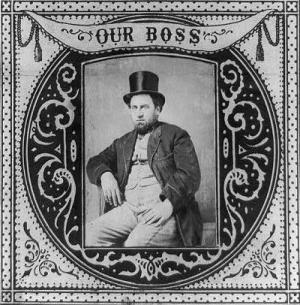
(he’s been split up, and works a little more subtly today)
I was originally just going to make this a comment on an earlier post of mine, but when I realized that if I did so I’d be directly following one of my own I decided to make it a post instead. Besides, this gives it much more visibility, and I suspect what I learned last night will be news to many.
When I saw this statement inside an on-line NYTimes story last night I couldn’t help thinking of a comment from one of my readers to the post in which I touched on the peculiarities of what we choose to call our democratic way:
In the overall race for the nomination, [after the New Hampshire primary] Clinton leads with 187 delegates, including separately chosen party and elected officials known as superdelegates. She is followed by Obama with 89 delegates and Edwards with 50.
“Superdelegates”? By my accounting, Obama should still be ahead of Clinton, having clearly exceeded her number of delegates in Iowa. I quickly checked my handy Wikipedia, and found that the system which established superdelegates was a response to a 1970’s change in the Democratic Party nomination process. Control had been taken out of the hands of party officials and entrusted to the more democratic (small “d”) primary and caucus formats, but the traditional smoke-filled rooms survived, albeit in diminished form. The bosses quicky arranged for the creation of a class of delegates to the presidential nominating convention, made up of elected officeholders and party officials, which was not to be bound by the democratic decisions made by primaries or public caucuses. Superdelegates comprise approximately one fifth of the delegates/votes in the national convention.
My commenter of last week argues for the democratic virtues of the American system, saying that in the “European system”, rather than go through what I might represent as an absurdly drawn-out presidential campaign and a motley series of public primaries,
The parties decide internally who will fill posts, and these decisions are made outside of the process of the election cycle, which is why the cycle runs only 6 weeks. They spend much longer posturing internally, outside of the public eye. Does that sound more democratic?
I would answer that the comparison isn’t so simple as that which he outlines, and considering the incredible mess we have made of the tools of democracy which we have inherited, he may even be asking the wrong question.
There are many more important reasons why the American electoral system fails the democratic test, so I won’t make too much of the impact of superdelegates, but being aware at least of their existence is one more small step toward dismantling the edifice of an unbearably selfish and destructive American exceptionalism.
[image of Boss Tweed, on an 1869 tobacco label, from Wikipedia]

more words on photo prohibitions, these from the artist
UPDATE: Will Ryman heard about his gallery’s attitude toward its visitors’ use of photography, and has commented generously on my recent post about gallery camera prohibitions.
Ryman is a scholar and a storyteller, an artist and a gentleman. I hope Marlborough will eventually decide to make itself worthy of him.
Joyce Pensato at Friedrich Petzel
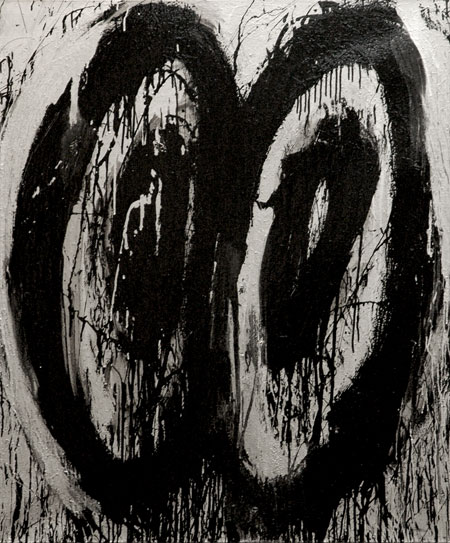
Joyce Pensato The Drippy Droopy Eyes 2007 enamel and metalic paint on linen 48″ x 40″
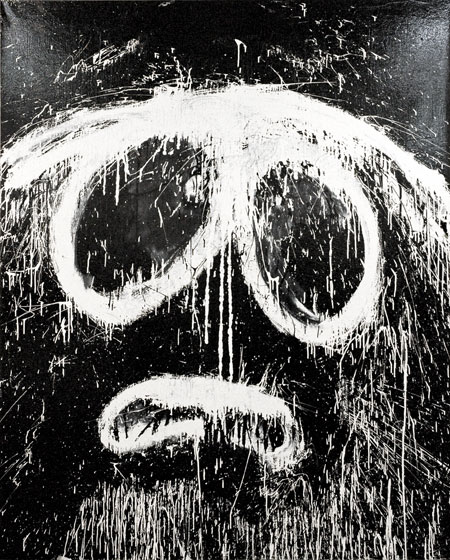
Joyce Pensato Evil Stan 2007 enamel on linen 90″ x 72″
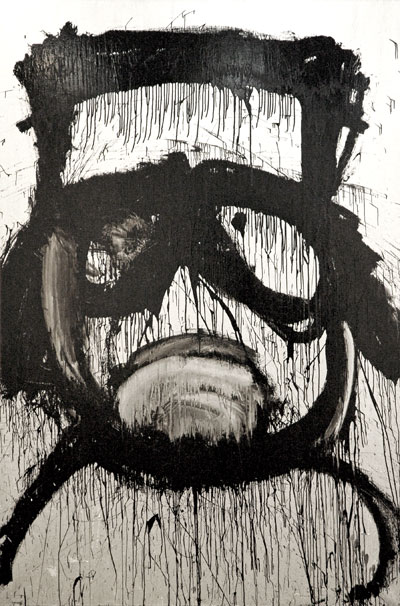
Joyce Pensato I Don’t Want to be Tamed 2007 enamel on linen 108″ x 72″
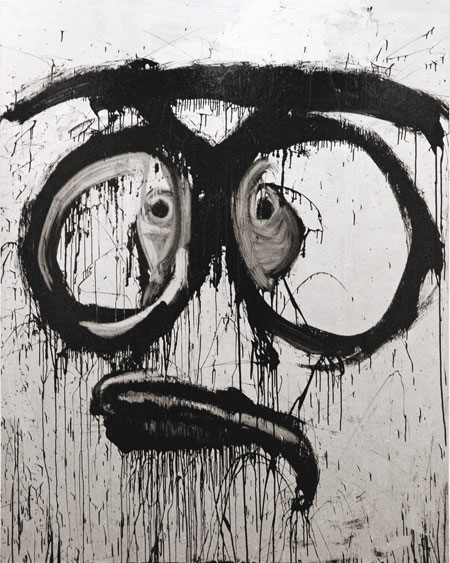
Joyce Pensato Psycho Killer 2007 enamel and metallic paint on linen 90″ x 72″
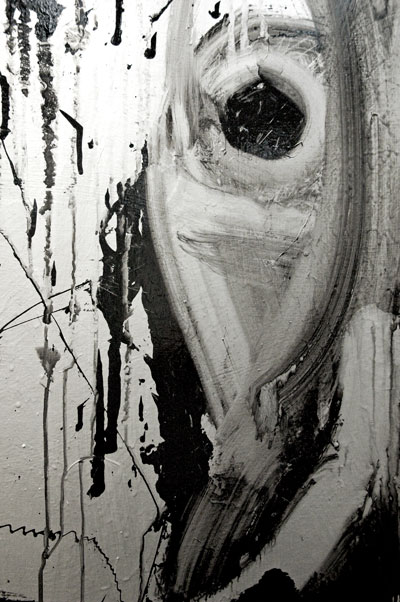
[detail]
Joyce Pensato is back in Chelsea. I first came across her work in the early nineties at Bill Bartman’s Art Resources Transfer. She had donated some wonderful drawings to this legendary non-profit gallery’s annual benefits. They are still among our very favorite things.
Around this same time I spotted a silver and black, medium-sized canvas by the artist at Max Protetch’s gallery. I had missed Pensato’s show at the gallery, but thought this piece was just about the most exciting thing I’d ever seen. I agonized for what now seems like forever over whether I could cover the gallery’s more-than-fair price. Unfortunately my answer was no, but deep down I knew even then that I’d always regret not swinging it somehow. Since then Pensato has shown in Elga Wimmer‘s Chelsea space, installed her studio inside Exit Art for a while, and appeared in a number of galleries in Brooklyn. I don’t think Barry and I have missed any of them. She’s also had solo shows all over Europe, but she hasn’t really been attached to a Manhattan gallery since the nineties.
Until now. Friedrich Petzel has invited her in to mount a show of large paintings in the larger of the gallery’s two spaces on West 22nd Street. These twelve canvases are spectacularly alive, whether seen from across a room or inches away from their surfaces. I’ve always thought of her work as belonging to abstraction, although of course every piece, whether a drawing, a painting, a sculpture or a mural, begins with some iconic American cartoon character.
I don’t really know why American collectors, curators and museums haven’t already gone crazy over Pensato’s work. I hope it doesn’t escape them this time. I don’t normally think of the domestic market for contemporary art as particularly naive or conservative, but I suspect that if she isn’t considered marketable enough it may stem from some weird combination of, on the one hand, collectors’ disdain for what they mistakenly dismiss as a hackneyed choice of cutesy subject and, on the other, their fear of the frightening, even perverse directions in which she seems to take them.
Pensato seems to aim for an ambiguity which balances cuteness and horror. She succeeds over and over again, without ever repeating herself.
Painters have loved her for years and the museums will parade her tomorrow. More people should see her today.
Over the years I’ve become increasingly fond of Pensato’s works on paper (or tortured sheetrock, in the case of many of her murals), partly because of the bits of color which manage to creep into or peek out of the black and white or black and silver sweeps of charcoal or paint, and partly because they so satisfyingly boast the artist’s characteristically-vigorous, even violent erasures. It’s interesting that there are no examples of either medium in this show, although the title, “The Eraser”, alludes to physical operations which are less evident in the paintings.
Go now for the paintings; come back for the drawings I hope the gallery will show next.
more re photo prohibitions and fair use

(invisible art)
I’m not the least surprised that I’ve gotten responses (in comments, emails, and conversation) of all kinds to my several posts on the subject of gallery photo prohibitions. What I have found surprising is the fact that even when they support the idea of openness in general it seems that many people remain confused by the legal issue of accessibility as it relates to copyright.
I know that with this post I’m really asking to be inundated with arguments from all sides, but the issue isn’t disappearing and I don’t think, especially as photographers, that we should be feeling around in the dark.
I’m confident about arguing for openness, but I’m not adequately versed in the case law which supports it, so in order to shed some light on the issue I turned to someone who is. Artist and activist Joy Garnett had to become an expert when her work, which reflects the issues of access and alteration to images found in the media, was challenged by a photographer in 2004.
First off, there’s simply no legal basis for a photo ban based on the argument of copyright infringement. Quoting from the excellent Fair Use Network site:
The fair use doctrine permits anyone to use copyrighted works, without the owners’ permission, in ways that are fundamentally equitable and fair. Common examples of fair use are criticism, commentary, news reporting, research, scholarship, and multiple copies for classroom use.
Staying specific to the discussion here, Garnett emphasizes that in the U.S. film or photographic documentation for purposes of reporting or reviewing, as well as for scholarship and education, especially if it’s non-commercial, is protected in the Constitution under the doctrine of fair use.
The Fair Use Network site continues with this sorry advisory:
Unfortunately, creative industries are often overly cautious in establishing their informal practice guidelines, with consequences that unduly restrict the exercise of fair use rights.
And that’s where we are today. When galleries tell us that we are not permitted to take pictures, they aren’t protecting the artist. More likely, they’re protecting what they see as their responsibility to control what’s going on in their private bailiwick. It may be counterintuitive, and counterproductive to the interests of the visual artist, and of the arts in general, but it is very a part of much human nature.
For more on the subject of fair use and free expression, go to The Free Expression Policy Project [FEPP] site, or the “fair use” entry on Wikipedia.
Now for a change of air, and an excellent immersion course on a topic only partly related to the subject of this post, “Artists, Documentarians and Copyright”, see the excellent Hungry Hyaena.
[image from abandonedbutnotforgotten]

Marlborough Gallery prohibits photography
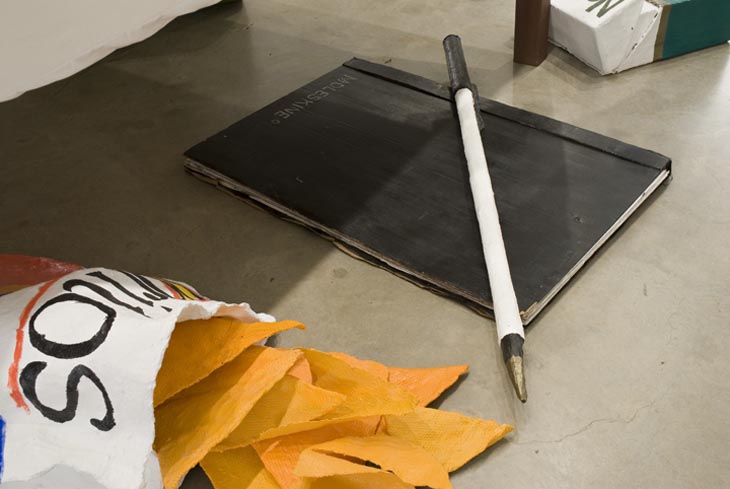
Will Ryman The Bed 2007 papier-m�ch�, magic sculpt, resin, acrylic, wire mesh, wood, cloth [detail of installation]
(the artist taking notes)
No, that headline is not about the fact that Marlborough doesn’t seem to have ever shown artists whose work is photo-based, but rather that the gallery will not permit photography goings-on in its spaces.
This afternoon I watched the attendant at the front desk race across the floor to tell an unsuspecting enthusiast visiting the current installation by Will Ryman that pictures were not allowed. When I followed her back and asked whether the rule was general or only for this particular show, she said that it was regular Marlborough policy, and added by way of explanation (I’m paraphrasing here) that the owners didn’t want people to use their photos for something unauthorized.
Sure, that would be something like, um . . . selling t-shirts with images of Will Ryman sculptures? I don’t think the artist is going to worry about that. Nor do I think he would regret having visitors extend their memory and their pleasure in what should be treasured by all, circulated and displayed, as a demonstrably visual art. Even better, what about the ability of photography (the modern word of mouth) to enable others who are unable to visit the gallery to share in the pleasure of someone who can, before the work itself disappears into the home of a rich collector? Maybe the unauthorized snapshot would be simply the equivalent of taking notes.
Perhaps when we visit Marlborough and galleries with similar policies we’re actually in the wrong century or on the wrong continent: Photography hasn’t been invented yet, or it must be some foreign sorcery being used to steal our souls (or “copyright”). Would a visitor be permitted to sketch the work or scribble some paragraphs on a pad?
Barry and I have admired Will Ryman’s work for some time and both of us have mentioned his show appearances on our sites. I’m very sorry that our shared position on the stupidity of photo prohibitions will prevent us from reporting on such a major event as this one. The Marlborough Gallery has never been featured on either of our blogs, but because it was Ryman’s this show was included in the listings (we made it a pick) on ArtCal listings, our on-line edited calendar of New York gallery shows. As long as the management maintains its current policy it won’t happen again.
[image from Saatchi Gallery]