
untitled (sushi tray) 2007

untitled (bubble and foam) 2007
Author: jameswagner
Hany Armanious at Foxy Production
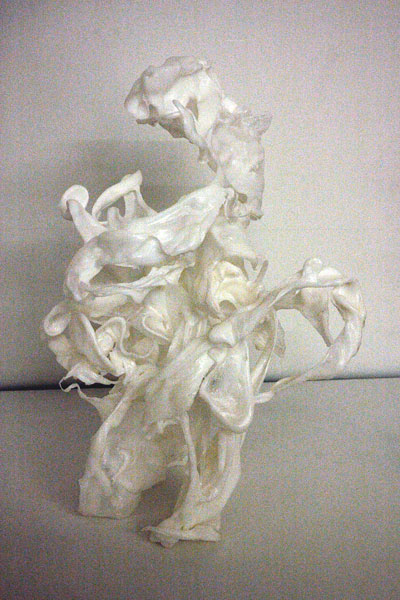
Hany Armanious Basic Construction 2007 PVC 19″ x 11″ x 11″ [installation view]
I’m starting with an image that isn’t even part of Hany Armanious’s first solo outing at Foxy Production. I spotted this flamboyant little piece sitting on a table in the low light of the gallery’s rear office. It’s very different from the shapes and materials included in the show itself, and yet it clearly has more than its creator’s fertile imagination in common with the much larger and earthier work gathered in the equally-darkened main exhibition space under the off-putting rubric, “Year of the Pig Sty”.
I was already primed to appreciate whatever Armanious might do for this show, having liked very much his work the gallery had shown early this spring at the Armory show. On the other hand, I don’t think anything could have prepared me for what even the press release [required reading here] has to confess looks like “a shocking vista of filth and disarray”.
In Armanious provocative work, perverse actions take place upon unexpected materials, resulting in enigmatic objects, scenes and associations. Like a pranksterish alchemist, he transforms the process of casting into a witty and symbolic practice. His detours and digressions through the fictional systems he constructs, paradoxically foster both confusion and engagement.
I loved it. I only worried that the more casual or less adventurous gallery visitor, staying on the outside of the glass front door, might read the messy darkened space as the doleful site of an abandoned shop, or the only slightly happier scene of an installation somehow gone awry.
“Basic Construction”, the pure white, water-molded PVC sculpture resting on a table in the back of the gallery has the elegance of a rococo porcelain figurine, although it has abandoned any pretense of the kind of naturalistic representation which bound eighteenth-century models; this fancy is pure form – and the eye, delighted, imagines it taking wing.
“Year of the Pig Sty” is about the casting objects with a much more grounded approach (pun almost intended). At the same time it appears to be as much about the possible, what hasn’t happened yet, as it is about actually building things. Armanious is still in the process of making stuff here, or at least showing us how stuff might be made (since it seems very unlikely he’s going to pick up where he’s left off), although I don’t think he’s telling us why. Still, I think I’m hooked, and I probably won’t be alone. There’s more room for our wits and imaginations among these peculiar orchestrations of mud, steel, plastic and felt – and still more mud – than there is in most artist-led mystery tours.
The gallery’s site has more images of work in this show and of other work by the artist.
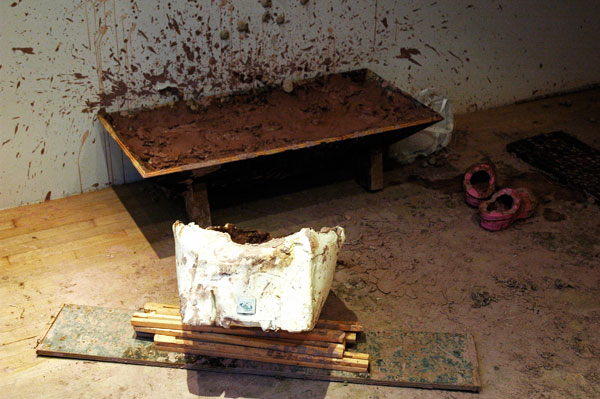
Hany Armanious Year of the Pigsty 2007 real mud, formply, wood, silicone, pigment, polyurethane, slingshot, dimensions variable [detail of installation]
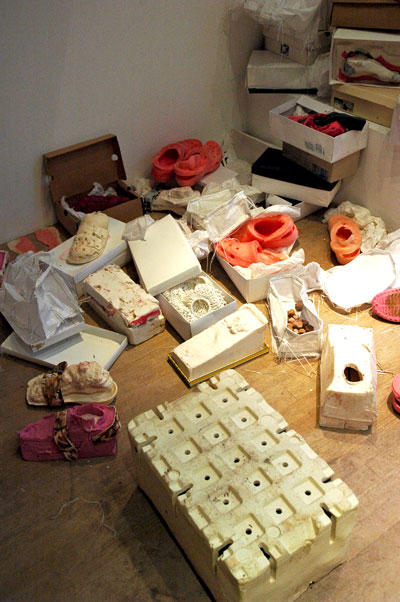
Hany Armanious Year of the Pigsty 2007 real mud, silicone, pigment, epoxy, polyurethane, cardboard, plaster, snooker table pockets, dimensions variable [detail of installation]
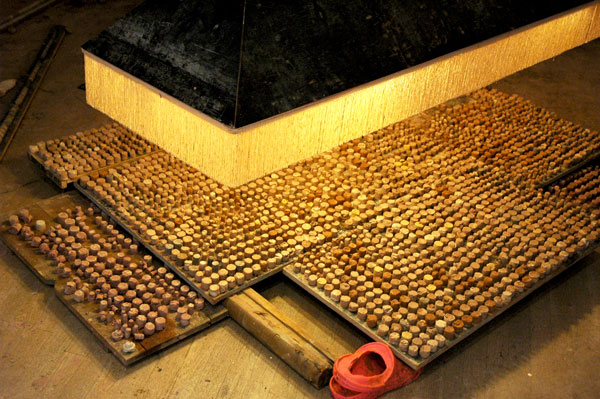
Hany Armanious Year of the Pigsty 2007 real mud, epoxy, metal clamps, formply, fringing, chain, electrical components, wood, 71 lightbulbs, 1538 real mud bricks, resin, felt, dimensions variable [detail of installation]
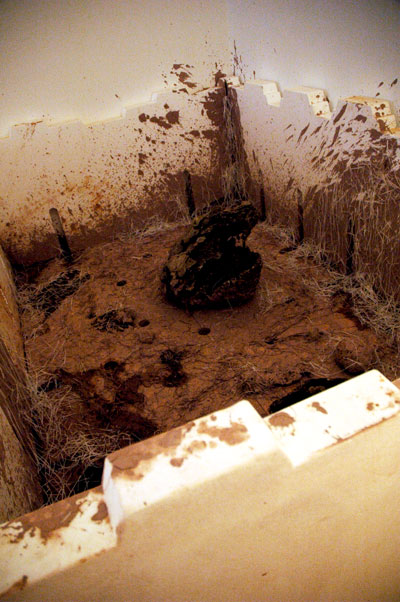
Hany Armanious Year of the Pigsty 2007 polystyrene, real mud, silicon, dirt, shredded plastic 40″ x 112″ x 75″ [large detail of installation]
Bryan Zanisnik at Priska Juschka
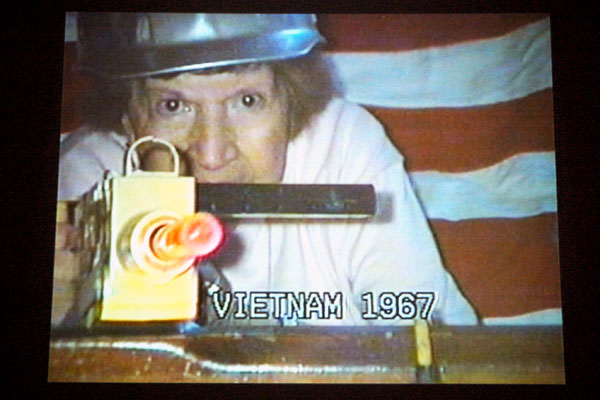
Bryan Zanisnik Remembrance of Things Past 2007 video [still from instalaltion]
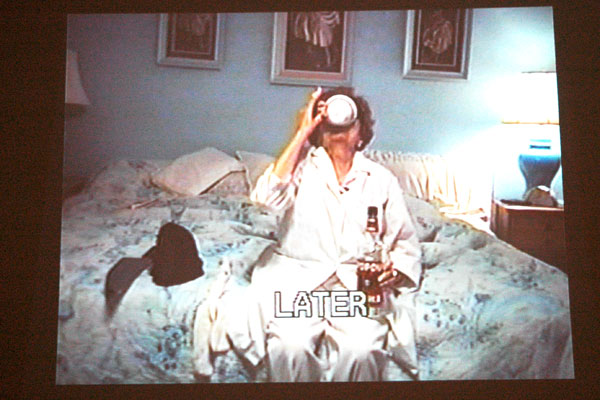
Bryan Zanisnik Family Reunion 2007 video [still from installation]
Bryan Zanisnik‘s show at Priska Juschka, “80 Year War“, may be totally charming but it’s also very compelling for reasons I haven’t quite been able to explain to myself. I say this even after having experienced the work twice: Barry and I were first taken with it when we saw an earlier form of it in Zanisnik’s Hunter College studio.
The gallery’s press release explains the project, which is displayed in the space as two DVD videos and several digital C-prints:
In this exhibition, Zanisnik will present two videos from his series 80 Year Wara video project that he initiated with his grandmother between the ages of 13 and 15. In this work, he filmed his grandmother and parents re-enacting several plots of war, immigration, and gangster predicaments. Rather than perceiving the original footage as raw material, Zanisnik considered it an archive from which he pulled various portions without manipulating them. Thus, culled from eight hours of overall footage, these short videos are the result of an extensive and insightful editing process.
No, it’s probably not just about seeing this entire delightful family indulging the ripe fantasies of an imaginative son and grandson, and I’m pretty sure it’s not the suggestion of environmental consciousness, its recycled-materials aspect. I’m thinking more of the fact that we’re looking at footage assembled from video the adult artist had shot when he was in his early teens: How could art be a more fundamental and direct expression of its creator’s Bildung? I also can’t forget the oddly-sweet, safe moving pictures and dialog of Zanisnik’s games, and comparing their innocence with the ugly, dangerous reality of the world which was unfolding as the child became an adult.
What does the decision to mount this kind of work say about a young artist’s self-confidence? I’m happy to say that it was more than warranted, and I can’t wait to see what’s next.
not so strange: Dalai Lama and Bush very good bedfellows

I’m thinking a blood-red ink would be more appropriate about now
Well of course he and Bush get along. Although he was presented the Nobel Peace Prize in 1989 “for his consistent resistance to the use of violence,” the Dalai Lama (aka Tenzin Gyatso) supports war, including the Iraq war. Of course by now we know that the Dali Lama supports everything. It’s what makes him so popular.
Today I accidentally came across a post I wrote four years ago at about the time of the last visit to the White House of the West’s vagabond Tibetan saint obsession [what I call the bandwagon/group-think syndrome]. I think it was already the smiling Gyatso’s second audience with Bush, and at that time I excerpted a report on the Guardian site:
The Dalai Lama said Wednesday that the U.S.-led war in Afghanistan may have been justified to win a larger peace, but that is it too soon to judge whether the Iraq war was warranted.
“I think history will tell,” he said in an interview with The Associated Press on Wednesday, just after he met with President Bush.
I’ve looked everywhere online, but I couldn’t find any sign that history has told His vacuous Holiness anything yet.
I’ll end by confessing that I’m no longer capable of being surprised by another form of hypocrisy, that of our peace-lovers in Congress pretending to be fired up about a Chinese-occupied Tibet while they continue to pursue the ruination and occupation of their own, equally-defenseless victim state in the Middle East.
[image of the Dalia Lama’s handprint from mmothra]
Lucas Moran at Buia
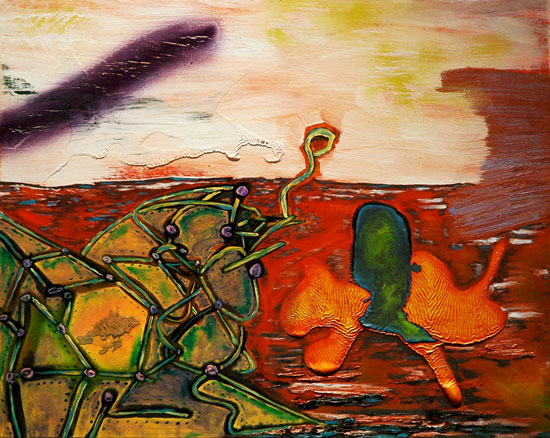
Lucas Moran Fishing Net 2007 oil and spray paint on canvas 24″ x 30″
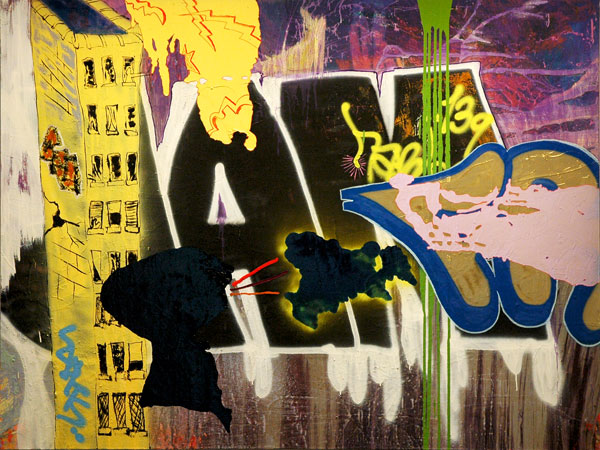
Lucas Moran Summer Jam 2007 oil, spray paint and galkyd on canvas 62″ x 84″
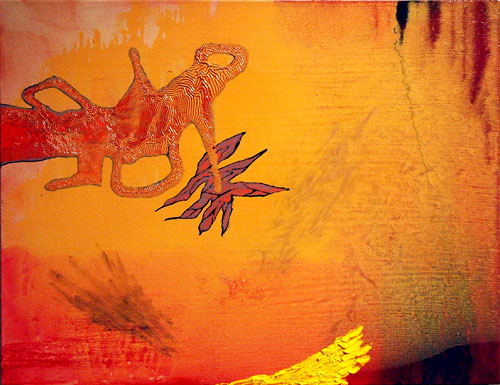
Lucas Moran Untitled 2007 oil, spray paint and galkyd on canvas 18″ x 24″
Because of a lot of distractions, only some related to visits to galleries, I’m way behind on a lot of my self-assigned postings, and I’ve wanted to do at least a quick post about Lucas Moran’s show at Buia, “From Here On Out“, for several weeks now. The artist’s small to medium-sized canvases exhibit a mix of tangled shapes and extravagant colors worked, and sometimes alarmingly distressed, in oil and spray paint, here and there including galkyd, and occasionally revealing traces of powdered sandstone.
These paintings broadcast equal elements of chaos and order and remain fundamentally non-pictorial even if they don’t leave our imagination to wander totally unattended: Many include both subtle and conspicuous graffiti and pop art components – sometimes both – welcome interlopers which focus Moran’s abstraction, dragging us into an exotic, alien world whose gritty seductiveness is intensified by the artist’s ability to manipulate the mixed media with such wicked skill.
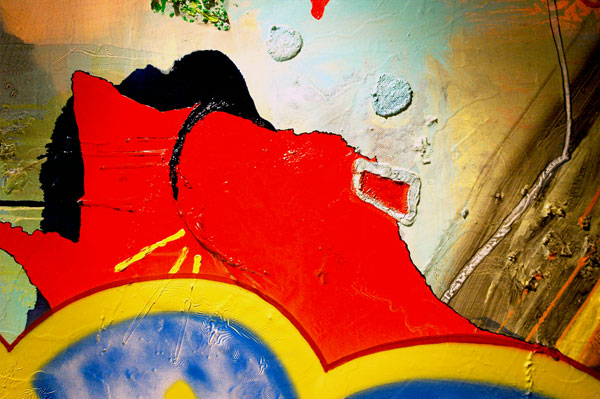
Lucas Moran Untitled 2007 oil, spray paint, sandstone and galkyd on canvas 62″ x 50″ [detail]
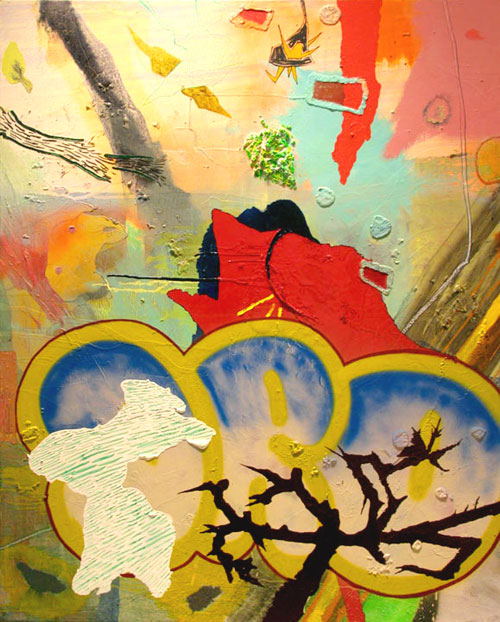
[full image]
More good stuff on Moran from Tom Moody.
[thumbnail image from the gallery]
we Americans are ‘good Germans’
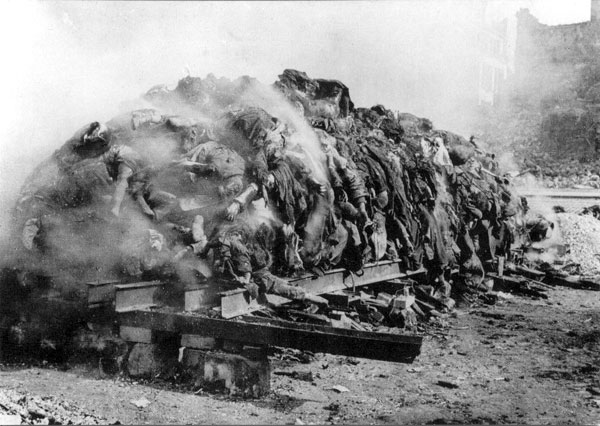
war is never what we expect it to be: Dresden, stacked bodies after 1945 Allied firebombing
We despair.
Four and a half years ago Barry and I each decided that we were retiring from both direct and indirect political action. We had just gone into the streets along with almost a million of our neighbors to protest the Bush regime’s plans for an unprovoked war against a small, almost defenseless state on the other side of the planet only to see the media virtually ignore the the demonstration and our two senators go on to support the the cynical, naked aggression in spite of polls which showed the majority of the people in New York State opposed it.
I don’t even sign petitions any more.
So why should I be surprised today to see that almost everyone else may have made the same decision? Americans now seem to be sitting this one out. They’re still answering the pollster’s questions, and in spite of the statistical bump favoring the war in its early stages, they still don’t like it, even if that’s as far as they’re willing to go.
Some four weeks ago, upon hearing the news of the latest failure of our so-called Democratic Congress to do absolutely anything to end a war which three quarters of Americans now oppose, Barry said to me, “That’s exactly why I’m now so estranged from political life”. I’m there too, but I’m sickened as he is by so much more than just the war itself: There are the cold Constitutional issues of course, which no one seems interested in dealing with, but the war and its hundreds of thousands of deaths and maimings, millions of refugees, and incalculable numbers of destroyed lives is only the most spectacular part of an even broader system of terror which has been corrupting us all. This is a campaign which threatens people everywhere in the world including of course our own communities, a vicious but also incredibly stupid and dangerous crusade unleashed in our name after September 11. We have prisons and countless “interrogations” consciously designed by our elected officials and governmental institutions to exist outside of any known system of justice. “I see no sense of outrage by the people running our government”, Barry continued. “They show absolutely no sense of outrage.”
In fact neither of us sees much evidence of outrage anywhere within our borders, including an absence among ordinary citizens. In spite of the fact that we don’t have the kind of motivation which a fully-developed police state might provide, we, that is all Americans, have become very good at being “good Germans“.*
I started writing this post in mid-September but only got as far as a short mock-up. Frank Rich’s passionate Op-Ed piece in Sunday’s NYTimes [conveniently, the online text has direct links to his references] made me go back to my notes. Rich uses the phrase “Good Germans” in his headline without fully defining it, but he does do an excellent job of shattering any illusions of innocence we might still retain.
We do torture people. We can no longer deny it. This may be the first time you’ve seen Andrew Sullivan’s name used on this blog (and I’d like it to be the last), but Rich links to our lazy mainstream media’s designated homosexual spokesperson to illustrate the connection between the administration’s “interrogation” practice and that of the Nazis.
As Andrew Sullivan, once a Bush cheerleader, observed last weekend in The Sunday Times of London, “America’s ’enhanced interrogation’ techniques have a grotesque provenance: ’Verschärfte Vernehmung’, enhanced or intensified interrogation, was the exact term innovated by the Gestapo to describe what became known as the third degree. It left no marks. It included hypothermia, stress positions and long-time sleep deprivation.”
We apparently do commit war crimes, and we hire mercenaries. Rich believes the tale of our well-paid hired guns is “a leading indicator of every element of the war’s failure”, and sometimes the worst stories can’t be swept under the carpet. Three weeks after the Nisour Square massacre of 17 Iraqis, the Times columnist skillfully parses the more recent killing on Tuesday, by members of another private security firm, of the two women driving a car in Baghdad in these words:
The gunmen who mowed down the two Christian women worked for a Dubai-based company managed by Australians, registered in Singapore and enlisted as a subcontractor by an American contractor headquartered in North Carolina. This is a plot out of ”Syriana” by way of ”Chinatown”. There will be no trial. We will never find out what happened.
We’re now “laundering” our atrocities! Is anyone out there following this?
Actually, almost all of us are going about our business as if nothing is happening. We’re not lying down on the tracks in front of troop transports. We’re not wearing badges announcing our identification with the muslim “other”. We’re not beating down the doors of the NSA demanding that we be “interrogated” about our loyalty to the “Homeland”. We’re not running standing in front of a Marine Sergeant’s M-16 as he tries to search the home of a frightened Iraqi family.
Yes, these are heroic acts, and perhaps they’re completely preposterous in the twenty-first century, but I don’t even see or hear us talking about resistance in any form.
The rest of the world is following this very closely. We don’t look good. We’re already paying for our cowardice, and the bill is not going to get any smaller. Rich’s column concludes with a warning and an appeal:
Our humanity has been compromised by those who use Gestapo tactics in our war. The longer we stand idly by while they do so, the more we resemble those “good Germans” who professed ignorance of their own Gestapo. It’s up to us to wake up our somnambulant Congress to challenge administration policy every day. Let the war’s last supporters filibuster all night if they want to. There is nothing left to lose except whatever remains of our country’s good name.
I have to end by saying I just don’t share his Frank Capra optimism. How can we as ordinary Americans expect to have any impact on government policy when we have neither democracy nor the stomach for serious revolt?
*
Borrowing the definition found in Wikipedia: The ‘good Germans were the citizens of Nazi Germany who, after 1945, claimed not to have supported the regime, even if they made no effort to oppose it. Today the term has been given a broader application, one which refers to people in any country who observe reprehensible things being done by their government but nevertheless remain silent and do not challenge or impede them.
[image from erichufschmid via airamericaradio]

Pro Publica arrives in town: expected to speak to power
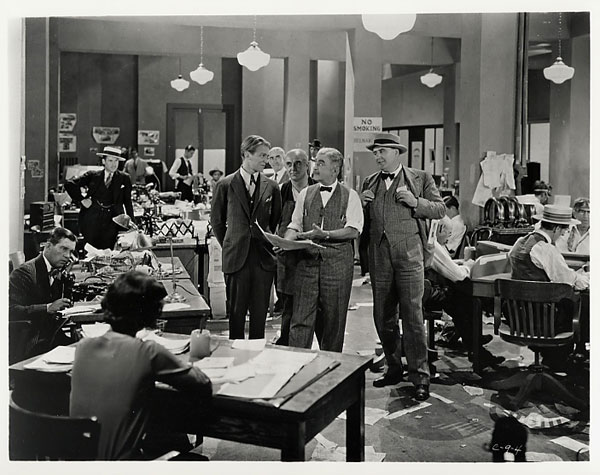
In the middle of the Times city room in The Power of the Press (Columbia Pictures, 1928), the city editor (Robert Edison) congratulates cub reporter Clem Rogers (Douglas Fairbanks Jr.) for getting his first page-one story as the more seasoned reporters gripe that it was all beginner’s luck.
Sometimes the news about the news is the best news.
In the NYTimes today we learn about the formation of a well-funded and independent, non-profit group of investigative reporters who will give away their work to individual news organizations, those in which its work will “make the strongest impression”. Beginning early next year Pro Publica will operate out of a newsroom in New York City with 24 journalists and a staff of about a dozen more on an annual budget of $10 million.
[Paul E. Steiger, previously top editor of The Wall Street Journal and soon to be Pro Publicas president and editor-in-chief] said he envisions a mix of accomplished reporters and editors, including some hired from major publications, and talented people with only a few years experience, so that the group will become a training ground for investigative reporters. He would not say specifically where he is shopping for talent, but did not rule out The Journal.
I don’t see how the project could fail. Both commercial and non-profit news organizations are cutting costs and neglecting the kind of journalism which will be Pro Publica’s meat and potatoes. If one outlet declines to pick up the coverage they offer, another will. At the very least the one which turned down the story will be asked why it isn’t covering it. And there’s no reason why this thing would have to be confined to the print media.
Mr. Steiger said that relationships with publications could be tricky, requiring the flexibility to make each comfortable.
In most cases, he said, Pro Publica will appeal to a newspaper or magazine while a project is under way, to gauge interest and how much oversight the publication wants. In others, he said, his group might present more or less finished products to other outlets.
If Pro Publica and a publication cannot agree on how to approach a topic, or what can be written about it, he said, his group will look for another outlet, or publish its reporting on its own Web site.
Did I mention that the the plan is to do “long-term projects, uncovering misdeeds in government, business and organizations”. Quoting Steiger, describing how Pro Publica hopes to fill a vacuum in almost all current news coverage: It is the deep-dive stuff and the aggressive follow-up that is most challenged in the budget process”.
The money comes from Herbert M. and Marion O. Sandler (California mortgage lending, savings and loans), described as major donors to the Democratic Party and critics of President Bush.
Mr. Sandler [who will serve as chairman of the group] said his interest in investigative journalism has been abetted by friendships with reporters in the field.
Both my father and my older brother always focused on the underdog, justice, ethics, whats right, Mr. Sandler said. All of my life Ive been driven crazy whenever I encounter corruption, malfeasance, mendacity, but particularly where those in power take advantage of those who have few resources.
Old-school progressive journalism breathes again, paradoxically funded by a pair of “financial honchos” and directed by a successful Wall Street Journal editor. This is not exactly “Mr. Smith Goes to Washington“, but then nothing ever was.
[image and caption from IJPC]
my favorite Iraq war photo

a long way from Williamsburg
I found this image searching Google while preparing my post about Ashley Gilbertson’s book. It’s from a photo-sharing site in an album maintained by a Marine photo journalist, Staff Sergeant Chad McMeen. This is the photographer’s own caption:
This Marine customized his bicycle beyone the point most are capable of. By extending the front forks and welding the rear swingarm in a lower angle he was able to position himself feet above the ground. Somehow with a backpack, bulky jacket and rifle slung across his body he managed to mount the bike and ride effortless.
[image from webshots]
Clayton Patterson at Kinz, Tillou + Feigen
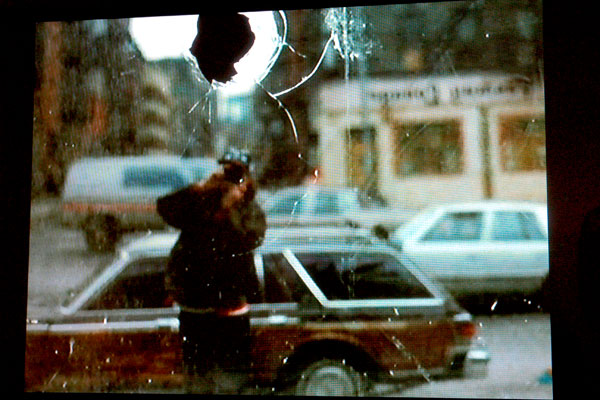
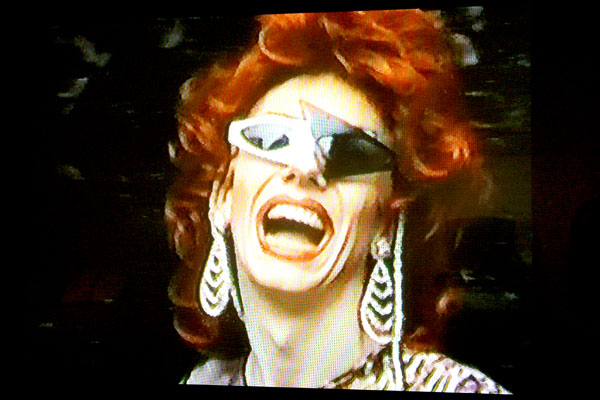
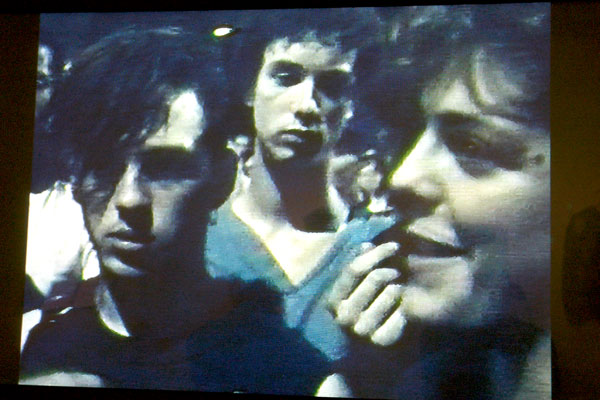
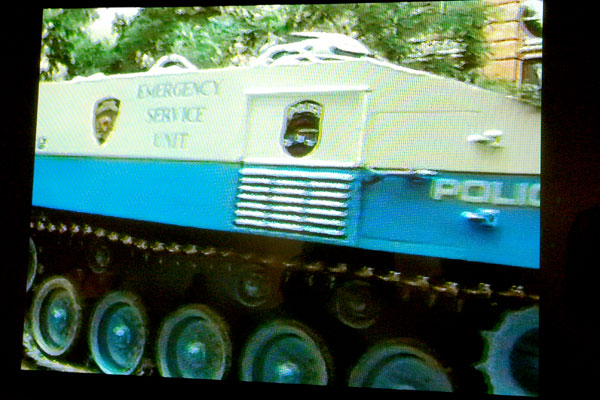
[four stills from the video installation of the film, “Captured”]
How do you write about a chronicler with a soul? How do you write about a bard with a camera? We can’t begin to understand the importance of people like this until they are gone. Maybe it has to wait until we are gone as well, but in the meantime we can give it a try.
I’d have to see this show, “The Lower East Side“, for its historical and political importance, even if the photographs didn’t have their own beauty. And they do.
Clayton Patterson (okay, it’s already the legendary Clayton Patterson) is currently represented by some of his sculpture, a tiny sampling of his enormous archive of photographs, and an excerpt from a documentary video in a show at Kinz, Tillou + Feigen, a gallery whose heritage, through Richard L. Feigen and Feigen Contemporary is itself pretty legendary.
The sculptures assembled from found materials are documents themselves, setting the entire installation in a specific time and space. The photographs are intense portraits, both candid and posed, of the Lower East Side community stretching from the early 80’s to the present. To anyone who did not know this city before the mid-90’s, or who might be unfamiliar with the neighborhood now, many will look like they must have been invented. In fact they are all perfectly true, and astonishingly intimate.
The same must be said of a film, “Captured”, shown on a television monitor in the smaller space. Its subject is Patterson and the neighborhood he calls home and which he has looked after for almost three decades. It was put together by Dan Levin, Ben Solomon and Jenner Furst, largely using Patterson’s own footage, and excerpts are being played in the gallery through the duration of the show. Patterson’s photographs can be seen on the gallery site. Here I’m only showing stills from the film, except for this one image:
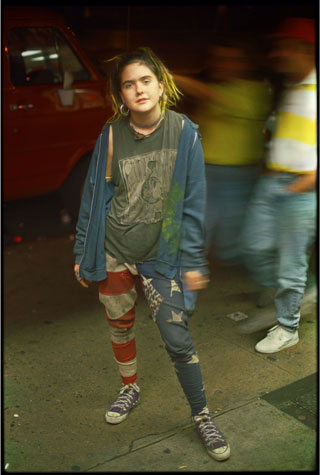
Clayton Patterson Untitled (grunge girl) 1992/2007 C-print
By the way, if you’re very young, on the street, and want to have a distinctive style, wouldn’t it make sense to find your own? That’s why I was struck by the resemblance between this 1992 “Grunge Girl” captured by Patterson, and this 2002 “Billy”, who was part of Bradley McCallum and Jacqueline Tarry’s show at Marvelli gallery three years ago (the couple is now represented by Caren Golden).
[image at the bottom from ktfgallery]
so President Gore it is

the once and future president
I’m not arguing he should be nominated and elected this time because he won the Nobel Peace Prize, but because winning the Nobel Peace Prize can make it happen.
Why Al Gore, and not anyone from within the current field of designed and positioned candidates? To begin, because I can’t support much of what I’m hearing from any of the three current “frontrunners”; to continue, because I believe Gore says what he thinks, not what he thinks others think he should say; and to conclude, because he would be elected.
Although I can’t know what was going on in his mind at the time, I realize that I might have to advance one doubt about Gore’s reputation for plain speaking: Had the man we voted for once before* been candid and upright about the truth in November and December of 2000 the world would be a much better place today, and we would now be thinking about who should succeed a President Gore.
*
Although not “we”, since as a New Yorker I could pull the handle for Nader without affecting the Electoral College votes.
ps: I’m also pretty happy with what Richardson is saying, I’ve always thought Kucinich had it right on just about everything, and Mike Gravel should be getting more of a hearing. I’m still really disturbed about the Democratic Party as it now exists, and while I don’t know how or whether I could reconcile that with a Gore, Richardson, Kucinich or Gravel candidacy, it could be very exciting finding out.
[image from classicalvalues]