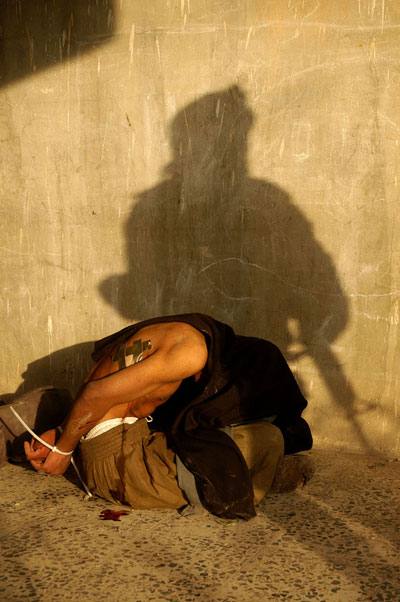
The captured fighter claimed to be a student who had gotten stuck in Falluja. A marine responded. “Yeah, right, University of Jihad, motherfucker.”
What the fuck
It’s a hot title, only partially-disguised by the military alphabet code. Ashley Gilbertson‘s “Whiskey Tango Foxtrot: A Photographer’s Chronicle of the Iraq War“, is a devastating account in photographs and text of the human tragedy of the U.S. presence in Iraq.
This book (in visual arts terms, his first solo outing, after appearances in several compilations) is also a portrayal of an infernal war engine which has destroyed a small, weak nation and threatens to waste our own. While adding to the numbers of individual Iraqi victims it continues to churn up and spit out its own people, like the profoundly-damaged veterans visited back home by Nina Berman in her book and photo exhibition, “Purple Hearts“.
In Iraq Gilbertson worked physically with dangers, artistic handicaps and challenges which Berman experienced mostly psychologically inside the U.S. through her friendships with and documentation of neglected and abused American veterans once they were deposited home – perhaps the most horrific “unintended consequences” of an insane, premeditated war. Gilbertson has spent much of the last four and a half years living virtually on his own in the chaos of Iraq armed only with his camera, its function significantly hamstrung by the guys in the white hats: The Pentagon itself imposes significant formal restraints of all kinds on any journalists who venture into a combat zone which it pretends to control, but Gilbertson also was prevented from including virtually any images of dead Americans (“Publishers Weekly” says it’s because the victims’ fellow soldiers forbade photographs). The book does however include a number of bloody and messy scenes of death and destruction, most victims already removed, and there are many images of dead or injured Iraqis.
But the combination of Gilbertson’s art and humanity, the power of both the photographs and the commentary which accompanies them, more than meets the challenges of his courageous, self-imposed assignment. These are the images which will survive the war, and which will continue to haunt and condemn a people which devised and tolerated it.
I first came across Gilbertson’s work when I was trying to locate online one of his images for a post I wanted to do on a subject illustrated by one of his photographs. I had seen the picture in the print edition of the NYTimes, but I couldn’t find it anywhere on the paper’s web site, probably because it had only appeared as an image with a short caption. I emailed the artist. He wasn’t certain which shot I was asking about, but he graciously forwarded me several jpegs, with a very short note, apologizing for its brevity with the explanation, “out in the badlands right now so can’t talk. Sorry.” I was impressed. Now I wanted to see more of his work, and I absolutely had to meet him.
The book arrived today; I get my second wish next week.
Gilbertson will be celebrating the book’s publication with a signing event and gallery opening at Gallerybar on the Lower East Side, next Thursday, October 18. The party is from 7 to 11, at 120 Orchard Street, but the exhibition of photographs from “W-T-F” continues for six weeks.
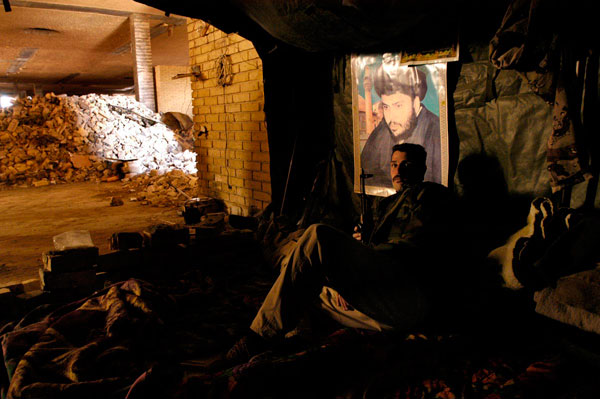
A member of the POB [Public Order Battalion] sits in front of a poster depicting Muqtada al-Sadr. he is paid and armed by the Iraqi and American governments: his allegiance lies with al-Sadr and the Mahdi army.
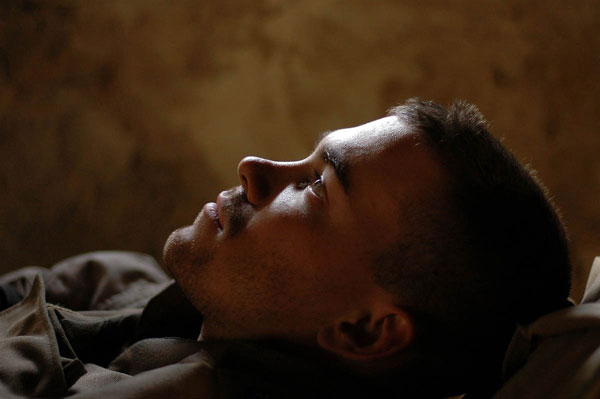
Corporal Joel Chaverri during a break in combat.
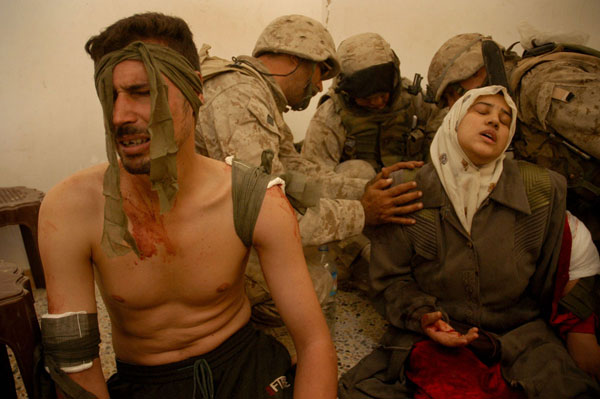
Inside the Grand Mosque, marines treat the young woman injured in the attack on her family’s car.
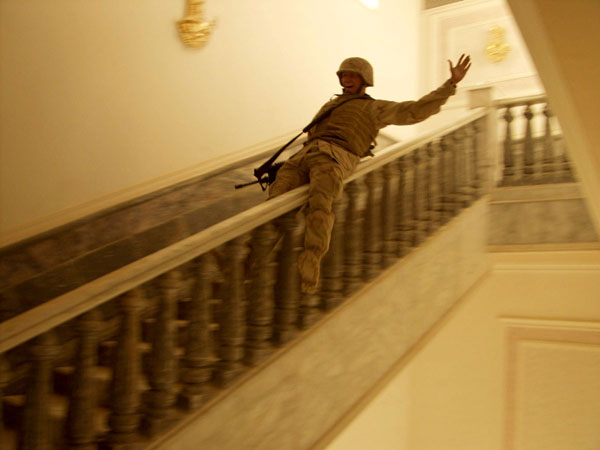
A marine slides down the marble handrail in Saddam’s palace in Tikrit.
[the captions are from “Whiskey Tango Foxtrot”; the images are from Gilbertson]
Author: jameswagner
subway vellum
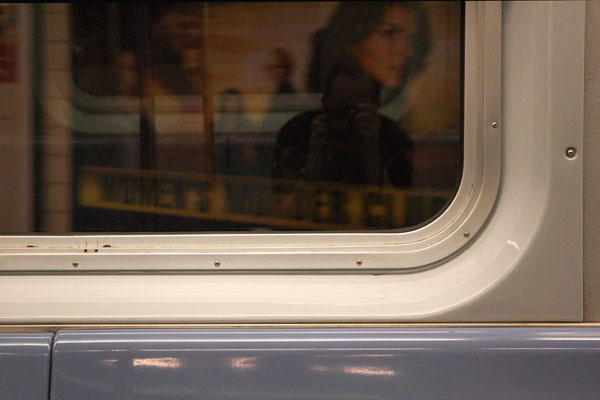
untitled (women’s) 2007
the ArtCal Zine debuts
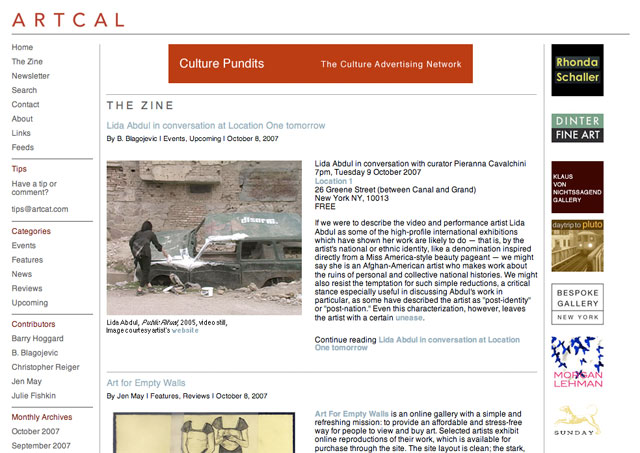
ArtCal Zine home page screen grab
Omigosh, I’m not sure I can stand the excitement. ArtCal now has a real zine! No, I’m really serious about my enthusiasm: I think this thing is really cool. ArtCal is becoming less an appendage of its editors and more community-driven, but it’s still only the beginning. Watch for additional forms of editorial content and visitor interchanges in the future.
Barry and the the managing Zine editor, Bosko Blagojevic, have been working wonders, and at the moment we have a very smooth vehicle and a number of eager contributors in the pipeline, many of them artists themselves, busy now putting together articles.
Look for “FROM THE ZINE” on the middle of the right-hand side of the ArtCal home page, just above “CULTURE PUNDITS BLOG POSTS”. Individual pieces will be scrolling down from the top of the zine page as they are published. For a look at the complete list, click onto any one of those already showing or onto the words “FROM THE ZINE” at the top of the box. Older entries will be archived and easily retrieved through different searches. To avoid missing out on anything, you may also subscribe to a feed, as I just did.
There’s going to be no real limit to either the geographical reach of subject material or the idiosyncratic style of writing in the Zine portion of ArtCal, so expect to be surprised.
[image from ArtCal]
gallery photo prohibitions harass all visitors

say no to the no
Lately you may have noticed a decline in posts here about gallery shows. There’s a reason: I’m not feeling it just now.
I’m going to sound like a grouch, if not just a scold, but my concern about a recent development in the world of exhibiting art has begun to affect my disposition or mood even when I’m not looking at art or writing about it. And I don’t like it one bit.
While I don’t think visual artists themselves have a problem with visibility, it seems that some of their galleries do. It may only be anecdotal evidence, but there appears to be a growing tendency among exhibitors to restrict or prohibit photography. I have been blogging about the visual arts for nearly five years, almost always including in these posts my own images of the shows I visit.
Because of my own recent experience, and that of others, with galleries trying to control visual access to their artist’s work, for some time I have been feeling very sensitive about carrying my camera into an exhibition space, any exhibition space. I was in Chelsea yesterday when the incident which inspired this post occurred. Prior to it there was a moment in another gallery when I probably misunderstood the interest expressed by the attendant in my photographing work. I tensed for a moment, believing I was being challenged, but much later Barry told me he thought it was a totally friendly inquiry, that she only wanted to see what I might write about the show.
It did set me up for the real encounter we experienced in the gallery we visited only minutes later. Although I was now feeling a little shell shocked, I had already gone ahead and captured some images of that show when I was asked by the woman at the front desk, “This isn’t for publication, is it?”. After I explained my purpose she replied by way of an explanation of her question that she had been instructed to tell people that “images are not supposed to be used for publication”. Little more was said and everything still remained more or less unresolved when we left shortly after.
I don’t need the harassment, and no one else does either. I go to gallery shows to see art, and I bring my camera with me in order to share what I see with others who might be encouraged to pay a visit themselves or who might not be able to experience it themselves. I try to capture and upload my own image of work I see because I believe a work of art can and should be seen in many ways, and that it has nothing to lose and much to be gained from encounters with multiple and differing observations.
I have always felt comfortable around art, I have always felt comfortable in gallery environments, and I have always done what I could to help others share this comfort. I pretend no special propagative powers in the arts, and I claim no special rights of access, as an acolyte, a writer or a photographer. I believe that no casual visitor to a gallery should have to report to a desk in hopes of being able to demonstrate her or his worthiness for license to use a camera unobtrusively.
Beginning with the first two much earlier incidents, which were spaced in time at some distance from the other more recent examples, I have encountered or been told about prohibitions broadcast by the following galleries, although it is likely that there are others with similar policies:
303 Gallery (one show)
Gagosian (one show) UPDATE: it’s now all shows
Capla Kesting
Jonathan LeVine
Pace on West 22nd Street (but not Pace Prints)
Paul Kasmin
I will not be writing about shows hosted by these galleries when they maintain camera prohibitions. This saddens me almost as much as the triggering affronts discomforted me. Each of the galleries may claim to have adopted restrictions for their own good reasons, but whether a visitor is using a camera (without flash or tripod) as a personal notebook, a sketchbook, an online diary, a flickr gallery, a blog or for any other benign purpose, the effect on the artist is equally malefic, even if the fan can just walk out. Any possible malignant purpose on the photographer’s side, imagined or real, can be dealt with by other means, without directing a massive preemptive blow to the art being shown, or an enthusiasm for art.
Galleries (and museums, too) must not be converted into hostile environments.
Finally, I will say here that I absolutely do not have to be an art blogger. It consumes a huge amount of my time, no one is paying me, and I have an enormous number of other important interests. If these shortsighted camera restrictions become more general within the gallery community, I will no longer post about shows at all. I have no interest in being associated with anything which encourages more opaqueness in the display of works of visual art. In addition, if I continue to be nervous about even going into galleries (I’m almost never without my camera in my hand no matter where I am), I may decide to give up altogether a routine that once gave me such great pleasure.
HAPPY UPDATE: The gallery Pavel Zoubok had a photo-prohibition at the time this post was written, but has since changed its policy
[image from stanford recycling center]
Dame Ethel Smyth’s “The Wreckers”

John Singer Sargent Ethel Smyth 1901 pastel
If this hundred-year-old opera had always enjoyed the success it deserves today I’d probably be whining about the endless parade of productions of La Boheme, Aida, La Traviata, Carmen and The Wreckers. As it turned out, for reasons I now find inexplicable, the last of the works I just named never made it. Dame Ethel Smyth‘s wonderful opera had in fact never been performed anywhere in the Western Hemisphere until last Sunday afternoon.
Barry and I are huge fans of Leon Botstein’s programs with the American Symphony Orchestra. For us it’s about “new music”, but surprise! Here the pleasures of unfamiliar musical genius arrive via a well-prepared trip backward in time. The Orchestra’s mission under Botstein’s direction is more usually described as the resurrection of large-scale symphonic or operatic works from the previous two centuries, music which has been neglected, presumably unjustly. The audience may not always agree, but it’s never left without help in mustering its response: In advance of each concert the music director supplies absolutely vital and articulate notes on the works themselves, as well as the context of their original creation and subsequent neglect.
All of this explains why I’ve been a subscriber since 1991, when Botstein began his current tenure as music director and principal conductor. So we would have been in Avery Fisher Hall on Sunday regardless of what the program was, but this one promised to be a particular treat.
“The Wreckers” was composed by a privileged and educated fierce Victorian English lesbian suffragette who was once imprisoned for her activism but otherwise lived and worked in friendship with some of the European cultural giants of her age. The opera’s theme, perhaps more topical in 2007 than at the time of its composition (1903-04), is the horrors of which a provincial, fanatically-religious, self-regarding community is capable. Botstein’s essay in the program notes suggested that it’s the first worthy opera written by a Brit in almost two hundred years. Of course I was interested.
Reviewing the afternoon’s performance and the opera itself for the NYTimes Bernard Holland seems to have been almost as enthusiastic as I was, about both the performance and the opera itself, and he appears to agree its oblivion was a big mistake:
The Wreckers gets your attention. It charges at the audience with all guns blazing, and tramples the weak and the hesitant in its path with a story of pillaged ships and triangular loves.
Smyth (1858-1944) was determined to fill as big a physical and emotional space as eight singers and a big chorus and orchestra could manage. Everyone onstage seemed to rage with Ethel Smyth fever, pouring out nonstop fervor in one relentless fortissimo after another.
. . . .
The Wreckers is not aimless cannon fire; Smyth knew what she was doing. Her orchestra makes winds whistle, waves roll and crash, and fog creep over the rocks in dark minor chords. From the land we hear hornpipes and sea chanteys in the distance. All the elements of a complete oceanography are present and rationally arranged.
But while I thought the work was a real keeper, and I’m dying to see it fully-staged, Holland, apparently viewing it only from the vantage of the succeeding one hundred years (a considerable advantage over poor Smyth) ends a very enthusiastic review of the merits of the piece itself with a bizarre non sequitur:
Does The Wreckers get a third chance? At some point, I am sure. It is not a deathless work, and too much exposure might do it more harm than good. Too much value is put on permanence anyway. Disposable is not a dirty word. People got their moneys worth on Sunday and should perhaps let The Wreckers go back to sleep.
Only in the American world of opera world is the word “deathless” always confined to the teeny list which begins with La Boheme, Aida, La Traviata and Carmen.
For more information about Smyth and her opera, see the American Symphony Orchestra’s site, and click onto links for the two essays at the bottom, under “Dialogues & Extensions”.
The image below, a late-eighteenth-century painting by George Morland, describes a somewhat brighter version of the dark setting of Smyth’s opera.
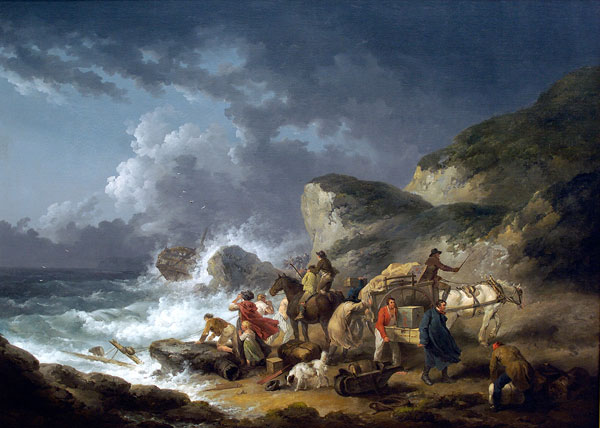
George Morland The Wreckers 1790-1799
[first image from de.wikipedia; second image from the National Gallery of Canada via sandstead]
the “war on terror” has reduced us to slaves
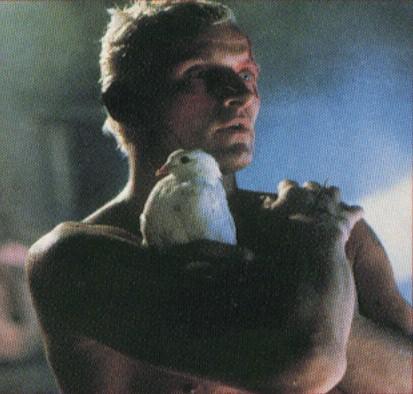
Roy Batty‘s epiphany
Last night I spent far too much time worrying about how to express the depth of my broader frustration and despair before posting the latest version of my regular fulminations over Guantanamo. I should have waited until this morning, when I opened Newsday, and read John Anderson’s review of the “Blade Runner: The Final Cut”.
Anderson ends his report on what is billed as the director Ridley Scott’s definitive version of the dark 1982 classic with this:
One of the its more chilling moments foreshadows our current climate with a kind of clairvoyance.
“Quite an experience to live in fear,” says Rutger Hauer’s rampaging Replicant, for whom we have no small amount of sympathy. “That’s what it’s like to be a slave.” Here, “Blade Runner” not only foreshadows a post-industrial world, but seems to critique the post-9/11 world as well.
[image from cogeco]
GUANTANAMO DELENDA EST!

This post is part of a series begun on May 21, 2007, which will continue until the U.S. concentration camps at Guantanamo Bay and elsewhere around the world have been razed.
Many of us learned years ago that we don’t live in a democracy, but until 2006 some might still have thought the Democratic Party would pretend to respect its own name. And couldn’t we once assume, regardless of what they actually did, that Democrats would at least talk like liberals?
Voters gave the party majorities in both houses of Congress nearly a year ago, but absolutely nothing has been accomplished on the three most critical national issues of our time. I’m referring to the War in Iraq, for whose termination the election was a referendum, but which has in fact been expanded; to the Military Commissions Act of October 2006, which wiped out Habeas Corpus; and to the network of concentration camps we’ve established around the world since 9/11, the most visible of which is that at Guantanamo Bay.
The Democrats helped the Republicans create each of these cynical outrages, which together now represent the greatest continuing threat to our national security. The party has been unwilling to put an end to any of them, and most Democratic politicians don’t even pretend to oppose the Constitutional assault called the “Patriot Act” or the continuing atrocities of state-sponsored torture. Conscience, principle and courage are not to be found anywhere.
And what of Guantanamo Bay itself? It now belongs to the Democrats.
So what’s going on here?
Did the citizen die along with the Constitution? Is there nothing that those with eyes and minds can do? Should I or anyone else outside the greasy corridors of power even bother to bring up these subjects any longer? Does it serve any purpose to remind ourselves of the shame and humiliation these horrors bring down upon all of us with the passage of each day?
[fabric color swatch, otherwise unrelated to Guantanamo, from froggtoggs]
second annual New York Art Book Fair
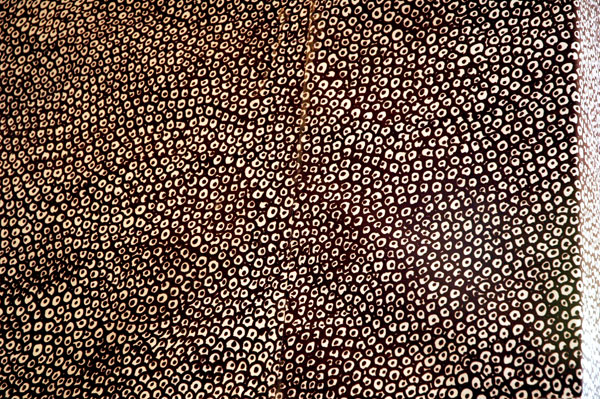
Noah Lyon‘s print mural, wrapped around a wall above his colorful booth

Slavs & Tatars poster (“the money, it’s not so smart, says the Tajik guy”)
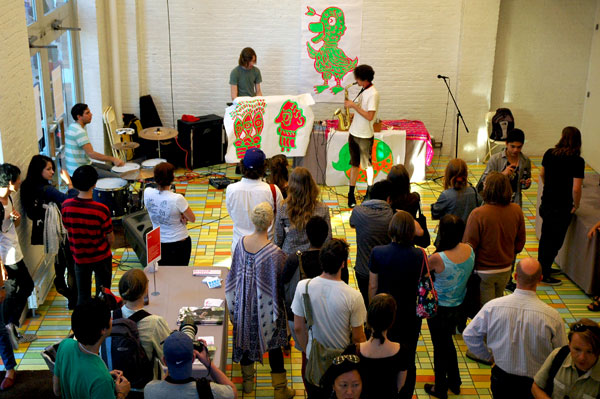
Soiled Mattress and the Springs, sounding here more hardcore than laid-back, accompanied by Matthew Thurber’s drawings
I know the images above may not seem to represent the primary focus of the New York Art Book Fair, but even under ideal circumstances I find it very difficult to get an interesting photograph of a book. Representing both a challenge and an obstacle, last weekend’s covered market, had thousands of them. Spread over two floors of the old Dia space in Chelsea, every book demanded a look or a reading and, in some cases, even a hearing. There was also the challenge an excited crowd can present to any attempt at photo documentation (or vice versa).
Incidentally the creators of work shown in all three images actually were hawking books of some kind. Lyon was showing his own beautiful printed and handmade volumes in addition to his work in other media; the Moscow collaborative, Slavs & Tatars, displayed books, posters and T-shirts, all of which were reminders of the rest of the world’s ignorance and long neglect of the richness of a multicultural Eurasia; and the the punk/lounge trio Soiled Mattress and the Springs were invited to help launch the new arts magazine, ANP Quarterly.
I’ve decided that art book fairs are even more exhausting than straight art fairs: I’m sure it has almost everything to do with what the crowded, small-scale displays can do to the eyes and the head.
But nothing will keep us away from another incarnation of this one. Barry and I saw some great stuff, met some wonderful people (books, art, a little music and the people who love those things – what’s not to like?), went home with a few goodies – and an even longer wish list – and had at least as much fun as we did last year, at the first appearance of the fair, which was created and run by Printed Matter.
Michael Cline at Daniel Reich
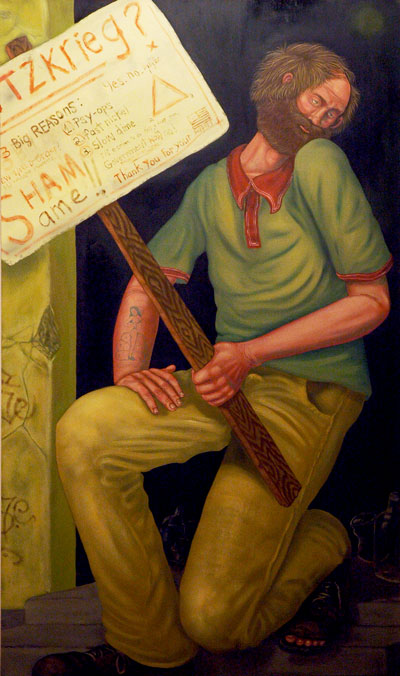
Michael Cline Picket 2007 oil on linen 62″ x 36″
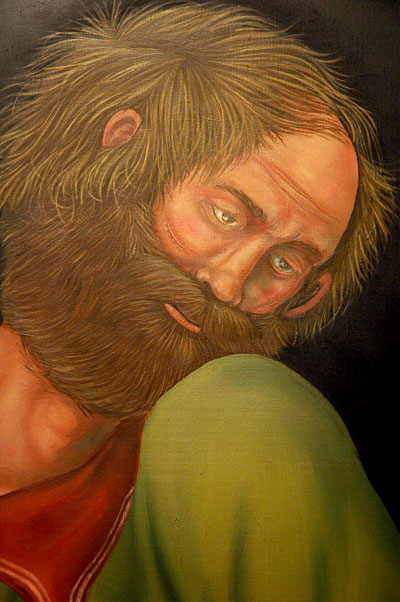
[detail]
In time, Michael Cline’s jaw-dropping show of oils at Daniel Reich, “Folks”, may be recorded as a cultural benchmark, both aesthetic and social, for offering us such a peculiar and powerful window onto the darker and neglected side of this urban moment. It certainly will not be forgotten by those who experience the paintings.
These sacred/profane altarpieces go where the photographer’s art cannot.
pink cupcake exceeds sell-by date: CLOSED
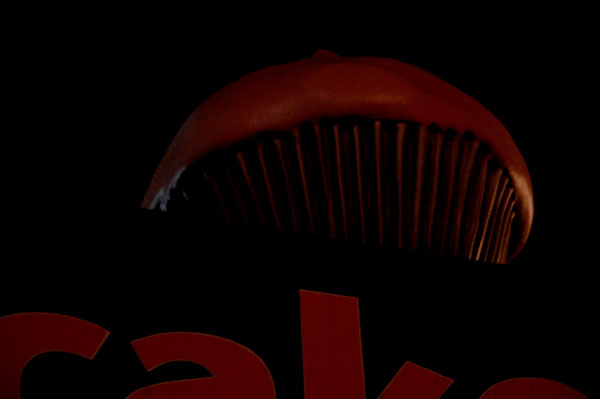
lights out
The pink cupcake is dark tonight. Dead. And long may it rest, in oblivion.
I was immediately sorry for what the closing of Burgers & Cupcakes might mean to its employees, but minutes after I heard the news from Barry that the restaurant had closed (he had seen the sign on the window this evening) I told him that I actually felt sorry for the owners.
Then he reminded me that one of them had referred to that paragon of neighborhood aesthetics and sensitivity, the Sixth Avenue branch of the huge Caliente Cab Company chain, as a model for what they described as (if not in the same word) their own landmark sign, a giant spotlighted, revolving cupcake poised on top of an illegal canopy above the curb. Now I can feel totally comfortable saying that anyone who could argue that the archtypical Village monstrosity was an appropriate model for a new, improved 23rd Street totally deserves to go out of business.
We had a celebratory toast before a late supper tonight.
With no thanks to our City Council representative.
UPDATES: Today the giant cupcake itself is nowhere to be seen, although the illegal canopy on which it once rotated remains in place. [reporting from the scene on Tuesday, October 2] Now [later this afternoon] we’ve heard that someone had paid $400 to take it away.