


We wandered through Hudson River Park along the West 20’s and 30’s on Sunday afternoon, intermittently dodging the distractions of speedy human-powered wheeled traffic (much of the pedestrian path remains to be built), construction equipment, the banshee screams of jet helicopters alighting and flying off only feet from the path, and the monstrous hulks of deteriorating piers, including one still used by the city as a towed-vehicle pound.
It will be a magnificent park when it’s completed, as long as we are able to maintain its beauty and its comforts, but under the present circumstances our Sunday walk had to be mostly about checking on its progress since our last venture so far west.
Yet we were still able to enjoy the richness of the small life forms and still-life forms installed where the harbor’s waters wash or beat the shore of our narrow urban world. We checked the odometer on Paul Ramirez-Jonas’s installation, “Long Time“, but were disappointed to find the wheel itself was quite still at the moment, poised somewhere between the force of the rising tide and the current of the river.
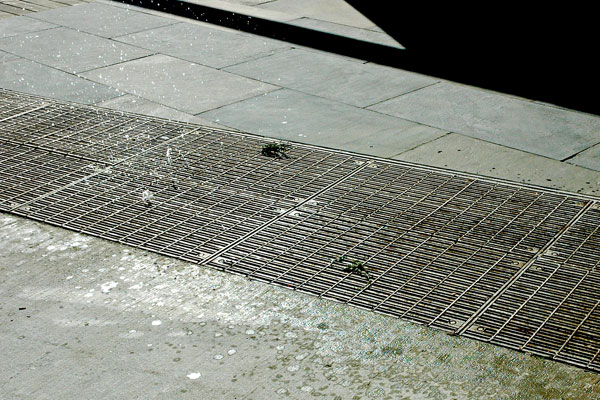
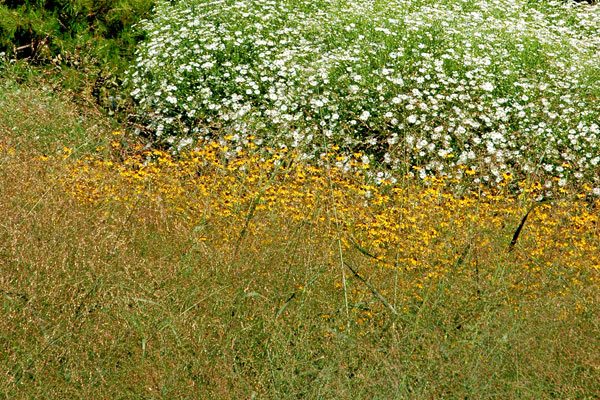
At the edge of a blocks-long reserve composed of a landscaped thicket designed to reintroduce the rich natural history of the Hudson estuary, we watched a Monarch butterfly and two dancing white moths. We saw and heard many birds but it was the tiny female or immature male Painted Bunting* which I’ll remember most. No turkeys, deer or coyotes that day. We also heard and watched the surf throw spray up through a long grate on the edge of the walkway. I captured an image of a bit of the spume washing over the outstretched branches of two hardy plants eager to reach more of the light of the afternoon sun, but the animal life on the edge of the river was even less willing to wait for my camera.
*
in the low afternoon sun of September the little guy didn’t look at all like most of the images I found on line, but instead was more like a wren-size fluffy ball of chartreuse and, if I might exaggerate a bit, nearly as bright as Sweetpea
Author: jameswagner

Matthew Northridge at Zach Feuer window
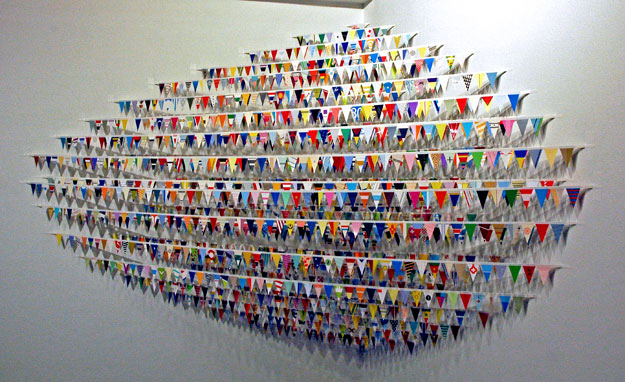
Matthew Northridge Memorial to the Great Western Expo September 11 – October 20, 2007
[no other information available for this piece, shown here in an installation view]
I have to admit that among the changing installations in the Chelsea gallery area I look forward to most, with something like the same childish delight with which I once welcomed Tooth Fairy or Easter Bunny visits, are those to be found in Zach Feuer‘s window on 10th Avenue (the west side, between 25th and 26th Street). This modest space, which has been carved out of a former entryway, is currently occupied by a single wonderful piece by Matthew Northridge.
Capla Kesting throws blogger out of gallery

Travis Lindquist [image protected here from viewers]
In Williamsburg last Friday evening Barry and I had just come from a reception and we had a little time to kill before the 7 o’clock hour when the galleries we had planned to visit would be opening their doors for this month’s “Williamsburg Every Second“.
We were in a festive mood.
We walked over to Capla Kesting to take a look at their Travis Lindquist show. I wasn’t very interested in most of the work, but the relatively arcane historical references in some of the drawings arranged in an interesting way on the center wall induced me to take a closer look. I decided to capture a few images for consideration later. I had already taken several photographs when I was told by a woman who was apparently connected to the gallery that they had their own shots of the work and most of them were available on their own site. I started to explain that I liked to capture my own images for my artblog and I would have gone on to try to explain exactly why, but I was interrupted by some words to the effect that they have to “protect the copyright”, and I was told that I would not be allowed to photograph the art.
I tried to at least explain what I had been doing and I reached for a card to introduce myself and my site, but neither she nor David Kesting, the Proprietor, would have any of it. Neither wanted to know who I was, but they definitely wanted me out. I told Barry, who had not been a part of any of this exchange, that I wanted to leave. As we turned to go Kesting yelled after us, “Don’t come back, you hear?!”
I wouldn’t think of it.
Also, to avoid some questions in the future, I should add here that since ArtCal is “The Opinionated New York Art Guide” and as it is the opinion of its editors that Capla Kesting Fine Art has chosen to restrict the public’s visual access to visual art, the gallery will not be included in its listings from this date.
“The Pierogi Show” at Pocket Utopia
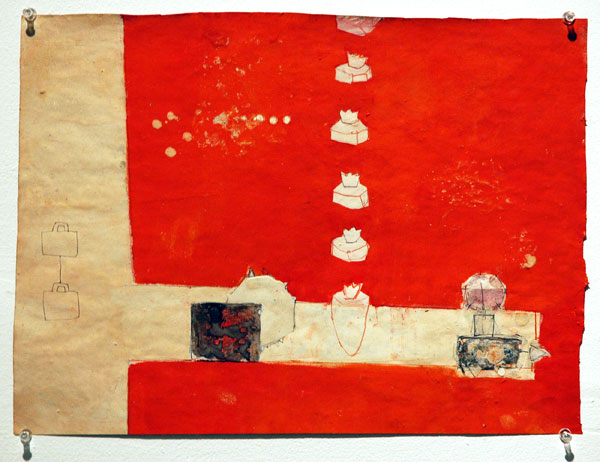
Manfred Fuchs Untitled 2002 12″ x 16″ mixed media on paper [installation view]
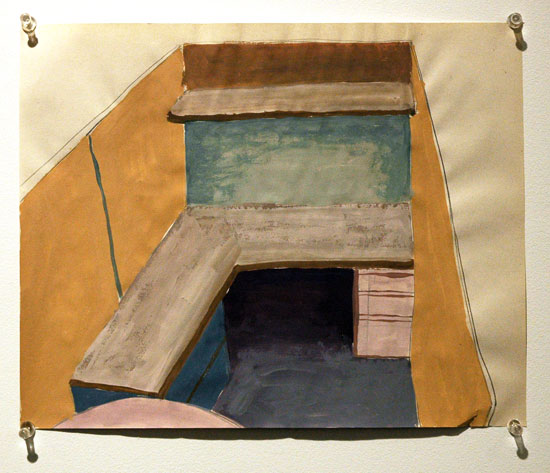
Michelle Marozik Office Cubicle 2004 8.5″ x11″ [installation view]
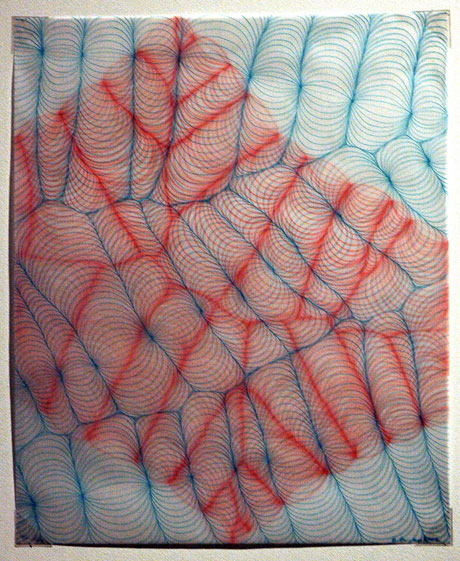
Bethany Bristow Blue and Orange Drawing 2002 ink on vellum [installation view]

Bill Gerhard Four Day Exposure 2006 black paper 12″ x 18″ [installation view]
My last post was about a show at Pierogi; this one is about a show called “The Pierogi Show” and it’s a very different thing.
The pioneering artist-run Williamsburg gallery currently devoted to a solo show of work by Jim Turok is known around the world as much for what is not hanging on its walls (meaning its extraordinary flat files) as for its ability to turn up, show and support great work while continuously serving as the vital heart of a community of artists. While most of Pierogi’s files are still stowed on North 7 Street, Austin Thomas’s “Pocket Utopia” has mounted a tribute to what Joe Amrhein, its founder, has accomplished and continues to accomplish. For the first official show in her space on Flushing Avenue, just five stops east of the Bedford stop on the L line, she has borrowed and hung pieces by 20 artists whose works on paper normally hang out in Amrhein’s drawers.
On her lively gallery blog Thomas describes a selection process which had to somehow eliminate 98% of the material available:
The file has 900 artists in it, maybe more. I had to come up with some sort of structure to review it. Mike (husband) entered all 900 names into a spreadsheet, then we determined that 88 artists was a representative sample, so he had a computer program select 88 artists randomly. With a list containing the 88 artists in hand, I went looking through the files and guess what? I was still overwhelmed. I sat immobilized for weeks as the opening date of Pocket Utopia approached. Finally, I selected 20 artists from the 88 randomly selected artists because that’s the number of artists that Pierogi showed in their first show at Four Walls.
My process might seem random, but I think that’s how the art world works. Funny, the computer didn’t select my name. I’ve had work in the Flatfile for about 10 years. I always try to put new and my best work in, and maybe that’s why the 20 artists I chose are consistently good.
I’m amused that the presence of both random and curatorial elements in the story of how these particular works were drawn to Bushwick doesn’t seem to me to be so different from that which artists also experience in the larger world, where some capricious combination of chance and merit determines whether work gets to be shown.
Thomas is right when she writes that the work is good, and some of it is very good indeed.
The complete list of artists in the exhibition:
Hildur Ásgeirsdóttir Jónsson
Clement Bagot
Claudia Barthoi
Lee Boroson
Bethany Bristow
David Brody
Tamar Cohen
Guy Corriero
Peggy Cyphers
Kate Drendel
Miriam Dym
Bruce Edelstein
clyde forth
Manfred Fuchs
Bill Gerhard
Fred Gutzeit
Michelle Ha
Theresa Hackett
Michelle Marozik
Mike Miga
Team Lump
Mika Yokobori
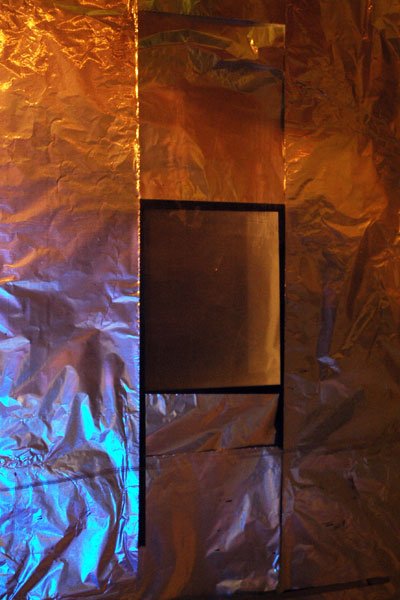
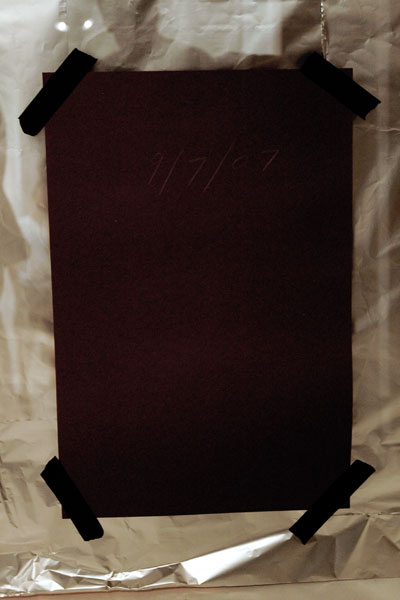
I’d like to add a couple more images, and a few words, on Bill Gerhard’s work, on the excuse that one of the two pieces of his in the show presents the drama of an evolving site-specific installation. “Four Day Exposure” from 2006, and shown above, hangs on the left wall of the gallery, but “Window Aperture”, is both a 2007 installation and a work in progress.
Gerhard uses the sun as a drawing tool, exposing black construction paper to form minimal shapes, in these cases simple rectangles The two thumbnail images below show the second work, first the face of the paper as it appeared at night from the sidewalk in front of the south-facing building and then the reverse side as visible from inside the gallery.
Jim Torok at Pierogi

Jim Torok Don’t Forget Who You Are 2007 acrylic on panel 12″ x 14″

Jim Torok Do Not Be Too Afraid 2007 acrylic on panel 48″ x 60″
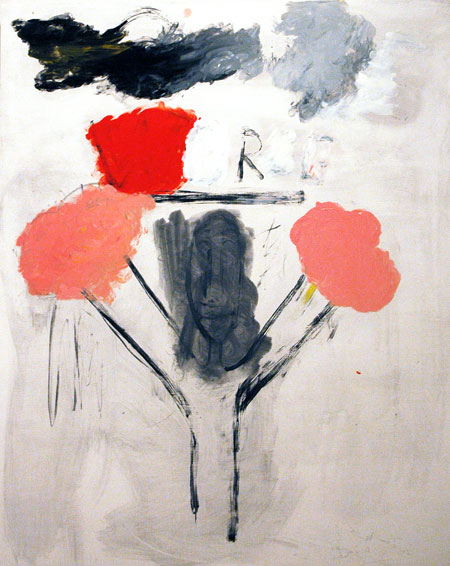
Jim Torok You Are Wrong 2007 acrylic on panel 48″ x 37″
The image at the top is of the first painting you come to as you walk into the door of Jim Torok’s show at Pierogi. Is it talking to its creator or to us? This small panel and the larger one I show below it relate to the artist’s now very familiar style, work which has drawn in and seriously (or not so terribly seriously) amused many people for years.
I like the third image very much as well, but to find Torok working in abstraction was a total surprise to me.
There is a third chapter in this show with the simple title, “Recent Work”. Apparently Torok had been doing similar work for some time, so I don’t know why the almost photo-realist drawings and paintings in the gallery’s smaller room were the biggest surprise of all, so much so that until I went back to the entrance and picked up a checklist I had assumed it represented a separate show by another artist.
These small face essays (oil on panel or graphite on paper) are pretty amazing, for their skill, their extremely light touch and for including a degree of expression not usually found in formally-posed portraits. I can’t really say why my camera and I didn’t try to capture any of them. Maybe we were both a little intimidated.
Below is an image of one of those pieces, borrowed from the gallery site and uploaded to appear more or less life-size (on my laptop’s screen at least).

Jim Torok Mary Carlson 2007 oil on panel 2.5″ x 2″
The artist and the gallery have prepared a bonus event for anyone who visits tonight, during WIlliamsburg’s monthly party, “Art After Hours”:

[“Mary Carlson” image from Pierogi; final image, uncredited otherwise, via Meredith Allen]
Kissinger to be Grand Marshall of Steuben Day Parade
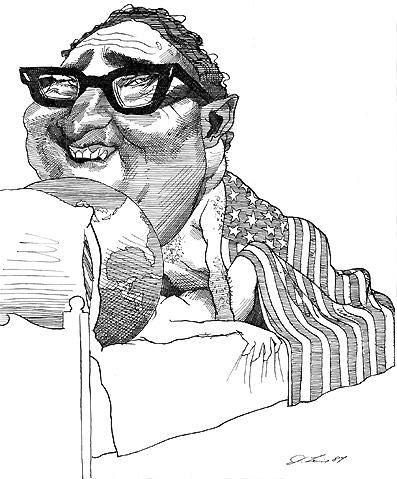
the Realpolitiker‘s very favorite Tracht
UPDATE: For concerned citizens of the world who might find the information useful, I’ve learned that Kissinger is expected to speak at the Parade Gala Benefit Banquet scheduled for 7 o’clock tonight, Friday, at the New York Hilton & Towers, 1335 Sixth Avenue, between 53rd and 54th Streets.
Would somebody please tell the folks behind New York’s German American Steuben Parade that having Henry Kissinger as a grand marshal is not cool at all. The kind of war crimes for which this man is wanted by governments in a number countries all over the world may be very American these days, but that doesn’t mean any ethnic group should be proud to be associated with their author, even if it has a tenuous relationship with the land of his birth.
I’m an American of unmixed German ancestry going back generations, I’ve studied U.S. and German history, and I’ve studied and lived here and in Deutschland, so I might be given some leave to say that I suspect the folks living in what the chairman of Saturday’s event calls the “alte Heimat” would not be so thick as some of their cousins over here seem to be. German Germans also generally know their history pretty well – for significant historical and moral reasons.
The big event is scheduled for this Saturday. I have to be in Greenpoint that afternoon, or I’d be there physically to remind him that not all of us have forgotten what he’s done. The parade starts at noon, and runs uptown on Fifth Avenue, starting at 63 Street and ending at 86 Street. I’m not sure how these thing work, that is, I don’t know where a so-called Grand Marshal might best be spotted, but there is a reviewing stand somewhere along the route of the march.
Tchuss!
[David Levine image from The Corsair]
the Chelsea Symphony is super!
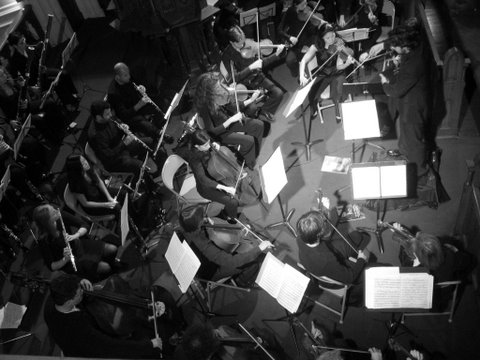
supernal music between the altar and the first pew
Barry and I are big fans of the two-year-old Chelsea Symphony. It has little to do with allegiance to a home team, even if that’s what got us into the little German Church around the corner the first time. There were also at least two other connections: One of our neighbors, Blair Lawhead, is a superb violinist who plays with the group and Louise Fishman, who also lives across the hall and had beaten us to a performance, has since lent an image of one of her magnificent paintings to animate the orchestra’s posters. It seemed like everyone in the building, including the doormen and porters, knew about our local band of players before Barry and I heard them for the first time.
This summer, through the generosity of another neighbor, David Shear, a string quartet composed of musicians from the Orchestra was engaged to play as part of our annual garden party. Wow. Now that’s a home team.
Since first attending a concert last summer, we’ve found it almost impossible to miss any of their appearances. Yes, they’re that good; they’re very good – but there’s even more to like.
I started out in the Midwest a long time ago with a passion for serious music almost from the very beginning. I’ve now lived and traveled over much of the world, during which time I’ve enjoyed some magnificent orchestras I’ve attended (with pleasure, but often with too much wincing) more than most people’s share of performances by smaller, less professional ensembles. When I’m home I’m surrounded by thousands of LPs and CDs, for the most part “classical” recordings of music stretching from ancient Greece to the day before yesterday. They are mostly professional ensembles and the majority are on commercial labels.
But to be in a modest-sized hall with this Mozart-sized company of well-rehearsed, enthusiastic and gifted young artists lifts the spirit in ways an orchestra like the New York Philharmonic never can. Yes, tears will happen. And perhaps to top it off, there’s at least one piece of new music in each program – take that, Lincoln Center and Carnegie Hall programmers!
If New York has more living composers than there are music programs open to them, there are also far more great musicians and conductors than there are seats or podiums available in the orchestras. Some of these composers and performers still believe in symphonic music and some of them are stubborn enough and creative enough to take things into their own hands and do something about it. Some of them have founded, or found a home in, the Chelsea Symphony.
I highly recommend this concert experience, regardless of what your previous commitment to classical music may be, even if doing so might make it harder for me to ever find a seat again only a dozen feet from the conductor.
This is an excerpt from the Wikipedia entry for the Chelsea Symphony:
The Chelsea Symphony is an orchestra noted for its uniquely fluid hierarchy. Based in New York City, The Chelsea Symphony’s members rotate as the ensembles own conductors, composers, and soloists. Each season, every conductor conducts a complete symphonic program with the group; each composer has a new work performed by the full orchestra; and every soloist performs a featured piece with the entire ensemble. The Chelsea Symphony gives most of its concerts at the German Church of St. Paul’s.
There will be performances this Saturday at 8 and Sunday at 3, in St. Paul’s Church at 315 W 22 Street (just west of 8 Avenue).
Saturday at 8:
Debussy Prelude to the Afternoon of the Faun (Don Lawhead conducting)
Haydn Cello Concerto in D Major (Mark Seto conducting, Michael Haas, cello)
Wagner Siegfried Idyll (Geoff Robson conducting)
Mozart Symphony 29 (Geoff Robson conducting)
Sunday at 3:
Strauss Concerto No. 1 for Horn (Mark Seto conducting, Katherine Smith, horn)
Wieniawski Fantasia on themes from Gounod’s Faust (Mark Seto conducting, Hanna Lachert, violin)
Wagner Siegfried Idyll (Geoff Robson conducting)
Mozart Symphony 29 (Geoff Robson conducting)
[image from Wikipedia]
NYTimes still mixing “editorial” with the news
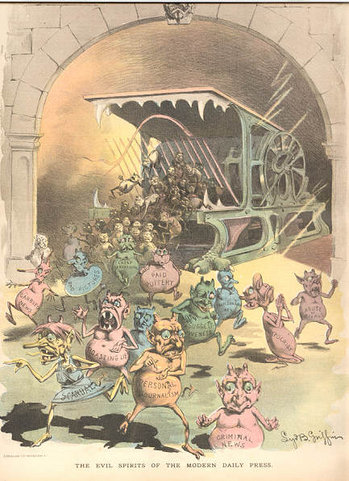
I’m going to end up skimming the features and skipping the “news” pages altogether. Is anybody else noticing this stuff?
It’s looking like the NYTimes is out of control. This is the way one of the paper’s teasers read on today’s print front page:
In Iraq, the report from General Petraeus and Ambassador Ryan C. Crocker to Congress was viewed favorably because it portrayed the situation accurately [my italics]. While many said they preferred a quick withdrawal of troops, several seemed to accept that sectarian violence would keep American forces in Iraq for some time to come.
Inside the paper, on page A10, the article itself made it clear that the glowing opinion of the account given by the pair Maureen Dowd calls the “Surge Twins” was actually one held by the very few Iraqis the reporter either bothered to or was able to ask (perhaps in telephone interviews):
More than 20 Iraqis of different sects and ethnicities said in interviews across the country that they viewed the report favorably because it or, at least the parts shown on television in Iraq portrayed the situation accurately.
Does this sound like objective reporting? Most readers probably never made it to the tenth page, and so were left [deliberately?] with an impression of this historical encounter that had been created by a totally misleading marketing blurb/preview.
[image of 1888 Puck cartoon from answers.com]
Greenpoint public library benefit Saturday
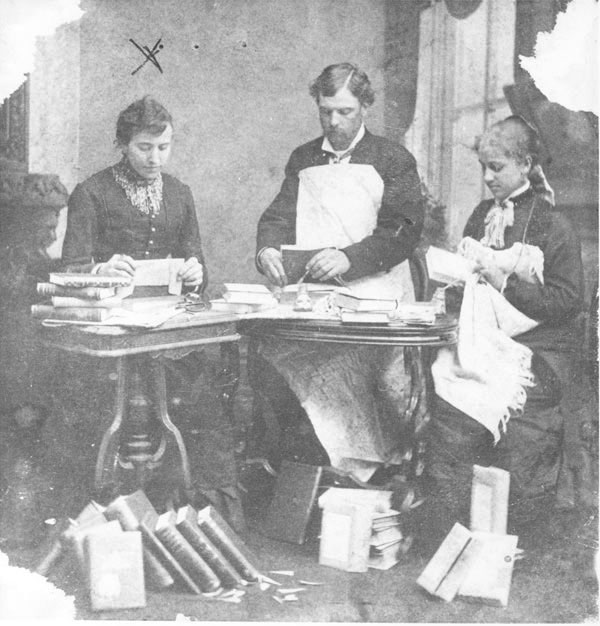
“Del Baldwin, Tence Massey and Anna Pope are preparing library books for circulation.”
Barry and I will be participating with Leah Stuhltrager as jurors in a benefit for the Greenpoint branch of the Brooklyn Public Library on Saturday. The event is being organized by Aileen Tat with the generous help of many others, including the artists donating work.
We love Greenpoint, and we love libraries. And I love this photograph.
Barry and I think the three of us will be awarding a prize or prizes to some of the artists represented in the sale. As Barry writes on his own site, “Show up and be shocked to see us outside before 2pm!”
In a totally baffling development which seems designed to frustrate all the volunteers involved in this project, the BPL central marketing department has told us that as bloggers the following information is all we are permitted to post:
The Greenpoint 100: Friends of the Greenpoint Library Artists’
Benefit
Saturday, September 15, 2007
11:00 am to 2:30 pm
At the Greenpoint Library
107 Norman Ave. @ Leonard St.
Brooklyn, NY 11222
For more information please call the library at 718-349-8504 or
email friendsofthegreenpointlibrary@gmail.com
[1878 image by unknown photographer, along with supplied caption, from wichitaphotos.org]
Alex the parrot
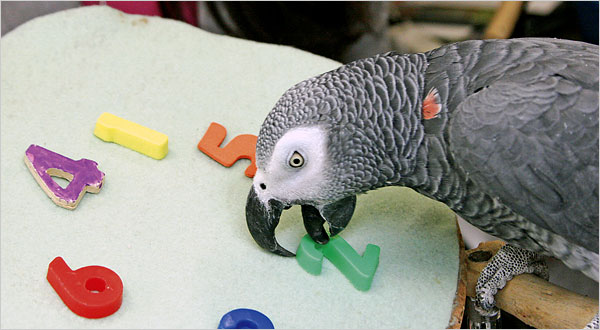
“Thinking about animals”
He was probably already my favorite member of the paper’s staff, but a short piece by Verlyn Klinkenborg in today’s NYTimes was worth far more than the price of admission. He is writing about Alex, the extraordinary African Grey parrot who died last week [“Brainy Parrot Dies, Emotive to the End“], and this is much of what he concludes, about Alex – and ourselves:
A truly dispassionate observer might argue that most Grey parrots could probably learn what Alex had learned, but only a microscopic minority of humans could have learned what Alex had to teach. Most humans are not truly dispassionate observers. Were too invested in the idea of our superiority to understand what an inferior quality it really is. I always wonder how the experiments would go if they were reversed if, instead of us trying to teach Alex how to use the English language, Alex were to try teaching us to understand the world as it appears to parrots.
These are bottomless questions, of course. For us, language is everything because we know ourselves in it. Alexs final words were: I love you.
There is no doubt that Alex had a keen awareness of the situations in which that sentence is appropriate that is, at the end of a message at the end of the day. But to say whether Alex loved the human who taught him, wed have to know if he had a separate conceptual grasp of what love is, which is different from understanding the context in which the word occurs. By any performative standard knowing how to use the word properly Alex loved Dr. Pepperberg [Dr. Irene Pepperberg, Alex’s companion and student].
Beyond that, only our intuitions, our sense of who that bird might really be, are useful. And in some ways this is also a judgment we make about loving each other.
To wonder what Alex recognized when he recognized words is also to wonder what humans recognize when we recognize words. It was indeed surprising to realize how quickly Alex could take in words and concepts.
Scientifically speaking, the value of this research lies in its specific details about patterns of learning and cognition. Ethically speaking, the value lies in our surprise, our renewed awareness of how little we allow ourselves to expect from the animals around us
.
[image by Mike Lovett from NYTimes]