
Michael Jones McKean The Astronomers’ Ecstasy As They See Solidarity Between Forms 2007 100″ x 108″ x 44″ [large detail of installation]

[detail]
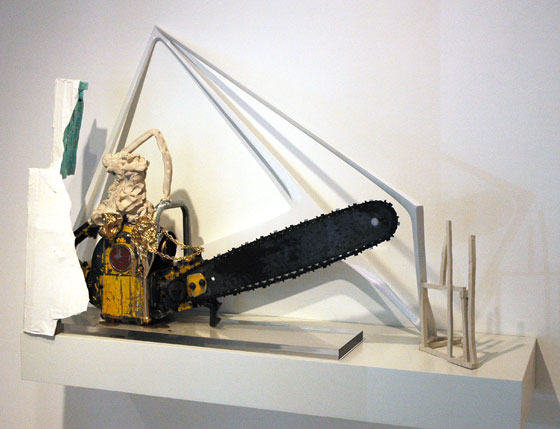
Michael Jones McKean The Allegory of Rule and the Geometry of Wind 2007 36″ x 49″ x 15″ [large detail of installation]

{detail]
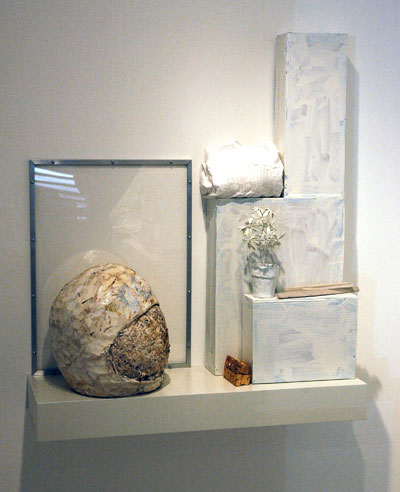
Michael Jones McKean The Freeing of Cosmonaut Volynov and Pitcher Gooden’s Song 2007 42″ x 36″ x 12″ [installation view]
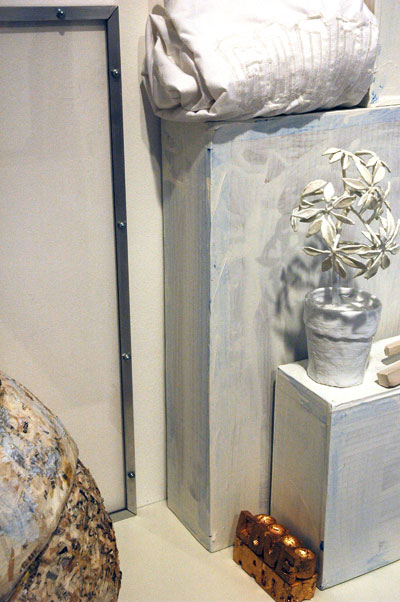
[detail]
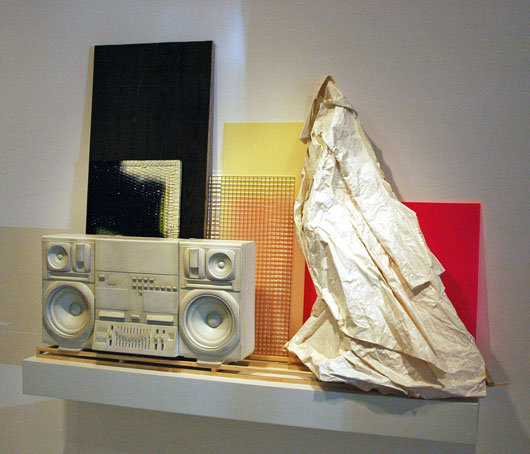
Michael Jones McKean Our Age of Brass and Ghosts 2007 53″ x64″ x16″ [installation view]

[detail]
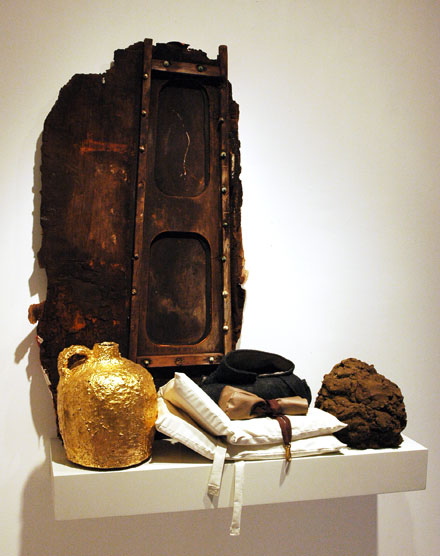
Michael Jones McKean The Ancients 2007 52″ x42″ x 13″ [installation view]

[detail]
Stephen Lichty was the first to introduce Barry and me to Michael Jones McKean‘s art. I was excited by the images the artist/curator was able to show to us this summer, and later I did a little more internet searching on my own. I read a bit (but, deliberately, not much) about what McKean was doing, and I listened to an interview on line. Now I was really anxious to see the work in person.
We heard that Clayton Sean Horton‘s gallery Sunday was going to have an exhibition of his work first thing this fall, and I couldn’t wait to see it, although I knew I’d miss the opening. I even thought to myself that the scheduling conflict might not be so unfortunate, since I could assume the reception would be crowded and I was familiar with both the modest size of the gallery and the grand scale of much of McKean’s work.
In fact I wondered how Sunday was going to be able to show anything at all substantial of the artist’s work, even without the additional squeeze threat of an opening night, in the show which came to be called, “The Discipline of Astronomy and Wind“.
We visited the gallery and met McKean himself a few days after the exhibition opened. I needn’t have worried about my chances of seeing full installations, and remarkably everything there is from 2007. After entering the space we introduced ourselves and then for a while we just walked around and between the five large-ish pieces Horton and McKean had placed so cunningly in two beautiful white rooms.
At the beginning I was certain that I would shortly want some kind of briefing from the artist, since both the materials and their arrangements seemed so alien and abstract, but within a few minutes, I turned to McKean with a wide grin and said, “I don’t think I have to ask you anything.” So much had already been communicated by the pieces themselves, with a little help from their titles, a rich, evocative list of their materials*, and my own pocket full of history, that no more guidance was necessary. Throughout the nearly 80 minutes [yes!] we spent with it, and even to this moment, the work has continued to speak for itself.
These pieces, each of them mounted on an integral platform resting on the ground or projecting from the wall, are gorgeous, full-dimensional “collage sculptures” in a lavish tapestry of shapes, colors and textures incorporating materials both found and fabricated by the artist. The superb craftsmanship (in all kinds of materials and skills) with which he realizes the incredibly-elegant contours of many of their elements distinguishes McKean’s work from much of the sculpture being shown today which may also incorporate ordinary, found materials.
But it’s ultimately his aesthetic, combined with a humanism which enables each of his projects to serve as something like an avatar of our relationship to the hopes, dreams and failures of our freaky civilization and the wonderful and mad heroes it regularly churns out, that makes this art so honest, so brilliant, and so unforgettable.
I hope my posting of all these images doesn’t look a bit excessive, but not everyone who sees this entry is going to be able to visit Eldridge Street in the next month. Also, I can’t recommend McKean’s own site enough, for those who want to see more.
There’s also this from Grand Arts in Kansas City, and an interview with Public Radio KUHF.
*
see the checklist, available at the gallery, but not on line
Author: jameswagner
no roll call for our own victims, on 9/11 or any other day

GUANTANAMO DELENDA EST!
It’s the eleventh of September again. Yes, it happens once a year. But I’m not interested in adding to the revanchisme stoked by every mention of the terrible events which occurred in my city six years ago. I am interested in the fact that even if we wanted to we would be unable to read a list of the names of the hundreds of thousands of people we have killed in the name of our own dead (many of whom were from countries other than the U.S.).
Moreover, the continuing shame of our concentration camps at Guantanamo and elsewhere in the world doesn’t seem to be worthy of the attention of many who actually do oppose the war in Iraq.
We are letting ourselves be ridden by fools, fanatics, politicians and arms suppliers – and those who profit from the evil mischief done in our name. The killing could stop, the camps could be closed and the terror could be defused, but not if we refuse to look at the world outside – and continue to let others exploit us.
[fabric color swatch, otherwise unrelated to Guantanamo, from froggtoggs]
D-L Alvarez at Derek Eller

D-L ALvarez Occasion to be Denounced 2007 crepe paper installation, dimensions variable [large detail of installation]
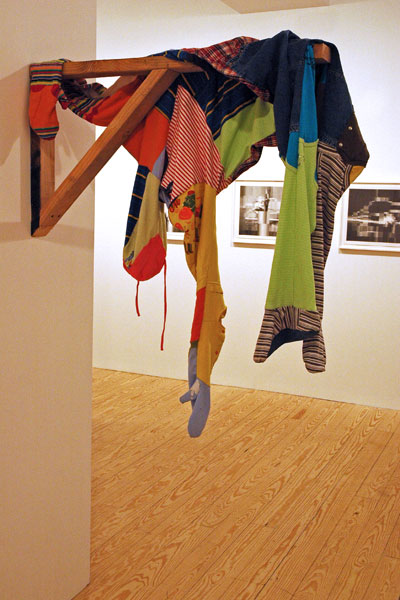
D-L ALvarez Something to Cry About 2007 children’s clothing, dimensions variable [large detail of installation, with detail of “The Closet” behind]
D-L Alvarez is showing five very dissimilar new works in the Berlin-based American’s latest solo show at Derek Eller, “Parents’ Day“.
It’s an elegant installation of beautiful objects. At the opening reception they each managed to evoke for this visitor personal memories independent of the artist’s own allusions: My imagination couldn’t wait to run with the show’s title, and with the nearly-total abstractions of a large series of pencil drawings with the title, “The Closet”. An excerpt from the press release however, read after seeing the work, sheds some light on where the artist himself is on the two pieces which dominate the images seen above:
Beginning with the show’s title and the piece, Occasion to be Denounced (2007), Alvarez sets the tone of celebrating a special occasion. Made entirely of crepe paper, Occasion to be Denounced (2007) underlines the fragility of such situations. Celebration in the genre of slasher films is a common motif, implemented in the titles of films such as Happy Birthday to Me, Mother’s Day, and Silent Night Deadly Night. The later was controversial for depicting a killer in a Santa suit, which brings to light another common theme of the genre: that the killer’s identity, including often his or her gender, is almost always disguised.
The costumes that Alvarez provides in Something to Cry About (2007) might well belong to the Mom and Dad of Parents’ Day. They are cheery in appearance, but also completely concealing: each of the two uniforms having been sewn from several of children’s clothes.
The statement ends with a reference to the artist’s inspiration for the show:
Alvarez is less interested in the spectacle of crime as in the cultural history crime forges. A truly American genre, slasher films of the 70s and 80s connected to already existing cultural drifts. They reflect the violation of innocence exemplified by the transition that took place at the end of the sixties when paranoia replaced free love
I’ve come this far with absolutely no interest in slasher films (I’m not even sure I ever really enjoyed (is that the right word?) Hitchcock’s textbook classic, “Psycho”, but if I would hope to learn more about the genre, I now know to whom I would turn. I’ve always had a great respect for Alvarez’s intelligence and imaginative insight, so I also know I could learn much from the artist who could create this show about an era, and a “transition”, which was very much my own.
Thomas Lendvai at Winkleman
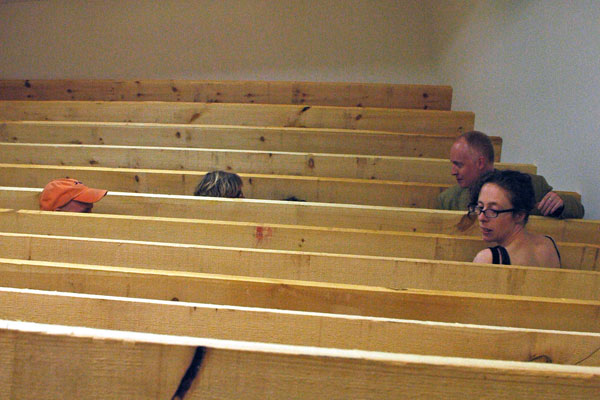
detail of Thomas Lendvai’s site-specific sculpture, “Between Pain and Boredom”
I doubt that any gallery installation in the city rewarded visitors with as much fun on Thursday night as that of Thomas Lendvai at Winkleman.
It was a hit opening night. Everyone left smiling, and there were images all over the blogosphere the next day. To understand what we’re all talking about, you really had to be in the gallery, but not only that, you had to enter into the construction itself. Of course the production continues for another month, so there are still plenty of chances to check it out. Bring friends; the performance is even better with a crowd.
And make sure you let you eye and your head follow all the artist’s elegant swoopy planes through and beyond the gallery walls themselves.
Jules de Balincourt at Zach Feuer
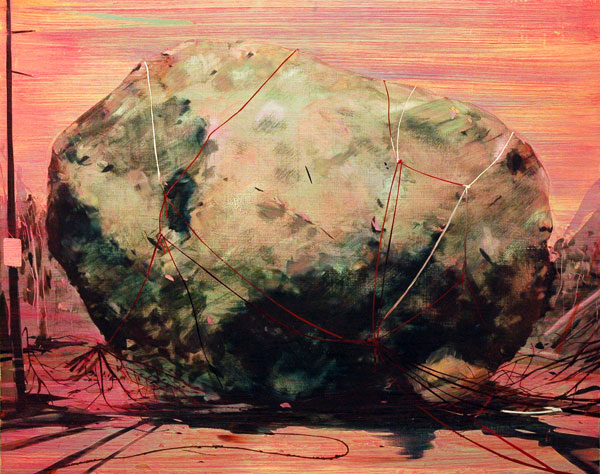
Jules de Balincourt Untitled 2007 oil and enamel on panel 27 x 34
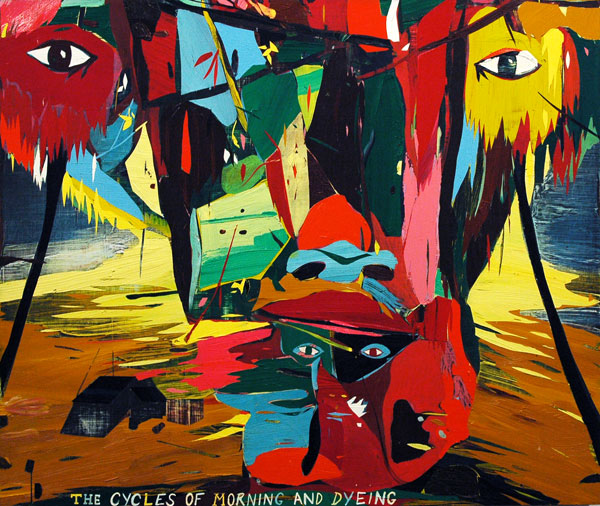
Jules de Balincourt Cycles of Morning and Dyeing 2007 oil on panel 32″ x 38″
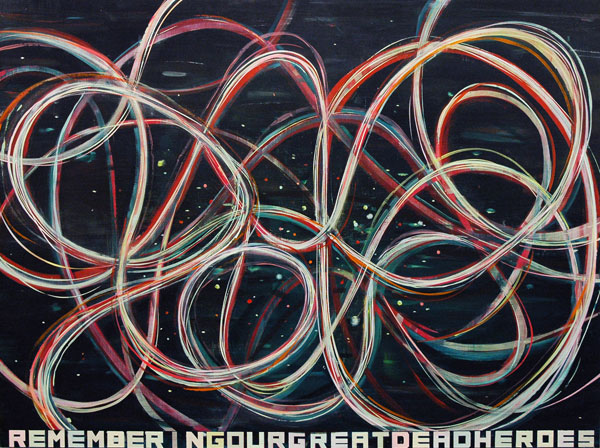
Jules de Balincourt Remembering Our Great Dead Heroes 2007 oil on panel 36″ x 48″
The huge crowds at the fall gallery opening receptions will make my comments about the work being shown somewhat equivocal at times, and Jules de Balincourt’s exhibition at Zach Feuer, “Unknowing Man’s Nature“, is the first example. I’ve really liked the artist’s work since first seeing it in the gallery’s early, rudimentary office space not long before the artist’s first show, and Barry and I are delighted we were once able to afford the painting we saw then. We brought it home to enjoy and it’s provoked us every day since.
I suppose that since I’d already seen so much of his work I thought I should be prepared for a surprise this time. Maybe it’s just me, but I was expecting, well, that I’d see work I hadn’t expected. So once I got into the gallery I guess I may have been slightly disappointed not to have to stretch a bit more. Still, it was a packed opening, and subtlety always has a hard time competing with a general merriment, so I’m definitely going to have to approach these paintings again, this time with the distraction of fewer friends and strangers.
But as I going over the several images I’d gathered last night I have to say that they look very good on their own terms, and I’m thinking: They’re going to grow.
I confess I’m already very fond of the first painting I show at the top.
NOTE: I woke up this morning, Saturday, thinking about one of the images I had uploaded above; I’ve now substituted “Remembering Our Great Dead Heroes” for “Not Yet Titled” because I was unhappy with the quality of my photograph of the latter]
Cheryl Donegan at Oliver Kamm 5BE
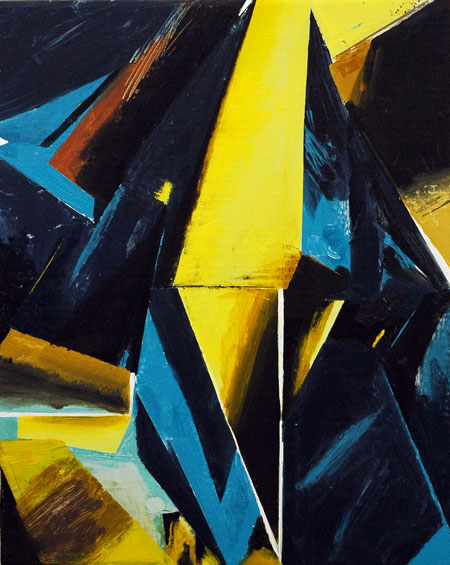
Cheryl Donegan The Hard Night 2007 water-based oil on cardboard 20″ x 16″
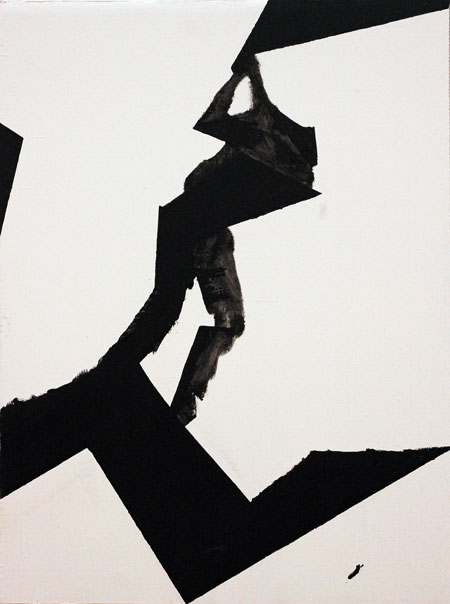
Cheryl Donegan Greatness is 1/3 2007 water-based oil on cardboard 24″ x 18″
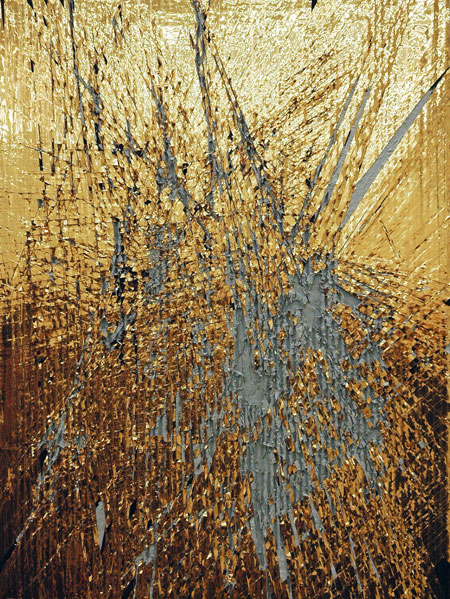
Cheryl Donegan Luxury Dust (Gold) 2007 gold tape on cardboard 25″ x 18″
Oliver Kamm opened his fall lineup of shows with “Luxury Dust”, an exhibition of paintings by Cheryl Donegan.
I was really looking forward to this show, and I loved it. [sorry for the brevity, but I’m going to try to be very economical with my time and texts for a while if I’m to even begin posting as many images as I would like during the current frenzy of openings, especially since even on the busiest weekend of the art year I still can’t keep from doing angry political posts]
well, not quite Einsatzgruppen, but kangaroo courts for sure
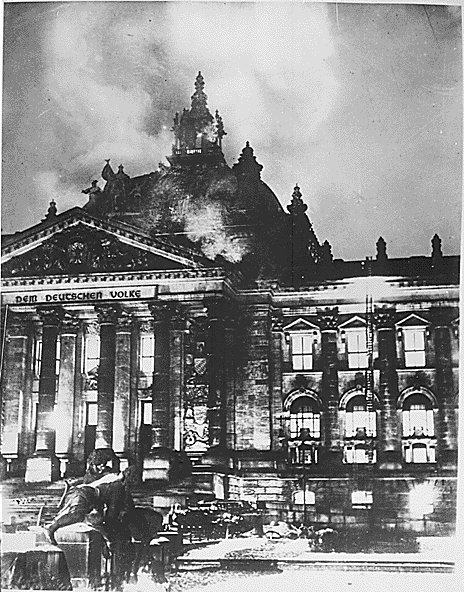
another site found to be invaluable as a ruin (the Reichstag burning, 1933)
“U.S. builds for future at Guantanamo“
GUANTANAMO BAY U.S. NAVAL BASE, Cuba (Reuters) – The U.S. military is building a mobile courtroom complex on an unused runway at the Guantanamo Bay naval base and plans to be ready by March to conduct as many as three terrorism trials at a time.
I saw this horrific headline and its story early yesterday and I’ll confess that my imagination immediately ran out of control. The first thing that came into my head was an association of these traveling units with the Nazi regime’s Einsatzgruppen (“task forces”), the official euphemism used for the mobile killing units which followed its armies as they advanced into Eastern Europe and the Soviet Union during World War II.
I immediately checked the historical facts however and I was reminded that the Wehrmacht‘s portable units did not even pretend to have a judicial element. Still, the idea of the heroic conquerors of Fascism and Communism creating mobile courtrooms to hand out extra-judicial judgments against a group of people whom we’ve been concentrating together for years in an inaccessible extra-territorial prison camp drives me absolutely crazy! Don’t these political villains and idiots have any sense of what this looks like? Or do they even care?
Of course to be fair to myself in my original call on this Reuters story, it’s not as if we haven’t been guilty of extra-judicial killing ourselves throughout the entire course of our war in Iraq, and much of it stinks of racism. I don’t even have to talk about the crimes committed by frightened young soldiers introduced into an alien land without appropriate numbers or equipment and without a proper mission.
Sometimes we actually boast about our official bloodletting. This is from a July 29, 2003 post on Jurist:
Last week the US military assassinated Uday and Qusai Hussein in a villa in Mosul, Iraq. Hundreds of troops armed with automatic weapons, rockets, rocket-propelled grenades, and tow missiles, and dozens of vehicles and aircraft, attacked four people armed with AK-47 automatic rifles. Mustapha, the 14-year old son of Qusai, was also killed in the operation, along with another individual who was apparently a bodyguard.
. . . .
The assassinations prompted chest-thumping and back-slapping all around. Even Senator Ted Kennedy joined British Prime Minister Tony Blair, The New York Times and the Washington Post, in congratulating Bush on the good news.
Except for the distinct difference between their initial senses of judicial urgency, a more appropriate reference for the quickie tribunals we are finally planning to set up in Guantanamo after all this time would be a court we ourselves destroyed sixty years ago: The Nazi Volksgerichtshof (“People’s Court”) was also set up outside the operations of any constitutional frame of law and the record of its hideous procedures illustrates some of the same perversions of justice. The excuse for the establishment of this Nazi political court was what the government insisted was the danger its sworn enemies posed to the health and security of the population. The Reichstag fire, the destruction of a very visible national symbol, was described as an act of terror, and its partisans were supposedly everywhere.
The “People’s Court” dispensed with ordinary juristic procedures and its indictments, its verdicts and its sentences were all determined by political dictate. Our own wheeled Cuban courtrooms will represent an ad hoc legal system that follows neither civilian nor military law, and it is outside the international laws of war established under any number of valid treaties, some in effect for well over a century. We know what it does follow, and that image should frighten us as much as it does its designated targets.
No, I’m not claiming that the contemporary U.S. is Nazi Germany, but at the current rate at which we are giving up our rights and our principles, I have to wonder what it is that we are we going to hold onto in order to be able to distinguish our system from the evil we once recognized in another?
[image from wikimedia]

Shane Hope
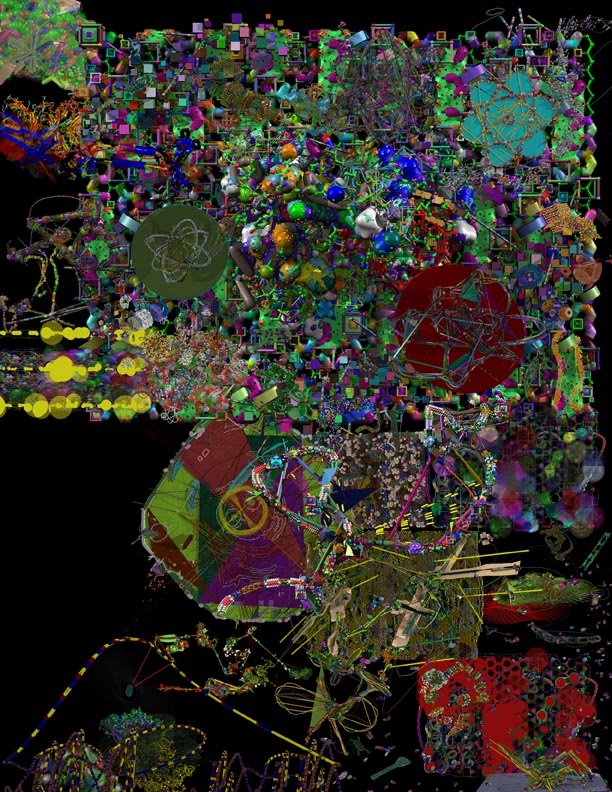
Shane Hope Chromosome More Clipped Graphite on Atomolecularly Manufactured Cell-ecular Unfolded Docking Decoy Proteins vs. Microbially Scribbled Scriptable Ornamentally Challenged Secondary Structures and Superstring Art, molecules, 2030
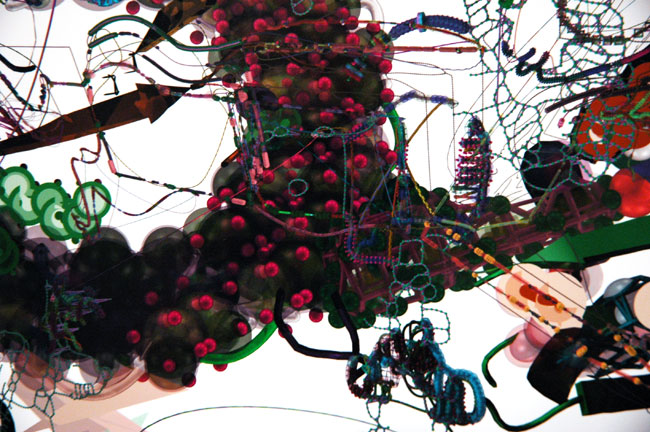
Shane Hope Infomorphic Animolecular Flowchart Food Chain of Event Horizons “cause what�s the pointing the Anywayfinding Thanatophiliacamouflage Decoy Decay Rights in a Switchable Habitat that is an Untitled Molecular Assemblage No. -1/3.33″�, molecules, year 203_ [detail]

[full view]
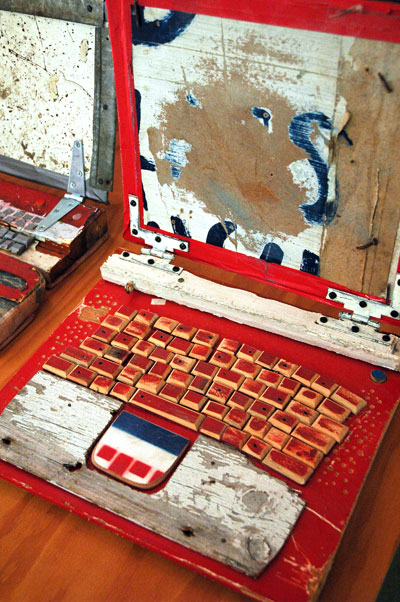
Shane Hope Folk Computronium Laptop No. n+2.22
, paint and salvage, actual size, 1776 [large detail of installation]
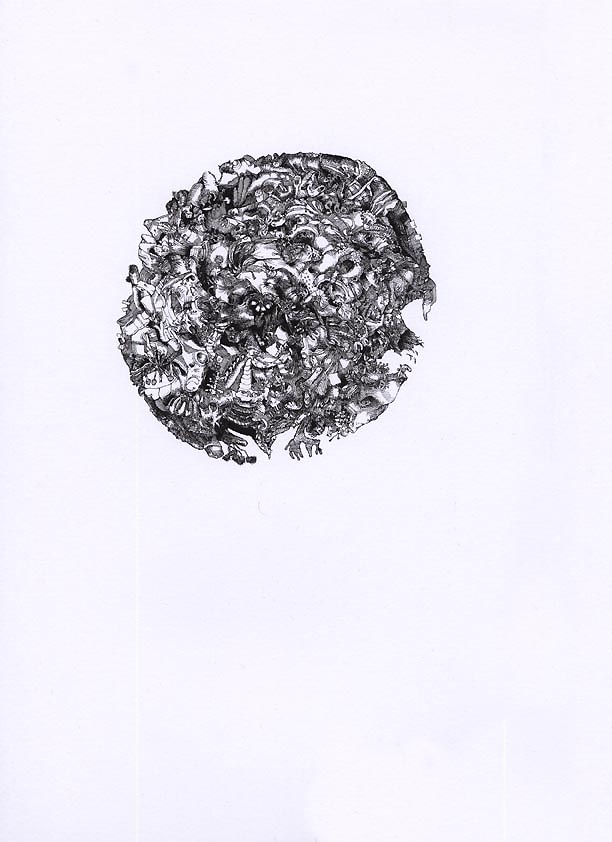
Shane Hope Goo(f) Ball No π, dark matter demarcations on lesser dimensional bits of tree, year wheneverafter
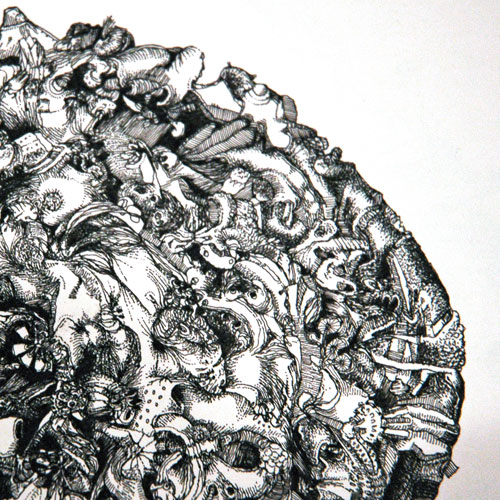
[detail]
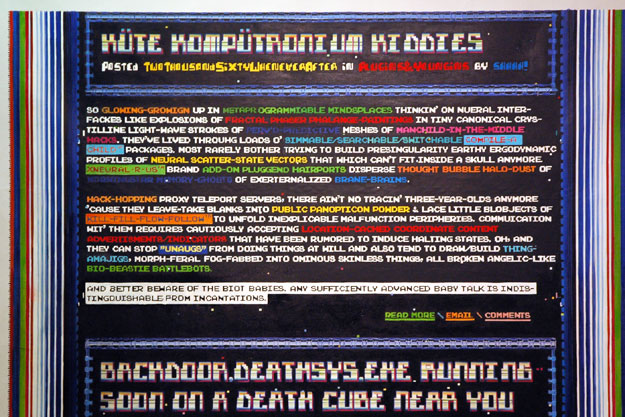
Shane Hope Kate Kompatronium Kiddies (study) So glowing-growign up in metaprogrammiable mindsplaces thinkin’ on nueral interfackes like explosions of fractal phaser phalange-paintings in tiny canonical crystilline light-wave strokes of perv’d-predictive meshes of manchild-in-the-middle hacks. They’ve lived throuhg loads o� simmable/searchable/switchable Compile-A-Child� packages. Most rarely bother trying to build presingularity earthy ergodynamic profiles of neural scatter-state vectors that which can�t fit inside a skull anymore. xNeural-R-Us� brand add-on pluggend hairports disperse thought bubble halo-dust of morningstar memory-ghosts of exerternalized brane-brains
Hack-hopping proxy teleport servers, there ain�t no tracin� three-year-olds anymore �cause they leave-take blanks into public panopticon powder & lace little blobjects of Kill-Fill-Flow-Follow� to unfold inexplicable malfunction peripheries. Commuication wit� them requires cautiously accepting location-cached coordinate content advertisments/indicators that have been rumored to induce halting states. Oh, and they can stop �Unaugs� from doing things at will and also tend to draw/build thingamajigs, morph-feral-fog-fabbed into ominous skinless things, all broken angelic-like bio-beastie battlebots.
And better beware of the Biot Babies. Any sufficiently advanced baby talk is indistingquishable from incantations.
outsourced oil on canvas, 72″ X 72″, Posted Two Thousand Sixty Whenever After [large detail of installation]
They’re beautiful. But I’m thinking right now, maybe I can get away with not being able to come up with any intelligent comments on these works on the argument that their titles already occupy so much screen space. Naw, I’m just going to have to admit that my real reticence comes from having been totally humbled by the awesome intelligence and fertile imagination of the artist himself.
We visited Shane Hope‘s studio last month at the suggestion of Stephen Lichty, who has been appointed director of Project Gentili, a new Italian Kunsthalle opening this fall in Prato, outside Florence. The artist will be the space’s featured artist in November. I’m going to be very sorry to miss that show.
His art is described by Hope himself as “outsider biotech”, and I suppose the lengthy titles shown above (up to 13 lines) might be more useful to those who weren’t as stuck in the liberal arts at school as I was. It’s a pretty intense body of work, exhibited in a number of mediums, and the artist’s passion suggests a mind and a way of life off of any grid of which I’m aware (I was told by Lichty that Hope has mastered his personal off-road BC wheel). I noticed a more conventional [?] model leaning near the door on our way out of his studio.
Although their images are significantly computer-generated, many of the more striking pieces are directed with a hand and a mind inspired by fictive extensions of extraordinarily-complicated scientific concepts. Hope’s work is describing a future married to his own imagination, and I’m staggered by the beauty – and the terror – of both the design and its implications.
ADDENDA: This description of the molecular drawings is from Marisa Olson, who was writing about Hope’s representation in Rhizome‘s installation at Scope NY in the spring of last year:
Shane Hope’s drawings involve molecular modeling systems�collections of techniques to model or mimic the behavior of molecules�in a process whereby the three-dimensional architecture of molecules is interpreted (or predicted), visually represented, and manipulated.
[first and fifth images from outsider biotech]
fuck Mother Teresa!

a very rewarding friendship (Blessed Teresa greeting friend Charles Keating)
On this tenth anniversary of the demise of Mother Teresa, the acclaimed world-champion of suffering and death [whose lifer inmates were refused even aspirin, but who died only after availing herself of the very finest and most expensive medical treatment available in the West], I can no longer stay silent.
I’ve written at some length about the mutha before, and I was going to ignore the outrageous outpouring of memorials which have attended this happy date until just now, when I came upon an editorial in today’s NYTimes with the oddly-equivocal headline, “A Saint of Darkness”. This is ostensibly a secular journal, but it’s a sappy paean and it ends with an extraordinary reference to the grotesque Catholic cult figure’s supposed struggles against religious disbelief. These gilded lines would almost certainly embarrass even the National Catholic Reporter:
Mother Teresa, sick with longing for a sense of the divine, kept faith with the sick of Calcutta. And now, dead for 10 years, she is poised to reach those who can at last recognize, in her, something of their own doubting, conflicted selves.
And now, as we’re told by the Church, her agent, she herself belongs to the gods.
But not so fast. There is another, less fictive take on this wretched creature than that so successfully hyped around the Western world. The Times editorial board itself may be of more than one mind on the subject of the “just-say-no-to-drugs-and-yes-to-Jesus nunnery fund-raiser and baptism zealot. On this same holy day, on the opposite page from the editorial they also publish an OP-ED piece by Chitrita Banerji, “Poor Calcutta”, which delivers a very different slant on the story of the woman with the current Vatican title, “Blessed Teresa of Calcutta”. Banerji is speaking first for the dignity of her hometown Calcutta [I share her love for that magnificent city], which she argues the scary nun and her fanatical acolytes have savaged in the public mind, but her defense requires some bluntness about the fundamental error of the campaign. Here are two excerpts:
[The worldwide condemnation of Calcutta over other cities] was an instance of spin in which the news media colluded voluntarily or not with a religious figure who was as shrewd as any fund-raising politician, as is evident from the global expansion of her organization. For Calcutta natives like me, however, Mother Teresas charity also evoked the colonial past she felt she knew what was best for the third world masses, whether it was condemning abortion or offering to convert those who were on the verge of death.
. . . .
[Banerji writes that she had hoped that after the nun’s death the balance of perception might be restored to her beloved city] Ten years and one beatification later, however, the relentless hagiography of the Catholic Church and the peculiar tunnel vision of the news media continue to equate Calcutta with the twinned entities of destitution and succor publicized by Mother Teresa. With cultish fervor, her organization, the Missionaries of Charity, promotes her as an icon of mercy. Meanwhile, countless unheralded local organizations work for the needy without the glamour of a Nobel Prize or of impending sainthood.
Once again, on the true nature of Mother Superior Teresa and her Missionaries of Charity: No medical care was given to any of the people to whom members of her oder “ministered”; the Mother had a creepy lust for suffering; even by its founder’s own admission she was only interested in racking up the maximum numbers of “souls” for the next life; to that end any friendship, any kind of transaction was appropriate; and finally, the earthly Church she represented was not the compassionate institution imagined by many of her patrons, but rather one whose elements would be unrecognizable to even the most conservative of Catholics.
This sounds like they would want to create hell everywhere on earth; it would hardly seem to be a good advertisement for their regime in heaven, but what do I know about the attraction of marketing, fads, bandwagons or cults?
[image from zatma.org]

night bike bag

untitled (seams) 2007
homage to Dan