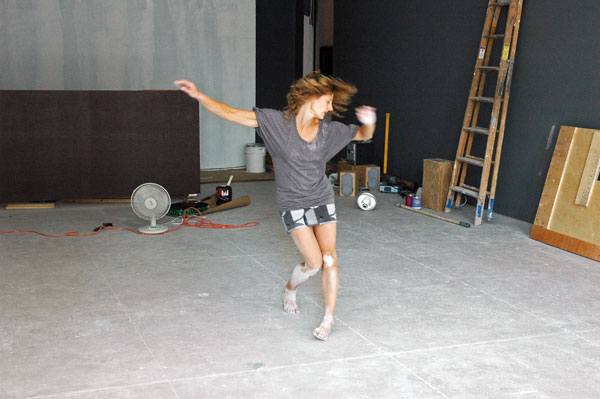
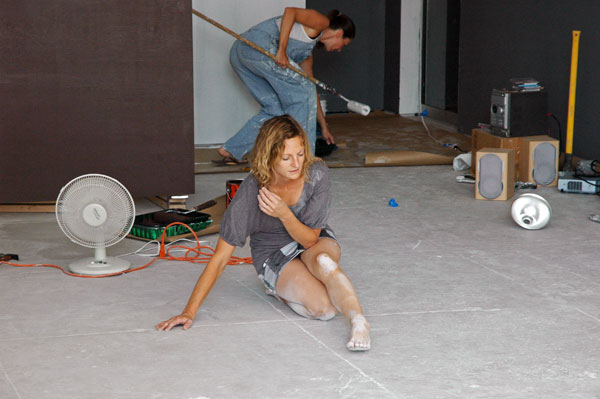
Barry and I walked over to Elizabeth Dee this afternoon to catch part of an all-day performance by Felicia Ballos and Flora Weigman. It was today’s segment of “Carte Blanche“, the gallery’s August-long program of video and performance art curated variously by gallery artists, the gallery director, guest artists, or guest curators.
The images shown above are of a section of Weigman’s improvisational dance solo. Her movement totally energized the bare exhibition space while it was in the process of being returned to clean, white-box gallery mode (hands-on-paint-roller gallery director Jennie Moore can be seen in the wings). Accompanying her performance was the raw machine-music of Wolf Eyes, their CD “Burned Mind“, from Sub Pop.
Ballos told me later that she had been turned onto Wolf Eyes by Steven Parrino.
For another image, including a link to a slide show with dozens more, see Bloggy.
Tomorrow’s program includes a talk by Drew Heitzler, artist, curator and Champion Fine Art co-founder, now the co-owner of the Culver City bar, Mandrake. Heitzler’s performance is titled Im Not an Alcoholic, and in it he is expected to address the history of artist-run bars. The fun, including “beer with friends”, starts at 6:30.
Author: jameswagner
Chris Quinn can’t even get a pothole fixed
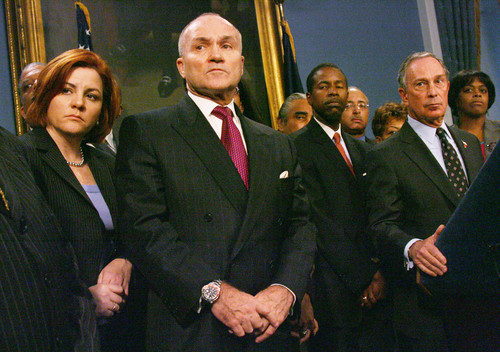
she’s busy (Quinn sharing with the Police Chief and the Mayor)
Over the past several months I’ve written repeatedly about my frustration and disgust with Chistine Quinn’s attack on our First Amendment rights in her role as City Council Speaker.
She remains completely tone-deaf on the issue, positioning herself somewhere within the cold heart of the NYPD/Republican establishment.
But I’m not a single-issue agitator, and if Tip O’Neil was right when he said “all politics is local“, Quinn’s office should be very worried.
During this same period and starting well before, as one of her local district’s constituents I have been trying to get her office’s attention on the kind of ordinary small-scale problem neighborhood representatives handle all the time – and resolve.
In response to my inquiry about the construction of an invasive animated commercial advertising sign on a public sidewalk next to our home I was eventually told by Quinn’s office that the City authorities had determined that the offending business had no permit for it and could not have been granted a permit had they applied for one because it threatened public safety. The installation would have to be removed within 30 days.
That was March 2, over five months ago, and it’s now eight months since I first made inquiries.
I have been following up with my Council Member’s office ever since to see why nothing has been done. Each time I’ve had to call, and I’ve been told the assistant forgot about it once again but would look into it right away. That has been repeated perhaps eight times.
On July 9 I learned directly from the Department of Buildings that the violation associated with the complaint number I had been given in December had somehow mysteriously disappeared months before. When I asked Quinn’s office if they could get some explanation I was told the person to whom I had been talking over all these months was in a meeting but would call me later that day. On the day after someone else called and said that my file was second from the very top of the first assistant’s priorities and I would hear back from her that very day.
I’ve not been called, and of course the offending installation (a spot-lighted giant revolving cupcake on top of a sidewalk canopy built too close to a hydrant) hasn’t been removed.
For all his transgressions, and they were many, at least New Yorkers can remember Al D’Amato as someone who could get a pothole filled – “Senator Pothole”. What are we going to call Christine Quinn?
[image by Julia Gaines from Newsday]
Gaudi not dead; only injured
I used to think, “Gaudi”, eccentric, interesting, even beautiful, but a dead end.
But then, was/is El Greco a dead end?
I actually knew virtually nothing about Gaudi when I first visited Barcelona 45 years ago and found myself straddling my bike outside the construction fence below the unfinished towers of the Sagrada Familia. Everything was locked-up tight (there seemed to be nothing more than what I was looking at, in any event) and I already understood that this project’s fate was uncertain at best. I had been told by other travelers my age whom I had met along my route that summer in Europe that if I was going to go to gloomy (yeah, after all this was only 1961) Barcelona this architectural monument to Catalan modernisme or European expressionism was absolutely not to be missed.
I have to remind myself as I write this that before arriving in Europe that May I was still totally infatuated with the purity and minimalism of the International Style. As far as I had been concerned no architecture or design that had preceded it was of any interest except as history, and real history had ended about the time Victoria ascended the British throne in 1837.
I do remember that, a couple of decades after the end of the Spanish Civil War, Gaudi’s dark pile on the outskirts of Barcelona looked very weird, but even then, before the real start of the Sixties, I was thinking weird was a compliment. This scruffy facade without a building clearly bore some resemblance to Gothic cathedral models, but the multiple, siamesed towers looked like a monstrous mutation, and their rough, jagged, natural details and screwy hollowness suggested a severely-neglected maintenance program. They were pretty scary. There was no tourist brochure. I really didn’t get it, but it felt important.
This spring I went back. The construction project had been re-started years ago and now there’s a realistic expectation that the building will actually be completed in 20 (or maybe 80) more.
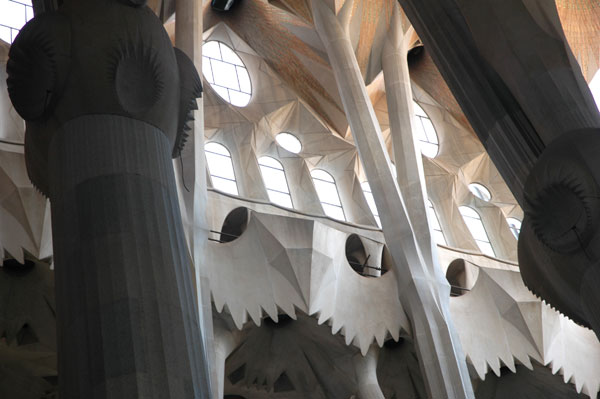
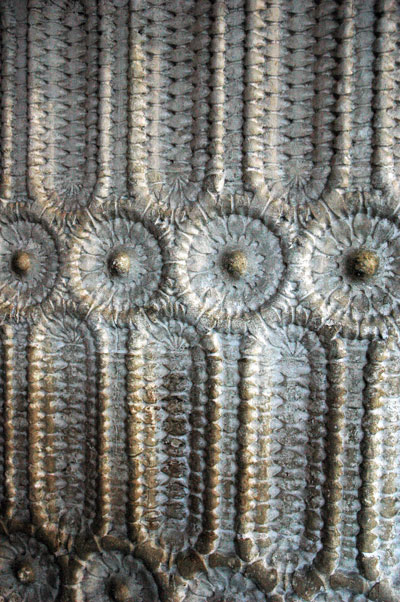
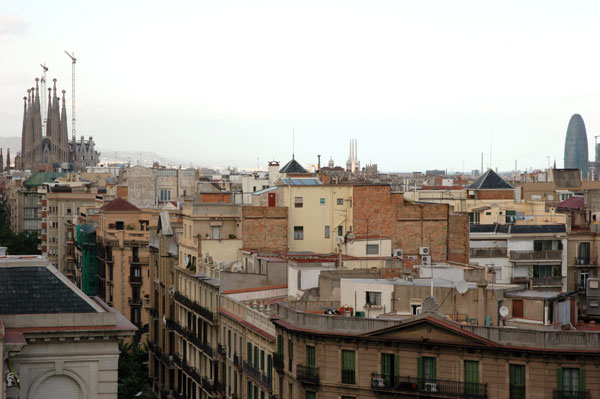
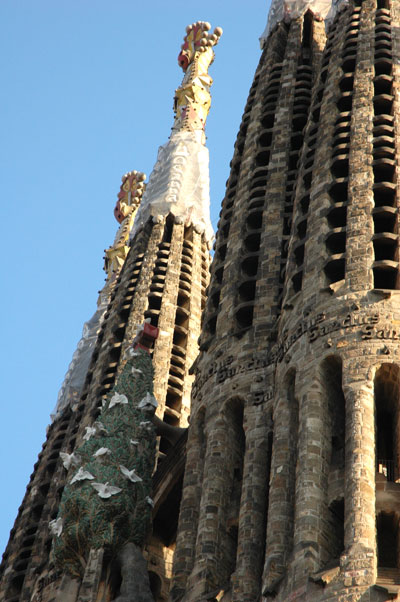
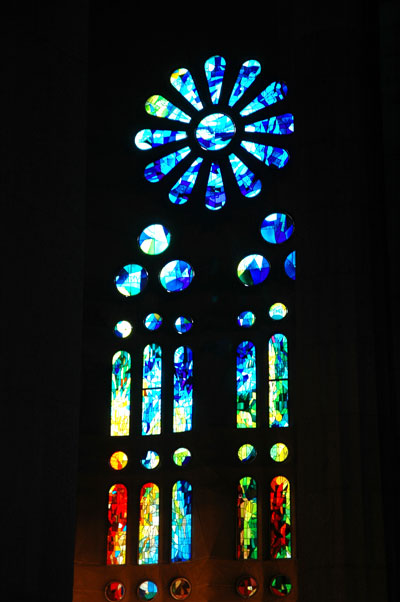
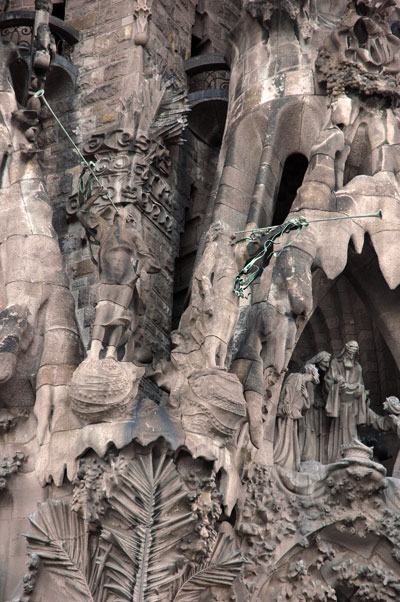
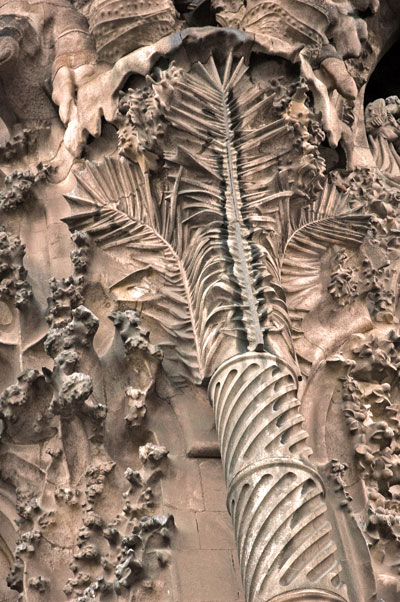
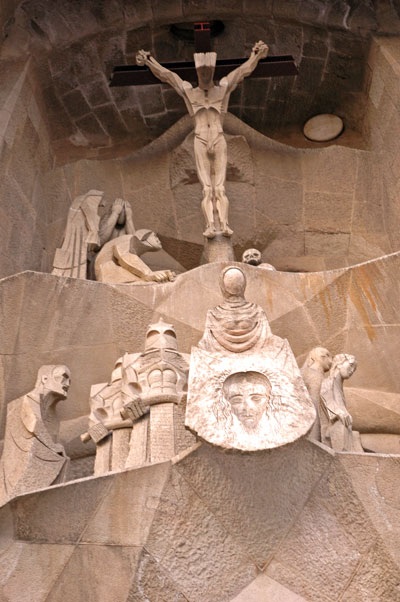
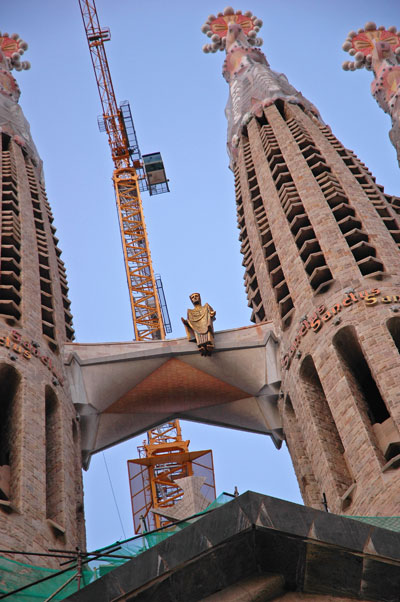
I was able to get inside this time (this time there was an inside). I had done some homework since 1961, but even had I been a really lazy student I couldn’t have been less excited about it on my second visit than I was. I’m going to leave any description up to the images I’ve posted here, but I will say that I have never seen anything like it and don’t expect I or anyone else ever will. Hmmm, wait. Santiago Calatrava’s name suddenly came into my head as I typed that. I’m not an unequivocal fan of his art, but even if there may be a link between his work and that of the Catalonian master (and no dead end after all?) it’s unlikely Calatrava will ever have a commission which would match his skills as well as the Barcelona basilica did Gaudi’s.
But there is still that other thing, what I now have to describe as the darker side of Gaudi. I’m only going on the basis of information easily available to anyone, but I realize my emphasis may present a picture of the man not familiar to most. I’m writing about the less admirable parts of Gaudi’s story as someone who admits he is able to love and appreciate Richard Wagner’s operas as among the very greatest accomplishments in Western music even while he is completely familiar with and fully disgusted by much of the composer’s personal and professional life. Gaudi was a great artist, but he was also a fundamentalist, right-wing Christian who would almost certainly have supported Franco during the civil war which began ten years after his death.
The architect had taken over construction responsibilities for the shrine/basilica in 1883, when he was 31. The project, whose ominous formal name is “Temple Expiatori de la Sagrada Família” [Expiatory Church of the Holy Family], had been proposed years before by the Asociación Espiritual de Devotos de San José [Spiritual Association of Devotees of St. Joseph], a reactionary devotional Catholic movement whose objective was to fight the modern industrial liberal world and its accompanying social changes and to bring about the triumph of the Catholic Church in Spain and elsewhere. The architect appears to have been very comfortable with that mission.
Gaudi also appears to have been an elitist, at least in so far as his professional practice was concerned. Elsewhere in Europe early in the last century architects were routinely inspired to design projects for the benefit of the public, even if their bills were being covered by private commissions. Gaudi built only mansions, private parks, and the high-end luxury condos of his day. His patrons were wealthy private citizens. This architect didn’t do affordable housing or public accommodations of any kind.
In the early years of the 20th century his contemporaries on the Left, including many artists, Spanish or otherwise, seem to have loathed the aging genius, even beyond his death in 1926. Years before that he had turned more and more inward and religious, abandoning all secular projects and devoting himself exclusively to work on the Sagrada Familia.
Even unfinished that edifice, which was conceived in the 19th century, is magnificent in every way. But it remains Catholic, perhaps even Catholic with a vengeance, in the midst of the population of this very unobservant nation and at the threshold of the 21st century. As we were leaving the sanctuary at the end of the afternoon this spring, from the side in the corner I heard the sound of a general rosary devotion. That day it was protected from visitors like us by high temporary walls. After experiencing the larger, glorious, purely aesthetic wonders of this place for an hour or more it was strangely disconcerting. Were they dreaming about reversing the last two hundred years?
My own wish would be to see this extraordinary building become a living monument to the survival of the creative human spirit. It should be possible for all people to approach and cherish it equally, sharing it generously, without a parochial consciousness. A transcendent place for music or poetry, surely. Best to hold the Hail Marys.
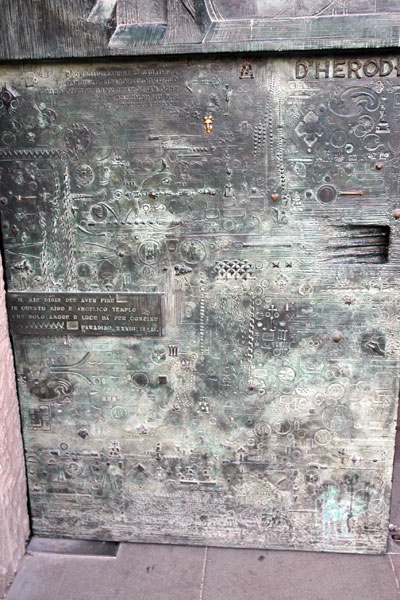
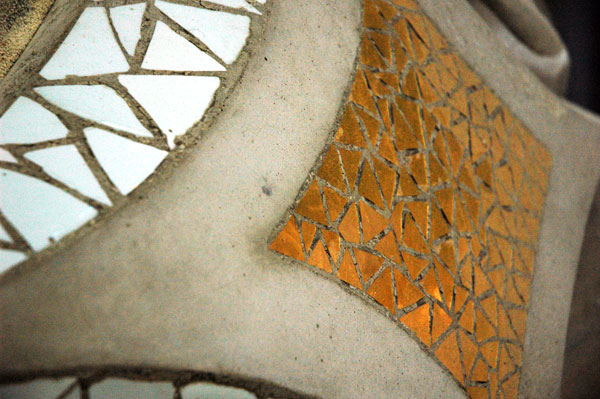
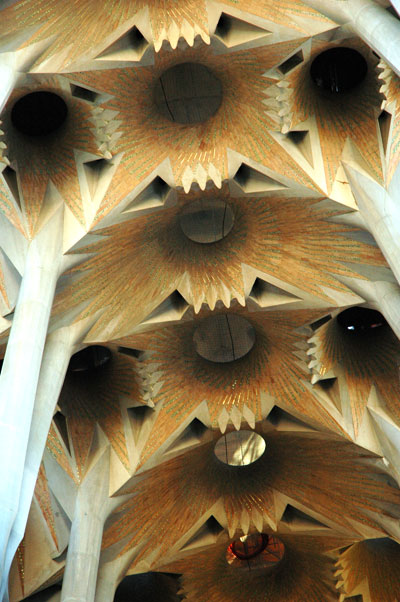
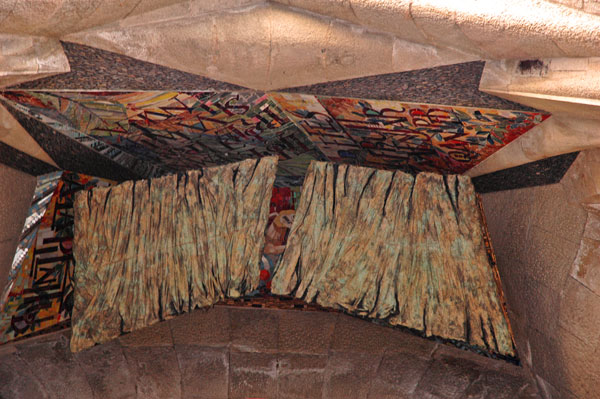
These thumbnails are all images of the Sagrada Familia:

GUANTANAMO DELENDA EST!
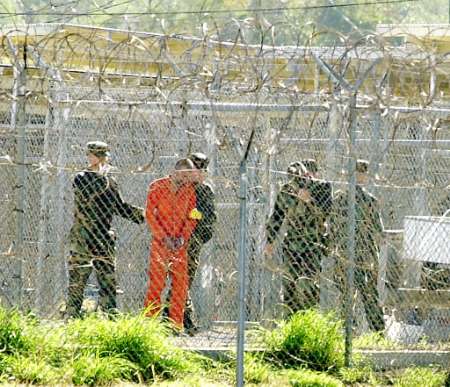
GUANTANAMO MUST BE DESTROYED!
This post is part of a series begun on May 21, 2007, which will continue until the U.S. concentration camp at Guantanamo Bay has been razed.
[image, otherwise unattributed, via salvationinc]
Bushwick lace
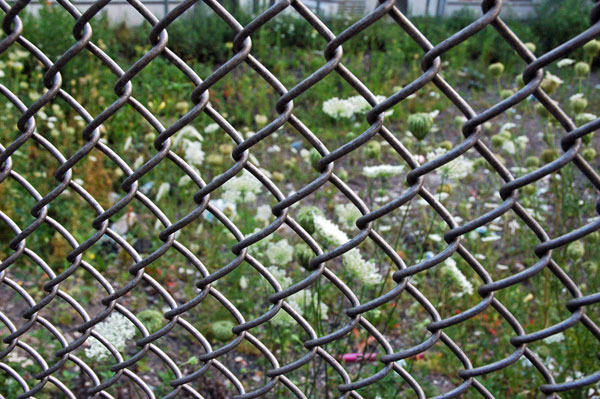
untitled (lace) 2007
SVA studio building control panel
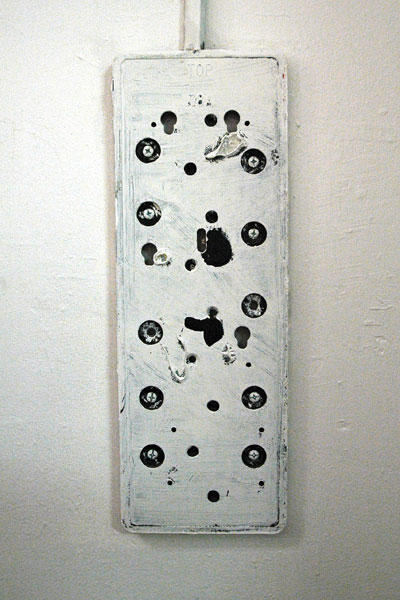
untitled (top) 2007
citing David Gibson
Bruce High Quality Foundation
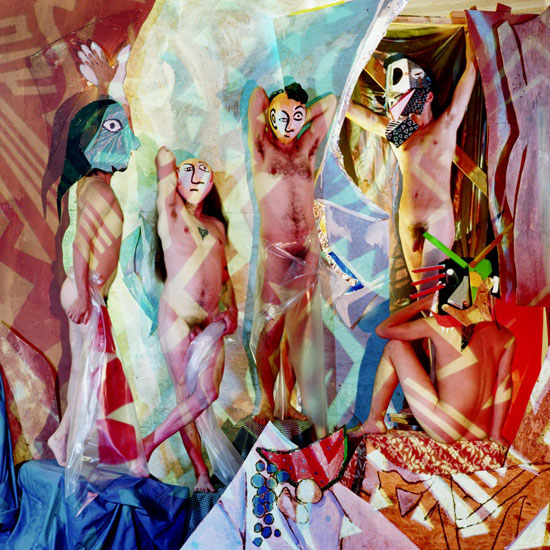
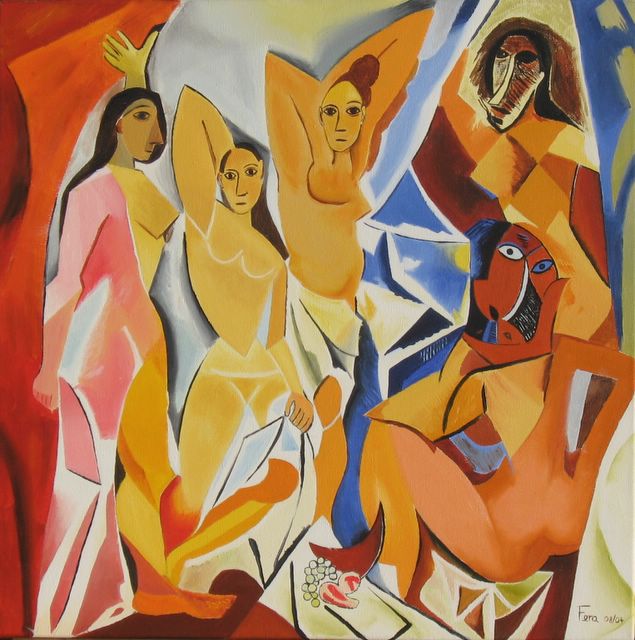
Bruce High Quality Foundation Bachelors of Avignon*
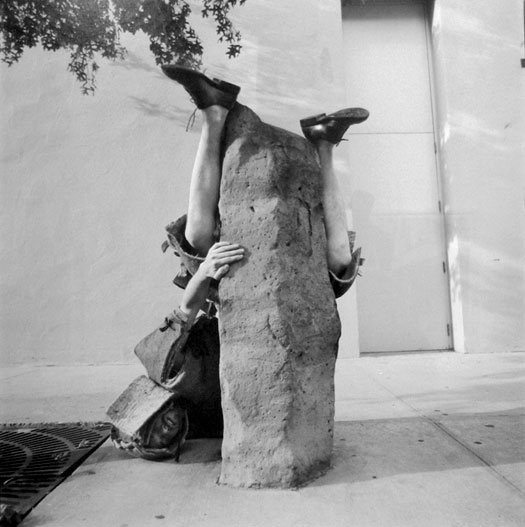
Bruce High Quality Foundation Joseph Beuys, from the “Sculpture Tackle” series
In spite of some serious temptations which might have gotten ourselves to Bushwick weeks ago Barry and I didn’t get to the Bruce High Quality Foundation installation in the group’s large storefront on Broadway until this past Monday. Energetic and creative young artists doing funny things, bouncing off every manner of cultural icon or shibboleth along the way. What’s not to love? The words “irreverent” and “political” should be in there somewhere. I’m on it. Only sorry that it took me so long.
On the homepage of the three-year-old collaborative’s website there’s a motto which reads: “Professional Challenges. Amateur Solutions”. And for a description of mission there’s this: “The Bruce High Quality Foundation was created to foster an alternative to everything”
An incomplete list of their projects, past, present or continuing, but arranged in no particular order, may explain a little more. You might have already come across one or more of these but not not been able to make out the infectious pattern:
- local waters smallcraft pursuit of Robert Smithson’s Floating Island by one of the Cristo’s saffron “Gates”
- a film centered on the Art Basel Miami trade show, conjuring both Marx and Jean-Luc Godard
- a commemoration of 100 years of Picasso’s “Les Demoiselles d’Avignon” with artists’ living sculpture [image above was not manipulated]
- a series of “sculpture tackle” performances around the city complete with target-specific costumes
- a WTC ground zero hero fast food concession cart intervention offering customers a “Manwich”
- an audition for Jeffrey Deitch’s Artstar reality television show by Bruce High Quality himself
- a construction of a full-size soapbox derby car for a run down the Guggenheim’s spiral ramp
- a bike fountain for Brooklyn Museum’s Feminist wing with its own gold wing, broken wheel, faucet seat and wire laundry basket
- a steaming midsummer hot-chocolate break by bundled-up skiers and snowboarders at the Roosevelt Island gondola terminal
- a living sculpture riff on G�ricault’s “The Wreck of the Medusa” below the Williamsburg Bridge
Still, you probably have to have been to the studio or been witness to at least one of the projects, or else done some traipsing through the links or their own site, YouTube or elsewhere to fill out the picture enough to penetrate the enigma of BHQF. I was the perfect fan candidate, and it took a while even for me to get it (I’m not sure what I would have been able to make of Picasso’s first leaps into cubism without being able to go to the internet back in 1907).
The exhibition is titled “RENT STRIKE! & Other Activist Jingles from the Crypt of Bruce High Quality” and I’m told it can still be visited by appointment through the end of this week. Email the studio at thebrucehighqualityfoundation@gmail.com, but if you end up missing this show, I’m sure there will be plenty of excitement going forward; it doesn’t look like they’re going to disappear.
I was interested in knowing something about the people within the group, including their rough numbers, and I did suspect they would be rough, so I asked a member to tell me more. I learned that just now most are guys, and I was told that five of them currently share the Brooklyn studio. “Bruce” then continued:
But we are always trying to cast a wider net, and steer clear of core membership. Our thinking about the Bruce High Quality Foundation has revolved more around growing it up and getting it to a level where it totally dwarfs our individual efforts than the Beatles model. We would like there to be offices all over the world, outposts for the Bruce High Quality Foundation, and maybe people to take over the operations for us when we all die. I would say the Bruce High Quality Foundation numbers between 5 and 5000. It should be more like a movement than a rock band.
*
the original, whose birthday is celebrated this year, belongs to MoMA:
The images at the top of this post, of photographs framed and on the walls in the current installation, are JPEGS furnished by Bruce High Quality. I was able to capture a few shots of my own while we were there on Monday, and I’m arranging them here as large thumbnails:

sculpture tackle suit installation detail
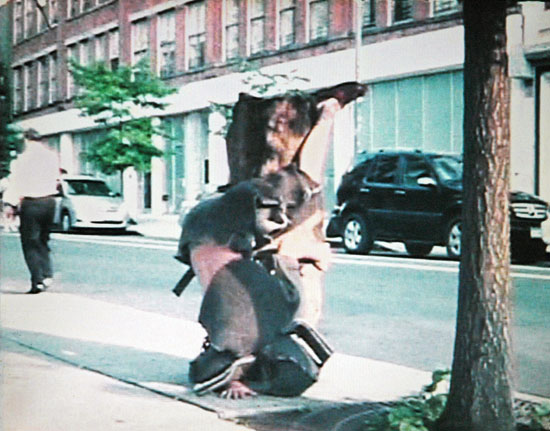
large detail of Beuys sculpture tackle video still
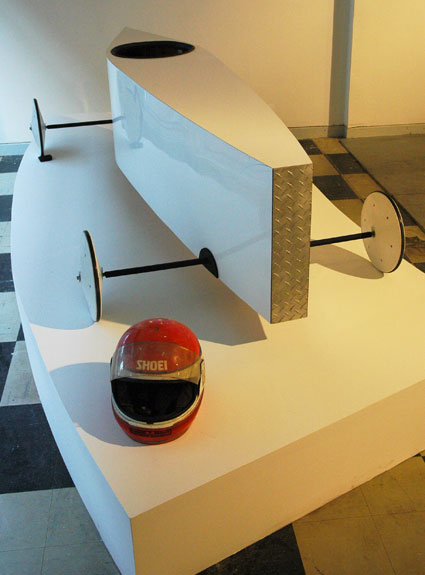
Guggenheim soapbox car installation
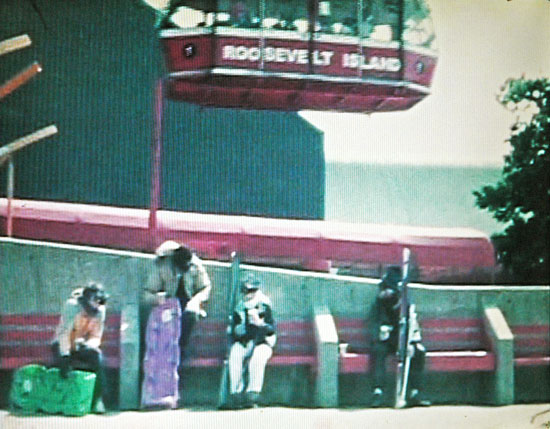
large detail of summer winter-sports lift station video still
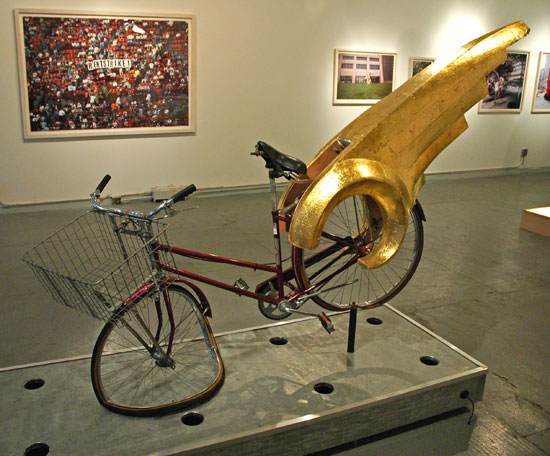
installation view of Feminist wing winged fountain sculpture
[first two images from brucehighquality; the thumbnail image of Picasso’s painting from fernando lobo]

Lisa Smith at SVA Open Studios
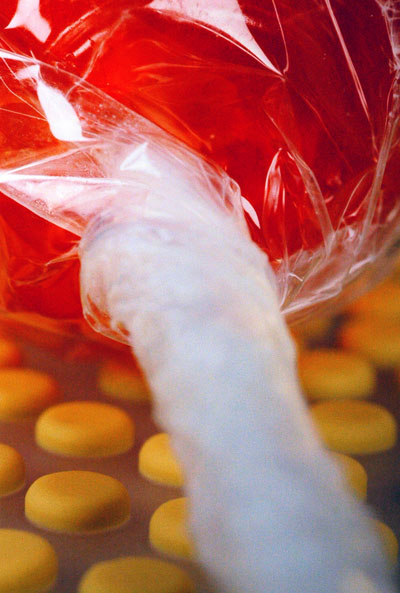
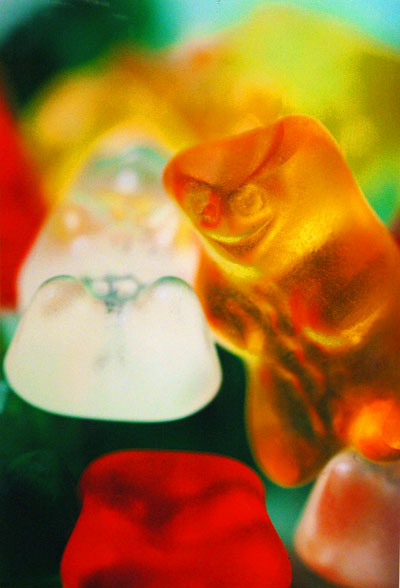
Exceedingly luscious. These two images were part of Lisa Smith’s installation in the photography gallery at last Thursday’s School of Visual Arts Open Studios event.
Hagar Sadan at SVA Open Studios
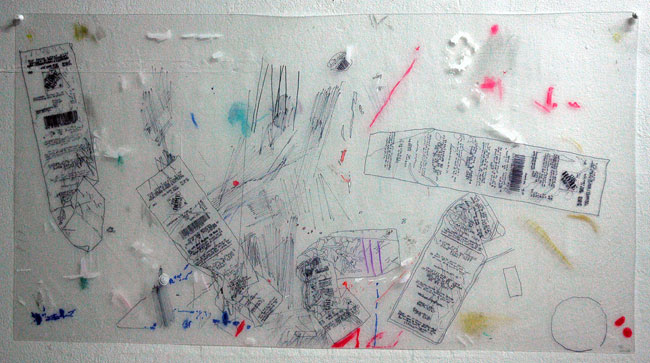
I think the heat inside the SVA Open Studios event was wearing down my stamina by the time I came across Hagar Sadan’s art on Thursday. I captured only this one image, but I remember liking the rest of the work a lot. Much of it had been assembled from recycled plastic bags. This particular piece didn’t really resemble anything else in her two spaces, but certainly represented the artist’s creative energy and perhaps an inability to take an ordinary break like other, ordinary people. The images here have been drawn on plastic, tracing simple items which were lying on a workbench in her studio.
Kenneth Walker at the SVA Open Studios
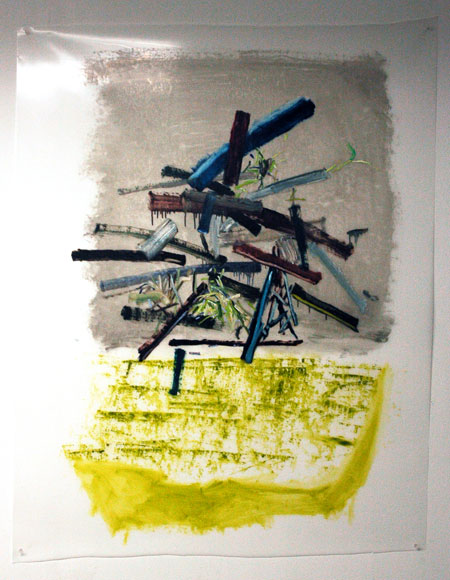
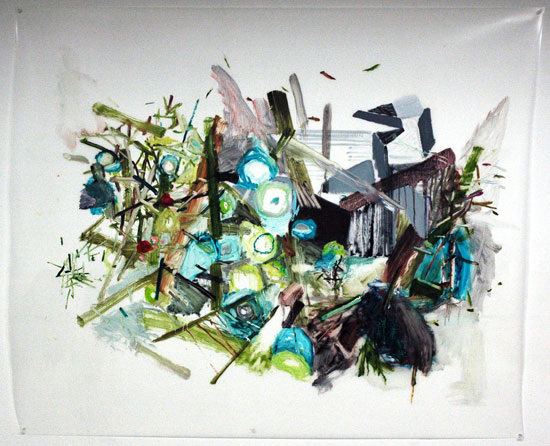
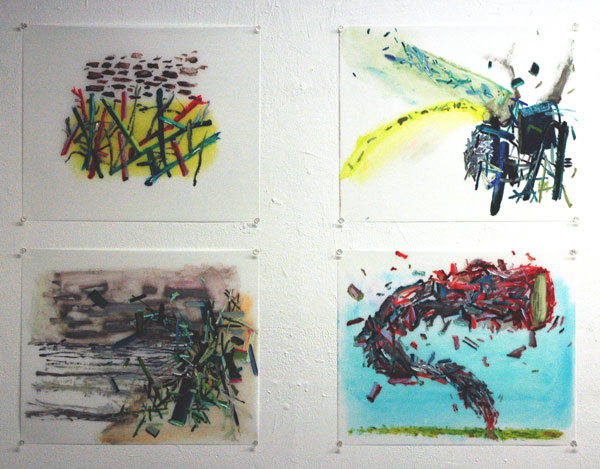
Kenneth Walker did these beautiful drawings on mylar, seen at the SVA Open Studios last Thursday. They had a three-dimensional, sculptural quality but suggested weightlessness at the same time.