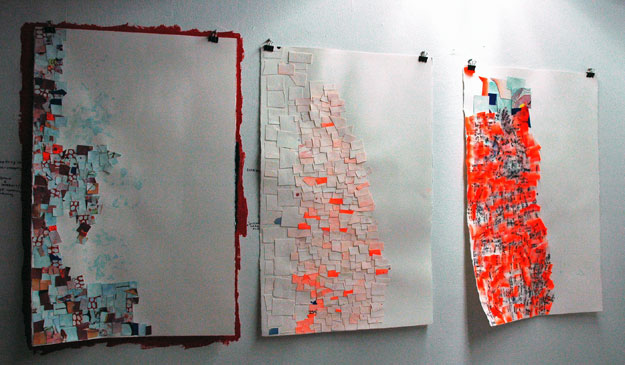
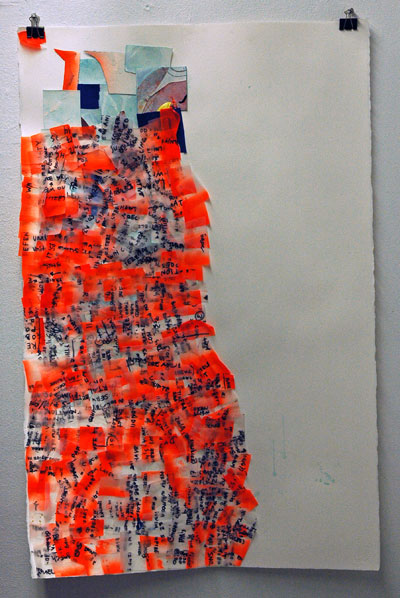
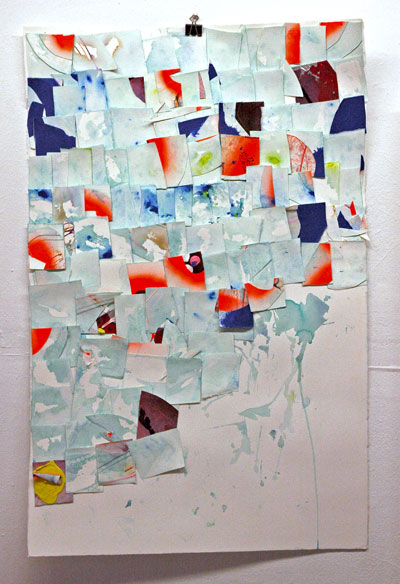
The beautiful work of Steve Page seen at the SVA Open Studios reception is an example of why these visits to student exhibitions can be so exciting for enthusiasts, even those who are able to regularly make the rounds of the less well-known galleries.
In addition, while we were in Page’s space, thanks to the familiarity of the school’s “Summer Residence Faculty” professor-cum-godfather David Gibson with the artist’s work, we were able to see the progression from those pieces which marked the beginning of this summer residency. Very different from the pieces seen above, they were rawly-dramatic on their own terms.
Author: jameswagner
Luis Tovar at SVA Open Studios
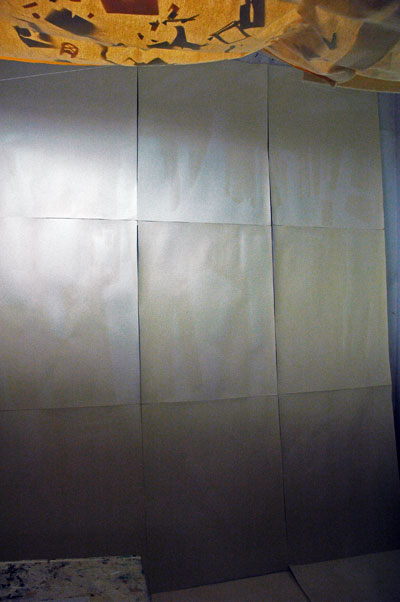
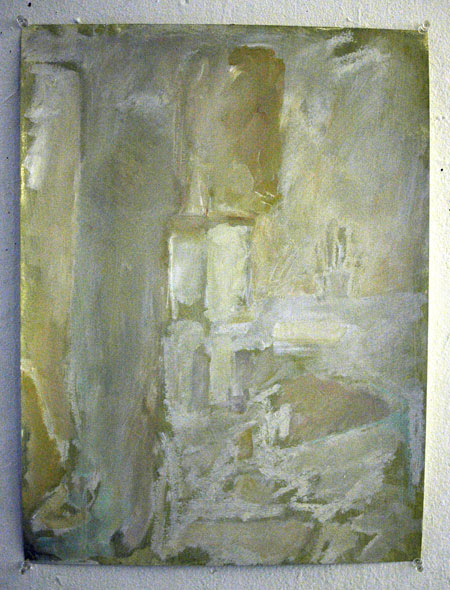
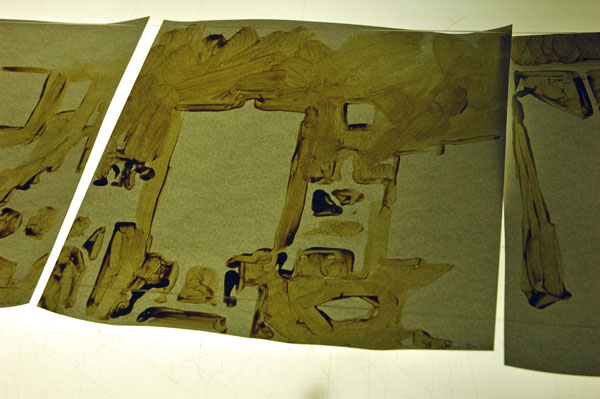
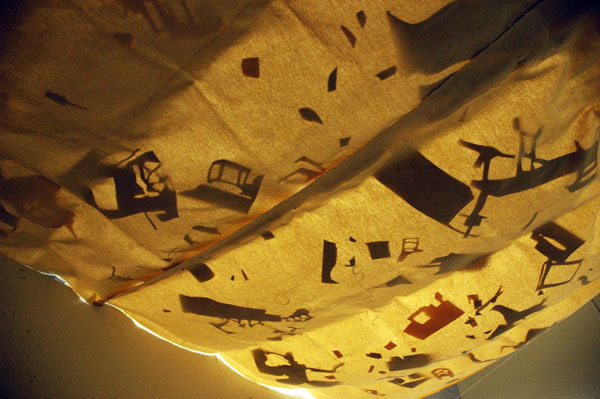
Luis Tovar’s drawings at the School of Visual Arts Open Studios event were mostly almost-abstract renderings of negative space, specifically the spaces of his own studio and those of the other artists in the school’s loft building on 21st Street. These works on paper were expressive, charged, and gorgeous, whether “tiled” over an entire wall, pinned individually on another, arrayed on a light box or resting playfully on a cloth suspended from the ceiling.
Joshua Allen Harris at SVA Open Studios
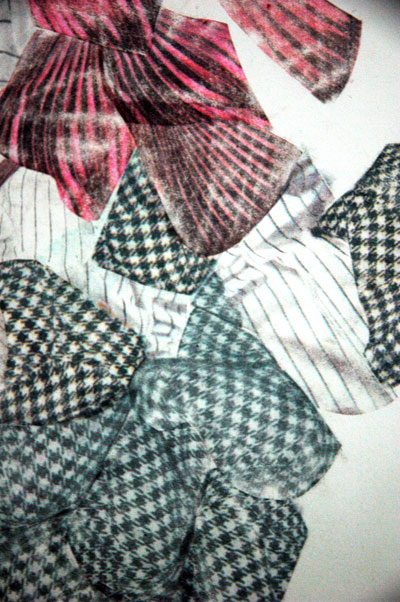
Joshua Allen Harris, detail of the work on the left in the thumbnail below
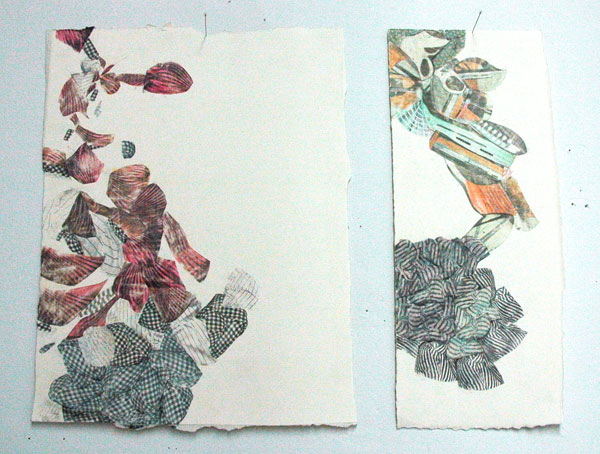
[full view of two drawings]
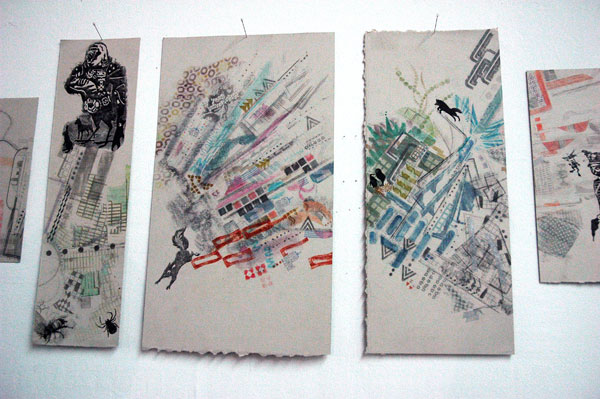
Joshua Allen Harris, studio wall detail
My camera was angry with me for making it take pictures in the near-darkness at the SVA Open Studios on Thursday night. My apologies to Mr. Nikon and to my visitors for these bluish shots, but I thought the work was too interesting to let them lie fallow in my computer. The shapes and colors on these graceful works on paper by Joshua Allen Harris were made by laboriously rubbing the ink off of portions of images found on fresh newspapers (collected at dawn or even earlier, I was told, before their ink dries completely). The artist may also have incorporated some collage elements, but I don’t think there is any conventional drawing on any of these pieces.
The work is exquisite, and unlike anything I’ve ever seen, but it evokes for me images in a large personal history of other charms and beauties.
SVA Open Studios, including Gabriel Shuldiner
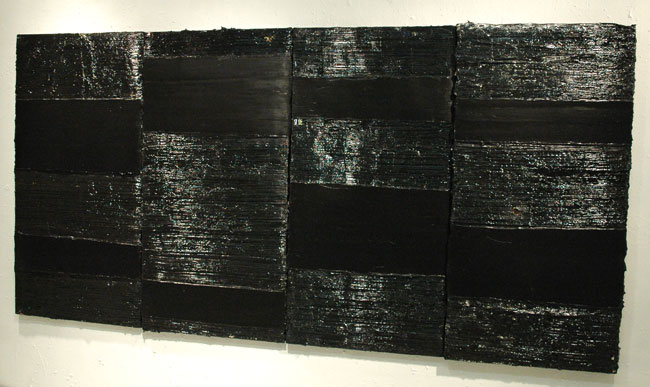
Gabriel Shuldiner An Unavoidable Destiny 2007 modified acrylic polymer, pigment, latex house paint, alkyd resin, gesso and casein resin, overall dimensions variable, approx. 48″ x 96″ x 1″ [installation view]
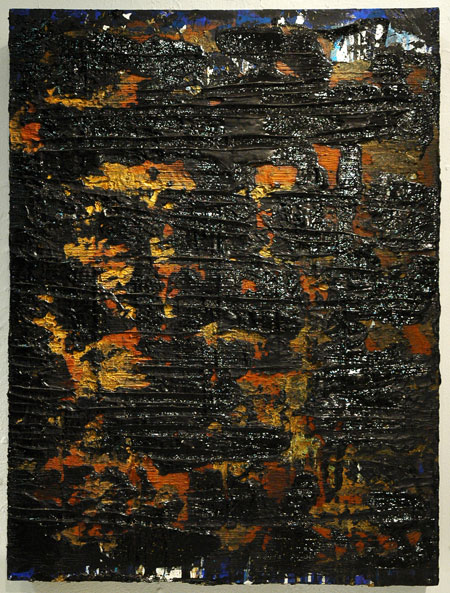
Gabriel Shuldiner Site And Context (Part I) 2007 modified acrylic polymer, pigment, enamel house paint, gesso, Enamelac, rust, dirt and alkyd resin on canvas on mounted wood panels, overall dimensions variable, approx. 40″ x 30″ x 6″ [installation view]

[detail]
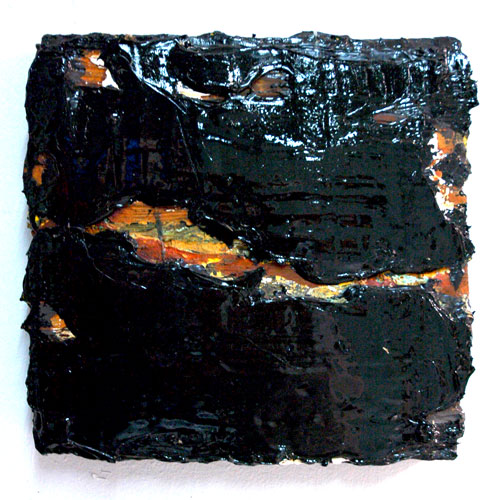
Gabriel Shuldiner Until Repetition Becomes Endurance 2007 modified acrylic polymer, pigment, gesso, reus and alkyd resin on canvas on mounted wood, overall dimensions variable, approximately 19.5″ x 19.5″ x 3″ [installation view]
Barry and I stopped by the open studios and exhibition of the Summer Art Residency of the School of Visual Arts on Thursday evening. This particular edition was an especially exciting one, judging at least partly from the fact that although it was a warm and humid evening (even warmer and more humid inside the building on 21st Street) we ended staying much longer than we expected.
As we had met Gabriel Shuldiner before and had seen some of his earlier work, we were not coming upon it totally blind. Shuldiner is very attracted to what he describes as the “power, authority and brillance” in the color black, even if he usually manages to introduce glimpses of some of its components in his lusty paint-sculptures. He writes about his art:
My work is about process: both highly intuitive and mathematically considered. . . . .
I experiment with many different materials, and am fascinated by the contrast and dialogue between them. Unconventional implements, homemade tools and modified paints help to make each mark, gash, scratch and chip as intentional and vital as my brushstroke.
My paintings evolve over time and eventually function as compositional objects; their relationship to the wall, to their environment and to the viewer’s position becomes an important and vital compositional element, as does the light it absorbs, reflects and scatters off the varied black pigments, creating further shades of grays and whites.
For more images and words, see Barry.
Most of the other artists were new to us and about them I have virtually no information other than names and images captured that night. I will be uploading mostly-undocumented photos of work by several of them later today or tomorrow.
Mayor’s office withdraws proposed NYC photo ban
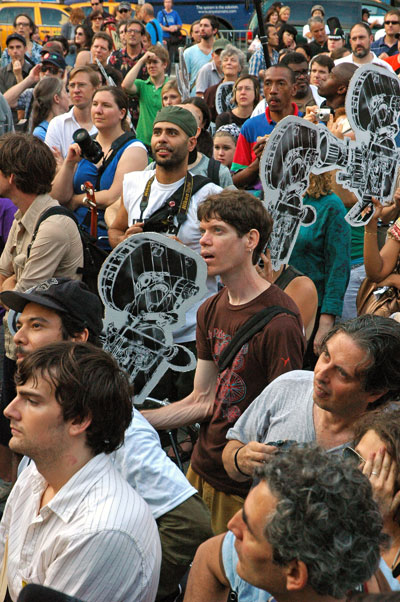
crowd before an animated Norm Siegel at July 27 First Amendment rally
The Mayor’s office has backed off from its outrageous set of proposed rules for people using photography anywhere in New York City. It’s a great victory for a free people alert to the threat of arbitrary government and willing to oppose it, but I’d advise against relaxing any guards.
They’ll be back. City officials said they would redraft the rules
In the end any proposed regulation absolutely must be held to a standard that freely permits photography anywhere in the city so long as people are not interfering with anyone else. Beka Economopoulos, the co-founder of Picture New York said it best:
I already have a permit for my camera; it’s called the First Amendment
Corporations and governmental units of every size have their own surveillance cameras trained on me willy-nilly virtually everywhere I go in this city and at all times of the day and night. I don’t recall their ever applying to me for a permit. I should not have to consult their directives or ask their permission to flip a shutter when I wish to do so myself.
Duke Riley: news from the [water] front
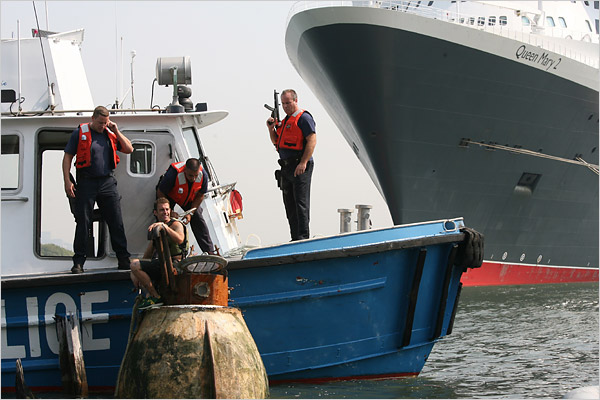
under arrest
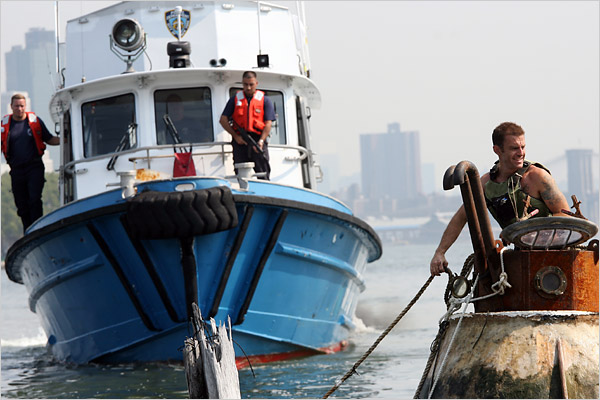
securing the acorn
This story had legs from the start, sea legs. Barry and I were watching it on line as it grew all day yesterday, and apparently it’s still going.
I would say that this late and abbreviated post were redundant except that I want to broadcast the respect for Duke Riley that we both share, and also to refer to our early immersion in the larger story of his remarkable art, including a wide-eyed visit to the first solo show at Magnan Projects in January last year. Then there was also the excitement of being able to share my own personal connection to and love for Rhode Island, the School of Design, Newport, and the little bicycle shop down my block on the corner of Brook Street, all sites associated with the still-unfolding story of the “Acorn” submersible project.
Don’t miss the slide show or the video on the NYTimes site.
My favorite take on the reaction of our guardians of public safety to the artist’s marine intervention? Libby and Roberta:
The Coast Guard and police didn’t think Riley’s floating bobber was so amusing and the boat was confiscated and he and his accomplices were charged with “marine mischief.” Talk about hammering a fly! Nobody seems to have a sense of humor or whimsy anymore, especially when it comes to imaginative art outside the normal channels. Now that’s a crime.
[images by Damon Winter from NYTimes slide show]
“collage + abstraction” at Pavel Zoubok
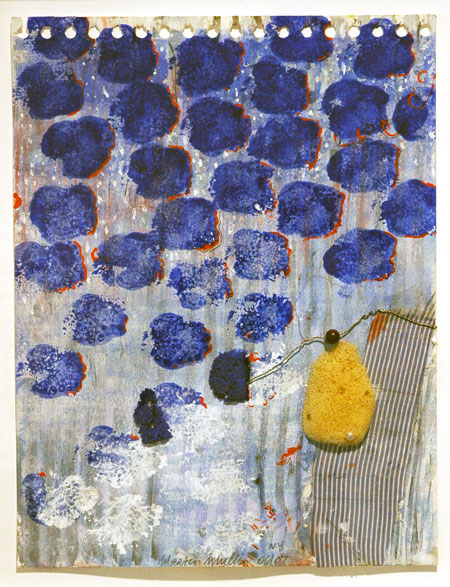
Martin Mullin Hydra 2006-2007 mixed media collage 11.75″ x 9″ [installation view]
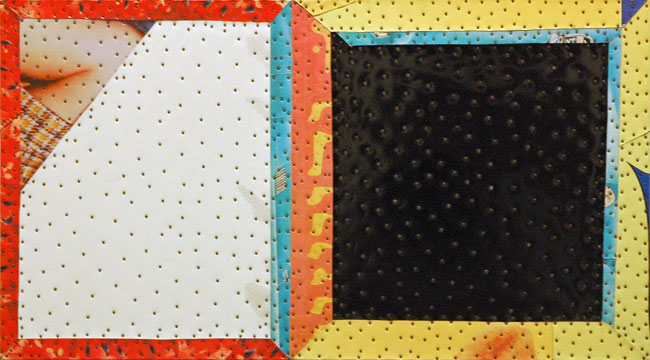
Tony Berlant 24 Hours 2000 11.5″ x20″
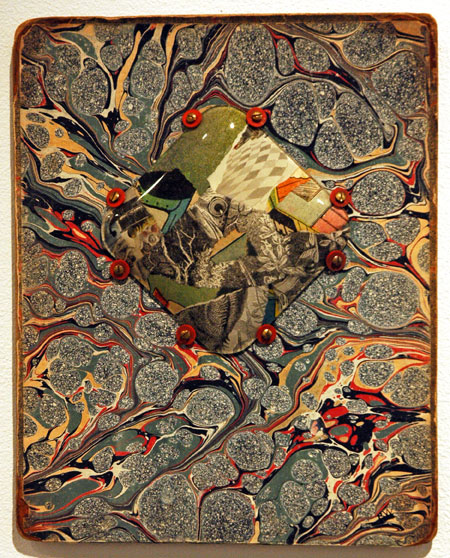
Robert Warner Untitled 2007 flint glass and collage on book board 10.25″ x 8.25″ [installation view]
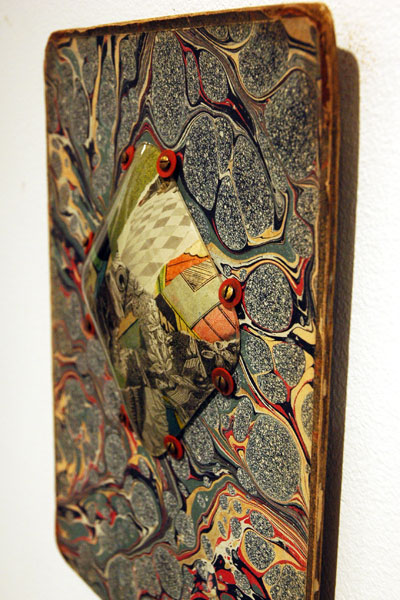
[detail]
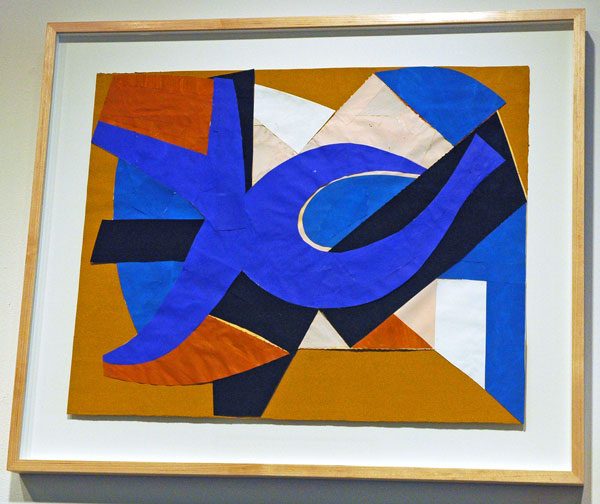
Fritz Bultman Waves and Others 1978 painted paper collage 16″ x 20″ [installation view]
Pavel Zoubok’s current group show, “collage + abstraction“, can described pretty much by its title alone. The works shown were created by 55 artists over most of the last 100 years. The oldest piece is Kurt Schwitters’s tiny, 1921 “Lady in Red”.
It’s a rich collection, and in a visit to the gallery earlier this week I found the small and large beauties of these dozens of works arranged as they are in a handsome, rhythmic, salon-ish installation almost overwhelming. And it’s all very elegant.
That last adjective however provokes me to ask mischievously whether something might be missing. There’s nothing obviously outrageous going on here. Maybe that’s only an over-stimulated today talking, looking for novelty, and in the interest of disclosure I should say right now that I like outrageous (note: Pavel Zoubok has often fed my appetite generously).
I definitely won’t fault the gallerist/curator’s aesthetic choices for this show, but in spite of my love for both abstraction and collage I think I regret the almost total absence of representational imagery in these works. Also, even if I can accept the restriction defined by the exhibition’s title definition, and although some of the works employ stuff outside the collagist’s conventional range of paper materials, maybe the components and, yes, the shapes of the collages selected could have been a bit less predictable. Stefan Saffer‘s “Fortress” and Robert Motherwell’s “Celtic Air” are two of the very few pieces which do not subscribe to a presentation involving four right-angle corners, and Saffer’s folded paper structure actually breathes totally free, managing to resist confinement in a frame of any kind, only barely able to rein in its third dimension.
But all this is small change when looking at the work itself. I went back to the gallery today, along with Barry and an artist friend. All three of us had a really hard time leaving.
GUANTANAMO DELENDA EST!
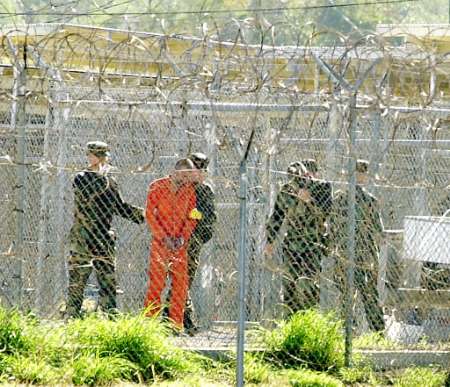
Cato the Elder didn’t have a blog, but he was still able to repeatedly harangue his fellow citizens at every opportunity, even at cocktail parties, with the slogan, CARTHAGO DELENDA EST! [Carthage must be destroyed!] He continued at it for years. Cato meant that Rome would never be safe while Carthage stood.
I do have a blog. The headline of this entry, a modification of Cato’s ancient mantra, means that modern Rome, our own threatened republic, will never be safe while Guantanamo is allowed to stand. Whether in Rome really had to destroy Carthage may be at least arguable; the imperative for the eradication of Guantanamo is not.
[this post is part of a series of reminders begun on May 21, 2007, which will continue until the concentration camp at Guantanamo Bay is razed]
[image, otherwise unattributed, via salvationinc]
Jeremy Blake 1971-2007
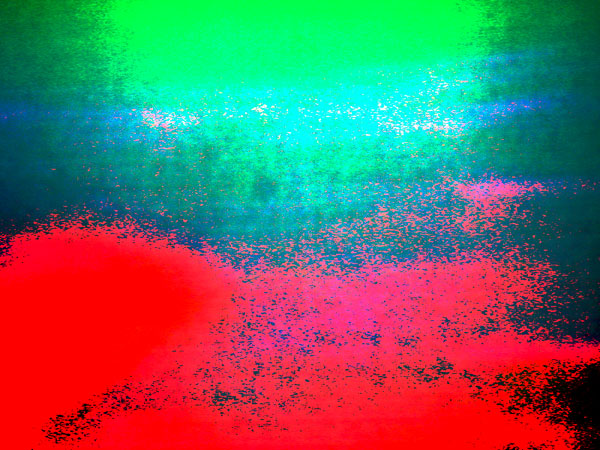
Jeremy Blake Reading Ossie Clark 2003 video [still taken from November, 2003 installation]
Jeremy Blake is no longer no longer missing, but he is still very much missed. The picture above looks very different to me after the news of the last two weeks; it now suggests a brilliant, burning star.
I posted this short piece three and a half years ago, with another capture from “Ossie Clark”.
[there are sensitive photos of Jeremy, and Jeremy with Theresa Duncan, on the Wikipedia entry]
eruv on 6th Avenue
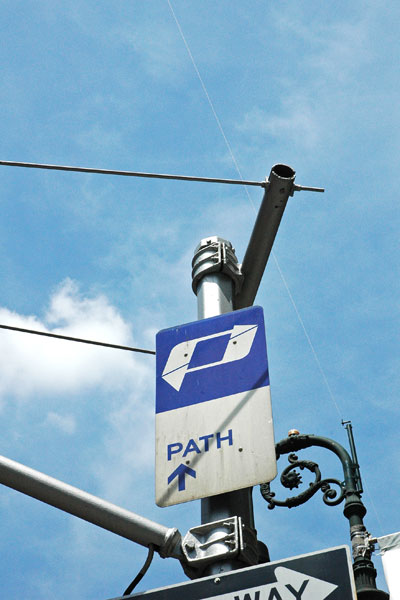
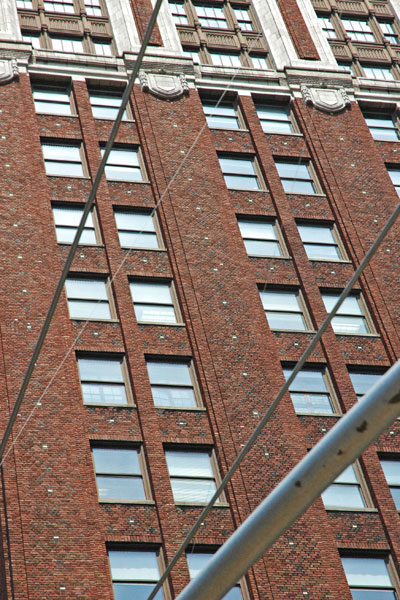
Last week on the day I took shots of this symbolic fence (the thin [nylon?] wires in the photos) along 6th Avenue just below 23rd Street I couldn’t find anything on line confirming that it represented a currently-valid eruv, or shituf mevo’ot [sharing of the alleyways], but the concept itself fascinates me.