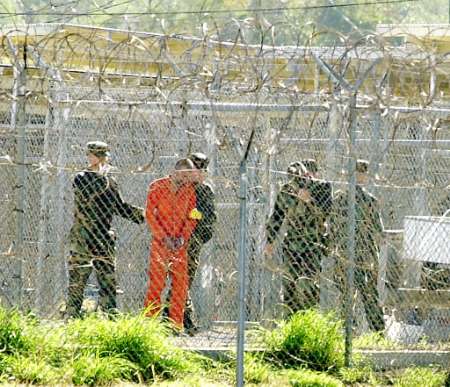
There are no summer breaks inside the cages at Guantanamo, and no AC.
[image, otherwise unattributed, via salvationinc]
Author: jameswagner
New Museum rises on the Bowery
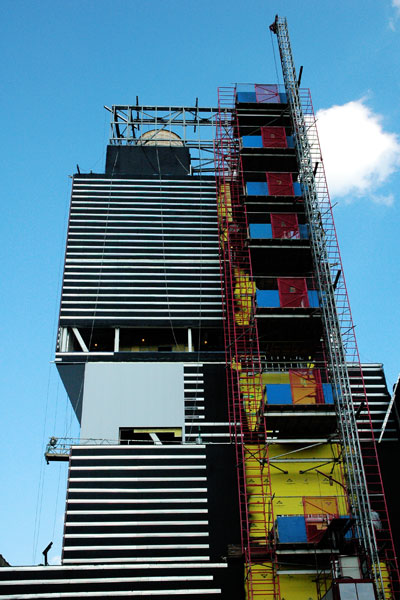
coming soon to a changing neighborhood
Looking at this stage more like the Pompidou than the casual stack of clean, minimal, white spaces which will eventually sit on the side of one of the oldest and most historically-evocative streets in New York City, the new New Museum is slowly rising above [most of] the roofs of the Lower East Side, where it will soon help to re-define the cultural landscape of an entire community.
We have already been seeing a number of good galleries opening up all over the neighborhood, and I wouldn’t expect that trend to slow down any time soon. My only question is what took them so long?
In spite of the fact that I live almost on top of the Chelsea gallery ghetto, I more than welcome a new destination: At least on visits to that side of town art junkies will be able to get a drink or a snack while making [our] unflagging rounds.
ADDENDUM:
Looking at this image this morning I realize I should have mentioned how impressed I was several years ago when the Museum announced the location of their new building. It’s was a coup for the architects, Sejima + Nishizawa/SANAA, and for the institution, and of course a boon for all New Yorkers. The building is at the eastern end of Prince, a street which has attracted interesting tenants at least as long as I’ve been coming to the city. It comes to a full stop at Bowery, and when I took this picture I was roughly across the street from the site of the legendary Manny’s music shop (where I first heard John Zorn play live). Even the great gothic cathedrals of Europe don’t always get such a grand parade for a front yard.
rare sighting of a brace of two of my favorite things
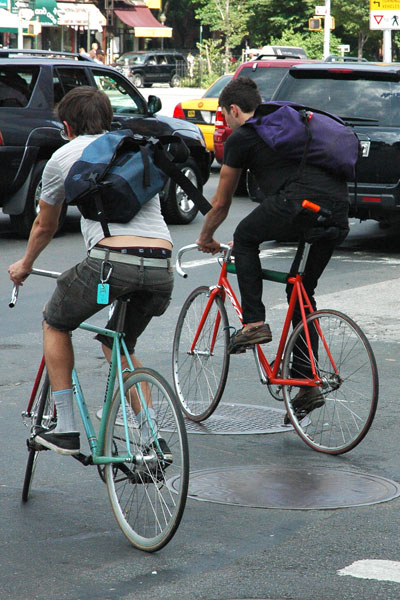
lithe youths on light bikes, turning out of Rivington Street last Saturday
“The Atrocity Exhibition” at Thiery Goldberg
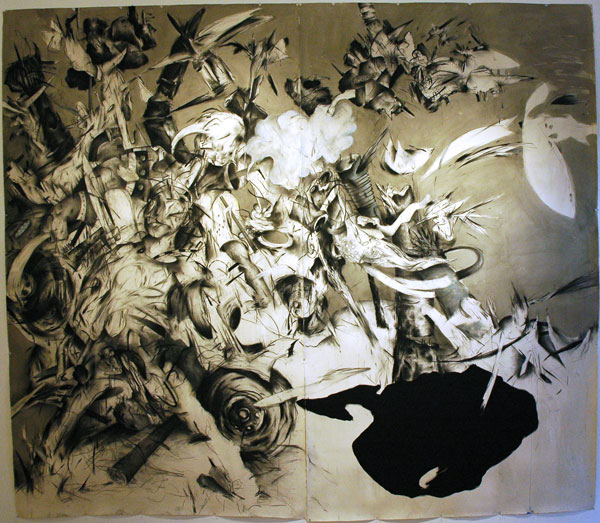
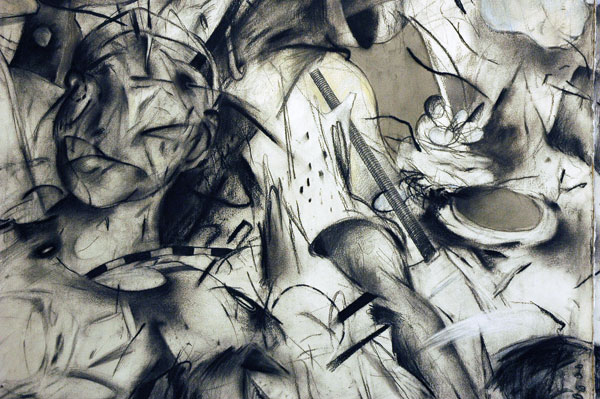
Ahmed Alsoudani Opened Ground 2007 charcoal, pastels and acrylic on paper 80″ x 105″ [installation view]
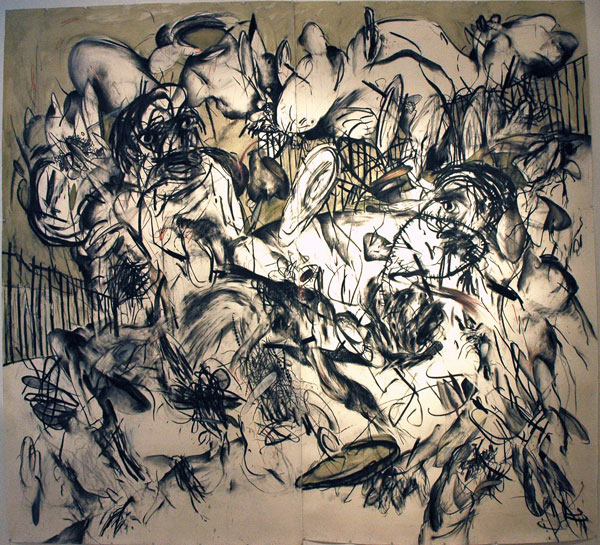
Ahmed Alsoudani Untitled 2007 charcoal, pastels and acrylic on paper 94″ x 107″ [installation view]
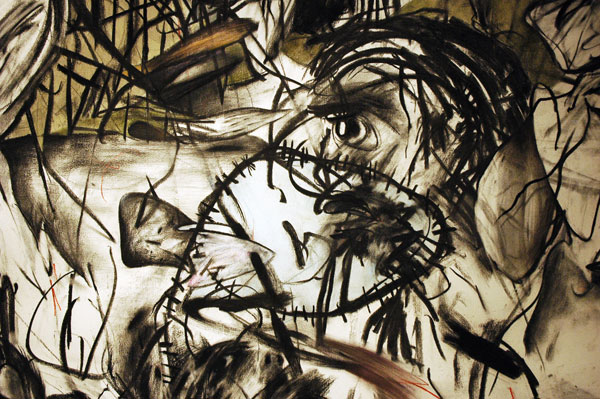
[detail]
After entering the gallery and exchanging greetings with gallery-keeper Ron Segev, I looked over his shoulder and was almost immediately aware that I was looking at something profoundly disturbing, and profoundly important. I’m referring to the work of Ahmed Alsoudani, one of four artists represented in “The Atrocity Exhibition”, currently installed at Thiery Goldberg on Rivington Street on the Lower East Side.
Alsoudani is a young artist, currently living in Connecticut, who was born in Iraq and came to the U.S. after the first Gulf War. He’s an American citizen today, but his work has not forgotten the recent history of his native land and the enormous and continuing human disaster whose burden (of the guilt, if not so much the grief) is so closely shared by his adopted home.
My first thought when I saw these two large drawings was that I was looking at a twenty-first-century “Guernica”. The technique is ultimately Alsoudani’s own, but much of his subject and elements of his dramatic representation of violence evokes the truth and the power of Picasso’s anti-war masterpiece, the honest outrage of Goya’s “Disasters of War”, or the grotesque beauty of Miro’s anti-fascist “Black and Red” series.
All of my references are to Spanish artists whose work was impacted by fascist or imperial violence, but they occurred to me even before I had learned about the artist’s origins or had read that his work is intended to specifically address the savagery being visited on the land he had to flee years ago, but where his mother and others still remain. Now I don’t consider it a stretch to see a connection in this small gallery space between the atrocities of the nineteenth and twentieth centuries and the memorials created by artists whose own countrymen were sacrificed to power, greed, ignorance and fear, and our own atrocity in our own century and a memorial (or series of memorials, since the cataclysm continues) created by another artist, again a countryman of the sacrificial victims, again the very same scourges.
These are fearsomely-magnificent works. I am very grateful to have gotten even a small peek into this artist’s extraordinary vision and imagination.
I was also very impressed with the work of the other three artists being shown this month, Ben Grasso, who regularly shows wonderful exploding stuff mid-explosion, and who is associated with Thiery Goldberg, Wendy Heldmann, who shows aftermaths, and lives and works in Los Angeles, and Molly Larkey, represented by two sculptures from her “Bombs” series, and who I think is showing in several spaces around town just now, including PS1.
By the way, the title of the show, “The Atrocity Exhibition”, describes its contents much more straightforwardly than is usually the case these days.
If there are no other images in this entry it’s only because of the difficulties I encountered in capturing any decent document of the other works. There are a few small pictures on the gallery’s own site, but not enough at the moment to keep wise visitors from investigating themselves.
“Three for Society” at 303 Gallery
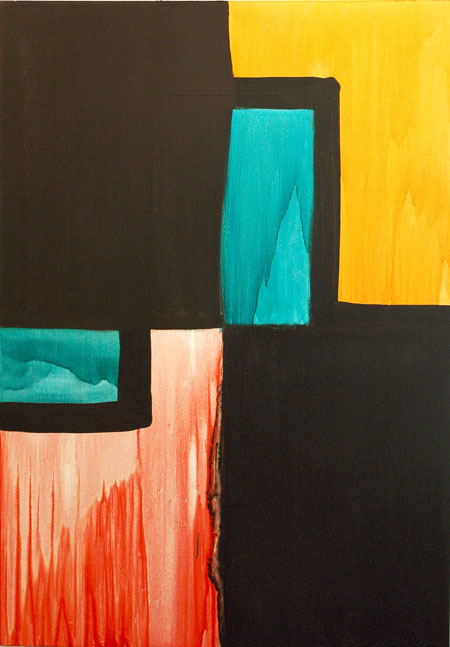
Mary Heilmann Sunset at Makapu 1984 oil on canvas 60″ x42″
I’m probably showing an image by the most well-known of the artists included in this pretty serious summer group show, Three for Society, at 303 Gallery, but it’s the kind of extraordinary painting which so ordinarily produced by Mary Heilmann, so I couldn’t resist sharing.
The other names in the exhibition, a majority of which belong to artists associated with the gallery, are Robert Boyd, Rebecca E. Chamberlain, Anne Chu, Hans Peter Feldmann, Tom Gidley, Florian Maier-Aichen, Collier Schorr, Agathe Snow, David Thorpe and Jakub Julian Ziolkowski.
Williamsburg and Bushwick, my big sky country
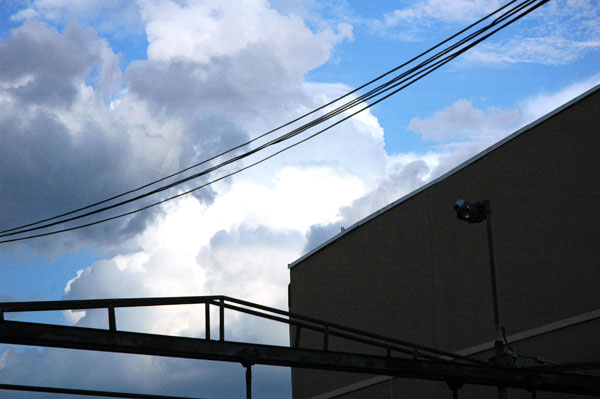
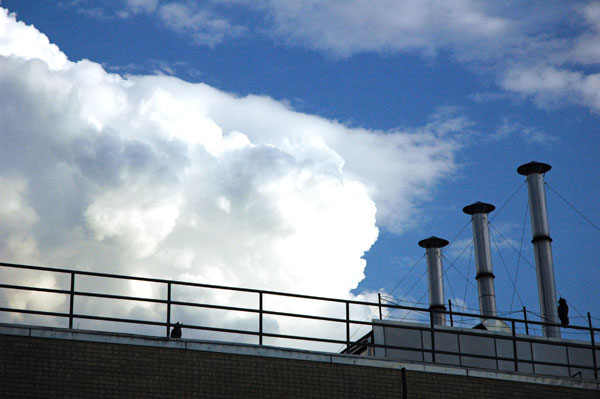
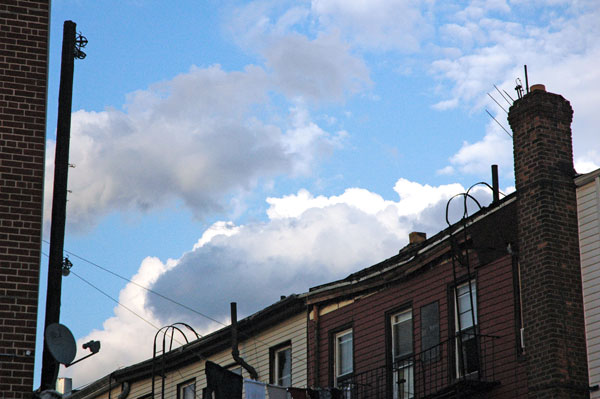
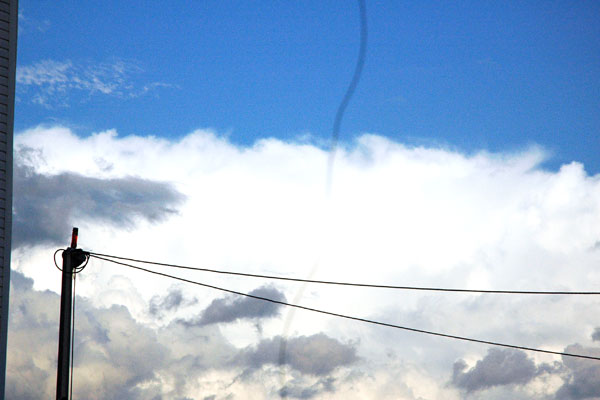
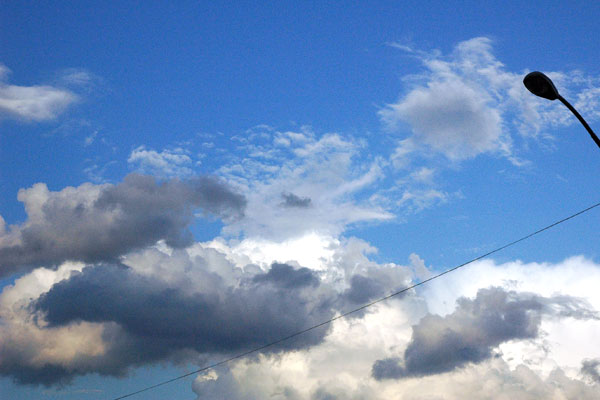
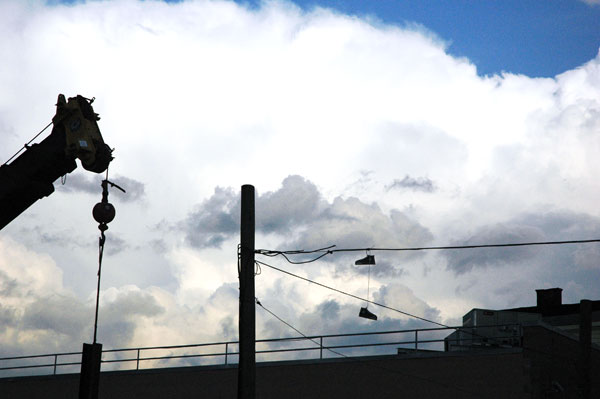
I do think that until you’ve visited the high prairie you don’t fully understand the term, “Big Sky Country”. I’ve been to Montana several times, and I understand. But today I live in a Manhattan canyon, so I also understand how much of a difference even a slightly more low-rise neighborhood can make.
When you finally surface after a ride on the L to Williamsburg or beyond the world always looks very different, not least because of the huge importance the sky assumes when buildings are only two or three stories tall.
When I was very young most of the other kids pretended they could fly, but I just couldn’t get very excited about a Superman cape. In the summer, if I wasn’t on my bike, I would often lie on the lawn and imagine myself climbing through the clouds, especially when they looked as sturdy as these do.
These pictures were grabbed early in the evening yesterday after Barry and I emerged at the Morgan stop (which is really Bushwick) to make the opening at Pocket Utopia.
For those who might be wondering, the wavy line dangling from the top of the fourth picture is a loose telephone cable. I really liked its intervention there, and I would have tried to get it into focus, but I didn’t want to make Barry wait while I dealt with it.
“A New American Portrait” at Jen Bekman
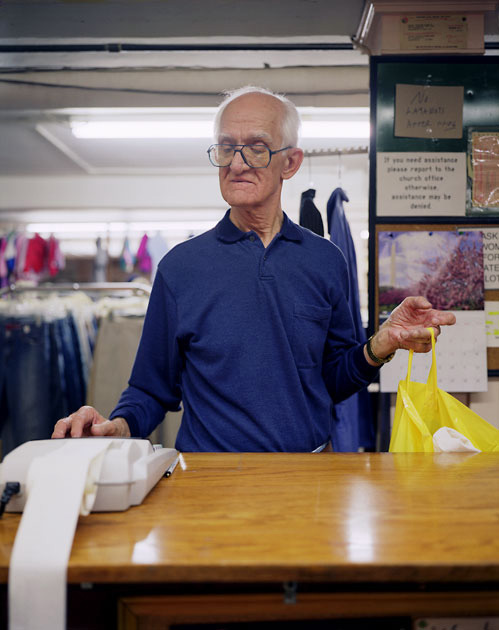
Brian Ulrich Untitled (Thrift 0628) 2006 30″ x 24″
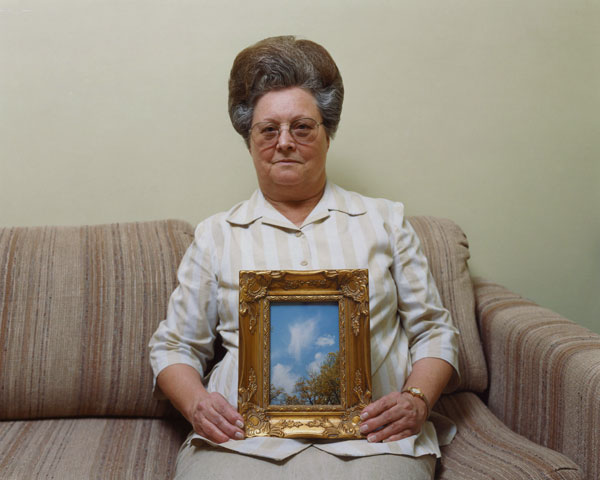
Alec Soth Bonnie (with a photograph of an angel), Port Gibson, Mississippi 2000 32″ x 40″
They’re American, so they come in many models. They’re not all pretty, but their images are all riveting. They’re all portraits, but they’re not the kind that comes out of a photographer’s studio. Each of them is done by an artist.
Jen Bekman’s current show, “A New American Portrait”, is co-curated by Bekman herself and Jörg Colberg.
The photographers represented are Christine Collins, Jen Davis, Benjamin Donaldson, Amy Elkins, Peter Haakon Thompson, Todd Hido, Alec Soth, Brian Ulrich, and Shen Wei.
[Ulrich image from Jen Bekman, Soth image from Alec Soth]
update on Jacques Louis Vidal performance schedule

On Tuesday I wrote that Jacques Louis Vidal had scheduled performances through two more weekends during his current show at Sunday on the Lower East Side [LES], but today I’ve received word that he has reduced them to a single day’s production, to be mounted this Saturday afternoon, July 7.
It will be a workshop at the gallery called “making friends + keeping friends”, and should start soon after the mesquite cookout, which is on the schedule from 1 to 4. I definitely recommend a visit to Eldridge Street on Saturday.
Tommy Hartung and Rashawn Griffin room at Moti Hasson,
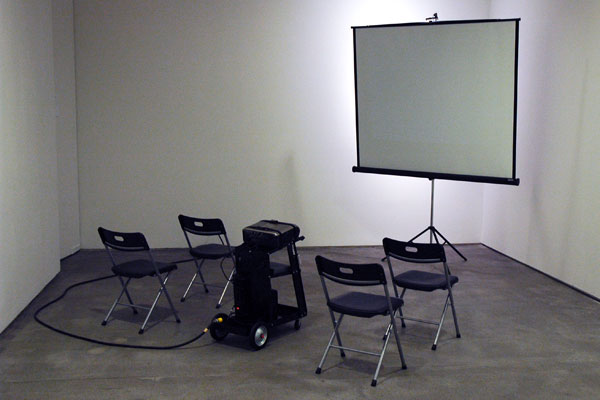
Tommy Hartung Viewing Station #1 2007 4 black folding chairs, media cart, tripod projection screen, dimensions variable [installation view]
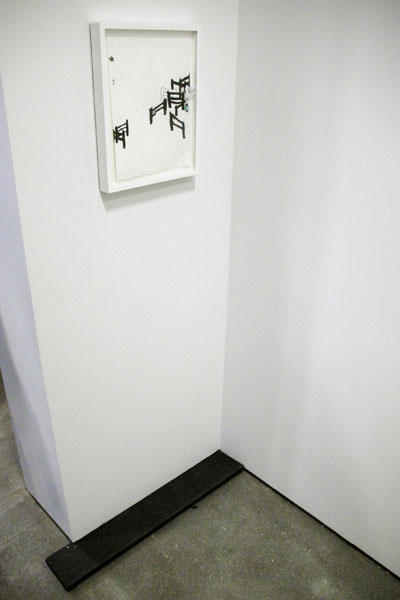
Rashawn Griffin Untitled (Everything Has) 2006 ink, thread, mixed media on paper, dimensions variable [installation view]
and the big white box still looks like it’s been barely disturbed. Tommy Hartung and Rashawn Griffin have each brought a number of examples of their very different work into the North Gallery at Moti Hasson, but somehow this elegant installation of smart, (almost) monochromatic work manages to look both spare and lush at the same time.
“New Mutants” slip into Canada
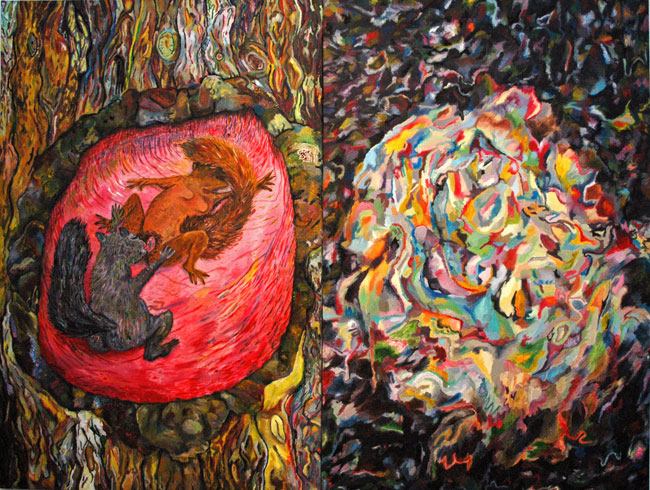
Michael Williams Fur Tree 2007 oil on canvas 58″ x 76″
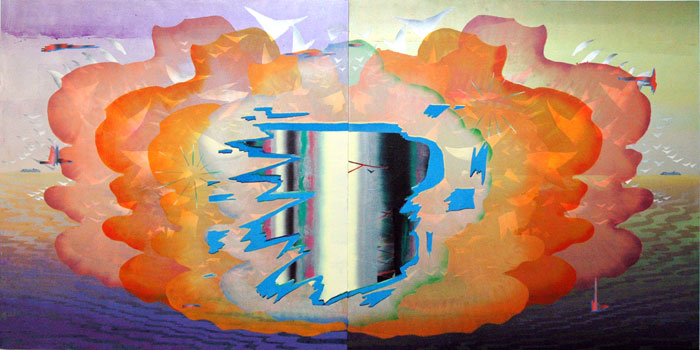
Melissa Brown Untitled 2007 silk screen on aluminum 48″ x 96″
Once again Canada manages to put on a show which local art fans will miss at their own peril, or at least at the risk of losing out on some good serious fun. Dan Nadel curated the gallery’s “New Mutants”, a show of work by Melissa Brown, Brian Chippendale, Julie Doucet, C.F., Trenton Doyle Hancock, Ben Jones, Amy Lockhart, Sakura Maku, Frank Santoro, Patrick Smith and Michael Williams. Yes, that Michael Williams.