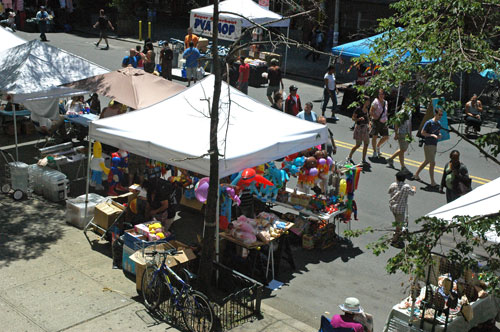
the view from the parlor today
It’s not the pedestrian street we had in mind.
We awakened this morning to the sweet refrain of amplified hawkers of corporately-manufactured goods, and the stench of greasy food. Yes it’s another so-called “neighborhood street fair” in Chelsea. We get at least half a dozen each year below our windows and on the blocks radiating from the intersection one hundred feet to the west.
The city authorities seem to love these things; the neighborhoods don’t. These regular floods of open stalls have absolutely nothing to do with the people or small businesses whose apartments and storefronts they engulf: New Yorkers really don’t knit tubesocks in home workshops and we don’t shuck corn on our fire escapes.
My real point in writing this is to point out the hypocrisy of a multi-ethnic City like this one continuing to permit these abominations, which corrupt the concept of a genuine neighborhood fair, while at the same time refusing to permit the queer community to hold their Pride Festival tomorrow, which happens only once a year, in the very queer (okay, mostly only “gay”) community of Chelsea.
The content of that last paragraph comes from Barry, who made the deliciously-derisive juxtaposition immediately after I told him what I had seen outside our front windows.
Author: jameswagner
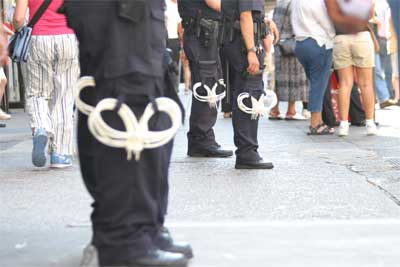
trans march led by police wagon, loads of handcuffs ready
One of our sources tell us that tonight’s Trans March was phenomenal!
Donald Grove commented on Bloggy’s post about the Audre Lord Project‘s experience trying to secure a permit for a transgender march tonight. This is the text of this queer supporter’s brief report:
I just finished the Trans March, and I am a bit too footsore to do the Drag
March. But I am thrilled to say that the Trans March was very VERY big. I
would guess around 500 people. Lots of trans folks with a strong mix of
gender non-conforming and queer support. It was excellent!
We got to march in the street most of the way, which was smart, because the
march was so big. But we were preceded almost the entire way by a paddy
wagon, with smiling cops holding their bundles of plastic handcuffs. I
suppose they could make some screwy stupid statement about protecting the
march from bashers, but who would buy that? They were their with the paddy
wagon first because they wanted to send a message to that uppity Audre
Lorde Project for taking them to court.
Well screw the cops! The march was huge, and all the police accomplished
was to look puffy, pasty and pointless in the company of so many awesome,
sexy, spirited gender-self-defining folks, both young and old, of many
colors!!!
I wasn’t there, but I have to add my own wee commnent:
This has got to stop! A happy group of peaceful marchers who have been brutalized by the police for millenia were forced to accept the deliberately-confrontational imposition of an NYPD police wagon, together with its armed and restraint-laden crew, as their very visible “grand marshal” when they chose to parade through their own neighborhoods.
Were there police snipers on the roof, like during the Puerto Rico Day Parade? I’m also surprised that our guardians of public order don’t seem to have swept up spectators who were wearing their pink or lavender gang colors.
While we’re on the subject of marches and marshals, does anyone else find it problematic, if no longer surprising, that both of the grand marshals in the really big queer march on Sunday, Sharon Kleinbaum and Troy Perry, are members of the clergy?
[image of NYC police at the 2004 RNC from Theoria via Daily Kos]
Julian Pozzi and John Pearson at Jeff Bailey
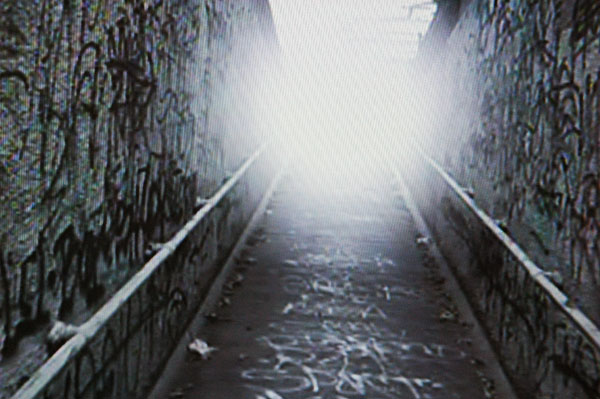
John Pearson Daylight Landscape 2001 video [large detail still from installation]
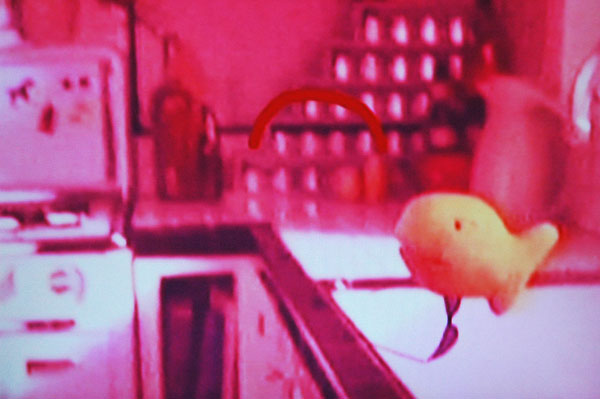
John Pearson Untitled with Commercial 2005 video [large detail still from installation]

John Pearson Untitled (white light) 2005 [large detail still from installation]
I’ve been a little distracted with the aftermath of the drama inside City Council Chambers on Wednesday evening, so I haven’t had much time for some art posts I’ve wanted to do. The reverb continues even now [more on that eventually], so this and other entries may for a while be more brief than I would prefer.
But they will be no less enthusiastic. I was really taken recently with the videos Jeff Bailey is showing in his gallery’s office space, and I think they really deserve a larger exposure. The artist is John Pearson, and the small show of videos and photographs was curated by Julian Pozzi, the artist whose beautiful paintings on paper are being shown in the main space. It’s a wonderful idea for any gallery, and an especially happy one in this case.
There is much sweetness and some humor in these short videos, but for all that they are more than sophisticated enough at managing the not-so-simple effect of child-like, wide-eyed wonder, of looking at the world for the very first time.
In addition to his work as a painter, Pozzi is the organizer for Youth and Anti-Youth, which is presenting John Pearson’s work at the gallery. The gallery describes the group as “a nomadic curatorial enterprise begun in Brooklyn in 1997”. Images of Pozzi’s own paintings can be found on the Jeff Bailey web site, but the work really has to be experienced in person.
panel on radical history of Lower East Side
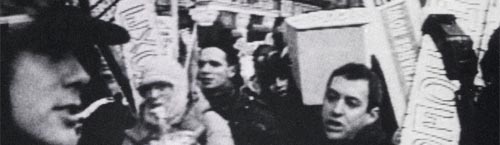
ACT UP demonstration for access to clean needles, seventeen years ago
After yesterday’s post, which was totally connected to current political activism, I’m going to turn back and examine what the territory looked like in the 80’s and 90’s.
Although many of us are still busy working on some of the very same issues which engaged New York activists, writers, artists, and residents in the previous two decades, it would make no sense at all if we were to ignore a radical activist history which can still inform what we do today.
On Tuesday, June 26, the New York Book Club at the Lower East Side Tenement Museum and the Gotham Center for New York City History at CUNY are hosting a panel discussion in the Museum. Called “Resistance: A Radical History of the Lower East Side”, the event’s participants will be Jay Blotcher, Al Orensanz and Michael Rosen. The moderator will be Clayton Patterson.
I think all of these people (with very interesting but quite different backgrounds in the same neighborhood) are contributors to a new book with the same title, a collection of writings and images. Okay, it sounds like it’s also a book signing, but on Tuesday it seems both oral and written history will be shared with those who stop by.
I know Jay well, originally through ACT UP, where he directed media relations, but in addition to his AIDS activism he has also worked as a collage artist, documentary filmmaker, journalist and publicist. If he’s involved in something like this, it’s likely to be at least worth a detour.
The address is 108 Orchard Street, near Delancey, and the time is from 6 to 8 pm.
[image from the film “Clean Needles Save Lives: Drug Users Doing It For Ourselves” via Creative Time]
Radical Homosexual Agenda zaps Quinn on police authority
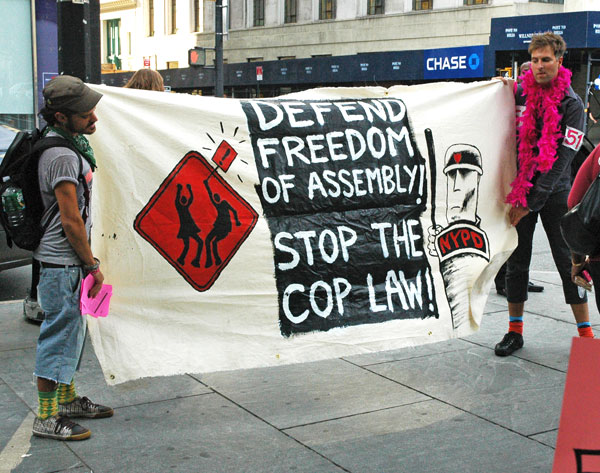
outside
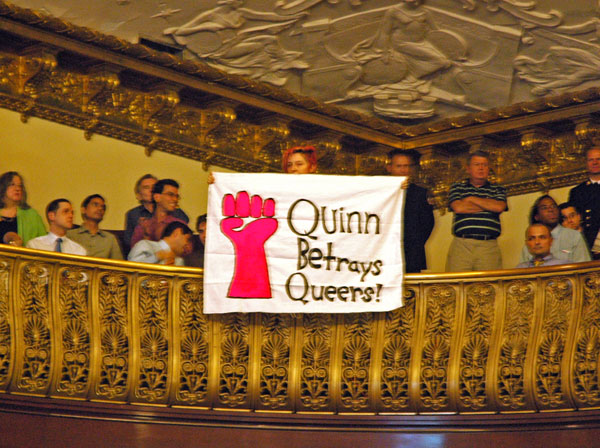
balcony left
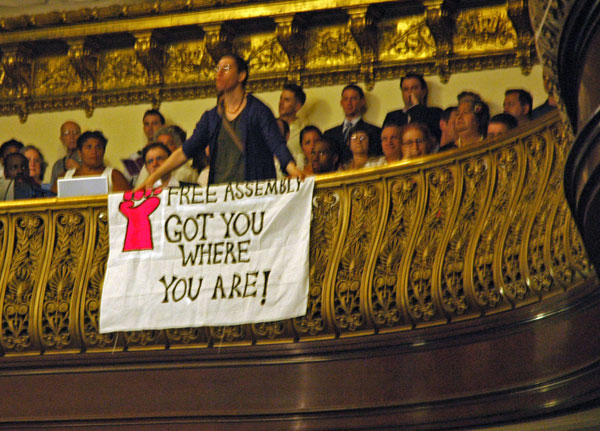
balcony center
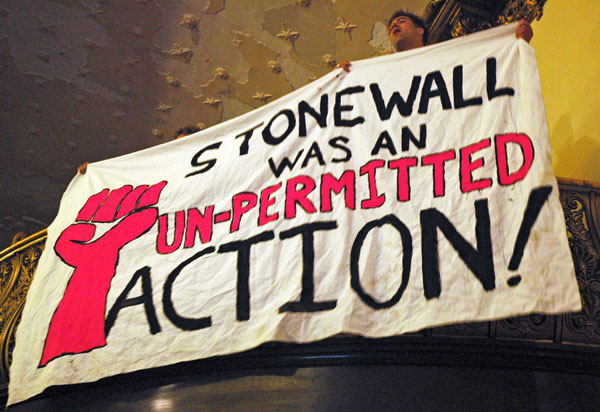
and balcony right
Tonight The Radical Homosexual Agenda struck once again, dramatically zapping Chris Quinn deep inside City Hall during her presentation at the the “Celebration of LGBT Pride” hosted annually by the City Council Speaker.
Why did these homosexuals interrupt the homosexual Speaker while she was addressing her core homosexual constituency in this historic room, the Council Chamber on the second floor of our two-hundred-year-old seat of government? Because Quinn was the civilian agent for a secretly-negotiated agreement (there were no public hearings) with the NYPD which gives the police full authority to restrict public assembly and public speech (if more than 49 people get together anywhere, under any circumstances, they are all subject to arrest – unless they have applied to the police for a permit ahead of time and have received the department’s approval). This policy was never submitted to the Council for consideration; no statute supports this agreement and practice; it is the creation of the Speaker herself.
Why did they do so in the midst of what was planned as a celebration of LGBT accomplishments and not incidentally also an evening honoring Quinn’s personal and political success? Because she has made herself inaccessible to those who have sought to meet with her on this issue.
Is she the only proper target for those outraged by the permit rule? Certainly not, but she is at once the one with the greatest power to do something about this abomination and, because of a background which included street activism, the one who should have been the least likely politician to endorse it in the first place.
Incidentally, the parade permit “law” which Quinn has approved trusts the police to do the right thing, even in our clear memory of the appalling history of the department so often demonstrating the contrary and continuing to do so up to the present moment. It’s a record which screams to the powerless and to all minorities of the danger and absurdity of such misplaced faith. Tonight even the Speaker herself couldn’t prevent the police protection assigned to the her own hosted reception from ousting in front of her eyes the guests who wanted to address her on this issue, and this was after she had said they should be allowed to speak.
I think it’s important to note that in her remarks after they were removed from the balcony she did not deny that the so-called “Parade Laws” were very much her doing, her own policy, and she has said as much when she has been asked about them before. She is the right target.
After her critics had been summarily removed from the Chambers, Quinn told the remaining invitees that she was willing to meet with anyone who disagreed with her on the question of Police rules for assembly. For the record, I have been assured several times by those who know groups that have tried to engage her that she has repeatedly refused to do this in the past.
The fundamental issue remains that in New York City the NYPD totally controls what we used to call the Constitutional (First Amendment) right of assembly and speech, and our first woman, first lesbian, and first [former] activist Council Speaker thinks that’s just fine.
As usual, Barry was able to cut through all the muck with a comment which defines the issue perfectly: “This development, along with what we have seen happening over at least the last six years, seems to make it clear that New York has given up even on the principle of civilian control of the police.”
Peter Pezzimenti at Monya Rowe
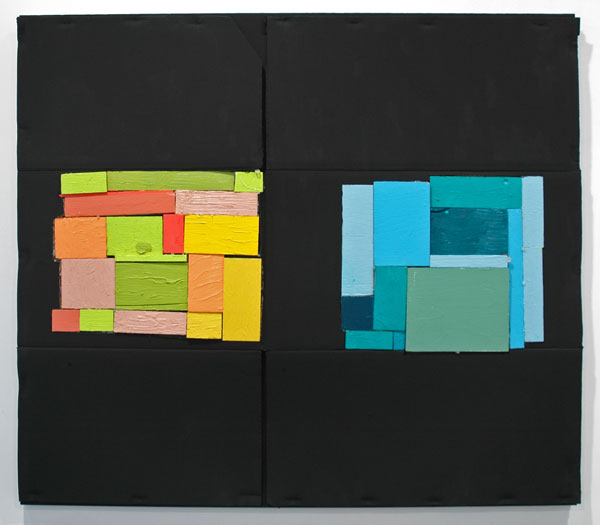
Peter Pezzimenti Untitled 2007 oil and latex on wood and cardboard 31″ x 36″ [installation view]
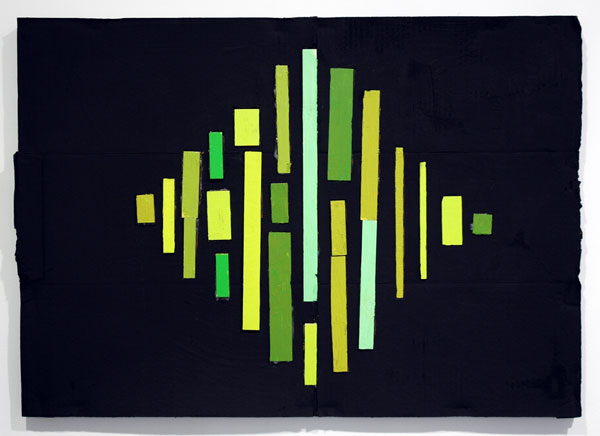
Peter Pezzimenti Untitled 2007 oil and latex on wood and cardboard 24″ x 34″ [installation view]
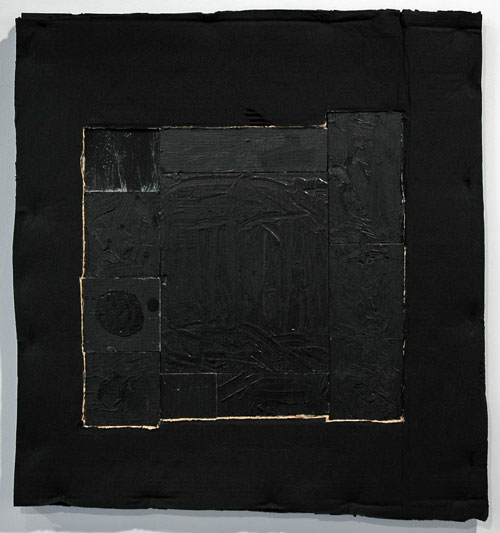
Peter Pezzimenti Untitled 2007 oil and latex on wood and cardboard 23.5″ x 22.5″ [installation view]
The sculptures by Peter Pezzimenti being shown at Monya Rowe through this Saturday are as much about painting as they are about space. In fact, I was slightly surprised when I went to the gallery site just now and saw the work described as “sculptures”, even though I was there precisely because I was wondering about what noun I should use, and I wanted to know how the press release was categorizing these beautiful pieces.
Pezzimenti’s assemblages of roughly-cut blocks of wood are totally alive inside their mat-black shrouds, even when the wooden shapes themselves have been painted black, as is the case with two of the fifteen being shown. Once they have engaged the viewer, they don’t seem to want to leave the eye alone. I like both their boldness and their obvious playfulness (even today I’m not entirely weaned from an early and profound passion for building blocks).
Another disclosure, and, I confess, this one is a modest boast: Barry and I picked out a Pezzimenti work at the recent Momenta Art benefit. It was one of a number of works generously donated by Monya Rowe and the artists. This sculpture now hangs on (holds up, sits on or from?) one of our walls.
Sarah Peters at Winkleman
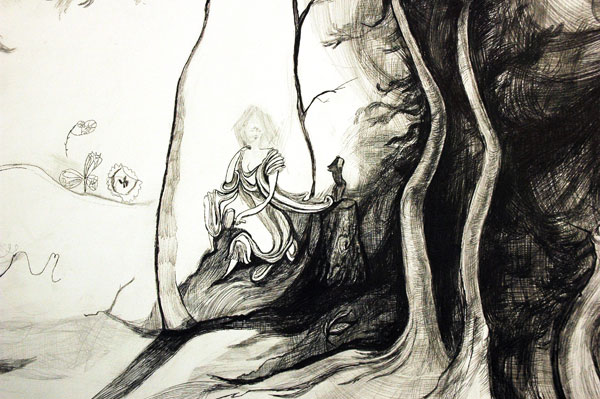
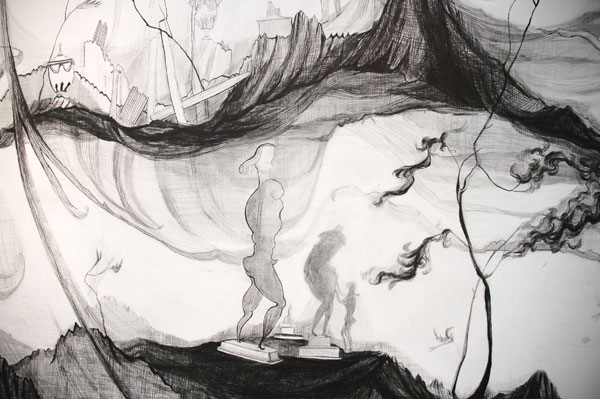
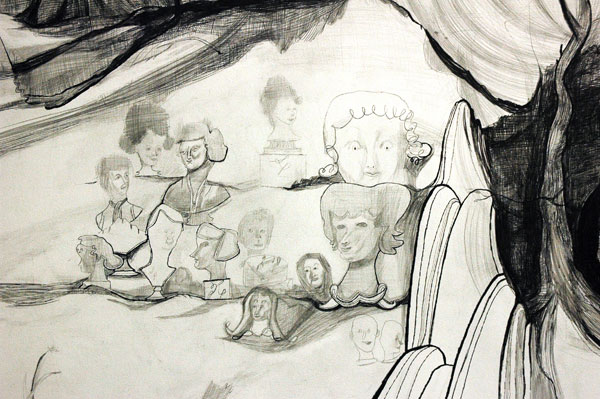
Sarah Peters Being American 2007 pen and pencil on paper 42″ x 240″ [details of installation]
I was going to post about some very good shows we had seen earlier, but this show got in my way. I suppose it’s because we ended up buying a drawing ten minutes after walking into the opening reception for Sarah Peters’s first solo show at Winkleman Gallery on Saturday. I couldn’t wait, and I thought I shouldn’t, to explain.
This body of work by Peters may have struck a chord in me, but it’s more than a personal connection that drew me to the drawings. The work is wonderful. It’s very strong and I’d be charmed by it even without a very particular relationship to its subject.
I lived in New England for twenty years before moving to New York and during that time I grew totally comfortable with, no, I fell in love with the history and the aesthetic of one of this country’s most idiosyncratic areas, a distinct region which played an extremely important role in the creation of a national culture and its mythology.
Peters draws from an eighteenth (and early nineteenth) -century America mostly settled by Europeans who were interested in establishing, to the best of their knowledge and abilities, what they understood as a European culture, but one built on a new, idyllic continent they believed to be largely their own creation.
Art, many would be surprised to hear then and now, was always a part of the experience of New England and the Atlantic seaboard, even if most early Americans would have to wait one or two hundred years before they even had access to anything like the semi-provincial academy represented by William Rush or the Peale family, both of whom appear in Peters’s work at Winkleman.
There was always folk art, including examples produced by the genteel occupation of young women, by the genius of local and itinerant artisans, and by the enthusiasms of just about anyone with the luxury of a little time and the passion to create. Needlework, stencils, drawings, wall, floor, and furniture painting, frakturs, quilts, rugs, wood or stone carvings, reverse-paintings on glass, collages and decorated pottery are just some of the forms which can stil delight us today.
I grew to love the charming and often very eccentric examples of this naive art when I came across it in friends’ homes, in house museums, old antique shops and even barns and yard sales (this was now decades ago), but I have to confess my taste in furnishing the home I restored as something of a house museum ran more toward the minimal, and my partner and I led an artist friend to any folk art finds we might come across. I had decided early on (with further inducement provided by a probate record which listed the deceased owner’s meager possessions) that the fictional inhabitants of this modest 1760 clapboard house just wouldn’t have had the time or the wealth to accumulate much treasure. For their sake I hope I was wrong.
Sarah Peters work addresses the imagery with which the people filling up this new continent described their ideals. She begins with a few stunning and quite haunting (anonymous?) portraits and continues with still lifes and fantastic landscapes populated by smaller noble heads and clothed and unclothed bodies in classical poses, both sober and quite silly, magnificent trees and lofty mountains, broken columns and covered urns, flower arrangements and Greek vases. While she’s doing this she introduces an extravagance which only an intervening two centuries could have made possible. Think William Blake and maybe Alfred Stieglitz and Francis Bacon.
There is something definitely more than a bit off about these images with their art or historical references. Peters is no copyist. The show’s title (also the title of the largest piece in the show, a monumental twenty-foot-long drawing after the nineteenth-century fashion for panorama paintings) is “Being American”. It’s about a world now long gone, but which in fact never existed as it was imagined at the time. I’d also say that the idea of this preposterous world impacts us today perhaps even more than it ever did in the past.
In the end however Peters gives us a very original Elysium, and for that we can be grateful, as Elysiums are as necessary as they are agreeable. I will quote part of the press release:
Through her ongoing exploration of the earnestness with which early American artists strived, but often failed, to match the formal achievement of their European counterparts, Peters presents a spellbinding vision of an imagined paradise where the artworks of 18th Century America that missed the mark (often due to their creator’s misreading of an ideal that never really was) went to spend eternity.
Sweet.
Oh yes, here’s an image, with a detail, of the drawing which we picked out for ourselves:
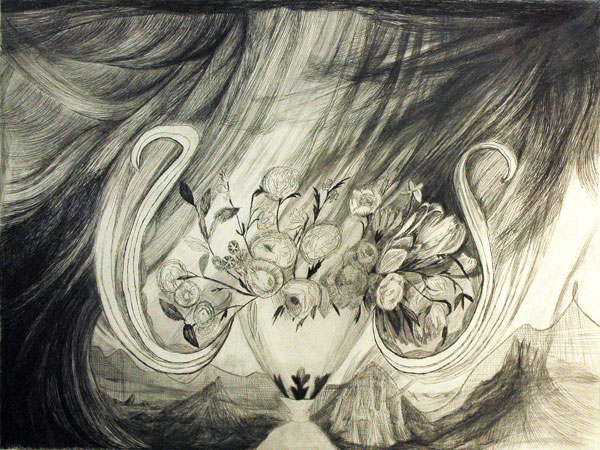
Sarah Peters S�ance 2005 pen, pencil and charcoal on paper 18″ x 24″

[detail]
West 19th Street walls
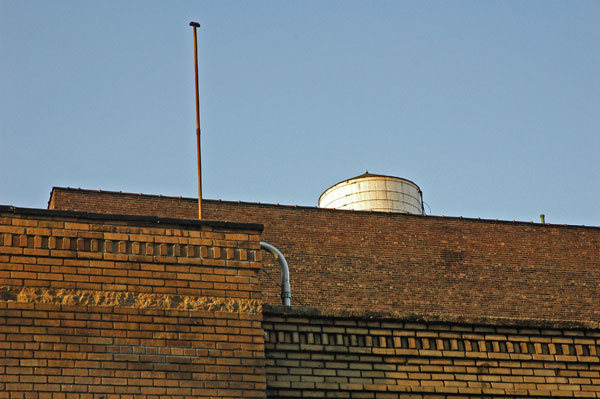
untitled (tawny brick) 2007
sad ending for Brooklyn College MFA suit

still
I was stunned when I first heard about the “settlement” of the Brooklyn College MFA students‘ cases against the City of New York, the NYC Parks Department and Brooklyn College, cases which had cited First Amendment violations and property damages. I haven’t even been able to bring myself to write about it until now, more than ten days later.
The eighteen students whose Master of Fine Arts thesis show was summarily shut down on May 4, 2006 by a Parks official, had their work removed from the gallery and damaged by their own College shortly thereafter.
After a full year of spent filing complex suits and presenting arguments, including negotiations between the students’ lawyers and lawyers representing New York City the entire affair has ended with something like a squeak or a whimper.
The students (and one professor) each received $750 from the City, and the head of the Brooklyn Parks Department, the self-appointed public censor, issued a written statement which some have described as an “apology”. Neither Brooklyn College itself nor any official connected with the school has had to do anything. In fact no one has lost her or his position in the City or the College. Oh yes, the settlement also required the City to pay the fees of the students’ lawyers the amount of $42,500.
The students had decided not to file a separate suit against Brooklyn College after being told that they would have to secure other lawyers, and after being persuaded that a suit against the school which asked for compensation for the physical damage to their art works would have been ugly. In any event they weren’t interested as a group in the cost and distraction of pursuing any further suit; they also don’t appear to have ever regarded their case as simply a matter of compensation for material damages.
Of course it was never about money, so it seems to me that makes the piddling $750 figure ridiculous on the face of it.
I’m concerned about the fact that there really is no apology in the Parks chief’s statement (it’s more like the familiar “if anyone was offended . . .”), and that no institution has had to admit error, no official has been sacked, and none has fallen on his or her sword.
No principle has been upheld except that of the authority of the authorities.
Oh, yes, the “apology”, issued on city of New York Parks & Recreation letterhead, reads as follows:
Statement of defendant Julius Spiegel, Brooklyn Borough commissioner of New York City Department of Parks and Recreation, in connection with the Settlement of Cohen, et. al. v. City of New York, et. al., 06-cv-2975 (CBA) (SMG).
“While I had no role in the removal and subsequent damage to Plaintiffs’ artwork by others, I acknowledge my responsibility for ordering the closing of the Plaintiffs’ art exhibit at the Brooklyn War Memorial, and for thereby setting in motion actions that led to the damage of Plaintiffs’ artwork, which a reviewing court might find constituted a violation of the student-exhibitors’ First amendment rights. Whatever the outcome in court might have been, I apologize to the Brooklyn College art students who spent long hours and considerable effort in creating their artwork and in mounting their exhibition at the Brooklyn Memorial site.”
Now I know I wasn’t one of the victims in this case (except in the sense we are all victims of censorship and the violation of intellectual and artistic property), and I wasn’t privy to the discussions which preceded the announced settlement, but I mourn what has happened, or what has not happened, and I want to make a very few more general observations:
* A city which thinks of itself as cultured and sophisticated doesn’t let its functionaries shut down art exhibitions because of personal hang-ups about their nasty bits.
* No art school is worthy of the name if it fails to defend its students’ rights of expression and in fact callously destroys the creative work they produce in its shelter.
* Constant artists, and constant art institutions, artists and institutions with real integrity, do no look the other way when their colleagues or those they serve are attacked or humiliated for their art.*
*
Of the entire local and national arts community, aside from some good words from a few bloggers, these students received written or vocal support only from their own College faculty, the CUNY faculty, the College Art Association and the President of the School of Visual Arts. The Brooklyn Museum was approached directly, because of its own struggle with censorship (when it had received an enormous amount of outside support), and its reply was something to the effect that the institution would no longer be getting involved in anything of this sort.
[image from timesonline]
Guantanamo remains

Are any of our grasping, dissembling politicians even thinking about it?
[image, otherwise unattributed, via salvationinc]