Gavin Green at Outrageous Look

Green_Gavin.jpg
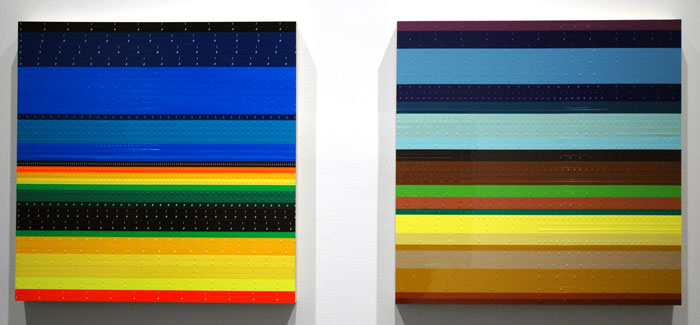
Gavin Green If (A) 2006, and If (B) 2007, both embossed plastic on panel 24″ x 24″ [installation view]

Green_Gavin_Hoalam_Haba.jpg
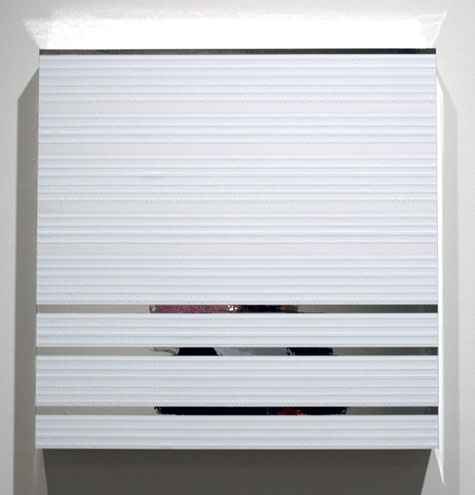
Gavin Green Hoalam Haba 2006 embossed plastic and mirrored vinyl on panel 24″ x 24″ [installation view]

Outrageous Look is showing a dozen of Gavin Green‘s brilliantly-colored and finished abstractions, painted almost entirely with embossed strips of plastic produced by an ordinary home and office label maker. The pieces are each named for the letters, words and phrases which have been punched out on long strips and wrapped around 12, 24 or 36-inch square panels.
Green discussed this series of work in an interview with the director of the gallery, Brook Bartlett. This is small excerpt from the pages which were available at the desk:

The work, if it’s going out into the world, needs to communicate.
….
Taking things (and words or phrases) that one might ignore, or take for granted, and subjecting them to an inquiry – I try to make work that asks questions. But it’s not just asking a question, it’s trying to look into subjects with rigor that I get excited about.
Asking questions, to me, doesn’t have to imply that you are searching for answers; it’s more about the act of asking the question, because it opens doors to the unexpected – it keeps things alive.“

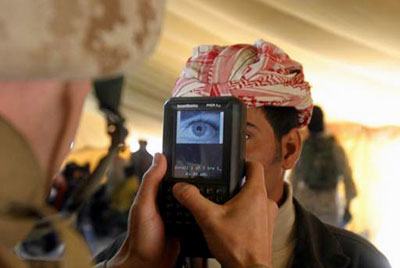
“we’ll need your eyes” – U.S. building database of Iraqi males

FOLLOW-UP: see this post for the missing image, and more

I can’t find it anywhere on the NYTimes site or through Google News, but our print edition of the paper this morning carries an extremely important photograph on page A6 by Ashley Gilbertson. The image is of three heavily-armed and armored American soldiers interrogating an Iraqi man who is wearing casual pants and a t-shirt sitting in his own home while his family stands in the background. Significantly, the family’s large floor covering has been folded back and away from the area occupied by the four men.
The full caption reads:

We’ll just Need to Scan Your Eyes for Our Files
Imad Salman Ichleef, 37, was questioned yesterday by American soldiers about insurgent activity in his neighborhood of Ghazaliya in baghdad. Using a biometric recording device, one of the soldiers scanned Mr. Ichleef’s retinas, collected his fingerprints and photographed his face. The interview was part of a strategy to put Iraqi males into a database [my italics]. Mr. Ichleef’s family waited patiently so they could get back to their lunch.

There is no related article. I agree with Barry’s comment that this image and this program would be unlikely to be buried on an inside page (on a Saturday yet) in the Arab media.
Actually, neither the technology nor the increasingly-widespread U.S. goverernment practice is news, as the 18-month-old post on the site where I found the January 2005 image below reminds us. But rather once again it’s a picture that makes the impression, in this case it’s the picture I haven’t yet been able to locate on line.

retina_scanning.jpg
Is this the new face of occupation?

[image from bagnewsnotes]

“Intelligent Design” at Momenta

Williams_Aaron_Forever.jpg
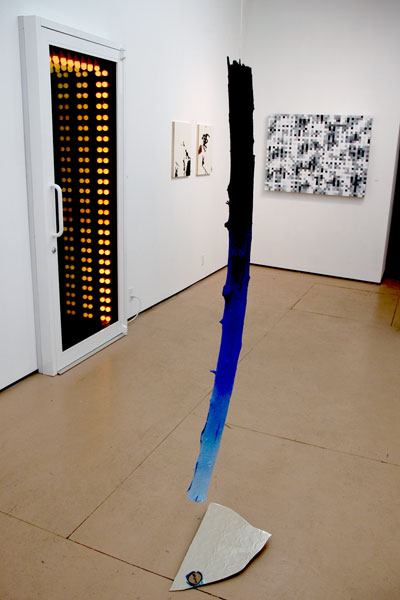
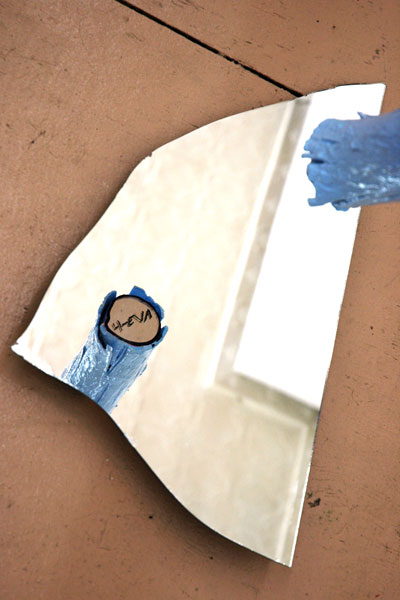
Aaron Williams Forever 2006 tree, mirror, acrylic and enamel paints, wood shim, string 72″ x 16′ x 12″, in the foreground, with works by Ivan Navarro, Deborah Grant and Aron Namenworth on the walls [installation view]
Williams_Aaron_Forever_deta.jpg
[detail of “Forever”]

I love to find a show that’s as attractive as it is challenging, but it’s bingo! when it’s also photogenic. Momenta’s current exhibition was “guest organized” (the phrase taken from the press release) by Rico Gatson and Ellie Murphy, and it is all of the above.
The theme shared by these 18 works by 14 artists is their use of different systems to get at material which is essentially unsystematic. The gallery notes say that the title of the show, “Intelligent Design”, is intended to reference an indifference to theories of evolution or arguments for intelligent design. As someone living in America who is profoundly secular in orientation, I really feel the heat from that last phrase; I also found the discussion contained in the complete text somewhat abstruse. I’d like to think that it’s essentially about the thought and practice of a generation which has walked away from the old, bogus debate and is now proceeding to address the world on its own terms.
The participating artists are Jane Benson, Judy Blanco, Sanford Biggers, Nicole Cherubini, Rico Gatson, Deborah Grant, Elana Herzog, Ellie Murphy, Aron Namenwirth, Ivan Novarro, Kelly Parr, Ara Peterson, Traci Tullius, Aaron Williams, and James Yamada.

Navarro_Ivan_White_Holeway.jpg
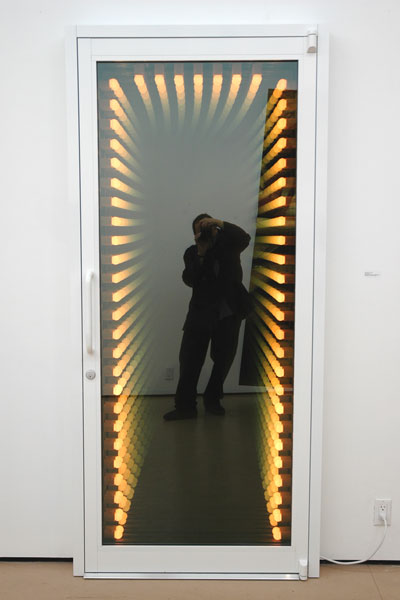
Ivan Novarro White Holeway 2006 aluminum door, mirror, one-way mirror, light bulbs, and electic energy 86″ x 39.5″ x 4.5″ [installation view, including image of photographer]

Parr_Kelly_Threes.jpg
Kelly Parr Threes (January and July) 2007 digital print collage 108″ x 60″ [installation view]

cupcake preservation?

cupcake_trespass.jpg
cupcake as landmark?

I know I’m going to regret bringing the subject up again, and not only because the additional notoriety may only be what the owners of Burgers & Cupcakes want. But I did a post one month ago reporting that the pink cupcake would come down by the beginning of April. It’s still there today, so I feel obliged to do a follow-up.
Melanie La Rocca of the office of our local City Council member Chris Quinn was told by the Department of Transportation [DOT] that the B&C owners did not have a valid permit even for a conventional framed sidewalk canopy, and that the mechanical “cupcake” mounted on the top of the unauthorized structure which is there now could not be permitted in any case, because it would be a violation of city statute. [sidewalk canopies cannot feature advertising, lights, mechanical devices or even the business’s phone number]
I was informed of this on March 2, and at that time La Rocca also said that the DOT had told her the owners had 30 days to comply with the law, meaning the cupcake would have to be removed, even if a proper permit for the canopy itself could be registered by then. I read later, in a report in a local newspaper, Chelsea Now, that the violation wasn’t actually issued until March 15 or 22 (the exact date reference wasn’t clear in the article).
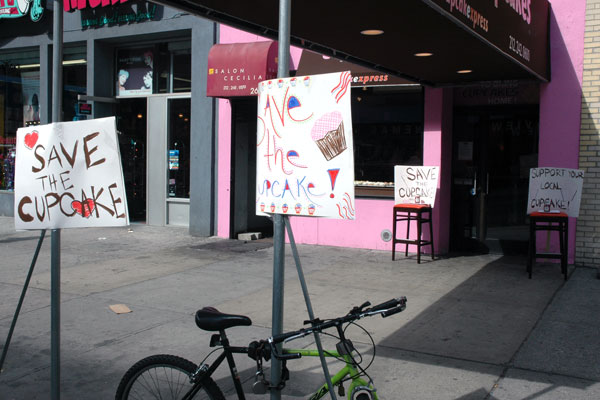
Today the owners initiated their “save the cupcake!” campaign with both cutesy hand-made signs and printed fliers outside the restaurant calling for support from anyone willing to buy something from among the scattershot reasons they give for wanting their cupcake preserved.

1.) [the DOT order is a] “beaurocratic [sic] boondoggle,”
2.) “The cupcake brightens a dreary street.”
3.) “Everyone in the neighborhood loves our cool sign.”
4.) “. . . now they are messing with a twenty thousand dollar cupcake.”
5.) “. . . loosing [sic] it will hurt our new business.”
6.) “I’m sick and tired of the city having their hands all over my business.”

I guess they think the same New York which recently wasn’t interested in saving an authentic landmark, like the former Huntington Hartford Museum, designed by Edward Durell Stone, is going to be interested in rescuing their cupcake.
Let me describe once again the reason for my interest in this admittedly less than life-and-death issue: A large lighted, revolving plastic cupcake mounted above a public sidewalk, and in fact perched virtually on the street curb, is an encroachment upon a public way. The sidewalk is part of the street, not of the building lot whose property line ends where the pavement begins. There are certainly safety issues for drivers and pedestrians as well, explaining why it’s the Department of Transportation which has responsibility here, but I’ll leave the details of addressing those subjects to the professionals. As a citizen I am most concerned with the danger of commercial encroachment and the precedent it would establish.
These are our streets; they can’t be turned over to the highest bidder.

Okay, although it is not and could not be the basis for the complaint I registered with the DOB last December, I admit that I do think the pink and brown shop and its canopy are both truly ugly. Also, unlike the B&C owners I do not think my street is “dreary”, and I believe the clutter and crude disruption created by their ugly little shop adds nothing of value to the streetscape. I repeat, these are my personal opinions and nothing more, but if we are talking about aesthetics, I believe, ironically, that it’s only the cupcake itself which might be worthy of a first, even a second look from a civilized New Yorker – if it were installed in an appropriate context.
Josh Wolf is freed

Wolf_Josh_SFChronicle.jpg
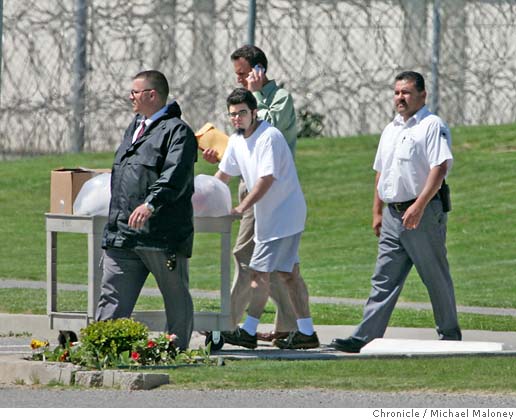
Flanked by two prison officials, Josh Wolf (center) pushes a cart full of his belongings (mostly books and letters) outside the gates of the Federal Correctional Institution in Dublin. Behind him is David Greene, one of his attorneys. Chronicle photo by Michael Maloney

UPDATE: Since this was posted a Wikipedia entry has been created for Josh Wolf; and Wolf himself has a blog

Blogger journalist Josh Wolf was freed yesterday.
But I’m not entirely sure what happened.
Wolf was in prison for refusing to comply with a federal subpoena. He was released from a California prison on Tuesday in what is described as a compromise struck with federal prosecutors. The court has the videotapes it wanted, but Wolf will not have to testify about the protest he documented or identify people visible in his reporter’s documents. The entire tape coverage has now been made visible on his blog, to ensure that anyone in the world might see what the police will see.
Wolf had said all along that he was willing to show to the judge and to the US Attorney video the footage which the grand jury had asked for, but this is where it gets fuzzy for me: I had thought that up until now he was not willing to hand over physical custody of the tapes themselves (possibly explaining this month’s “compromise”). The San Francisco Chronicle however reports that yesterday Wolf said that he offered to turn over his videos last November on the condition that he be excused from testifying, and prosecutors had turned him down.
In a press conference immediately following his release after more than seven months of incarceration he said that he absolutely will not testify about the protest he covered back in July 2005 (the subject of the federal case), even if ordered once again to do so, and that if he were unable to get a new subpoena removed, he would be prepared to return to prison to defend his Constitutional rights as a journalist.
He was asked by one reporter, why is this whole thing important? He answered that It’s greatest importance lies in reinforcing the principle that journalists simply must not act as investigators for the government.
This is a large excerpt from a statement on Wolf’s own site:

When I was subpoenaed in February of last year, I was not only ordered to provide my unedited footage, but to also submit to testimony and examination before the secretive grand jury. Although I feel that my unpublished material should be shielded from government demands, it was the testimony which I found to be the more egregious assault on my right and ethics as both a journalist and a citizen.
As there was nothing of a sensitive or confidential nature on my video outtakes, I had no reason to withhold their publication once I had exhausted all my legal appeals. When that point arrived I had already spent three months behind bars. I was advised by my legal team that publishing the video would not lead to my release; instead it would indicate to the court that my imprisonment was having a coercive effect even though it was not.
This hypothesis was verified when one of my attorney�’s inquired whether the Assistant US Attorney would accept the footage in lieu of my testimony, he was told that the video alone would not suffice and that the US Attorney would accept nothing less than my full compliance with the demands of the subpoena. Things change.
When the judge came to realize the support for my cause was growing and that I was unlikely to waver anytime soon, he ordered both parties to meet with a magistrate judge in the hopes we could reach a solution amenable to everyone. After two rather strenuous sessions of mediation, we at last came to an agreement that not only leaves my ethics intact but actively serves the role of a free press in our so-called free society.

[image and caption from SFGate]

“A Cloudy Day’s Epiphany” at Dinter

Van_Slyck_Valaire_words.jpg
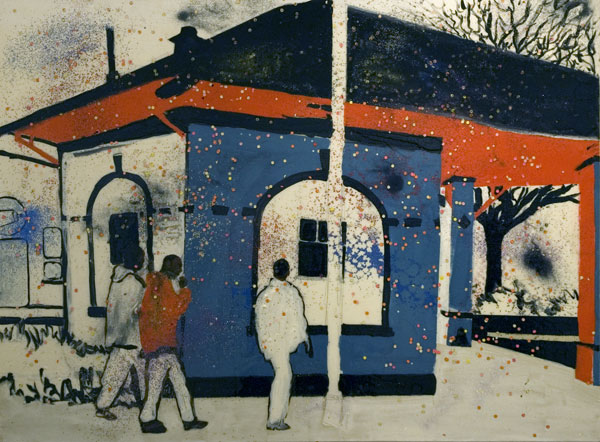
Valaire Van Slyck And even though we don’t mean what we say, we throw our words like bombs and handgrenades 2006 enamel, acrylic, confetti, glitter and clear-coat canvas 36″ x 48″

Guenther_Andrew_Space_2.jpg
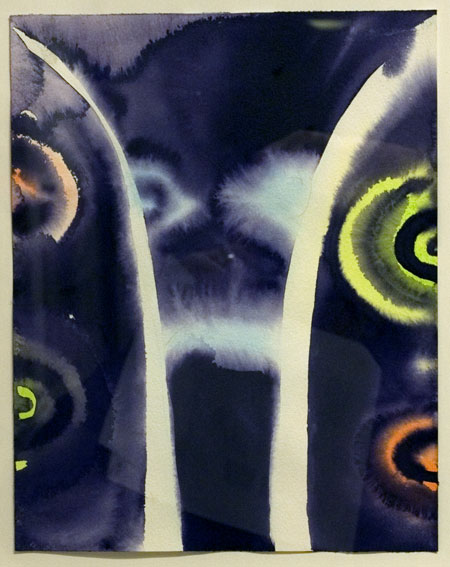
Andrew Guenther The Space Between Faces 2006 acrylic on paper 12″ x 9″ [installation view]

Ridge_Brent_Execution.jpg
Brent Ridge The Execution of the King 2007 acrylic and pencil on canvas 30″ x 40″

Two weeks ago, in my post about the Cynthia Broan show, “What F Word?”, I wrote that my next entry would be something of a foil for its concentration on art produced by women. Sorry. I’m finally getting around to the men only now.
There seems to be an almost unanimous agreement that 2007 is to be the year of women and art (I hope the new attention is not just a vogue). There are big museum shows, important gallery retrospectives and even traveling exhibitions devoted to all sorts of angles on the modern history of what has always been the largest group of neglected modern artists.
The distortion and waste of this fundamental imbalance means that we’ve all been missing out on a lot. And that’s not even mentioning the baleful personal consequences for the one half of the world’s artists who have been locked out by the other – or by those who care for and feed them.
None of this is new to anyone reading these lines. We also know that everyone has a lot of catching up to do, even if there’s no danger the art that men make will be ignored in the interim. All of which brings me to “A Cloudy Day’s Epiphany“, the group show installed currently at Chelsea’s Dinter Fine Art, curated by Simon Cerigo. The artists are Devendra Banhart, Andrew Guenther, Brent Ridge and Valaire van Slyck. Dash Snow had been invited, but [perhaps because he’s such a guy*] his work hadn’t shown up by the time of the opening reception. I see his name is no longer included on the gallery’s site for the show.
I walked into the Dinter immediately after leaving the Broan show. When I was reminded who had curated this one and recalled what I knew about his own art from a terrific show I had seen at Capsule gallery, I looked around and immediately saw “Epiphany” as a boys’ club. But this actually seems to be the good club, the one you wouldn’t mind being a part of, even (or perhaps especially) if you were a girl.
It’s a very good group and there’s some very good work. I don’t think this is work which can be used to dramatize a male/female artistic dichotomy, and it’s not just because of the tie dye and glitter elements. I’m glad that even guys now seem to know that it really does take all kinds to make this world, and that we may finally be trying to come to terms with that reality.

p.s. It’s a four-artist show and, as I’m only including images of three, I feel I have to explain: I just didn’t get a good image of any of Devendra Banhart’s works.

*
or maybe there’s another story

Oliver Herring at Max Protetch

Herring_Oliver_Wade_1.jpg
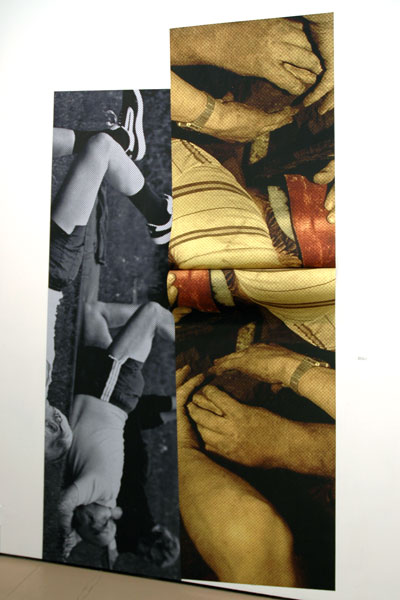
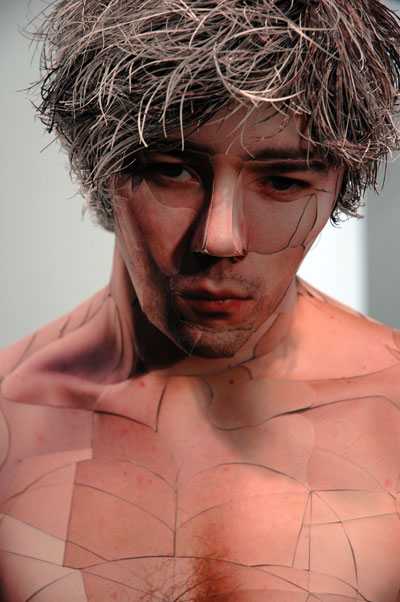
Oliver Herring Wade 1 2006 digital C-prints, museum board, foam core and polystyrene 68″ x 22.5″ x 15″ [detail of installation]

Oliver Herring‘s show at Max Protetch closed on Saturday.
Everything in this multi-media installation was breathtakingly beautiful, but this life-size photo-collage sculpture of a young male nude was of another dimension altogether. I found it almost impossible even to stand in front of the piece in order to capture this image; I didn’t think I could lower the camera, and I’m no prude. I don’t know whether my unease was from being in the presence of such beauty (the entire body was as sensuous as the face and shoulders), or because this figure standing before me was strangely so much more alive than anything sculpted with surfaces less pellucid.
An excerpt from Roberta Smith’s review of Herring’s 2004 show in the gallery:

But the showstoppers here are two pensive life-size sculptures fashioned from hundreds of close-up photographs of a thin young man in his underwear and a beautiful young woman in a flowery sundress. The delicate patchwork beings, at once whole and dissected, suggest a mind-bogglingly painstaking process for all concerned, as well as artist-model relationships of unusual intimacy.

Go to the gallery site for more images of the show just ended.

“The Art of the Deal” at Kantor/Feuer

Kantor_Feuer_Liberman_Tan_2.jpg

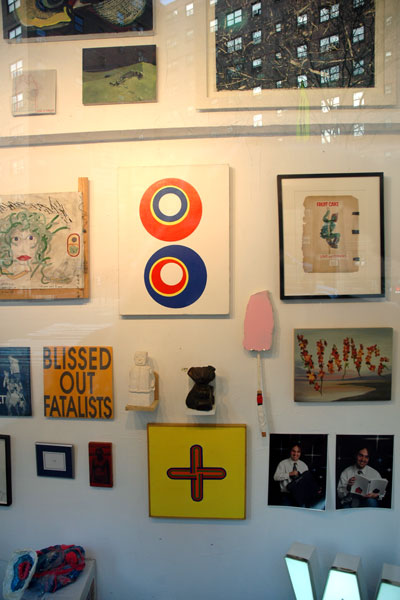
The Kantor/Feuer Window show, “The Art of the Deal”, which opened on Saturday may be “The ultimate art show for insiders.”, as Art Fag City calls it, but if you do happen to find yourself inside it’s actually very funny.
All visitors to the show will in fact be outside, since the “gallery” doors are locked and the exhibiton space itself is the equivalent of a building vestibule. And truthfully, since there are no real big-deal galleries represented by these twenty or so gallerists, this particular insiderdom is still a pretty comfortable neighborhood.
From the press release of artist/curators Justin Lieberman and Lumi Tan:

“The Art of the Deal” is an Artist-curated exhibition of early works by well known gallerists who once sought their calling on the other side of the table as artists. Far from the cynical venture it might at first appear to be, this show presents the idea of creative production as an egalitarian venture open to all who would choose to embark on it, regardless of their vocation.

My favorite piece, at least as seen from five feet away through reflecting glass, may be (Sunday gallery) C. Sean Horton’s pink popsicle-like sculpture in the center of this capture.
The complete list of the artists/gallerists who will be hanging together on 10th Avenue until May 11, are:

Roland Augustine (Luhring Augustine), William Brady (ATM Gallery), Elizabeth Burke(Clementine), John Cheim (Cheim and Read), Burr Dodd (Brooklyn Fireproof), Derek Eller (Derek Eller Gallery), Zach Feuer (Zach Feuer Gallery), Jane Hait (Wallspace), Sean Horton (Sunday), David Kordansky (David Kordansky Gallery),Nick Lawrence (Freight + Volume), Philip Martin (Cherry and Martin), Sheri Pasquarella (SLP Art Culture Commerce), Jeff Poe (Blum and Poe), Andrea Pollan (Curator’s Office) Becky Smith (Bellwether), Fred Snitzer (Fredric Snitzer Gallery). Kelly Taxter (Taxter and Spengemann), Elisabeth Wingate (independent consultant), Mike Weiss (Mike Weiss Gallery) and Scott Zieher (ZieherSmith)

Incidentally, this is the only show in Chelsea which can be seen 24 hours a day, seven days a week.

Hunter Reynolds at Artists Space

Reynolds_Hunter_dress.jpg
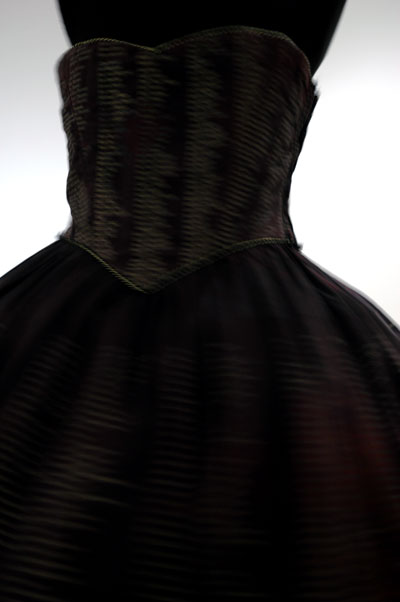
Hunter Reynolds Patina du Prey’s Memorial Dress: 1993 to 2007 [detail of installation]

Spinning, spinning, spinning.
Hunter Reynolds‘s elegant installation, “Patina du Prey’s Memorial Dress: 1993 to 2007“, is currently installed in one of the galleries of Artists Space. The performer/artist/activist‘s elegant, couture, strapless ball gown hangs from a torso mannequin in the SoHo gallery, not-so-slowly spinning on its axis (as it did when so memorably inhabited in the past by its creator himself), accompanied by an ambient piece of music composed for and contributed to the installation by the contemporary composer Edmund Campion.
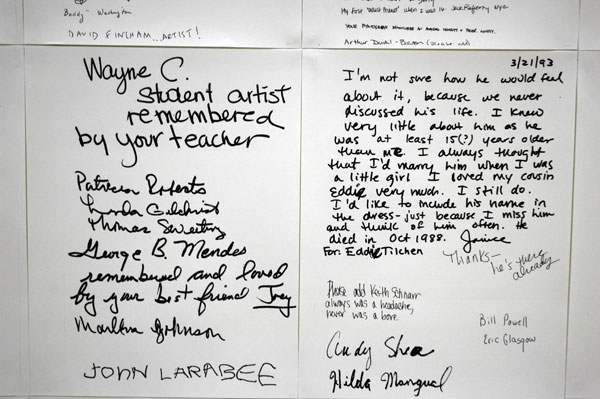
This is not just another cold tally of the epidemic, but rather a very human, a very personal collection of thousands of memorials, and a rich artistic gesture as well: The names on the dress were initially drawn from the list of names on the AIDS quilt as it existed in 1993, so it embodied the memories of friends and family members. Since then, wherever the dress has appeared the artist has invited visitors to write additional names, also of people lost to the disease and remembered by friends and family members, in an accompanying ledger book.
Is the supply of names running down? No. While the death rate for this epidemic may have slowed or declined in industrial nations during the last ten or fifteen years, at least within the population segments hit first and hit the hardest, the toll for the planet as a whole has skyrocketed. More significant to the specific groups which have seen his installation, when Reynolds’s project was begun in 1993 the friends or families of people with AIDS were far less likely to admit they were friends or families of people with AIDS; they were very unlikely to come forward with names to be added to a memorial of any kind. Reynolds confirmed to me on Friday that even in the American and European cities visited by the Memorial Dress, cities where life-sustaining HIV drugs are most generally available, the frequency of the ledger entries continues unchanged. It seems the survivors of a plague whose casualties themselves the world branded odious from the start are still coming out of the closet today.
What can be seen at the gallery this month is the second (1996) realization of Patina du Prey’s mangown. The first was the 1963 dress; the current version is constructed of a rich dark (faux-black?) silk fabric covering a fitted bodice and crinoline skirt printed in gold to include thousands of additional names added during the travels of the original. The artist hopes to create a third dress, which will incorporate the four to five thousand new names which have been added to the books in recent years.
This image is of a detail of one page from one of those books:

REynolds_Hunter_dress_names.jpg

PANEL AND PARTY
On Tueday, April 10, between 6:30 and 8 pm at the Artists Space gallery on 38 Greene Street in SoHo, Visual Aids and Artists Space will co-host a panel discussion, “Diamonds and Pearls: Remembrances and Recent Thinking on the Memorial Dress”, with Hunter Reynolds, Lia Gangitano, Alexander Gray and Simon Watson, moderated by Benjamin Weil and Amy Sadao.
Following the panel, from 8 until 9, guests are invited to party with Patina du Prey; there will be food and drink. [suggested donation: $5-7].