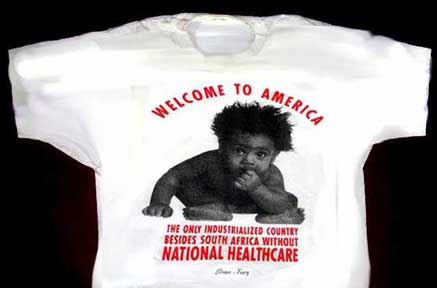
This t-shirt was designed by the legendary activist artist collective Gran Fury 17 years ago.
Today South Africa has national health care.
A lot of people still think they can do something to help drag our own country into the [twentieth] century. Some of them know they have to ACT UP to get there. But activists also know how to party, and sometimes a little cash is needed to help make a stink, so ACT UP is throwing a $20 celebration/benefit bash this evening, and everyone is welcome.
The doors of Manhattan’s LGBT Center at 208 West 13th Street (just west of 7th Avenue) will open at 7 pm. The program will start at 8 or 8:30 and will feature readings/performances by Pulitzer-prize winning author Michael Cunningham, the notorious Church Ladies for Choice, Mark Hannay (formerly of the Hot Peaches), and fabulous downtown performance artist Penny Arcade. The evening ends with a dance party that goes until midnight.
[image via ACT UP]
Author: jameswagner
my favorite activist
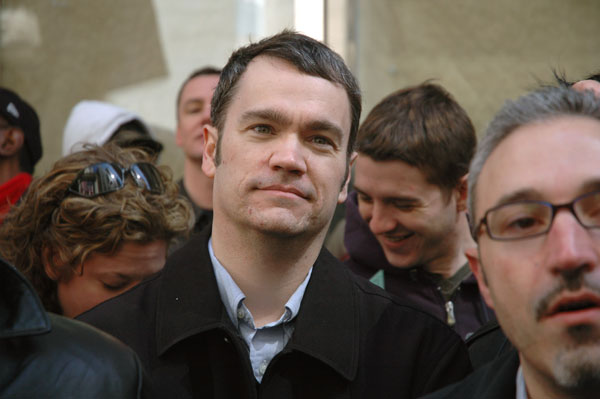
ACT UP renewed, and transformed
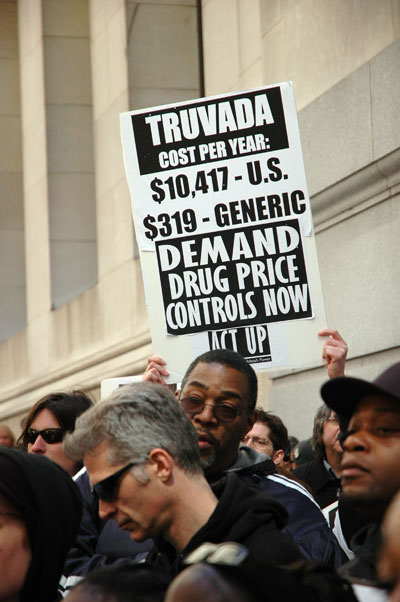
across from the Stock Exchange yesterday
If yesterday’s ACT UP twentieth-anniversary action demonstrated anything, it was the coalition’s own renewal, and its transformation from an AIDS activist group once largely made up of young middle-class queer white males into one devoted to the this country’s larger, evolving healthcare crisis and composed of a much broader community of people who have realized we are all directly affected by both AIDS and a medical system completely inadequate to address it or other health needs.
In New York yesterday every age group and every community in this hugely-diverse city appeared to be represented in the crowd which gathered in and around the Wall Street area. They hurled chants at a powerful corporate medical, insurance and political establishment, reached out in conversations to regular passersby, they brandished both printed and hand-lettered signs addressing an aloof, fortress-minded establishment, and they carried or dragged with them some 50 bulky black body-bag props as they wound through the narrow downtown streets in a band of roughly a thousand souls. At the site of the bull statue near Bowling Green some 30 people were arrested for civil disobedience while lying down in the street amongst those bags.
The NYTimes did not consider the event worthy of a single word or image. See See Andy Humm in Gay City News for the best account of the day.
The new ACT UP appears determined to be only the nucleus [or perhaps, this still being ACT UP, really only the trigger] for re-igniting an enormous popular movement, coinciding with the run-up to the 2008 election, directed toward finally securing this nation’s adoption of a single-payer healthcare system after something like one hundred years of broken dreams and promises.
What follows are a few scenes from the struggle as renewed just yesterday.
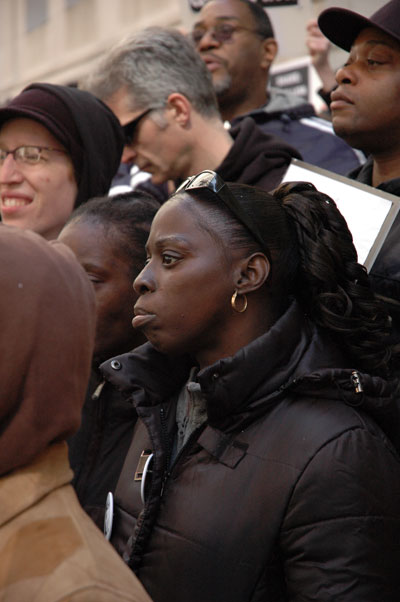
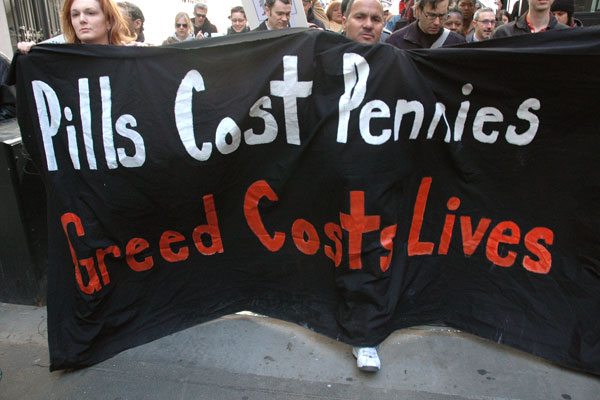
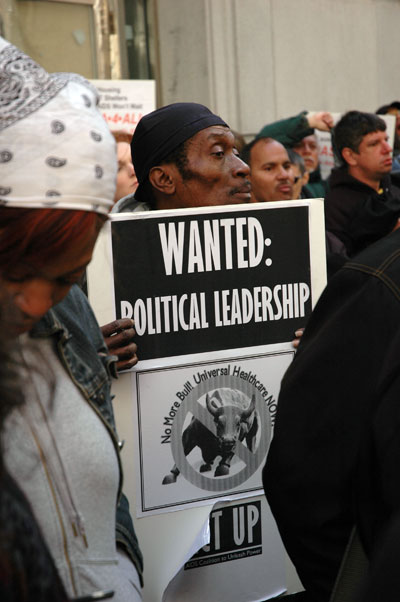
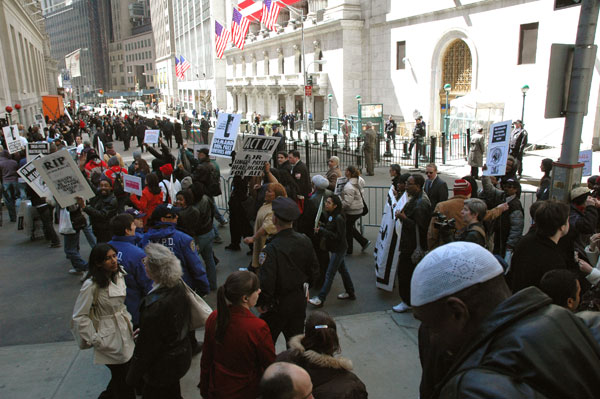
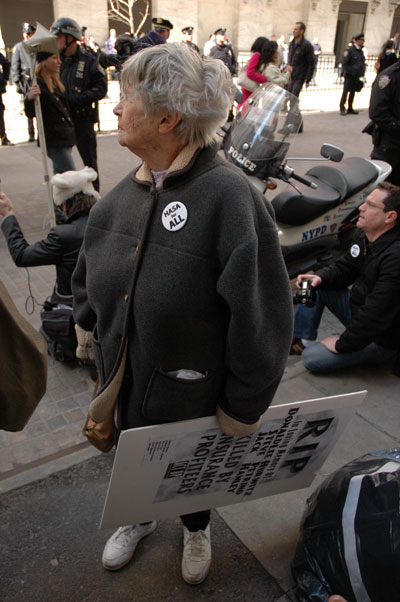
ACT UP back to the Wall, this time for single-payer healthcare
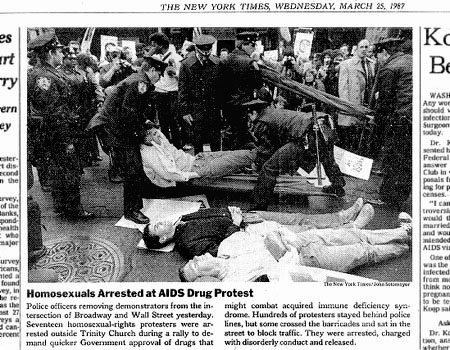
going back for more, 20 years later
Apparently as a nation we can accept throwing away something like half a trillion dollars (and counting), and very likely some 700,000 lives, on a remote elective war whose only accomplishment was a second term for the regime of the biggest Big Brother we’ve ever had, but we [or at least our media and our elected representatives] still think a single-payer healthcare system means handing over too much power to government.
ACT UP has always supported a single-payer health care system, and its members have always understood the role of war in thwarting its achievement. Tomorrow morning, Thursday, at 11:30 this remarkable and unfortunately still indispensable activist group of stalwarts will be marching on and in Wall Street to mark its twentieth anniversary and the beginning of its campaign to make access to healthcare for all, including single-payer insurance and drug price controls, a major issue throughout the 2008 election campaigns.
Anyone who is able to make it is welcome to join us as we gather for the march at 11 am. We will be stepping off from the Federal Building downtown, on the east side of Broadway at Worth Street, just above Chambers Street.
Twenty years on, the press will no longer be labelling us all “homosexuals”, as did the NYTimes in its coverage of the first action, shown in the image above, although it was exactly that powerful picture and its caption which sucked me into the group. As far as tomorrow is concerned, while it should be assumed that only those who have decided to commit some form of civil disobedience could be arrested, there is less certainty about that than there ever was in our present terrifying, and terror-stuck, political climate.
I’m bringing my camera, for surveillance purposes.
An editorial in the current issue of The Nation is an excellent tribute* to the historic accomplishment of ACT UP and a reminder that neither the role nor the actors have yet disappeared. Excerpting the last three paragraphs of the editorial:
During the years that followed, ACT UP stormed the National Institutes of Health, the FDA and the Centers for Disease Control to protest their shortcomings. On the local level, Catholic dioceses and boards of education were targeted for blocking HIV information in public schools; city governments for failing to provide care and housing; jails and prisons for setting up segregation units. Some ACT UPers set up guerrilla needle-exchange programs; others staked out the entrances to junior highs to distribute condoms directly to students. Just as essentially, ACT UP members became self-taught experts in such arcane fields as virology and patent law and in so doing rewrote the patient-doctor relationship and helped put the idea of universal healthcare–now favored by a majority of Americans–on the political map.
Along the way, ACT UP borrowed strategies from other radical movements: antinuke protesters for techniques on civil disobedience, antiapartheid campaigners for bringing political funerals to the streets. Many of its tactics–videotaping demonstrations as protection against police brutality, coordinated but autonomous affinity group actions–have become standard fare in the global justice movement, as has ACT UP’s deeply democratic tradition.
ACT UP is now a shadow of its former self, but its alums have gone on to found Health Gap, a driving force for global treatment access; the Treatment Action Group, which continues to push the AIDS research agenda; and Housing Works, which has won housing for thousands of New York City’s HIV-positive homeless. And true to form, the organization will mark its twentieth anniversary with a march on Wall Street March 29 to demand single-payer healthcare for all.
*
including a candid apology for the progressive journal’s own historic neglect: “Though barely noticed in the pages of this publication, ACT UP would revolutionize AIDS research and treatment, as well as inject new life into the gay movement and infuse the tactic of direct action with its own style of theatrical militancy.”
[image from actupny]
Frankie Martin at CANADA
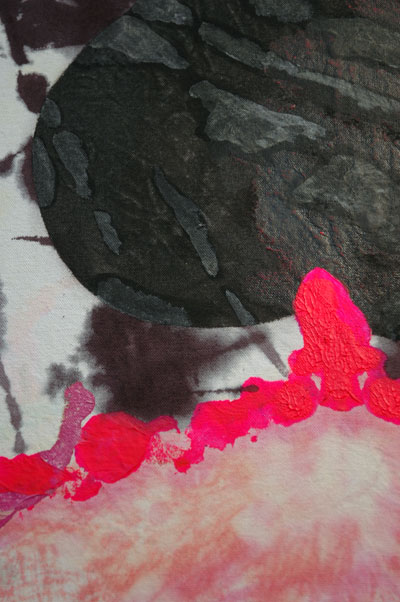
Frankie Martin the (rainbow) stinker 2006 fabric and acrylic paint 82″ x 50″ [detail from installation]
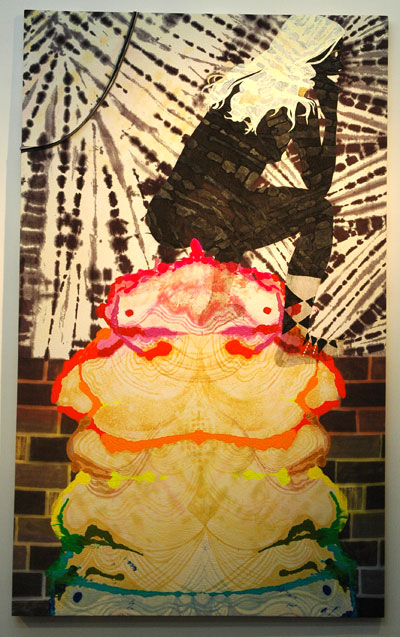
[installation view]
I visited “in your dreamz“, Frankie Martin‘s first solo show at CANADA twice, a luxury I unfortunately don’t allow myself often. I liked it the first time; I loved it the second.
I can’t remember the last time I saw a tie-dyed painting.
Martin has always had tons of fun with her art, and fortunately she lets us all in on it. This show was no exception, especially as it involved madly-conceived, energetically-executed and weirdly-disposed drawings, videos, music, installations, sculptures, assemblages and, well, . . . painting. The two large paintings on the west wall of the gallery stuck out, mostly because they were just so darn beautiful. And then I noticed the tie-dyed fabrics, the sparkle dust and the subject matter itself, and I was transported back into the cool wit embodied in the ambience created by the rest of the show.
kohlrabi land mines

untitled (kohlrabi) 2007
I confess I’m more shy about taking pictures of food stalls in Chinatown than I am about taking pictures of art in galleries, so I did this one on the run yesterday, between gallery stops. I also had to poke between real customers. It’s not cropped, and the fact that it came out at all was a big smiley surprise.
possibly the last word on photographing others’ art
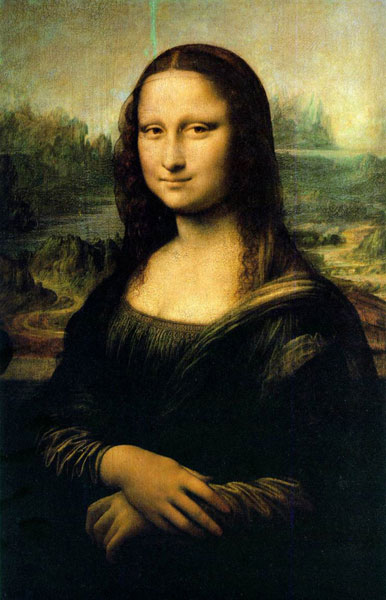
not without its replicas – and its history
I think the most sensible (and succinct) take on the question of visually recording visual art is contained in the second paragraph of a short comment submitted on my original post by the artist-blogger Hungry Hyena:
“As you suggest in the last paragraph, I think most artists would want the image to be passed along to the institution requesting it.
Furthermore, once the work leaves the studio, it has its own life, and random photos of the piece are just one more piece of that history.”
By the way, many thanks to Ed Winkleman for his post taking up the subject raised here this past week about restrictions on the public’s use of cameras in museums and galleries.
I couldn’t help noticing however that Ed’s entry manged to attract five or six times the number of comments mine did. Now I’m pressing tongue firmly in cheek here: If jealousy were not enough reason to be concerned about my colleague’s readers’ healthy response, perhaps, borrowing the spirit of the restrictive photo policies adopted by some of the most respectable cultural institutions in America, I should regret not having posted a preemptive do-not-record notice, or (reflecting the opinion of some of our more gentle readers on the subject of photographic captures) at least not having insisted that bloggers entering my site ask permission of the person sitting behind the screen before running away with copies of my proprietary posts.
[image from Georgetown University]
House votes on the war: do we say “whoopie”?
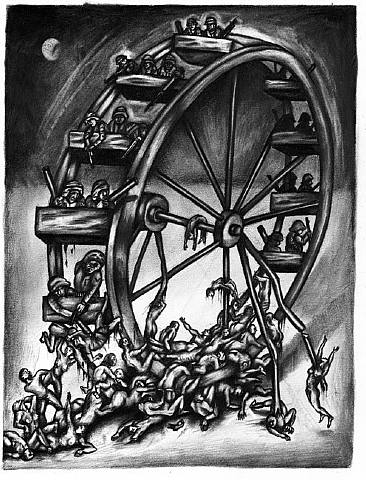
Sue Coe Wheel of War 2004 mixed media drawing on board 12.5″ x 8.5″
WASHINGTON (Reuters) – The U.S. House of Representatives on Friday defied President George W. Bush, voting to impose a September 1, 2008, deadline for withdrawing all American combat troops from Iraq.
Ummm, . . . .
Am I supposed to get excited? Did you see that end date? Almost five months after the Congressional election which was essentially a referendum to end the Iraq war House Democrats were finally able to rouse themselves from their criminal political lethargy long enough to (almost) agree on a resolution which (sorta) says we should withdraw (note: it says “combat troops”) by September 1, 2008. That “deadline” is almost two years after the election and five and a half years after this disastrous war of aggression began. Not surprisingly, there are all kinds of ifs and buts in the agreement, and apparently nothing has to be done this year, so Bush can continue to send additional troops.
Anything can happen when this Executive gets to make the decisions for another eighteen months; think of the all the things he/it could engineer to make support for a continuation, even an escalation of this war entirely likely.
In any event, the White House has already said Bush will veto such a bill should the Senate manage to cooperate with the House resolution and one finds its way to his desk.
By the end of this year, if not sooner, the war will belong to the Democrats as much as the Republicans, and I’ll wager that since the oil and permanent bases secured by this Administration now belong to both parties we’re never going to leave Iraq.
I used to think the only solution was the impeachment of both the President and VIce-President, followed by their successful criminal prosecution. Now I’m thinking that even that unlikely (but not inconceivable) scenario probably wouldn’t change anything at all in the Middle East.
[image from artnet courtesy of Galerie St. Etienne]
the invisible artist, the invisible art

invisible art [large detail]
This is a true story (only the names have been withheld, for considerations of privacy and copyright):
A young artist is chosen to be in a group show at a respectable small non-profit space.
An appreciative and enthusiastic art blogger captures an image of the artist’s work installed in that space and publishes it on his site.
On a return visit to the space months later the blogger is told by people in charge that photographs are not allowed at any time.
The blogger ceases to photograph any artists’ work in that space.
Two years after the image of the young artist’s work appeared on the blogger’s site a major museum in another city writes to him asking if it could have permission to use it in publicity materials being prepared prior to a solo show it has scheduled of the artist’s work, since there is no other photograph of the piece available.
The blogger suspects that the piece itself may no longer physically exist, thus explaining the importance of his photograph.
What does the blogger do in this case, and in the larger scheme of things, what does this scenario say about our cultural institutions’ photography restrictions generally?
[invisible image from alpinebutterfly]
“What F Word?” at Cynthia Broan
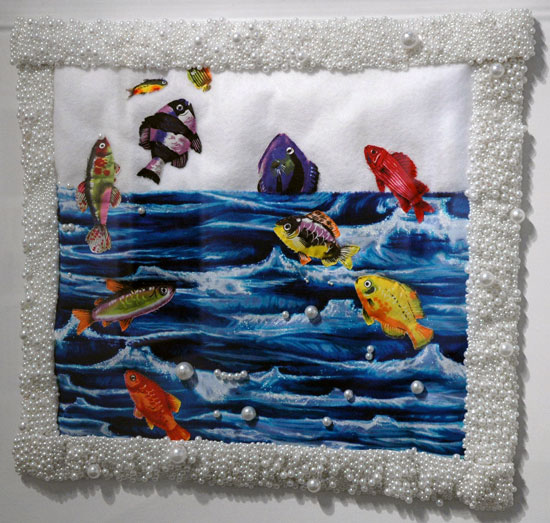
Sabyna Sterrett Flood 1979 faux pearls, fabric and thread 19.5″ x 22″ (25.5″ x 28″ in plexiglas box) [installation view]
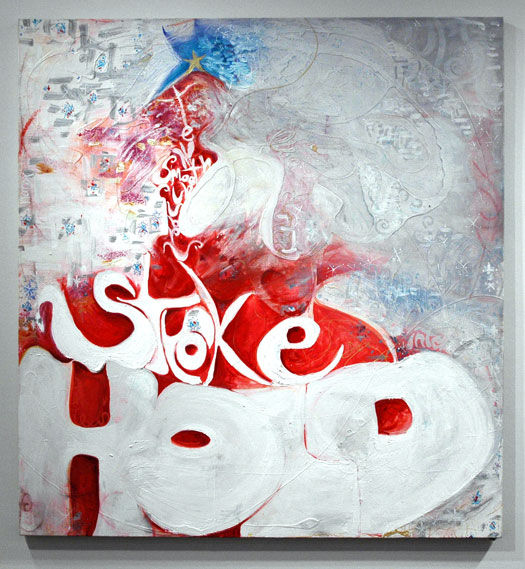
Suzanne McClelland Coming to a Head 2007 oil on linen 60″ x 56″ [installtion view]
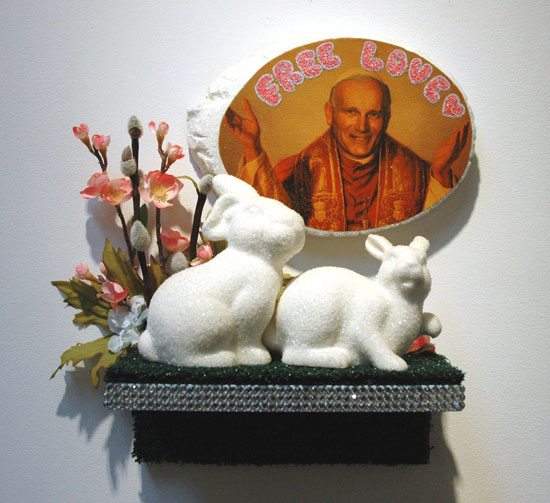
Lauren Gibbs Free Love 2006 ceramic, silk flowers, diamond dustwood, astroturf, acrylic, rhinestones 15″ x 17″ x 7″ [installation view]
Cynthia Broan’s show of feminist art, bearing one of the season’s more delightfully ambiguous titles, “What F Word?“, closed last Saturday, but some of the work included there (much, much more than what I’m showing here) deserves another shout.
I would say this is especially true because of its contrast (or harmony?) with a guy show (masculine art?) running concurrently just two streets south of her 29th Street space. [but more on that in the next post]
The work in the Cynthia Broan installation, which included, if I’m counting right, 33 artists or collaborators and twice as many pieces, spanned the last 45 years. I’d call that slice of time the years which will always have to be considered heavily touched by the 60’s, even if that amazing decade’s social innovations and political progressiveness has sadly been largely reversed. The arts thankfully somehow escaped that numbing and conservative fate which has ever been attached to an aging population.
It was wonderful to see firsthand so much revolutionary work from many years ago, but one of the most remarkable things about this show was the difficulty in dating the pieces without a scorecard. Sabyna Sterrett’s pristine, plastic-boxed pillow sham could have been made yesterday, and some of the newest work, at least partly because it employed found or organic materials which already showed physical age, looked like it could have been around for decades. Moreover, since many of the issues and obstacles facing women artists today are little changed from 1962, it just wasn’t that easy dating the work on the basis of its substance.
I left the gallery thinking I would like to have felt something more of the presence of the curator, the artist Carol Cole Levin, but the cast was certainly terrific. In alphabetical order they were: Ghada Amer & Reza Farkhondeh, Janet Biggs, Phyllis Bramson, Carol Cole, Patricia Cronin, Nancy Davidson, Lesley Dill, Diane Edison, Susan Paul Firestone, Dana Frankfort, Lauren Gibbes, Gina Gibson, Kate Gilmore, Nancy Grossman, Jane Hammond, Rajkamal Kahlon, Robin Kahn, Deborah Kass, Suzanne McClelland, Beverly McIver, Ulrike Mueller, Barbara Nessim, Shay Nowick, Brenda Oelbaum, Lesley Patterson-Marx, Elaine Reichek, Beatrice Schall, Rachel Selekman, Lowery Stokes Sims, Anita Steckel, Sabyna Sterrett, Jennifer Viola and May Wilson.