score another one for Christ, or?

“Quiet tsunami prayers mark Christmas in Thailand” read the headline on the lead story on YAHOO! NEWS when I first looked this afternoon. The story begins:

KHAO LAK, Thailand (Reuters) – Simple Buddhist ceremonies marked Christmas Day in Thailand’s tsunami zone on Sunday as relatives of victims remembered their loved ones on the eve of the Indian Ocean disaster’s first anniversary.

Does anybody else find this offensive?

the Target is women – the weapon, “religious freedom”

you can no longer expect more from Target.
Barry just sent me an email with a link to this story reporting essentially that the Target corporation will refuse to fill certain prescriptions because to do so would be both immoral and a violation of religious freedom [my italics]. Alright, officially they’re saying that they won’t force the pharmacists they employ to violate their own personal morals, although apparently neither the corporation nor the pharmacists will have any problem with dereliction of professional duty.
I instant-messaged him a reply:

ref. Target’s morals, I now expect “religious freedom” will soon trump everything else the Constitution says

And Barry typed right back:

It’s the only right left

Those crazy cults have won: Welcome to the promised land.

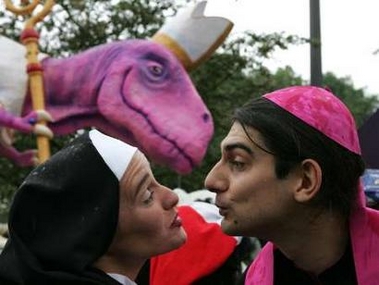
papal Carnival in Cologne

anti-religious.jpg
demonstrators dressed as a priest and a nun kiss in front of a large model dinosaur during an anti-religion demonstration in Cologne August 19, 2005 [as der Ratzinger arrived in Cologne]

Sometimes it’s best to let the thing speak for itself.
I’m very proud of my family’s ancient Rhenish Catholic [and before that, Roman without the Catholic] Heimat, and amazed at the effrontery of [Yahoo!]. See Bloggy for a related post.

[image by Pawel Kopczynski from Reuters which, together with my excerpt from its accompanying caption, is furnished by Yahoo!]

laundry room Speedo

laundryroomSpeedo.jpg
special bulletin spotted this afternoon

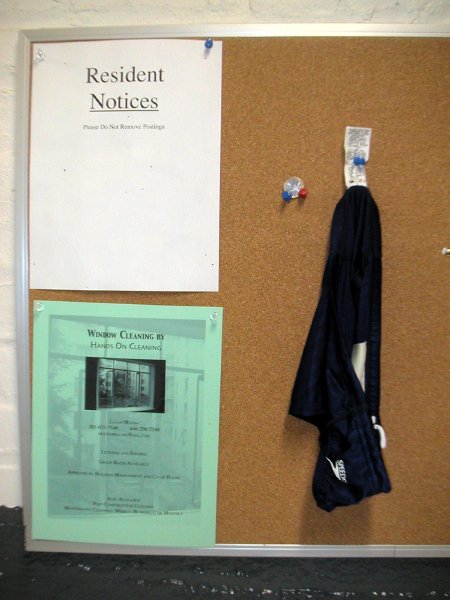
For me at least this was definitely the most provocative found item of clothing I’ve seen in our basement laundry room in the eighteen years I’ve been visiting its splendors. This midnight-blue Speedo even beats the 2(x)ist thong, size 32, I spotted a couple of years ago, since my first serious fetish matured at club pools during long summer afternoons decades before underwear even thought of becoming fashion.
For the curious, the tiny suit on the bulletin board is a size 34. From my own experience this means that in the real world it’s more like a 28 or 30. Sigh.
The small silver item immediately to its left is a one-Euro coin supported on the cork by two pushpins.
Ah yes, we are in Chelsea.

life after birth

stemcellballot.jpg
respect

A gentle letter to the editor in today’s New York City Newsday ends with this terse critique of the Republicans’ evil politics of stem-cell research: “After all, we may differ as to when human life begins, but it certainly does not end at birth.”
The full text follows.

President George W. Bush’s antipathy to stem-cell research is a paradox wrapped in a conundrum. How can he have any respect for human life when his rush to war has resulted in the deaths of thousands of innocent people?
To say nothing of his role as governor of Texas, where he executed numerous people. If Bush was truly concerned with the dignity of human life, his policies would be 180 degrees different in almost every category. After all, we may differ as to when human life begins, but it certainly does not end at birth.
Max Podrecca
Manhattan

Is anybody listening?

[image from nature.com]

“Pink Houses”


heroes at large

We met these two extraordinary men for the first time this afternoon. Until then our knowledge and experience of the nobility and the courage of John Schenk and Robert Loyd had been limited to the incredible reports which regularly came to us from Barry’s wonderful mother Earline, their good friend and neighbor.
John and Robert are visiting New York this week from Conway, Arkansas, because their story and that of their now thoroughly-notorious pink Victorian house is being told in a documentary which is part of the New York Independent Film and Video Festival.
Barry has already written more about the couple and the film, “Pink Houses.” We will be seeing it tomorrow night, Tuesday, at 6 o’clock. He’s included an article from the Arkansas Democrat-Gazette, a statewide paper.

While the film is presented from the viewpoint of these two men, it also includes comment from a representative of the Family Council — a Little Rock-based organization that promotes traditional family values — and television footage of Greenbrier farmer Wesley Bono talking about his decision to spread a dump-truck load of manure along streets around the Pink House on the day of last summer’s gay-pride parade.
“It didn’t stop us,” Schenck says in the film, while standing outdoors with Loyd. “It smelled horrible for a couple of days, but we’re used to dealing with manure.”
. . .
In their 19 years in the Pink House, the two say, people have driven by and shouted derogatory names, shot at their house, broken their car windows and destroyed holiday decorations.
“One year we had a 9-foot Energizer bunny,” Loyd says. “It was decapitated Easter morning. I thought that was a little extreme.”

And some of us once assumed that the big city queer owned the breed’s style and courage.
Details: The 51-minute film will be screened at 6 o’clock on Tuesday, May 3rd, on screen 6 of the Village East Cinema, 181 2nd Avenue at 12th Street.

[image original source not available at this time]

this time it looks like suicide; cross your fingers

clericsin hell.gif
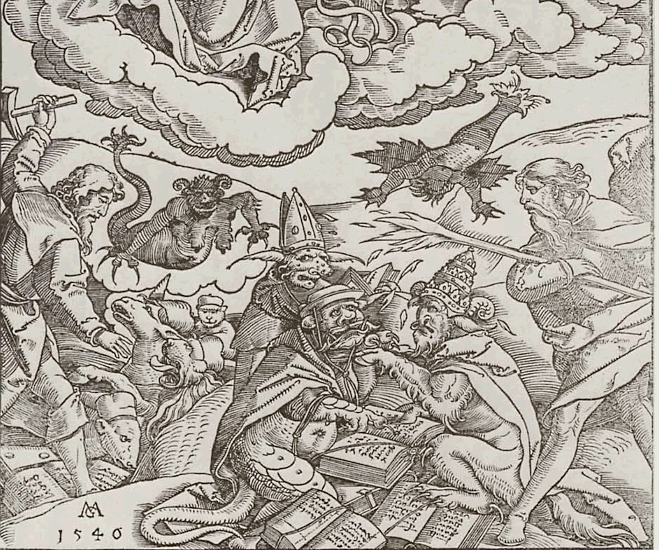
Matthias Gerung Der römische Klerus in der Hölle [Roman clerics in hell] 1546 wood cut detail

They always insist that suicide is a “mortal sin,” but at least there’s hope for the survivors, the rest of us, those not members of the cult but who have had to suffer its injuries.
As I suspected immediately upon hearing about the appointment of Ratzinger as its chief executive, the Roman Catholic Church seems to have committed suicide. For reasurance, see the essay by the Catholic intellectual Hans Küng which appeared in Der Spiegel several weeks ago, while the last pope was still dying. Küng is the eminent Swiss German theologian who in 1979 was stripped by the Church of his right to teach because of his liberal critique of papal authority. This is only an excerpt from his conclusion:

For the Catholic church, this pontificate, despite its positive aspects, has on the whole proven to be a great disappointment and, ultimately, a disaster. As a result of his contradictions, this pope has deeply polarized the church, alienated it from countless people and plunged it into an epochal crisis — a structural crisis that, after a quarter century, is now revealing fatal deficits in terms of development and a tremendous need for reform.
Contrary to all intentions conveyed in the Second Vatican Council, the medieval Roman system, a power apparatus with totalitarian features [my italics], was restored through clever and ruthless personnel and academic policies. Bishops were brought into line, pastors overloaded, theologians muzzled, the laity deprived of their rights, women discriminated against, national synods and churchgoers’ requests ignored, along with sex scandals, prohibitions on discussion, liturgical spoon-feeding, a ban on sermons by lay theologians, incitement to denunciation, prevention of Holy Communion — “the world” can hardly be blamed for all of this!!
The upshot is that the Catholic church has completely lost the enormous credibility it once enjoyed under the papacy of John XXIII and in the wake of the Second Vatican Council.
If the next pope were to continue the policies of this pontificate, he would only reinforce an enormous backup of problems and turn the Catholic church’s current structural crisis into a hopeless situation.

These word were written weeks ago. Today it doesn’t look like there’s much doubt about what can be expected of the regime which has succeeded that of Wojtyla, since it was the choice of, in Küng’s words, the “largely mediocre, ultra-conservative and servile episcopate” he created. Suicide.
Amen.

[image from Alois Payer]

star-struck pope

popecamerabug.jpg
(documenting his own fabulousness)

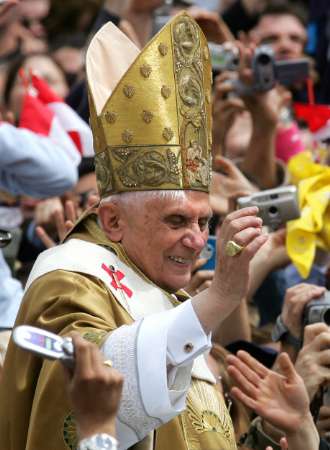
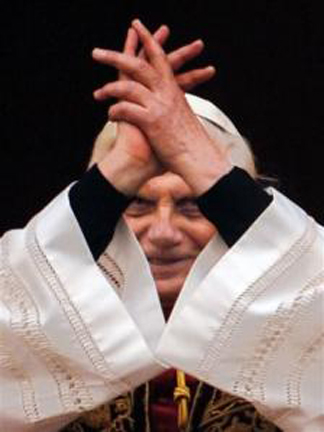
I’ve been looking at pope-arama pictures for a couple of weeks now. Frankly however, since the more colorful elements of Vatican porn, the Medieval pomp and circumstance, have been severely cut back over the last few decades, there’s really not much to look at any more. These old men are very happy going back to the heavy Middle Ages thing, but without the fun part.
Nevertheless I shouldn’t have been surprised (although I really was) to see “the faithful” raising thousands of arms holding cameras aloft while various old relics pass in front of them (present reality isn’t good enough; people today don’t think they’re really looking at something unless they manage to get their own snapshot of it). What really shocked me was seeing Ratzinger himself apparently seduced by his own fame in the same way.
Okay, the camera in his hand is just an illusion produced by a telephoto lens, even if it was fun for a second. But do we think Jeb Bush or Berlusconi took any pictures when they went up to kiss the guy’s ring while he sat on his throne? Maybe I have to rephrase that: Can fans get away with just shaking his hand these days?

[image by Max Rossi from Reuters]

Ratzinger’s history in New York

pope2.jpg
how do you say “booga booga!” in ten languages?

In an email with the subject line, “My encounter with Pope Benedict XVI,” a friend and awesome activist colleague of mine reminds us today that our outrage over what Josef Ratzinger represents has a history, including one very much in our midst. The following paragraphs are an excerpt from Michaelangelo Signorile’s first book, “Queer in America: Sex, the Media and the Closets of Power,” published in 1993.

[The event described here occurred on January 27, 1988. I will forever be grateful to the new pope for being so integral to my development.]
One protest that was announced was an upcoming zap of Josef Cardinal Ratzinger, the German prelate who was head of the Congregation for the Doctrine of Faith. He had written a paper for the Vatican in which he said that homosexuality was “intrinsically evil” and a “moral evil.” Cardinal Ratzinger had said the church had to fight the homosexual and fight against legislation that “condoned” homosexuality.
The Ratzinger appearance was at St. Peter�s, a church known for its modern architecture, at Citicorp Center…When I arrived, the place was packed. It was in a big amphitheater that looked more like the United Nations General Assembly chamber than a church. This wasn�t going to be a Catholic mass; St. Peter�s wasn�t even a Catholic Church. Ratzinger may have been a religious figure but he was also a political leader, especially since he was the church’s antigay crusader, here to fight against gay civil rights legislation. The church wanted him to speak in a slick, modern, secular-looking space, free of ornate and intimidating religious d�cor and adornment. It made the gathering accessible and open to people of all faiths and political persuasions.
Ratzinger sat at the altar, along with Cardinal O’Connor and several other prelates. Judge Robert Bork, the conservative Supreme Court nominee who’d just been rejected by the Senate, sat in the front row. Mrs. William F. Buckley, Jr., was there too, as was an incredible array of Upper East Side women, the upper crust of New York’s Catholic Society. There were prominent Wall Street businessmen and local government officials. And rows and rows of nuns, brothers, and priests, perhaps the heads of orders and parishes. I began to feel very small � I hadn’t seen so many priests since Catholic school.
I looked for protesters, but I couldn’t see anyone with a sign or a T-shirt. I wondered for a few moments if anything was really going to happen. I had decided to go there strictly to watch, to check out how these people operated when they conducted these demonstrations. As for myself, I didn’t know the first thing about protesting and I still wasn’t sure about it. I certainly didn’t like the idea of getting arrested.
…Ratzinger took the podium and began to speak. As soon as he finished his first sentence, a group of about eight people to the left of the crowd leaped to their feet and began chanting “Stop the Inquisition!” They chanted feverishly and loudly, their voices echoing throughout the building. The entire room was fixated on them. Activists suddenly appeared in the back of the church and began giving out fliers explaining the action. Two men on the other side of the room jumped up and, pointing at Ratzinger, began to scream, “Antichrist!” Another man jumped up, in one of the first few rows near the prelate, and yelled, “Nazi!” All over the church, angry people began to shout down the protestors who were near them; chaotic yelling matches broke out.
It was electrifying. Chills ran up and down my spine as I watched the protestors and then looked back at Ratzinger. Soon, anger swelled up inside me: This man was the embodiment of all that had oppressed me, all the horrors I had suffered as a child. It was because of his bigotry that my family, my church — everyone around me — had alienated me, and it was because of his bigotry that I was called “faggot” in school. Because of his bigotry I was treated like garbage. He was responsible for the hell I’d endured. He and his kind were the people who forced me to live in shame, in the closet. I became livid.
I looked at Cardinal O’Connor, who had buried his head in his hands, and I recognized the man sitting next to him. It was O’Connor’s spokesman and right-hand man, Father Finn, who had been the dean of students back at my high school, Monsignor Farrell. A vivid scene flashed in front of my eyes: The horrible day when I was in the principal’s office talking to the principal, the guidance counselor, and the dean, the day they threw me out because I was queer. I looked back at Ratzinger, my eyes burning; a powerful surge went through my body. The shouting had subsided a bit because some of the brothers had gotten in front of the room to calm the crowd. The police had arrived and were carting away protestors.
Suddenly, I jumped up on one of the marble platforms and, looking down, I addressed the entire congregation in the loudest voice I could. My voice rang out as if it were amplified. I pointed at Ratzinger and shouted: “He is no man of God!” The shocked faces of the assembled Catholics turned to the back of the room to look at me as I continued: “He is no man of God — he is the Devil!”
I had no idea where that came from. A horrible moan rippled across the room, and suddenly a pair of handcuffs was clamped on my wrists and I was pulled down….
…I was excited the see something in the New York Post the next day besides the gossip columns: a headline � “Gays Rattle Pope’s Envoy” � next to a photo of an anguished Cardinal Ratzinger.
I joined the ACT UP media committee.

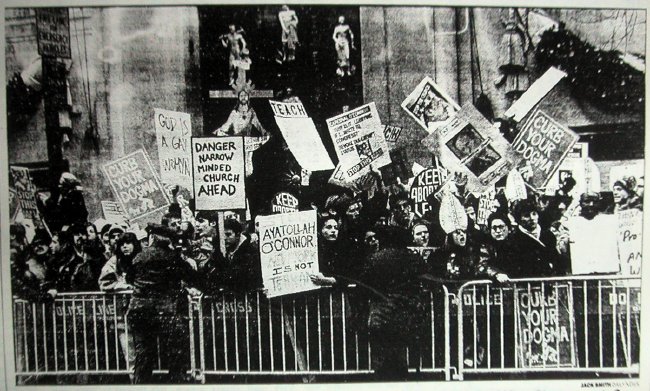
One year later Signorile and I both participated, along with thousands of others, in the 1989 “Stop the Church” action. One of the most important catalysts for its success was our community’s anger over Ratzinger’s 1986 letter to the bishops of the Catholic church, “On the Pastoral Care of Homosexual Persons.”
stopthechurch.jpg
outside St. Patrick’s Cathedral, December 10, 1989

[image at top by Domenico Stinellis from the Associated Press via Robert Boyd; lower image is that of a Jack Smith photo on the front page of the Daily News copied from my archives]