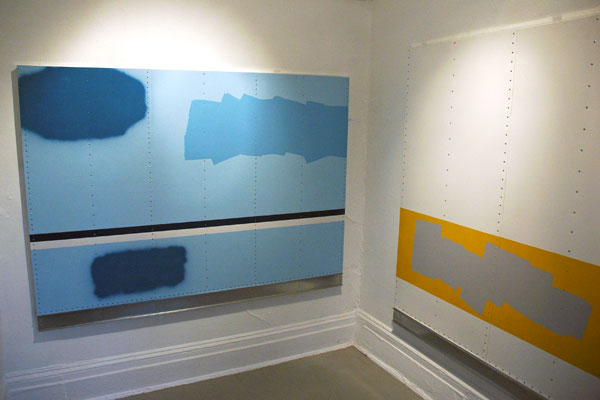
installation view of Derek Stroup’s “Blue Panel”, on the left , and a large detail of the slightly larger “White Panel” on the right (each completed in 2009, of enamel paint on sheet metal, with an aluminum stud below, and measuring approximately 5′ x 6′)
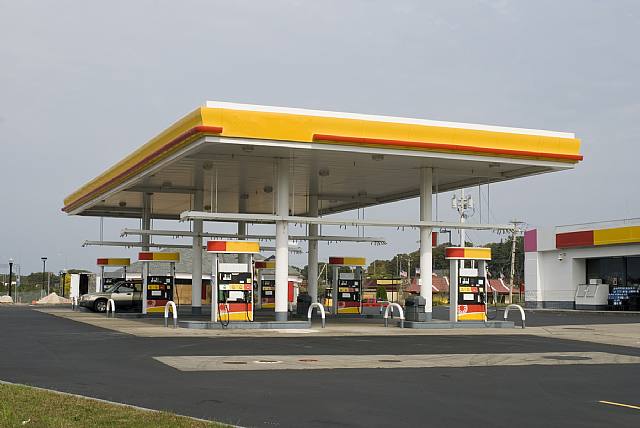
Derek Stroup Shell 1 2008 digital C-print
Derek Stroup‘s show, “Station Pieces“, in the front rooms of Williamsburg’s A. M. Richard gallery closes tomorrow, Sunday. Barry and saw it this afternoon and we immediately designated it a top pick on ArtCat.
In this elegant, and very eloquent small show the artist presents conceptual work attached to imagery stubbornly-familiar to all of us. Stroup also deals with a number of the contemporary art world’s current recognized preoccupations: He incorporates or tackles the subjects of street art, economic devastation, the endangered planet, sculpture assembled from existing materials, hand-made versions of machine-made products, digitally-altered images, realism, abstraction, the new minimalism, text (or its effacement), the recording of built landscapes, and architectural fragments. He pulls it all together with amazing skill, to totally original, and gorgeous, effect, but when we leave its presence Stroup’s art rewards us with questions whose answers will continue to elude us.
The installation may ostensibly be devoted to commonplace proprietary gas stations, but, to begin with, all logos have been completely erased. This was accomplished digitally on the one photograph included, and with thick strokes of paint (much as tags or graffiti are routinely removed by the owners of the property on which they are inscribed) on the three “paintings”, whose surfaces or mountings have been co-opted for use as minimalist, abstract panels – sculptures in fact, since they are rendered on large sheets of riveted steel attached to other elements.
The commercial signs and the apparatuses, having now been rendered entirely anonymous, appear to have lost their purpose, and the world which created them – and was fed by them – may have entirely lost its validity. Or not.
The largest, most ambitious and most complex piece in the show is “Red, White, Grey 2 (Station Exterior)” which, except for its essential conceptual element, might suggest the practice of any number of younger sculptors today, except that the materials Stroup uses are not exactly “found”; instead, designed to assume a specific form, the components were pulled from the racks of suppliers of new construction materials.
I tried to get an image of “Red, White, Grey”, whose nine feet by nine feet dimensions ensure that it fully occupies the larger of the two rooms, but I couldn’t come up with anything which even suggested the awesome impact of the piece I stared at this afternoon.
You have to be there. Really. So this thumbnail can only be a rough approximation:
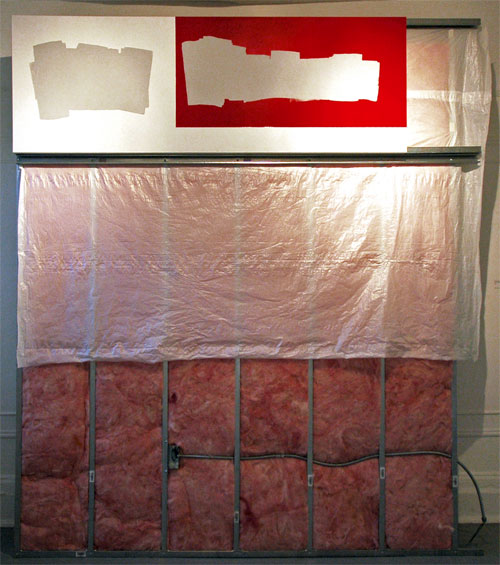
[second image from artnet]
Category: Culture
Michael Mandiberg at Eyebeam
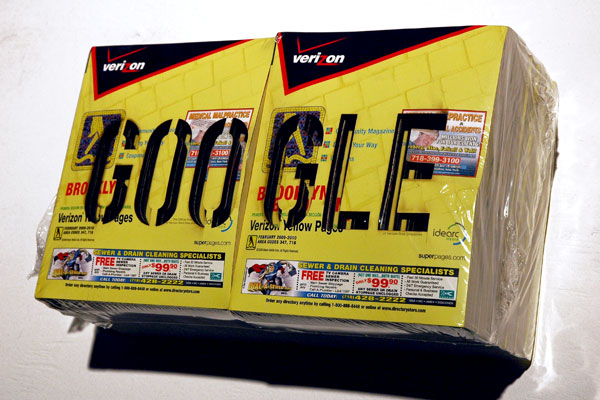
Michael Mandiberg GOOGLE 2009 shrinkwrapped laser cut Brooklyn yellow pages
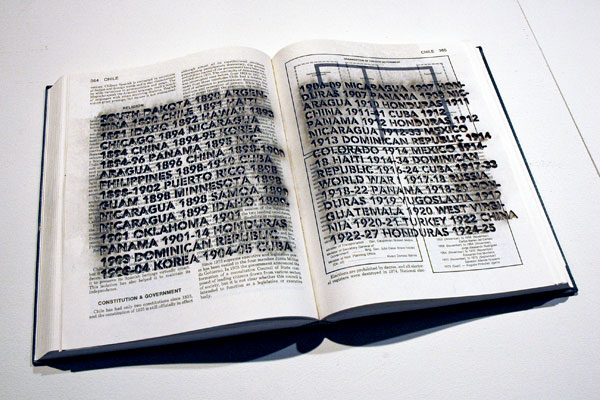
Michael Mandiberg We have never had a year of peace 2009 (in progress) laser cut 3 volume edition of the Encyclopedia of the Third World
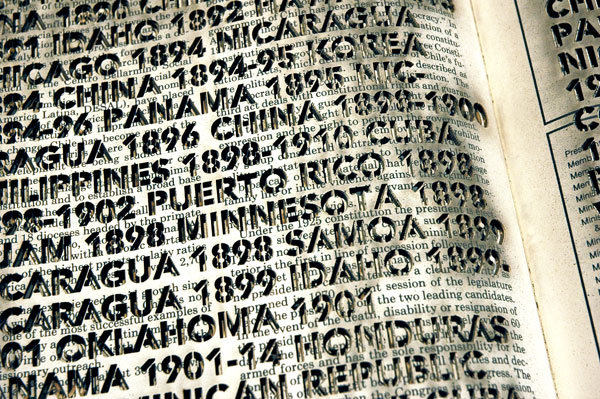
[detail]
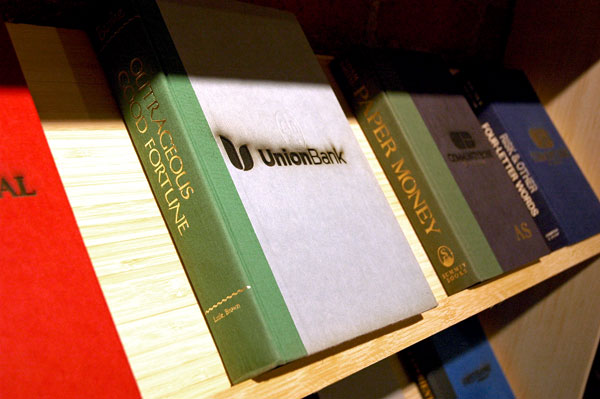
Michael Mandiberg FDIC Insured 2009
Michael Mandiberg has just finished assembling a handsome installation of his work at Eyebeam. It apparently represents only some of the work he has been doing over the past six months.
Barry and I had a preview of the installation on Monday. Although not currently open to the public except by making arrangements with the artist (see below), this work, along with that of Eyebeam artists In residence, student residents, and other senior fellows can be seen during Open Studios: Fall 2009, scheduled for the afternoons of October 23 and 24, between 3 and 6 each day.
Mandiberg’s one dozen separate pieces consist primarily of old, found books cut with a laser, handsomely shown individually or assembled in groups of two or more and placed on the artist’s own constructions.
Mandiberg goes where no laser cutter has ever gone before. Some of the work physically and dramatically distinguishes important newly-established contemporary technologies from their aging or defunct antecedents (many of which could once have been described as cutting edge themselves), The result is a visual dialogue charged with the passage of time and composed in the empty spaces we see “written” in and on various kinds of reference books.
One piece, a work in progress (surprisingly, lasers take their time), is titled “We have never had a year of peace”. When finished it will comprise the three volumes of the “Encyclopedia of the Third World”, lying on their spines next to each other, open at a random page in the middle where the artist has deeply burned the name and year of every war fought by this peace-loving republic since 1890.
Another body of work consists of a wall display of cast-off volumes describing how to make money. Mandiberg has “whittled” with a laser into their hard front covers to describe the logos of, according to the artist, “all of the failed banks of the Great Recession”.
Not directly related to the re-worked dictionaries, encyclopedias, phone directories, or investment monographs are some breathtaking laser-cut drawings of the security patterns ordinarily found printed inside those familiar small mailing envelopes used by banks and similar institutions.
Those interested in seeing more images, or in visiting the space where these exquisite, yet powerfully-resonant pieces are installed, should go to the dedicated page on the artist’s own site, where he advises:
Eyebeam is currently closed to the public, but if you would like to see this installation you have two options. Contact me (myfirstname@mylastname.com) to set up a time to meet, or come by the Eyebeam Open Studios, which will be October 23rd and 24th from 3-6PM.
introducing Idiom

Idiom.
It’s beautiful (I love the blue logo), and it’s very smart. That’s exactly how I wish I could describe everything in the world. Unfortunately I can’t always arrange it. But Barry and I are going to have a lot to do with this new thing we’re putting together, along with some very beautiful and awesome-smart people, so we’re certainly going to be working on that beautiful and smart thing.
We’re hoping our efforts will please visitors as well.
Idiom is our collaboration with a few other arts fanatics in the creation of a digital magazine, which we’re describing as an online publication of urban artistic practice. As announced in today’s press release, we will be asking creative and articulate “emerging artists, writers and arts professionals to report on, review, and otherwise cover overlooked or under-thought aspects of the larger creative community, Idiom offers a local, engaged counterpoint to the prevailing discourse of contemporary art.”
That means all the arts, although we anticipate a heavy emphasis on the visual arts.
Stephen Squibb will be the editor, and the senior editor is B. Blagojevic.
NURTUREart benefit October 12
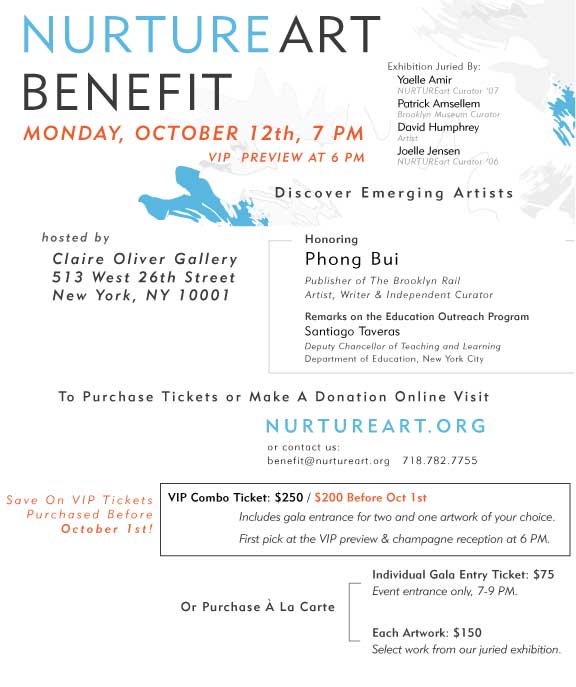
This year’s NURTUREart benefit will be on October 12th, at Claire Oliver in Chelsea. Barry and I will be there. It’s one our favorite non-profits and one of the most fun events of the year (okay, they like us too, and the price is right). It’s also a terrific opportunity to acquire some great stuff while at the same time supporting both emerging artists and emerging curators.
Raising money for the arts is obviously tougher than ever this year, but this event offers a precious opportunity to forget for a night that not everyone believes that great art can exist even when it hasn’t been bought by the right people.
For the first time ever, all of the works which will be available at the benefit can be viewed on line. Have a sneak preview here, and join us on West 26th Street less on Día de la Raz.
Also, note that tomorrow, Wednesday will be the last day to take advantage of the early bird admission price, so hurry down to your local internet line.
SOSka Group’s “Barter” at Cardboard Gallery in DUMBO
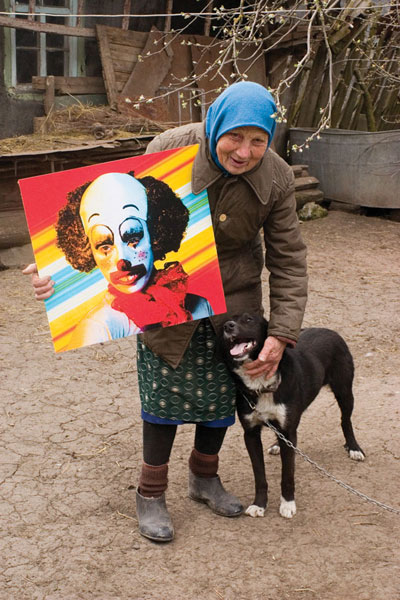
SOSka Group Barter 2007 digital print
We weren’t in DUMBO long enough for the judgment to mean an awful lot, but for both Barry and I the highlights of our visit on Saturday to the “Art Under the Bridge Festival” were several of the pieces shown in the video_dumbo space and the Cardboard Gallery down the block, which hosted “Barter“, an installation of a work by the Ukrainian art collective SOSka Group.
In another world, how many eggs would you trade for an image created by Lichtenstein? How many buckets of potatoes for that Komar and Melamid? Which of your laying hens would you give for the Cindy Sherman?
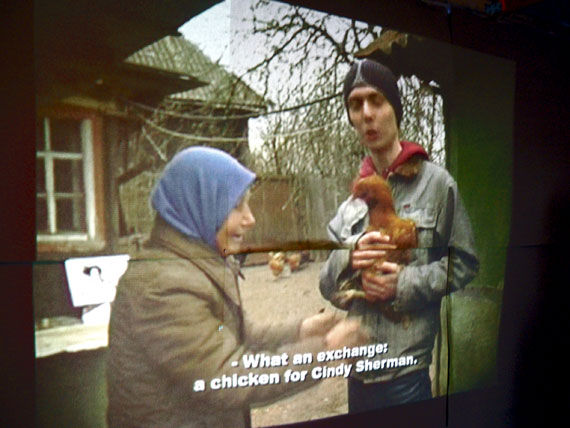
From the Cardboard Gallery’s announcement:
In SOSka’s video Barter (2007) the artists arrive at a local village and set up a display of artistic reproductions by Chuck Close, Cindy Sherman and others in hopes of trading them for food with the local farmers. While the video offers a playful glimpse into the perceived value of art, it also provides a telling social commentary about conditions in post-soviet Ukraine from the point of view of those who are insulated from the geo-politics of the western cannons and from the contemporary art world, including the artists themselves. The video will be accompanied by a series of photographs that document of the farmers posing with their selections and interior shots of where and how they have chosen to display these works in their homes.
The video itself is totally compelling on a number of levels. Its conceptual question, addressing the commodity value of iconic contemporary art images once they have been removed from their cultural origins, is hardly more riveting than its documentation of some compelling people inhabiting a very different culture, to whom these images are introduced as “pictures”. Notice how carefully these people think about the art; they tell us why they like it, and even where they’re going to put it.
I wanted the grainy moving pictures to go on and on, and more than that, having traveled in other countries through rural villages not unlike Velyki Prokhody, I envied the artists their opportunity for engagement.
You can watch the entire video here, but you’ll miss out on the ambiance inside the cardboard box where we saw it projected.
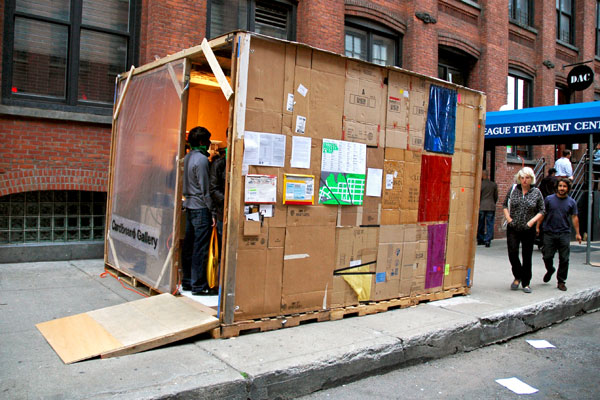
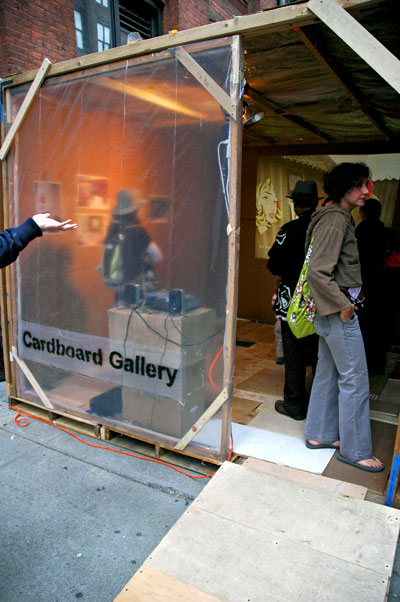
There’s more information on SOSka here, and you can find the home page of the Cardboard Gallery here.
[initial image from newcityart]
New Museum commits suicide with banality
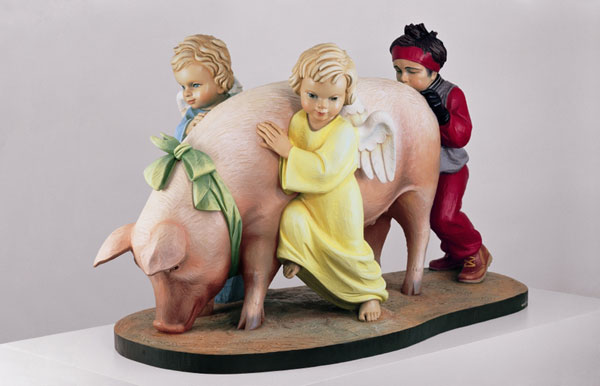
Jeff Koons Ushering in Banality 1988 polychromed wood sculpture
Jeff Koons seems to have said it himself, years ago.*
Banality.
Many of us have been worrying about the New Museum for some time, including fans who were around at the time of its founding, but I’m not talking about money worries. The institution was founded by Marcia Tucker in 1977, who conceived of it, in a description published on its own web site, as “a place with a scope lying somewhere between grassroots alternative spaces for contemporary art and major museums that show only artists of proven historical value.”
The New York Times reports today that in February the zigzag Bowery tower will host a show of work from the collection of Dakis Joannou, one of its own trustees, chosen by Jeff Koons, who is a close friend of the Greek billionnaire. The article tell us that Joannou’s collection includes, other than work by Jeff Koons, art by other celebrated artists, and mentions Maurizio Cattelan, Urs Fischer, Robert Gober, Chris Ofili, Charles Ray and Kiki Smith.
Zowie.
Is this even legal? I mean, this is supposedly a non-profit, and aside from the self-serving aspect, it looks a lot like insider-trading; I see lots of money flying around, and I’m wondering why we shouldn’t ask, cui bono?
I don’t think Marcia would consider a show of work by established artists, curated by one of the country’s most-established artists, and selected exclusively from the collection of one of its own wealthiest, and fully-established trustees to fit the dream – or the reality – which once described the New Museum.
The outrage doesn’t stop with the Joannou takeover. The same Times piece tells us that the cozy NM/Joannou/Koons project will “inaugurate an exhibition series called ‘The Imaginary Museum,’ which will showcase the best private collections of contemporary art from around the world that are rarely seen by the public.”
Those contemplated museums may be imaginary, but the real institution we used to look to for excitement is fast disappearing, if not already gone.
If the New Museum had to fit something into their calendar at the last minute, why not pick some emerging curators to pick some emerging artists and fill all those floors with excited visitors who won’t stop thinking and talking about art. (In fact, the directors should be doing this anyway, with deliberate planning, and not as a desperate solution.) The art they’re inviting into Marcia’s rooms belongs in the older museums she critiqued for their cowardice, and if big collectors can’t yet part with their stashes, but still want a larger public to see it, let them invite that public into their homes, as so many have done for years in Miami, Berlin or elsewhere. If they’re afraid the carpets will get messed up, tell them to rent a hall. We’ll all come – after touring my fantasy show of emerging art at the New Museum.
ADDENDUM: I had originally wanted to make this a very short post, not trusting my anger, but now I can’t resist linking to this publicity piece which appeared in Artforum last summer. I already knew about the Koons-styled Joannou yacht, but it was through seeing this beautiful, satirical flyer/poster piece by Pedro Velez that I was directed to the article which had inspired it. Velez says that we can each use his image as we please, adding: “it’s a public piece of art…” Now there’s a concept.
It helps to have seen the Artforum images first (if you have the stomach for them), but here’s Velez’s poster:
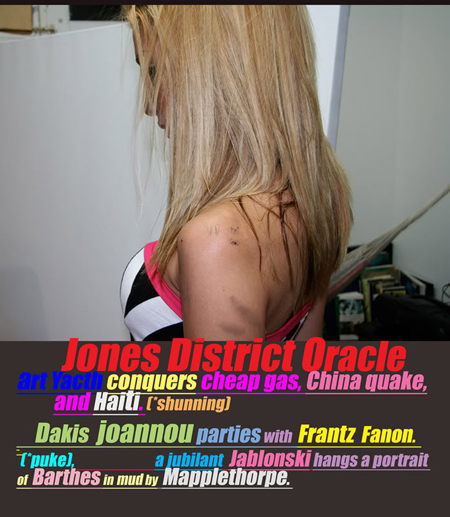
poster by Pedro Velez from “Dakis Joannou and the Yacht that Conquers” (2008)
*
I just had this thought: Maybe it’s all a joke, that the whole project could be a way for Koons to have a laugh with us all. If so, I doubt the Museum is in on it.
[top image from joeren’s blog; bottom image from the artist]
Tracey Baran at Leslie Tonkonow, and a memorial grant
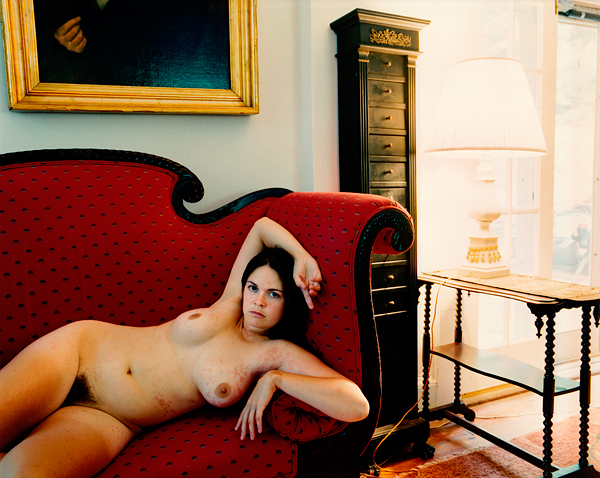
Tracey Baran Ivy 2001
UPDATE: The silent auction for the SVA Tracey Baran Memorial grant has been extended through Friday, October 2nd, for all unsold lots. The fine works which remain are being offered with reduced reserve prices, and can be seen here.
It’s a celebration, not a retrospective, but it’s enough to show how much we will miss her, and of course her remarkable art.
Leslie Tonkonow is currently hosting an installation of the late artist Tracey Baran‘s work. It supports the only slightly ambiguous title, “Pictures of Tracey“. But there’s so much more that couldn’t possibly be fitted into one space, in one show; I’m sure it’s not going to disappear.
Roughly concurrent with the exhibition, the School of Visual Arts is hosting a benefit auction for an annual grant given in Tracey’s name. The silent auction, of works donated by other artists, except for one painfully-beautiful photograph by Baran herself, will continue through September 30th on iGavel.com. Proceeds will fund the grant, which is open to emerging female photographers from the United States.
[image from Leslie Tonkonow]
Franklin Evans at Sue Scott Gallery
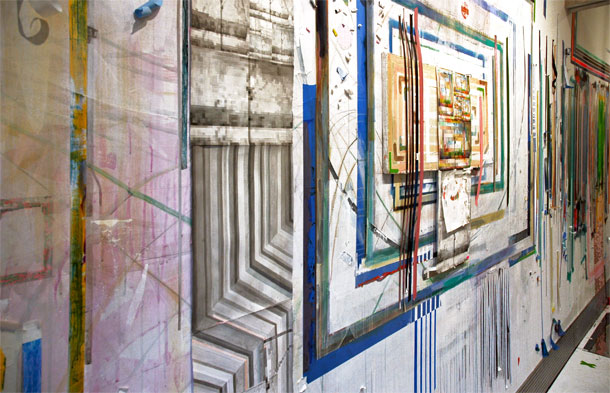
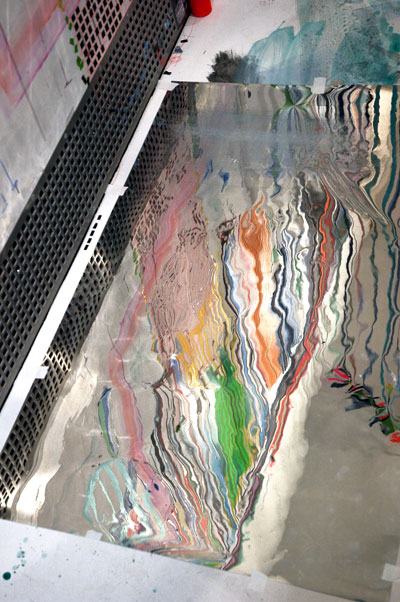
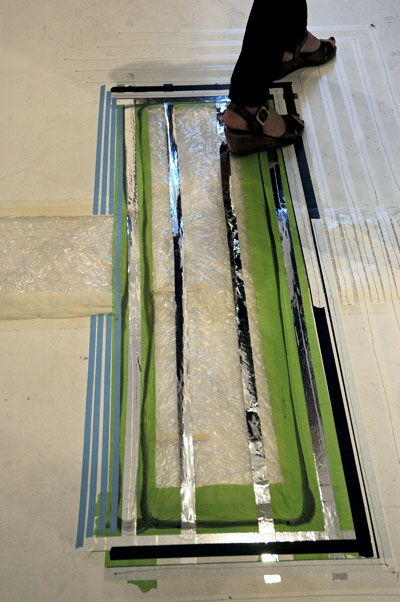
Lately Franklin Evans has, as the Sue Scott Gallery press release says, “used his studio as his primary subject”, wowing any visitors lucky enough to have been able to stop by. Fortunately for many more, he had weeks to install his current show, “2008/2009 < 2009/2010“, since it meant he could extend and enlarge what has become a spectacular studio practice, one which employs watercolor, wallboard, paper, tape, bubble wrap, thread, Mylar, press releases, parts of the gallery (inside and out), the occasional found object, and art monographs.
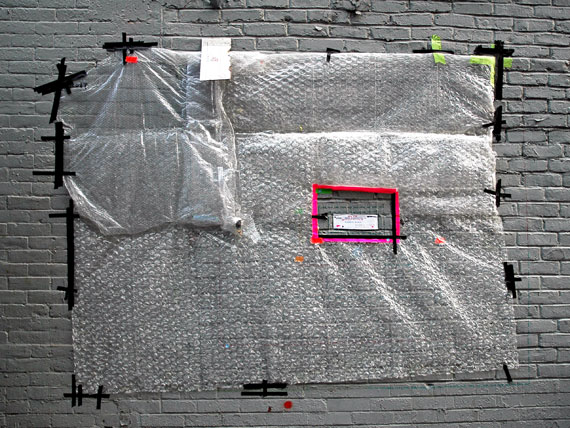
sign outside the gallery [am I reading a flag?]
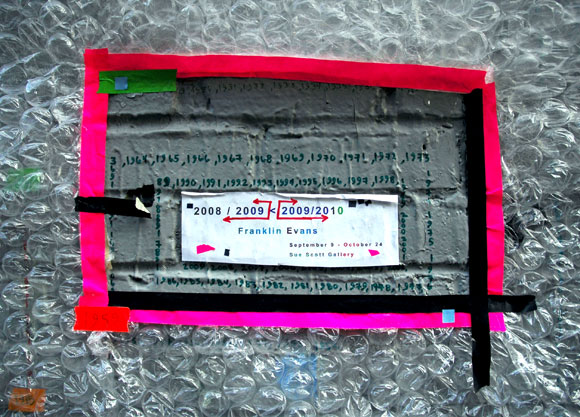
[detail]
Obama addresses UN; we watch “Save the Green Planet”
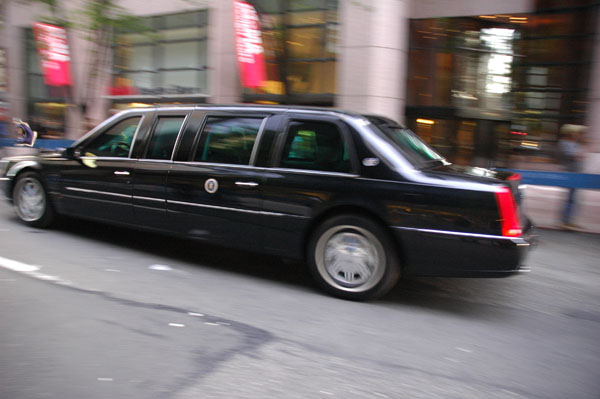
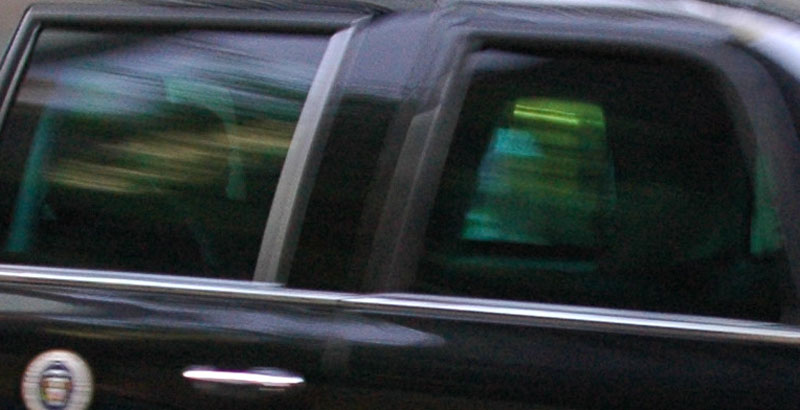
spotted as I left MoMA yesterday afternoon: the Presidential truck speeding east on 53rd Street with the Obama party securely ensconced, heading back to the Waldorf from the David Letterman taping
At the UN climate summit today, Obama told the General Assembly that the U.S. is “determined to act” on climate change. Last night at home, in an unplanned salute to the summit, Barry and I watched “Save the Green Planet“.
Right now I’m thinking that while we were enjoying that film we probably contributed as much toward toward averting the worst fate of the earth as anything promised by our President.
That just doesn’t make me feel so good, so I hope I’m wrong.
We’ve been on a Korean film binge lately, all knockouts, and most by the director Bong Joon-ho. Although we were unprepared for the violence in Joon-Hwan Jang’s hybrid comedy/drama/horror/sci-fi/thriller, we ended up watching most of the DVD’s long list of extra features and I still have “Jigureul jikyeora!” rolling around inside my head.
Jason Hanasik at +Kris Graves: “He Opened Up”
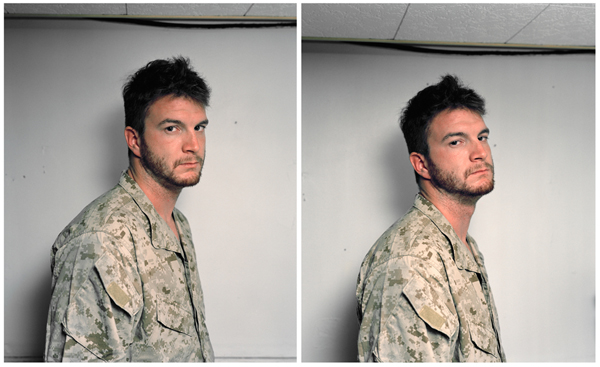
Jason Hanasik Steven Two-Faced 2007 digital C-print
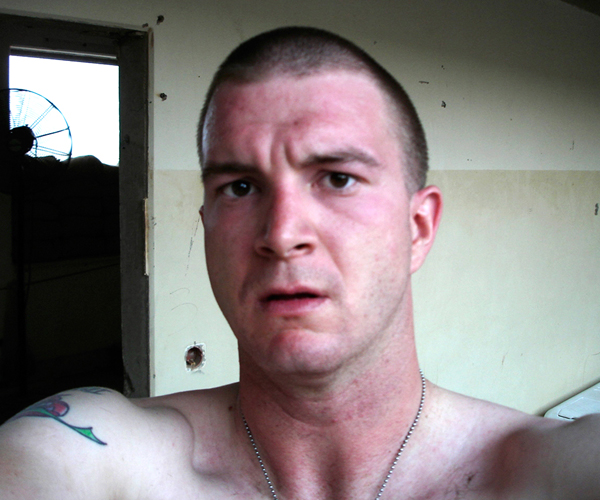
Jason Hanasik Steven’s self-portrait #2 2008 digital C-print
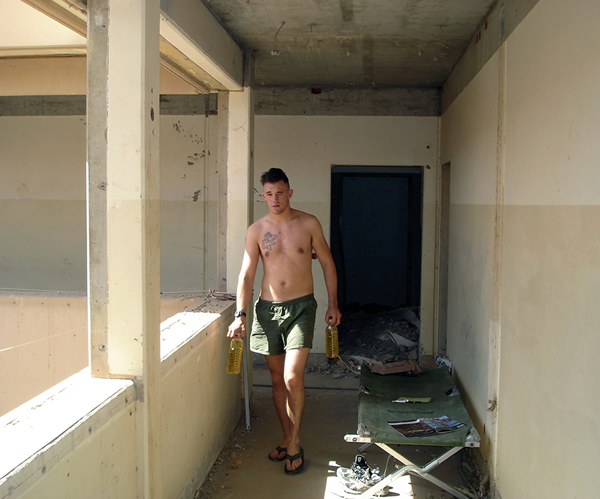
Jason Hanasik Steven’s photograph of a man carrying two bottles of piss 2008 digital C-print
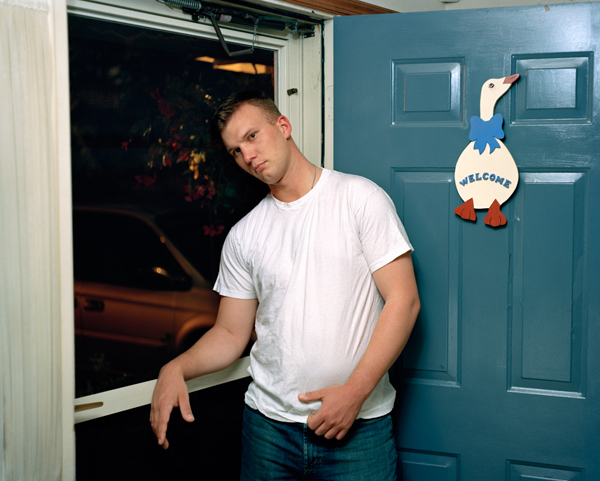
Jason Hanasik Patrick (Welcome) 2005 digital C-print
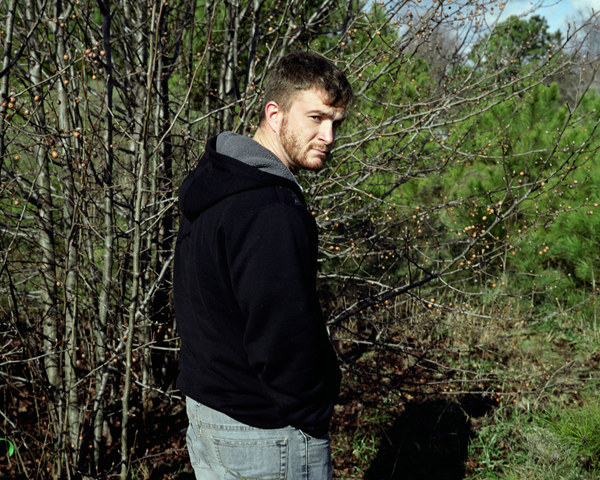
Jason Hanasik Steven (turn) 2008 digital C-print
I think it’s about the fact that guys often have trouble functioning as full human beings, but sometimes they’re offered an opportunity and they grab it; and then sometimes they lose it. I’d say this is true of both hets and homos.
The artist himself describes his project as
.
. . a photography, video, and installation project which engages image making as a platform to intervene inside Western culture’s traditions and expectations as they relate to masculinity, sexuality, and class.
We, the men of these images and me, might not sit at an equal distance from the center, but we all have a complicated relationship to what is considered normal — to our benefit and our destruction.
Jason Hanasik‘s show at +Kris Graves in DUMBO, with the (not quite) enigmatic title, “He Opened Up Somewhere Along the Eastern Shore”, is an extremely moving exercise in storytelling with photographs, mostly the artist’s own and some (not quite) “found”.
Nine images are hung along one wall of the gallery and two more hang on a section of another wall to the left, with a final object, a hand-written letter reproduced as an inkjet print, at the near edge of a third wall on the right. Most of the photographs are dominated by the figure of a young male; some of the subjects appear several times. They are all marines.
Partly because the size of the prints varies and because they are each mounted at a different height, they appear to dance in front of the visitor, but without a real beginning – or an end; this is not going to be a simple narrative.
The images in the photographs bounce around in time and in space, and touch many emotions as they do so, as does their “story” itself; it’s a story which could be written in many ways, and we can each find our own. Hanasik’s materials provide a documentation of some intense, probably under-expressed, male friendships. They remind us of the difficulty we all have in characterizing the more heartfelt qualities of these friendships, whether we are parties to them or only observers.
The men photographed by the artist are brothers. Jason Hanasik grew up in Virginia knowing both Steven and Patrick, but he became a very close friend of Patrick, the older (his BFF, in fact). Jason and Patrick played football together in High School. Jason at first hardly knew Steven, who had his own best friend. His name was Josh, and he does not appear in these images. Their relationships, especially that of Jason and Patrick, were made more complicated as they grew older and each of them gradually became aware of Jason’s homosexuality (including Jason himself), but Jason and Patrick’s friendship survived, survived even the nightmares of Iraq, from which Patrick described this affectionate daydream in a letter to Jason:
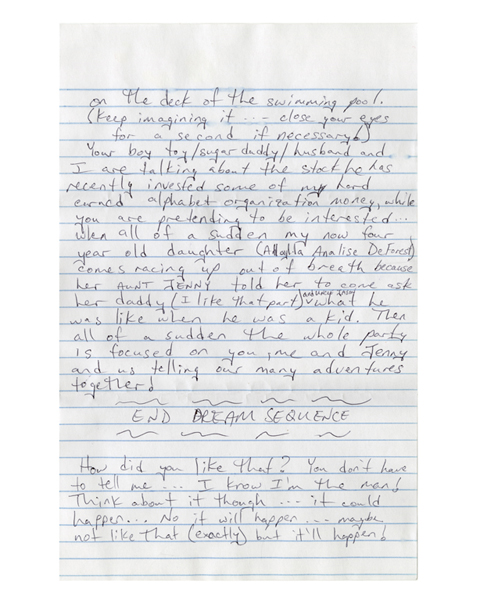
Jason Hanasik 11Mar04 2009 inkjet print 10″ x 8″
Jason was the only one of the four who did not join the marines and so was the only one who did not go to Iraq, where Steven was a part of a tragedy (the death in combat of his friend Josh on what had been the first “tour” for both of them) he was unable to share with his comrades. Then, on the first leg of an impulsive road trip with Steven something happened that changed Jason’s relationship to his best friend’s more taciturn sibling.
The title of the gallery exhibition refers to the catharsis Steven experienced while Jason and he were driving from Virginia to visit Patrick and his wife in upstate New York, Steven opened up, and it made possible a real friendship between the two for the first time. Like that shared by Jason and Patrick its emotional intimacy didn’t fit the simple antithetical forms we’re told are the only ones we can expect from male relationships.
Three of the photographs in the show were taken by the straight-identifying Steven while he was in Iraq. The two that are not self-portraits, in particular, are witness of just how inscrutable male emotions, and male sexuality, still remain to the understanding of all of us, male or female, straight or queer.
The installation also includes a video taken with a pocket camera or cellphone. It appears on the gallery wall as a smallish, faint, projected image, a short loop, and it shows two beautiful, smiling young marines dancing a tango, complete with dips, on the balcony of a barracks courtyard inside Baghdad. There is no sound.


Jason Hanasik In the Green Zone: November 2007 digital video 2008 [two stills]
The video too is by Steven.
I remember, but only as someone who was able to watch from a safe distance, the horror of Vietnam, and what it did to the men and women of my generation: And the silence; all kinds of silence. It’s excruciating to see it happening all over again.
After only a few minutes inside the gallery last week, I was already almost in tears, and at the time I had even less information than I am able to share in this post. Barry and I were fortunate to be able to hear more about the work in two conversations with the artist himself. Although at first I was somewhat reluctant to ask about the context of the project, Hanasik was generous in his replies.
I found that the images stand up either with or without much of a “background”. Having seen them on line before talking to Hanasik and before we visited the gallery I know they can pretty much speak for themselves. That’s why I had to get to the gallery: I wanted to hear them up close.
ADDENDUM: There is now a loop of the video, “In the Green Zone: November 2007” imbedded on the artist’s site here.
[images provided by the artist]