Thomas Lendvai’s installation at Plus Ultra, as seen during the opening reception, with Ed Winkleman and Barry Hoggard showing as prairie dogs*
It’s great fun, even if you couldn’t be there for the cheer of the opening. Thomas Lendvai’s plane of wooden joists has cut through the Plus Ultra space at a rakish angle, totalling re-configuring the white box and challenging the ordinary conventions of architectural space. There’s nothing else in the gallery, but if you tried to add anything more than the bodies and faces of visitors attracted to this striking, minimal show (installed in one of the smartest galleries in the city) the room would be visually destroyed.
Fortunately, on the evening I stopped by those additions were all very beautiful.
* the analogy was Barry’s, and it just popped out when he saw the image
Category: Culture
Cuchifritos really goes to market this time
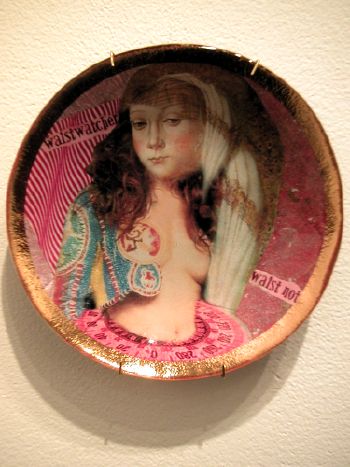
Janice Taylor, one plate from the series, JustDesserts
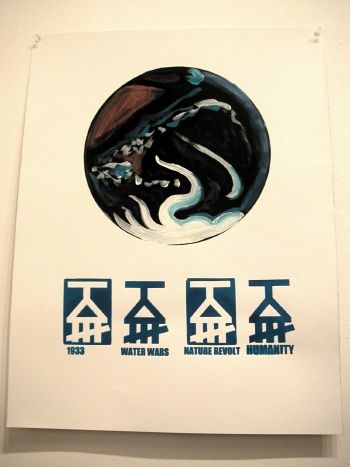
Peter Missing, handmade poster

Charlie Becker, handmade action figures, from a series
There are few spaces where a show called “Represented by Retail” would be more appropriate. The non-profit art gallery/project space Cuchifritos occupies a conventional store unit at one end of a colorful and historical indoor market on the Lower East Side. [note for western downtowners: the Essex Market is something like Chelsea Market, but with a soul]
The exhibition, as described on the gallery site by its curator (and director of the gallery) Paul Clay, “Explores a new crop of artists who are represented as much through retail stores as by galleries.” But don’t jump to conclusions about crass commercialism or the quality of work offered directly to an open market. More from Cuchifritos:
Critics from this urban/street/corporate scene see contemporary artists as modifying their output to make it gallery-ready and collector-appropriate, which they see as no different from making art that is corporate-acceptable, as long as they feel the primary qualities of their work are still getting out into the world. Some see contemporary artists as simply cobranded with a gallery rather than a corporation, and like galleries, there are good and bad corporations to hook up with. The quest to maintain a level of integrity is the critical goal.
Cobranding of products is seen by many as a dilution of the art by corporate goals in sponsorship, but what is happening now can be read as the artification of commercial products. Viral transmission of art into the commercial product arena.
Making better things through art, every day.
cardboard art
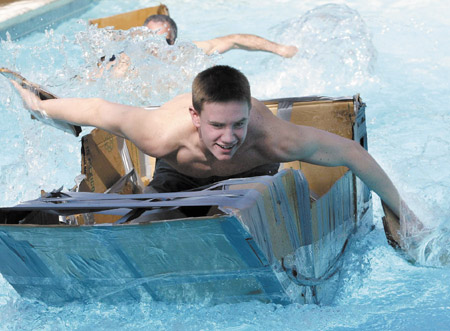
I love cardboard. It’s warm, accessible, forgiving and versatile, and it comes in all sizes, colors and surfaces. It’s also totally without pretension, even when it’s pretty expensive. All these virtues describe the stuff before it’s been worked, and sometimes the work really moves.
While one afternoon’s experience doesn’t suggest a school, as we were heading home last night I thought about the fact that in three gallery stops and one studio visit this humble material had been the basis for most of the art we had seen. Odd. Maybe it was only because all of the venues were very downtown, but it actually seemed very right.
[image from California State University Chico]

Patrick Grenier and Silo
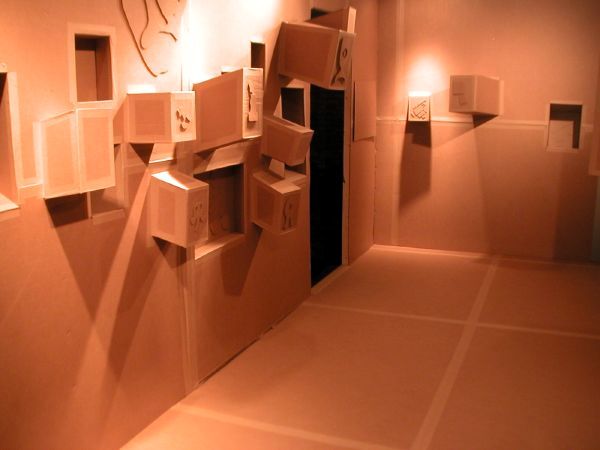
Patrick Grenier Make Room for Dada, Constructivism and Suprematism 2004 cardboard, ink, glue, metal, wood and paper 120″ x 252″ x 204″ installation view of interior
It’s a beautiful space, and it’s in an alley much too interesting to be a part of the New York grid, but it is, and it looks like now there’s going to be another reason to visit Freeman Alley besides Freeman’s.
The gallery is Silo, and its current beautiful, very timely (but obscure?) show, “Wrestling With Architecture,” is of work by Patrick Grenier. Grenier addresses the relationship between art and the spaces where art is made at home – or not. All of it seems to be about the Museum of Modern Art. I think he’s just asking the questions, which is probably alright, since there are all kinds of answers out there.
Luke Murphy
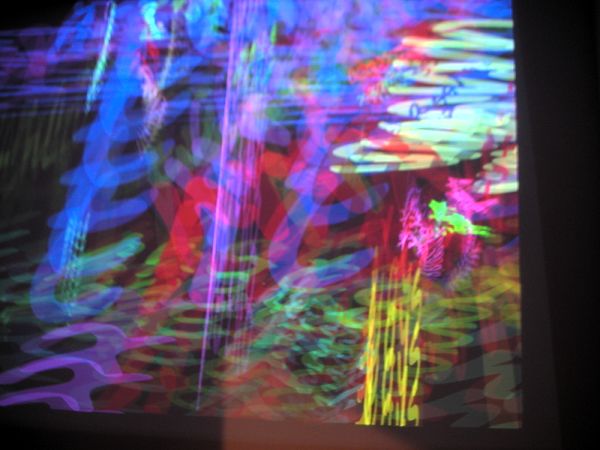
Luke Murphy Porno Painter/Eroloop 2004 file on disk, still from installation projection
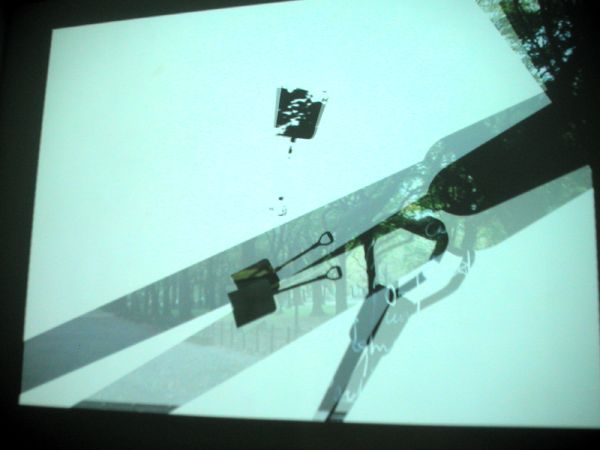
Luke Murphy Cascade 2004 file on disk, (slow-shutter) still from installation projection
I’m going to leave a discussion of this one to Barry; real computer genius is behind the art created by Luke Murphy which we saw at Canada this afternoon. I can only speak to the product, and it’s really wonderful.
Klara Liden at Reena Spaulings
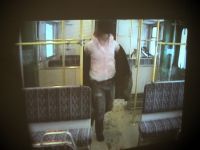
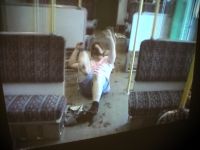
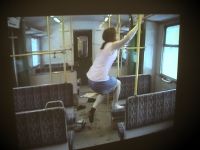
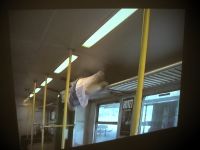
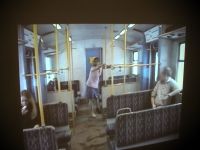
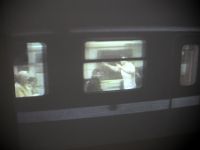
Klara Leiden Paralyzed 2003 video, 3 minutes, stills taken from installation
This is what keeps some of us going. The wonderful energy of a new gallery located where none have gone before, and the first exposure to an exciting new artist.
I left Reena Spaulings Fine Art this afternoon with a grin from here to there, and a bounce in a pair of feet which had been complaining about mistreatment until just before Barry and I entered the rough storefront space on the east end of Grand Street.
The centerpiece of the gallery installation was a site-specific installation which seems to define a sub-genre. Klara Liden builds imaginative natural habitats in the midst of hard urban realities, and here on the Lower East Side she has collected corrugated cardboard from both the immediate neighborhood and the basement of this old building in order to assemble a treehouse-like room on stilts within which she has mounted photographs documenting her scavenging for its construction.
Two videos make up the remainder of the exhibition, and I have uploaded stills from one of them above. The young Swedish artist is shown madly and athletically dancing through a Stockholm subway car at night, shocking a number of other passengers, all of whom it seems would prefer to be able to ignore her. The soundtrack is by the Legendary Stardust Cowboy.
We are told that Liden has studied formally as an architect. We can see that she is a subversive architect. She is described in the press release as “a genius,” and I wouldn’t argue with that. “Before this show she invented a free postal system in Stockholm, made books with ‘appropriated’ outdoor advertising, and built an underground house on the banks of the River Spree.” Each of these enterprises is beautifully recorded in simple books available in the gallery.
The show continues until January 31. Unfortunately there is no web site yet, but there is always ArtCal. Go talk to the nice people we found on Grand Street today.
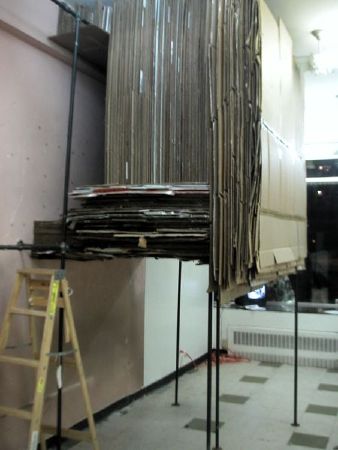
Klara Liden Benign 2004 cardboard, wood, steel, photographs, installation view of the structure, with ladder entrance
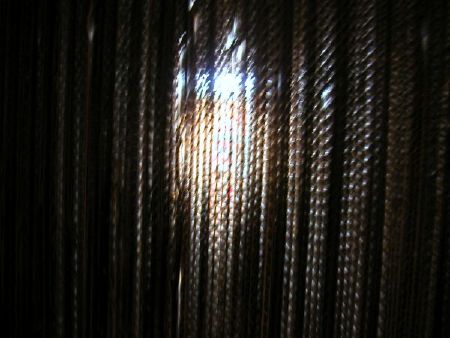
Klara Liden Benign 2004 cardboard, wood, steel, photographs, installation view from within the structure, through the corrugations
more at Caren Golden
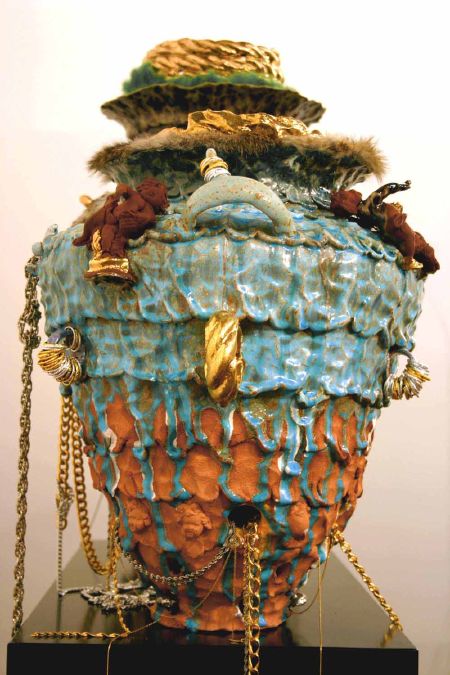
Nicole Cherubini G-Pot with a Rose 2004 stoneware, fake gold and silver silver jewelry, red rabbit fur, enamel 41″ x 15.5″ x 15.5″
I now have a jpeg of one of the Nicole Cherubini pieces which really is in the Caren Golden show, so I am showing it above, together with images below of work by two other artists seen in the same space.
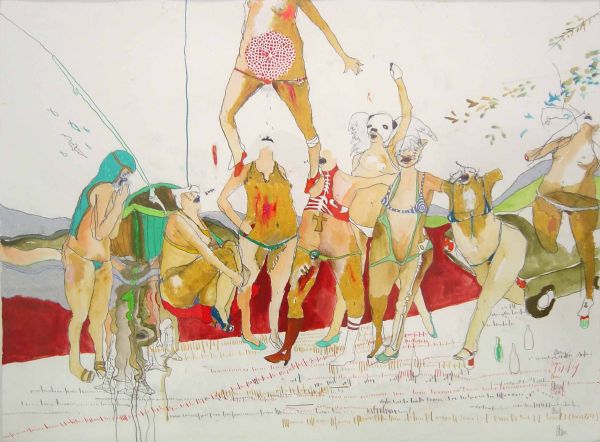
Amy Morken Untitled 2004 graphite, colored pencil, pastel, oil stick 22″ x 30″
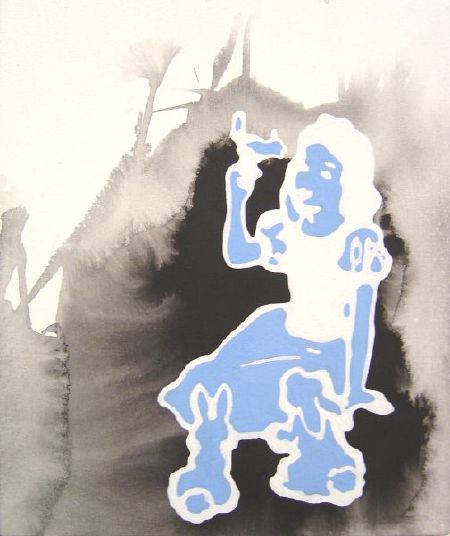
Ryan Humphrey In the Woods 2004 acrylic on canvas 12″ x 10″
The remaining artists shining in “The Twilife” are Emily Keegin, Emily Joyce, Dan Kopp, Evan Lintemans, Julie Nord, Elizabeth Olbert, Luis Coig Reyes and Andrew Sendor.
[images from Caren Golden Fine art]
the Austrian Cultural Forum
GÃŒnther Domenig, on the architect’s imagination.
I love visiting the Austrian Cultural Forum building. Once you’ve greeted the very-New York concierge guy behind the desk inside the door of the narrow 24-story tower on 52nd Street, you could actually be in Wien. The two-year-old building designed by Raimund Abraham is that modern. And, yes, I really mean that about the city. The former capital of the Austro-Hungarian empire is no longer just old. Go see for yourself.
Anyway, back in New York, yesterday I stopped by the Forum’s current exhibition, âGÃŒnther Domenig: Structures that Fit My Nature,â which unfortunately offers only a tantalizing and impressionistic glimpse of the work of the interesting Styrian architect GÃŒnther Domenig. The modest spaces which occupy four levels of the building are mostly devoted to just two projects, the Steinhaus in Steindorf, KÀrnten (Carinthia) and the Dokumentationszentrum (Documentation Center) in Nuremberg, and there is precious little guidance to those (the supply of the show’s brochure had been exhausted long before I arrived).
The first structure is Domenig’s own still-evolving dwelling and offices on the shores of a vacation lake, and the second is his striking deconsecration of the notorious Nazi Party Rally Grounds.
One of the most useful (and stylish) elements of the installation was the wall-size video screen interview with the architect (edited as a monolog spliced with photographs of his work) which occupied one of the rooms. I think it should be recommended viewing for anyone who wishes to understand where truly new architecture should start. I wish I had taken notes, but Domenig says something profound about the relationship between the architecture in the architect’s head and the architecture which has to be constructed in the messy real world.
I loved the little wooden dock shown in the video; it seems to have made the transition.
The causes for his repeated exasperation, and his extraordinary perseverance in the face of enormous obstacles, helps to explain why we get almost no truly exciting buildings in New York these days. We have to insist on great patrons as well as great architects.
the dream
[GÃŒnther Domenig STONEHAUS, Relations PPP 1987 pencil and color pencil, installation view]
ADDITIONAL PROGRAMS
The Cultural Forum has some more wonderful programming lined up over the next two months. First there will be an exhibition of figurative works by Austrian artists and others called “Slices of Life: Blueprints of the Self in Painting.” It opens with a public reception on Tuesday, January 18, from 6 to 8pm. The artists include Amy Cutler, Plamen Dejanoff, Nicole Eisenman, Johanna Kandl, Elke Krystufek, Muntean/Rosenblum, Katrin Plavcak, Lisa Ruyter, Markus Schinwald, Ena Swansea, Nicola Tyson and Gregor Zivic. (I’m having fun trying to imagine which of these artists has a connection with Austria, especially if I imagine connections something other than that of birth.)
Beginning the next day there will be a number of chamber music, lieder concerts and film programs in the building’s small, two-level jewel-box theatre. Somewhat exceptionally for this institution whose expressed mission (encouraging and describing the impact of the digital world on the arts and culture at large) has meant that it has hosted some very exciting new stuff, the January and February programs are limited to composed “classical” music, although they range, almost all somehow Austrian, from Haydn and Schubert through Mahler, Berg, Schulhoff and Krenek, to PÀrt and Kurtag.
I’ll be there January 18, but I’m also going back for the music and the films. There’s always the building too, and maybe I’ll get further upstairs some day. I still haven’t seen almost 20 of those tantalizing 24 stories.
Nicole Cherubini at Caren Golden
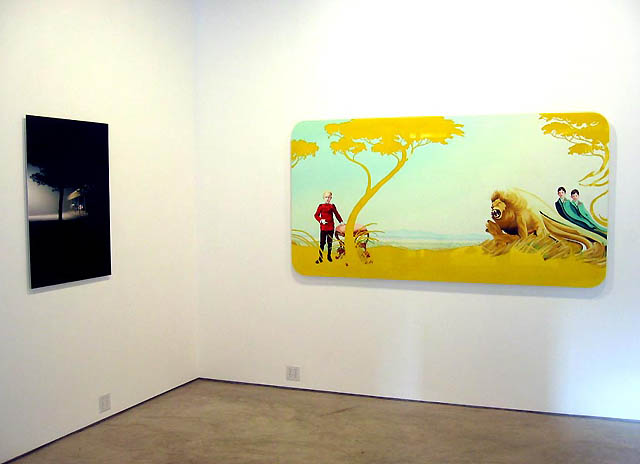
installation view of works by Emily Keegin and Andrew Sendor at Caren Golden Gallery
Caren Golden has assembled a fascinating group show, “The Twilife,” curated by Brit Shapiro. I’m not sure I understand the conceit which brought the work of these eleven artists together, but somehow it works.
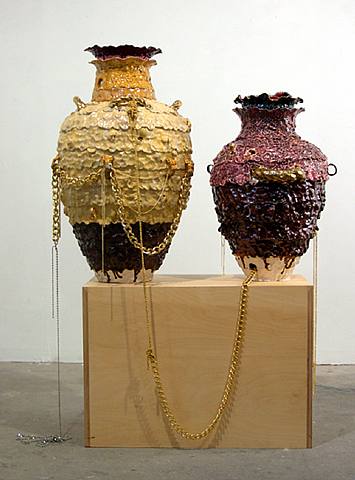
Nicole Cherubini A Pair of G-Pots with Cherubs, Fur and Rope 2004 mixed media [work not in the current Caren Golden show]
There are no weak spots in the roster, but one of these artists really stands out, both for what I saw on West 23rd Street and for my personal history with the work.
Barry and I had first seen smart conceptual work by Nicole Cherubini when it was photo-based, but for a while she has been creating some pretty outrageous stoneware sculptures. I don’t know for sure why it has taken me so long to “get” her fabulous ceramics, but they really took my breath away when I saw what she had contributed to this show.
I’m afraid my blindness had something to do with the stubborn native reserve I had thought I had overcome long ago, after years of embracing the exuberant expression of less retiring friends and strangers and especially after embracing the often extravagant art of my own times.
This surprises and embarasses the me I thought I had become.
Cherubini’s art mocks the posturing of wealth characteristic of all civilizations, even if her pots could only have been created today. Every age displays its extravagance, but this one has not only rejected absolutely all restraint, it absolutely glories in the rejection.
I don’t think this gorgeous, exuberant sculpture could have been done in the 80’s, even in the East Village. In the few years since the dispersion of the world evoked in the current New Museum retrospective of a special time and place, our everyday world has gone so much farther than Arch Connelly or Rodney Alan Greenblat. Cherubini is simply claiming this current outrageous age for her art.
[first image from ArtNet, second image from Samson Projects LLC via ArtNet]
Susan Sontag
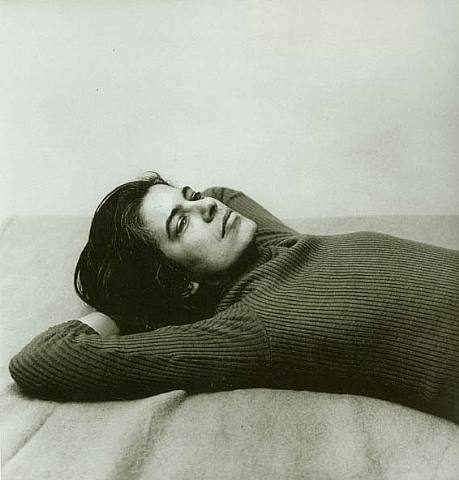
Peter Hujar Susan Sontag [1974-1975]
Susan Sontag died on Tuesday.
Beginning almost twenty years ago I had included her as a part of the homeland I had just adopted and which she had acquired at birth. Because of my profound general “otherness” and two nearly-profound early family dislocations, while it may not strictly fit the meaning of the German das Heimat, my New York City home had come to mean everything for me.
In this Manhattan Heimat Susan Sontag was my neighbor. Physically she really was my neighbor, since she owned an apartment just two blocks away from mine. For years I saw her everywhere in the city, although we never met. Her mind and what she was doing with it had already ensured that she would mean much more to me than an ordinary neighbor normally could. And then one evening I walked through the aura with which I had surrounded her.
I had already seen Edgar Reitz’s monumental first “Heimat,” (most sections twice) when I eagerly subscribed to the first American screening of the thirteen episodes of “Zweite Heimat” at the Public Theater almost twelve years ago.
After arranging myself in the first row for a double feature of two episodes, I noticed that she was only a few seats to my left. Only by coincidence, I had brought her new book, “The Volcano Lover,” with me to keep me occupied while waiting for the lights to go down. I think it was during the break that I gathered the courage to speak to her and ask if she might sign my copy.
I must have mumbled a few words, I hope not too gushing, about how much I admired both her writing and her bold social and political activism, and then we exchanged a few thoughts about the film, all of which escape me now, except that we discovered that we were both enormous fans of both epics. She signed the book, “for Barry and Jim – Susan Sontag ‘Heimat 6&7’ 7 July 1993.”
On every other day I spotted her in the audience she was totally absorbed in conversations with various companions. I was saved from embarassing myself, but I seriously regret the lost opportunities. Gosh, I wish I could have gone with her to Sarajevo, but Barry has written from the heart about how much she became a part of our New York experience, of our own shared Heimat.
She will certainly be greatly missed by many.
It’s late Tuesday night as I’m writing this. The death toll for all the shores around the Indian Ocean, the work of one wave over only a few hours, has now exceeded that of the U.S. military alone in Vietnam over a period of ten years. I’m already recalling Sontag’s unassailable morality, her creative curiosity and her courageous voice as I think about the individual and community tragedies millions of people in southern Asia are enduring at this moment. What would Sontag say about our government’s lame response? Colin Powell is absolutely wrong. We are stingy, very stingy, and we have been for decades.*
*The United States initially offered $15 million in relief to cover all of the nations affected (what we spend on the Iraq war every hour, and a fraction of the estimated cost of Bush’s January 20 Nuremberg rally). Oh sure, after being ridiculed by people in a number of other countries, we’ve now apparently upped our commitment by another $20 million, although that figure is marked as a loan.
Radically contrary to popular U.S. opinion, the amount of our foreign aid, in terms of percentage of gross national product (approximately one tenth of one percent), is the lowest of any industrialized nation in the world. Incidently, Norway’s contribution is proportionately almost ten times that of ours.
[image from Matthew Marks via artnet]