Two shows, both already gone, both video installations, but I’m not making anything of whatever other similarities they may have.
They are very different artists, doing very different work. Okay, there is singing in each of the pieces, but combining them in one post started out only as a device to make a decent-sized package for the few words I expected to be able to come up with separately for these two artists’ very moving shows. Now I’m thinking that it kind of works.
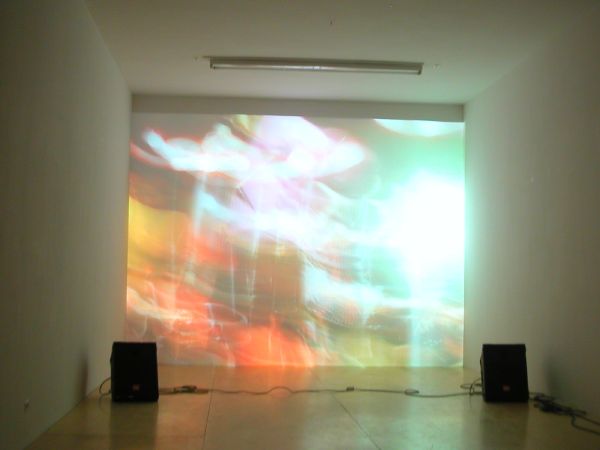
Lutz Bacher Crimson & Clover (Over & Over) 2003 30:00 min video still
Lutz Bacher’s “Crimson & Clover (Over & Over),” shown at Participant Inc. on Rivington Street on the Lower East Side, documents one of the performances within a memorial concert for the beloved art dealer Colin de Land at CBGB some time last year. Of course the video itself also played over and over, but it was continuously mesmerizing and the combination of its abstract and romantic beauty transcended the identities of the performers (Angelblood and others) and even the extraordinarily moving occasion.
The gallery had installed the work on its upper level and the screen occupied every inch of the far wall, top to bottom, from one side to the other. The otherwise empty room became a long, flickeringly-lit box frame for an extraordinary kaleidoscope of sound and light.
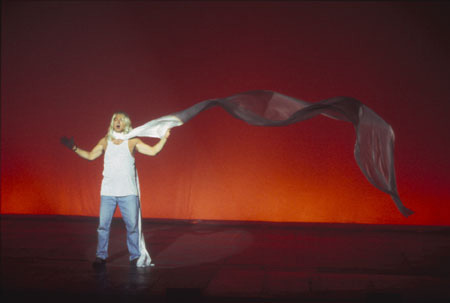
Jesper Just Bliss and Heaven 2004 6:30 min video still
Over in Chelsea Perry Rubinstein had installed three videos by the young Danish artist Jesper Just. The work got a lot of attention from critics and for good reason. I was pretty much taken with each of them, perhaps even shamelesssly, but maybe I’m just very vulnerable to this sort of genuine sentiment when it is mixed so brilliantly with the wacky context established by the artist here.
And great production values, too.
For more on Just, see this discussion and this awesome five-minute video opera.
[second image from Galleri Christina Wilson]
Category: Culture
art bloggers in hard print
Wow.
I haven’t seen the January Art in America, but I’ve heard, through subscribers who have already received their copies, about the “FRONT PAGE” article, “Art in the Blogosphere.” The issue still hasn’t reached the stores, and there’s nothing on their site, but I did receive a scanned image from one generous blogger.
Barry writes that I’ve achieved fame in the print media.
[for more on the story see Joy garnett]
This modest site, jameswagner.com, is one of twelve included in a list assembled for the magazine by Raphael Rubinstein, who writes in his introduction, “. . . there are now quite a few interesting art-related blogs. Here is a list, briefly annotated, of those that I’ve found to be worth regular visits.”
My first reaction was shock, especially when I heard how short the list was. When I finally saw it I realized that a number of important people weren’t there. If the list actually means anything, I think it’s quite unfair. I can only explain my inclusion as something of a fluke, especially since I’m “not in the industry” (in the words of a friend who is, Michael Gillespie). Not only do I have no academic credentials in the fine arts, but I’m also neither a working artist nor a critic, I’m not selling anything, and I can buy very little.
I’m a fan.
Then I thought (again, if the list actually means anything), wow!, the blogosphere makes it pretty easy to become slightly famous. Without the financial resources, the connections, real talent or probably even the will to get “published,” a lot of people now see the stuff I upload.
If I can do that, almost anyone should be able to. I wonder if this world is ready for us.
Scary.
But I’m not going to let the pressure get to me. (the audience is hushed here) This is going to remain the very independent, subjective and idiosyncratic arts-politics-and-whatever blog it’s been for two and a half years. With the arts I write only about (some of) the things that please me; with everything else it could be praise, condemnation, plain observation, or just a silly whim. I also try to amuse with decent images whenever possible, while trying to avoid overwhelming bandwidth with their size or number.
Chie Fukao
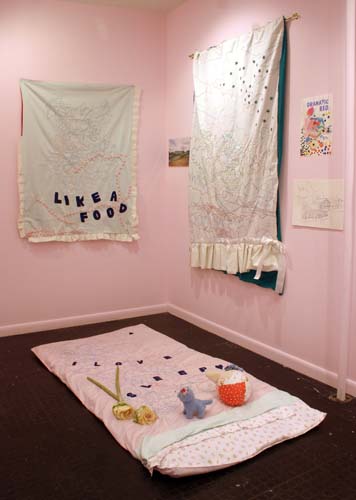
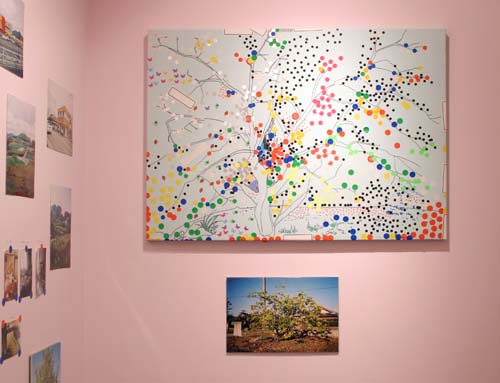
Lital Mehr was holding down the fort at Bill Brady’s ATM Gallery on Avenue B and East 10th Street a week ago when we stopped in to see the first New York solo show of an exciting young Tokyo artist, Chie Fukao. The two images above are details of a gallery installation which almost defies description. The exhibition includes photographs, collages, drawings, sewn clothing and other materials, sculpture, and found objects, some of the pieces the creation of her mother or younger sister.
Several of her works on canvas represent something of a culmination of a process in which Fukao passed one image through several media in succession. Those pieces may be the most sophisticated in a show which has absolutely no clunkers, but on this first visit I was most excited about the softer stuff suspended from hangers or pegs, or left lying on the gallery floor.
It’s a little messy, but absolutely lovely, and you know you’re in a very new world the moment you walk through the door. I’m going to want to see more of it.
In the middle of our conversation that afternoon Lital said something about how absolutely fearless Bill was about taking chances, above all in trusting an artist no less than his own good judgment. She’s absolutely right. We’ve been fascinated watching it happen. It’s what makes ATM so important.
[images from ATM gallery]
I guess this explains a lot
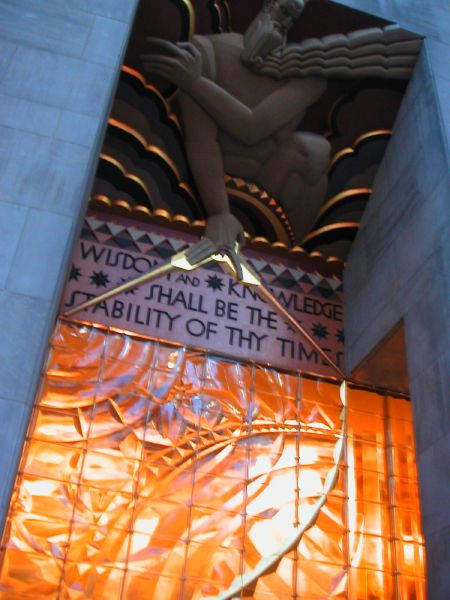
A lot has changed in 65 years. The country which built this great skyscraper now seems to have decided it can do so much better without wisdom or knowledge; we’re in for a very bumpy ride.
I took the photograph at dusk, while walking across town on Monday. The image is of Lee Lawrie’s sculpture relief above the front entrance of the RCA Building (today sometimes thoughtlessly referred to as the GE Building) on Rockefeller Plaza. According to the Rockefeller Center Visitor’s Guide, the William Blake-inspired figure represents Wisdom, who rules over man’s knowledge and interprets the laws of nature. The compass points to the light and sound waves of the cast glass screen below. The inscription is based on Isaiah 33:6
“Black Box BRD”
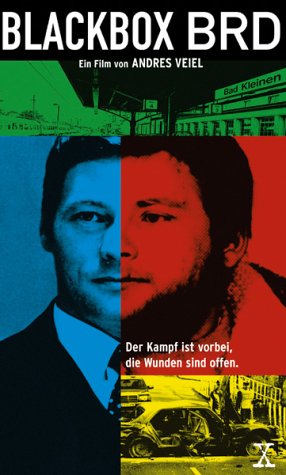
“Der Kampf ist vobei, die Wunden sind offen” (“The battle is over, the wounds are open”)
The 2001 German film, “Black Box BRD,” is in a documentary form, and it uses the Baader-Meinhof/RAF story as structure. Barry recently found it in a regular Sundance Film Channel email and recorded it. He had thought the human story (one victim and one activist, along with the people who knew them) was fictional and that is what he had told me.
Okay, even if we’re both pretty familiar with German history and German culture, maybe our memories for news names and disasters is somewhat wanting, because only after we finished watching the film this evening and did some on-line searching did we find that it was entirely based on fact. It sure makes a difference in how one sees the “actors” if only later do you realize they were playing themselves. Now I find myself running most of the scenes of the film through my mind over and over again.
I thought it was an interesting and pretty successful attempt at making its two historical extremes sympathetic. The Deutsche Bank honcho ends up as an idealist, not so far from where the young revolutionary began, and the revolutionary just may have lost his soul before he died.
But in the end I’m not sure that it makes much difference to my appreciation of the filmmakers’ accomplishment whether the characterizations of the two protagonists is accurate or not. Neither Alfred Herrhausen nor Wolfgang Grams are really important as individuals to most of the members of its intended audience. What may matter to us most is the gift of imagining for a moment that the archetypes they represent might be more complex than what is usually presented to us.
[quote appears on the film’s website homepage]
Joymore
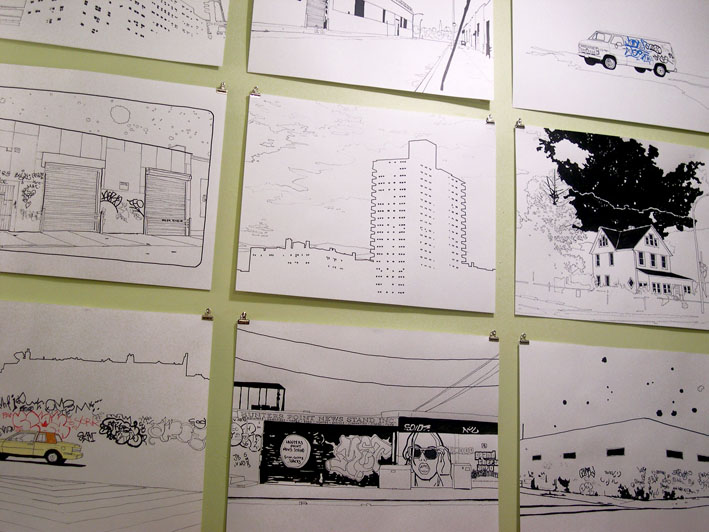
Carlos Roque, detail, Processed Normal Without Frames 2004, fifteen drawings, permanent ink and color pencils on paper
UPDATED AND CORRECTED INFORMATION IN THE TEXT BELOW
Great show! Joymore is the kind of gallery you hope to find in Williamsburg (or anywhere else on the planet you may be at the moment) but it’s still a big surprise when you do. Typically the principal lives in the space, and is totally committed to the artists whose work is being shared with you. You probably haven’t seen the work anywhere else – yet.
Inside the gallery, where we found a stunning group show of five artists, we spoke to Melissa Schubeck, who brought Joymore from Chicago. A quick check on line reveals that she’s pretty familiar with alternative space and alternative artists. In an email she sent today I learned further that Joymore began as a gallery space there in 2000, and that the name was also attached to a number of public art projects she curated. In the last year she was joined by a partner, John Henley.
In Williamsburg, where she will be on her own again, she plans to continue the project space in addition to curating public art projects in alternative environments. It looks like great fun!
Chicago’s loss is our gain for sure.
Actually I already knew some of the work of Andrew Jeffrey Wright. One year ago Barry and I had gone home with two small drawings from a show at Champion Fine Arts curated by Reed Anderson. Even within the smaller dimensions of Joymore’s rooms he still manages to show two very different kinds of work on Grand Street. Excellent stuff.
Carlos Roque happened to be sitting in the back room working while we were there last Sunday, so I was able to tell him how fine I thought his wall of mostly black and white drawings were.
Pedro Velez’s photographs and drawings would probably confound almost anyone on a first visit, but the mind really wants to know more. Gotta go back.
Josh Kline is responsible for a large digital, faux-heroic glacial landscape which covers the wall facing the entrance.
Oh yes, there’s also an outside sculpture space, a wonderfully luxurious appendage in a space this small. It had been raining the day we visited, and in spite of the abstraction of its form Devon Costello’s “Glacier” looked very good with a shallow pool on its base.
[image from Joymore]
the Barnes Foundation for all
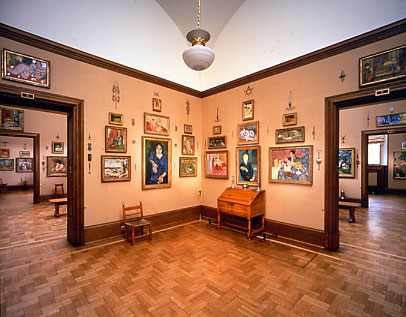
galleries of the Barnes Foundation
In a compact, tightly-argued piece in this morning’s NYTimes Roberta Smith puts the brouhaha over the disposition of the collection of the Barnes Foundation into a clear perspective.
Once more we are reminded that no one really owns art, that all collectors are temporary custodians. And the greater the art, the less any one person, especially a dead one, can control its destiny.
In the end, art belongs to the people it inspires, the people who use it to understand themselves and the world better – and the people who use it to create more art, and the possibility of more inspiration.
I feel compelled to add here that my respects come from someone who really loves old hinges but hasn’t been to Merion, Pennsylvania.
[image from new-york-art.com]
Thomas Allen
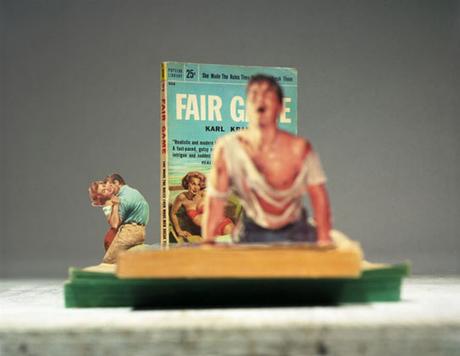
Thomas Allen Lure chromogenic print 20″ x 24″

Thomas Allen Swell 2004 chromogenic print 20″ x 24″
Books and the images they inspire, captured and re-configured here a second time. Thomas Allen has a very smart, and very elegant, show at the very fine new Foley Gallery on West 27th Street. He makes the oddest assortment of books sing, visually, in a way we may not have heard since childhood.
While you’re there, make sure you look around in the other two small-ish spaces, where there are still more treasures to be seen. You probably haven’t seen these artists anywhere else – yet.
[images from the Foley Gallery]
Lombard-Freid Fine Arts
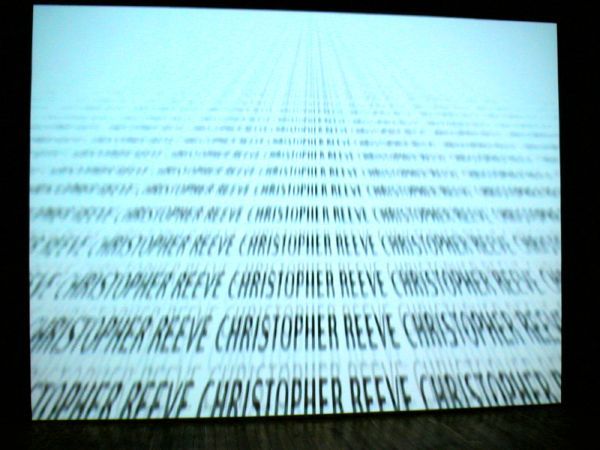
Jordan Wolfson Infinite Melancholy 2003 video, 4 minute loop, still image of installation projection
The title’s a handful. Lombard-Freid‘s “The Festival of Dreams (part 1): Songs of Innocence & Experience” is a small group (four artists) show, but there’s a promise of more to come. Based on the quality of the work there now, I’ll be anticipating part 2.
The Kenneth Anger film stills are as beautiful as you might expect (actually, more beautiful than I expected), but the paintings by Cornelius Quabeck are a delight, and the Jordan Wolfson video in the back is awesome (you need to hear the piano), regardless of your connection to Christopher Reeve.
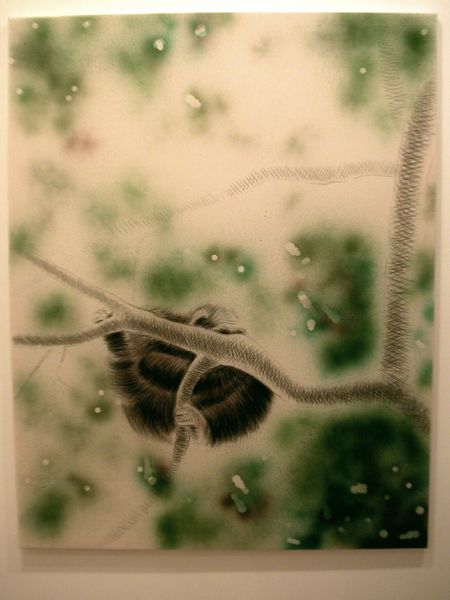
Cornelius Qualbeck Phunga (Camo) 2004 charcoal and spraypaint on canvas 90.5″ x 60″
Jenny Laden
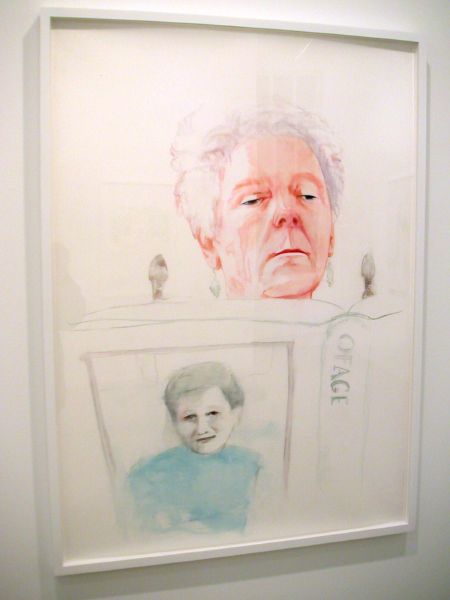
Jenny Laden Adina (armchair) 2004 watercolor on Mylar 42″ x 32″
I’ve been looking at Jenny Laden’s work for a few years, and it’s never looked as good as it does now. Gorgeous. She has a show right now at Jeff Bailey and it runs until December 23. These images and those on the gallery site itself only hint at the beauty of her paintings. They have to be seen directly. Her beautiful subjects are described with great delicacy and clearly with much love, and her medium leaves the still-liquid colors of their features floating without any ground whatsoever.
The color shown below in the photo representing a detail of “Ann (sweater)” comes closest to that in the work itself.
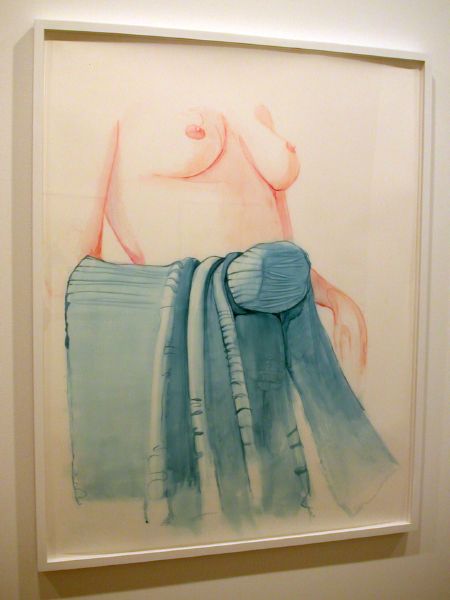
Jenny Laden Ann (sweater) 2004 watercolor on Mylar 42″ x 30″
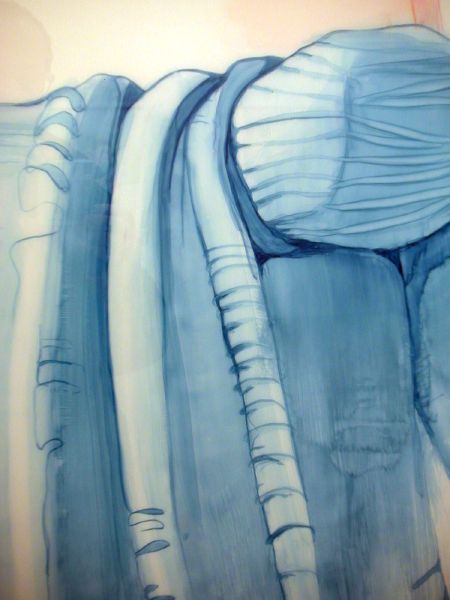
Jenny Laden Ann (sweater) 2004 watercolor on mylar, detail