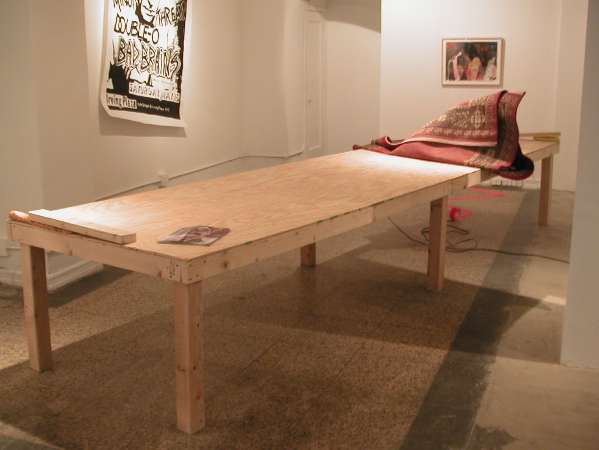
Bozidar Brazda Re-constituted Prison Wall (2004) plywood, bread, rug, spray paint, carpet, stereo and CD 192″ x 48″ x 53″ (variable)
In an auspicious debut inside a new gallery in Chelsea, the work by Bozidar Brazda at Haswellediger & Co. on 23rd Street includes some gorgeous works on paper. There is an overall concept to the installation, called “The Journalist,” which includes a number of individual sculptures. The parts and the whole were both just about equally baffling, but in a good way. I mean that I don’t really know what he’s doing here, but I wouldn’t want to miss anything he does in the future.
Category: Culture
Eugene Von Bruenchenhein
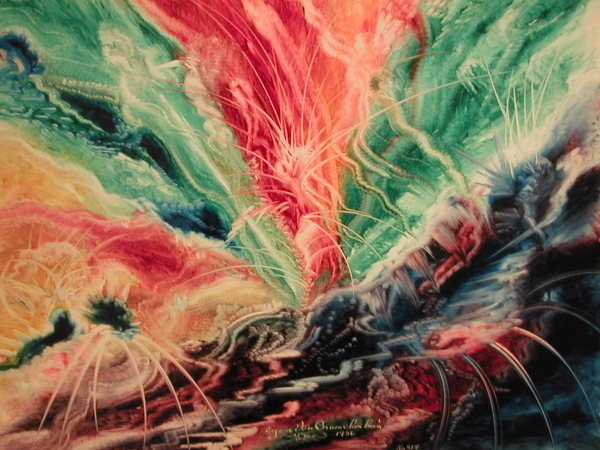
Eugene Von Bruenchenhein untitled oil paint on board 22″ x 28″ large detail
When we walked into the show at Feigen Contgemporary on Saturday afternoon the fantastic art of a brilliant outsider, Eugene Von Bruenchenhein, was totally new to us, but not to many others, as we quickly discovered.
The exhibition closed that day, but for anyone seduced by the image above, beyond what is available on the gallery website there are many more in a number of media (and a fascinating story) easily Googled.
His wife was the model in his photograpy, and his muse for decades, but she wasn’t the only one who was hot:
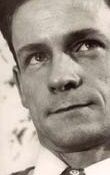
Von Bruenchenhein
[black and white image from gmtPlus9]
American Fine Arts must not die
American Fine Arts [no website] opened a smashing new show, “Election,” last night, but the legendary gallery founded by Colin de Land (and currently located in the last home of the equally fabulous gallery created by Pat Hearn) will close when this show is taken down November 18.
This is a very big loss, but I can’t imagine a gallery scene without Daniel McDonald around and I don’t expect we’re going to lose sight of him.
Apart from that, Mrs. Lincoln really enjoyed the show in the space Daniel has been managing full-time at least since Colin’s tragic death last year (just three years after we had grieved for his wife, Pat) is fully worthy of its history. She adds that it’s a must-see, and preferably before the momentous [civil?] war-time election going down just eleven days hence.
The show was organized by James Meyer. There’s no gallery checklist yet, so the images I can show below have only a skeletal description.
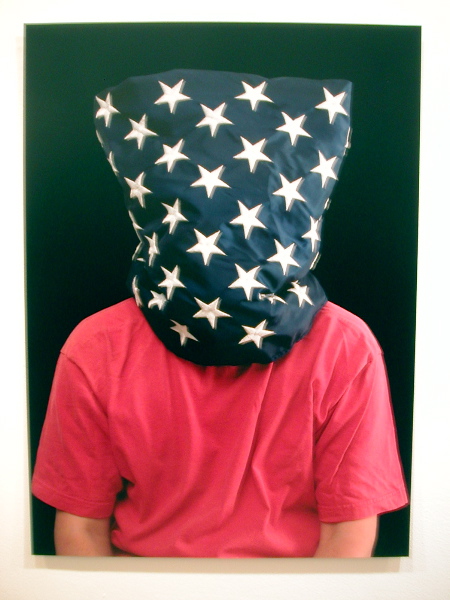
Hans Haacke Star Gazing
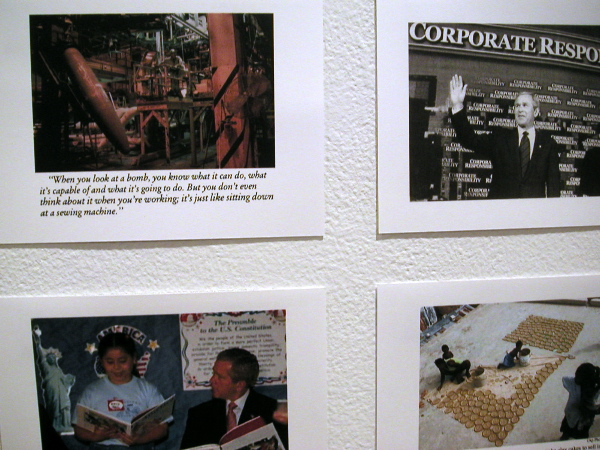
Carl Andre and Melissa Kretschmer Welcome to Bushworld detail
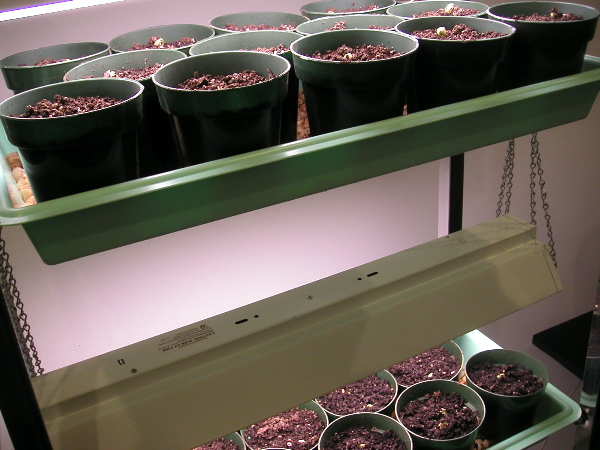
Claire Pentecost Molecular Invasion detail of installation

John Waters Have Sex in a Voting Booth
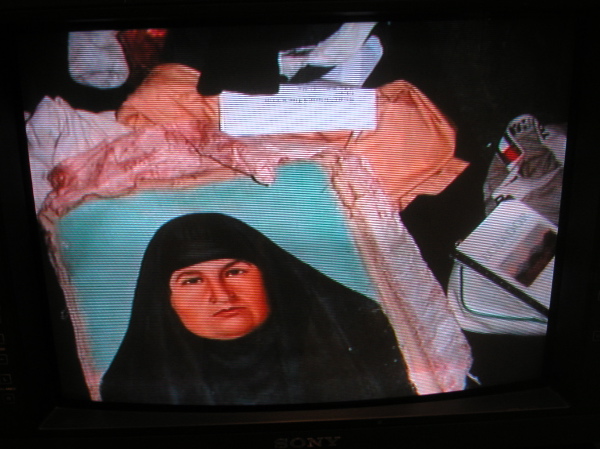
Paul Chan Baghdad in No Particular Order still from video
Democracy is Fun?
This evening we stopped in at the opening reception for White Box‘s new group show, “Democracy is Fun?,” the latest in a series of intense installations they’ve been mounting as a response to our republic’s desperate cries for help. We stayed longer than we had originally intended, and here are some of the reasons why. I should point out that, as is usual on these pages, the images which appear in the post are those the camera seemed to like. They are definitely not the only interesting works in the show, which was curated by Michele Thursz and Defne Ayas.
The gallery will be open election night with screenings and performances, and I’m sure there will be cable for the actual returns. Many of us will be more comfortable with the crowd which is going to be drawn to 26th Street than we would almost anywhere else. [As we get closer to November 2, I may post a list of the spaces which will be welcoming people who would not really be comfortable in either candidate’s headquarters.]
This work near the entrance went straight to the core of America’s funny democracy:
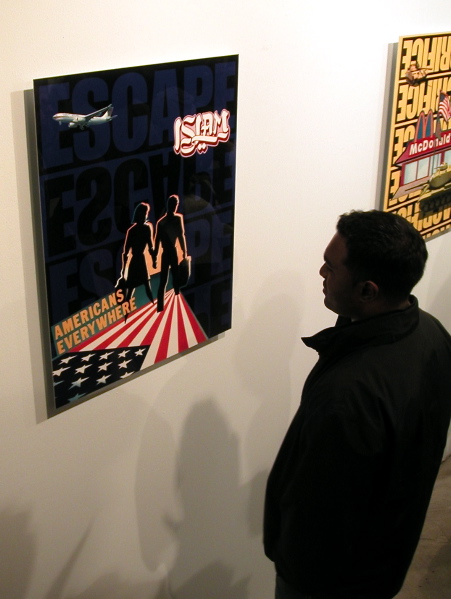
Hug and Magnan Escape (2004) duraflex printed mounted on aluminum, installation view
These political footballs were the kinetic sculptures we found rolling underfoot throughout the gallery space; they would occasionally meet a smartly placed toe which launched the scary Bush heads across the floor:
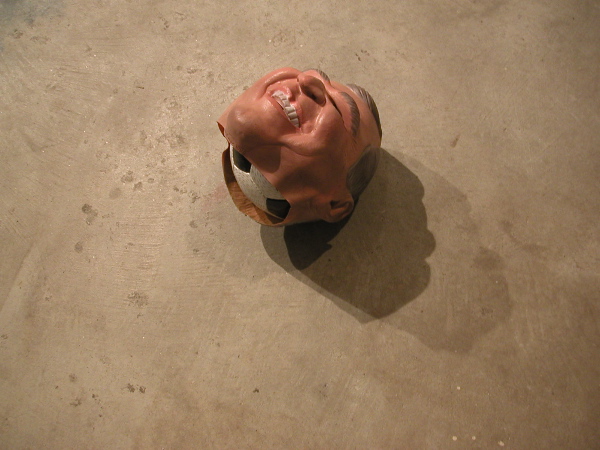
Kendell Geers Kicking Against the Pricks (2004) 11 political latex masks, footballs, detail of installation view
Michael Anderson had eight collages made up of reconstructed “posters” along the west wall:
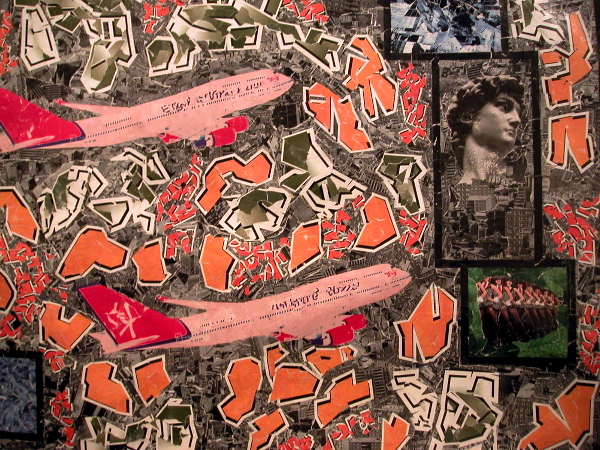
Michael Anderson Empire Strikes Back (2004) street posters from NYC 32″ x 24″ detail
Hug and Magnan again – just because it says it so well and looks so good doing it:
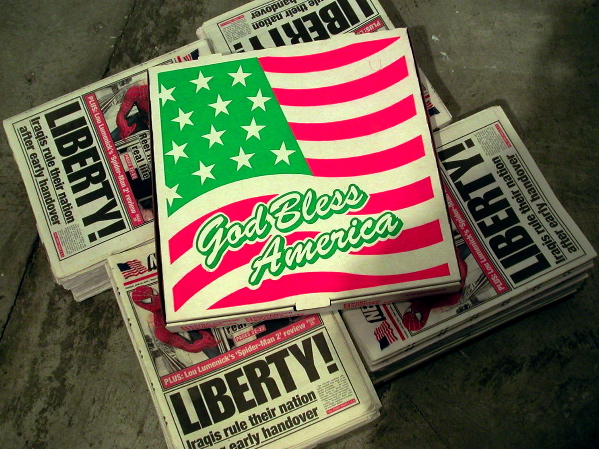
Hug and Magnan God Bless America flashe on found object, installation view
Marc Almond
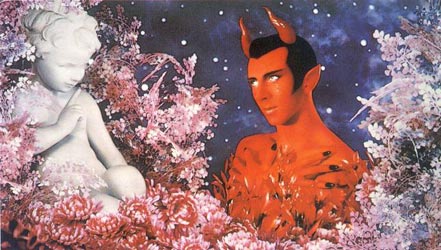
Pierre et Gilles Le diable (1989) unique hand-painted photograph
Needed here.
Marc Almond was critically injured in a motorcycle accident today in London. See Bloggy for a link to a 2002 Guardian tribute to Soft Cell, and an mp3 of “Tainted Love.”
[image from covadonga]
the House and Peter Hort
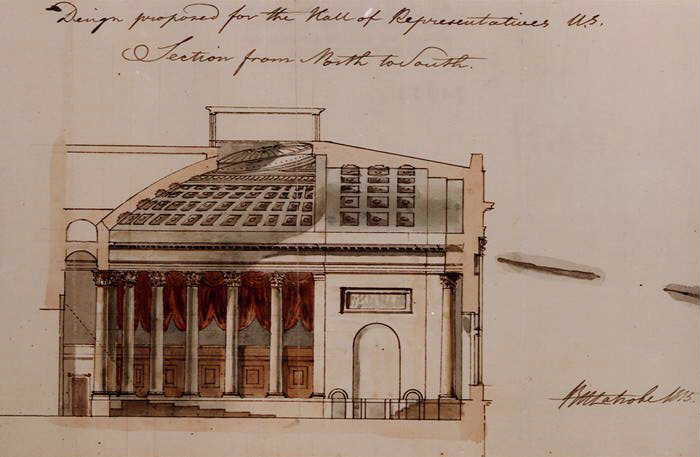
Benjamin Henry Latrobe Design Proposed for the Hall of Representatives, U.S., Section from North to South (1815) ink and watercolor on paper
For weeks now Barry and I have both been dismayed by the strange candidacy which Peter Hort has mounted for Representative of our local Congressional district.
I believe what is happening only shows that even supposedly sophisticated New Yorkers are naive when it comes to politics, or that money can persuade otherwise good people to act quite badly. Both explanations are pretty disturbing, but each is still better than some of the other possibilities.
For his reading of the subject, including both background and foreground, see Barry’s post of last night which links to his previous entries, to Hort’s own site and a number of other relevant sources.
[image of the old House chamber from Library of Congress]
children outside a “real world”
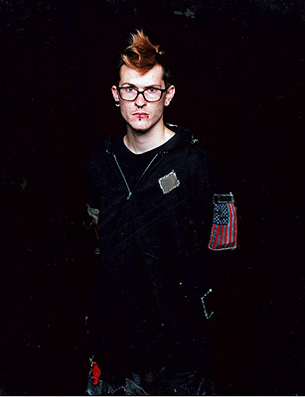
Bradley McCallum & Jacqueline Tarry James August 6th, 2002 1 :01 – 2:00 PM
color photograph, 50″ x 40″
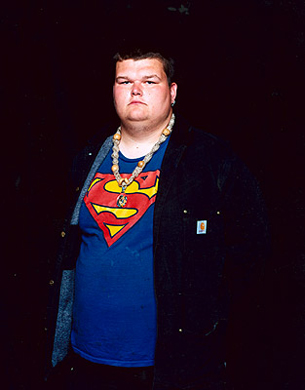
Bradley McCallum & Jacqueline Tarry Frost August 6th, 2002 5 :01 – 6:00 PM
color photograph, 50″ x 40″
They share a medium and a subject. Both of the shows currently installed in Chelsea’s Marvelli Gallery are the product of an artist’s camera and both are about young people (sometimes very young people) who have rejected (or been ejected from) a society which will now accept their images filtered as art.
Bradley McCallum and Jacqueline Tarry show large, sensitive almost-full-length color portraits of homeless Seattle teenagers (and young adults who became homeless as teenagers). Their subjects’ costumes seemed incredibly stylized to me at first, perhaps almost unbelievable, and the life-sized photographs exhibit such technical beauty that you are likely to be very surprised, as I was the other night, should you hang out in the room a little while longer. The people on those walls will soon begin to seem less picturesque and much more familiar, but there will be little comfort in that development.
Two flat-screen monitors showing the same two-hour video are mounted on opposite walls of the same gallery space, with their starting moments deliberately out of sync. The moving images document 26 people (including among them the few shown in the room’s still photographs) as they step up in succession to replace from behind the figure a viewer has been watching standing facing the camera and who now disappears. This takes place on a very ordinary-looking Seattle neighborhood corner, one which may be a central part of these people’s world. The central figures are almost motionless, but the pedestrians and vehicles within the camera’s frame speed by at a literally regardless pace ten times faster than real life, since the filming was done over a period of 26 hours and the video has been accelerated to occupy only two. The soundtrack consists of excerpts from each of the subjects’ individual conversations with Tarry, layered with the low ambient energy of traffic noises.
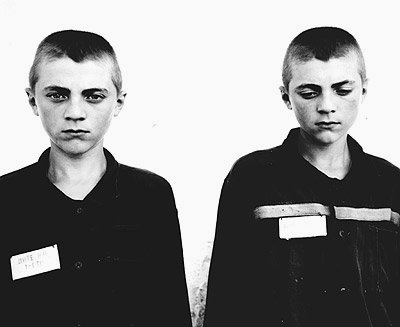
Ingar Krauss Untitled (2003) gelatin silver print, 33.5″ x 41″
In a smaller room at the rear of the gallery Ingar Krauss shows a number of black and white photographs of children and young teenagers who are a part of the Russian penal system today. The subjects alone would guarantee interest, but Krauss’s gift manages to raise tragedy to the level of a powerful art which will not be denied here. Unfortunately we can’t know whether or how this may help these small victims of society’s incompetence.
[images from Marvelli Gallery]
Joe Ovelman in the streetscape
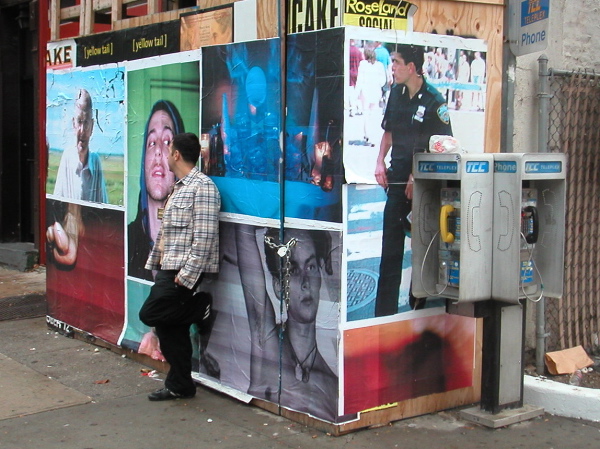
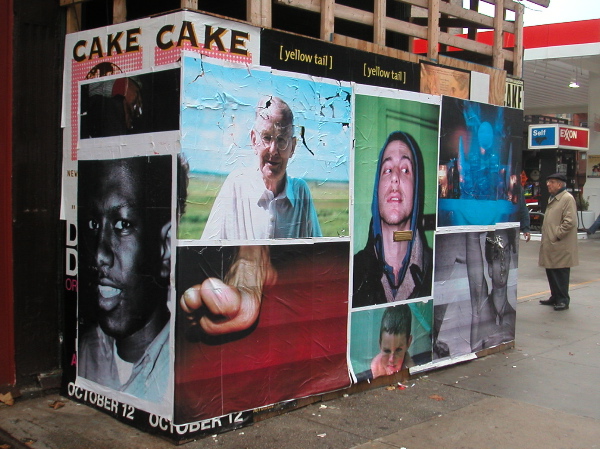
He called around noon today. “James, I’ve just posted something.” For a second I was thinking of the the internet, but then I realized that Joe Ovelman is currently not even connected, and it dawned on me that he was talking about posting in the traditional sense.
Actually, Joe doesn’t do many things in the traditional way. If he’s not showing his art in a formal gallery space he finds a way to get it out where all kinds of people are going to see it anyway. Today he wheat-pasted a contractor’s temporary wall on 11th Avenue just below 23rd Street with photocopies of some of his images, and if the area he covers is smaller than his previous outside “canvases,” the individual images themselves are much larger.
There’s also the wonderful effect he has produced by extending the work to the smaller sides of the fence structure which projects along the plane facing the avenue. It becomes a box. The carefully-balanced colors and patterns combine in a jewel-like three-dimensional installation. Joe’s latest post is sculpture.
And the serendipitous pleasures of the interaction the work inspires: When I mentioned to Joe that I really liked the mail slot touch, he said that he had watched from the corner as at least one passer-by lifted its door and peered inside. Also, just as we arrived there late this afternoon the young man in the picture above was arranging the pose in which he is seen here while [his girlfriend?] snapped his picture.
For more, see Barry’s post.
Stockhausen
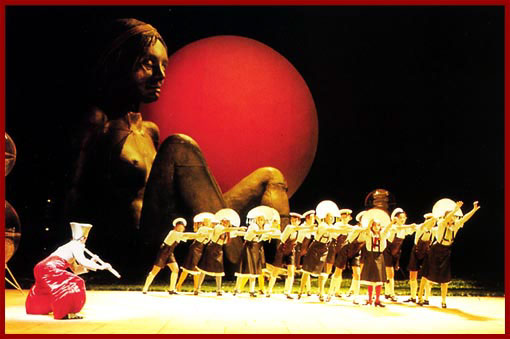
Der Kinderfänger (the Pied Piper), from “Montag aus Licht,” Act III, scene 2
Yay! It sounds like he’s finished it! Karlheinz Stockhausen has announced that the premier of his life’s work, the 29-hour “Licht” (“Light”) cycle, will be performed in Dresden in 2008.
I think I’ve been waiting as long as he has. I’ve hungrily collected recordings of each of the seven sections, named for the days of the week, as they have gradually become available (I’m only aware of the existence of four at this time), but I’ve been excited by his music since first hearing it through the CBC/BBC/NDR broadcasts transmitted across the Detroit River in the 1950’s. Thank you, Canada.
I actually don’t know any of the things about music that could be acquired from formal study; I’ve had none. But I’ve been listening to things all my life, most of the time attracted to the less obvious arrangements of sounds. Maybe I’m just a romantic, but I think of Richard Wagner wherever I confront Stockhausen’s great project (no, seriously), and I’m not making the association just because of the obvious similarities in the ambitions of these two geniuses.
For a small taste of Stockhausen’s storybook, through a short synopsis of the opera’s first section, “Montag Aus Licht,” see this text from “An Unofficial Website about Stockhausen“:
The theatre foyer seems to be underwater, bathed in green rays of light. The inverted Eve formula can be heard from many basset-horns.
In the first act a huge statue of Eve is on the sea shore, and is tended to by many woman with perfume and water. (Later this image was adapted for use in a famous television advertisment for the painkiller Nurofen®). The statue, which has three soprano soloists singing down from the larynx, gives birth to seven boys with animal heads who are followed into the world by seven little men from Cologne folk-lore: the Heinzelmånnchen. 3 sailors arrive from the sea to witness an elaborate pram dance with all the nurses and newborns racing geometrically about the beach. All the while surreal events are portrayed through the use of sound samples (e.g. baby animals, steam trains, the Marseillaise sung by a budgerigar), and the children involve themselves in all manner of clamour, mischief and bodily functions. At the height of the chaos an icecream seller arrives on an upside-down bicycle and moments after that Lucifer arrives joined by a web to his grotesque double. He is buried in the sand by the three sopranos. The women’s weeping is soon accompanied by falling rain , and the act ends with Lucifer emerging from the sea and ordering the boys back into the womb of the statue.
“Everyone back in!! The whole thing again from the start !!!”
The second act starts with a procession of candle-bearing maidens, and a very long concert grand piano approaches the statue. A short complicated piano piece is played by the boy budgerigar, and the womb of the statue begins to glow. Seven boys of the week are born, and each is taught his own song for his day. The boys are seduced by three female musicians who emerge from the Eve Statue.
In the final act Eve appears playing basset-horn, and performs for her reflection. Soon a musician arrives as an alto-flute player, and joins Eve in a duet. Children come and listen, and eventually the flute player is distracted by them and leads them away into the clouds.
As the public leaves the theatre they find the foyer bathed in clouds, and can hear the children climbing higher and higher, like birds.
For more information, see the composer’s own site.
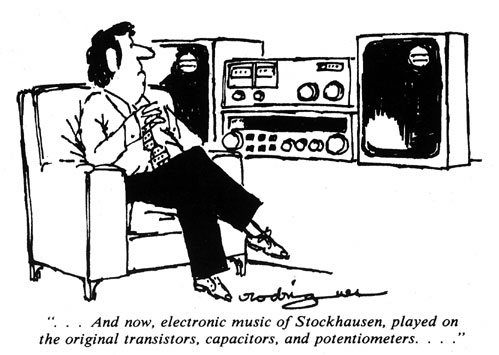
[photo image by Henning Lohner from swipnet; cartoon from a 1980 edition of “Stereo Review,” via Stockhausen’s site today]
“Arna’s Children”
The powerful documentary, “Arna’s Children,” is now at the Quad Cinema here in Manhattan. I’d be much more excited if it were playing in every town in the U.S., but unfortunately it’s not going to happen. If you want to know why, see what I wrote last May.
I just noticed that of the four films currently being shown at the Quad, Barry and I have actually seen three. This is pretty amazing, since the two of us rarely get around to slipping into a movie theatre in the crush of so many seductive live (therefore more time-sensitive) performance offerings. Like “Arna’s Children,” the other two films would not be described as directed toward mainstream audiences (whatever that means), but I can recommend both “The Child I Never Was” and, most enthusiastically, Bruce LaBruce’s “Raspberry Reich.”
If these films have anything in common, it’s the ability of each to re-arrange minds which might have thought everything was already nicely in place.