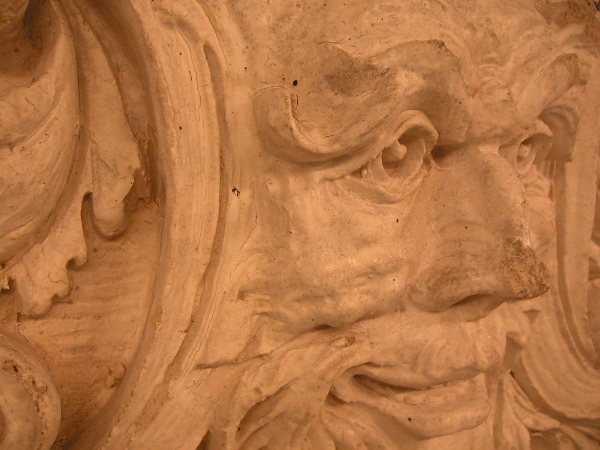
19th-century terra cotta fragment newly mounted inside the Museum subway station
The Brooklyn Museum celebrated its $63 million shiny new front door and merry greensward with a wonderful party this weekend. The elaborate entrance shed and its landscape approach added no square footage to the exhibition space of the grand Beaux Arts pile and its architectural merits will be debated for years, but it definitely appears to be a hit with the its city.
The Museum inaugurated a new commitment to its community with “Open House,” a wonderful show of work by living artists working in Brooklyn and a sadly postumous retrospective of the truly fabulous art of Patrick Kelly. I highly recommend both shows, but while we had come for the energy of the celebration and the honoring of Brooklyn artists, we were both bowled over by what Thelma Golden’s curating has done with Kelly’s legacy. It’s about much more than dresses. The designer would have been delighted with both the style and heterogeneity of the people filing through all his gorgeous stuff on Sunday.
For many young visitors however the weekend will be remembered first for participatory art, music, funny paper hats and a spectacular new fountain with a sense of humor. The people we saw on Sunday both inside and outside the building were definitely not all of the sort usually attracted to sober museum precincts. It’s clear that from now on neither this Museum nor its visitors, its true patrons, will be satisfied thinking of the institution as just a warehouse of dead culture.
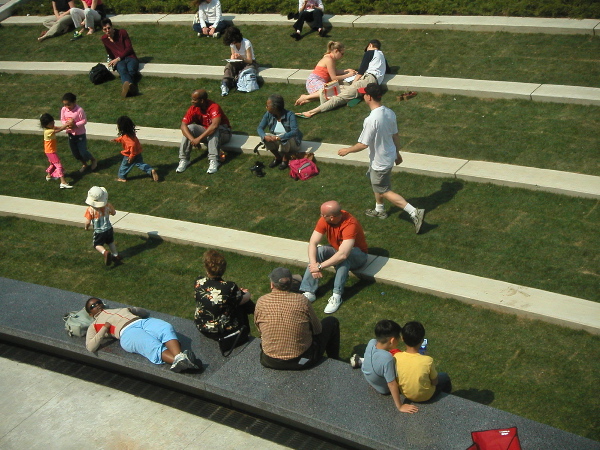
Brooklyn crowd exhausted by art – or just waiting for the next fountain
Category: Culture
David Humphrey comes off the walls
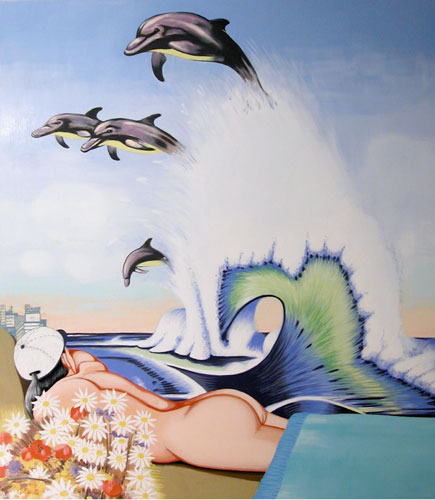
David Humphrey Wave Watcher (2003) acrylic on canvas 96 x 84 inches
I used to think he was a brilliant, mysteriously compelling eccentric. Still brilliant and mysteriously compelling, David Humphrey is looking less eccentric today. But it’s not that Humphrey is getting more conventional. Rather, it’s that in the contemporary art world convention is just not convention any more.
While originally known as a painter, Humphrey has lately also been working with sculpture, and it shows. In the exhibition which opened at Brent Sikkema April 3 it shows in the intelligence of the sculpture – a carnival of enigmatic figures in weird combinations of clay, plastic, marble, bronze, found porcelain figures and fabric – and it shows in the paintings.
Ed Winkleman said that he thought the wonderful sculptures have really impacted the painting. If the sculpture has informed the painting, I think it actually gives a new form to it. Humphrey’s imagery was often more ghostly and semi-abstracted, and today there are some hard edges. At least one central figure or group in each painting has a real, if more or less cartoon-like, shape. While these paintings may be shy one dimension, they have a very strong sculptural presence.
It’s a great show and it should attract serious critical attention. The size of the opening crowd would have been respectable in a large group show of young artists who had brought all of their friends. Humphrey’s admiring peers were there that night, but I’m sure they won’t be the only ones talking about these works.
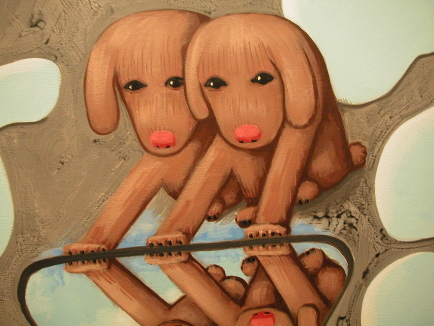
David Humphrey Twin Pups detail (2003) acrylic on canvas 44 x 54 inches
[upper image from Brent Sikkema]
Joe Ovelman, “Like A Virgin”
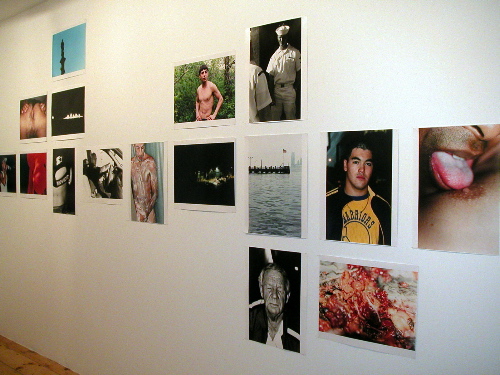
detail of installation of C-prints
No, he’s not a virgin to the gallery world, and it should already be clear that I really like the work of Joe Ovelman, so maybe I don’t have to say much about his current show at Oliver Kamm/5BE Gallery. Actually, the real reason I don’t have to say much is that the installation itself says everything. Even the individual C-prints are as much a part of the space as they are gorgeous independent images.
But you really have to be there. I don’t think I’ve seen a gallery or museum space pulled together to better effect. The works themselves steal through several mediums, they’re as fresh as last night (or this afternoon), and they should excite young collectors. Prices, even for original, handmade work, start at, well, free.
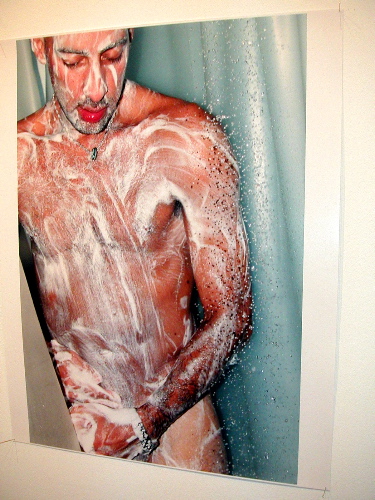
untitled C-print 20 X 16 inches
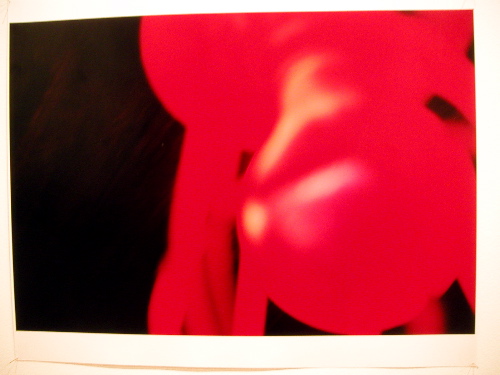
untitled (2004) C-print 16 X 20 inches
The front room includes a beautiful five-panel text piece titled “When I Grow UP,” dozens of playful, framed post-it notes, a wall installed as a monument to the human/natural landscape reconstructed in the gallery’s backroom, a framed nod to every new enterprise’s iconic first dollar display, and an elegant black and white reliquary document of one of Ovelman’s generous public walls.
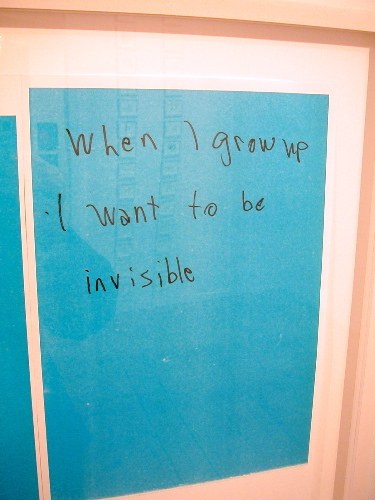
detail of When I Grow Up (2004) color xerox and marker on paper 20 X 60 inches
The central gallery space pulls the art off the wall with two plinths, one supporting a handmade book, “Resolution 452,” the other a stack of small papers marked “Blame Cher.”
Finally there’s the back room. Like most, Ovelman’s includes interesting ambient sounds. Unfortunately they are not accessible from this post.
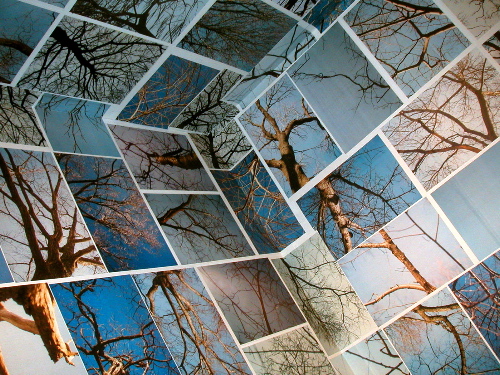
Rambles (2004) color xerox photos, dimensions variable
We’re told Joe blames Cher for everything. Thanks, Cher.
[the images are my own casual record, and cannot begin to reproduce the excitement of the originals]
Daniel Rushton
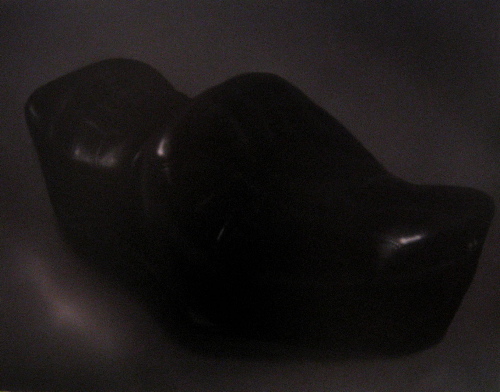
Daniel Rushton Motorcycle Seat (2004) acrylic on Panel 48″x60″
One of our happiest acquisitions, now from a number of years past, was that of three beautiful silkscreen monoprints by Daniel Rushton. Our guests usually ask about them right away, but until recently we were unable to tell them anything about Dan’s current work, even though we would occasionally run into the tall young Canadian on our gallery walkabouts.
We were finally able to visit his Williamsburg studio earlier this week where we saw recent paintings which began as drawings on his computer before they were moved to canvas with bristle and airbrush. The most exciting image for me was this relatively large homage to the bike covered in a different canvas just outside the door.
Dan spoke of being interested in objects which enclose or are enclosed by the body. With works as strong as this and the others we saw on Tuesday, he won’t have any trouble in getting others to share this interest.
[image furnished by the artist]
Wangechi Mutu
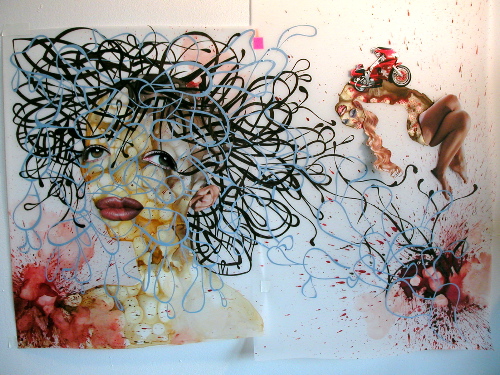
Wangechi Mutu (view of a work in progress)
I should have known better. The Studio Museum in Harlem opened the studios of its current artists in residence this afternoon, and there I was initially so dazzled by the work of Wangechi Mutu that I didn’t give a thought to whether it had yet been widely seen. It turns out that it definitely has, and, silly I, even by me, both at Momenta and in The New Museum. Still, I think it must never have looked so mature, in fact so damn brilliant as it did today in her cluttered atelier on the third floor.
The work there was all on paper, painted and collaged with magazine cutouts into voluptuous, almost sculptural forms which defy an easy identity for either their medium or their portraiture, but they do sing.
Mutu is included in a group show which just opened at Chicago’s Rhona Hoffman Gallery. Simon Warson is responsible for the terrific roster, whose other names are Tim Lokiec, Nick Mauss, Bradley McCallum & Jacqueline Tarry, Paul P., Adam Pendleton, Aida Ruilova, and Mickalene Thomas.
See Susan Vielmetter for images from 2002 and 2003.
[image, of a work in progress, captured off the artist’s studio wall on Sunday]
UPDATED: caption added to image, second image removed, line with link to Susan Vielmutter gallery added, bracketed attribution at bottom revised
Bj�rk with friends
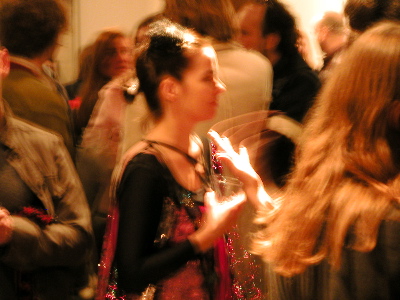
just hanging out with friends
Two nights ago Bloggy seemed to be suggesting that “a certain Icelandic singer” would show up at the Jack the Pelican Presents opening tonight, and sure enough, the fans were not disappointed. A certain perhaps-the-most-famous-American-artist-in-the-world, her very biggest fan, was also there, by many reliable accounts, but unfortunately we never saw him.
The gallery installation was the North American debut of the three women of The Icelandic Love Corporation collaborative. Oh yes, Hrafnhildur Arnardottir was there as well. Is there anyone left in Iceland who isn’t an artist?
Judging from our modest experience, Bj�rk regularly shows up looking like a fairy princess on a visit from another galaxy, but she doesn’t just breeze in with courtiers and disappear into protected space or speed back out the door. Like the last time we saw her at a gallery opening, she was comfortable in the midst of the crowd and, although she was already there when we arrived, she showed no interest in leaving even by the time our own group had tired of the festivities.
The crowd was gentle with celebrity. Hey, it’s not only New York, it’s Williamsburg. We’re all famous.
exquisite, no corpse
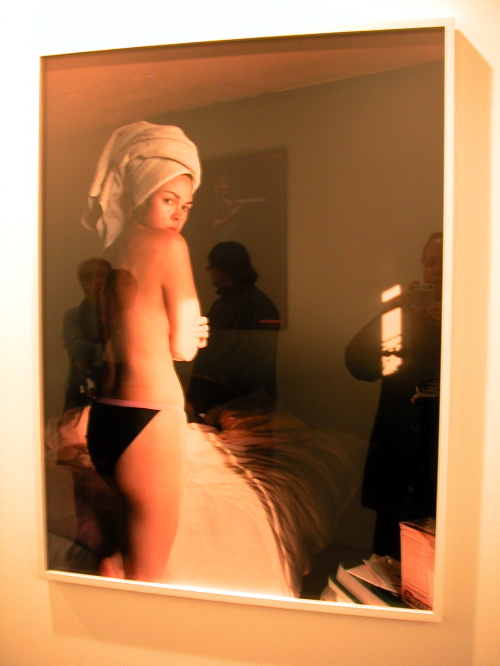
image of Tracey Baran image
The image was irresistible, and it remains irresistible even through these layers. A self-portrait, it’s one of the photographs included in Tracey Baran’s current show at Leslie Tonkonow.
—
Updated: typo fixes.
discomforting beauty
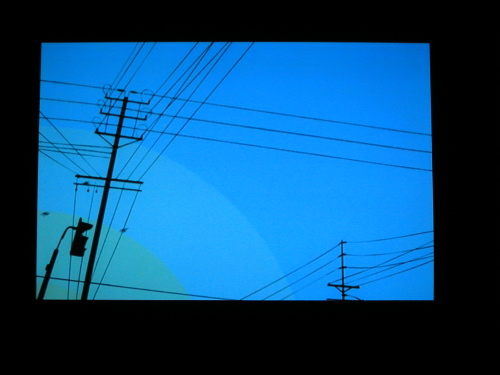
Brian Alfred, still from video, Artflick.001:painter_BrianAlfred
After checking out the Ester Partegas show at Foxy Production and talking to Tracey Baran at the opening of her amazing show at Leslie Tonkonow last Saturday we thought we only had energy for a quick stop at Max Protech Gallery, but once we were inside we decided to stay for a while.
The show was Brian Alfred‘s “Overload” and it was . . . cool, made more cool by the music of dj E*VAX (Audiodregs Records) and some excellent sake. I loved the small discomforting collages even more than the paintings, but both were beautifully morphed by the disturbingly elegant computer-animated video projected in a separate room.
Of course the people were equally stunning, and none of them seemed discomforted in the least, but rather as happy to be there as we were, no less for seeing Josie* looking so stunning in what appeared to be an electric green Miyake vest.
Hmmm, on April 16 the gallery will host a special event, Computer/Animation Screening/Performance, at 7 pm, featuring Cory Archangel, Mumbleboy, Scott Roberts and Paperrad. Sounds wonderful, and I’m sure it will.
For a mini-tour of 35 years of art and of Max Protech, click onto “About Max Protech Gallery” on the gallery site.
_____________________
*the gallery Director, Josie Browne
—
Updated: typo fixes.
queen honors faggot socialist republican
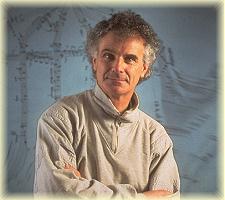
Peter Maxwell Davies
The great British composer Sir Peter Maxwell Davies has been appointed Master of the Queen’s Music.
The Guardian site begins its report thus:
Buckingham Palace yesterday admitted that the Queen has chosen Sir Peter Maxwell Davies, a gay, self-styled “old-fashioned socialist” and republican, as the Master of her Music.
The fact that Maxwell Davies is also perhaps the pre-eminent British composer of the day appears not to have been a handicap for a job which has seen some previous musical talents overlooked in favour of justly obscure nonentities.
Although previous incumbents have included Sir Edward Elgar and Arnold Bax, the 380 year-old post inaugurated by King Charles I has also been held by the likes of Nicholas Staggins and Maurice Greene, chosen instead of Henry Purcell and George Frederick Handel.
Perhaps understandably, there is little in the Guardian article about his musical production. We have just about every recording of his music ever available in the U.S., so for us at least the music needs no introduction. The paper also neglects describing just how beautiful a man Davies is [very], but it seems to have missed little else in composing a report that succeds in being exquisitely provocative.
The composer made clear at the weekend that had the job been offered by the government he would not have accepted because of his opposition to Tony Blair and the Iraq war, which he described as the worst foreign policy decision since the crusades.
The Sunday Times quoted him as saying: “I voted for Blair twice, but never again. He has betrayed the principles of the Labour party, not just on Iraq, but on tuition fees and foundation hospitals. Yes, I’m an old-fashioned socialist and I feel utterly let-down.”
His principles did not prevent him accepting a knighthood in 1987, as an honour for music, though he threatened to send it back seven years later because of plans to amalgamate London’s orchestras.
He has accepted the job for 10 years, rather than for life, on the basis that it may be used to promote music, rather than for the composition of anthems and other ceremonial music for royal occasions.
A palace spokeswoman said tactfully yesterday that the post, which carries with it a small stipend, placed no obligations on its holder.
. . . .
His works have been performed all over the world and are said to be becoming more accessible to general audiences, which may come as a relief to a royal family of generally limited musical interests – the Queen paid her first visit to the Proms for 50 years last summer.
She may be relieved to know that Maxwell Davies has been known to write compositions to mark propitious events, including a lullaby for the first baby born on the Orcadian Island of Hoy for 25 years. She may be less impressed that his previously best-known work about royalty, Eight Songs for a Mad King, was a meditation on the insanity of George III.
This is also the man who composed the extraordinary opera of the Antichrist, “Resurrection”, described in these excerpts from an amazing review in the NYTimes [byline uncredited]:
Begun in the early 1960s but not performed until 1987, Resurrection, with music and libretto by Mr. Davies, is one of the fiercest works of social criticism ever to come from the pen of a classical composer.
. . . .
The savage parody could easily turn preachy and heavy-handed, and it is to Mr. Davies’s credit that he, like Weill, knows how to handle such material with an irreverent, comic touch. The libretto is witty, often ingenious and viciously anticlerical. (A minister sings: “For we can make the Book mean just anything we please,/And use it as a weapon to bring you to your knees,/With the promise of salvation shining on your steadfast face,/By the word of God, this Book, we can keep you in your place.”)
The composer helpfully describes in clinical detail the transformation he has in mind during the metamorphosis of the patient into the Antichrist: “Despite the lack of testes, which the Surgeons removed, the Patient’s penis slowly becomes erect – a huge submachine gun, directed over the audience.”
. . . .
It is also a protest against the sexual conformity demanded in a Thatcherite England and a Reaganite America. A recurring theme of Resurrection is the homophobia spouted by the hypocritcal political and religious establishments. In one particularly memorable scene, three of society’s supposed moral guardians – a Policeman, a Judge and a Bishop – have an unscheduled meeting in a stall of a public lavatory.
. . . .
It is impossible to listen to the opera without finding it chillingly timely. The message of Resurrection could easily be transplanted to the United States, circa 1996. But it is doubtful that it could be staged in the present [January 1996] political climate. Somehow, one imagines that Federal, state and corporate support would not be forthcoming.’
Ain’t opera grand?
[image from MaxOpus]
the next Chinatown
Maybe Chinatown isn’t going to be the next Soho, Chelsea, or Williamsburg, but it is going to be the next Chinatown. Maybe it can be sui generis. It sure would be nice to see the big guys stay elsewhere. There’s a place for a Chelsea, especially if it stays sprinkled with alternative spaces, and Williamsburg is just fine as it is.
Anyway, whatever happens elsewhere, watch for a number of new gallery spaces to open in one of the last “unimproved” neighborhoods in the southern half of Manhattan. It’s going to happen. Economics will drive it, but its integrity, energy and good subway accessibility will all be part of the attraction of the Canal Street area.
There seems to be room for more. Especially in New York, people want art. Art just seems to make us happy. Sometimes it makes gallery people happy too. It’s best when that happens.
I sure hope that galleries in Chinatown will be good for the people already there. Judging from the gallery presence already dotting southeastern Manhattan it seems at least likely to be good for everyone else.
I wrote about Michele Maccarone’s space, Maccarone, Inc., last October, raving about the Phil Collins show, and we returned recently to see Chivas Clem’s installation [officially closed one week earlier, I think] of re-contexualized media images, once again spread through the three floors of a small, barely-spruced-up old commercial building on Canal Street near the Manhattan Bridge. The intrepid explorer Holland Cotter reviewed [scroll down] the show early last month.
Great shows, but still no website and this time not even a press release or card for a visitor, at least by the time we got there. Nobody said art was easy, even for its fans.
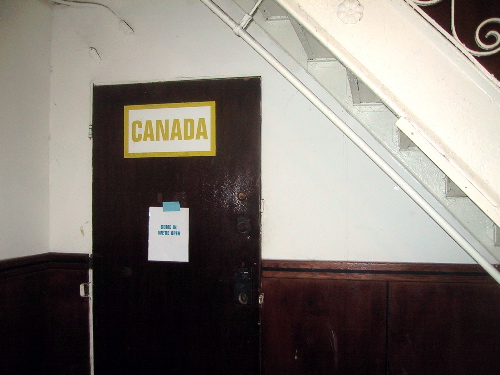
down the hall, turn left, first door on the right, “come in, we’re open”
The improbably-named Canada [no, the principals aren’t even Canadian] tries a little harder. Here on Chrystie Street just north of Canal, once you track down the space and navigate the hallway, you’ll find some very sweet people and the usual artist informationals. Two weeks ago we visited Michael Mahalchick’s wonderful soft sculptures and the videos of sound art by other artists Mahalchick had invited to further enrich the funky gallery space. They have a real website.
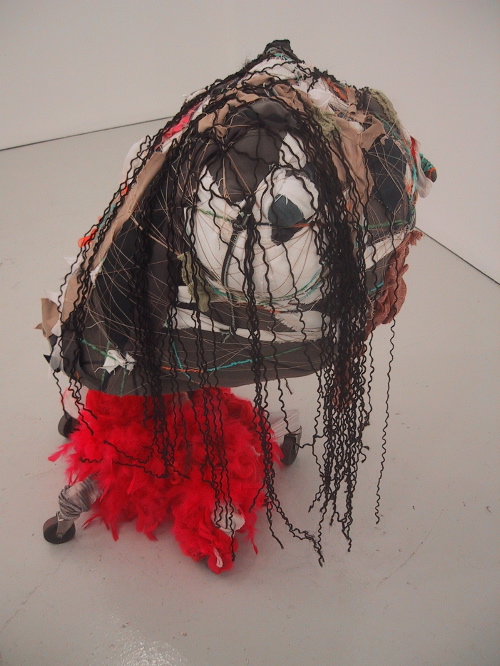
Michael Mahalchick Billie
Not to take away anything form the shows we’ve seen in the “formal” exhibition spaces, but the best thing about Canada may be the promise (and reward) of the goodies hanging or lying about in their back room. While we were there this time we made nusiances of ourselves asking to see and hear more about everything we could get our eyes on, work of artists who had already shown in the gallery or who would or might be seen there in the future.
Oddly, none of the work I’m going to mention here really comes across in photo reproduction, because of textures materials or dimension, but we were very excited about every collage we saw by Brian Belott, and Sarah Braman looks better every time I see the work, especially if you can look at the pieces inside and out. Even the fact that the one piece we saw by Carrie Moyer looked better than what we have seen in other venues may be a testament to the gallery. The Sunday we last visited we spoke to Constance Feydy.
These are very savvy gallerists, and I hope they stay on the edge even if their intelligence and judgment means they are not likely to remain only on the periphery.