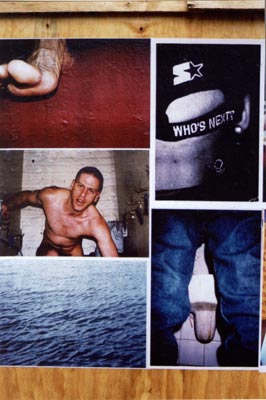
Joe Ovelman, Two Walls 2003, guerilla installation
If you missed Joe Ovelman’s walls in Chelsea last month, and if you want to see more of the work I’ve talked about in the past on this site, stop by Oliver Kamm’s 5BE Gallery by November 15, when the current small group show closes.
Ovelman has covered most of one wall of the gallery with many of the arresting images with which he had earlier wheatpasted the plywood on either 25th Street or 10th Avenue, and I don’t think anyone has torn them off the plaster yet.
5BE Gallery is located on the second floor at 504 West 22nd Street, just west of 10th Avenue.
[image from Oliver Kamm 5BE Gallery]
Category: Culture
save 2 Coumbus Circle from the philistines!
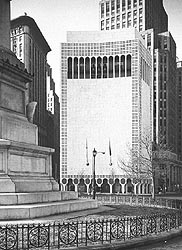
2 Columbus Circle
Maybe there’s a chance for a last-minute reprieve.
Three preservation groups filed suit yesterday to stop the city from selling the vacant [Edward Durell Stone] city-owned building at 2 Columbus Circle to a museum that wants to strip off the building’s modernist facade.
Taking issue with an environmental review that cleared the way for the building to be transferred to a quasi-public agency that would handle the sale, the preservationists demanded a new environmental impact statement on the proposed alterations. They also accused the city of moving to dispose of a building worthy of landmark status “without adequately considering the consequences of its loss.”
The lawsuit alleged that because the city wanted to sell the building, the city’s Landmarks Preservation Commission was reluctant to hold a public hearing on designating it a landmark. “The city’s economic objectives infected the process for considering the potential landmark status of the building and subsequently tainted the environmental analysis that it performed in order to gain legal authorization for the sale,” the lawsuit said.
By Vitruvius, it’s the only building worth looking at in the entire plaza, er, circle. For more on both the modernist building and the political-economic and aesthetic battle, see the LANDMARK WEST, Recent Past preservation and City Review sites.
[image is historical photograph, courtesy Ezra Stoller, 1964 ©ESTO, on Recent Past Preservation site]
excellent Team work
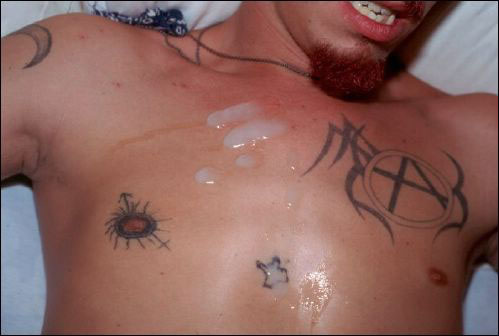
Michael Meads, Anarchist Cum Shot, 2002
The most exciting gallery show in town – at least until the next one – is at Team right now, “my people were fair and had cum in their hair (but now they’re content to spray stars from your boughs)”. But it wasn’t the name of the show that pulled me into the space last Tuesday.
Instead, the cause of my unplanned detour as I rushed to the White Box benefit that evening was the fact that I had spotted a familiar Jeff Burton image on the back wall of the gallery’s second room. Yup. From the sidewalk, almost half a floor above the space. It was something of a red flag.
Barry and I went back together yesterday, and we’ll definitely return, probably more than once.
For me it might have been enough that this group show, curated by Bob Nickas, is provocative, and that it presents work by a number of young artists whose work we have already coveted or actually jumped on, but the installation is mad really awesome by the inclusion of some of their kindred of the last four decades, painter, sculptors, photographers and film or video makers, some now established, some nearly forgotten and some even ignored.
What holds it all together is its honesty and its delight in sexual pleasure. Also, the eye loves it all. There’s not a dud in the entire show, a roster of 39 different artists.
Even the (serendipitous?) blending of sound from the two monitors playing near to each other contibuted to the energy of the (Six!) exhibition spaces.
One cavil, but it’s more of a surprise, given this particular Team assemblage: Where’s Joe Ovelman?
The show’s statement by Jose Freire is a gem.
I’m not even sure much of the work is even available for sale, but I’m happy to think of the entire business as a great public service. Thanks, guys.
Oh yes, we’re also delighted to find an important gallery installation whose title cannot appear in the NYTimes.
The show is up through November 15 at 526 West 26th Street.
[image from Team Gallery]
lovely music, but sometimes a challenge
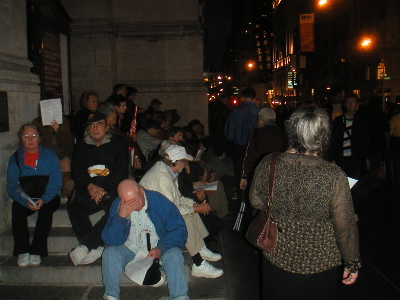
sounds of the city: part of the audience for John Cage’s “Music for Carillon”
I love John Cage’s music, always have, but even I understand that not all of it is lovable.
Late Sunday afternoon it was totally delightful. Sunday evening was a different story. The “Music for Carillon” which engaged much of Fifth Avenue at dusk reflected both the beauty of his art and the playfullness of the man. There was no way for devotees to avoid the ambient sounds of a busy city and there was no way the busy city (or at least that part of it) could avoid the musical occasion.
Best parts: the smiles, and watching the music engage and sometimes totally arrest passersby, especially children; oh, and listening to the counterpoint added by the beep beep beep of the front-end loader across the street.
The NYTimes reviewer referred to the “humming Cagean symphony of the street.” I wonder if he had also been at Saturday afternoon’s performance by Margaret Leng Tan of Cage’s “Sonatas and Interludes for Prepared Piano”.
That day’s musical experience would have been perfection but for the regular interruption of rehearsal sounds and security guard radio conversations throughout. This time Zankel Hall’s persistent subway sounds were totally overwhelmed by totally avoidable screw-ups. Ms. Tan briefly interrupted her performance early on and turned to the audience, smiling, to comment, “This is something of a Cagean moment.” In spite of continual distractions, she went on to play magnificently for almost another hour. Unfortunately Cagean moments would not have been embraced even by Cage until the fifties, years after he had composed the delicate piece she was performing. Carnegie Hall owes her and the audience a formal apology.
Sunday night was . . . interesting. But for me, and also at least for the same Times reviewer, Jeremy Eichler, who had reported on the Carillon concert, it was a disappointment. Three extremely austere pieces were programmed for the evening, “Music for Three (by One),” excerpts from “James Joyce, Marcel Duchamp, Erik Satie: an Alphabet” and Cage’s “Winter Music,” was performed simultaneously with a solo vocal work from his “Song Books.” Eichler laments:
More Cage followed that night at Zankel Hall, where 15 pianos were strewn across the stage and balconies, conjuring hopes of more exhilarating sonic anarchy, but alas it was not to be.
. . . .
It was of course a musical lecture on Zen-like awareness and Cage’s theories of silence, and there are profound truths here if one is in the right frame of mind to receive them. Some in the audience seemed up for the task, sitting with eyes closed in poised reflection. This listener was not among them. For about 15 minutes I admired Cage’s refusal to compromise, but I found the mandated stillness to be heavy-handed. After that I just kept hearing the subways coming and going beneath Zankel Hall, and wished I were on one of them.
Oh yes, these concerts were all part of the “When Morty Met John…” festival, of which the highlight was almost certainly Morton Feldman’s Second Quartet. John Rockwell reviewed that performance, but he must have missed the “Sonatas and Interludes” excitement of that afternoon, because he praised Zankel Hall’s “acoustically sealed” insulation and its impressive doors, writing that passing through them was “like entering a bank vault”.
He praised the Flux Quartet for a remarkable performance, and he described the work itself as “an amazing composition one whose beauties (longeurs is a word that doesn’t even apply) are still slowly revealing themselves, from performance to performance.” [There have been exactly two since it was composed in 1983.]
The Quartet is approximately six hours in duration, so we will probably always have some wait between hearings, meaning there is at least little chance of tiring of it. I bought the CDs, so I guess that means I will enjoy testing that proposition.
“Based on a True Story”
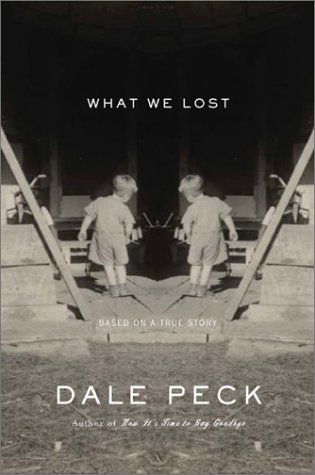
Some people would like us to think that it’s all about the literature of literature, but the rest of us would probably rather read books than reviews, even if (or apparently for some, especially if) the pen is wielded by Dale Peck.
Actually I don’t even like to go to readings unless the book is the work of a friend, or someone who is as brilliant and provocative as, say, Gore Vidal – or Dale Peck. But here’s a recommendation.
Dale is a friend, but he’s also a great artist who never lets his readers get too comfortable, so I’m going to be at the Chelsea Barnes & Noble next Thursday at 7 o’clock expecting to be both patted and scratched.
He wrote today, “please come hear me read from ‘What We Lost‘, my new memoir (or, as the Times Magazine would have it, novel)”. With that reference and a look at the James Atlas piece itself you can see that, although I believe the book hasn’t yet been reviewed outside of the trade publications, the dustup has already begun.
The NYTimes site includes an excerpt of the “memoir”, of which this is itself an excerpt:
He must fall asleep then because when he opens his eyes the truck is stopped and the old man is not in the cab. He assumes they’ve stopped for gas until he sees a gnarled branch above the windshield like a jab of brown lightning and he sits up. To his right a row of leafless trees stretches up the side of a hill and to his left there is a white house, small and rectangular, its tiny second-story windows the shape of dominoes laid on their sides. Before he gets out of the cab he grabs the pillowcase containing his brothers’ clothes and the old man’s medicine, and the first thing he does is fall flat on his face because he can’t feel his feet. Still half asleep, he sits on the crust of snow that covers the ground like stale cake frosting and takes off Jimmy’s shoes. The ground is cold and hard beneath his bottom but the bottoms of his feet feel nothing at all, and, teetering, rudderless, he stands up and floats around the truck in his socks, the pillowcase less ballast than slack sail hanging down his back. A pitted two-track driveway runs around the house and up the hill toward a pair of barns and a tall round building that the boy recognizes instinctively as a silo even though it reminds him of a castle tower. At the foot of the silo he sees the old man talking to another man. Like the old man, this stranger is short and thin and has only half a dozen strands of hair slicked flat to his skull, but unlike the old man he stands absolutely still, one hand holding a pitchfork lightly but firmly, tines down, and a cap on the ground between the two men, bottom up like a busker’s. The only thing that moves is his head, which shakes every once in a while, back and forth: no. The old man’s legs are wobbling and his arms are flapping in the air, and as he wobbles toward them the boy is reminded of a seagull he saw once in the bay. The seagull’s legs were trapped in a fishing net, and every time it flapped its wings its orange legs would lift out of the water trailing weed-draped mesh. Over and over the bird’s legs had shaken like the old man’s with its efforts to free itself but each time, exhausted, it splashed down again.
The old man and the stranger are still a good twenty yards away when the old man turns and reels toward the boy. His legs and arms make motions like the spokes of a rimless wheel, and he is shouting,
I won’t let her send him away! Not my boy! Not my firstborn son! Not again!
He jerks right past the boy without seeming to see him, his doddering gait half step and half slide on the slick grade, and it seems pure chance that one of his flailing hands catches hold of the door handle, a veritable miracle that he is able to crack it open. The shotgun sound is like an echo of itself in the quiet air, and the boy whips his head from side to side as if he can find the original source. He is in the back of the house now. From this angle he sees that it is actually L-shaped. He can’t see the farmhouse across the street, the mountain twenty miles to the south. He sees only a bulbous clump of gray-green evergreens and the tin-domed silo and the two barns and a patch of leafless woods at the top of the hill and then a big field studded with black-and-white and butter-brown cows. When the truck coughs into life one of the cows looks up from whatever thin strands it is pulling from the ground, looks first at the truck and then at the boy and then drops its head again and roots around for more grassgreen grass, the boy can see, even from this distance. It is the middle of January and thin streaks of snow paint zebra stripes on soil hard as a city sidewalk, but the grass that grows from that soil is still green, and by the time the boy turns back to the truck it has backed out of the driveway, narrowly missing what looks like a fencepost with some kind of placard mounted atop it. The truck would have gone into the ditch on the far side of the road had there not been a tree there. Instead something glass breaks, a taillight that is not already broken perhaps, and when the old man shifts into first the boy hears first the transmission’s grind and then the glass as it falls onto the road. The truck goes so slowly that had he wanted to the boy could have run after it, could probably have caught it even, even with his numb feet. But he just stands there swaying, watching the truck recede as if one of them, the truck or the boy, is on an ice floe borne away from the shore by a half-frozen current. By the time the truck disappears over the hill the stranger has walked down from the barns and walked on by. There is smoke coming from a chimney on the left wall of the house and the stranger’s pitchfork makes a metallic ping each time it strikes the frozen ground.
Feeling floods into the boy’s feet then, as if a pot of pasta water had tipped off the stove and spilled over them. He reels, bites back a cry of pain; catches his breath and catches his balance.
Uncle Wallace? he says to the thin brown back retreating down the hill.
The stranger doesn’t stop, doesn’t turn around.
Get my hat, Dale, he says. At the door he pauses to look the boy up and down, and then he shakes his head one more time. In the failing light his scalp looks white and cold.
Don’t forget your shoes, he says, and walks into the house.
For Dale’s friends, fans, and the disgruntled too I suppose, the details for this reading and others scheduled across the country in the months ahead are these:
Wednesday, October 6 @ 7
Barnes and Noble Chelsea
675 Sixth Avenue, between 21st and 22nd
New York
Monday November 10 @ 6:30
Free Library of Philadelphia, Independence Branch
Philadelphia
Tuesday, November 11 @ 7
Olsson’s Dupont Circle
Washington, DC
Tuesday, November 18 @ 7:30
Wordsworth Bookstore
Cambridge, MA
Tuesday, January 6 @ 7
Barbara’s Bookstore
Chicago
Thursday, January 8 @ 7
Bound to be Read
Minneapolis
Tuesday, January 13 @ 7:30
Cover Bookstore
(Cherry Creek location)
Denver
Saturday, January 17 @ 3
Elliot Bay
Seattle
Monday, January 19 @ 7:30
Annie Bloom’s Bookstore
Portland, Oregon
Thursday, January 22 @ 7
A Clean, Well-Lighted Place for Books
San Francisco
Sunday, January 25 @ 5
Obelisk Bookstore
San Diego
Tuesday, January 27 @ 7:30
B&N (West Pico location)
Los Angeles
Friday, January 30 @ 7
Book People
Austin
Tuesday, February 3 @ 7
Rainy Day Books
Kansas City
surprising Morty, delighting John
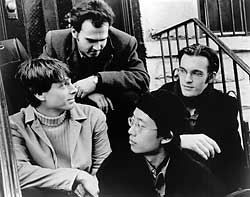
It’s a six-hour-long string quartet in one movement, but Morton Feldman’s second is both greater and less than the sum of its parts. Greater because it’s ultimately much much more than a succession of minimalist pings and rrrr’s, and less because hearing it live doesn’t seem at all like being kept after school until nine o’clock at night. Even with my own abreviated experience with the work, I now completely understand Jan La Barbara’s program note:
For the performers, to play a work like this is to live for a time inside the mind of the composer, to share, for an instant, that artistic sensibility. To listen to such a work is to come close to that experience, the sense of immersion in anothers mind.
As part of a series of concert events in New York this weekend called “When Morty Met John…”, curated by La Barbara, which describes the extraordinary legacy of the work of Morton Feldman and John Cage and of their personal and musical friendship, the magnificent young Flux Quartet braved Morton Feldman’s (yeah, “seminal”) 1983 Second Quartet. The performance took place in beautiful new Zankel Hall, which has been blasted out of the bedrock below the much larger Carnegie Hall itself.
OK, Barry and I did actually leave before the piece had run its course, but that was for reasons totally unrelated to its merits. I think I can say that if anyone other than the performers themselves bore any kind of burden tonight it was the working Carnegie Hall staff, which had to hang around until past midnight, and which kept the bar open throughout the evening.
Zankel seems to be having some success in its announced intention of appealing to youth. The crowd this evening looked nothing like that you’d normally find around Lincoln Center, and in fact might have made even the youthful crowds which flock to Columbia University’s Miller Theater these days look a little mature – or at least dowdily academic.
The members of Flux rivalled their rapt audience for cuteness, but there was no competition in the honors for heroism. No stops, no stretching, no snacks and above all no bathroom breaks for the four stalwart artists who generously shared their platform with shoeless and barefoot youths, cheeks of tan and pale (and a few of their elders), reclining around them on a couple of kilims and the bare boards themselves.
I haven’t seen anything like it since Pandit Pran Nath performed in the sanctuary of the Cathedral of St. John’s on acres of oriental carpet over a decade ago. This is my religion.
When everything comes to a halt, about a half hour from now, I would not be surprised if their enthusiastic audience seizes the players and carries them out of the auditorium on their shoulders in triumph. Laurels would be nice.
Morty would be very surprised, and John would be delighted.
Oh yes, there’s a CD set, and even a DVD, of the Flux doing this piece. It’s available through Mode Records.
More events on Sunday, October 26:
Feldman’s “Triadic Memories” at Columbia’s Miller Theatre 2:30
Cage’s “Music for Carillon” [on Fifth Ave., and free!] at St. Thomas Church 5:15
An evening of Cage at Zankel Hall 7:30
[image from Preview/Musicview]
time for our own opera
Wonderful, wonderful theater. Music theater. Opera. Whatever.
No, it’s not a “musical”. If it were, I would not have been in the audience tonight. It’s pure art, especially if art must be both human and accessible to be truly pure.
But don’t be afraid. If it’s opera, it’s what Puccini was for his audience a hundred years ago, not what Puccini represents today.
But it’s only here one more evening – this time around.
David Rodwin‘s “Virtual Motion” can be seen tomorrow, Saturday, at LaMaMa for the last time. Sad enough that the entire run was only three days, sadder still that we didn’t see it until tonight and can only write about it now.
I have no idea how Rodwin’s art had escaped us until recently, especially since it relates to and is as exciting as the best work of some of our favorite modern theatrical composers, like Robert Ashley, Conrad Cummings, John Moran, and Mikel Rouse.
Rodwin created the music, the book, lyrics and the choreography, and produces, engineered and performs the piece solo. While he has created larger-scale work in the past, including one opera with a cast and crew of thirty, “. . . I knew I needed a simpler, more economical piece if I wanted my work to be seen by a larger, more diverse audience in more places.” He’s not competing with the Met, since its line of business is essentially that of a well-endowed museum of antiquities. “Virtual Motion” has already delighted people in over a dozen cities, and only some of those would ever be found in a traditional opera house.
In this latest piece the artist is an extraordinarily charismatic and beguiling presence on an almost totally bare stage, both bearing and born on gorgeous waves of live and recorded sounds combined. The music is totally integrated with the theatre in a shared contemporary humanity.
Well damn, the tickets are only $20, and it’s only an hour and a half long, with intermission. Don’t miss it. Years from now everyone will be talking about the birth at the turn of the century of this “new opera” form, but you shouldn’t wait that long to find out what it’s all about. Details:
La MaMa E.T.C.
The Annex
74 A East 4th Street
New York, NY 10003
Tickets: 212-352-3101
Tip: There’s both audio and visual stuff on his website!
[image from jadelake]
Greeks bearing a real gift
AND THE CITY HAS MADE THE NAME OF HELLENES ATTRIBUTABLE NOT TO ORIGIN BUT TO THE MIND
isocrates, athens, 380 bc
Apropos nothing in particular, I wanted to record this wonderful legend we saw mounted on the wall of the Onassis Cultural Center while passing through the public passage at Olympic Tower this evening.
the tapestry of empire
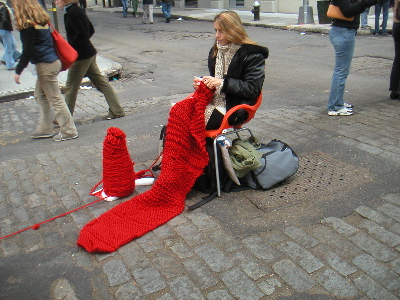
somewhat less than one half of Maria Marinelli’s performance at d.u.m.b.o.
Maria Marinelli was also a part of the d.u.m.b.o. festival this past weekend where she was represented by a performance of “Arazzo,” one of the four parts of her mixed media project, “IMPERO.”
What I saw on Saturday was two women knitting separate long panels or “tapestries” in red yarn of an almost painfully bright hue. They were separated that afternoon by a full block’s length of the same skein of thread each was incorporating into her work.
The two pieces being woven by the performers will eventually meet in the center where no more unused thread will remain. In order for one piece to be completed the other one must be destroyed.
in English, the name of the greater project is “EMPIRE.” The artist explains, “This metaphor makes visible the paradigm by which every imperialistic culture operates.”
“Women’s work,” indeed!
d.u.m.b.o. art – and real estate
There was plenty of art – and entertainment [is that a problem?] – at the d.u.m.b.o. art under the bridge festival this past weekend even for those who didn’t make it into the many open artists’ studios. Much of it was about real estate. All of the very best outside stuff was conceptual.
One of my favorites was “Endangered Species,” the work of Michelle Handelman and Vincent Baker, located under an arch of the neighborhood’s eponymous Bridge.
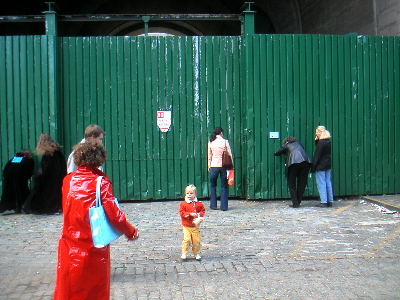
Behind the heavy green-painted corrugated metal wall, and really down under manhattan bridge overpass was a wonderful sound installation of the cries of some very angry elephants. The curiosity quotient was strong, but nothing was actually visible beyond the barrier.
A small placque in the lower right of the picture identified the artists, and added:
harlem, soho, tribeca, the lower east side….we haven’t forgotten.
PLEASE DO PUT HANDS IN GATE