Rauschenberg

RB1.jpg
RB2.jpg
RB3.jpg

ROBERT RAUSCHENBERG, Autobiography, 1968
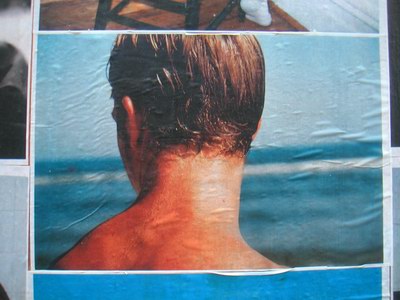
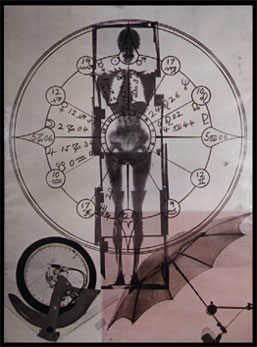
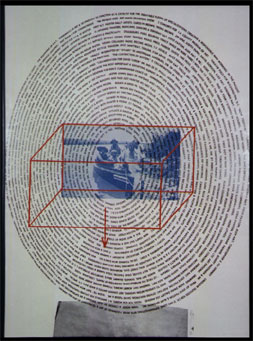
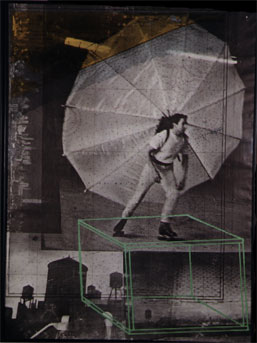
The three panels of this large offset lithograph by Robert Rauschenberg from 1968 titled Autobiography are displayed vertically and exceed 16 feet in height. They were printed with the type of press used to make commercial billboards. The three panels are layered with seemingly disparate images that, on closer examination, are probably thematically grouped. The top panel features a composite X-ray of Rauschenberg’s own body superimposed with the artist’s astrological chart, suggesting both the present and the future. The center panel deals with the artist’s past; at its center is a photosilkscreen of the artist as a two-year-old boy with his parents boating on a bayou near his home in Port Arthur, Texas. Surrounding this photosilkscreen is a labyrinthine oval of handwritten text narrating events in the artist’s life. The lower panel seems to address artistic creativity and is dominated by an enlarged photograph of Rauschenberg during his 1963 performance “Pelican,” in which he wears rollerskates and a parachute on a wooden armature harnessed to his back. Rauschenberg was one of several performers and he also choreographed this performance. This particular image suggests both movement and flight, which are themes carried through in Rauschenberg’s art and life.
Autobiography’s visual overlay of seemingly discrete and unrelated appropriated images is quintessential Rauschenberg, but the emphasis on personal or autobiographical subject matter is not. The vision underlying Rauschenberg’s aesthetic has often been interpreted to mean that meaning itself is created through accidental, improvised, intuited, and even illogical juxtapositions and associations. In that sense, what Rauschenberg offers us in Autobiography are images he had at hand but they are also images of personal significance to him. Rauschenberg once stated: “I don’t want my personality to come out through the piece . . . I want my [work] to be [a] reflection of life . . . your self-visualization is a reflection of your surroundings.”

[image and text from Philadelphia Art Alliance]
“bobrauschenbergamerica” in tears

We went to a performance at BAM of Charles Mee’s “bobrauschenbergamerica” tonight. Barry and I both found that like much of this wonderful man’s work, which I’ve now been enjoying for several decades, this evening of theater, which was created and performed by SITI Company and directed by Anne Bogart, took a while to come together. Barry thinks it’s Mee’s plan, and I think I agree.
When it was finally assembled it was magnificent.
I haven’t seen a decent review in the media, so I won’t link to any tonight, and I don’t have the nerve to try one myself, but I will at least say that I was eventually overcome by the piece’ sweet sincerity and delighted with its amazing sense of place. In a dramatic account of the world which produced Robert Rauschenberg’s art that would seem to mean a mission was accomplished.
But it didn’t come easily. It was about halfway through an evening punched through with scattershot American vignettes, at once both perverse and ordinary, that I began to cry. The tears were for the sometime beauty and goodness of this people and for how much has been lost in recent decades, but they were also tears of joy.
Admittedly the play and its performance basically ignored the ugliness and the evil that was also a part of what we regard as the simpler, mid-century America, and it’s assignment was not to dwell on how much the bad stuff remains or has multiplied today. Still, when the stage was emptied tonight, only warmth and especially hope remained behind. Amazingly, there was no sugar on the floor of the theater, but there was also not a wit of jingoism in the air, no rhetoric of any stripe. Quite an accomplishment that, especially these days.
The most moving moment in the theater this evening was an oration whose conceit is that it begins by appearing to be an actor’s address to the audience about this play, but it very soon becomes clear that it is much more. Barney O’Hanlon played Carl, who speaks to the museum visitors immediately after his assassination.
What follows is the complete oration, delivered near the end of the evening, a beautiful ode to art and artists in general, and the art and the artists of this strange people in particular.

[Carl, who has been lying on the stage dead, sits up and gives a speech welcoming everyone to an art opening, while we hear cement mixers, pounding, banging, clanking, sawing.]
OK.
How we put the show together.
First, I want to welcome everyone
I’m glad you could all come tonight.
We don’t often get to do a show like this
where we can just put on whatever we like
figure OK what the hell
lets just do whatever we feel like
and hope you’ll enjoy it.
I often feel those of us who are in the museum world
are particularly blessed.
Because we get to explore our feelings
whatever they may be
that’s a sort of freedom.
You know, that’s how it is to deal with art
because art is made in the freedom of the imagination
with no rules
it’s the only human activity like that
where it can do no one any harm
so it is possible to be completely free
and see what it may be that people think and feel
when they are completely free
in a way, what it is to be human when a human being is free
and so art lets us practice freedom
and helps us know what it is to be free
and so what it is to be human.
But, still, it often seems to me almost miraculous
how we can put things here in the museum
and ordinary folks
my mom and dad and my own neighbors
and I myself
will come to see things
sometimes things that I myself find completely incomprehensible
and really offensive
people will come to our museum
and think: oh, that’s interesting
or, oh, that’s stupid
but they don’t really hold it against the show
they just move on and look at something else and think
oh that’s cool.
And I wonder:
how do we get away with that?
And I think well, we are a free people
that’s why
and we understand that
in a way maybe other people in the world don’t
we like an adventure
often we might think
well, that’s a piece of junk
but that’s how this fellow sees the world
and there’s a certain pleasure in seeing things from his point of view
we are a patient people
no matter what you hear people say
and a tolerant people
and a fearless, open people
that’s how it is for us
I think that’s how it is to be an American.
We’re all unique.
It’s a precious thing to compare ourselves to nothing else.
This is my working attitude.
I don’t feel shame in my joy.
[He looks confused.]
I started out here knowing what I meant to say
and now I have to say
I don’t know what I said.
But I’d just like to welcome you
and let you know
we’re all glad to be here with you tonight
to share this with you
and we hope you have a swell evening.

[The text can be found on Charles Mee’s own wonderful site, which amazingly and very generously makes all of his work available to the public]

dull straight white men with money & power score again

FOLLOW UP on “two shades of green
Yesterday it was an article in New York magazine which triggered my despairing post about developments at the World Trade Center site. Today it’s the New York Times. Why are they getting upset only now, when it’s almost certainly too late to stop the grinding gears of business-as-too-usual as we stand on the side awaiting the arrival of banality-and-much-worse?
The first paragraph of the following quote appears as the introduction to the piece in the NYTimes print edition this morning, but is curiously missing on the website, depriving David Dunlap’s text of much of its sense for electronic readers, and even producing quite a different spin.

The faces staring upin horror that morning from the streets of Lower Manhattan were every color. So were the faces staring out from the “missing” fliers around the city. But the hands drawing the plans for the new World Trade Center are almost all white.
What may have been lost in the transition are voices; voices that might have questioned basic assumptions about a program in which skyscraping commercial development is to accompany the memorial, cultural and open spaces; voices that might have asked whether a public domain under tight control is truly public.

The New York architect J. Max Bond Jr., whom the paper describes as “both black and an éminence grise in architectural circles,” advocates a process which would include not just minority voices but those of poets, philosophers and artists.
He also takes issue with proposals to put pseudo public spaces in private hands, [a development which has increasingly burdened New York over the last few decades], and suggests that opening participation in decision making to the larger community would have exposed such follies.

Many designs for the site called for gardens, shops, museums, restaurants and viewing platforms on high floors or at the top of buildings. But Mr. Bond said any space under strict scrutiny was not universally welcoming.
“It’s always been difficult for young blacks, for young Hispanics, for anyone who looks aberrant to get access to the upper realms of Wall Street towers,” he said. “For a city of immigrants, the public realm is more than ever now the street. If I’m a Dominican kid and my immigration papers are not quite right, I’ll never go up there because I’ll never dare show my fake ID.
“All these public spaces are going to be like shopping malls: privately controlled. You won’t be able to wear a T-shirt that says, `Down with Ashcroft’ because that will be viewed as hostile or threatening.”

And on the subject of skyscraper superlatives Bond’s comments show the full extent of his modern humanism:

“There’s a macho thing that keeps coming out: we should build a building that tall to show them,” he said. “Not everyone shares that sensibility. It’s a particularly male, Western sensibility.
“I’m not saying people of color are wiser. But women, people of color, gays, immigrants have all had to look at themselves. They have experienced the underside of society in a much more profound way.
“Architecture inevitably involves all the larger issues of society.”

Including, obviously, the issue of who really retains the power.

Tim Rollins and K.O.S. at A.R.T.

kosflame.jpg
Tim Rollins and K.O.S., untitled, from Prometheus Bound, 1997
[image not in the show at Art Resources Transfer]

It’s a gorgeous mini-retrospective, or, better, a retrospective of the smaller-scale parts of 20 years of collaboration. Tim Rollins‘s work with the Kids of Survival (K.O.S.), studies in this case, mostly on paper alone, are now being shown in three rooms at the Art Resources Transfer (A.R.T.) space in Chelsea until November 15.
What for me had until now been available only in scattered glimpses of separate projects is now assembled in what admittedly is still only a tantalizing suggestion of the larger, finished pieces in each. But what a treat these suggestions are!
Each of the 40 works is inspired by and is physically lying upon the text of a major literary work or musical composition. Art has seldom been so literate, especially if we remember that the Tim Rollins and K.O.S. collective is as much about teaching as it is about painting and drawing.
The artists’ chronology begins with a 1983 delicate sketch of Jesse Owens on a page of Mein Kampf. Chapter: “Race.” It ends with Bush II in 2003, drawn as a two-legged squirel stretched across a page of Animal Farm which includes the creatures’ Seven Commandments, which begin with, “1. Whatever goes upon two legs is an enemy.”
In betwen there is Aeschylus, Ray Bradbury, Dante, Hawthorne, Haydn, Kafka, Stoker, Strauss, Wells and dozens of others, all of them beautifully illustrated and intelligently and powerfully amplified in the process. It’s a great treat, and a moving encounter on any level.
A.R.T. is located at 210 11th Avenue, between 24th and 25th Streets, on the fourth floor, and open Tuesday though Saturday from 11 until 6. 212-691-5956

[image from Dia Art Foundation]

two shades of green

Kelly and money.
The results are in, ladies and gentlemen.
Forget two years of agony and hopes for resolution, two years of arguments and competitions, two years of talk and spin, we now have an answer. The World Trade Center site is going to look nothing like what we wanted, what we were told we would get, what we should have.
Liebeskind’s design, whatever its value, is dead, even if Liebeskind, complicit in his own defeat, is still there for cover (and surely a fat paycheck). The public be damned, money is talking, and the conversation isn’t pretty or smart, because Larry Silverstein is in charge.
We’re going to have to suffer years, actually decades, of construction messes in order to end up saddled with a huge affront, the usual New York contemporary corporate high-rise junk. There is no coherent plan, no monumental architecture, no humanity, no spirit, and not even a cold aesthetic geometry survives.
Last week I was once again struck by the absolute rightness of Ellsworth Kelly’s magnificent WTC site proposal in his ‘Ground Zero’, when I visited the Whitney Museum, which is currently displaying his “red green blue work.” The simple newsheet collage he sent to the NYTimes architectural critic Herbert Muschamp early in September has been donated to the Museum. It hangs, modestly-framed and almost invisible, near the elevators in the lobby.
Sublime. It’s what we need right now. We can build towers on other lots. There’s nothing to keep us from getting Kelly’s green, except the money that talks.

Phil Collins at Maccarone

Collinsenduring.jpg
Phil Collins, enduring freedom 2002
[the image is not part of the current NY show]
Collinsforever.jpg
Phil Collins, fov evevr 2003
[image currently at Maccarone Inc.]

I’ve been very bad. Barry and I went to the Phil Collins show at Maccarone Inc. last Sunday, and I’m only getting around to writing about it a week later.
It’s a wonderful, intelligent gallery and an exciting space, particularly right for this aesthetic. Rough. No, tough, but with much warmth. Collins’s work is breathtaking, and its presence in these rooms is just right. We arrived on a beautiful fall afternoon, in the full light of day. I hope you schedule something similar. You’ll be on vibrant eastern Canal Street, just before the entrance to the Manhattan Bridge.
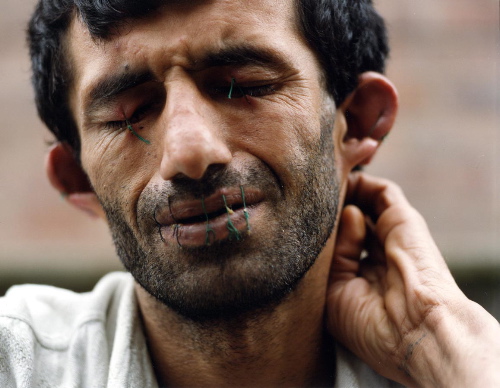
Collins’s images are incredibly powerful even if you’re ignorant of their context. The context, at least for some of the work in this show, that dealing with asylum-seekers, refugees and the displaced, is provided by an incredible video running on the ground floor. I had gotten all of the way up the stairs before Angela told us that the raw storefront space below was now part of the gallery. We headed back down to view an extended, much-violated and frightened Kosovo family being shuffled around a large couch for a group photograph, but not before we watched one boy, a beautiful injured teenager who was unable to remember much of anything about his assault, being questioned about the scars he shyly revealed to the camera.
On the third floor are intimate but incredibly strong images of people who answered a newspaper advertisement asking for people who would agree to strip for his camera in a hotel room rented for the purpose. Collins is from Northern Ireland and has lived in parts of the former Yugoslavvia and other parts of the world which have suffered from ethnic violence. The hotel was in Basque San Sebastian. The results apparently surprised even the artist.
Collins’s larger body of work is about the impact of social and political conflicts on human beings everywhere in the world, and it’s also about his own relationship to his subjects. He is able to remove himself from the people he photographs only far enough to complete his record. He remains involved, and we are drawn in along with him, never to leave altogether.
Only after we were already home did I think about the fact that we had no idea what the photographs were selling for. In fact, were they actually for sale? It had not occurred to either of us that what we had seen might have any relationship to commerce. I still haven’t asked, but I’ll be going back.
Visit Maccarone and Collin’s work. I think you still have all of this month. Sorry, the website isn’t finished yet. The gallery, located at 45 Canal Street, near Chrystie, is open Wednesday through Sunday from noon until 6. You’ll see three floors of an old mercantile building and a great artist’s humanity – and much of the greater humanity, including the inhuman parts.

MaccaroneB.jpg
From Maccarone’s third floor, Barry included

[Enduring Freedom image from Kerlin Gallery, Missing from fashionoffice]

coming home

burialground.jpg
A group of caskets moves up Broadway today, holding remains beyond just bones

Yes, New York had slaves, and apparently they weren’t all barbers and musicians.
Some of them, all still anonymous, are being returned tomorrow to the downtown Manhattan site of their burial in the seventeenth and eighteenth centuries

Twelve years after workers accidentally uncovered a burial ground for colonial era blacks in downtown Manhattan, the remains arrived Friday, headed for the empty lot where they were first discovered.
The remains, scheduled to be reinterred Saturday, arrived at Pier 11 at Wall Street on three police boats, in four small wooden coffins carved in Ghana. New York was the last stop on a five-city procession.
After a ceremony at South Street Seaport, the coffins were scheduled to be taken by procession to the African Burial Ground, located at the intersection of Duane and Elk streets.

Without a lot of in-the-face activism on the part of some dedicated New Yorkers over the last 12 years, we would hardly be aware of this part of our history even today.

Initially, the federal government tried not to comply with legal mandates about what to do in such a situation. But African American New Yorkers, including then Mayor David Dinkins, pressed the government to respect the remains found there and to find a way to honor this sacred space. After vigils and protests and religious observances and meetings held at the site by many in the community, construction was halted until all the remains could be unearthed and moved to be studied, with the promise that they would be re-interred back at the site.

Brian Lehrer devoted part of his WNYC program this morning to the early history of Africans in New York and the events of today and tomorrow. What scientists found in 10 years study of the bones now being brought back to New York was evidence of disease and the stress of carrying heavy loads. It was established that most were born in Africa, specifically west and central Africa, and that both the death rate and the rate of reproduction were extrordinarily poor. The data suggests that the slaves were treated as expendable, and that attrition was addressed by bringing in more.
The NYTimes devoted half of a page to the story in yesterday’s editions.

Not one of the skeletons in the burial ground could be linked to a person with a name, [urban anthropologist Dr. Sherrill D.] Wilson said. She says this is evidence that “these people were undocumented because they were viewed as a disposable population.” Also, she said, almost half of the bodies found were children, which suggests “they were literally worked to death.”

Slavery ended in New York in 1827, but the story continues.

For more information, including that about events this week, see the African Burial Ground site.

A FOOTNOTE:
It was during the Brian Leher Show, in a section not included in the on-line report linked above, that I heard about several caucasian bodies found buried with the others.
How could that be, in a 6-acre cemetary which the city had made necessary because blacks were not allowed to bury their own in the same ground with whites?
In 1741 New York thought it was the victim of a slave conspiracy or uprising, because of a series of unexplained fires. When the hysteria had subsided, 31 slaves and 5 free whites, suspected sympathizers or accomplices, had been executed. The authorities decided to visit the worst possible humiliation upon the caucasians; they were interred along with the slaves.
Africans customarily buried their dead facing west. The bodies of the sympathizers appeared to be lovingly laid facing east, the custom of their time and people.

[image from REUTERS/Chip East]

Edward Said

Edward Said died today.

“Every empire… tells itself and the world that it is unlike all other empires, that its mission is not to plunder and control but to educate and liberate. These ideas are by no means shared by the people who inhabit that empire, but that hasn’t prevented the U.S. propaganda and policy apparatus from imposing its imperial perspective on Americans, whose sources of information about Arabs and Islam are woefully inadequate.”

Said worked most of his life trying to remove the burden of our ignorance.

[Said was speaking this past July, and the quote was taken from a tribute on The Nation site today]